REVIEW 3 major objections 4 minor 66 references
MakeSense: An IoT Testbed for Social Research of Indoor Activities
T0 review · 3 major / 4 minor · reviewed 2026-08-14 · deepseek-v4-flash
Pith's one-line read MakeSense is an IoT testbed that claims to enable social researchers to study indoor activities in real homes and offices through quick, flexible, secure, real-time sensor monitoring.
desk verdict MakeSense is a real, installable end-to-end IoT testbed with two genuine deployments, but the paper's claim that sensor data enables social research is backed only by visual inspection and informal diary comparison, not by quantitative validation. read the letter →
The pith
A machine-rendered reading of the paper's core claim, the machinery that carries it, and where it could break.
The reading
What carries the argument
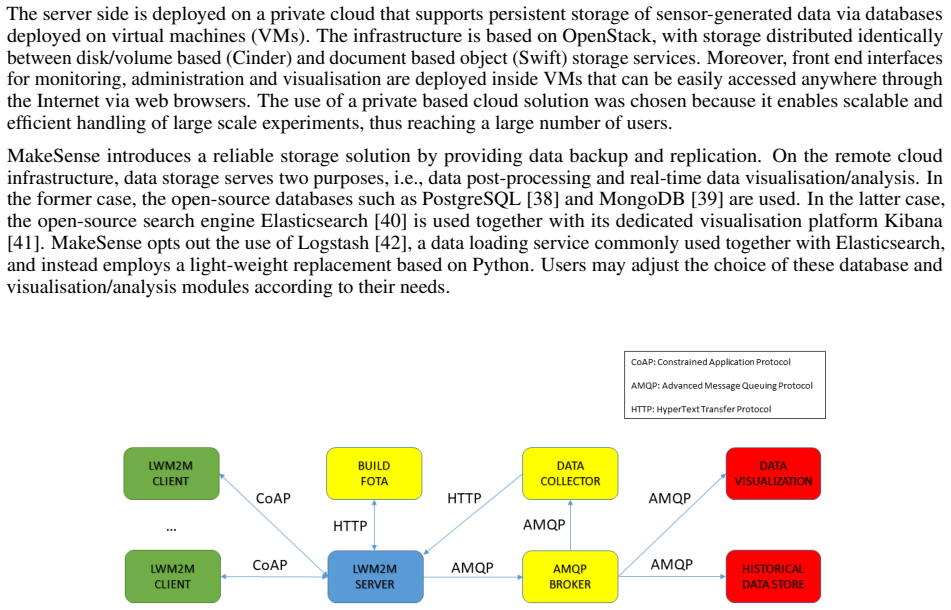
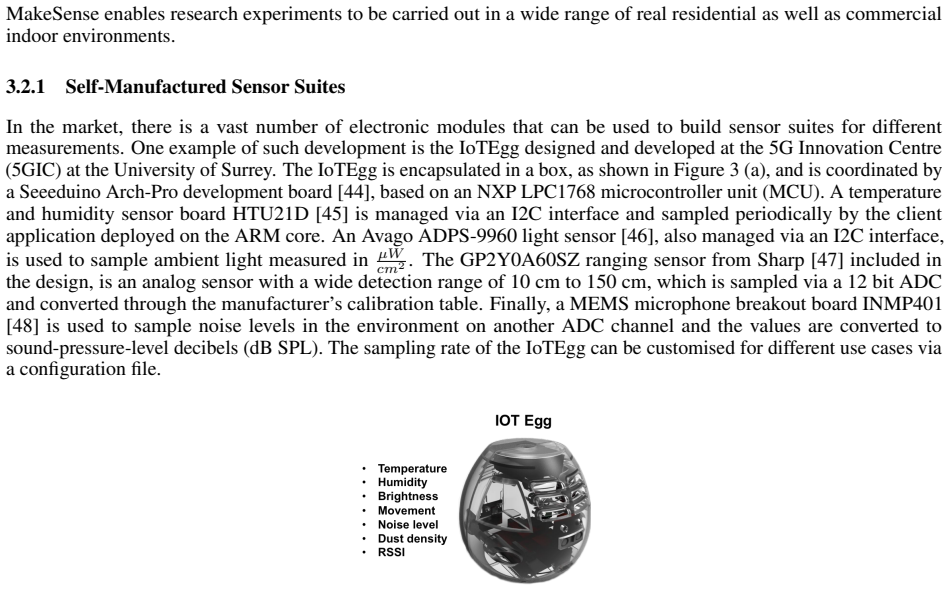
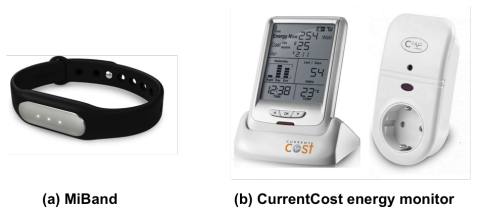
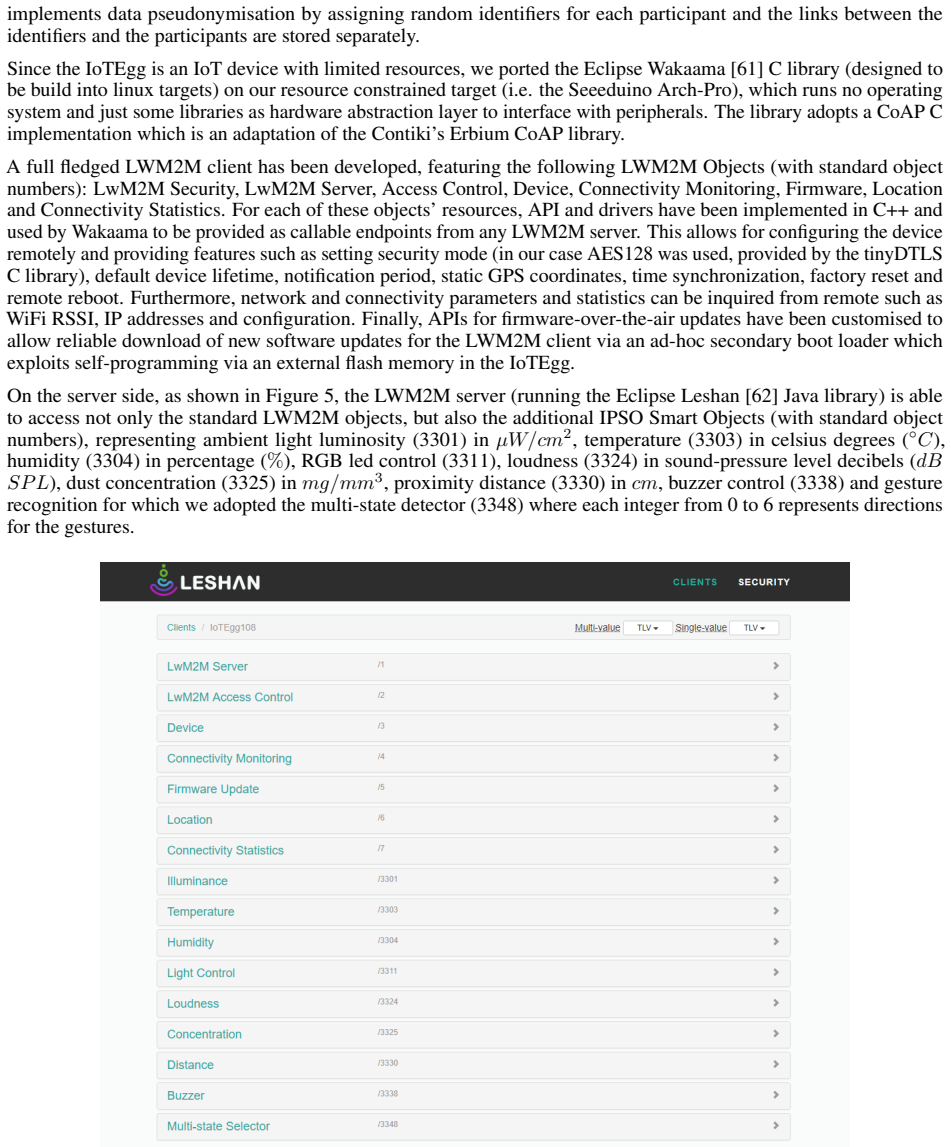
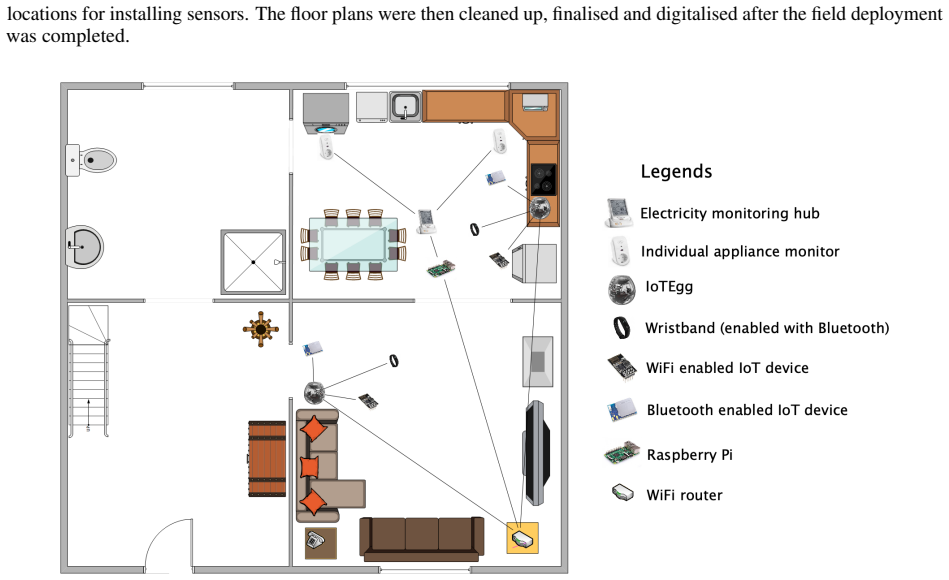
The load-bearing object is the IoTEgg, a self-manufactured sensor suite that measures temperature, humidity, ambient light, proximity, and noise, and also acts as a gateway for Bluetooth Low Energy (BLE) and WiFi devices such as wristbands and electricity monitors. It runs a ported LWM2M client using CoAP and DTLS, allowing remote configuration, firmware updates over the air, and secure data transmission to a cloud backend. The cloud side relies on RabbitMQ for message brokering, Elasticsearch and Kibana for real-time visualization, PostgreSQL and MongoDB for historical storage, and Docker images to automate server setup. This combination of a flexible edge device and a standardized, scriptable server stack is what carries the claims of quick setup, extensibility, and real-time monitoring.
What would settle it
In one of the monitored households, take a week of sensor data alongside the time-use diary, have an independent coder label cooking and laundry intervals from the diary, and measure whether simple thresholds on temperature, humidity, electricity, and proximity detect those intervals substantially better than chance; if they do not, the testbed's value for social research is not established even though the infrastructure works.
Extended reading notes
Core claim
The paper's central claim is that MakeSense provides a complete, end-to-end IoT infrastructure—from sensor hardware to cloud storage to live dashboards—that social researchers can use for real-world experiments on indoor activities. The system combines a self-manufactured sensor device, the IoTEgg, with commercial off-the-shelf wristbands and energy monitors, and manages them through the Lightweight M2M (LWM2M) protocol over WiFi, with AES encryption and pseudonymization applied to all data. In the home deployment the researchers inferred activities such as cooking, laundry, and presence by visually aligning sensor traces with time-use diaries; in the office deployment the testbed supported real-time environment-quality monitoring with feedback to occupants. The authors state the testbed enables quick setup, flexibility in deployment, integration of a range of IoT devices, resilience, and scalability.
Load-bearing premise
The claim depends on the assumption that changes in temperature, humidity, light, noise, proximity, wristband signal strength, and electricity use reliably track the indoor activities being studied; the paper offers visual alignment with time-use diaries rather than quantitative accuracy measures as support.
Editorial extensions
If this is right
- A social research team can move from no infrastructure to a running multi-sensor study in under an hour of server setup plus roughly ten minutes of connectivity setup per household.
- Researchers can watch sensor data live in Kibana dashboards and cross-check it against time-use diaries while the study is still running, rather than only after the fact.
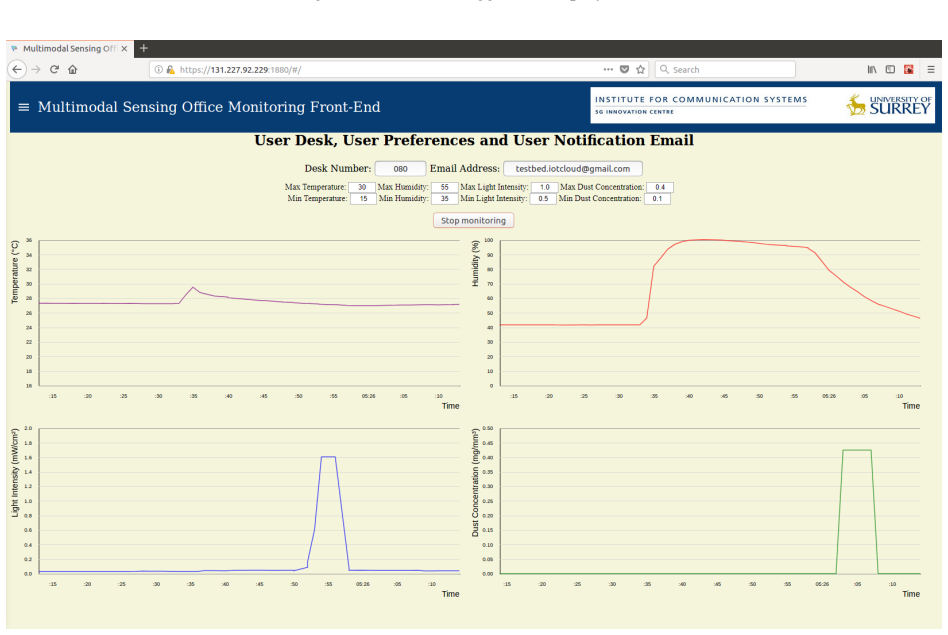
- The office case shows the same infrastructure can support situation-aware interventions, such as email or buzzer alerts when comfort conditions drift outside a user's preferences.
- Because data are encrypted and pseudonymized and no cameras or microphones are used, recruitment for in-the-wild studies may be easier and less intrusive for participants.
- The same testbed is intended to extend to other indoor settings, including nursing homes, schools, restaurants, and shopping malls.
Reading between the lines
- Whether the sensor streams actually support the intended social-science conclusions is not settled by this paper; a natural next step is to quantify how well sensor-derived activity labels agree with diary or observational ground truth in the same households.
- The combination of wristband signal strength and appliance-level electricity data could, in principle, be used to infer co-presence and the sequencing of household routines, extending the paper's visual-alignment approach into more structured behavioral analysis.
- The office feedback loop suggests a broader role for the testbed as an intervention platform, not just an observation platform; researchers could use the same actuators and notifications to test how environment changes affect behavior.
- If the visual-alignment method were replaced with a validated activity-recognition model, the testbed could generate automatically labeled longitudinal activity data, which would substantially increase its value for social research.
Signed reviews
Editorial analysis
A structured set of objections, weighed in public.
Referee Report
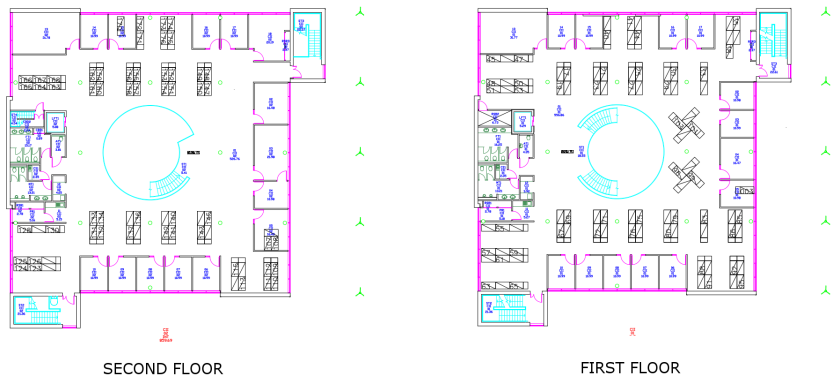
Summary. The paper presents MakeSense, an IoT testbed for social research on indoor activities, built around a self-manufactured IoTEgg sensor hub (temperature, humidity, light, noise, proximity, dust) that also relays BLE wristband RSSI and commercial energy-monitor data to cloud backends via LWM2M/CoAP. The testbed includes encrypted transmission, pseudonymisation, Docker-based server deployment, and Kibana-based visualisation. Two case studies are described: HomeSense, with sensor suites installed in 20 households, and an office deployment of 100 IoTEggs on desks, the latter also supporting a situation-aware feedback application. The central claim is that MakeSense enables real-world large-scale social research through quick setup, flexibility, integration of diverse devices, resilience, and scalability. The evaluation is qualitative: sensor data are visually compared with time-use diaries in the home study, and the office occupancy threshold is stated as chosen empirically without a formal accuracy assessment.
Significance. If the central claim is established, MakeSense would be a genuinely useful contribution: it provides an end-to-end, open-source, non-intrusive infrastructure that lowers the technical barrier for social researchers, with plausible design choices (WiFi/BLE, LWM2M, message queues, Docker) and credible deployment scale (20 homes, 100 desks). The paper explicitly addresses privacy via encryption and pseudonymisation, and the authors make deployment scripts available. The strength of the contribution, however, rests on a premise that the paper does not yet substantiate: that the collected sensor signals reliably track the human activities of interest. The two case studies demonstrate that the system can be installed and can produce real-time plots, but they do not quantify the relationship between sensor data and ground-truth activities. Because that relationship is the load-bearing element for the 'enables social research' claim, the paper needs additional validation, which could plausibly be performed by re-analysing the already-collected deployment data.
major comments (3)
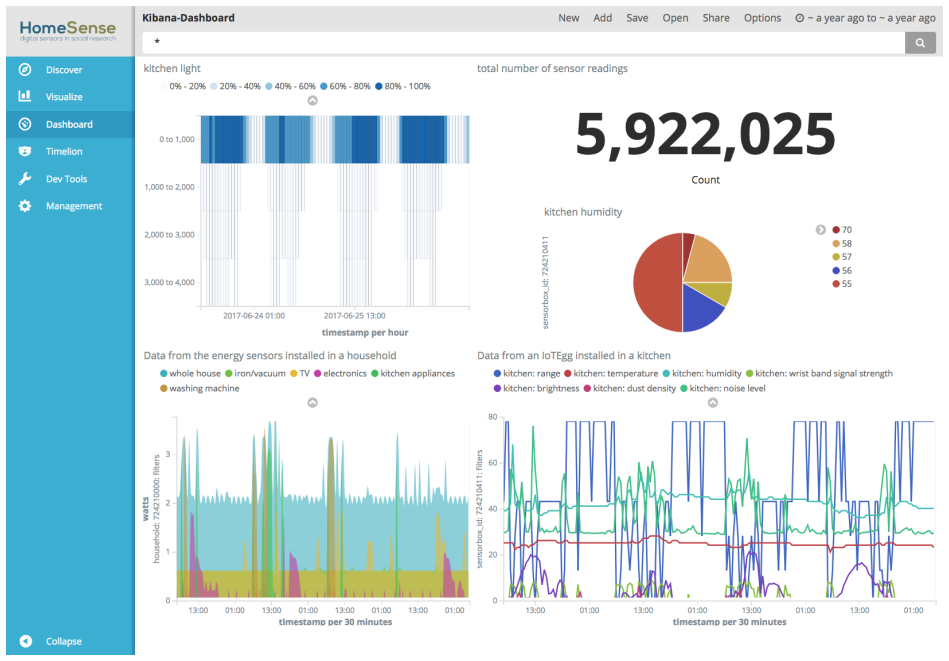
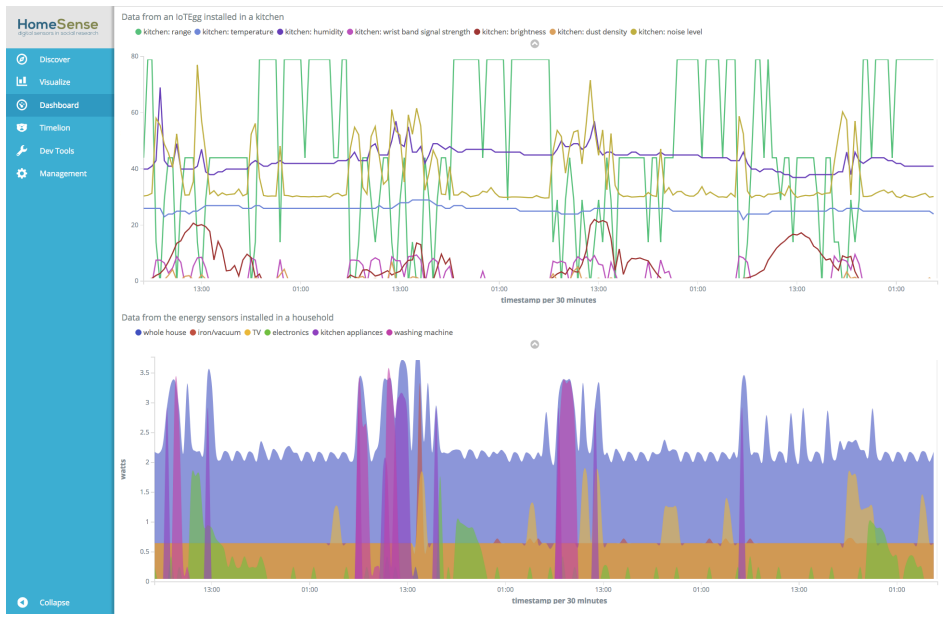
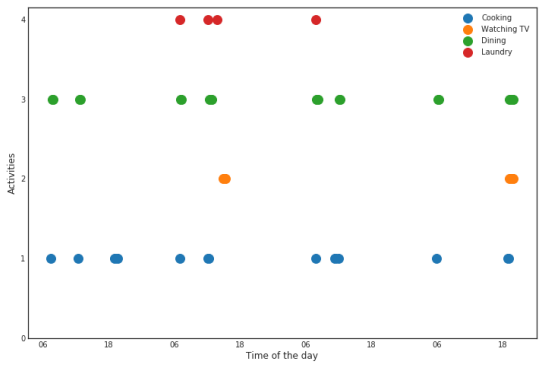
- [Section 4.1.2 (Figures 8 and 9)] The claim that MakeSense enables social research on indoor activities hinges on the validity of inferring activities from sensor signals, but Section 4.1.2 supports this only by visual alignment between sensor plots and time-use diaries. The authors state that kitchen use is visible in ranging, wristband RSSI, and noise; that humidity changes 'may be caused by' food preparation; and that laundry correlates with washing-machine electricity. No precision, recall, correlation coefficient, Cohen's kappa, or classification accuracy is reported for any activity. This is a missing-support issue rather than a disagreement with consensus, and it is directly addressable: the HomeSense data already include time-use diaries, so the authors could report, for example, event-detection performance for cooking, laundry, and TV watching against the diary ground truth, or at minimum a quantitative correlation between sensor-derived events and diary entries.
- [Section 4.2.2 (office monitoring) and Section 3.2.2 (RSSI localisation)] The office case study depends on a proximity-based occupancy detector with a threshold of 75 cm that is described only as 'chosen empirically' (Section 4.2.2), and the wristband RSSI-based localisation (Section 3.2.2) is presented as a 'rough localization method' with no accuracy evaluation. Since the feedback application actuates a buzzer and sends email notifications when occupancy is detected, false positives and false negatives directly affect user trust and the validity of any social-research conclusions. The paper should report at least a small labelled evaluation of occupancy detection against ground truth (e.g., known presence/absence periods) and, if RSSI localisation is claimed as a feature, a characterisation of its spatial error or reliability.
- [Sections 1, 3, and 5 (resilience and scalability claims)] The abstract and introduction claim that MakeSense provides 'resilience, and scalability,' and Section 3 describes redundant storage and message-queue decoupling, but no quantitative evidence is provided for either property. There are no data-loss rates, no uptime statistics, no latency measurements, and no stress test with a large number of concurrent devices. The 20-home, 100-IoTEgg deployments are respectable demonstrations, but they do not by themselves establish scalability or resilience under failure conditions. The authors report (Section 6.7, 6.8) that watchdogs and automatic re-spawning were needed to address crashes and service lags, which suggests that such data exist and could be summarised; reporting measured packet-loss/downtime figures would turn these claims from design aspirations into evaluated properties.
minor comments (4)
- [Section 5 (Step 2.2)] The 'quick setup' claim in the abstract and introduction is partially qualified by Step 2.2, which recommends a 24-hour quality test before field deployment; the paper should clarify in the introduction that 'minutes' refers to field installation after a recommended pre-deployment quality-assurance period, to avoid overstating the setup effort.
- [Figure 8] The caption and text indicate that wristband signal strength, brightness, and dust density are 're-scaled using Kibana's scripted fields,' but the scaling (e.g., min/max values or normalisation method) is not described, making the visual alignment hard for readers to interpret quantitatively.
- [Throughout] There are several typographical and formatting issues, including 'Philips HomeLab' versus 'Philiphs HomeLab' in the text and references, the incomplete reference entry for MongoDB ('open-source depdocument-oriented database program'), and inconsistent use of 'data is' versus 'data are'; these should be corrected during revision.
- [Section 3.1] The paper says data are 'encrypted with AES 128 bit before transmission' but also mentions DTLS with pre-shared keys; the relationship between DTLS (which already provides encryption) and the additional AES-128 step should be clarified to avoid confusion about the security architecture.
Circularity Check
No circularity found: MakeSense is a systems paper whose claims are supported by architecture and deployment experience, not by a fitted parameter or a self-citation chain.
full rationale
MakeSense is a systems/testbed paper. The claimed contribution is an infrastructure (IoTEgg hardware, LWM2M/CoAP communication, cloud storage, and Kibana visualization) plus two demonstration deployments. There is no equation-level derivation in which an output is defined as its input, and no fitted parameter is renamed as a prediction. The 75 cm occupancy threshold in Section 4.2.2 is explicitly a system setting ('chosen empirically') used to trigger comfort feedback, not a predicted scientific result. The Section 4.1.2 inference that sensor signals correspond to cooking, laundry, and presence is supported only by visual alignment with 10-minute time-use diaries and is hedged with language such as 'may be caused by'; this is a missing quantitative validation concern, not circularity, because the sensor-to-activity mapping is not derived from the testbed's claimed features. The reference to the HomeSense project [65] is a deployment in which the authors used their own testbed, but the load-bearing engineering claims (quick setup, non-intrusiveness, encryption, scalability, flexibility) are supported by architectural description and field experience rather than by citing a uniqueness theorem or prior result that already assumes the conclusion. No specific reduction of the kind required by the circularity rules can be exhibited, so the appropriate finding is no significant circularity.
Assumptions & free parameters
free parameters (1)
- Occupancy proximity threshold =
75 cm
assumptions (2)
- domain assumption Household and office environments have adequate WiFi coverage and power sockets for the IoTEggs.
- domain assumption Sensor modules' manufacturer calibrations are accurate outside the lab.
invented entities (1)
-
IoTEgg sensor hub
Cite this review
Pith. "Pith review of MakeSense: An IoT Testbed for Social Research of Indoor Activities." pith.science (2026). https://pith.science/paper/Z5DKDLTM
@misc{pith2026190803380,
  author       = {Pith},
  title        = {Pith review of: MakeSense: An IoT Testbed for Social Research of Indoor Activities},
  year         = {2026},
  howpublished = {\url{https://pith.science/paper/Z5DKDLTM}},
  note         = {Machine review of arXiv:1908.03380}
}
read the original abstract
There has been increasing interest in deploying IoT devices to study human behaviour in locations such as homes and offices. Such devices can be deployed in a laboratory or `in the wild' in natural environments. The latter allows one to collect behavioural data that is not contaminated by the artificiality of a laboratory experiment. Using IoT devices in ordinary environments also brings the benefits of reduced cost, as compared with lab experiments, and less disturbance to the participants' daily routines which in turn helps with recruiting them into the research. However, in this case, it is essential to have an IoT infrastructure that can be easily and swiftly installed and from which real-time data can be securely and straightforwardly collected. In this paper, we present MakeSense, an IoT testbed that enables real-world experimentation for large scale social research on indoor activities through real-time monitoring and/or situation-aware applications. The testbed features quick setup, flexibility in deployment, the integration of a range of IoT devices, resilience, and scalability. We also present two case studies to demonstrate the use of the testbed, one in homes and one in offices.
Figures

Figures from the paper (8 more)
Reference graph
Works this paper leans on
-
[1]
Internet of things: A survey on enabling technologies, protocols, and applications
Ala Al-Fuqaha, Mohsen Guizani, Mehdi Mohammadi, Mohammed Aledhari, and Moussa Ayyash. Internet of things: A survey on enabling technologies, protocols, and applications. IEEE Commun. Surv. Tutorials , 17(4):2347–2376, Fourthquarter 2015
work page 2015
-
[2]
Context aware computing for the internet of things: A survey
Charith Perera, Arkady Zaslavsky, Peter Christen, and Dimitrios Georgakopoulos. Context aware computing for the internet of things: A survey. IEEE Commun. Surv. Tutorials, 16(1):414–454, First 2014
work page 2014
-
[3]
Deep learning for sensor-based activity recognition: A survey
Jindong Wang, Yiqiang Chen, Shuji Hao, Xiaohui Peng, and Lisha Hu. Deep learning for sensor-based activity recognition: A survey. Pattern Recognit. Lett., pages 1–9, 2018
work page 2018
-
[4]
Leah Ruppanner. Contemporary Family Issues. Oxford University Press, Oxford, UK, 2015
work page 2015
-
[5]
Rowland Atkinson and Keith Jacobs. House, Home and Society . Palgrave Macmillan, London, 2016
work page 2016
-
[6]
Gattshall, Jo Ann Shoup, Julie A
Michelle L. Gattshall, Jo Ann Shoup, Julie A. Marshall, Lori A. Crane, and Paul A. Estabrooks. Validation of a survey instrument to assess home environments for physical activity and healthy eating in overweight children. Int. J. Behav. Nutr . Phys. Act., 5(1):1–13, January 2008
work page 2008
-
[7]
Williams, Catherine Coveney, and Robert Meadows
Simon J. Williams, Catherine Coveney, and Robert Meadows. ‘m-apping’ sleep? trends and transformations in the digital age. Sociol. Health Illn., 37(7):1039–1054, September 2015
work page 2015
-
[8]
Analysing hands-on-tech care work in telecare installations
Daniel López Gómez and Tomás Sánchez-Criado. Analysing hands-on-tech care work in telecare installations. frictional encounters with gerontechnological designs. In D. Prendergast and C. Garattini, editors, Aging and the Digital Life Course, chapter 9, pages 179–197. Berghahn Books, Oxford, UK, 07 2015
work page 2015
Show all 66 references
-
[9]
Ageing with telecare: care or coercion in austerity? Sociol
Maggie Mort, Celia Roberts, and Blanca Callén. Ageing with telecare: care or coercion in austerity? Sociol. Health Illn., 35(6):799–812, July 2013
2013
-
[10]
Change in spousal human capital and housework: A longitudinal analysis
Oriel Sullivan and Jonathan Gershuny. Change in spousal human capital and housework: A longitudinal analysis. Eur . Sociol. Rev., 32(6):864–880, December 2016
2016
-
[11]
Schiano, and Eric Paulos
James Pierce, Diane J. Schiano, and Eric Paulos. Home, habits, and energy: Examining domestic interactions and energy consumption. In Proceedings of the SIGCHI Conference on Human Factors in Computing Systems , CHI’10, pages 1985–1994, New York, NY , USA, 2010. ACM
1985
-
[12]
Occupant productivity and office indoor environment quality: A review of the literature
Yousef Al Horr, Mohammed Arif, Amit Kaushik, Ahmed Mazroei, Martha Katafygiotou, and Esam Elsarrag. Occupant productivity and office indoor environment quality: A review of the literature. Build. Environ., 105:369– 389, August 2016
2016
-
[13]
Making paradigms meaningful in mixed methods research
Peggy Shannon-Baker. Making paradigms meaningful in mixed methods research. J. Mix. Methods Res. , 10(4):319–334, October 2016. 18
2016
-
[14]
Recognition of dietary activity events using on-body sensors
Oliver Amft and Gerhard Tröster. Recognition of dietary activity events using on-body sensors. Artif. Intell. Med., 42(2):121–136, February 2008. Wearable Computing and Artificial Intelligence for Healthcare Applications
2008
-
[15]
Simon Sherratt
Jin Wang, Zhongqi Zhang, Bin Li, Sungyoung Lee, and R. Simon Sherratt. An enhanced fall detection system for elderly person monitoring using consumer home networks. IEEE Trans. Consum. Electron., 60(1):23–29, February 2014
2014
-
[16]
S-seer: Selective perception in a multimodal office activity recognition system
Nuria Oliver and Eric Horvitz. S-seer: Selective perception in a multimodal office activity recognition system. In Samy Bengio and Hervé Bourlard, editors, Machine Learning for Multimodal Interaction , pages 122–135, Berlin, Heidelberg, 2005. Springer
2005
-
[17]
de Ruyter, E
B. de Ruyter, E. Aarts, P. Markopoulos, and W. Ijsselsteijn. Ambient intelligence research in homelab: Engineering the user experience. In Werner Weber, Jan M. Rabaey, and Emile Aarts, editors, Ambient Intelligence, pages 49–61. Springer, Berlin, Heidelberg, 2005
2005
-
[18]
Intille, Kent Larson, Emmanuel Munguia Tapia, Jennifer S
Stephen S. Intille, Kent Larson, Emmanuel Munguia Tapia, Jennifer S. Beaudin, Pallavi Kaushik, Jason Nawyn, and Randy Rockinson. Using a live-in laboratory for ubiquitous computing research. In Kenneth P. Fishkin, Bernt Schiele, Paddy Nixon, and Aaron Quigley, editors, Pervasi...
-
[19]
Cook, Aaron S
Diane J. Cook, Aaron S. Crandall, Brian L. Thomas, and Narayanan C. Krishnan. Casas: A smart home in a box. Computer, 46:62–69, July 2013
2013
-
[20]
Kröse, T
B. Kröse, T. Van Kasteren, C. Gibson, and T. Van Den Dool. Care: Context awareness in residences for elderly - in proceedings of the conference of the international society for gerontechnology, 2008
2008
-
[21]
Bridging e-health and the internet of things: The sphere project
Ni Zhu, Tom Diethe, Massimo Camplani, Lili Tao, Alison Burrows, Niall Twomey, Dritan Kaleshi, Majid Mirmehdi, Peter Flach, and Ian Craddock. Bridging e-health and the internet of things: The sphere project. IEEE Intell. Syst., 30(4):39–46, July 2015
2015
-
[22]
How to choose an experimentation platform for wireless sensor networks? a survey on static and mobile wireless sensor network experimentation facilities
Anne-Sophie Tonneau, Nathalie Mitton, and Julien Vandaele. How to choose an experimentation platform for wireless sensor networks? a survey on static and mobile wireless sensor network experimentation facilities. Ad Hoc Networks, 30:115 – 127, 2015
2015
-
[23]
Santana, Veronica Gutierrez, Rajiv Ramdhany, Alex Gluhak, Srdjan Krco, Evangelos Theodoridis, and Dennis Pfisterer
Luis Sanchez, Luis Muñoz, Jose Antonio Galache, Pablo Sotres, Juan R. Santana, Veronica Gutierrez, Rajiv Ramdhany, Alex Gluhak, Srdjan Krco, Evangelos Theodoridis, and Dennis Pfisterer. Smartsantander: Iot experimentation over a smart city testbed. Computer Networks, 61:217 – 2...
2014
-
[24]
Dos and Don’ts in Mobile Phone Sensing Middleware: Learning from a Large-Scale Experiment
Valerie Issarny, Vivien Mallet, Kinh Nguyen, Pierre-Guillaume Raverdy, Fadwa Rebhi, and Raphael Ven- tura. Dos and Don’ts in Mobile Phone Sensing Middleware: Learning from a Large-Scale Experiment. In ACM/IFIP/USENIX Middleware 2016, Proceedings of the 2016 International Middl...
2016
-
[25]
Federation of internet of things testbeds for the realization of a semantically-enabled multi-domain data marketplace
Luis Sánchez, Jorge Lanza, Juan Ramón Santana, Rachit Agarwal, Pierre Guillaume Raverdy, Tarek Elsaleh, Yasmin Fathy, SeungMyeong Jeong, Aris Dadoukis, Thanasis Korakis, Stratos Keranidis, Philip O’Brien, Jerry Horgan, Antonio Sacchetti, Giuseppe Mastandrea, Alexandros Fragkia...
2018
-
[26]
Support innovative iot applications in the smart city domain, 2019
FINE. Support innovative iot applications in the smart city domain, 2019
2019
-
[27]
M. Nati, A. Gluhak, H. Abangar, and W. Headley. Smartcampus: A user-centric testbed for internet of things experimentation. In 2013 16th International Symposium on Wireless Personal Multimedia Communications (WPMC), pages 1–6, 2013
2013
-
[28]
The gator tech smart house: a programmable pervasive space
Sumi Helal, William Mann, Hicham El-Zabadani, Jeffrey King, Youssef Kaddoura, and Erwin Jansen. The gator tech smart house: a programmable pervasive space. Computer, 38(3):50–60, March 2005
2005
-
[29]
The human speechome project
Deb Roy, Rupal Patel, Philip DeCamp, Rony Kubat, Michael Fleischman, Brandon Roy, Nikolaos Mavridis, Stefanie Tellex, Alexia Salata, Jethran Guinness, Michael Levit, and Peter Gorniak. The human speechome project. In Paul V ogt, Yuuya Sugita, Elio Tuci, and Chrystopher Nehaniv...
2006
-
[30]
Ambient intelligence in assisted living: Enable elderly people to handle future interfaces
Thomas Kleinberger, Martin Becker, Eric Ras, Andreas Holzinger, and Paul Müller. Ambient intelligence in assisted living: Enable elderly people to handle future interfaces. In Constantine Stephanidis, editor, Universal Access in Human-Computer Interaction. Ambient Interaction ...
2007
-
[31]
Kientz, Shwetak N
Julie A. Kientz, Shwetak N. Patel, Brian Jones, Ed Price, Elizabeth D. Mynatt, and Gregory D. Abowd. The georgia tech aware home. In CHI ’08 Extended Abstracts on Human Factors in Computing Systems , CHI EA ’08, pages 3675–3680, New York, NY , USA, 2008. ACM. 19
2008
-
[32]
A smart home application to eldercare: Current status and lessons learned
Marjorie Skubic, Gregory Alexander, Mihail Popescu, Marilyn Rantz, and James Keller. A smart home application to eldercare: Current status and lessons learned. Technol. Health Care, 17(3):183–201, August 2009
2009
-
[33]
De Morais, Maria Menezes, Celeste Gabrielli, João Bentes, Anita Sant’Anna, Jonathan Synnott, and Chris Nugent
Jens Lundström, Wagner O. De Morais, Maria Menezes, Celeste Gabrielli, João Bentes, Anita Sant’Anna, Jonathan Synnott, and Chris Nugent. Halmstad intelligent home - capabilities and opportunities. In Mobyen Uddin Ahmed, Shahina Begum, and Wasim Raad, editors, Internet of Thing...
-
[34]
Espinilla, L
M. Espinilla, L. Marínez, J. Medina, and C. Nugent. The experience of developing the ujami smart lab. IEEE Access, 6:34631–34642, 2018
2018
-
[35]
Synthetic sensors: Towards general-purpose sensing
Gierad Laput, Yang Zhang, and Chris Harrison. Synthetic sensors: Towards general-purpose sensing. In Proceedings of the 2017 CHI Conference on Human Factors in Computing Systems , CHI ’17, pages 3986–3999, New York, NY , USA, 2017. ACM
2017
-
[36]
Open mobile alliance lightweight m2m protocol, 2018
OMA LWM2M. Open mobile alliance lightweight m2m protocol, 2018
2018
-
[37]
The constrained application protocol, 2018
CoAP. The constrained application protocol, 2018
2018
-
[38]
Postgresql open source object-relational database, 2018
PostgreSQL. Postgresql open source object-relational database, 2018
2018
-
[39]
Mongodb, open-source depdocument-oriented database program, 2018
MongoDB. Mongodb, open-source depdocument-oriented database program, 2018
2018
-
[40]
Elasticsearch distributed, restful search and analytics engine, 2018
ElasticSearch. Elasticsearch distributed, restful search and analytics engine, 2018
2018
-
[41]
Kibana data visualisation engine, 2018
Kibana. Kibana data visualisation engine, 2018
2018
-
[42]
Centralize, transform & stash your data, 2018
Logstash. Centralize, transform & stash your data, 2018
2018
-
[43]
Ipso smart objects - iot semantic interoperability workshop, 2016
Jaime Jimenez, Michael Koster, and Hannes Tschofenig. Ipso smart objects - iot semantic interoperability workshop, 2016
2016
-
[44]
Arch-pro mbed enabled development board, 2018
Seeeduino. Arch-pro mbed enabled development board, 2018
2018
-
[45]
Sparkfun humidity and temperature sensor breakout board, 2018
HTU21D. Sparkfun humidity and temperature sensor breakout board, 2018
2018
-
[46]
Sparkfun rgb and gesture sensor breakout board, 2018
APDS-9960. Sparkfun rgb and gesture sensor breakout board, 2018
2018
-
[47]
Sharp analog distance sensor (10-150cm), 2018
GP2Y0A60SZLF. Sharp analog distance sensor (10-150cm), 2018
2018
-
[48]
Sparkfun mems microphone breakout board, 2018
INMP401. Sparkfun mems microphone breakout board, 2018
2018
-
[49]
Sensortag, 2018
Texas Instruments. Sensortag, 2018
2018
-
[50]
Smoking activity recognition using a single wrist imu and deep learning light
Edwin Valarezo Añazco, Patricio Rivera Lopez, Sangmin Lee, Kyungmin Byun, and Tae-Seong Kim. Smoking activity recognition using a single wrist imu and deep learning light. In Proceedings of the 2nd International Conference on Digital Signal Processing, ICDSP 2018, pages 48–51,...
2018
-
[51]
Villar, Camelia Chira, Víctor M
Samad Barri Khojasteh, José R. Villar, Camelia Chira, Víctor M. González, and Enrique de la Cal. Improving fall detection using an on-wrist wearable accelerometer. Sensors, 18(5):1–28, April 2018
2018
-
[52]
Gait, wrist, and sensors: Detecting freezing of gait in parkinson’s disease from wrist movement
Sinziana Mazilu, Ulf Blanke, and Gerhard Tröster. Gait, wrist, and sensors: Detecting freezing of gait in parkinson’s disease from wrist movement. In IEEE International Conference on Pervasive Computing and Communication Workshops, PerCom Workshops 2015, pages 579–584, Washing...
2015
-
[53]
Mi band wristband, 2018
Xiaomi. Mi band wristband, 2018
2018
-
[54]
Energy monitor, 2018
CurrentCost. Energy monitor, 2018
2018
-
[55]
The uk-dale dataset, domestic appliance-level electricity demand and whole-house demand from five uk homes
Jack Kelly and William Knottenbelt. The uk-dale dataset, domestic appliance-level electricity demand and whole-house demand from five uk homes. Sci. Data, 2:1–14, March 2015
2015
-
[56]
Fit for everybody, 2019
Fitbit. Fit for everybody, 2019
2019
-
[57]
Garmin wearables, 2019
Garmin. Garmin wearables, 2019
2019
-
[58]
Open-hardware raspberry pi-based energy monitor, 2019
EmonPi. Open-hardware raspberry pi-based energy monitor, 2019
2019
-
[59]
Intelligently managing the home’s energy, 2019
Neurio. Intelligently managing the home’s energy, 2019
2019
-
[60]
Air pollution can’t hide, 2019
Kaiterra. Air pollution can’t hide, 2019
2019
-
[61]
Eclipse.org c library for lwm2m, 2018
Wakaama. Eclipse.org c library for lwm2m, 2018
2018
-
[62]
Eclipse.org java library for lwm2m, 2018
Leshan. Eclipse.org java library for lwm2m, 2018
2018
-
[63]
Securely build, share and run any application, anywhere, 2018
Docker. Securely build, share and run any application, anywhere, 2018
2018
-
[64]
Elastic x-pack extended features package, 2018
X-Pack. Elastic x-pack extended features package, 2018
2018
-
[65]
Digital sensors in social research, 2018
HomeSense. Digital sensors in social research, 2018. 20
2018
-
[2016]
Springer International Publishing
Reviewed August 14, 2026 · model on record in the stance chip above.
Discussion (0). Continue with ORCID to comment.