REVIEW 1 major objections 5 minor 50 references
An effective model for describing coherent population trapping resonances, which correctly takes into account the off-resonant frequency components in periodically modulated laser field
T0 review · 1 major / 5 minor · reviewed 2026-08-16 · deepseek-v4-flash
Pith's one-line read The light shift of a coherent-population-trapping resonance is governed by phase-dependent beats among off-resonant spectral components, not by ac Stark shifts alone.
desk verdict The effective model and the S12 beat-shift mechanism are a real contribution, but Fig. 7's phase-sensitivity demonstration is invalid because the two phase configurations are related by a time shift. read the letter →
The pith
A machine-rendered reading of the paper's core claim, the machinery that carries it, and where it could break.
The reading
What carries the argument
The load-bearing object is the reduced density-matrix equation (28) for a three-level $\Lambda$ system in a periodically modulated field with modulation frequency $f \approx \Delta_{\rm hfs}/N$. Only the two spectral components resonant with the optical transitions are kept exactly; every other component is treated by second-order perturbation theory and collected into two operators acting on ground-state populations and coherence: the shift operator $\hat{S}_{\rm sh}$ and the relaxation operator $\hat{P}$. The new physics sits in the non-diagonal element $S_{12} = \sum_{n \neq n_1} \delta_n^{(1)} \Omega_n^{(1)*} \Omega_{n+N}^{(2)} e^{i(\varphi_n - \varphi_{n+N})}/(\gamma_{\rm opt}^2 + |\delta_n^{(1)}|^2)$, which is the phase-sensitive beat between off-resonant components separated by the hyperfine frequency; it is this term that couples to the ground-state coherence and dominates the resonance shift in the examples.
What would settle it
Measure the CPT resonance light shift versus intensity for two laser fields with identical amplitude spectra but phase relations differing by a fixed step between adjacent components, for instance all phases zero versus phases stepped by $\pi/6$ in the eleven-component example of Section V. If the two measured shift curves coincide, the claimed phase-dependent $S_{12}$ contribution is absent in that regime; if they differ in magnitude or sign while the ac Stark shift is the same, the central claim is supported.
Extended reading notes
Core claim
The central claim is that the ordinary picture, in which the CPT resonance shift equals the difference of the ac Stark shifts of the two lower states, is fundamentally incomplete for polychromatic fields with periodic modulation. In the effective equation derived here, the off-resonant components enter through a Hermitian shift operator $\hat{S}_{\rm sh}$ whose off-diagonal element $S_{12}$ oscillates at the hyperfine frequency $\Delta_{\rm hfs}$ and represents beats between components separated by that frequency. This term acts directly on ground-state coherence and can shift the resonance peak by an amount comparable to, or larger than, the diagonal ac Stark terms. In explicit numerical examples, two fields with identical amplitude spectra but different phase relations produce CPT light shifts that differ in magnitude and even in sign, while the ac Stark shift is the same. The paper therefore concludes that spectrum information alone, for example from a spectrum analyzer, is insufficient to determine the CPT light shift if the phase relationships are unknown.
Load-bearing premise
The model assumes the optical transition is only weakly saturated, that optical coherence decays faster than spontaneous emission but still slower than the modulation period, and that every off-resonant spectral component has a one-photon detuning large compared with the optical linewidth; if a significant component sits close to resonance or the light is intense, the effective equation and the spectrum-insufficiency conclusion would need re-examination.
Editorial extensions
If this is right
- The resonance shift can be tuned through the relative phases of the spectral components, giving a control parameter beyond field amplitude.
- Spectrum-analyzer data are insufficient to predict the CPT light shift; clock developers also need phase information.
- For pure phase modulation at $\Delta_{\rm hfs}/2$ with equal resonant Rabi frequencies, $S_{12}$ vanishes and the ac Stark description is recovered, explaining the narrow parameter window of the ideal zero-shift regime.
- The reduced equation reproduces exact steady-state resonance shapes and shifts in the tested cases, so it can replace full multiharmonic density-matrix simulations for modulated-light CPT spectroscopy.
- At nonzero one-photon detuning, imbalance in the relaxation operator's diagonal pumping terms deforms the line shape and adds a shift beyond the ac Stark value.
Reading between the lines
- A phase-resolved characterization of the modulated laser output would be a natural diagnostic extension: if the $S_{12}$ term dominates, correlating measured interharmonic phases with clock shifts should predict which laser units can reach a zero-light-shift operating point.
- The same beat mechanism should appear wherever two non-resonant field components differ by the ground-state splitting of a $\Lambda$ system, so optically pumped magnetometers and two-photon atomic interferometers driven by pulsed or comb-like light should also be examined for phase-dependent shifts.
- A direct engineering extension would be to actively shape the phases of modulation harmonics, rather than amplitudes only, as a knob for suppressing light shift in chip-scale clocks.
Signed reviews
Editorial analysis
A structured set of objections, weighed in public.
Referee Report
Summary. The paper develops an effective theoretical model for coherent population trapping (CPT) resonances in periodically modulated laser fields. In the model, the two spectral components most resonant with the optical transitions of a three-level Λ-system are treated exactly, while all other 'off-resonant' components are incorporated to second order in the field. This reduction produces two additional operators in the density-matrix equation: a Hermitian shift operator and a relaxation-like operator, whose off-diagonal elements oscillate at the hyperfine frequency and depend on the relative phases of the spectral components. The authors derive these operators in Appendix A and claim numerical verification against exact Floquet solutions of the full density-matrix equations for N = 1, 2, 3, with the effective and exact curves visually coinciding. The central physical claim is that the light shift of the CPT resonance is not governed solely by the usual ac Stark shifts of the lower levels: the phase-dependent S12 beat term can be comparable to or even dominate the standard ac Stark shift. Consequently, the paper concludes that knowing the amplitude spectrum alone, e.g., from a spectrum analyzer, is insufficient to determine the CPT light shift.
Significance. If the claims hold, the effective model is a valuable and practically relevant tool for CPT atomic clocks and magnetometers: it simplifies a polychromatic Floquet problem to a compact equation, it identifies a previously underappreciated phase-dependent contribution to the CPT light shift, and it offers an explanation for the well-known sample-to-sample variability of VCSEL-based light-shift suppression. The perturbation-theory derivation is transparent, the numerical verification against an exact solution is genuine and uses no fitted parameters, and the model makes falsifiable predictions about the dependence of the light shift on spectral phase. However, the explicit phase-sensitivity counterexample in Section V is flawed by a symmetry, and this must be corrected before the paper's headline claim is fully supported.
major comments (1)
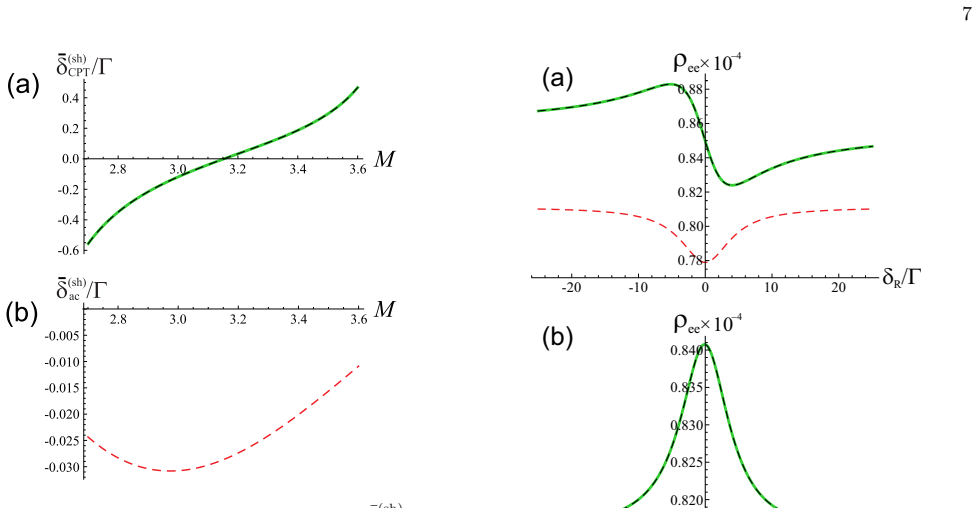
- [Sec. V, Eqs. (41)-(42), Fig. 7] The two phase configurations are physically equivalent under a time translation combined with a redefinition of the excited-state phase, so the plotted difference in the light shift in Fig. 7 cannot be correct. For the phases (42), φ_n = -nπ/6 = -n f τ with τ = π/(6f), so the positive-frequency part of the field equals e^{-iωτ} times the field (41) time-shifted by τ. The master equation (5)-(14) is invariant under a global time translation and under the unitary transformation |e> → e^{-iωτ}|e>, which multiplies the optical couplings by the same phase factor; consequently the steady-state zero-harmonic population ρ_ee^(0)(δ_R) is identical for the two phase sets. The different blue and green curves in Fig. 7 therefore indicate an error in the phase-to-field mapping or in the numerical solver. Since the abstract and Section V use this example as an explicit counterexample to the claim that the amplitude spectrum alone determines the CPT light shift, the demonstration must be redone with phase sets that are not related by a time translation plus a common phase, and the S12-based argument should be presented independently.
minor comments (5)
- [Eq. (14)] In the first two equations of the system (14), the expression 'Γ/2 (ρ_g1g1 − ρ_g2g2)/2' contains a duplicated division by 2; the intended term is presumably Γ(ρ_g1g1 − ρ_g2g2)/2.
- [Appendix A, Eq. (A13)] In the last line of Eq. (A13), the second off-diagonal term of \hat P should be |g2><g1| (the Hermitian conjugate of the preceding term), not |g1><g2|.
- [Sec. IV, Fig. 5] The text refers to the 'blue line' in Fig. 5(a) as the widely used ac-Stark-only approach, while the caption identifies this curve as a red dashed line; the colors in the text and caption should be reconciled.
- [Sec. IV] The verification against the exact calculation is stated only as 'no visual differences'; because the central results are small peak shifts, a quantitative comparison (e.g., the maximum deviation in the peak shift between the effective and exact curves) would strengthen the claim of adequacy.
- [Sec. II, Eq. (10)] The regime of validity is set by the hierarchy Γ ≪ γsp ≪ γopt < f and the condition γopt > k \bar v; a brief reminder in the conclusion that the claims apply within this hierarchy would help avoid over-generalization.
Circularity Check
No significant circularity: the reduced model is derived from the exact density-matrix equations and validated against exact numerics; the phase-sensitive S12 shift term is an analytic consequence, not a fitted input.
full rationale
The derivation starts from the exact Liouville equation (5) and the Fourier-decomposed field (2). In Appendix A the off-resonant optical coherences are adiabatically eliminated under the stated hierarchy (10) and weak-saturation assumption, producing the effective equation (28) with the operators (19)-(26). The non-diagonal S12 term (22), which carries the paper's central phase-sensitivity claim, is an explicit sum over the input amplitudes, phases, and detunings, not a parameter fitted to the light shift that is later predicted. The model is then checked against an independent exact numerical solution of the full equation (5) in Figs. 3-6, and the authors report that the curves visually coincide; such an independent numerical check is genuine evidence. Self-citations (e.g., refs. 31,32,45,48-50) appear as background or as proposed extensions and are not load-bearing for the derivation of S12 or for the comparison with exact results. One non-circular correctness caveat: in Sec. V the phase set (42) is related to the zero-phase set (41) by a global time translation with tau = pi/(6f) plus a common optical phase, so a time-translation-invariant theory should give the same steady-state signal; if Fig. 7 shows different shifts, this would indicate an error in the phase-to-field mapping or in the solver rather than a circular derivation. This caveat does not affect the circularity verdict because the main phase-sensitivity result is already contained in the analytically derived S12 operator and is supported by the exact-model comparisons.
Assumptions & free parameters
assumptions (6)
- domain assumption Closed Λ-system with γ1 + γ2 = γsp
- domain assumption Hierarchy of rates: Γ ≪ γsp ≪ γopt < f
- domain assumption Motionless atoms with γopt exceeding the Doppler linewidth
- domain assumption Weak saturation of optical transitions (small Rabi frequencies, ρee ≪ 1)
- domain assumption Second-order perturbation theory in the field for all off-resonant components
- domain assumption Secular approximation: only slowly varying terms kept
Cite this review
Pith. "Pith review of An effective model for describing coherent population trapping resonances, which correctly takes into account the off-resonant frequency components in periodically modulated laser field." pith.science (2026). https://pith.science/paper/Z6UCLNMC
@misc{pith2026250501924,
  author       = {Pith},
  title        = {Pith review of: An effective model for describing coherent population trapping resonances, which correctly takes into account the off-resonant frequency components in periodically modulated laser field},
  year         = {2026},
  howpublished = {\url{https://pith.science/paper/Z6UCLNMC}},
  note         = {Machine review of arXiv:2505.01924}
}
abstract
We have developed an effective mathematical model to calculate the coherent population trapping (CPT) resonance in periodically modulated light, when the modulation frequency $f$ varies near the fractional part of hyperfine splitting in the ground state $\Delta_{\rm hfs}/N$ (where $N=1,2,...$). In such polychromatic field, only two frequency components that are most resonant with atomic optical transitions are taken into account accurately, while all other off-resonant components are taken into account using the second-order perturbation theory in the field. Within the presented concept, equation for atomic density matrix is obtained, in which the contribution of all off-resonant components is reduced to the appearance of two new operators (non-diagonal, in general case): the shift operator and relaxation operators. In the case of three-level $\Lambda$-system, the adequacy of presented effective model was verified by numerical calculations of various dependencies, in which we did not find visual differences from the exact calculations. In addition to a significant mathematical simplification, our model provides a clear physical picture of various features of CPT spectroscopy in a periodically modulated laser field, including effects that have not been discussed in the scientific literature before. In particular, we show that the widespread viewpoint that the CPT resonance shift is determined by usual ac Stark shifts of the lower levels is, in general, fundamentally incorrect, since the contribution to the light shift due to beats at the frequency $\Delta_{\rm hfs}$ between different off-resonant frequency components can be comparable (or even dominate) with the standard ac Stark shift. Therefore, even if we have detailed information on the modulated field spectrum (e.g. using a spectrum analyzer), this is, in general, absolutely insufficient to determine the light shift of CPT resonance.
Figures


Figures from the paper (3 more)


Reference graph
Works this paper leans on
-
[1]
J. Kitching et al., IEEE Trans. Instrum. Meas. 49 1313 (2000)
work page 2000
-
[2]
Lutwak et al., in Proceeding of Precise Time and Time Interval (PTTI) Meeting, pp
R. Lutwak et al., in Proceeding of Precise Time and Time Interval (PTTI) Meeting, pp. 19 – 32 (2001)
work page 2001
- [3]
-
[4]
M. St¨ ahler, R. Wynands, S. Knappe, J. Kitching, L. Holl- berg, A. Taichenachev, V. Yudin, Opt. Lett. 27, 1472 (2002)
work page 2002
- [5]
- [6]
-
[7]
M. J. Mescher, R. Lutwak and M. Varghese, An ultra- low-power physics package for a chip-scale atomic clock, The 13th International Conferenceon Solid-State Sensors, Actuators and Microsystems, Vol. 1, June 2005, pp. 311- 316
work page 2005
- [8]
Show all 50 references
-
[9]
Shah and J
V. Shah and J. Kitching, Advances in coherent popula- tion trapping for atomic clocks, Adv. At. Mol. Opt. Phys. 59, 21 (2010)
2010
-
[10]
Wang, Review of chip-scale atomic clocks based on coherent population trapping, Chin
Z. Wang, Review of chip-scale atomic clocks based on coherent population trapping, Chin. Phys. B 23, 030601 (2014)
2014
-
[11]
Kitching, Chip-scale atomic devices, Applied Physi cs Reviews 5, 031302 (2018)
J. Kitching, Chip-scale atomic devices, Applied Physi cs Reviews 5, 031302 (2018)
2018
-
[12]
G. D. Martinez, C. Li, A. Staron, J. Kitching, C. Raman and W. R. McGehee, A chip-scale atomic beam clock. Nat Commun 14, 3501 (2023)
2023
-
[13]
P. Cash, W. Krzewick, P. MacHado, K. R. Overstreet, M. Silveira, M. Stanczyk, D. Taylor, and X. Zhang, Mi- crosemi Chip Scale Atomic Clock (CSAC) technical sta- tus, applications, and future plans, 2018 European Fre- quency and Time Forum (EFTF), Turin, Italy (2018), p. 65
2018
-
[14]
B. L. S. Marlow and D. R. Scherer, A Review of Commer- cial and Emerging Atomic Frequency Standards, IEEE Transactions on Ultrasonics, Ferroelectrics, and Fre- quency Control, vol. 68, no. 6, p. 2007 (2021)
2021
-
[15]
Miniature Atomic Clock SA.3Xm, https://www.microsemi.com
-
[16]
Nano Atomic Clock 1, https://www.accubeat.com
-
[17]
Ramsey (2002)
N.F. Ramsey (2002). Application of Atomic Clocks. In: Figger, H., Zimmermann, C., Meschede, D. (eds) Laser Physics at the Limits. Springer, Berlin, Heidelberg
2002
-
[18]
Maleki and J
L. Maleki and J. Prestage, Applications of clocks and frequency standards: from the routine to tests of funda- mental models, Metrologia 42, S145 (2005)
2005
-
[19]
Riehle, Frequency Standards: Basics and Applications (Wiley-VCH, 2005)
F. Riehle, Frequency Standards: Basics and Applications (Wiley-VCH, 2005)
2005
-
[20]
M. S. Grewal, L. R. Weill, and A. P. Andrews, Global Positioning Systems, Inertial Navigation, and Integratio n (Wiley-Interscience, Hoboken, NJ, 2007)
2007
-
[21]
J. D. Prestage and G. L. Weaver, Atomic clocks and oscil- lators for deep-space navigation and radio science, Proc. IEEE 95, 2235 (2007)
2007
-
[22]
Vanier and C
J. Vanier and C. Tomescu, The Quantum Physics of Atomic Frequency Standards (CRC Press, Boca Raton, FL, 2015)
2015
-
[23]
Bock and D
Y. Bock and D. Melgar, Physical applications of GPS geodesy: A review, Rep. Prog. Phys. 79, 106801 (2016)
2016
-
[24]
T. N. Bandi, A Comprehensive Overview of Atomic Clocks and their Applications, BEMS Reports 9, 1 (2023)
2023
-
[25]
Adel Hafiz et al
M. Adel Hafiz et al. Appl. Phys. Lett. 112, 244102 (2018)
2018
-
[26]
M. N. Skvortsov et al., Quantum Electronics 50, 576 (2020)
2020
-
[27]
P. Yun, R. Boudot, E. de Clercq, Phys. Rev. Applied 19, 024012 (2023)
2023
-
[28]
Alzetta, A
G. Alzetta, A. Gozzini, M. Moi, G. Orriols, An experi- mental method for the observation of r.f. transitions and laser beat resonances in oriented Na vapour, Il Nuovo Cimento B 36, 5 (1976)
1976
-
[29]
B. D. Agap’ev, M. B. Gornyi, B. G. Matisov, Yu. V. Rozhdestvenskii, Coherent population trapping in quantum systems, Phys. Usp. 36, 763 (1993)
1993
-
[30]
Arimondo, Coherent population trapping in laser spectroscopy, Prog
E. Arimondo, Coherent population trapping in laser spectroscopy, Prog. Opt. 35, 257 (1996)
1996
-
[31]
A. V. Taichenachev, V. I. Yudin, R. Wynands, M. Stahler, J. Kitching, L. Hollberg, Phys. Rev. A 67, 033810 (2003)
2003
-
[32]
Knappe, M
S. Knappe, M. St¨ ahler, C. Affoldberbach, A. V. Taichenachev, V. I. Yudin, and R. Wynands, Simple pa- rameterization of darkresonance line shape, Appl. Phys. B 76, 57 (2003)
2003
-
[33]
Y. Yano, W. Gao, S. Goka, M. Kajita, Theoretical and experimental investigation of the light shift in Ramsey coherent population trapping, Phys. Rev. A 90, 013826 (2014)
2014
-
[34]
K. A. Barantsev, G. V. Voloshin, A. S. Kuraptsev, A. N. Litvinov, and I. M. Sokolov, Spectrum and Light Shift of the Coherent Population Trapping Resonance in Cells with Antirelaxation Wall Coating in Specular and Diffuse 15 Reflection Models, J. Exp. Theor. Phys. 136, 139 (2023)
2023
-
[35]
Zhu and L
M. Zhu and L. S. Cutler, Theoretical and experimental study of light shift in a CPT-based Rb vapor cell fre- quency standard, in Proceedings of 32th Annual Precise Time and Time Interval Systems and Applications Meet- ing (Institute of Navigation, Reston, V A, 2000), p. 311
2000
-
[36]
F. Levi, A. Godone and J. Vanier, The light shift ef- fect in the coherent population trapping cesium maser, IEEE Trans. Ultrason. Ferroelectr. Freq. Control 47, 466 (2000)
2000
-
[37]
D. F. Phillips, I. Novikova, Ch. Y.-T. Wang, R. L. Walsworth, and M. Crescimanno, Modulation-induced frequency shifts in a coherent-population-trapping-base d atomic clock, J. Opt. Soc. Am. B 22, 305 (2005)
2005
-
[38]
V. Shah, V. Gerginov, P. D. D. Schwindt, S. Knappe, L. Hollberg, and J. Kitching, Continuous light-shift correc- tion in modulated coherent population trapping clocks, Appl. Phys. Lett. 89, 151124 (2006)
2006
-
[39]
Y. Yin, Y. Tian, Y. Wang, and S. Gu, The light shift of a chipscale atomic clock affected by asymmetrical multi- chromatic laser fields, Spectrosc. Lett. 50, 227 (2017)
2017
-
[40]
J. W. Pollock, V. I. Yudin et al. Phys. Rev. A 98, 053424 (2018)
2018
-
[41]
V. I. Yudin et al. Phys. Rev. Applied 14, 024001 (2020)
2020
-
[42]
Abdel Hafiz et al
M. Abdel Hafiz et al. Phys. Rev. Applied 14, 034015 (2020)
2020
-
[43]
D. S. Chuchelov, E. A. Tsygankov, M. I. Vaskovskaya, S. A. Zibrov, V. L. Velichansky, S. V. Petropavlovsky, and V. P. Yakovlev, J. Phys.: Conf. Ser. 1686, 012029 (2020)
2020
-
[44]
J. W. Pollock, V. I. Yudin et al. Appl. Phys. Lett. 120, 154001 (2022)
2022
-
[45]
V. I. Yudin, M. Yu. Basalaev, A. V. Taichenachev, O. N. Prudnikov, D. A. Radnatarov, S. M. Kobtsev, S. M. Ignatovich, and M. N. Skvortsov, Frequency shift caused by the line-shape asymmetry of the resonance of coherent population trapping, Phys. Rev. A 108, 013103 (2023)
2023
-
[46]
D. A. Radnatarov, S. M. Kobtsev, V. A. Andryushkov, M. Yu. Basalaev, A. V. Taichenachev, M. D. Radchenko, and V. I. Yudin, Active Suppression of the Light Shift in an Atomic Clock Based on Coherent Population Trap- ping in 87Rb Vapor Using the Phase Jump Technique, JETP Letter...
2023
-
[47]
E. A. Tsygankov, D. S. Chuchelov, M. I. Vaskovskaya, V. V. Vassiliev, S. A. Zibrov, and V. L. Velichansky, Non- linear frequency shift caused by asymmetry of the multi- peak coherent population trapping resonance, Phys. Rev. A 109, 053703 (2024)
2024
-
[48]
M. Yu. Basalaev, V. I. Yudin, A. V. Taichenachev, M. I. Vaskovskaya, D. S. Chuchelov, S. A. Zibrov, V. V. Vassiliev, and V. L. Velichansky, Dynamic Continuous- Wave Spectroscopy of Coherent Population Trapping at Phase-Jump Modulation, Phys. Rev. Appl. 13, 034060 (2020)
2020
-
[49]
V. I. Yudin, A. V. Taichenachev, and M. Yu. Basalaev, Dynamic steady state of periodically driven quantum sys- tems, Phys. Rev. A 93, 013820 (2016)
2016
-
[50]
V. I. Yudin, A. V. Taichenachev, M. Yu. Basalaev, and D. V. Kovalenko, Dynamic regime of coherent population trapping and optimization of frequency modulation pa- rameters in atomic clocks, Opt. Express 25, 2742 (2017)
2017
Reviewed August 16, 2026 · model on record in the stance chip above.
Discussion (0). Continue with ORCID to comment.