REVIEW 2 major objections 5 minor 16 references
Non-decomposable Lagrangian cobordisms between Legendrian knots
T0 review · 2 major / 5 minor · reviewed 2026-08-03 · deepseek-v4-flash
Pith's one-line read For every genus, non-decomposable Lagrangian cobordisms exist
desk verdict First non-decomposable Lagrangian cobordisms of arbitrary positive genus, built from a clean Livingston-style obstruction; the only real caveat is that the central Lagrangian-concordance step is outsourced to unpublished preprints. read the letter →
The pith
A machine-rendered reading of the paper's core claim, the machinery that carries it, and where it could break.
The reading
What carries the argument
The carrying mechanism is the pair consisting of (i) the two-fold branched cover homology group H_1(Σ_2(K); F_p), whose dimension is controlled by the determinant of K, and (ii) the critical-point inequality c_2(Σ) ≥ (β_1(Σ_2(K_0); F_p) − β_1(Σ_2(K_1); F_p))/2 − g(Σ) for any connected Morse cobordism Σ. In this paper the inequality is fed with K_0 = Λ^n (whose branched-cover homology is ≥ n because p divides det(Λ)) and K_1 = U^n (whose homology is 0). The positive difference amplifies with n, so taking n > 2g forces at least one index-2 critical point in the constructed cobordism, which blocks decomposability.
What would settle it
For a concrete case, e.g., a Legendrian pretzel knot with det = 9, attempt to present the constructed genus-1 cobordism as a sequence of elementary moves; if such a presentation exists, the non-decomposability claim is false. A more direct check is to compute dim_{F_3} H_1 of the two-fold branched cover of the stabilized connected sum and verify the lower bound n, since the whole obstruction rests on that count.
Extended reading notes
Core claim
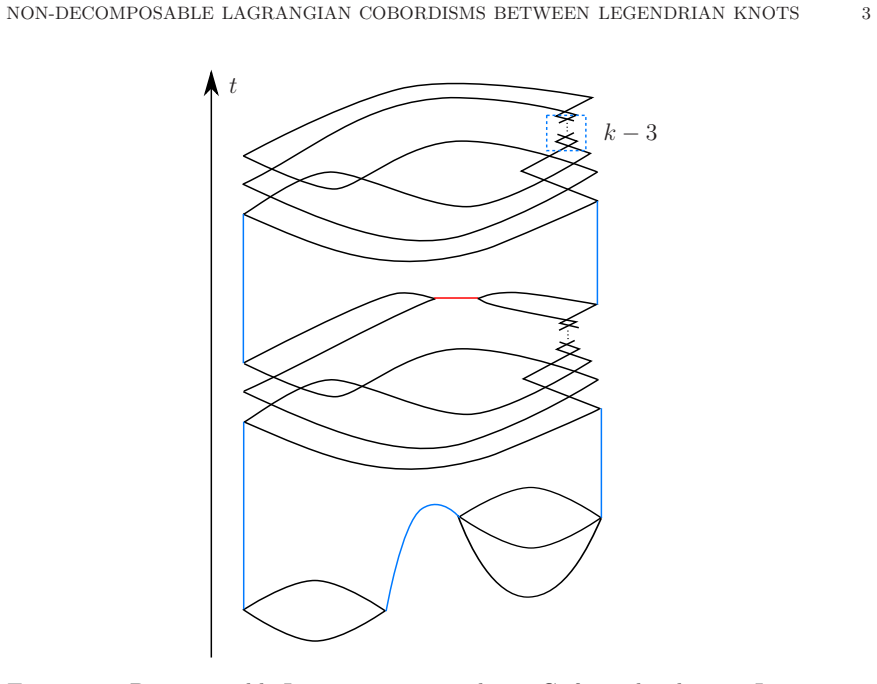
The central claim is Theorem 1: let Λ be a Legendrian knot in the standard contact S^3 such that an odd prime p divides det(Λ) and there is a decomposable Lagrangian concordance from the tb = −1 unknot U to Λ. Then for every g > 0 there are stabilized connected sums Λ^n and U^n and a genus-g Lagrangian cobordism from Λ^n to U^n that is non-decomposable. The proof reverses the concordance, uses an h-principle and an approximation theorem to make it Lagrangian, and concatenates a genus-one cobordism from a positive-then-negative stabilization. Non-decomposability comes from a critical-point estimate on two-fold branched covers: p divides det(Λ), so the branched-cover homology of Λ^n is at leas
Load-bearing premise
The construction depends on the cited step in §3 that a reversed decomposable concordance can be isotoped to a totally real concordance and then approximated by a genuine Lagrangian concordance; if that approximation is unavailable, the cobordism L_g does not exist.
Editorial extensions
If this is right
- For any Legendrian knot with det divisible by an odd prime and a decomposable concordance from the unknot, the construction produces non-decomposable Lagrangian cobordisms in every genus.
- The examples include the Legendrian pretzel knots P(3,−3,k) with determinant 9, their connected sums with any concordance from the unknot, and any ribbon concordance realized as a decomposable Lagrangian concordance.
- The constructed cobordisms are non-ribbon, so they contain an actual index-2 critical point; they are not merely non-decomposable in a subtle sense.
- The condition n > 2g is the only restriction on the genus; increasing the number of connected sum copies allows arbitrarily large genus.
Reading between the lines
- The connected-sum amplification gives a general recipe: any concordance from a knot whose determinant has an odd prime factor can be converted into non-decomposable cobordisms of all genera, so the phenomenon is not confined to the specific examples listed.
- If a version of the critical-point inequality existed for the prime 2, the construction could extend to knots whose determinant is even; the paper only uses odd primes.
- The authors note that removing the stabilization of the ends is difficult because a Whitehead-doubling trick used elsewhere does not commute with connected sums; a different way to control branched-cover homology could remove that restriction.
- The h-principle/approximation step in §3 is cited rather than demonstrated in this paper; if that step fails for a given input, the existence of the cobordism L_g itself would be in doubt even though the obstruction argument is sound.
Editorial analysis
A structured set of objections, weighed in public.
Referee Report
Summary. The paper claims: if Λ is a Legendrian knot in (S^3, ξ_std) such that an odd prime p divides det(Λ) and there is a decomposable Lagrangian concordance C from the tb=-1 unknot U to Λ, then for every g>0 there exist Legendrian knots Λ− and Λ+ (sufficiently stabilized connected sums of Λ^n and U^n, respectively) and a genus-g Lagrangian cobordism L_g from Λ− to Λ+ that is non-decomposable. The proof reverses the n-fold connected sum of C, uses the h-principle for totally real embeddings together with Dimitroglou Rizell's approximation theorem to obtain a stabilized Lagrangian concordance S(T^n), attaches genus-one cobordisms of Sabloff–Vela-Vick–Wong, and applies Livingston's estimate to show that L_g has a positive number of index-2 critical points. Examples are drawn from pretzel knots, connected sums, and Etnyre–Leverson realizations of ribbon concordances.
Significance. If the existence step in §3 is accepted, this is the first construction of non-decomposable Lagrangian cobordisms of arbitrary positive genus, going beyond previously known non-decomposable caps and concordances. The obstruction mechanism is attractive: it uses Livingston's branched-cover critical-point bound rather than the more elaborate invariants used in the authors' earlier work. The determinant arithmetic and the application of Proposition 6 are clean, and the paper provides several concrete families of Legendrian knots satisfying the hypotheses. The main limitation is that the crucial production of the Lagrangian concordance S(T^n) is delegated to the authors' own preprints and to a strong approximation theorem, without a statement or verification of its hypotheses in this manuscript.
major comments (2)
- [§3, paragraph beginning 'Then we argue the same way as in [9, Section 2] and [8, Section 5]'] The existence of the stabilized Lagrangian concordance S(T^n) is the load-bearing premise of the proof: without it L_g is never produced, and the Livingston estimate is never applied. The paper does not state the approximation theorem from [7] nor verify its hypotheses (cylindrical ends, total reality, formal Lagrangian condition, stabilization threshold) for the T^n obtained from (C^n)^{-1}. The arguments of [8,§5] and [9,§2] are cited only as 'the same way', and these are the authors' own preprints. Please include a precise lemma with the full theorem statement and a verification for this specific T^n, or an actual proof.
- [§3.3 / Theorem 5] The application of Livingston's inequality (3.1) to L_g also needs a short justification that L_g, after truncation of the cylindrical ends, is a connected Morse cobordism in [0,1]×S^3 satisfying the hypotheses of Theorem 5. This is likely standard for exact Lagrangian cobordisms, but it should be stated explicitly; if a perturbation is required, argue that c2 and g remain unchanged.
minor comments (5)
- [§2, Examples C] The concordance from [11] may start at a stabilized Legendrian unknot, while condition (2) of Theorem 1 is stated for the tb=-1 unknot U. The proof only uses det=1, so the theorem can be generalized to any Legendrian unknot; please adjust the statement or add a sentence explaining the reduction.
- [Theorem 1] The notation 'Λ^n(g)' is confusing; it should be Λ^{n(g)} or simply Λ^n with n chosen later as a function of g.
- [§3.2] Minor wording: 'Formulas 3.1, 3.2 and 3.3' should refer to equations (3.1)–(3.3).
- [§3] The notation 'S(T^n)' for the Lagrangian concordance obtained from the totally real T^n is introduced without explanation; since 'S(·)' is also used for Legendrian stabilization, a sentence clarifying the notation would help.
- [References] Several key results are cited to preprints [3], [8], [9], [11]. In particular Proposition 6 is quoted from [3, Theorem 2.5]; a short proof would make the paper more self-contained.
Circularity Check
No significant circularity: the genus-g non-decomposability is established by Livingston's independent estimate; the only flagged item is a same-author citation for the existence of S(T^n), which is a completeness risk rather than a circular reduction.
full rationale
The claimed derivation is not circular. The only step that deserves scrutiny is in Section 3, where the authors write: 'Then we argue the same way as in [9, Section 2] and [8, Section 5]... Finally, we modify T^n using the approximation result of Dimitroglou Rizell [7] and get the Lagrangian concordance S(T^n) from S(Λ^n) to S(U^n).' This is a self-citation to the authors' own preprints [8] and [9], and the existence of S(T^n) is load-bearing for the construction of L_g; moreover the hypotheses of the h-principle/approximation step are not checked in the paper. That is a legitimate completeness/correctness concern, but it is not a circularity: [8] and [9] concern Lagrangian concordances (genus zero) between stabilized Legendrian knots, not the target genus-g non-decomposable cobordisms. The non-decomposability is proved by Livingston's inequality (Theorem 5, Eq. (3.1)) applied to L_g, together with standard determinant multiplicativity and Borodzik-Tröl's Proposition 6. No fitted parameter is renamed as a prediction; no equation is identical to an input by construction; no ansatz is smuggled in by citation. The computations det(Λ^n)=det(Λ)^n, det(U^n)=1, and c2(L_g) ≥ n/2−g>0 are standard and externally supported. Hence the paper has no significant circularity; at most a minor self-citation/completeness flag applies.
Assumptions & free parameters
assumptions (6)
- domain assumption Livingston's estimate (Theorem 5): c2(Σ) ≥ (β1(Σ2(K0);Fp) − β1(Σ2(K1);Fp))/2 − g(Σ).
- domain assumption Borodzik–Tröl Proposition 6: if p|det(K) then dim H1(Σ2(K^{#n});Fp) ≥ n; if p∤det(K) then H1(Σ2(K);Fp)=0.
- standard math Determinant multiplicativity under connected sum: det(K1#K2)=det(K1)det(K2), and det(K)≠0.
- domain assumption The h-principle for totally real embeddings and Dimitroglou Rizell's Lagrangian approximation result turn the reversed decomposable concordance into a genuine Lagrangian concordance S(T^n).
- domain assumption Sabloff–Vela-Vick–Wong Lemma 3.2: there is a genus-one Lagrangian cobordism from (S+S−)(Λ') to Λ'.
- domain assumption Every decomposable Lagrangian cobordism between Legendrian knots in S^3_std is ribbon.
Cite this review
Pith. "Pith review of Non-decomposable Lagrangian cobordisms between Legendrian knots." pith.science (2026). https://pith.science/paper/Z7EJS726
@misc{pith2026251108731,
  author       = {Pith},
  title        = {Pith review of: Non-decomposable Lagrangian cobordisms between Legendrian knots},
  year         = {2026},
  howpublished = {\url{https://pith.science/paper/Z7EJS726}},
  note         = {Machine review of arXiv:2511.08731}
}
abstract
For a given $g>0$, we construct a family of non-decomposable Lagrangian cobordisms of genus $g$ between (stabilized) Legendrian knots in the standard contact three-sphere. The main technique we use to obstruct decomposability is based on Livingston's estimates.
Figures


Reference graph
Works this paper leans on
-
[7]
Dimitroglou Rizell, Lagrangian approximation of totally real concordances , Proc
G. Dimitroglou Rizell, Lagrangian approximation of totally real concordances , Proc. London Math. Soc. (3) 2025;130:e70042
2025
-
[3]
M. Borodzik and P. Tru¨ ol, Non-complex cobordisms between quasipositive knots , preprint 2025, available at 2504.04894
arXiv 2025
-
[1]
Agol, Ribbon concordance is a partial ordering , Commun
I. Agol, Ribbon concordance is a partial ordering , Commun. Am. Math. Soc. 2 (2022), 374–379
2022
-
[2]
Bae and I
Y. Bae and I. S. Lee, On Alexander polynomials of pretzel links , Kyungpook mathematical journal, 60(2):239–253, June 2020
2020
-
[4]
Chantraine, Some non-collarable slices of Lagrangian surfaces , Bull
B. Chantraine, Some non-collarable slices of Lagrangian surfaces , Bull. Lond. Math. Soc. 44 (2012), no. 5, 981–987
2012
-
[5]
Chantraine and N
B. Chantraine and N. Legout, Doubly slice knots and obstruction to Lagrangian concordan ce, Comptes Rendus. Math´ ematique, Volume 361 (2023), 1605–1609
2023
-
[6]
Cornwell, L
C. Cornwell, L. Ng, and S. Sivek, Obstructions to Lagrangian concordance , Algebr. Geom. Topol. 16 (2016), no. 2, 797–824
2016
-
[8]
G. Dimitroglou Rizell and R. Golovko, Instability of Legendrian knottedness, and non-regular La grangian concordances of knots , preprint 2024. Available at arXiv:2409.00290
arXiv 2024
Show all 16 references
-
[9]
Dimitroglou Rizell and R
G. Dimitroglou Rizell and R. Golovko, Non-regular Lagrangian concordances between Lagrangian fi llable Legendrian knots, preprint 2025. Available at arXiv:arXiv:2509.13594
2025
-
[10]
Ekholm, K
T. Ekholm, K. Honda, and T. K´ alm´ an, Legendrian knots and exact Lagrangian cobordisms , J. Eur. Math. Soc. (JEMS) 18 (2012), 2627–2689
2012
-
[11]
Etnyre and C
J. Etnyre and C. Leverson, Lagrangian realizations of ribbon cobordisms , preprint 2024. Available at arXiv:2410.06305
2024 arXiv
-
[12]
Guadagni, J.M
R. Guadagni, J.M. Sabloff, and M. Yacavone, Legendrian satellites and decomposable cobordisms, Journal of Knot Theory and Its Ramifications, Vol. 31, No. 13, 2250071 (20 22)
-
[13]
Lin, Exact Lagrangian caps of Legendrian knots , J
F. Lin, Exact Lagrangian caps of Legendrian knots , J. Symplectic Geom. 14(1):269–295 (2016)
2016
-
[14]
Livingston, Critical point counts in knot cobordisms: abelian and metac yclic invariants, Trans
C. Livingston, Critical point counts in knot cobordisms: abelian and metac yclic invariants, Trans. Amer. Math. Soc. Ser. B, 10:171–200, 2023
2023
-
[15]
Pan, Exact Lagrangian fillings of Legendrian (2,n) torus links , Pacific Journal of Mathematics, 289-2 (2017), 417–441
Y. Pan, Exact Lagrangian fillings of Legendrian (2,n) torus links , Pacific Journal of Mathematics, 289-2 (2017), 417–441
2017
-
[16]
Sabloff, D
J. Sabloff, D. Vela-Vick, and C. Wong, Upper bounds for the Lagrangian cobordism relation on Legen - drian links , . Algebr. Geom. Topol. 24 (2024), no. 8, 4237–4263. F aculty of Mathematics and Physics, Charles University, So kolovsk´a 49/83, Prague 8, 186 00, Czech Republic E...
2024
Reviewed August 3, 2026 · model on record in the stance chip above.
Discussion (0). Continue with ORCID to comment.