Mapping the Milky Way with Masers
Pith reviewed 2026-06-29 04:06 UTC · model grok-4.3
The pith
SKA-VLBI will map the Milky Way's full spiral structure in detail using maser astrometry from the solar neighborhood to the far side.
A machine-rendered reading of the paper's core claim, the machinery that carries it, and where it could break.
Core claim
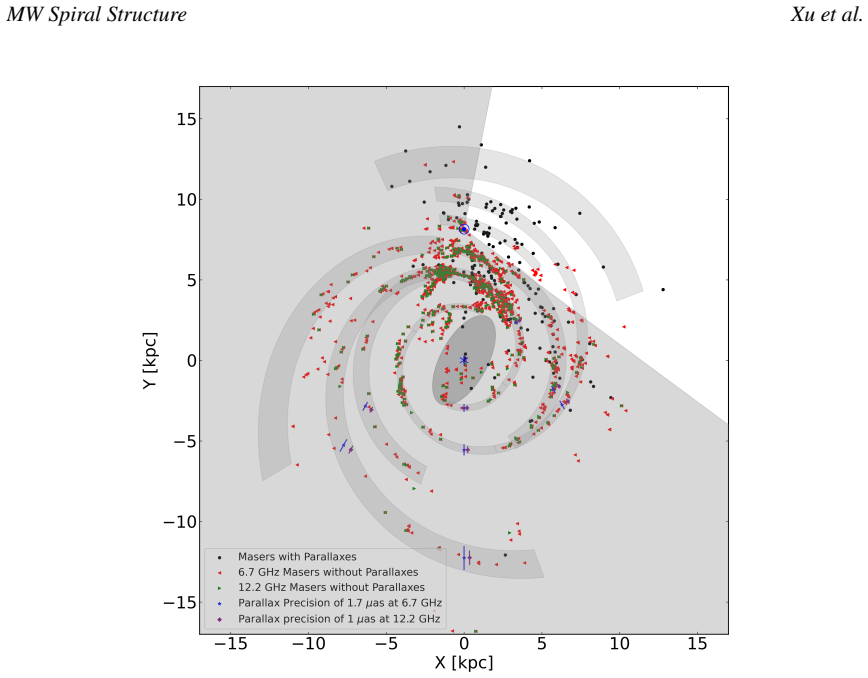
SKA-VLBI's combination of astrometric precision and sensitivity will enable detailed mapping of the Milky Way's spiral structure from the solar neighborhood through the Galactic Center to the far side, while supplying precise three-dimensional parameters for the Galactic bar, clarifying the nature of the 3-kpc Arm, and refining measurements of Solar motion and the Galactic rotation curve.
What carries the argument
High-precision VLBI astrometry of maser sources across the Galactic disk with SKA-VLBI.
If this is right
- The full spiral structure becomes traceable in three dimensions from the solar neighborhood to the far side.
- The three-dimensional geometry and orientation of the Galactic bar can be determined directly.
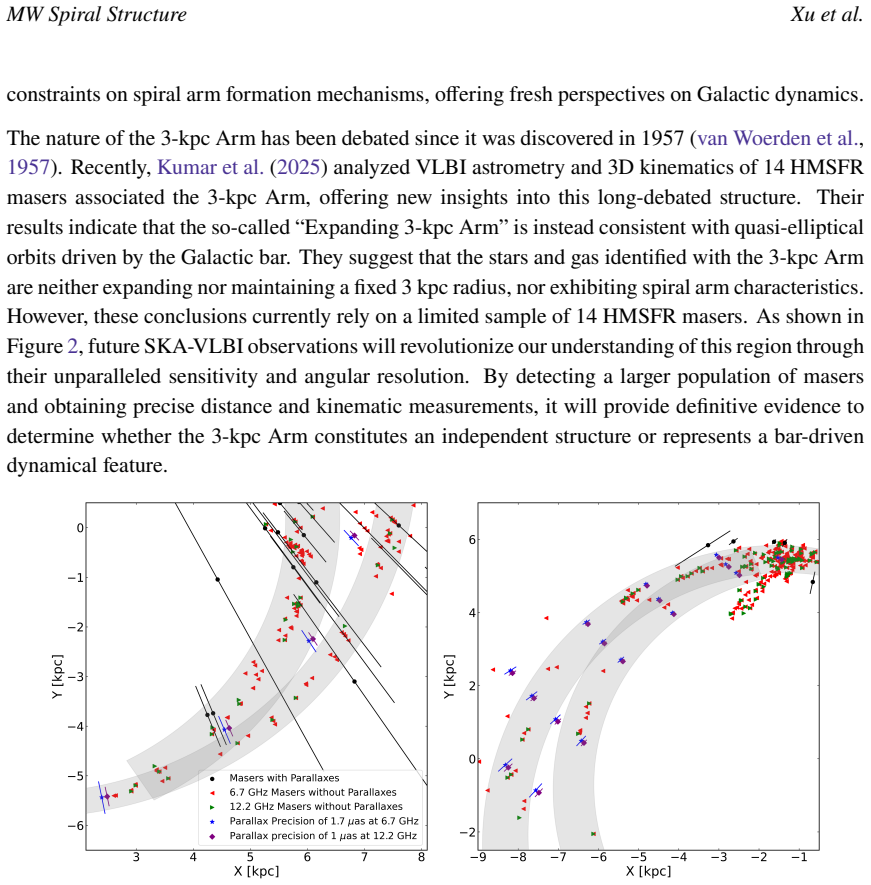
- The dynamical coupling between the bar and spiral arms, including the status of the 3-kpc Arm, can be tested observationally.
- The Solar motion and the shape of the Galactic rotation curve can be measured with higher accuracy than before.
- The resulting structural parameters serve as benchmarks for models of other barred spiral galaxies.
Where Pith is reading between the lines
- Improved Galactic parameters would allow more accurate placement of other Milky Way tracers such as young stars and gas clouds.
- A complete maser-based map could be compared directly with numerical simulations of barred galaxy evolution.
- The same dataset would supply an independent check on distance scales used in extragalactic studies.
Load-bearing premise
SKA-VLBI will achieve the necessary astrometric precision and sensitivity to detect and measure enough masers throughout the full Galactic disk, including the Southern sky and near the Galactic Center.
What would settle it
Failure of SKA-VLBI to detect and measure a statistically useful sample of masers on the far side of the Milky Way or in the Southern sky at the required precision would prevent the claimed full-disk mapping.
Figures
read the original abstract
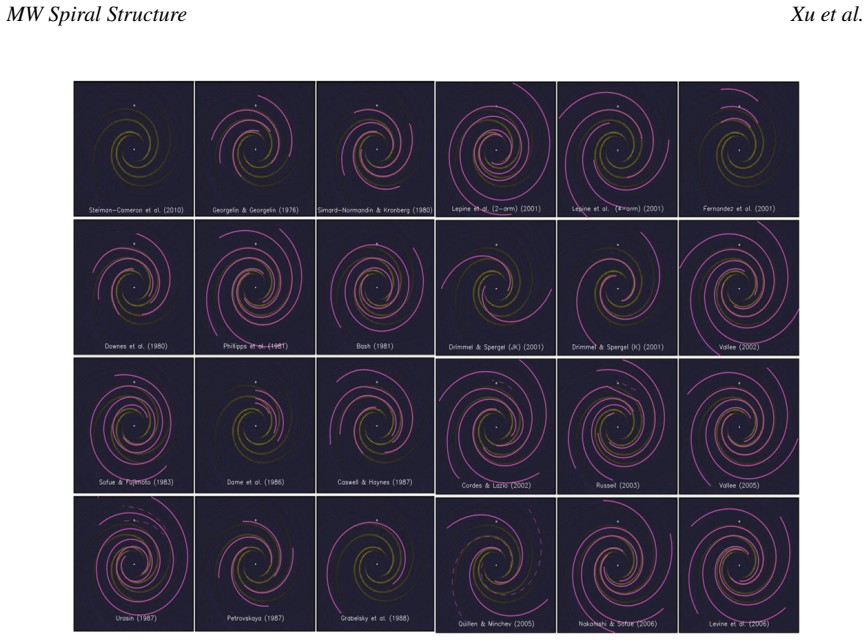
SKA-VLBI is poised to revolutionize our understanding of the Galactic structure through its unprecedented astrometric precision and sensitivity. As a next-generation facility, it will answer long-standing questions about the Galactic structure by mapping its entire spiral structure in detail, spanning from the solar neighborhood, through the Galactic Center, to the far side of the Milky Way. Its access to the Southern sky will allow us to obtain more precise 3D parameters of the Galactic bar, reveal the nature of the 3-kpc Arm, and clarify the dynamical coupling between the bar and the spiral arms. By leveraging high-precision astrometry of numerous celestial objects with SKA-VLBI, the Galactic fundamental parameters such as the Solar motion and the Galactic rotation curve can be constrained more precisely. These advancements will not only elucidate the structure of our Milky Way, but also provide benchmarks for understanding barred spiral galaxies in general. Furthermore, they are important for advancing our knowledge of cosmological structure formation. The capabilities of SKA-VLBI will open a new era of high precision Galactic astrometry.
Editorial analysis
A structured set of objections, weighed in public.
Referee Report
Summary. The manuscript is a forward-looking perspective on the capabilities of SKA-VLBI for Galactic astrometry. It claims that the facility's unprecedented precision and sensitivity will enable detailed mapping of the Milky Way's entire spiral structure (from solar neighborhood through the Galactic Center to the far side), precise 3D parameters of the Galactic bar, clarification of the 3-kpc Arm and bar-spiral coupling, and tighter constraints on Solar motion and the rotation curve via maser observations, with broader implications for barred galaxies and cosmology.
Significance. If the performance assumptions hold, the perspective would highlight a potentially transformative advance in Milky Way studies by providing comprehensive 3D dynamical mapping. The work correctly identifies key open questions in Galactic structure. However, because the manuscript supplies no new derivations, error budgets, or source-count modeling, its significance remains prospective and tied to unverified extrapolations from current VLBI performance.
major comments (2)
- [Abstract] Abstract: The claim that SKA-VLBI 'will map the entire spiral structure... spanning from the solar neighborhood, through the Galactic Center, to the far side' and 'will allow us to obtain more precise 3D parameters of the Galactic bar' is presented without any quantitative source-count estimates, sensitivity calculations, or comparison to existing VLBI detection limits. This assumption is load-bearing for the central thesis.
- [Abstract] Abstract: No reference is made to SKA technical requirement documents, maser population studies, or simulations that would anchor the assertion of sufficient detections 'across the full Galactic disk, including in the Southern sky and near the Galactic Center.' The absence of such anchoring leaves the performance extrapolation unsubstantiated.
minor comments (1)
- The text would benefit from a dedicated section (or appendix) containing even order-of-magnitude projections for detectable masers and achievable astrometric precision to make the perspective more concrete.
Simulated Author's Rebuttal
We thank the referee for their constructive comments on our perspective manuscript. The points raised highlight the need for better anchoring of performance claims, which we address below through targeted revisions while preserving the forward-looking nature of the work.
read point-by-point responses
-
Referee: [Abstract] Abstract: The claim that SKA-VLBI 'will map the entire spiral structure... spanning from the solar neighborhood, through the Galactic Center, to the far side' and 'will allow us to obtain more precise 3D parameters of the Galactic bar' is presented without any quantitative source-count estimates, sensitivity calculations, or comparison to existing VLBI detection limits. This assumption is load-bearing for the central thesis.
Authors: We agree that the abstract presents these capabilities without accompanying quantitative estimates or direct comparisons in the manuscript. As this is a perspective article outlining expected advances rather than a technical study with new modeling, we intentionally avoided introducing original derivations. To address the concern, we will revise the abstract and main text to reference existing source-count and sensitivity studies from VLBI maser surveys (e.g., BeSSeL and related works) and SKA planning documents. This will provide context for the extrapolations without changing the paper's scope. revision: partial
-
Referee: [Abstract] Abstract: No reference is made to SKA technical requirement documents, maser population studies, or simulations that would anchor the assertion of sufficient detections 'across the full Galactic disk, including in the Southern sky and near the Galactic Center.' The absence of such anchoring leaves the performance extrapolation unsubstantiated.
Authors: We acknowledge that the current version lacks explicit citations to SKA technical documents or maser population studies. In revision, we will add references to key SKA science requirements papers and maser survey analyses that discuss detection rates, Southern sky coverage, and performance near the Galactic Center. These citations will substantiate the expected reach of SKA-VLBI while maintaining the perspective format. revision: yes
Circularity Check
No circularity: forward-looking perspective with no derivations or fitted inputs
full rationale
The document is a perspective piece on expected SKA-VLBI capabilities for Galactic mapping. It contains no equations, no fitted parameters, no predictions that reduce to inputs by construction, and no self-citation chains or uniqueness theorems. All claims are prospective statements about future instrument performance rather than derivations from prior results within the paper. This matches the default non-circular case for non-derivational papers.
Axiom & Free-Parameter Ledger
Reference graph
Works this paper leans on
-
[1]
doi: 10.1146/annurev-astro-081915-023441. A. Brunthaler et al.Astronomische Nachrichten, 332(5):461, June
work page internal anchor Pith review doi:10.1146/annurev-astro-081915-023441
-
[2]
doi: 10.1002/asna. 201111560. L. Hyland, S. Ellingsen, and M. Reid.Publications of the Astronomical Society of Australia, 42: e160,
-
[3]
doi: 10.1017/pasa.2025.10119. K. Immer et al.Astron. Astrophys., 632:A123, Dec
-
[4]
doi: 10.1051/0004-6361/201834208. J. Kumar et al.Astrophys. J., 982(2):185, Apr
-
[5]
doi: 10.3847/1538-4357/adb70f. J. J. Li et al.Astrophys. J. Suppl. Ser., 262(2):42, Oct
-
[6]
doi: 10.3847/1538-4365/ac8791. Y. Li et al.Research in Astronomy and Astrophysics, 24(7):072001, July
-
[7]
doi: 10.1093/mnras/118.4.379. L. H. Quiroga-Nuñez, H. J. van Langevelde, M. J. Reid, and J. A. Green.Astron. Astrophys., 604: A72, Aug
-
[8]
doi: 10.1051/0004-6361/201730681. M. J. Reid.Astron. J., 164(4):133, Oct
-
[9]
doi: 10.3847/1538-3881/ac80bb. M. J. Reid and M. Honma.Annu. Rev. Astron. Astrophys., 52:339–372, Aug
-
[10]
doi: 10.1088/0004-637X/693/1/397. M. J. Reid et al.Astrophys. J., 885(2):131, Nov
-
[11]
doi: 10.3847/1538-4357/ab4a11. M. J. Rioja and R. Dodson.Astron. Astrophys. Rev., 28(1):6, Sept
-
[12]
doi: 10.3847/1538-3881/153/3/105. K. L. J. Rygl et al. InAdvancing Astrophysics with the SKA – II (AASKAII)
-
[13]
doi: 10.1126/science.aan5452. T. Y. Steiman-Cameron. In D. L. Block, K. C. Freeman, and I. Puerari, editors,Galaxies and their Masks, page 45, Jan
-
[14]
doi: 10.1007/978-1-4419-7317-7_3. Y. Sun et al.Astrophys. J. Lett., 977(2):L35, Dec
-
[15]
doi: 10.3847/2041-8213/ad9605. H. van Woerden, G. W. Rougoor, and J. H. Oort.Academie des Sciences Paris Comptes Rendus, 244:1691–1695, Jan
-
[16]
VERACollaborationetal.Publ.Astron.Soc.Jpn,72(4):50,Aug.2020. doi: 10.1093/pasj/psaa018. C. Wegg, O. Gerhard, and M. Portail.Mon. Not. R. Astron. Soc., 450(4):4050–4069, July
-
[17]
doi: 10.1093/mnras/stv745. J. Wei et al.Astron. J., 168(6):264, Dec
-
[18]
doi: 10.3847/1538-3881/ad8632. Y. Xu, M. J. Reid, X. W. Zheng, and K. M. Menten.Science, 311(5757):54–57, Jan
-
[19]
doi: 10.1126/science.1120914. Y. Xu et al.Astrophys. J., 947(2):54, Apr
-
[20]
doi: 10.3847/1538-4357/acc45c. 10
discussion (0)
Sign in with ORCID, Apple, or X to comment. Anyone can read and Pith papers without signing in.