REVIEW 4 major objections 5 minor 115 references
BASILISK: Bayesian Hierarchical Inference of the Galaxy-Halo Connection using Satellite Kinematics--I. Method and Validation
T0 review · 4 major / 5 minor · reviewed 2026-08-14 · deepseek-v4-flash
Pith's one-line read A Bayesian hierarchical likelihood that keeps raw satellite kinematics can recover unbiased halo-mass distributions and orbital anisotropy from galaxy survey data.
desk verdict Basilisk is a genuinely new likelihood for satellite kinematics with a solid three-tier validation, but the unbiasedness claim runs ahead of what the tests actually show and the Tier-3 mock is less adversarial than it looks; still, this deserves a serious referee. read the letter →
The pith
A machine-rendered reading of the paper's core claim, the machinery that carries it, and where it could break.
The reading
What carries the argument
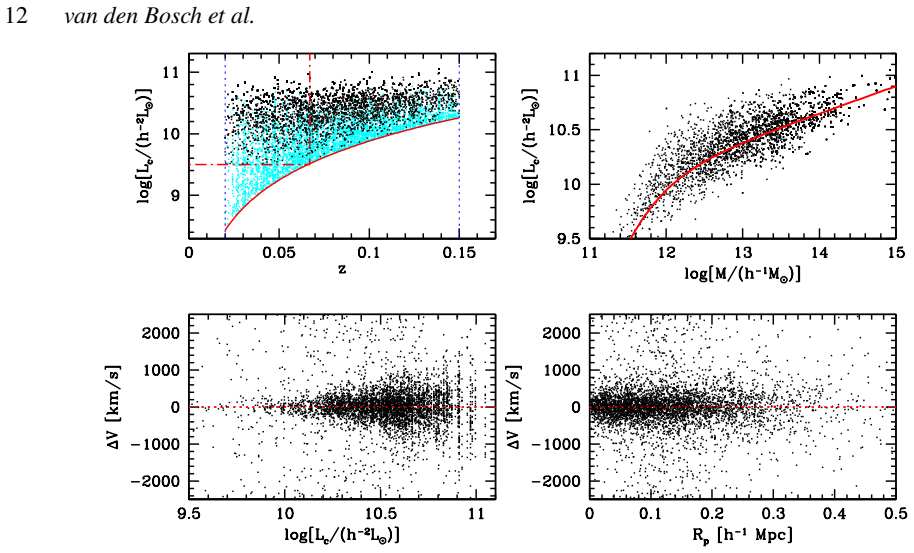
The engine is the hierarchical satellite-kinematics likelihood $L_{\rm SK}$ of Eqs. (5)-(11): for each primary, the number of secondaries and their $(\Delta V, R_p)$ coordinates constrain a latent halo mass through Bayes' theorem, with the halo-occupation statistics supplied by a conditional luminosity function and the kinematics supplied by a spherical Jeans-equation model of satellites with a Gaussian line-of-sight velocity distribution. The number of secondaries per primary enters as data, which is what lets the method constrain the scatter in the galaxy-halo relation and avoid the satellite-weighting bias. Interlopers are modeled with a parametric effective bias, and fibre collisions are corrected by down-weighting the expected secondary count. Together these pieces replace stacking and velocity-dispersion summary statistics with a full data likelihood.
What would settle it
Run Basilisk on a hydrodynamical cosmological simulation where satellite galaxies may be out of equilibrium, treating the simulation as a mock redshift survey, and compare the recovered $P(M|L_c)$ with the true distribution of its central galaxies; a significant offset would falsify the steady-state Jeans assumption.
Extended reading notes
Core claim
The central claim is that the full likelihood for the projected phase-space data, with each central's halo mass treated as a latent variable and marginalized over, yields unbiased constraints on the galaxy-halo connection. Specifically, Basilisk accurately recovers the conditional luminosity function parameters and the full PDF $P(M|L_c)$ for central luminosity versus halo mass, simultaneously constrains the satellite orbital anisotropy, and does so without binning or summary statistics. The validation shows this holds for idealized mocks, for mocks built from N-body haloes with realistic interlopers and fibre collisions, and for mocks in which satellites follow the phase-space distribution of subhaloes. The paper concludes that stacking-based analyses that ignore mass-mixing or assume isotropic orbits can be superseded by this approach.
Load-bearing premise
The load-bearing premise is that satellite galaxies behave as a virialized, steady-state tracer population of a spherical dark-matter halo, so their line-of-sight velocities follow the spherical Jeans equation with a Gaussian velocity distribution; if real satellites are recently accreted, aspherical, or out of equilibrium, the inferred halo masses could be biased.
Editorial extensions
If this is right
- Satellite kinematics can be applied to flux-limited surveys, enlarging the usable sample and dynamic range relative to volume-limited stacking analyses.
- The method simultaneously constrains halo mass and orbital anisotropy, removing the need to assume isotropic satellite orbits.
- Because scatter in the galaxy-halo connection is modeled, the inferred $P(M|L_c)$ is not biased by mass-mixing.
- Individual halo masses for primaries are produced as by-products, allowing tests of how halo mass depends on secondary properties.
- Mild central velocity bias and modest errors in the inferred satellite radial profile do not bias the galaxy-halo connection inference.
Reading between the lines
- If Basilisk's unbiased recovery survives on real surveys, satellite kinematics could serve as an independent check of galaxy-galaxy lensing without needing shape measurements, potentially probing gravity by comparing dynamical and lensing masses.
- The framework extends naturally to stellar-mass-based occupation statistics, and the hierarchical setup could absorb uncertainty in stellar-mass estimates.
- The paper's demonstrated insensitivity to the satellite radial profile suggests that adding satellite luminosities to the likelihood may be a low-risk way to tighten the satellite component of the conditional luminosity function.
- One open extension is to let halo concentration enter the occupation model, since concentration correlates with satellite number and could feed back on the inferred halo masses.
Signed reviews
Editorial analysis
A structured set of objections, weighed in public.
Referee Report
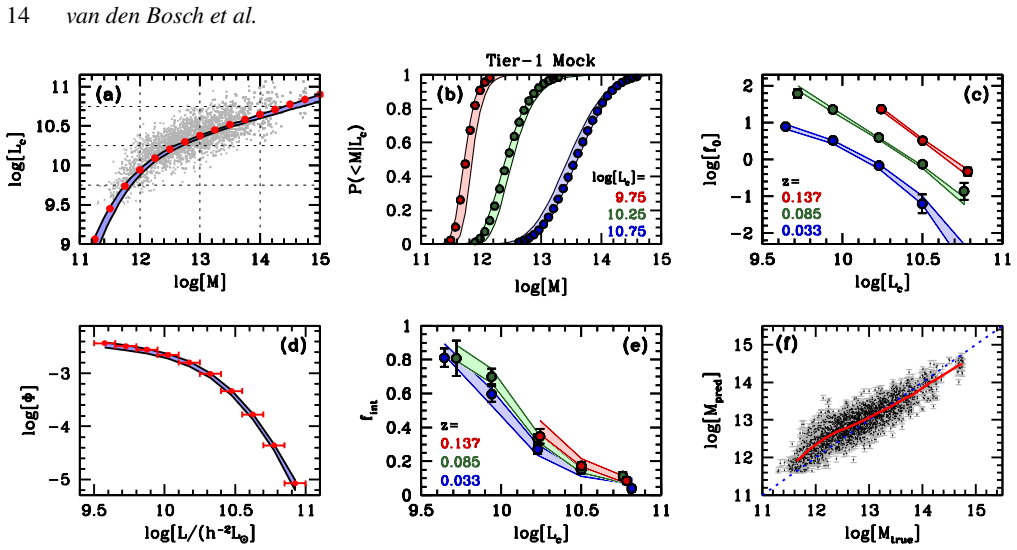
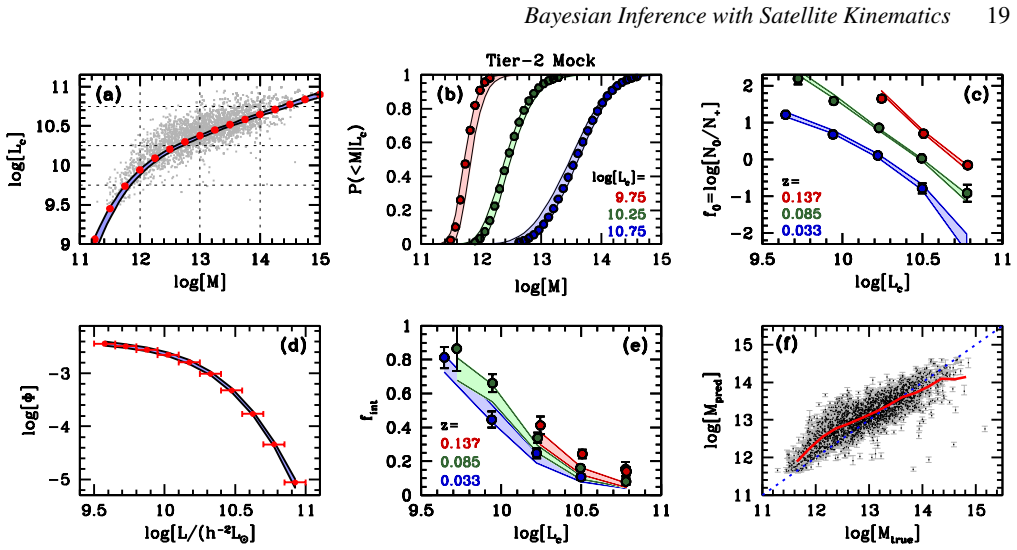
Summary. This paper introduces Basilisk, a Bayesian hierarchical method that constrains the central and satellite conditional luminosity functions using the raw projected phase-space coordinates of primary-secondary galaxy pairs, without binning or velocity-dispersion summary statistics. Satellites are modelled as a relaxed tracer population in spherical NFW haloes with a Gaussian line-of-sight velocity distribution (Eqs. 44-50), and the likelihood marginalizes over halo mass as a latent variable (Eqs. 5-11). The method is validated on three mock tiers: idealized model mocks (Tier-1), N-body-based mocks with analytic satellite phase-space, realistic interlopers and fibre collisions (Tier-2), and N-body mocks in which satellites are placed on resolved subhaloes (Tier-3). The paper reports unbiased recovery of the central CLF parameters and the full P(M|Lc), plus an anisotropy constraint, and claims precision competitive with galaxy-galaxy lensing.
Significance. The method is conceptually a step forward: it avoids luminosity binning, exploits the Delta-V-Rp correlation, uses flux-limited samples, and includes the number of secondaries per primary as a constraint, which Appendix B shows is crucial. The three-tier validation, especially the Tier-3 subhalo mocks and the tests against central velocity bias and radial-profile errors, is a genuine strength. However, the load-bearing validation of the Jeans/Gaussian assumptions is weaker than the abstract's general unbiasedness claim, and the presented 'predicted halo masses' are not full posterior estimates. If the missing tests are supplied or the claims are appropriately qualified, this would be a valuable methods paper.
major comments (4)
- [§5.3 and §7] The Tier-3 mock is the only validation in which satellite phase space is not drawn from the same Jeans/Gaussian model used in the likelihood, and it is therefore load-bearing for the paper's unbiasedness claim. As described in §5.3, satellites are assigned to the N_sat subhaloes with the highest M_peak, which selects the oldest, most tidally relaxed subhaloes; when N_sat exceeds the resolved subhalo count, the missing phase-space coordinates are taken from subhaloes of other, similar-mass haloes, which breaks the physical host-satellite correlation. Moreover, the analysis still imposes a spherical NFW profile, a zero-scatter concentration-mass relation, and a Gaussian LOSVD (Assumptions I-III in §7). The paper's own §7 acknowledges that real satellite populations violate these assumptions via recent accretion, asphericity, and backsplash (citing Wang et al. 2017; Adhikari et al. 2019). A successful recovery on the most relaxed subhalo subset does not establish unbiasedness for the full range of disequilibrium expected in real data; the authors should either relax the subhalo selection (e.g., random subhaloes including recent infall), add a mock that violates the Jeans/Gaussian assumptions more strongly, or soften the general claim in the abstract.
- [Eq. (54) and §5.1-§5.3] The 'predicted halo mass' M_pred used in Figs. 4(f), 7(f), and 9(f) is computed from P(M|Lc,zc,Ns) alone, without conditioning on the satellite phase-space data (Delta-V, Rp). It is therefore not the full posterior mean of the latent halo mass under the Basilisk model, and the small offsets quoted (⟨log(Mpred/Mtrue)⟩ = 0.10-0.15 with scatter 0.31-0.37) cannot be used to validate the kinematic likelihood or to support the statement in §1 that Basilisk yields individual halo-mass estimates as a by-product. If individual halo masses are part of the claimed output, the paper should sample or approximate the latent masses from the full posterior and report the bias of those estimates; if not, Eq. (54) and the related text should be re-labelled as the population-level conditional expectation.
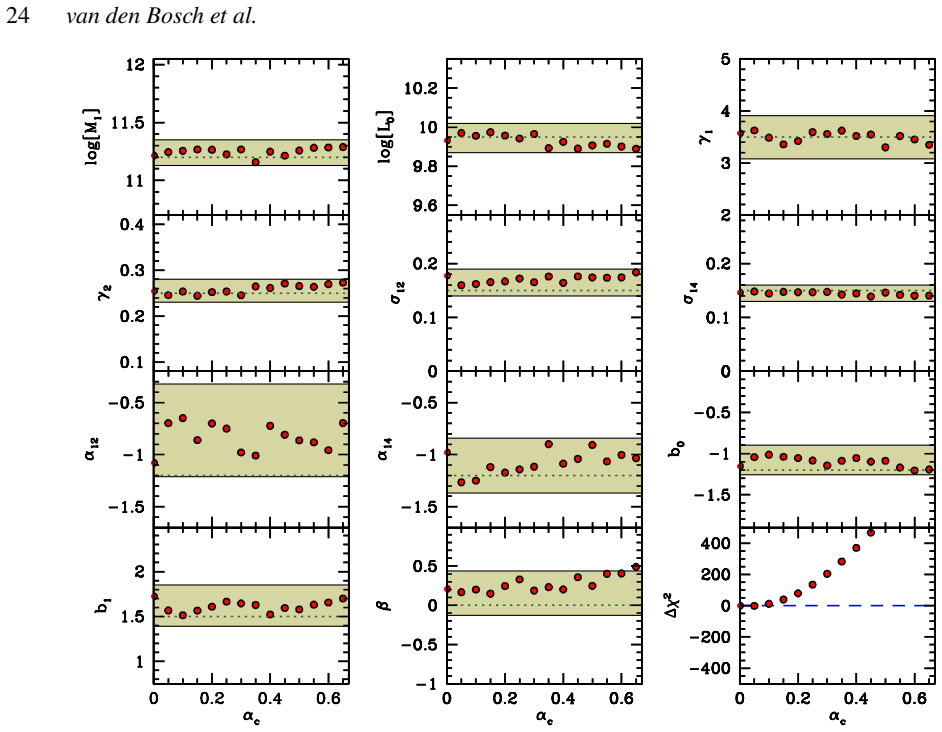
- [§4.2.3, §5, and Table 2] The reported posterior percentiles are conditional on the radial profile parameters (R,gamma) being fixed at their best-fit values; the MCMC is run separately for the best-fit (gamma,R) pair rather than marginalizing over these parameters. Table 2 therefore presents conditional intervals that understate the parameter uncertainty. The sensitivity analysis in §6.2 shows that the best-fit CLF parameters shift by less than the conditional 95% intervals when R and gamma are varied, which is reassuring, but it does not provide the fully marginalized posteriors. The authors should either marginalize over (R,gamma) in the MCMC or explicitly state that all quoted intervals are conditional and provide a marginalization check for at least one tier.
- [Table 2 and §5.2] The abstract claims 'unbiased constraints on the galaxy-halo connection' without restricting the claim to the central component, but Table 2 shows that the satellite CLF slope alpha_12 is not recovered in the Tier-2 or Tier-3 mocks: the input value -1.20 is outside the 95% intervals (-1.21,-0.32) and (-1.01,-0.37) respectively. The text in §5.2 openly acknowledges that parameters characterizing Phi_s(L|M) are often inconsistent with the input. Because the satellite component is part of the galaxy-halo connection, the paper should either qualify the unbiasedness claim to the central part Phi_c(L|M) or explain why the alpha_12 bias is not a violation of the central claim.
minor comments (5)
- [§1] The phrase 'the only available method that simultaneously solves for halo mass and orbital anisotropy' is too strong; Wojtak & Mamon (2013) already constrained anisotropy from satellite kinematics, as the paper itself notes later. Suggest rewording.
- [Figure 3] For the Tier-3 mock the best-fit gamma is 0, at the edge of the prior range; the authors should note that the recovery of a cored profile is partly prior-limited.
- [§3.5] No convergence diagnostics (e.g., Gelman-Rubin statistics or autocorrelation lengths) are reported for the MCMC chains; a brief statement would help the reader assess the quoted confidence intervals.
- [Table 2] The rows for log[ra/rs] report percentiles from a separate OM-model MCMC, but the table caption does not state whether these are conditional on the fixed (R,gamma) values; clarify.
- [§5.2] The text says the Tier-2 mock uses the measured concentration of each halo while the analysis assumes a zero-scatter concentration-mass relation; this is a strength of the test and could be stated more prominently in the summary of the validation strategy.
Circularity Check
No significant circularity: validation is staged, with the Tier-1 same-model mock explicitly labeled a sanity check and Tier-3 providing an independent subhalo phase-space benchmark.
full rationale
The central inference chain is not circular. The likelihood in Eqs. (5)-(11) is built from the CLF occupation model plus a spherical-NFW, Jeans-equation, Gaussian-LOSVD phase-space model, and the paper claims only that this likelihood recovers the input galaxy-halo connection in controlled mocks, not that the phase-space model is derived from first principles. The only mock tier that reuses exactly the same phase-space model as the likelihood is Tier-1, and the paper explicitly disclaims it as independent evidence: "this mock data set is generated using exactly the same model as used to compute the likelihood, and the results of the likelihood analysis discussed below therefore merely serves as a sanity check of Basilisk's inference procedure." Tier-2 adds N-body haloes, realistic interlopers, and survey incompleteness, but still assigns satellites with the same analytical Jeans/Gaussian prescription, so it tests selection and nuisance effects rather than the phase-space model. The load-bearing validation against an independent phase-space benchmark is Tier-3, where satellites are placed on subhaloes of the SMDPL simulation; as the paper states, "in the Tier-3 mocks the satellite galaxies only obey assumptions II and III in as far as subhaloes do." The fact that the CLF parameters are recovered from Tier-3 data is not circular: the likelihood still imposes a spherical, Gaussian, Jeans-equilibrium satellite model while the mock generates satellite kinematics from N-body subhalo orbits, so the CLF recovery is a nontrivial inversion test, not an identity. Self-citations to Lange et al. (2019a,b) and van den Bosch et al. (2004) supply selection criteria, incompleteness corrections, and prior methodology, but they are not invoked as a uniqueness theorem or as proof of the unbiasedness claim; the unbiasedness is demonstrated against the mocks. The Maccio et al. (2008) concentration-mass relation is adopted as an explicit simplifying assumption, and the paper tests robustness to realistic concentration scatter via the Tier-2 and Tier-3 mocks. No fitted parameter is renamed as a prediction, and no equation reduces to another by construction. The paper is method-validation work with an honest division between self-consistency checks and independent tests, so the appropriate circularity score is 0.
Assumptions & free parameters
free parameters (17)
- log M1 (characteristic halo mass of central L-M relation)
- log L0 (normalization of central L-M relation)
- gamma1 (low-mass slope of central L-M relation)
- gamma2 (high-mass slope of central L-M relation)
- sigma12 (central luminosity scatter at 10^12 h^-1 M_sun)
- sigma14 (central luminosity scatter at 10^14 h^-1 M_sun)
- alpha12 (satellite CLF slope at 10^12 h^-1 M_sun)
- alpha14 (satellite CLF slope at 10^14 h^-1 M_sun)
- b0 (satellite CLF normalization)
- b1 (satellite CLF mass slope)
- b2 (satellite CLF mass curvature)
- eta0 (interloper bias normalization)
- eta1 (interloper bias luminosity slope)
- eta2 (interloper bias redshift slope)
- beta (constant anisotropy) or log[ra/rs] (Osipkov-Merritt anisotropy radius)
- R (ratio of satellite scale radius to halo scale radius)
- gamma (inner slope of satellite gNFW profile)
assumptions (7)
- domain assumption Satellites are a virialized, steady-state tracer population; spherical Jeans equation applies.
- domain assumption Haloes are spherical NFW profiles with the Maccio et al. 2008 concentration-mass relation and zero scatter.
- domain assumption Line-of-sight velocity distribution of satellites is Gaussian with zero mean after normalization over |DeltaV| < DeltaV_max.
- domain assumption Interlopers are uniform in projected radius and line-of-sight velocity.
- domain assumption The CLF functional forms (log-normal centrals, modified Schechter satellites) and their redshift independence over 0.02 < z < 0.15 describe the true galaxy-halo connection.
- domain assumption The primary completeness C(M|L,z) is independent of halo mass and can be set to unity.
- standard math Numbers of satellites and interlopers are independent Poisson variables.
Cite this review
Pith. "Pith review of BASILISK: Bayesian Hierarchical Inference of the Galaxy-Halo Connection using Satellite Kinematics--I. Method and Validation." pith.science (2026). https://pith.science/paper/ZBMU5LVB
@misc{pith2026190807547,
  author       = {Pith},
  title        = {Pith review of: BASILISK: Bayesian Hierarchical Inference of the Galaxy-Halo Connection using Satellite Kinematics--I. Method and Validation},
  year         = {2026},
  howpublished = {\url{https://pith.science/paper/ZBMU5LVB}},
  note         = {Machine review of arXiv:1908.07547}
}
read the original abstract
We present a Bayesian hierarchical inference formalism (Basilisk) to constrain the galaxy-halo connection using satellite kinematics. Unlike traditional methods, Basilisk does not resort to stacking the kinematics of satellite galaxies in bins of central luminosity, and does not make use of summary statistics, such as satellite velocity dispersion. Rather, Basilisk leaves the data in its raw form and computes the corresponding likelihood. In addition, Basilisk can be applied to flux-limited, rather than volume-limited samples, greatly enhancing the quantity and dynamic range of the data. And finally, Basilisk is the only available method that simultaneously solves for halo mass and orbital anisotropy of the satellite galaxies, while properly accounting for scatter in the galaxy-halo connection. Basilisk uses the conditional luminosity function to model halo occupation statistics, and assumes that satellite galaxies are a relaxed tracer population of the host halo's potential with kinematics that obey the spherical Jeans equation. We test and validate Basilisk using mocks of varying complexity, and demonstrate that it yields unbiased constraints on the galaxy-halo connection and at a precision that rivals galaxy-galaxy lensing. In particular, Basilisk accurately recovers the full PDF of the relation between halo mass and central galaxy luminosity, and simultaneously constrains the orbital anisotropy of the satellite galaxies. Basilisk's inference is not affected by potential velocity bias of the central galaxies, or by slight errors in the inferred, radial profile of satellite galaxies that arise as a consequence of interlopers and sample impurity.
Figures


Figures from the paper (9 more)




Reference graph
Works this paper leans on
-
[1]
Abbott T. M. C., et al., 2018, @doi [ ] 10.1103/PhysRevD.98.043526 , http://adsabs.harvard.edu/abs/2018PhRvD..98d3526A 98, 043526
-
[2]
Adhikari S., Dalal N., More S., Wetzel A., 2019, @doi [ ] 10.3847/1538-4357/ab1a39 , https://ui.adsabs.harvard.edu/abs/2019ApJ...878....9A 878, 9
-
[5]
Azzaro M., Patiri S. G., Prada F., Zentner A. R., 2007, @doi [ ] 10.1111/j.1745-3933.2007.00282.x , https://ui.adsabs.harvard.edu/abs/2007MNRAS.376L..43A 376, L43
arXiv 2007
-
[6]
Bahcall J. N., Tremaine S., 1981, @doi [ ] 10.1086/158756 , http://adsabs.harvard.edu/abs/1981ApJ...244..805B 244, 805
doi:10.1086/158756 1981
-
[7]
Balogh M. L., et al., 2014, @doi [ ] 10.1093/mnras/stu1332 , http://adsabs.harvard.edu/abs/2014MNRAS.443.2679B 443, 2679
-
[8]
Becker M. R., et al., 2007, @doi [ ] 10.1086/521920 , http://adsabs.harvard.edu/abs/2007ApJ...669..905B 669, 905
doi:10.1086/521920 2007
-
[9]
Behroozi P. S., Wechsler R. H., Wu H.-Y., 2013, @doi [ ] 10.1088/0004-637X/762/2/109 , http://adsabs.harvard.edu/abs/2013ApJ...762..109B 762, 109
-
[10]
A., et al., 2003, @doi [ ] 10.1086/376517 , http://adsabs.harvard.edu/abs/2003ApJ...593....1B 593, 1
Berlind A. A., et al., 2003, @doi [ ] 10.1086/376517 , http://adsabs.harvard.edu/abs/2003ApJ...593....1B 593, 1
doi:10.1086/376517 2003
Show all 115 references
-
[11]
A., et al., 2006, @doi [ ] 10.1086/508170 , http://adsabs.harvard.edu/abs/2006ApJS..167....1B 167, 1
Berlind A. A., et al., 2006, @doi [ ] 10.1086/508170 , http://adsabs.harvard.edu/abs/2006ApJS..167....1B 167, 1
2006 doi
-
[12]
Princeton University Press
Binney J., Tremaine S., 2008, Galactic Dynamics: Second Edition . Princeton University Press
2008
-
[13]
Biviano A., Katgert P., Thomas T., Adami C., 2002, @doi [ ] 10.1051/0004-6361:20020340 , http://adsabs.harvard.edu/abs/2002A
2002 doi
-
[14]
R., Lin H., Lupton R
Blanton M. R., Lin H., Lupton R. H., Maley F. M., Young N., Zehavi I., Loveday J., 2003, @doi [ ] 10.1086/344761 , http://adsabs.harvard.edu/abs/2003AJ....125.2276B 125, 2276
2003 doi
-
[15]
R., et al., 2005, @doi [ ] 10.1086/429803 , http://adsabs.harvard.edu/abs/2005AJ....129.2562B 129, 2562
Blanton M. R., et al., 2005, @doi [ ] 10.1086/429803 , http://adsabs.harvard.edu/abs/2005AJ....129.2562B 129, 2562
2005 doi
-
[16]
G., Specian M
Brainerd T. G., Specian M. A., 2003, @doi [ ] 10.1086/378149 , http://adsabs.harvard.edu/abs/2003ApJ...593L...7B 593, L7
2003 doi
-
[17]
G., Blandford R
Brainerd T. G., Blandford R. D., Smail I., 1996, @doi [ ] 10.1086/177537 , http://adsabs.harvard.edu/abs/1996ApJ...466..623B 466, 623
1996 doi
-
[18]
L., Norman M
Bryan G. L., Norman M. L., 1998, @doi [ ] 10.1086/305262 , http://adsabs.harvard.edu/abs/1998ApJ...495...80B 495, 80
1998 doi
-
[21]
C., More S., Mo H., Yang X., 2013, @doi [ ] 10.1093/mnras/sts525 , http://adsabs.harvard.edu/abs/2013MNRAS.430..767C 430, 767
Cacciato M., van den Bosch F. C., More S., Mo H., Yang X., 2013, @doi [ ] 10.1093/mnras/sts525 , http://adsabs.harvard.edu/abs/2013MNRAS.430..767C 430, 767
2013 doi
-
[22]
F., Berlind A
Calderon V. F., Berlind A. A., 2019, preprint, http://adsabs.harvard.edu/abs/2019arXiv190202680C ( @eprint arXiv 1902.02680 )
2019 arXiv
-
[23]
C., Hearin A., Padmanabhan N., Berlind A., Mo H
Campbell D., van den Bosch F. C., Hearin A., Padmanabhan N., Berlind A., Mo H. J., Tinker J., Yang X., 2015, @doi [ ] 10.1093/mnras/stv1091 , http://adsabs.harvard.edu/abs/2015MNRAS.452..444C 452, 444
2015 doi
-
[24]
G., et al., 1997, @doi [ ] 10.1086/310801 , http://adsabs.harvard.edu/abs/1997ApJ...485L..13C 485, L13
Carlberg R. G., et al., 1997, @doi [ ] 10.1086/310801 , http://adsabs.harvard.edu/abs/1997ApJ...485L..13C 485, L13
1997 doi
-
[25]
Chen J., 2008, @doi [ ] 10.1051/0004-6361:20079018 , http://adsabs.harvard.edu/abs/2008A
2008 doi
-
[26]
H., Kravtsov A
Conroy C., Wechsler R. H., Kravtsov A. V., 2007, @doi [ ] 10.1086/521425 , http://adsabs.harvard.edu/abs/2007ApJ...668..826C 668, 826
2007 doi
-
[28]
Cooray A., Milosavljevi \'c M., 2005, @doi [ ] 10.1086/432259 , http://adsabs.harvard.edu/abs/2005ApJ...627L..89C 627, L89
2005 doi
-
[29]
Cuddeford P., Louis P., 1995, @doi [ ] 10.1093/mnras/275.4.1017 , http://adsabs.harvard.edu/abs/1995MNRAS.275.1017C 275, 1017
1995 doi
-
[31]
F., Caldwell R
Daniel S. F., Caldwell R. R., Cooray A., Melchiorri A., 2008, @doi [ ] 10.1103/PhysRevD.77.103513 , https://ui.adsabs.harvard.edu/\#abs/2008PhRvD..77j3513D 77, 103513
2008 doi
-
[32]
Davies L. J. M., et al., 2019, @doi [ ] 10.1093/mnras/sty3393 , http://adsabs.harvard.edu/abs/2019MNRAS.483.5444D 483, 5444
2019 doi
-
[33]
S., et al., 2013, @doi [ ] 10.1088/0004-6256/145/1/10 , http://adsabs.harvard.edu/abs/2013AJ....145...10D 145, 10
Dawson K. S., et al., 2013, @doi [ ] 10.1088/0004-6256/145/1/10 , http://adsabs.harvard.edu/abs/2013AJ....145...10D 145, 10
2013 doi
-
[38]
E., Mao Y.-Y., Newman J
Fielder C. E., Mao Y.-Y., Newman J. A., Zentner A. R., Licquia T. C., 2019, @doi [ ] 10.1093/mnras/stz1098 , http://adsabs.harvard.edu/abs/2019MNRAS.tmp.1041F
2019 doi
-
[39]
Foreman-Mackey D., et al., 2013, emcee: The MCMC Hammer , Astrophysics Source Code Library ( @eprint ascl 1303.002 )
2013
-
[42]
Goodman J., Weare J., 2010, @doi [Communications in Applied Mathematics and Computational Science, Vol. 5, No. 1, p. 65-80, 2010] 10.2140/camcos.2010.5.65 , http://adsabs.harvard.edu/abs/2010CAMCS...5...65G 5, 65
2010 doi
-
[43]
Guo Q., Cole S., Eke V., Frenk C., 2012, @doi [ ] 10.1111/j.1365-2966.2012.21882.x , http://adsabs.harvard.edu/abs/2012MNRAS.427..428G 427, 428
2012
-
[44]
Guo H., et al., 2015a, @doi [ ] 10.1093/mnras/stu2120 , http://adsabs.harvard.edu/abs/2015MNRAS.446..578G 446, 578
-
[45]
Guo H., et al., 2015b, @doi [ ] 10.1093/mnras/stv1966 , http://adsabs.harvard.edu/abs/2015MNRAS.453.4368G 453, 4368
-
[46]
Guo H., et al., 2016, @doi [ ] 10.1093/mnras/stw845 , http://adsabs.harvard.edu/abs/2016MNRAS.459.3040G 459, 3040
2016 doi
-
[47]
Han J., et al., 2015, @doi [ ] 10.1093/mnras/stu2178 , http://adsabs.harvard.edu/abs/2015MNRAS.446.1356H 446, 1356
2015 doi
-
[48]
P., Zentner A
Hearin A. P., Zentner A. R., van den Bosch F. C., Campbell D., Tollerud E., 2016, @doi [ ] 10.1093/mnras/stw840 , http://adsabs.harvard.edu/abs/2016MNRAS.460.2552H 460, 2552
2016 doi
-
[49]
P., et al., 2017, @doi [ ] 10.3847/1538-3881/aa859f , http://adsabs.harvard.edu/abs/2017AJ....154..190H 154, 190
Hearin A. P., et al., 2017, @doi [ ] 10.3847/1538-3881/aa859f , http://adsabs.harvard.edu/abs/2017AJ....154..190H 154, 190
2017 doi
-
[50]
Hoekstra H., et al., 2001, @doi [ ] 10.1086/318917 , http://adsabs.harvard.edu/abs/2001ApJ...548L...5H 548, L5
2001 doi
-
[51]
C., Harris W
Hou A., Parker L. C., Harris W. E., 2014, @doi [ ] 10.1093/mnras/stu829 , http://adsabs.harvard.edu/abs/2014MNRAS.442..406H 442, 406
2014 doi
-
[52]
C., 2017, @doi [ ] 10.1093/mnras/stx1979 , http://adsabs.harvard.edu/abs/2017MNRAS.472..657J 472, 657
Jiang F., van den Bosch F. C., 2017, @doi [ ] 10.1093/mnras/stx1979 , http://adsabs.harvard.edu/abs/2017MNRAS.472..657J 472, 657
2017 doi
-
[53]
P., Suto Y., 2002, @doi [ ] 10.1086/341065 , http://adsabs.harvard.edu/abs/2002ApJ...574..538J 574, 538
Jing Y. P., Suto Y., 2002, @doi [ ] 10.1086/341065 , http://adsabs.harvard.edu/abs/2002ApJ...574..538J 574, 538
2002 doi
-
[54]
Klypin A., Yepes G., Gottl \"o ber S., Prada F., He S., 2016, @doi [ ] 10.1093/mnras/stw248 , http://adsabs.harvard.edu/abs/2016MNRAS.457.4340K 457, 4340
2016 doi
-
[55]
U., van den Bosch F
Lange J. U., van den Bosch F. C., Zentner A. R., Wang K., Villarreal A. S., 2019a, @doi [ ] 10.1093/mnras/sty2950 , http://adsabs.harvard.edu/abs/2019MNRAS.482.4824L 482, 4824
-
[56]
U., van den Bosch F
Lange J. U., van den Bosch F. C., Zentner A. R., Wang K., Villarreal A. S., 2019b, @doi [ ] 10.1093/mnras/stz1466 , https://ui.adsabs.harvard.edu/abs/2019MNRAS.487.3112L 487, 3112
-
[57]
Leauthaud A., et al., 2012, @doi [ ] 10.1088/0004-637X/744/2/159 , http://adsabs.harvard.edu/abs/2012ApJ...744..159L 744, 159
2012 doi
-
[58]
Leauthaud A., et al., 2017, @doi [ ] 10.1093/mnras/stx258 , http://adsabs.harvard.edu/abs/2017MNRAS.467.3024L 467, 3024
2017 doi
-
[59]
J., Stanford S
Lin Y.-T., Mohr J. J., Stanford S. A., 2004, @doi [ ] 10.1086/421714 , http://adsabs.harvard.edu/abs/2004ApJ...610..745L 610, 745
2004 doi
-
[60]
L., Mamon G
okas E. L., Mamon G. A., 2001, @doi [ ] 10.1046/j.1365-8711.2001.04007.x , http://adsabs.harvard.edu/abs/2001MNRAS.321..155L 321, 155
2001
-
[62]
D., 1993, @doi [ ] 10.1093/mnras/261.2.283 , http://adsabs.harvard.edu/abs/1993MNRAS.261..283L 261, 283
Louis P. D., 1993, @doi [ ] 10.1093/mnras/261.2.283 , http://adsabs.harvard.edu/abs/1993MNRAS.261..283L 261, 283
1993 doi
-
[65]
A., Biviano A., Murante G., 2010, @doi [ ] 10.1051/0004-6361/200913948 , https://ui.adsabs.harvard.edu/abs/2010A&A...520A..30M 520, A30
Mamon G. A., Biviano A., Murante G., 2010, @doi [ ] 10.1051/0004-6361/200913948 , https://ui.adsabs.harvard.edu/abs/2010A&A...520A..30M 520, A30
2010 doi
-
[66]
M., Brinkmann J., 2006, @doi [ ] 10.1111/j.1365-2966.2006.10156.x , http://adsabs.harvard.edu/abs/2006MNRAS.368..715M 368, 715
Mandelbaum R., Seljak U., Kauffmann G., Hirata C. M., Brinkmann J., 2006, @doi [ ] 10.1111/j.1365-2966.2006.10156.x , http://adsabs.harvard.edu/abs/2006MNRAS.368..715M 368, 715
2006
-
[67]
M., Nakajima R., Reyes R., Smith R
Mandelbaum R., Slosar A., Baldauf T., Seljak U., Hirata C. M., Nakajima R., Reyes R., Smith R. E., 2013, @doi [ ] 10.1093/mnras/stt572 , http://adsabs.harvard.edu/abs/2013MNRAS.432.1544M 432, 1544
2013 doi
-
[68]
Mandelbaum R., Wang W., Zu Y., White S., Henriques B., More S., 2016, @doi [ ] 10.1093/mnras/stw188 , http://adsabs.harvard.edu/abs/2016MNRAS.457.3200M 457, 3200
2016 doi
-
[69]
A., et al., 2002, @doi [ ] 10.1086/341364 , http://adsabs.harvard.edu/abs/2002ApJ...571L..85M 571, L85
McKay T. A., et al., 2002, @doi [ ] 10.1086/341364 , http://adsabs.harvard.edu/abs/2002ApJ...571L..85M 571, L85
2002 doi
-
[70]
Merritt D., 1985, @doi [ ] 10.1086/113810 , http://adsabs.harvard.edu/abs/1985AJ.....90.1027M 90, 1027
1985 doi
-
[71]
J., White S
Mo H. J., White S. D. M., 1996, @doi [ ] 10.1093/mnras/282.2.347 , http://adsabs.harvard.edu/abs/1996MNRAS.282..347M 282, 347
1996 doi
-
[74]
C., Cacciato M., Skibba R., Mo H
More S., van den Bosch F. C., Cacciato M., Skibba R., Mo H. J., Yang X., 2011, @doi [ ] 10.1111/j.1365-2966.2010.17436.x , http://adsabs.harvard.edu/abs/2011MNRAS.410..210M 410, 210
2011
-
[75]
N., Brownstein J
More S., Miyatake H., Mandelbaum R., Takada M., Spergel D. N., Brownstein J. R., Schneider D. P., 2015, @doi [ ] 10.1088/0004-637X/806/1/2 , http://adsabs.harvard.edu/abs/2015ApJ...806....2M 806, 2
2015 doi
-
[77]
S., Cole S., 2008, @doi [ ] 10.1111/j.1365-2966.2007.12583.x , http://adsabs.harvard.edu/abs/2008MNRAS.383..646N 383, 646
Norberg P., Frenk C. S., Cole S., 2008, @doi [ ] 10.1111/j.1365-2966.2007.12583.x , http://adsabs.harvard.edu/abs/2008MNRAS.383..646N 383, 646
2008
-
[78]
Nurmi P., et al., 2013, @doi [ ] 10.1093/mnras/stt1571 , http://adsabs.harvard.edu/abs/2013MNRAS.436..380N 436, 380
2013 doi
-
[79]
P., 1979, Pisma v Astronomicheskii Zhurnal, http://adsabs.harvard.edu/abs/1979PAZh....5...77O 5, 77
Osipkov L. P., 1979, Pisma v Astronomicheskii Zhurnal, http://adsabs.harvard.edu/abs/1979PAZh....5...77O 5, 77
1979
-
[80]
Pillepich A., et al., 2018, @doi [ ] 10.1093/mnras/stx3112 , http://adsabs.harvard.edu/abs/2018MNRAS.475..648P 475, 648
2018 doi
-
[81]
D., Casas S., Amendola L., Biviano A., 2019, @doi [ ] 10.1093/mnras/stz825 , http://adsabs.harvard.edu/abs/2019MNRAS.486..596P 486, 596
Pizzuti L., Saltas I. D., Casas S., Amendola L., Biviano A., 2019, @doi [ ] 10.1093/mnras/stz825 , http://adsabs.harvard.edu/abs/2019MNRAS.486..596P 486, 596
2019 doi
-
[82]
Planck Collaboration et al., 2014, @doi [ ] 10.1051/0004-6361/201321591 , http://adsabs.harvard.edu/abs/2014A
2014 doi
-
[83]
Prada F., et al., 2003, @doi [ ] 10.1086/378669 , http://adsabs.harvard.edu/abs/2003ApJ...598..260P 598, 260
2003 doi
-
[84]
A., Seo H.-J., Leauthaud A., Tinker J
Reid B. A., Seo H.-J., Leauthaud A., Tinker J. L., White M., 2014, @doi [ ] 10.1093/mnras/stu1391 , http://adsabs.harvard.edu/abs/2014MNRAS.444..476R 444, 476
2014 doi
-
[85]
Robotham A. S. G., et al., 2011, @doi [ ] 10.1111/j.1365-2966.2011.19217.x , http://adsabs.harvard.edu/abs/2011MNRAS.416.2640R 416, 2640
2011
-
[86]
J., Turnrose B
Rood H. J., Turnrose B. E., 1968, @doi [ ] 10.1086/149617 , http://adsabs.harvard.edu/abs/1968ApJ...152.1057R 152, 1057
1968 doi
-
[87]
N., Maller A
Salcedo A. N., Maller A. H., Berlind A. A., Sinha M., McBride C. K., Behroozi P. S., Wechsler R. H., Weinberg D. H., 2018, @doi [ ] 10.1093/mnras/sty109 , http://adsabs.harvard.edu/abs/2018MNRAS.475.4411S 475, 4411
2018 doi
-
[88]
H., Frenk C
Sawala T., Pihajoki P., Johansson P. H., Frenk C. S., Navarro J. F., Oman K. A., White S. D. M., 2017, @doi [ ] 10.1093/mnras/stx360 , http://adsabs.harvard.edu/abs/2017MNRAS.467.4383S 467, 4383
2017 doi
-
[89]
S., et al., 2004, @doi [ ] 10.1086/383293 , http://adsabs.harvard.edu/abs/2004AJ....127.2544S 127, 2544
Sheldon E. S., et al., 2004, @doi [ ] 10.1086/383293 , http://adsabs.harvard.edu/abs/2004AJ....127.2544S 127, 2544
2004 doi
-
[90]
A., McBride C
Sinha M., Berlind A. A., McBride C. K., Scoccimarro R., Piscionere J. A., Wibking B. D., 2018, @doi [ ] 10.1093/mnras/sty967 , http://adsabs.harvard.edu/abs/2018MNRAS.478.1042S 478, 1042
2018 doi
-
[91]
Sonnenfeld A., Leauthaud A., 2018, @doi [ ] 10.1093/mnras/sty935 , http://adsabs.harvard.edu/abs/2018MNRAS.tmp..910S
2018 doi
-
[93]
Tempel E., et al., 2014, @doi [ ] 10.1051/0004-6361/201423585 , http://adsabs.harvard.edu/abs/2014A
2014 doi
-
[94]
V., Klypin A., Abazajian K., Warren M., Yepes G., Gottl \"o ber S., Holz D
Tinker J., Kravtsov A. V., Klypin A., Abazajian K., Warren M., Yepes G., Gottl \"o ber S., Holz D. E., 2008, @doi [ ] 10.1086/591439 , http://adsabs.harvard.edu/abs/2008ApJ...688..709T 688, 709
2008 doi
-
[95]
Velander M., et al., 2014, @doi [ ] 10.1093/mnras/stt2013 , http://adsabs.harvard.edu/abs/2014MNRAS.437.2111V 437, 2111
2014 doi
-
[96]
S., et al., 2017, @doi [ ] 10.1093/mnras/stx2045 , http://adsabs.harvard.edu/abs/2017MNRAS.472.1088V 472, 1088
Villarreal A. S., et al., 2017, @doi [ ] 10.1093/mnras/stx2045 , http://adsabs.harvard.edu/abs/2017MNRAS.472.1088V 472, 1088
2017 doi
-
[97]
Vogelsberger M., et al., 2014, @doi [ ] 10.1093/mnras/stu1536 , http://adsabs.harvard.edu/abs/2014MNRAS.444.1518V 444, 1518
2014 doi
-
[99]
Wang W., Han J., Cole S., Frenk C., Sawala T., 2017, @doi [ ] 10.1093/mnras/stx1334 , http://adsabs.harvard.edu/abs/2017MNRAS.470.2351W 470, 2351
2017 doi
-
[100]
Wang W., Han J., Cole S., More S., Frenk C., Schaller M., 2018a, @doi [ ] 10.1093/mnras/sty706 , http://adsabs.harvard.edu/abs/2018MNRAS.476.5669W 476, 5669
-
[101]
Wang E., et al., 2018b, @doi [ ] 10.3847/1538-4357/aac4a5 , http://adsabs.harvard.edu/abs/2018ApJ...860..102W 860, 102
-
[102]
F., Berlind A
Watson D. F., Berlind A. A., McBride C. K., Masjedi M., 2010, @doi [ ] 10.1088/0004-637X/709/1/115 , http://adsabs.harvard.edu/abs/2010ApJ...709..115W 709, 115
2010 doi
-
[103]
F., Berlind A
Watson D. F., Berlind A. A., McBride C. K., Hogg D. W., Jiang T., 2012, @doi [ ] 10.1088/0004-637X/749/1/83 , http://adsabs.harvard.edu/abs/2012ApJ...749...83W 749, 83
2012 doi
-
[104]
H., Tinker J
Wechsler R. H., Tinker J. L., 2018, @doi [ ] 10.1146/annurev-astro-081817-051756 , http://adsabs.harvard.edu/abs/2018ARA
2018 doi
-
[105]
H., Bullock J
Wechsler R. H., Bullock J. S., Primack J. R., Kravtsov A. V., Dekel A., 2002, @doi [ ] 10.1086/338765 , http://adsabs.harvard.edu/abs/2002ApJ...568...52W 568, 52
2002 doi
-
[106]
H., Zentner A
Wechsler R. H., Zentner A. R., Bullock J. S., Kravtsov A. V., Allgood B., 2006, @doi [ ] 10.1086/507120 , http://adsabs.harvard.edu/abs/2006ApJ...652...71W 652, 71
2006 doi
-
[108]
R., Tinker J
Wetzel A. R., Tinker J. L., Conroy C., van den Bosch F. C., 2013, @doi [ ] 10.1093/mnras/stt469 , http://adsabs.harvard.edu/abs/2013MNRAS.432..336W 432, 336
2013 doi
-
[109]
D., et al., 2019, @doi [ ] 10.1093/mnras/sty2258 , http://adsabs.harvard.edu/abs/2019MNRAS.484..989W 484, 989
Wibking B. D., et al., 2019, @doi [ ] 10.1093/mnras/sty2258 , http://adsabs.harvard.edu/abs/2019MNRAS.484..989W 484, 989
2019 doi
-
[110]
A., 2013, @doi [ ] 10.1093/mnras/sts203 , http://adsabs.harvard.edu/abs/2013MNRAS.428.2407W 428, 2407
Wojtak R., Mamon G. A., 2013, @doi [ ] 10.1093/mnras/sts203 , http://adsabs.harvard.edu/abs/2013MNRAS.428.2407W 428, 2407
2013 doi
-
[111]
L., Mamon G
Wojtak R., okas E. L., Mamon G. A., Gottl \"o ber S., Prada F., Moles M., 2007, @doi [ ] 10.1051/0004-6361:20066813 , http://adsabs.harvard.edu/abs/2007A
2007 doi
-
[113]
L., Mamon G
Wojtak R., okas E. L., Mamon G. A., Gottl \"o ber S., 2009, @doi [ ] 10.1111/j.1365-2966.2009.15312.x , http://adsabs.harvard.edu/abs/2009MNRAS.399..812W 399, 812
2009
-
[114]
Wojtak R., Gottl \"o ber S., Klypin A., 2013, @doi [ ] 10.1093/mnras/stt1113 , http://adsabs.harvard.edu/abs/2013MNRAS.434.1576W 434, 1576
2013 doi
-
[118]
J., van den Bosch F
Yang X., Mo H. J., van den Bosch F. C., Pasquali A., Li C., Barden M., 2007, @doi [ ] 10.1086/522027 , http://adsabs.harvard.edu/abs/2007ApJ...671..153Y 671, 153
2007 doi
-
[119]
J., van den Bosch F
Yang X., Mo H. J., van den Bosch F. C., 2008, @doi [ ] 10.1086/528954 , http://adsabs.harvard.edu/abs/2008ApJ...676..248Y 676, 248
2008 doi
-
[120]
J., van den Bosch F
Yang X., Mo H. J., van den Bosch F. C., 2009, @doi [ ] 10.1088/0004-637X/695/2/900 , http://adsabs.harvard.edu/abs/2009ApJ...695..900Y 695, 900
2009 doi
-
[121]
Ye J.-N., Guo H., Zheng Z., Zehavi I., 2017, @doi [ ] 10.3847/1538-4357/aa70e7 , http://adsabs.harvard.edu/abs/2017ApJ...841...45Y 841, 45
2017 doi
-
[122]
G., et al., 2000, @doi [ ] 10.1086/301513 , http://adsabs.harvard.edu/abs/2000AJ....120.1579Y 120, 1579
York D. G., et al., 2000, @doi [ ] 10.1086/301513 , http://adsabs.harvard.edu/abs/2000AJ....120.1579Y 120, 1579
2000 doi
-
[123]
P., B \"o rner G., 2003, @doi [ ] 10.1086/375148 , http://adsabs.harvard.edu/abs/2003ApJ...590..654Y 590, 654
Yoshikawa K., Jing Y. P., B \"o rner G., 2003, @doi [ ] 10.1086/375148 , http://adsabs.harvard.edu/abs/2003ApJ...590..654Y 590, 654
2003 doi
-
[124]
Zaritsky D., White S. D. M., 1994, @doi [ ] 10.1086/174840 , http://adsabs.harvard.edu/abs/1994ApJ...435..599Z 435, 599
1994 doi
-
[125]
Zehavi I., et al., 2005, @doi [ ] 10.1086/431891 , http://adsabs.harvard.edu/abs/2005ApJ...630....1Z 630, 1
2005 doi
-
[126]
R., Berlind A
Zentner A. R., Berlind A. A., Bullock J. S., Kravtsov A. V., Wechsler R. H., 2005a, @doi [ ] 10.1086/428898 , http://adsabs.harvard.edu/abs/2005ApJ...624..505Z 624, 505
-
[127]
R., Kravtsov A
Zentner A. R., Kravtsov A. V., Gnedin O. Y., Klypin A. A., 2005b, @doi [ ] 10.1086/431355 , https://ui.adsabs.harvard.edu/abs/2005ApJ...629..219Z 629, 219
-
[128]
R., Hearin A
Zentner A. R., Hearin A. P., van den Bosch F. C., 2014, @doi [ ] 10.1093/mnras/stu1383 , http://adsabs.harvard.edu/abs/2014MNRAS.443.3044Z 443, 3044
2014 doi
-
[129]
R., Hearin A., van den Bosch F
Zentner A. R., Hearin A., van den Bosch F. C., Lange J. U., Villarreal A., 2019, @doi [ ] 10.1093/mnras/stz470 , http://adsabs.harvard.edu/abs/2019MNRAS.485.1196Z 485, 1196
2019 doi
-
[130]
Zu Y., Mandelbaum R., 2016, @doi [ ] 10.1093/mnras/stw221 , http://adsabs.harvard.edu/abs/2016MNRAS.457.4360Z 457, 4360
2016 doi
-
[131]
Zwicky F., 1933, Helvetica Physica Acta, http://adsabs.harvard.edu/abs/1933AcHPh...6..110Z 6, 110
1933
-
[132]
C., Ogiya G., 2018, @doi [ ] 10.1093/mnras/sty084 , http://adsabs.harvard.edu/abs/2018MNRAS.475.4066V 475, 4066
van den Bosch F. C., Ogiya G., 2018, @doi [ ] 10.1093/mnras/sty084 , http://adsabs.harvard.edu/abs/2018MNRAS.475.4066V 475, 4066
2018 doi
-
[133]
C., Yang X., Mo H
van den Bosch F. C., Yang X., Mo H. J., 2003, @doi [ ] 10.1046/j.1365-8711.2003.06335.x , http://adsabs.harvard.edu/abs/2003MNRAS.340..771V 340, 771
2003
-
[134]
C., Norberg P., Mo H
van den Bosch F. C., Norberg P., Mo H. J., Yang X., 2004, @doi [ ] 10.1111/j.1365-2966.2004.08021.x , http://adsabs.harvard.edu/abs/2004MNRAS.352.1302V 352, 1302
2004
-
[136]
C., Weinmann S
van den Bosch F. C., Weinmann S. M., Yang X., Mo H. J., Li C., Jing Y. P., 2005b, @doi [ ] 10.1111/j.1365-2966.2005.09260.x , http://adsabs.harvard.edu/abs/2005MNRAS.361.1203V 361, 1203
2005
-
[137]
C., Pasquali A., Yang X., Mo H
van den Bosch F. C., Pasquali A., Yang X., Mo H. J., Weinmann S., McIntosh D. H., Aquino D., 2008a, preprint, http://adsabs.harvard.edu/abs/2008arXiv0805.0002V ( @eprint arXiv 0805.0002 )
-
[138]
C., Aquino D., Yang X., Mo H
van den Bosch F. C., Aquino D., Yang X., Mo H. J., Pasquali A., McIntosh D. H., Weinmann S. M., Kang X., 2008b, @doi [ ] 10.1111/j.1365-2966.2008.13230.x , http://adsabs.harvard.edu/abs/2008MNRAS.387...79V 387, 79
2008
-
[139]
C., More S., Cacciato M., Mo H., Yang X., 2013, @doi [ ] 10.1093/mnras/sts006 , http://adsabs.harvard.edu/abs/2013MNRAS.430..725V 430, 725
van den Bosch F. C., More S., Cacciato M., Mo H., Yang X., 2013, @doi [ ] 10.1093/mnras/sts006 , http://adsabs.harvard.edu/abs/2013MNRAS.430..725V 430, 725
2013 doi
-
[140]
C., Ogiya G., Hahn O., Burkert A., 2018, @doi [ ] 10.1093/mnras/stx2956 , http://adsabs.harvard.edu/abs/2018MNRAS.474.3043V 474, 3043
van den Bosch F. C., Ogiya G., Hahn O., Burkert A., 2018, @doi [ ] 10.1093/mnras/stx2956 , http://adsabs.harvard.edu/abs/2018MNRAS.474.3043V 474, 3043
2018 doi
-
[141]
P., Magorrian J., Carlberg R
van der Marel R. P., Magorrian J., Carlberg R. G., Yee H. K. C., Ellingson E., 2000, @doi [ ] 10.1086/301351 , http://adsabs.harvard.edu/abs/2000AJ....119.2038V 119, 2038
2000 doi
Reviewed August 14, 2026 · model on record in the stance chip above.
Discussion (0). Continue with ORCID to comment.