REVIEW 3 major objections 4 minor
Real-World Cooperative Bimanual Dexterous Grasp of Large Objects from Single-View Observations
T0 review · 3 major / 4 minor · reviewed 2026-08-12 · deepseek-v4-flash
Pith's one-line read A diffusion model plus force-guided refinement reaches 61.9% success grasping large objects bimanually from a single RGB-D view.
desk verdict A real bimanual grasping system with honest real-robot experiments, but the missing no-refinement condition leaves the DDPM's contribution unidentified. read the letter →
The pith
A machine-rendered reading of the paper's core claim, the machinery that carries it, and where it could break.
The reading
What carries the argument
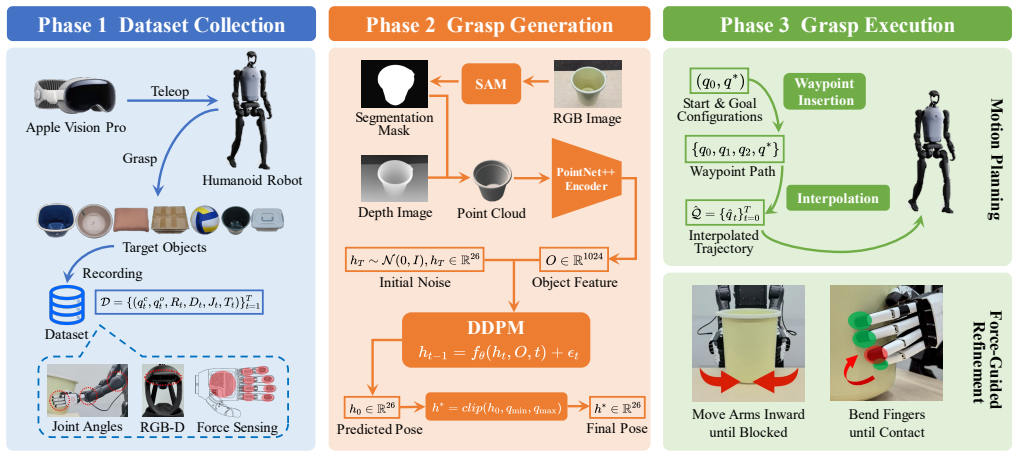
The load-bearing components are three. First, a teleoperated dataset of 353 grasp sequences on 33 large objects, collected from a humanoid robot with a head-mounted RGB-D camera and teleoperation, recording joint angles, RGB-D images, joint torques, and tactile signals, provides the training signal. Second, a DDPM with a 4-layer MLP denoiser, conditioned on a PointNet++ object feature, generates a 26-dimensional joint configuration from Gaussian noise over 200 denoising steps, with joint limit clipping for hardware feasibility. Third, the execution strategy computes a waypoint-based trajectory that lifts the arms laterally and approaches along the palm normal, then applies force-guided refinement: each palm moves toward the object midpoint until blocked, and each finger bends incrementally using torque and tactile thresholds until contact. The refinement is what converts a predicted pose into a stable grasp by compensating for geometric deviations not visible in a single view.
What would settle it
Run the pipeline on a set of objects whose center of mass is deliberately offset from the geometric center—for example, a long box with a heavy weight fixed at one end. If the single-view diffusion prediction places the hands near one end and the monotonic refinement cannot shift them toward the center of mass, the lift-and-hold success rate should drop markedly below the reported 61.9%; such a result would show that single-view sufficiency does not hold for uneven mass distributions.
Extended reading notes
Core claim
The central claim is that a Denoising Diffusion Probabilistic Model, conditioned on a 1024-dimensional PointNet++ feature of a single-view segmented point cloud, can synthesize a 26-dimensional bimanual grasp configuration (14 arm joints and 12 hand joints), and that executing this configuration with a two-stage force-guided refinement—moving arms inward until blocked and bending fingers until contact—yields physically stable grasps on objects the robot has never seen. The paper reports a mean lift-and-hold success rate of 61.9% across seven test objects, with each object tested in five poses and three attempts per pose, exceeding BimanGrasp-DDPM (28.6%), ViSiL-HD (37.1%), GraspNet (21.9%), and DexGraspAnything (15.7%). Ablations show that removing the arm-squeezing stage, the finger-adjustment stage, or the motion planning stage each substantially reduces success, and replacing the diffusion model with a handcrafted symmetric-open-palm baseline also degrades performance.
Load-bearing premise
The diffusion model's predicted joint configuration must lie within the recovery range of the handcrafted force-guided refinement, meaning the predicted hand and arm positions must be close enough to a stable grasp that moving the arms inward and bending the fingers monotonically can close the remaining gap; if the prediction is far off, as when a heavy object is grasped at one end, refinement cannot prevent slippage.
Editorial extensions
If this is right
- Bimanual grasp synthesis for large objects no longer requires a complete 3D mesh; a single head-mounted RGB-D frame provides enough information to generate an executable grasp configuration.
- The contact refinement stage is essential to real-world stability: removing arm squeezing or finger adjustment drops success from 61.9% to 42.9% or 34.3%, respectively.
- A teleoperated, real-world dataset can support learning of physically reachable bimanual grasp poses, addressing a gap left by simulation-only methods.
- The framework leaves room for extension to more complex scenes via open-vocabulary detection and collision-aware motion planning, as the authors note.
Reading between the lines
- A testable extension of the paper's claim is that learning the contact-refinement policy with tactile feedback—rather than the handcrafted monotonic closing—would raise success rates on off-center or heavy objects; the paper's own failure case (d) points to this limit.
- If the central claim holds, the design priority for bimanual dexterous grasping shifts from full-shape reconstruction to the reactive contact loop; the single-view point cloud need only approximate the grasp region.
- Because the dataset covers 33 objects but the object-level split leaves only seven for testing, measuring success across a larger suite of objects would clarify how quickly the diffusion model's grasp synthesis degrades with novel geometry.
- The handcrafted waypoint planner could be replaced by a learned motion policy that reasons about free space, potentially reducing failures from table collisions and torso obstruction that the paper documents.
Editorial analysis
A structured set of objections, weighed in public.
Referee Report
Summary. This paper presents a three-phase system for bimanual dexterous grasping of large objects on a real dual-arm humanoid. A teleoperation dataset (353 grasps on 33 objects) is collected; a DDPM is trained to predict a 26-dimensional arm-and-hand configuration from a SAM-segmented single-view point cloud; and execution combines motion planning with a force-guided refinement stage that moves arms inward until blocked and bends fingers until contact. The authors report a 61.90% mean lift-and-hold success rate over 7 unseen objects (15 trials each), with ablations degrading when components are removed, and they release code and a dataset.
Significance. The physical real-robot evaluation on unseen objects is a genuine strength: success is defined by lift-and-hold, the per-object rates and totals are internally consistent, and the ablations generally degrade monotonically as modules are removed. If the attribution to the learned model were cleanly identified, the system would be a useful step toward real-world bimanual grasping without full object meshes. However, because the force-guided refinement is a handcrafted reactive policy and is never removed in a no-refinement condition, the reported numbers currently cannot be attributed to the diffusion model; the lack of uncertainty quantification also weakens the comparative claims. These issues are fixable with additional experiments rather than being fundamental.
major comments (3)
- [III.C and Table III] The central attribution of the 61.90% success rate to the learned diffusion model is unidentified because no condition executes the raw predicted pose h* without force-guided refinement. Section III.C adds 'move arms inward until blocked' and 'bend fingers until contact' (Eq. (9)), a reactive policy that can convert a coarse palm placement into a clamped grasp regardless of the predicted finger configuration. Table III ablates arm squeezing and finger adjustment separately, but never removes both; the 'ours w/o motion planning' row still includes the refinement stage. The manuscript also does not report the success of the handcrafted centroid-positioning baseline when followed by the same force-guided refinement. Figure 4 shows generated poses 'without force-guided refinement' but gives no quantitative success for them. Without these conditions, the quantitative contribution of the diffusion model over the reactive policy is unidentified, and the comparison with baselines that lack the refinement stage is confounded. Please add: (i) raw DDPM output executed open-loop with no force-guided refinement, and (ii) the handcrafted baseline followed by the same refinement.
- [IV.B and Table II] The experimental comparison lacks uncertainty quantification. Each per-object success rate is an average of 15 binary trials, so with only 7 objects many per-object gaps are within sampling noise; for example, 73.33% versus 40.00% on the basin corresponds to 11 versus 6 successes out of 15. The aggregate differences may be real, but the paper needs raw trial counts, confidence intervals, or statistical tests (for example, Fisher's exact test per object or a paired test over object means) to support the claim that the proposed method consistently outperforms the baselines.
- [IV.C and Table III] The ablation 'ours w/o DDPM' replaces the learned predictor with a handcrafted symmetric-centroid positioning baseline, not with a non-diffusion learned model. This shows that some learned prediction is useful, but it does not isolate the diffusion formulation. Since the paper's stated contribution is a DDPM-based generator, a comparison with a non-diffusion learned baseline trained on the same data (for example, an MLP regressor or a VAE) is needed to support the claim that the diffusion model per se is responsible for the improvement.
minor comments (4)
- [Tables II and III] The table columns 'box 1', 'box 2', and 'box 3' are not self-explanatory; the text maps only box 1 and box 2 to object names, so please add a legend or use the physical object names consistently in the tables.
- [III.C and Table I] Equation (8) defines two contact thresholds, tau_th and delta_th, but Table I reports only a single force threshold (2.9 N). Please specify the tactile threshold delta_th and give units or normalization for the tactile readings T_{i,j}.
- [IV.B] The baseline descriptions do not state whether GraspNet and DexGraspAnything outputs are also given a pre-grasp offset or any collision-aware motion planning; please clarify whether the reported baseline failures include motion-level failures, to rule out trivial execution artifacts.
- [III.C] The title and abstract emphasize 'single-view observations,' and the paper explicitly acknowledges in Section III.C that force feedback is used during execution. Please make the split of responsibility clearer in the abstract: the learned synthesis is single-view, while the full system is a feedback policy. This would prevent a reader from inferring that the demonstrated success comes from vision alone.
Circularity Check
No circularity: the 61.9% success rate is measured on held-out objects in physical trials, and no prediction or fitted parameter is equivalent to its input by construction.
full rationale
The paper's derivation chain is empirical, not definitional. The DDPM is trained on teleoperated demonstrations (Eq. 6) using ground-truth joint configurations h0, and is evaluated on an object-level split with unseen objects; success is a physical lift-and-hold test. The force-guided refinement (Section III.C, Eqs. 8-9) is a handcrafted controller with fixed thresholds, not a fitted predictor, and its removal in ablations changes success rates, so its contribution is empirically isolated rather than assumed. No load-bearing self-citation appears: the cited baselines (BimanGrasp-DDPM, ViSiL-HD, GraspNet, DexGraspAnything) are external works, and no uniqueness theorem or ansatz is imported from the authors' prior work. The absence of an explicit 'raw predicted pose without refinement' success condition weakens attribution of the overall success to the diffusion model, but this is an experimental confound, not circularity: the raw pose is not defined in terms of the success metric, and the refinement is not fitted to the test outcomes. Therefore no step reduces by construction to its own input.
Assumptions & free parameters
free parameters (6)
- DDPM training hyperparameters (T=200 steps, 50k epochs, batch 16, lr 2e-4, hidden dim 512) =
T=200, epochs=50000, batch=16, lr=2e-4, hidden=512
- Contact thresholds tau_th and delta_th (force threshold 2.9 N) =
2.9 N (force) and unspecified torque/tactile thresholds
- Trajectory and velocity parameters (fast 0.5 m/s, slow 0.15 m/s, finger speed 1.57 rad/s, pre-grasp offset) =
0.5/0.15 m/s, 1.57 rad/s
- SAM selection heuristic (discard largest border segment, merge center segments) =
heuristic rule
- Success metric thresholds (5 cm lift, 2 s hold, 30 s timeout) =
5 cm, 2 s, 30 s
- Trained network weights (PointNet++ encoder, 4-layer MLP denoiser) =
learned from 353 teleoperated grasps
assumptions (6)
- standard math Standard DDPM forward and reverse diffusion equations (Eqs. 4-6) are valid for generating joint configurations.
- domain assumption Apple Vision Pro teleoperation with OpenXR-to-URDF retargeting and wrist IK produces demonstrations faithful to the robot's kinematics.
- domain assumption A single segmented RGB-D frame provides sufficient object geometry to synthesize a bimanual grasp for large objects.
- domain assumption Force-guided refinement (move arms inward until blocked, bend fingers until contact, Eq. 8-9) converges to a stable grasp whenever the predicted pose is near the grasp manifold.
- domain assumption The 7 test objects with 5 poses each are representative of unseen large-object bimanual grasping.
- ad hoc to paper Lift-and-hold physical stability (5 cm, 2 s) is a valid proxy for grasp quality.
Cite this review
Pith. "Pith review of Real-World Cooperative Bimanual Dexterous Grasp of Large Objects from Single-View Observations." pith.science (2026). https://pith.science/paper/ZCTQKO4I
@misc{pith2026260810383,
  author       = {Pith},
  title        = {Pith review of: Real-World Cooperative Bimanual Dexterous Grasp of Large Objects from Single-View Observations},
  year         = {2026},
  howpublished = {\url{https://pith.science/paper/ZCTQKO4I}},
  note         = {Machine review of arXiv:2608.10383}
}
read the original abstract
Bimanual dexterous grasping of large objects is a critical challenge in robotic manipulation. However, most existing studies focus on sequential manipulation rather than cooperative grasping, and methods addressing such bimanual tasks have largely been limited to simulation. These limitations stem from the difficulty of acquiring full 3D object models and generating physically plausible grasping actions. To fill this gap, we propose a real-world bimanual grasping framework that includes: a multimodal dataset capturing joint angles, visual observations and force signals; a Denoising Diffusion Probabilistic Model (DDPM)-based module that generates joint-level grasp configurations from segmented point clouds; and an execution strategy that integrates motion planning with online grasp refinement to ensure physical stability and feasibility. Our approach enables the synthesis of executable bimanual grasps from single-view inputs, reducing dependence on complete 3D object models and ensuring stable real-world performance. Experiments on a dual-arm robot demonstrate high success rates across unseen objects with varying geometries and poses, and ablation studies confirm the contributions of key components of our system.
Figures


Figures from the paper (3 more)


Reviewed August 12, 2026 · model on record in the stance chip above.
Discussion (0). Continue with ORCID to comment.