A random version of the Burr-ErdH{o}s-Spencer theorem
Pith reviewed 2026-05-22 04:30 UTC · model grok-4.3
The pith
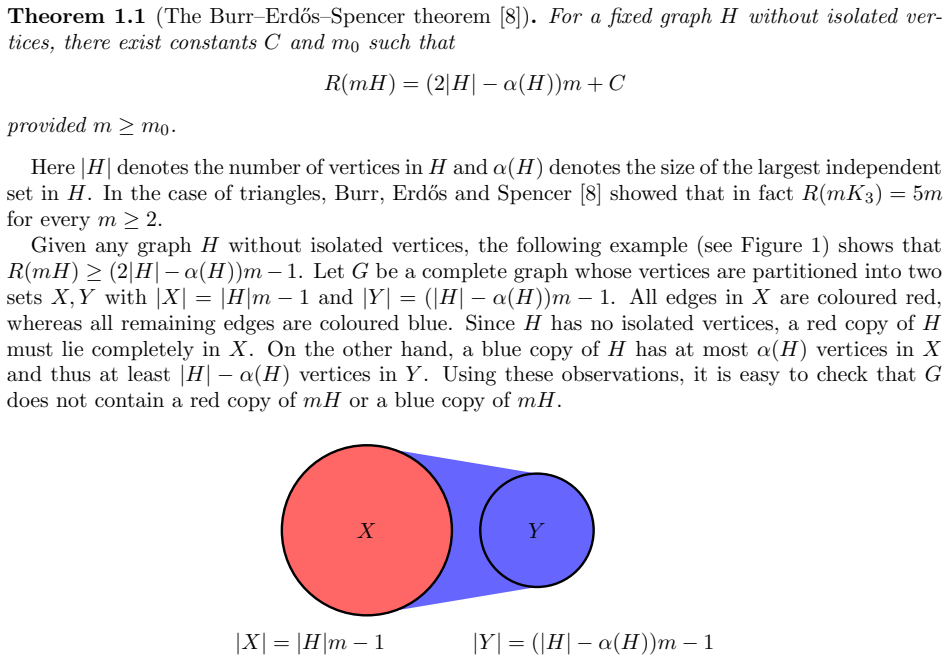
The 2-color Ramsey number for large disjoint unions of a fixed graph H extends to the random graph G(n,p) in an intermediate density range.
A machine-rendered reading of the paper's core claim, the machinery that carries it, and where it could break.
Core claim
We prove that for a fixed graph H with no isolated vertices and all sufficiently large s, there is a range of p such that with high probability every 2-edge-coloring of G(n,p) contains a monochromatic copy of the disjoint union of s copies of H, generalizing the random Ramsey theorem of Rödl and Ruciński by incorporating the Burr-Erdős-Spencer determination of the relevant Ramsey number.
What carries the argument
The binomial random graph G(n,p) in a density window that is dense enough for the Rödl-Ruciński theorem to force monochromatic copies of H but sparse enough for the Ramsey number to grow with the number of disjoint copies s.
If this is right
- The random Ramsey property for G(n,p) holds for target graphs that are large disjoint unions when s is large enough.
- The threshold density for forcing monochromatic copies in random graphs can be read off from the deterministic Ramsey numbers for multiple copies.
- Random-graph analogues exist for other Ramsey statements whose deterministic versions are known only for sufficiently many copies of a base graph.
Where Pith is reading between the lines
- Similar techniques might yield random versions for other classical Ramsey results that require many copies or multiple components.
- The precise location of the p-interval boundaries could be sharpened by examining the transition between single-copy and multi-copy behavior more closely.
- One could test whether the same extension works when the host graph is not binomial but another random model with comparable density.
Load-bearing premise
The edge probability p must be high enough for the single-copy random Ramsey property to hold with high probability yet low enough that the Ramsey number still increases when the number of disjoint copies grows.
What would settle it
Finding a density p inside the claimed interval and a large s such that with positive probability G(n,p) admits a 2-edge-coloring with no monochromatic copy of the disjoint union of s copies of H.
Figures
read the original abstract
A well-known result of Burr, Erd\H{o}s and Spencer [Transactions of the American Mathematical Society, 1975] determines the $2$-colour Ramsey number for any sufficiently large collection of vertex-disjoint copies of a fixed graph $H$ without isolated vertices. In this short note we prove a random version of this result, thereby generalising the random Ramsey theorem of R\"odl and Ruci\'nski [Journal of the American Mathematical Society, 1995].
Editorial analysis
A structured set of objections, weighed in public.
Referee Report
Summary. The paper proves a random analogue of the Burr-Erdős-Spencer theorem: for a fixed graph H with no isolated vertices and all sufficiently large k, the 2-color Ramsey property for the disjoint union k·H holds with high probability in G(n,p) precisely when p ≫ n^{-1/m_2(H)}, thereby generalizing the Rödl-Ruciński random Ramsey theorem. The argument invokes the classical Burr-Erdős-Spencer result and the Rödl-Ruciński theorem as black boxes; below the threshold the claim is immediate, while above the threshold the random graph contains polynomially many monochromatic copies of H and a greedy extraction yields k vertex-disjoint copies with high probability.
Significance. If the result holds, it cleanly extends random Ramsey theory to the multiple-copy setting of Burr-Erdős-Spencer while preserving the same density threshold, since m_2(k·H) = m_2(H). The approach is short and modular, relying on existing theorems plus a standard greedy argument; this structure makes the generalization transparent and suggests similar extensions may be possible for other Ramsey-type statements in sparse random graphs.
minor comments (2)
- [Introduction] The main theorem statement should be displayed explicitly (e.g., as Theorem 1) rather than left implicit in the abstract and proof sketch, to aid readability.
- Recall or cite the precise definition of the 2-density m_2(H) when first used, for readers who may not have the Rödl-Ruciński paper at hand.
Simulated Author's Rebuttal
We thank the referee for their positive and supportive report, which accurately summarizes the main result and its relation to the classical Burr-Erdős-Spencer theorem and the Rödl-Ruciński random Ramsey theorem. We are pleased that the referee finds the modular approach transparent and recommends acceptance.
Circularity Check
No significant circularity
full rationale
The paper establishes a random analogue of the Burr-Erdős-Spencer theorem in G(n,p) by treating the classical Burr-Erdős-Spencer result and the Rödl-Ruciński random Ramsey theorem as independent external black boxes. The below-threshold direction follows directly from the observation that any 2-edge-coloring avoiding monochromatic H also avoids monochromatic k·H. The above-threshold direction proceeds by noting that G(n,p) contains polynomially many monochromatic copies of H and applying a greedy extraction of k vertex-disjoint copies, which succeeds with high probability for fixed k. Because m_2(k·H) equals m_2(H), the threshold remains unchanged and no step reduces by construction to a fitted parameter, self-citation, or definitional equivalence. The derivation is self-contained against these external benchmarks.
Axiom & Free-Parameter Ledger
axioms (2)
- domain assumption Burr-Erdős-Spencer theorem holds for any fixed H without isolated vertices and sufficiently many disjoint copies.
- domain assumption Rödl-Ruciński random Ramsey theorem applies to single copies of H in G(n,p).
Lean theorems connected to this paper
-
IndisputableMonolith/Cost/FunctionalEquation.leanwashburn_uniqueness_aczel unclear?
unclearRelation between the paper passage and the cited Recognition theorem.
Theorem 1.3: for p ≫ n^{-1/m2(H)} a.a.s. every r-edge-colouring admits a monochromatic H-tiling covering (1-γ)n vertices (and the Burr-Erdős-Spencer density for r=2)
-
IndisputableMonolith/Foundation/AlexanderDuality.leanalexander_duality_circle_linking unclear?
unclearRelation between the paper passage and the cited Recognition theorem.
Proof via coloured sparse regularity lemma and KLR conjecture (Proposition 2.3)
What do these tags mean?
- matches
- The paper's claim is directly supported by a theorem in the formal canon.
- supports
- The theorem supports part of the paper's argument, but the paper may add assumptions or extra steps.
- extends
- The paper goes beyond the formal theorem; the theorem is a base layer rather than the whole result.
- uses
- The paper appears to rely on the theorem as machinery.
- contradicts
- The paper's claim conflicts with a theorem or certificate in the canon.
- unclear
- Pith found a possible connection, but the passage is too broad, indirect, or ambiguous to say the theorem truly supports the claim.
Reference graph
Works this paper leans on
-
[1]
Ramsey properties for tilings in random graphs
L. Arag˜ ao, X. Cheng, R. Filipe, R. Miyazaki, D. Peng and Z. Yan, Ramsey properties for tiling in random graphs, arXiv:2605.21471
work page internal anchor Pith review Pith/arXiv arXiv
-
[2]
P. Ara´ ujo, M. Pavez-Sign´ e and N. Sanhueza-Matamala, Ramsey numbers of cycles in random graphs,Random Structures & Algorithms66(2025), e21253
work page 2025
-
[3]
P. Balister, B. Bollob´ as, M. Campos, S. Griffiths, E. Hurley, R. Morris, J. Sahasrabudhe and M. Tiba, Upper bounds for multicolour Ramsey numbers, arXiv:2410.17197
- [4]
- [5]
-
[6]
M. Buci´ c and B. Sudakov, Tight Ramsey bounds for multiple copies of a graph,Adv. Combin.(2023), 22pp
work page 2023
-
[7]
Burr, On the Ramsey numbersr(G, nH) andr(nG, nH) whennis large,Discr
S.A. Burr, On the Ramsey numbersr(G, nH) andr(nG, nH) whennis large,Discr. Math.65(1987), 215–229
work page 1987
-
[8]
S.A. Burr, P. Erd˝ os, and J.H. Spencer, Ramsey theorems for multiple copies of graphs,Trans. Amer. Math. Soc. 209(1975), 87–99
work page 1975
- [9]
-
[10]
E.J. Cockayne and P.J. Lorimer, The Ramsey number for stripes,J. Aust. Math. Soc.19(1975), 252–256
work page 1975
-
[11]
Conlon, A new upper bound for diagonal Ramsey numbers,Ann
D. Conlon, A new upper bound for diagonal Ramsey numbers,Ann. Math., 170(2009), 941–960
work page 2009
-
[12]
D. Conlon, W.T. Gowers, W. Samotij and M. Schacht, On the K LR conjecture in random graphs,Israel J. Math. 203(2014), 535–580
work page 2014
-
[13]
A. Dudek and P. Pra lat, An alternative proof of the linearity of the size-Ramsey number of paths,Combin. Probab. Comput.24(2015), 551–555
work page 2015
-
[14]
P. Erd˝ os, Some unsolved problems in graph theory and combinatorial analysis, inCombinatorial Mathematics and Its Applications (Proc. Conf. Oxford 1969), Academic Press, London, 1971, pp. 97–109
work page 1969
-
[15]
Erd˝ os, Some remarks on the theory of graphs,Bull
P. Erd˝ os, Some remarks on the theory of graphs,Bull. Amer. Math. Soc.,53(1947), 292–294
work page 1947
-
[16]
P. Erd˝ os and G. Szekeres, A combinatorial problem in geometry,Compos. Math.,2(1935), 463–470
work page 1935
-
[17]
L. Gerencs´ er and A. Gy´ arf´ as, On Ramsey-type problems,Ann. Univ. Sci. Budapest. E¨ otv¨ os Sect. Math10(1967), 167–170
work page 1967
-
[18]
L. Gishboliner, M. Krivelevich and P. Michaeli, Color-biased Hamilton cycles in random graphs,Random Struc- tures & Algorithms,60(2022), 289–307
work page 2022
- [19]
-
[20]
Y. Kohayakawa, Szemer´ edi’s Regularity Lemma for sparse graphs, inFoundations of computational mathematics: Rio da Janeiro, 1997, Springer, pp. 216–230
work page 1997
-
[21]
M. Krivelevich, G. Kronenberg, A. Mond, Tur´ an-type problems for long cycles in random and pseudo-random graphs,J. London Math. Soc.107(2023), 1519–1551
work page 2023
-
[22]
Letzter, Path Ramsey number for random graphs,Combin
S. Letzter, Path Ramsey number for random graphs,Combin. Probab. Comput.25(2016), 612–622
work page 2016
-
[23]
Ramsey, On a problem of formal logic,Proc
F.P. Ramsey, On a problem of formal logic,Proc. Lond. Math. Soc.30(1) (1930), 264–286
work page 1930
-
[24]
V. R¨ odl and A. Ruci´ nski, Lower bounds on probability thresholds for Ramsey properties, inCombinatorics, Paul Erd˝ os is Eighty, Vol. 1, 317–346, Bolyai Soc. Math. Studies, J´ anos Bolyai Math. Soc., Budapest, 1993
work page 1993
-
[25]
V. R¨ odl and A. Ruci´ nski, Random graphs with monochromatic triangles in every edge coloring,Random Struc- tures & Algorithms5(2)(1994), 253–270
work page 1994
-
[26]
V. R¨ odl and A. Ruci´ nski, Threshold functions for Ramsey properties,J. Amer. Math. Soc.8(1995), 917–942
work page 1995
-
[27]
Sah, Diagonal Ramsey via effective quasirandomness,Duke Math
A. Sah, Diagonal Ramsey via effective quasirandomness,Duke Math. J.,172(2023), 545–567
work page 2023
-
[28]
D. Saxton and A. Thomason, Hypergraph containers,Invent. Math.201(2015), 925–992
work page 2015
-
[29]
A. Sulser and M. Truji´ c, Ramsey numbers for multiple copies of sparse graphs,J. Graph Theory,106(2024), 843–870
work page 2024
-
[30]
Thomason, An upper bound for some Ramsey numbers,J
A. Thomason, An upper bound for some Ramsey numbers,J. Graph Theory,12(1988), 509–517. 8
work page 1988
discussion (0)
Sign in with ORCID, Apple, or X to comment. Anyone can read and Pith papers without signing in.