REVIEW 4 major objections 4 minor 58 references
KNOSOS: a fast orbit-averaging neoclassical code for stellarator geometry
T0 review · 4 major / 4 minor · reviewed 2026-08-14 · deepseek-v4-flash
Pith's one-line read KNOSOS computes stellarator neoclassical transport by orbit-averaging the drift-kinetic equation, reproducing benchmark fluxes orders of magnitude faster than standard local codes while retaining the tangential magnetic drift and…
desk verdict A solid, open-source code paper that delivers real speedups and honest benchmarks; the main caveat is that the radial-locality envelope of the method is not directly validated. read the letter →
The pith
A machine-rendered reading of the paper's core claim, the machinery that carries it, and where it could break.
The reading
What carries the argument
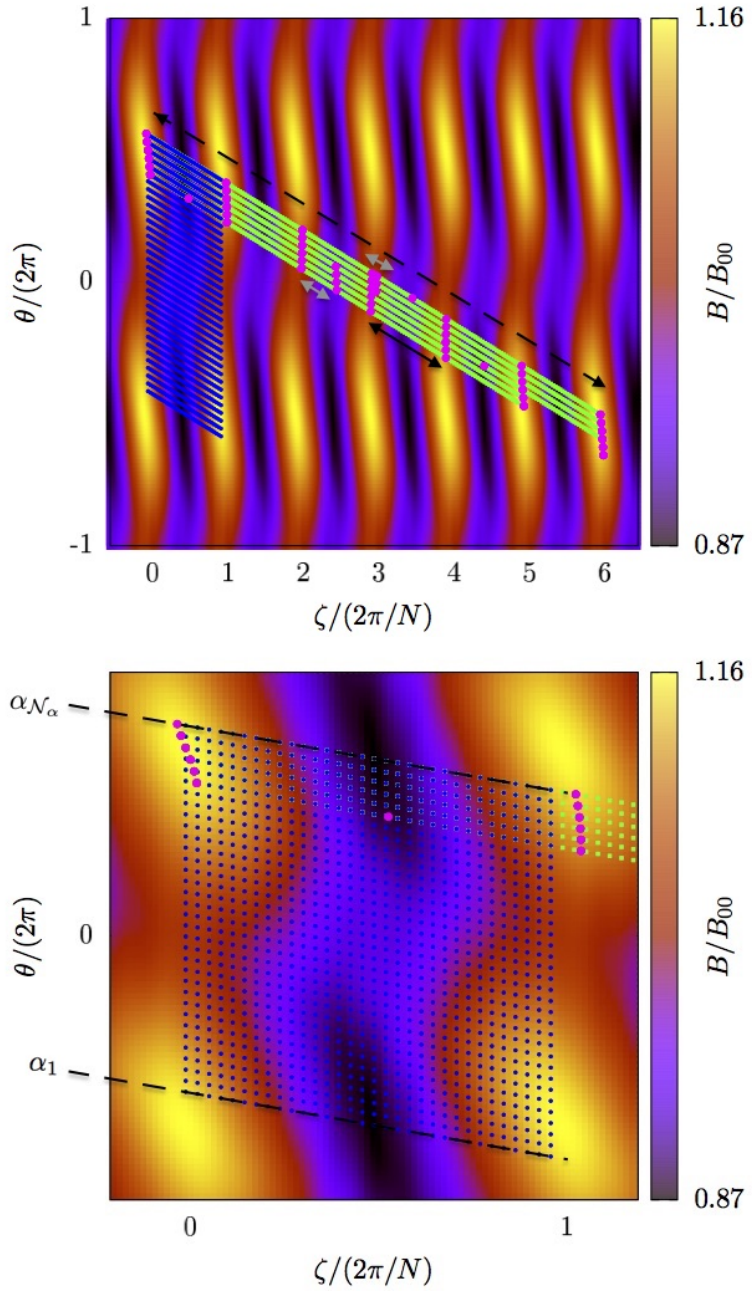
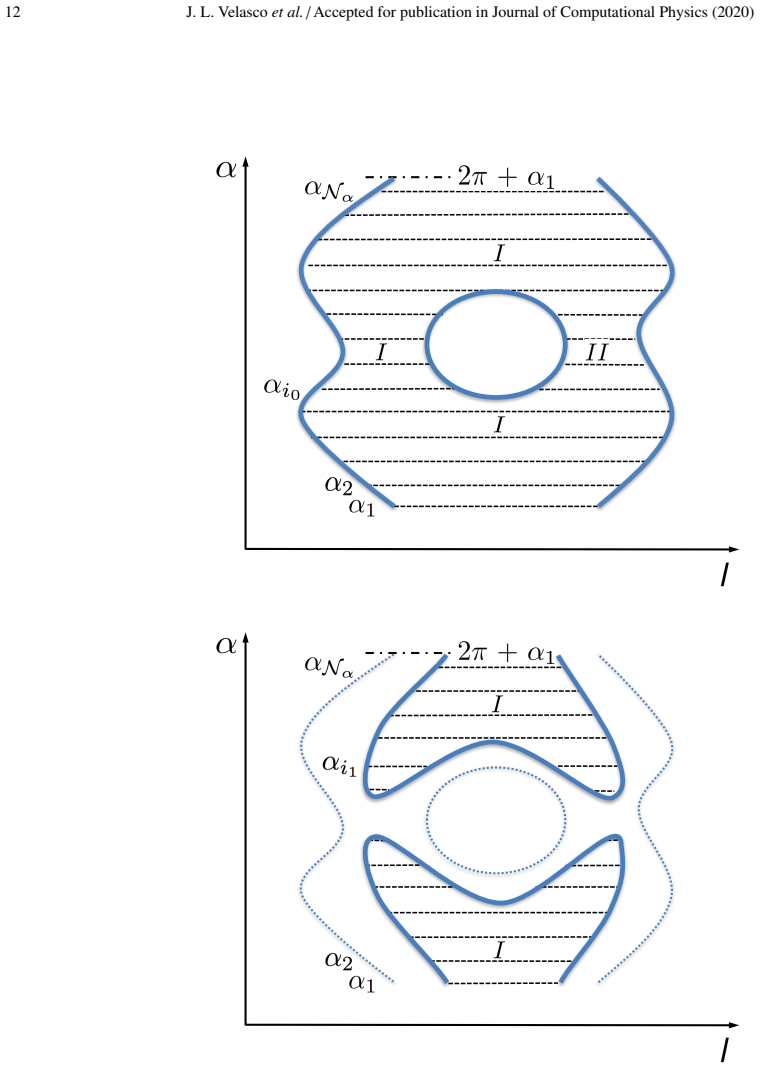
The load-bearing mechanism is orbit-averaging of the drift-kinetic equation. Bounce-integrals along field lines—I_{vM,α}, I_{vE,α}, I_{vM,ψ}, I_{vE,ψ}, and I_ν—absorb all dependence on the arc-length coordinate, leaving a differential equation in only the field-line label α and the pitch-angle λ. The radial coordinate ψ and speed v become parameters. Divergences of these integrals near trapping bifurcations are removed and evaluated analytically, and fast Fourier-based evaluation of the magnetic field along straight field lines accelerates the coefficient calculation. The linearity in φ₁ allows a response-matrix solution of quasineutrality, in which the drift-kinetic equation is solved once for each Fourier basis element and the factorization is reused, giving a speed-up of roughly the number of basis elements.
What would settle it
Take a strongly non-omnigenous stellarator configuration, such as one with large effective ripple and small aspect ratio, and compute the two bounce-averaged drift terms in inequality (23); if the radial-drift term is not much smaller than the tangential-drift term, then run KNOSOS and a radially global code with identical collision operators and profiles and compare the radial fluxes, because a significant disagreement beyond the DKES/EUTERPE benchmark error bars would show the local-ordering premise does not hold for that device.
Extended reading notes
Core claim
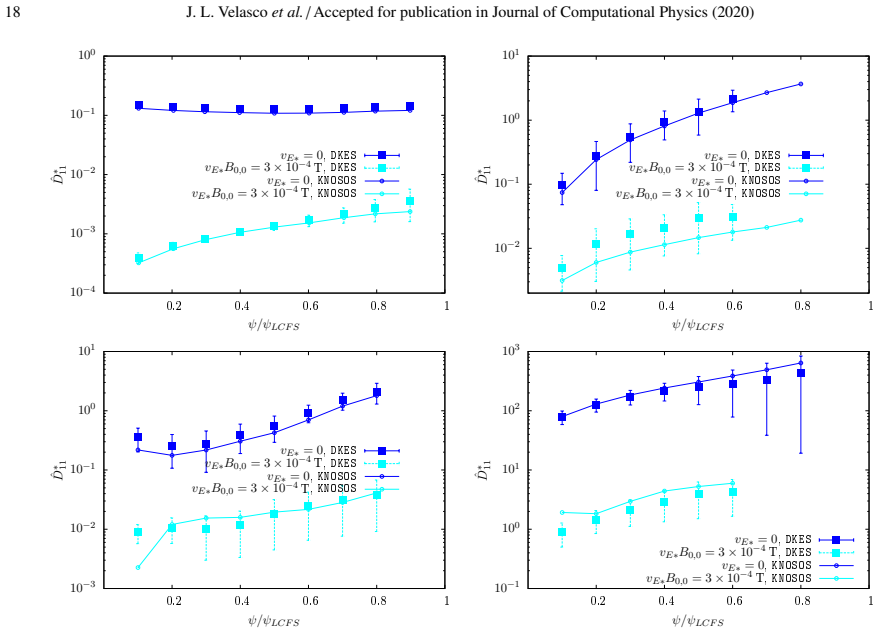
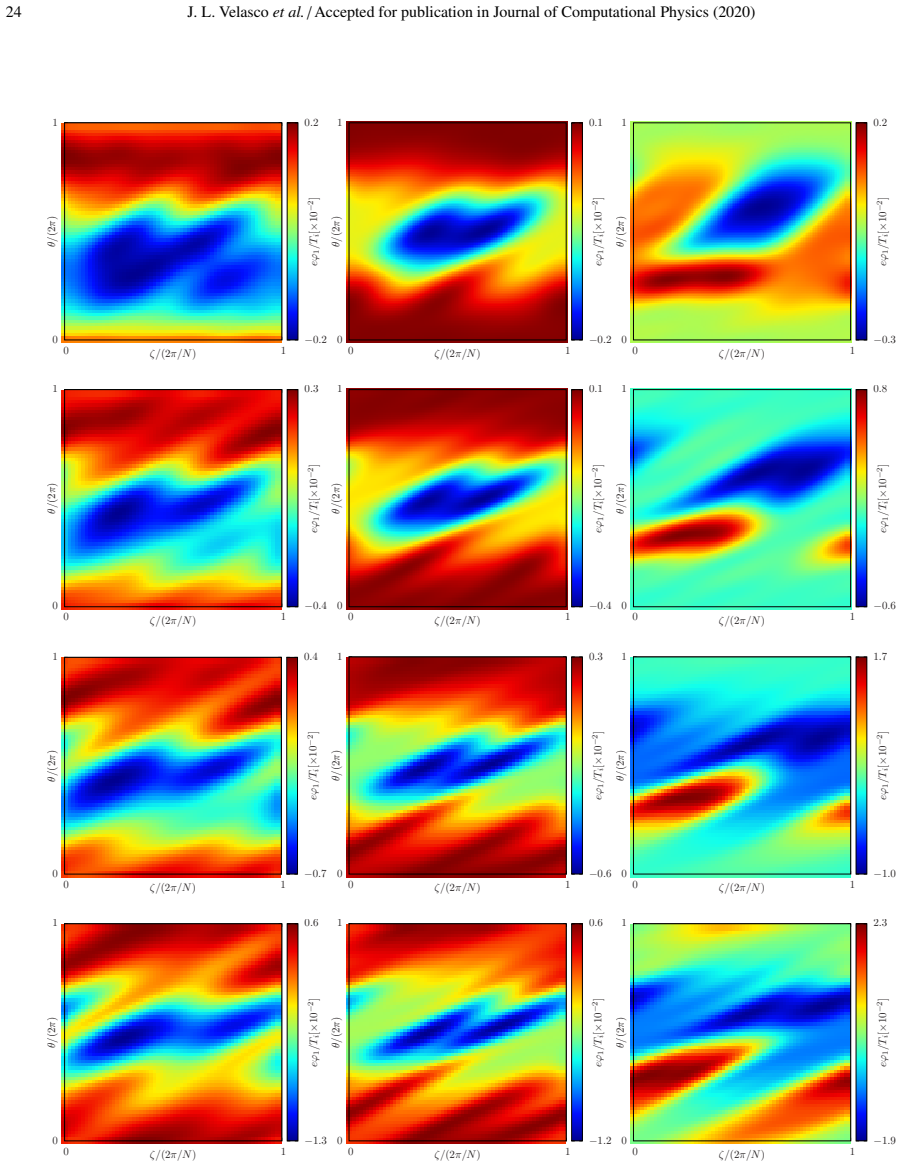
The central claim is that a rigorously orbit-averaged, radially local drift-kinetic equation can capture the neoclassical transport regimes relevant to stellarators—1/ν, √ν, and superbanana-plateau—while including physics that older local codes omit. Specifically, the tangential magnetic drift and the radial E×B drift caused by the flux-surface variation of the electrostatic potential φ₁ are retained, and quasineutrality is solved consistently because the equations are linear in φ₁. When the same simplifications as DKES are imposed, KNOSOS reproduces DKES monoenergetic transport coefficients across four very different stellarator configurations; when the full tangential-drift terms are kept, it matches EUTERPE calculations of φ₁ and shows that the tangential magnetic drift can change the radial energy flux by more than 50% in ion-root conditions and can qualitatively alter the amplitude and phase of φ₁.
Load-bearing premise
The argument assumes the plasma is close enough to omnigeneity and large enough in aspect ratio that the bounce-averaged radial drift is much smaller than the tangential drift, so the radial-derivative term in the drift-kinetic equation can be dropped; if that inequality fails, KNOSOS solves a different equation that misses radially global effects.
Editorial extensions
If this is right
- Databases of monoenergetic transport coefficients for a stellarator configuration can be generated on the order of seconds to minutes rather than hours, enabling broad parameter scans.
- The √ν and superbanana-plateau regimes, which the effective-ripple figure of merit ignores, can be computed fast enough to include them in stellarator optimization loops.
- Consistent solutions of quasineutrality with the flux-surface potential φ₁ become practical for systematic impurity-transport studies that were previously computationally prohibitive.
- KNOSOS can supply the radial electric field, the tangential electric field, and the full bulk-species distribution function as inputs to gyrokinetic turbulence calculations.
- The retained tangential magnetic drift can change predicted energy fluxes by tens of percent in ion-root plasmas, so transport calculations that omit it may misestimate confinement even when thermal particles sit in the 1/ν regime.
Reading between the lines
- This is an inference beyond the paper: because the speed gain comes from eliminating the arc-length and radial-derivative dependence, the same bounce-averaged response-matrix strategy could be extended to trace impurity species, yielding systematic impurity-flux scans across configurations and collisionalities.
- The benchmarks cover devices that are relatively close to omnigeneity; a natural testable extension would be to quantify, in a strongly non-omnigenous configuration, how much the dropped ∂ψg term corrupts fluxes as inequality (23) breaks down.
- The fast computation of √ν and superbanana-plateau transport suggests a geometry optimization target based on the variation of the second adiabatic invariant on the flux surface rather than the effective ripple alone; the paper points in this direction but does not develop such a figure of merit.
- The response-matrix formulation of quasineutrality makes KNOSOS a natural building block for coupling neoclassical fluxes into time-dependent transport codes, since repeated evaluations of fluxes for changing profiles would reuse the same precomputed matrices.
Signed reviews
Editorial analysis
A structured set of objections, weighed in public.
Referee Report
Summary. KNOSOS is an open-source code that solves the radially local drift-kinetic equation for trapped particles together with the flux-surface quasineutrality equation in stellarator geometry, using bounce averages to reduce the equation to the variables (α, λ). The code retains the tangential magnetic drift and the flux-surface variation of the electrostatic potential φ1, solves the quasineutrality equation via a linear response-matrix method, and is benchmarked against DKES monoenergetic transport coefficients for W7-X, LHD, NCSX, and TJ-II, and against EUTERPE for φ1 in LHD and W7-X. The paper reports runtimes of seconds to minutes and claims that, when solving equivalent equations, KNOSOS reproduces DKES and EUTERPE calculations orders of magnitude faster.
Significance. If the benchmarks are taken at face value, KNOSOS is a significant practical tool for stellarator neoclassical transport: it makes low-collisionality calculations fast enough for parameter scans and optimization, includes two effects that DKES-style monoenergetic approaches drop (the tangential magnetic drift and the flux-surface electrostatic potential variation), and is released as open source. The response-matrix solution of quasineutrality is a clean and efficient idea, and the agreement with the independently developed DKES and EUTERPE codes in the simplified comparisons is strong evidence that the discretization and bounce-average implementation are sound. The paper is also careful to qualify its central claim with "when solving equivalent equations" and to acknowledge the radially local approximation, which is a genuine strength.
major comments (4)
- [Section 2, Eq. (23)] The radially local ordering that justifies dropping the ∂ψgb term is never quantified for any of the devices benchmarked in Section 4. Because DKES also solves a radially local equation, agreement with DKES cannot validate inequality (23); both codes would fail together if the ordering broke down. The paper should either compute the relative size of the omitted bounce-averaged radial-drift term versus the retained tangential term for the benchmarked cases, or explicitly state that the benchmarks validate only the numerical solution of the local equation and not the applicability of the local approximation itself. This matters because inequality (23) defines the code's domain of validity.
- [Sections 4.2-4.3, Figs. 8-11] The main physical novelty of KNOSOS, the tangential magnetic drift in Eq. (24), is not benchmarked against any independent code. In Section 4.2 the comparison is internal (Q versus \hat Q, both computed by KNOSOS), and in Section 4.3 the EUTERPE comparisons use Eq. (52), which sets the tangential magnetic drift to zero; the right-hand columns of Figs. 10 and 11, which include this drift, have no independent reference. Please add a comparison with SFINCS or FORTEC-3D for at least one case where the tangential drift changes the result, or clearly label these predictions as not independently validated.
- [Section 4.3, Fig. 11] The W7-X edge case shows a clear underestimation of φ1 by KNOSOS relative to EUTERPE. The attribution to EUTERPE's plateau-regime contribution is plausible, but it is not demonstrated, and if correct it indicates that the local trapped-particle equation (9) is not adequate at that radial position. The paper should quantify the plateau contribution, for example by varying the cutoff v0 in Eq. (58) or by comparing with a non-local model, and should state explicitly over what radial range the φ1 validation is reliable.
- [Sections 3.4 and 4.1] No grid-convergence study is reported. The benchmarks use fixed grids (Nα=32 and Nλ=64 or 128), and the text acknowledges that the lowest-collisionality TJ-II points in Fig. 6 (bottom right) are under-resolved and would have required a finer grid. Since the paper's speed claims (seconds per case) are only meaningful if the chosen grids are adequate, please add a convergence study over Nα, Nλ, and the Fourier truncation N for at least one representative configuration, and report the corresponding accuracy of the computed fluxes.
minor comments (4)
- [Section 4.1, near Fig. 6] The sentence "This regime, which cannot be not described by a bounce-averaged drift-kinetic equation" contains a typo and should read "cannot be described".
- [Section 3.3, Fig. 2] The example in the text says that field lines are followed for "6" toroidal periods and refers to N/ι, but the rotational transform used in the example is not stated; please give the value of ι so the reader can verify the construction.
- [Section 3.5, Eq. (45)] The stated number of Fourier coefficients, N = 2(2Nn+1)(Nm+1), appears inconsistent with the summation limits in Eq. (45), where -Nn<n<Nn and 0<m<Nm; please check the counting or define the limits to match the expression.
- [Section 4] A summary table listing the benchmark configurations, grid sizes, and runtimes would improve reproducibility; these values are currently scattered through the text and figure captions.
Circularity Check
No significant circularity: KNOSOS benchmarks an independent code implementation against DKES and EUTERPE, with no fitted inputs; the radially-local ordering is a scope assumption, not a circular reduction.
full rationale
KNOSOS is a numerical implementation of a previously derived radially-local drift-kinetic and quasineutrality system (Eqs. 9 and 18; derivation credited to Refs. [5,25]). The paper does not fit any parameter to the benchmark outputs and then rename that fit a prediction. Section 4.1 solves the deliberately simplified DKES-like equation (52) and compares the resulting monoenergetic coefficients with DKES; this is an implementation benchmark against an independently developed code, not a self-defined prediction. Section 4.2 compares the full equation (24) with the simplified one, and the hybrid DKES+KNOSOS curve in Eq. (58) uses a cut-off v0 chosen in the 1/nu regime; the conclusion drawn from that curve is a consistency check about the plateau contribution, not a fitted central claim. Section 4.3 validates the quasineutrality response-matrix solution against EUTERPE by solving the same reduced equation (52) with the same assumptions, and the tangential-drift variant is an additional physics result rather than a fitted or circular assertion. The cited derivations in Ref. [25] are parameter-free, state their ordering assumptions, and do not assume the numerical results of this paper; although they are prior work by the same group, they are not empirical inputs to the benchmarks and therefore do not make the outputs equivalent to the inputs by construction. The radial-locality ordering expressed by inequality (23) is an approximation whose quantitative validity is not established by the benchmark suite, and the W7-X edge discrepancy may indicate its boundary; however, an unvalidated scope assumption is a correctness risk, not circularity, because it does not reduce the paper's claimed results to its inputs. Thus no circular step is identified.
Assumptions & free parameters
free parameters (4)
- Grid sizes Nα and Nλ =
32x64 to 32x128 in benchmarks
- Maximum trapped-well traversal =
6 toroidal periods in the W7-X example
- Fourier truncation for phi1 =
not specified
- Cut-off velocity v0 in hybrid DKES+KNOSOS flux =
not specified
assumptions (5)
- domain assumption Low collisionality: parallel motion is much faster than collisions, so the distribution function is independent of arc length and orbit averaging is valid.
- domain assumption Closeness to omnigeneity and large aspect ratio make the radial drift term proportional to ∂ψg negligible via inequality (23).
- domain assumption Low-beta magnetic geometry with Bψ=0 and incompressible E×B drift is used in eqs. (15) and (25).
- domain assumption Only pitch-angle scattering, with effective collision frequencies, is retained; quasineutrality assumes a pure plasma with one ion species.
- domain assumption Tangential drift does not alter the bounce points because drifts are much slower than parallel motion.
Cite this review
Pith. "Pith review of KNOSOS: a fast orbit-averaging neoclassical code for stellarator geometry." pith.science (2026). https://pith.science/paper/ZD6ZRURD
@misc{pith2026190811615,
  author       = {Pith},
  title        = {Pith review of: KNOSOS: a fast orbit-averaging neoclassical code for stellarator geometry},
  year         = {2026},
  howpublished = {\url{https://pith.science/paper/ZD6ZRURD}},
  note         = {Machine review of arXiv:1908.11615}
}
read the original abstract
KNOSOS (KiNetic Orbit-averaging SOlver for Stellarators) is a freely available, open-source code (\href{https://github.com/joseluisvelasco/KNOSOS}{https://github.com/joseluisvelasco/KNOSOS}) that calculates neoclassical transport in low-collisionality plasmas of three-dimensional magnetic confinement devices by solving the radially local drift-kinetic and quasineutrality equations. The main feature of KNOSOS is that it relies on orbit-averaging to solve the drift-kinetic equation very fast. KNOSOS treats rigorously the effect of the component of the magnetic drift that is tangent to magnetic surfaces, and of the component of the electrostatic potential that varies on the flux surface, {\varphi}_1. Furthermore, the equation solved is linear in {\varphi}_1, which permits an efficient solution of the quasineutrality equation. As long as the radially local approach is valid, KNOSOS can be applied to the calculation of neoclassical transport in stellarators (helias, heliotrons, heliacs, etc.) and tokamaks with broken axisymmetry. In this paper, we show several calculations for the stellarators W7-X, LHD, NCSX and TJ-II that provide benchmark with standard local codes and demonstrate the advantages of this approach.
Figures


Figures from the paper (8 more)





Reference graph
Works this paper leans on
-
[1]
A. Dinklage, M. Yokoyama, K. Tanaka, J. L. Velasco, D. L ´opez-Bruna, C. D. Beidler, S. Satake, E. Ascas ´ıbar, J. Ar´evalo, J. Baldzuhn, Y . Feng, D. Gates, J. Geiger, K. Ida, M. Jakubowski, A. L´opez-Fraguas, H. Maassberg, J. Miyazawa, T. Morisaki, S. Murakami, N. Pablant, S. Kobayashi, R. Seki, C. Suzuki, Y . Suzuki, Y . Turkin, A. Wakasa, R. Wolf, H. ...
work page 2013
-
[2]
A. Dinklage, the W7-X Team, Magnetic configuration e ffects on the Wendelstein 7-X stellarator, Nature Physics 14 (8) (2018) 855–860. doi:10.1038/s41567-018-0141-9 . URL https://doi.org/10.1038/s41567-018-0141-9
-
[3]
D. D. Ho, R. M. Kulsrud, Neoclassical transport in stellarators, The Physics of Fluids 30 (2) (1987) 442–461. doi:10.1063/1.866395. URL https://aip.scitation.org/doi/abs/10.1063/1.866395
doi:10.1063/1.866395 1987
-
[4]
C. D. Beidler, K. Allmaier, M. Y . Isaev, S. V . Kasilov, W. Kernbichler, G. O. Leitold, H. Maaßberg, D. R. Mikkelsen, S. Murakami, M. Schmidt, D. A. Spong, V . Tribaldos, A. Wakasa, Benchmarking of the mono-energetic transport coe fficients. Results from the Inter- national Collaboration on Neoclassical Transport in Stellarators (ICNTS), Nuclear Fusion 51 ...
work page 2011
- [5]
-
[6]
J. R. Cary, S. G. Shasharina, Helical plasma confinement devices with good confinement properties, Physical Review Letters 78 (1997) 674–677. URL http://link.aps.org/doi/10.1103/PhysRevLett.78.674
-
[7]
F. I. Parra, I. Calvo, P. Helander, M. Landreman, Less constrained omnigenous stellarators, Nuclear Fusion 55 (2015) 033005
work page 2015
-
[8]
A. H. Boozer, Transport and isomorphic equilibria, The Physics of Fluids 26 (2) (1983) 496–499. arXiv:https://aip.scitation.org/ doi/pdf/10.1063/1.864166, doi:10.1063/1.864166. URL https://aip.scitation.org/doi/abs/10.1063/1.864166
doi:10.1063/1.864166 1983
Show all 58 references
-
[9]
Landreman, P
M. Landreman, P. J. Catto, Omnigenity as generalized quasisymmetry, Physics of Plasmas 19 (2012) 056103
2012
-
[10]
Klinger, A
T. Klinger, A. Alonso, S. Bozhenkov, R. Burhenn, A. Dinklage, G. Fuchert, J. Geiger, O. Grulke, A. Langenberg, M. Hirsch, G. Kocsis, J. Knauer, A. Kr¨amer-Flecken, H. Laqua, S. Lazerson, M. Landreman, H. Maaßberg, S. Marsen, M. Otte, N. Pablant, E. Pasch, K. Rahbarnia, T. Stan...
2017
-
[11]
R. C. Wolf, et al., Major results from the first plasma campaign of the Wendelstein 7-X stellarator, Nuclear Fusion 57 (10) (2017) 102020. URL http://stacks.iop.org/0029-5515/57/i=10/a=102020
2017
-
[12]
Takeiri, the LHD team, Extension of the operational regime of the LHD towards a deuterium experiment, Nuclear Fusion 57 (10) (2017) 102023
Y . Takeiri, the LHD team, Extension of the operational regime of the LHD towards a deuterium experiment, Nuclear Fusion 57 (10) (2017) 102023. URL http://stacks.iop.org/0029-5515/57/i=10/a=102023
2017
-
[13]
Sunn-Pedersen, M
T. Sunn-Pedersen, M. Otte, S. Lazerson, P. Helander, S. Bozhenkov, C. Biedermann, T. Klinger, R. Wolf, H. S. Bosch, the Wendelstein 7-X Team, Confirmation of the topology of the Wendelstein 7-X magnetic field to better than 1:100,000, Nature Communications 7 (13493)
-
[14]
H. E. Mynick, T. K. Chu, A. H. Boozer, Class of model stellarator fields with enhanced confinement, Phyics Review Letters 48 (1982) 322–326. URL http://link.aps.org/doi/10.1103/PhysRevLett.48.322
1982 doi
-
[15]
Yamada, J
H. Yamada, J. Harris, A. Dinklage, E. Ascasibar, F. Sano, S. Okamura, J. Talmadge, U. Stroth, A. Kus, S. Murakami, M. Yokoyama, C. Beidler, V . Tribaldos, K. Watanabe, Y . Suzuki, Characterization of energy confinement in net-current free plasmas using the extended Internationa...
2005
-
[16]
M. C. Zarnstor ff, L. A. Berry, A. Brooks, E. Fredrickson, G.-Y . Fu, S. Hirshman, S. Hudson, L.-P. Ku, E. Lazarus, D. Mikkelsen, D. Mon- ticello, G. H. Neilson, N. Pomphrey, A. Reiman, D. Spong, D. Strickler, A. Boozer, W. A. Cooper, R. Goldston, R. Hatcher, M. Isaev, C. Kesse...
2001
-
[17]
Sagara, Y
A. Sagara, Y . Igitkhanov, F. Najmabadi, Review of stellarator /heliotron design issues towards mfe demo, Fusion Engineering and Design 85 (7) (2010) 1336 – 1341, proceedings of the Ninth International Symposium on Fusion Nuclear Technology. doi:https://doi.org/ 10.1016/j.fuse...
2010 doi
-
[18]
Fuchert, S
G. Fuchert, S. Bozhenkov, N. Pablant, K. Rahbarnia, Y . Turkin, A. Alonso, T. Andreeva, C. Beidler, M. Beurskens, A. Dinklage, J. Geiger, M. Hirsch, U. H ¨ofel, J. Knauer, A. Langenberg, H. Laqua, H. Niemann, E. Pasch, T. S. Pedersen, T. Stange, J. Svensson, H. T. Mora, G. Wur...
2018 doi
-
[19]
Geiger, C
J. Geiger, C. D. Beidler, Y . Feng, H. Maaßberg, N. B. Marushchenko, Y . Turkin, Physics in the magnetic configuration space of W7-X, Plasma Physics and Controlled Fusion 57 (1) (2015) 014004. URL http://stacks.iop.org/0741-3335/57/i=1/a=014004
2015
-
[20]
J. A. Alonso, C. D. Beidler, I. Calvo, A. Dinklage, Y . Feng, G. Fuchert, M. Hirsch, M. Landreman, A. Langenberg, H. Maaßberg, N. Pablant, 30 J. L. Velasco et al. / Accepted for publication in Journal of Computational Physics (2020) H. Smith, J. L. Velasco, G. Weir, D. Zhang, ...
2020
-
[21]
V . V . Nemov, S. V . Kasilov, W. Kernbichler, M. F. Heyn, Evaluation of 1/ν neoclassical transport in stellarators, Physics of Plasmas 6 (1999) 4622
1999
-
[22]
S. P. Hirshman, K. C. Shaing, W. I. van Rij, C. O. Beasley, E. C. Crume, Plasma transport coefficients for nonsymmetric toroidal confinement systems, Physics of Fluids 29 (9) (1986) 2951–2959. URL http://link.aip.org/link/?PFL/29/2951/1
1986
-
[23]
Turkin, C
Y . Turkin, C. D. Beidler, H. Maaßberg, S. Murakami, V . Tribaldos, A. Wakasa, Neoclassical transport simulations for stellarators, Physics of Plasmas 18 (2) (2011) 022505. URL http://link.aip.org/link/?PHP/18/022505/1
2011
-
[24]
C. D. Beidler, M. Y . Isaev, S. V . Kasilov, W. Kernbichler, H. M. S. Murakami, V . V . Nemov, D. Spong, V . Tribaldos, ICNTS-Impact of Incompressible E× B Flow in Estimating Mono-Energetic Transport Coe fficients, in: Proceedings of the 16th Int. Stellarator /Heliotron Workshop...
2007
-
[25]
Calvo, J
I. Calvo, J. L. Velasco, F. I. Parra, J. A. Alonso, J. M. Garc´ıa-Regana, Electrostatic potential variations on stellarator magnetic surfaces in low collisionality regimes, Journal of Plasma Physics 84 (4) (2018) 905840407
2018
-
[26]
Landreman, H
M. Landreman, H. Smith, A. Moll ´en, P. Helander, Comparison of particle trajectories and collision operators for collisional transport in nonaxisymmetric plasmas, Physics of Plasmas 21 (4) (2014) 042503. URL http://scitation.aip.org/content/aip/journal/pop/21/4/10.1063/1.4870077
2014 doi
-
[27]
J. M. Garc ´ıa-Rega˜na, R. Kleiber, C. D. Beidler, Y . Turkin, H. Maassberg, P. Helander, On neoclassical impurity transport in stellarator geometry, Plasma Physics and Controlled Fusion 55 (7) (2013) 074008. URL http://stacks.iop.org/0741-3335/55/i=7/a=074008
2013
-
[28]
Garc ´ıa-Rega˜na, C
J. Garc ´ıa-Rega˜na, C. Beidler, R. Kleiber, P. Helander, A. Moll´en, J. Alonso, M. Landreman, H. Maaßberg, H. Smith, Y . Turkin, J. Velasco, Electrostatic potential variation on the flux surface and its impact on impurity transport, Nuclear Fusion 57 (5) (2017) 056004. URL htt...
2017
-
[29]
Satake, M
S. Satake, M. O. an N Nakajima, H. Sugama, M. Yokoyama, Non-local simulation of the formation of neoclassical ambipolar electric field in non-axisymmetric configurations, Plasma and Fusion Research 1 (2006) 002. URL https://www.jstage.jst.go.jp/article/pfr/1/0/1_0_002/_article
2006
-
[30]
Calvo, F
I. Calvo, F. I. Parra, J L Velasco, J. A. Alonso, Stellarators close to quasisymmetry, Plasma Physics and Controlled Fusion 55 (12) (2013) 125014. URL http://stacks.iop.org/0741-3335/55/i=12/a=125014
2013
-
[31]
Calvo, F
I. Calvo, F. I. Parra, J. A. Alonso, J L Velasco, Optimizing stellarators for large flows, Plasma Physics and Controlled Fusion 56 (9) (2014) 094003. URL http://stacks.iop.org/0741-3335/56/i=9/a=094003
2014
-
[32]
Calvo, F
I. Calvo, F. I. Parra, J L Velasco, J. A. Alonso, Flow damping in stellarators close to quasisymmetry, Plasma Physics and Controlled Fusion 57 (1) (2015) 014014. URL http://stacks.iop.org/0741-3335/57/i=1/a=014014
2015
-
[33]
J. L. Velasco, I. Calvo, J. M. Garc ´ıa-Rega˜na, F. I. Parra, S. Satake, J. A. Alonso, the LHD team, Large tangential electric fields in plasmas close to temperature screening, Plasma Physics and Controlled Fusion 60 (7) (2018) 074004. URL http://stacks.iop.org/0741-3335/60/i=7...
2018
-
[34]
W. H. Press, S. A. Teukolsky, W. T. Vetterling, B. P. Flannery, Numerical Recipes in Fortran 77: the Art of Scientific Computing. Second Edition, V ol. 1, Cambridge University Press, 1996
1996
-
[35]
Kernbichler, S
W. Kernbichler, S. Kasilov, G. Kapper, A. Martitsch, V . Nemov, C. Albert, M. Heyn, Solution of drift kinetic equation in stellarators and tokamaks with broken symmetry using the code NEO-2, Plasma Physics and Controlled Fusion 58 (2016) 104001
2016
-
[36]
J. L. Velasco, K. Allmaier, A. L. Fraguas, C. D. Beidler, H. Maaßberg, W. Kernbichler, F. Castej´on, J. A. Jim´enez, Calculation of the bootstrap current profile for the TJ-II stellarator, Plasma Physics and Controlled Fusion 53 (11) (2011) 115014. URL http://stacks.iop.org/074...
2011
-
[37]
Barnes, F
M. Barnes, F. Parra, M. Landreman, stella: An operator-split, implicit–explicit delta-f-gyrokinetic code for general magnetic field configura- tions, Journal of Computational Physics 391 (2019) 365 – 380. doi:https://doi.org/10.1016/j.jcp.2019.01.025. URL http://www.sciencedirec...
2019 doi
-
[38]
Landreman, D
M. Landreman, D. R. Ernst, New velocity-space discretization for continuum kinetic calculations and Fokker–Planck collisions, Journal of Computational Physics 243 (2013) 130 – 150. doi:https://doi.org/10.1016/j.jcp.2013.02.041. URL http://www.sciencedirect.com/science/article/...
2013 doi
-
[39]
Moll ´en, M
A. Moll ´en, M. Landreman, H. M. Smith, J. M. Garc´ıa-Rega˜na, M. Nunami, Flux-surface variations of the electrostatic potential in stellarators: impact on the radial electric field and neoclassical impurity transport, Plasma Physics and Controlled Fusion 60 (8) (2018) 084001. ...
2018
-
[40]
E. J. Paul, M. Landreman, F. M. Poli, D. A. Spong, H. M. Smith, W. Dorland, Rotation and neoclassical ripple transport in ITER, Nuclear Fusion 57 (11) (2017) 116044. doi:10.1088/1741-4326/aa7fa4. URL https://doi.org/10.1088%2F1741-4326%2Faa7fa4
2017 doi
-
[41]
Matsuoka, S
S. Matsuoka, S. Satake, R. Kanno, H. Sugama, E ffects of magnetic drift tangential to magnetic surfaces on neoclassical transport in non- axisymmetric plasmas, Physics of Plasmas 22 (7) (2015) 072511. doi:10.1063/1.4923434. URL http://dx.doi.org/10.1063/1.4923434
2015 doi
-
[42]
d´ Herbemont, F
V . d´ Herbemont, F. I. Parra, I. Calvo, J. L. Velasco, Finite orbit width effects in large aspect ratio stellarators, in preparation
-
[43]
Balay, W
S. Balay, W. D. Gropp, L. C. McInnes, B. F. Smith, E fficient management of parallelism in object oriented numerical software libraries, in: E. Arge, A. M. Bruaset, H. P. Langtangen (Eds.), Modern Software Tools in Scientific Computing, Birkh¨auser Press, 1997, pp. 163–202
1997
-
[44]
Balay, S
S. Balay, S. Abhyankar, M. F. Adams, J. Brown, P. Brune, K. Buschelman, L. Dalcin, A. Dener, V . Eijkhout, W. D. Gropp, D. Karpeyev, D. Kaushik, M. G. Knepley, D. A. May, L. C. McInnes, R. T. Mills, T. Munson, K. Rupp, P. Sanan, B. F. Smith, S. Zampini, H. Zhang, J. L. Velasco...
2020
-
[45]
Balay, S
S. Balay, S. Abhyankar, M. F. Adams, J. Brown, P. Brune, K. Buschelman, L. Dalcin, A. Dener, V . Eijkhout, W. D. Gropp, D. Karpeyev, D. Kaushik, M. G. Knepley, D. A. May, L. C. McInnes, R. T. Mills, T. Munson, K. Rupp, P. Sanan, B. F. Smith, S. Zampini, H. Zhang, H. Zhang, PET...
2019
-
[46]
Kotschenreuther, G
M. Kotschenreuther, G. Rewoldt, W. Tang, Comparison of initial value and eigenvalue codes for kinetic toroidal plasma instabilities, Com- puter Physics Communications 88 (2) (1995) 128 – 140. doi:https://doi.org/10.1016/0010-4655(95)00035-E . URL http://www.sciencedirect.com/s...
1995
-
[47]
T. S. Pedersen, T. Andreeva, H.-S. Bosch, S. Bozhenkov, F. E ffenberg, M. Endler, Y . Feng, D. A. Gates, J. Geiger, D. Hartmann, H. H¨olbe, M. Jakubowski, R. K¨onig, H. Laqua, S. Lazerson, M. Otte, M. Preynas, O. Schmitz, T. Stange, Y . Turkin, the W7-X Team, Plans for the first...
2015
-
[48]
Ascas ´ıbar, D
E. Ascas ´ıbar, D. Alba, D. Alegre, A. Alonso, J. Alonso, F. de Arag ´on, A. Baciero, J. Barcala, E. Blanco, J. Botija, L. Bueno, S. Cabrera, E. de la Cal, I. Calvo, A. Cappa, D. Carralero, R. Carrasco, B. Carreras, F. Castej ´on, R. Castro, A. de Castro, G. Catal ´an, A. Chmy...
2019
-
[49]
Klinger, the W7-X Team, Overview of first Wendelstein 7-X high-performance operation, Nuclear Fusion 59 (11) (2019) 112004
T. Klinger, the W7-X Team, Overview of first Wendelstein 7-X high-performance operation, Nuclear Fusion 59 (11) (2019) 112004. doi: 10.1088/1741-4326/ab03a7. URL https://doi.org/10.1088%2F1741-4326%2Fab03a7
2019 doi
-
[50]
N. A. Pablant, et al, Investigations of the role of neoclassical transport in ion-root plasmas on W7-X, Nuclear Fusion submitted
-
[51]
Carralero, T
D. Carralero, T. Estrada, T. Windisch, J. L. Velasco, J. A. Alonso, M. Beurskens, S. Bozhenkov, H. Damm, G. Fuchert, E. Pasch, G. Weir, the W7-X Team, First V-band Doppler reflectometer results from the OP1.2b campaign in Wendelstein 7-X, in: 14th International Reflectometry Wor...
2019
-
[52]
Calvo, F
I. Calvo, F. I. Parra, J. L. Velasco, J. A. Alonso, J. M. Garc ´ıa-Rega˜na, Stellarator impurity flux driven by electric fields tangent to magnetic surfaces, Nuclear Fusion 58 (12) (2018) 124005. URL http://stacks.iop.org/0029-5515/58/i=12/a=124005
2018
-
[53]
Buller, H
S. Buller, H. M. Smith, P. Helander, A. Moll ´en, S. L. Newton, I. Pusztai, E ffects of flux-surface impurity density variation on collisional transport in stellarators, Journal of Plasma Physics 84 (4) (2018) 905840409
2018
-
[54]
J. M. Garc ´ıa-Rega˜na, T. Estrada, I. Calvo, J. L. Velasco, J. A. Alonso, D. Carralero, R. Kleiber, M. Landreman, A. Moll ´en, E. S ´anchez, C. Slaby, T.-I. Team, W.-X. Team, On-surface potential and radial electric field variations in electron root stellarator plasmas, Plasma...
2018
-
[55]
Fujita, S
K. Fujita, S. Satake, R. Kanno, M. Nunami, M. Nakata, J. M. G.-R. na, Global effects on the variation of ion density and electrostatic potential on the flux surface in helical plasmas, Plasma and Fusion Research 14 (2019) 3403102
2019
-
[56]
M. A. Pedrosa, J. A. Alonso, J. M. Garc ´ıa-Rega˜na, C. Hidalgo, J. L. Velasco, I. Calvo, C. Silva, P. Helander, Electrostatic potential variations along flux surfaces in stellarators, Nuclear Fusion 55 (5) (2015) 052001. URL http://stacks.iop.org/0029-5515/55/i=5/a=052001
2015
-
[57]
Estrada, E
T. Estrada, E. S ´anchez, J. M. G.-R. na, J. A. Alonso, E. Ascas ´ıbar, I. Calvo, A. Cappa, D. Carralero, C. Hidalgo, M. Liniers, I. Pastor, J. L. Velasco, Turbulence and perpendicular plasma flow asymmetries measured at TJ-II plasmas, Nuclear Fusion 59 (2019) 076021. doi: 10.1...
2019 doi
-
[58]
Calvo, F
I. Calvo, F. I. Parra, J. L. Velasco, J. M. Garc ´ıa-Rega˜na, Impact of main ion pressure anisotropy on stellarator impurity transport, Nuclear Fusion https://arxiv.org/abs/1907.08482. URL https://arxiv.org/abs/1907.08482
1907 arXiv
Reviewed August 14, 2026 · model on record in the stance chip above.
Discussion (0). Continue with ORCID to comment.