REVIEW 3 major objections 5 minor 19 references
Connections between resonance and nonlinearity in swimming performance of a flexible heaving plate
T0 review · 3 major / 5 minor · reviewed 2026-08-14 · deepseek-v4-flash
Pith's one-line read A viscous flexible plate has a true resonant frequency, and it predicts thrust peaks.
desk verdict A solid computational study giving the first viscous-flow resonance definition for a heaving flexible plate; the Er-based mode selection is a heuristic, but the paper's own small-amplitude simulations corroborate it. read the letter →
The pith
A machine-rendered reading of the paper's core claim, the machinery that carries it, and where it could break.
The reading
What carries the argument
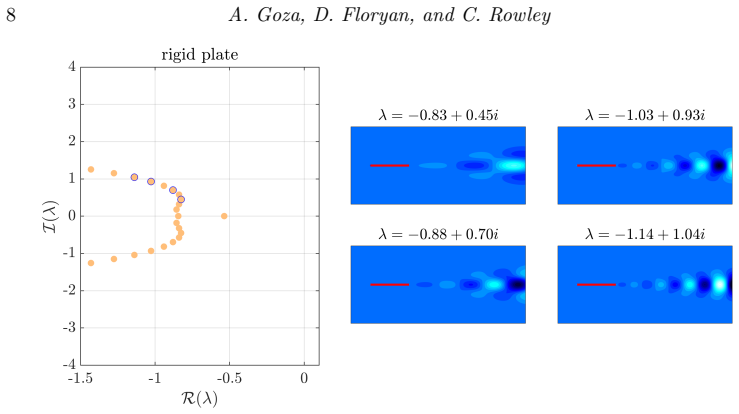
The carrying object is the global linear stability mode of the fully coupled fluid-structure system: eigenvalues $\lambda_i$ and modes $\varphi_i$ of the generalized problem $\lambda_i M \varphi_i = A \varphi_i$, where $M$ is the singular mass matrix and $A$ is the linearization of the spatially discrete Navier-Stokes and beam system about a stationary base state. Each mode is scored by the energy ratio $E_r = E_\text{plate}/(E_\text{plate}+E_\text{flow})$, computed from the eigenvector; the resonant frequency is the imaginary part of the eigenvalue with the largest $E_r$. This object does the work of defining resonance without ambiguous vacuum-beam scalings or finite-amplitude response criteria, and it provides a concrete frequency against which the nonlinear simulations are compared.
What would settle it
Compute the global modes linearized about a time-periodic base state that reproduces the $h_0 = 0.01$ heave motion; if the mode with the largest energy ratio has a frequency that differs from the stationary-base-state resonant frequency by more than the frequency resolution used here ($\Delta f = 0.1$), the claimed unambiguous resonance definition is not robust to the base state. Equivalently, re-define $E_r$ using only bending strain energy or only plate kinetic energy; if the predicted resonant frequency shifts materially, the resonance metric is an artifact of the chosen weighting.
Extended reading notes
Core claim
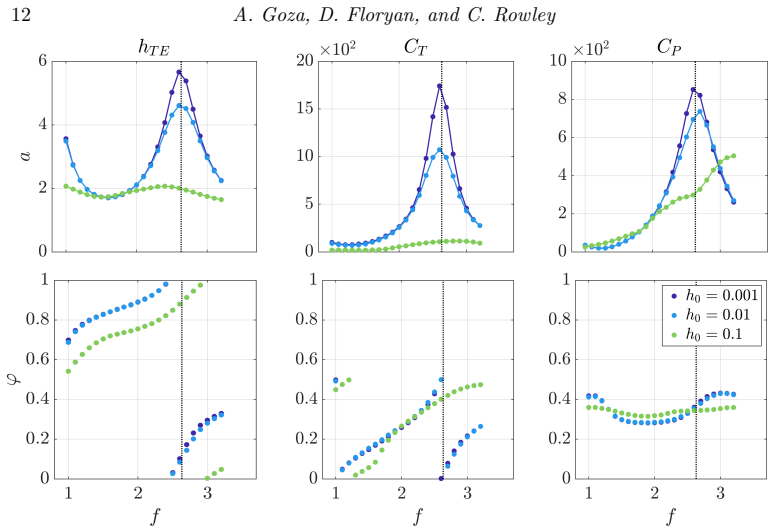
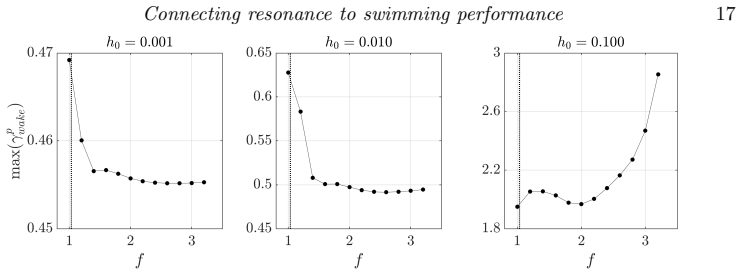
The central claim is that a fully coupled viscous fluid-plate system has a well-defined resonant frequency, obtained from the eigenvalues of the global linear stability problem linearized about the stationary state, and that this frequency organizes swimming performance. The resonant frequency is taken to be the imaginary part of the eigenvalue whose mode maximizes the energy ratio $E_r = E_\text{plate}/(E_\text{plate}+E_\text{flow})$, which weights modes by how much energy they put into the plate. For small heave amplitudes ($h_0 \le 0.01$) the trailing-edge amplitude, thrust, and input power all peak at or very near this frequency for every stiffness studied ($S=0.02$ to $20$), and the plate shape in the nonlinear simulations matches the corresponding eigenmode. At larger amplitude ($h_0=0.1$) the peaks broaden, weaken, and shift slightly, and nonlinear mechanisms—leading-edge separation, asymmetric wakes, aperiodic dynamics, qualitatively different input-power phase behavior—become visible, but for flexible plates the resonant frequency still marks the frequency of maximal wake circulation and near-maximal thrust. The paper concludes that resonance is a genuine, identifiable contributor to finite-amplitude swimming performance in viscous flow, not merely a linear artifact.
Load-bearing premise
The argument rests on identifying resonance with the frequency of the single global mode that maximizes the energy ratio $E_r$, computed about a stationary base state, and assuming that this same mode still governs finite-amplitude heaving.
Editorial extensions
If this is right
- At small heave amplitudes ($h_0 \le 0.01$), peaks in trailing-edge amplitude, thrust, and input power all occur near the resonant frequency defined by the global mode with the largest energy ratio.
- As heave amplitude increases to $h_0 = 0.1$, the resonant peaks broaden, weaken, and shift slightly in frequency, consistent with an effective damping supplied by nonlinear fluid mechanisms.
- For all stiffnesses considered, maximum mean thrust occurs at or near the frequency of maximum wake circulation, which for flexible plates sits close to the resonant frequency.
- At large amplitude and higher stiffness, leading-edge separation can appear without necessarily destroying performance, while for $S=2$ at $f>2.4$ it drives aperiodic dynamics and thrust peaks well away from resonance.
- Because the resonance definition is amplitude-independent, the same linear stability framework can be carried over to other parameter regimes and to flexible-wing flight, where the plate inertia relative to the flow differs.
Reading between the lines
- Editorial inference: The energy ratio $E_r$ weights total plate energy against total system energy, but other plausible weights, such as bending strain energy alone or flow kinetic energy alone, might select a different eigenvalue; a sensitivity sweep over energy weights would test whether the claimed unambiguous resonance frequency is robust.
- Editorial inference: The global modes here are computed about a stationary base state; repeating the analysis about a time-periodic base state that reproduces the finite-amplitude heave cycle would separate added-mass and damping shifts from nonlinear vortex effects, and would show whether the linear resonant frequency remains the right predictor at $h_0 = 0.1$.
- Editorial inference: The alignment of maximum mean thrust with maximum wake circulation suggests that a wake-circulation model built from linear global modes could serve as a cheap thrust predictor in regimes where leading-edge separation is weak.
- Editorial inference: The broadening and weakening of the resonant peaks resembles classical damping; if a single amplitude-dependent damping coefficient could collapse the peak height and width across all four stiffnesses, it would make the effective-damping interpretation quantitative.
Signed reviews
Editorial analysis
A structured set of objections, weighed in public.
Referee Report
Summary. The paper investigates whether resonance governs the swimming performance of a flexible heaving plate in a viscous fluid. It proposes a definition of resonance for the fully coupled fluid-structure system: the imaginary part of the eigenvalue of the global linear stability mode with the largest energy ratio Er = plate energy / (plate energy + flow kinetic energy), introduced in Eq. (4.1). Global eigenvalue computations are performed at Re = 240 and M = 0.01 for a range of stiffnesses, and high-fidelity nonlinear simulations are run at heave amplitudes h0 = 0.001, 0.01, and 0.1 for S = 0.02, 0.2, 2, 20, with frequency sweeps in increments of 0.1. At the smallest amplitude, peaks in trailing-edge amplitude, thrust, and input power occur near the Er-max natural frequency; at large amplitude the peaks broaden and weaken, the input power changes qualitatively, and leading-edge separation appears for stiff plates. The authors interpret these changes as the onset of non-resonant, nonlinear mechanisms and connect their observations to earlier high-Reynolds-number studies.
Significance. If the central claim holds, the paper provides a tractable and potentially unambiguous definition of resonance for viscous fluid-structure interaction and demonstrates that, at small amplitude, linear resonance organizes thrust and input-power peaks across a broad range of stiffnesses. The paper's strengths include machine-checked convergence of the eigenvalue computations (residual below 10^-8), a grid-convergence study in Appendix A, a nonlinear solver validated against prior work, and a systematic amplitude comparison using the scalings in Table 2. The falsifiable prediction that the Er-maximal mode frequency governs small-amplitude performance peaks is clearly stated. The main unresolved issue is whether the Er-max mode selection, rather than some other linear response measure, is the mechanism behind the observed peaks.
major comments (3)
- [§4, Eq. (4.1)] The central definition of resonance is the eigenvalue of the mode with the largest energy ratio Er, but the paper does not establish that this mode is the one most strongly excited by the prescribed leading-edge heave or that it dominates the harmonic forced response of the linearized system (3.2). Because the linearized FSI operator may be non-normal, forced-response peaks need not coincide with the eigenvalues of any single mode; a mode with large Er could have small projection onto the forcing or weak receptivity. The small-amplitude simulations at h0 = 0.001 are effectively a forced-response experiment, but they are sampled at Δf = 0.1 and only for four stiffness values, and they do not test alternative energy weightings. I recommend adding a direct linear forced-response calculation over the same frequency range, and reporting the sensitivity of the predicted resonant frequency to the definition of the energy ratio (for example, plate kinetic energy only, bending energy only, or flow kinetic energy only).
- [§3, Eq. (3.2)] The base state yb about which the global modes are computed is never specified. If yb is the steady uniform flow over an undeformed straight plate, the eigenvalue problem describes free (unforced) dynamics, and the link to the harmonically forced heaving plate is not formal: one must identify how the leading-edge heave enters the linearized equations and whether the forcing projects onto the Er-max mode. Please state yb explicitly and, if the connection is to be made through the nonlinear simulations, explain how the amplitude ramp of Eq. (3.3) ensures that the small-amplitude response is a perturbation about that same base state.
- [§5.2.4, Figs. 14–15] For S = 20, the resonant frequency f ≈ 3.1 is close to the upper end of the frequency sweep, leaving only a few data points beyond resonance. The statements that peaks occur 'near' resonance and 'broaden and weaken' at h0 = 0.1 are therefore weakly constrained for the stiffest case, and the broad peaks at f = 2.1–2.4 in Fig. 4 lie well below the resonant frequency. Extending the frequency range above 3.5, or refining the sampling around f = 3.1, would provide a clearer test of the resonance hypothesis for this stiffness.
minor comments (5)
- [Table 1 and §5.2.4] Table 1 lists the frequency range as 1–3.2, but §5.2.4 states that the range is f ∈ [1, 3.5] for S = 20; please reconcile these values.
- [Eq. (2.3)] The sign convention in the definition CP = -CL vLE should be stated explicitly, since positive input power must correspond to heaving against the lift force.
- [References] The reference to 'Criesfield 1991' appears to be a typo for Crisfield; please correct the spelling.
- [Appendix A] The grid-convergence study reports the plate-position error for one parameter combination at a single time instant; a sentence explaining why this case is representative of the full parameter sweep would strengthen the presentation.
- [Fig. 2] It is not stated how many eigenvalues are shown or how the subset with 'largest growth rate' is chosen; clarifying the selection criterion would help the reader understand whether the Er-max mode is always included.
Circularity Check
No significant circularity: the linear stability eigenvalues are computed independently of the nonlinear performance data, and the Er-based mode selection is a stated convention rather than a fitted parameter.
full rationale
The paper's central comparison is between the natural frequencies obtained from the linearized unforced FSI system and the performance peaks observed in forced nonlinear simulations. The eigenvalues are computed by solving lambda_i M phi_i = A phi_i, where A = dr/dy at the base state (Section 3, Eq. 3.2), and no performance quantity (h_TE, C_T, C_P) is used in that computation. The nonlinear simulation peaks for h0 = 0.001, 0.01, and 0.1 are independent forward outputs that could in principle disagree with the eigenvalue frequencies; the fact that they agree near the Er-max mode is an empirical finding, not a construction. The energy ratio Er (Eq. 4.1) is a selection rule for identifying which eigenvalue is structure-dominated, but the paper does not fit Er or the chosen frequency to the thrust, input power, or trailing-edge amplitude data. Thus the claim that 'peaks in trailing-edge motion and thrust occur near the resonant frequency' is a genuine prediction from the linear analysis. Self-citations (Goza & Colonius 2017; Goza et al. 2018) are used for numerical methods and global-mode formulation, providing independent method-level support rather than importing the paper's central conclusion. The known limitations, such as possible non-normality/receptivity effects of the linearized operator and the convention of maximizing Er, are scientific modeling choices or correctness risks, not circular steps.
Assumptions & free parameters
assumptions (4)
- domain assumption Two-dimensional Navier-Stokes flow and a geometrically nonlinear Euler-Bernoulli beam model the swimming plate at Re=240, M=0.01.
- domain assumption Linearization about the stationary base state y_b yields the natural frequencies that govern heaving response.
- ad hoc to paper The eigenvalue of the mode with the largest energy ratio Er is the system resonance relevant to swimming performance.
- domain assumption Heave amplitudes h0=0.001 and 0.01 are small enough that nonlinear effects are negligible, so their dynamics can be treated as linear.
Cite this review
Pith. "Pith review of Connections between resonance and nonlinearity in swimming performance of a flexible heaving plate." pith.science (2026). https://pith.science/paper/ZDBRE422
@misc{pith2026190805704,
  author       = {Pith},
  title        = {Pith review of: Connections between resonance and nonlinearity in swimming performance of a flexible heaving plate},
  year         = {2026},
  howpublished = {\url{https://pith.science/paper/ZDBRE422}},
  note         = {Machine review of arXiv:1908.05704}
}
read the original abstract
We investigate the role of resonance in finite-amplitude swimming of a flexible flat plate in a viscous fluid. The role of resonance in performance remains unclear for two reasons: i) a lack of definition of resonance for the fully-coupled fluid-structure interaction system in a viscous flow, and ii) the presence of nonlinear effects, which makes it difficult to disentangle resonant and non-resonant mechanisms in finite-amplitude swimming. We address point i) and provide an unambiguous definition for system resonance by computing global linear stability modes of the fully-coupled fluid-structure interaction system that account for the viscous fluid, the plate, and the coupling between them. We then resolve point ii) by considering high-fidelity nonlinear simulations of systematically increased amplitude. By comparing the results for different amplitudes with one another and with the linear stability modes, we separate linear and/or resonant effects from nonlinear and/or non-resonant effects. Resonant behavior is observed over a wide range of plate stiffnesses, with peaks in trailing-edge motion and thrust occurring near the resonant frequency defined by the global linear analysis. The peaks broaden and weaken with increasing heave amplitude, consistent with an increased damping effect from the fluid. At the same time, non-resonant mechanisms are present at large heave amplitudes. The input power exhibits qualitatively different dynamics at large heave amplitudes compared to smaller heave amplitudes, where resonance dominates. Moreover, leading-edge separation is present for stiff plates at large heave amplitudes, which can drastically alter the performance characteristics from what one would expect through linear predictions.
Figures


Figures from the paper (12 more)






Reference graph
Works this paper leans on
-
[1]
Journal of Fluid Mechanics 614, 355–380
Alben, Silas 2008 Optimal flexibility of a flapping appendage in an inviscid fluid. Journal of Fluid Mechanics 614, 355–380
work page 2008
-
[2]
Physics of Fluids 24 (5), 051901
Alben, Silas, Witt, Charles, Baker, T Vernon, Anderson, Erik & Lauder, George V 2012 Dynamics of freely swimming flexible foils. Physics of Fluids 24 (5), 051901
work page 2012
-
[3]
Computer Methods in Applied Mechanics and Engineering 197 (25), 2131–2146
Colonius, Tim & Taira, Kunihiko 2008 A fast immersed boundary method using a nullspace approach and multi-domain far-field boundary conditions. Computer Methods in Applied Mechanics and Engineering 197 (25), 2131–2146. Connecting resonance to swimming performance 21 Grid ∆x ∆t Smallest sub-domain size Total domain size ||χ−χf||∞ ||χf||∞ 1 0.0083 0.0004 [ −...
work page 2008
-
[4]
Criesfield, MA 1991 Non-linear finite element analysis of solids and structures, vol. 1 . Wiley, New York
work page 1991
-
[5]
Journal of Fluid Mechanics 732, 29–46
Smits, Alexander J 2013 Scaling laws for the thrust production of flexible pitching panels. Journal of Fluid Mechanics 732, 29–46
work page 2013
-
[6]
Ebert, David S, Musgrave, F Kenton, Peachey, Darwyn, Perlin, Ken & Worley, Steven 2003 Texturing & modeling: a procedural approach. Morgan Kaufmann
work page 2003
-
[7]
Journal of Computational Physics 336, 401–411
Goza, Andres & Colonius, Tim 2017 A strongly-coupled immersed-boundary formulation for thin elastic structures. Journal of Computational Physics 336, 401–411
work page 2017
-
[8]
Journal of Fluid Mechanics 857, 312–344
Goza, Andres, Colonius, Tim & Sader, John Elie 2018 Global modes and nonlinear analysis of inverted-flag flapping. Journal of Fluid Mechanics 857, 312–344
work page 2018
Show all 19 references
-
[9]
Journal of Computational Physics 321, 860–873
Goza, Andres, Liska, Sebastian, Morley, Benjamin & Colonius, Tim 2016 Accurate computation of surface stresses and forces with immersed boundary methods. Journal of Computational Physics 321, 860–873
2016
-
[10]
Physics of Fluids 25 (12), 121901
Hua, Ru-Nan, Zhu, Luoding & Lu, Xi-Yun 2013 Locomotion of a flapping flexible plate. Physics of Fluids 25 (12), 121901
2013
-
[11]
Lehoucq, Richard B, Sorensen, Danny C & Yang, Chao 1998 ARPACK users’ guide: solution of large-scale eigenvalue problems with implicitly restarted Arnoldi methods . SIAM
1998
-
[12]
Physics of Fluids 21 (7), 071902
Michelin, S ´ebastien & Llewellyn Smith, Stefan G 2009 Resonance and propulsion performance of a heaving flexible wing. Physics of Fluids 21 (7), 071902
2009
-
[13]
Physics of Fluids 26 (4), 041905
Moored, KW, Dewey, PA, Boschitsch, BM, Smits, AJ & Haj-Hariri, H 2014 Linear instability mechanisms leading to optimally efficient locomotion with flexible propulsors. Physics of Fluids 26 (4), 041905
2014
-
[14]
Journal of Fluid Mechanics 738, 250–267
Quinn, Daniel B, Lauder, George V & Smits, Alexander J 2014 Scaling the propulsive performance of heaving flexible panels. Journal of Fluid Mechanics 738, 250–267
2014
-
[15]
Proceedings of the National Academy of Sciences 108 (15), 5964–5969
Ramananarivo, Sophie, Godoy-Diana, Ramiro & Thiria, Benjamin 2011 Rather than resonance, flapping wing flyers may play on aerodynamics to improve performance. Proceedings of the National Academy of Sciences 108 (15), 5964–5969
2011
-
[16]
Journal of Experimental Biology 212 (1), 95–105
Balachandran, Balakumar 2009 Influence of flexibility on the aerodynamic performance of a hovering wing. Journal of Experimental Biology 212 (1), 95–105
2009
-
[17]
American Zoologist 23 (2), 709–725
Webb, Paul W 1988 Simple physical principles and vertebrate aquatic locomotion. American Zoologist 23 (2), 709–725
1988
-
[18]
Journal of Fluids and Structures 74, 385–400
Zhang, Yang, Zhou, Chunhua & Luo, Haoxiang 2017 Effect of mass ratio on thrust production of an elastic panel pitching or heaving near resonance. Journal of Fluids and Structures 74, 385–400
2017
-
[19]
Journal of Fluid Mechanics 751, 164–183
Zhu, Xiaojue, He, Guowei & Zhang, Xing 2014 How flexibility affects the wake symmetry properties of a self-propelled plunging foil. Journal of Fluid Mechanics 751, 164–183
2014
Reviewed August 14, 2026 · model on record in the stance chip above.
Discussion (0). Continue with ORCID to comment.