On Erlang mixture approximations for differential equations with distributed time delays
Pith reviewed 2026-05-23 02:48 UTC · model grok-4.3
The pith
Erlang mixture approximations convert distributed-delay equations into ordinary differential equations whose solutions converge for continuous bounded kernels.
A machine-rendered reading of the paper's core claim, the machinery that carries it, and where it could break.
Core claim
The paper claims that an Erlang mixture approximation to the delay kernel, when combined with the linear chain trick, produces a system of ordinary differential equations whose solutions converge to those of the original distributed-delay equation as the number of terms grows sufficiently rapidly, for any continuous and bounded kernel. The resulting ODE system can determine the stability of the DDE's steady states, and the convergence holds for the solutions themselves when the kernel is exponentially bounded as well. An auxiliary procedure using bisection and least-squares finds suitable coefficients for the mixture.
What carries the argument
Erlang mixture approximation of the delay kernel, transformed by the linear chain trick into an equivalent system of ordinary differential equations.
Load-bearing premise
The delay kernel is continuous and bounded.
What would settle it
A continuous and bounded kernel for which the Erlang mixture approximation fails to converge to the original DDE no matter how rapidly the number of terms increases.
Figures


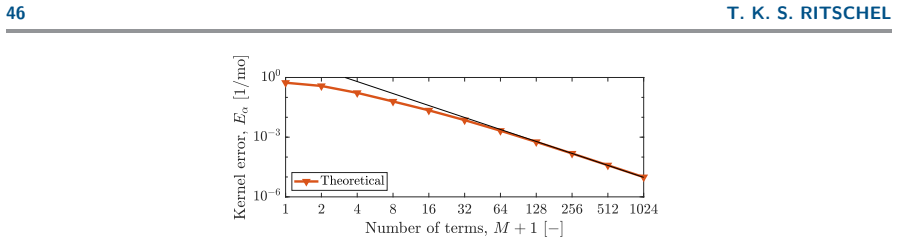
read the original abstract
In this paper, we propose a general approach for approximate simulation and analysis of delay differential equations (DDEs) with distributed time delays based on methods for ordinary differential equations (ODEs). The key innovation is that we 1) propose an Erlang mixture approximation of the kernel in the DDEs and 2) use the linear chain trick to transform the resulting approximate DDEs to ODEs. Furthermore, we prove that the approximation converges for continuous and bounded kernels and for specific choices of the coefficients if the number of terms increases sufficiently fast. We show that the approximate ODEs can be used to assess the stability of the steady states of the original DDEs and that the solution to the ODEs converges if the kernel is also exponentially bounded. Additionally, we propose an approach based on bisection and least-squares estimation for determining optimal parameter values in the approximation. Finally, we present numerical examples that demonstrate the accuracy and convergence rate obtained with the optimal parameters and the efficacy of the proposed approach for bifurcation analysis and Monte Carlo simulation. The numerical examples involve a modified logistic equation, chemotherapy-induced myelosuppression, and a point reactor kinetics model of a molten salt nuclear fission reactor.
Editorial analysis
A structured set of objections, weighed in public.
Referee Report
Summary. The paper proposes an Erlang mixture approximation to distributed delay kernels in DDEs, converted to ODEs via the linear chain trick. It claims to prove convergence of the approximation to the original DDE for continuous and bounded kernels when the number of mixture terms increases sufficiently fast under specific coefficient choices. It further claims that the resulting ODEs preserve the ability to assess stability of DDE equilibria and that solutions converge when the kernel is additionally exponentially bounded. A bisection-plus-least-squares method is given for selecting the mixture coefficients, and numerical examples on a modified logistic equation, a chemotherapy myelosuppression model, and a molten-salt reactor kinetics model illustrate accuracy, convergence rates, bifurcation analysis, and Monte Carlo simulation.
Significance. If the stated convergence and stability results hold with the claimed rigor, the work supplies a systematic, theoretically supported route for replacing distributed-delay DDEs by finite-dimensional ODEs, which would be useful for simulation, bifurcation studies, and stochastic analysis in applications. The explicit proofs of convergence for continuous bounded kernels and of stability preservation constitute a clear strength, as does the provision of a concrete parameter-selection procedure and the demonstration on three distinct models.
major comments (2)
- [Convergence theorem (§3)] Convergence theorem (abstract and §3): the claim that convergence holds 'for specific choices of the coefficients if the number of terms increases sufficiently fast' is central, yet the manuscript supplies neither an explicit rate nor an a-priori error bound in terms of the number of terms and the kernel's modulus of continuity; without such a quantitative estimate the practical prescription for choosing the truncation level remains incomplete.
- [Stability assessment] Stability section: the assertion that the approximate ODEs 'can be used to assess the stability of the steady states of the original DDEs' requires showing that the characteristic roots (or Lyapunov exponents) of the ODE system converge to those of the DDE; the manuscript does not appear to supply a perturbation argument or spectral convergence result that would justify this transfer for finite truncations.
minor comments (3)
- [Method section] The description of the linear-chain-trick transformation would benefit from an explicit block-matrix form of the resulting ODE system to make the dimension and coupling transparent.
- [Numerical examples] Figure captions for the numerical examples should state the number of mixture terms used and the achieved L^∞ or L^2 error relative to a reference solution.
- [Parameter selection] The least-squares objective used in the bisection procedure is not written out; an explicit formula would clarify what quantity is being minimized.
Simulated Author's Rebuttal
We thank the referee for the careful reading and constructive feedback on our manuscript. The comments highlight important aspects that can strengthen the presentation of our results. We address each major comment below and indicate the revisions we will make.
read point-by-point responses
-
Referee: [Convergence theorem (§3)] Convergence theorem (abstract and §3): the claim that convergence holds 'for specific choices of the coefficients if the number of terms increases sufficiently fast' is central, yet the manuscript supplies neither an explicit rate nor an a-priori error bound in terms of the number of terms and the kernel's modulus of continuity; without such a quantitative estimate the practical prescription for choosing the truncation level remains incomplete.
Authors: The convergence theorem establishes that the Erlang mixture approximations converge to the original DDE for continuous bounded kernels under the specified conditions on the coefficients and sufficiently rapid increase in the number of terms. While the proof is based on approximation properties that guarantee convergence without an explicit rate, we recognize that providing an a-priori error bound would be beneficial for practical applications. We will revise Section 3 to include a quantitative error estimate derived from the modulus of continuity of the kernel, using standard results from approximation theory for mixtures of Erlang distributions. This will also clarify the choice of truncation level in the numerical procedure. revision: yes
-
Referee: [Stability assessment] Stability section: the assertion that the approximate ODEs 'can be used to assess the stability of the steady states of the original DDEs' requires showing that the characteristic roots (or Lyapunov exponents) of the ODE system converge to those of the DDE; the manuscript does not appear to supply a perturbation argument or spectral convergence result that would justify this transfer for finite truncations.
Authors: We show in the manuscript that the solutions converge when the kernel is exponentially bounded, which provides indirect support for stability assessment. However, to directly justify the use for stability analysis of finite truncations, a spectral convergence result is indeed desirable. We will add a new subsection or appendix providing a perturbation argument demonstrating that the characteristic roots of the approximate system converge to those of the DDE as the mixture approximation improves, leveraging the continuity of the spectrum with respect to the delay kernel in an appropriate topology. revision: yes
Circularity Check
No significant circularity; derivation self-contained
full rationale
The paper establishes convergence of an Erlang-mixture kernel approximation to DDEs (via the linear chain trick) for continuous bounded kernels when the number of terms grows sufficiently fast, plus stability and solution convergence under an added exponential bound. These results are stated as theorems with explicit domain assumptions and coefficient conditions; the bisection/least-squares parameter method is a separate computational procedure. No quoted step reduces a claimed prediction or uniqueness result to a fitted input, self-citation chain, or definitional equivalence by the paper's own equations. The central claims remain independent of the paper's fitted values or prior self-references.
Axiom & Free-Parameter Ledger
free parameters (1)
- Erlang mixture coefficients
axioms (2)
- domain assumption The delay kernel is continuous and bounded
- domain assumption The kernel is exponentially bounded
Reference graph
Works this paper leans on
-
[1]
I. Al-Darabsah, S. A. Campbell, and B. Rahman , Distributed delay and desynchronization in a neural mass model , SIAM Journal on Applied Dynamical Systems, 23 (2024), pp. 3013–3051, https: //doi.org/10.1137/23M1618028
-
[2]
A. Aleksandrov, D. Efimov, and E. Fridman , Analysis of homogeneous systems with distributed delay using averaging approach , IFAC PapersOnLine, 56 (2023), pp. 174–179, https://doi.org/10. 1016/j.ifacol.2023.10.1565
work page 2023
-
[3]
A. Aleksandrov, D. Efimov, and E. Fridman , On stability of nonlinear homogeneous systems with distributed delays having variable kernels , Systems and Control Letters, 190 (2024), p. 105853, https: //doi.org/10.1016/j.sysconle.2024.105853
-
[4]
O. Bazighifan, E. M. Elabbasy, and O. Moaaz , Oscillation of higher-order differential equations with distributed delay, Journal of Inequalities and Applications, 2019 (2019), https://doi.org/10.1186/ s13660-019-2003-0
work page 2019
-
[5]
A. Bellen, Numerical methods for delay differential equations: Accuracy and stability problems , IFAC Proceedings Volumes, 33 (2000), pp. 127–128, https://doi.org/10.1016/S1474-6670(17)36928-8
-
[6]
H. Bergland, P. Mishra, P. A. Pedersen, A. Ponossov, and J. Wyller, Time delays and pollution in an open-access fishery, Natural Resource Modeling, 36 (2022), p. e12363, https://doi.org/10.1111/ nrm.12363
work page 2022
-
[7]
T. Cassidy, Distributed delay differential equation representations of cyclic differential equations , SIAM Journal of Applied Mathematics, 81 (2021), pp. 1742–1766, https://doi.org/10.1137/20M1351606
-
[8]
T. Cassidy, M. Craig, and A. R. Humphries, Equivalences between age structured models and state de- pendent distributed delay differential equations, Mathematical Biosciences and Engineering, 16 (2019), pp. 5419–5450, https://doi.org/10.3934/mbe.2019270
-
[9]
T. Cassidy, P. Gillich, A. R. Humphries, and C. H. van Dorp , Numerical methods and hypoexpo- nential approximations for gamma distributed delay differential equations , IMA Journal of Applied Mathematics, 87 (2022), pp. 1043–1089, https://doi.org/10.1093/imamat/hxac027
-
[10]
J. M. Cushing, An operator equation and bounded solutions of integro-differential systems, SIAM Journal on Mathematical Analysis, 6 (1975), pp. 433–445, https://doi.org/10.1137/0506038
-
[11]
J. M. Cushing, Integrodifferential equations and delay models in population dynamics, vol. 20 of Lectures Notes in Biomathematics, Springer, 1977, https://doi.org/10.1007/978-3-642-93073-7
-
[12]
O. Diekmann, M. Gyllenberg, and J. A. J. Metz , Finite dimensional state representation of linear and nonlinear delay systems , Journal of Dynamics and Differential Equations, 30 (2018), pp. 1439– 1467, https://doi.org/10.1007/s10884-017-9611-5. 38 T. K. S. RITSCHEL
-
[13]
O. Diekmann, M. Gyllenberg, and J. A. J. Metz , Finite dimensional state representation of physiologically structured populations , Journal of Mathematical Biology, 80 (2020), pp. 205–273, https://doi.org/10.1007/s00285-019-01454-0
-
[14]
HPC.0001, https://doi.org/10.48714/DTU.HPC.0001
DTU Computing Center , DTU Computing Center resources , 2025, https://doi.org/10.48714/DTU. HPC.0001, https://doi.org/10.48714/DTU.HPC.0001
-
[15]
J. J. Duderstadt and L. J. Hamilton , Nuclear reactor analysis, Wiley, 1976
work page 1976
-
[16]
A. S. Eremin , Runge-Kutta methods for differential equations with distributed delays , AIP Conference Proceedings, 2116 (2019), p. 140003, https://doi.org/10.1063/1.5114130
-
[17]
L. Guerrini, A. Krawiec, and M. Szyd lowski , Bifurcations in an economic growth model with a distributed time delay transformed to ODE , Nonlinear Dynamics, 101 (2020), pp. 1263–1279, https: //doi.org/10.1007/s11071-020-05824-y
-
[18]
N. Guglielmi and E. Hairer , Applying stiff integrators for ordinary differential equations and delay differential equations to problems with distributed delays , SIAM Journal on Scientific Computing, 47 (2025), pp. A102–A123, https://doi.org/10.1137/24M1632413
-
[19]
L.-S. Hahn and B. Epstein , Classical complex analysis, Jones and Bartlett Books in Mathematics and Computer Science, Jones and Bartlett, 1996
work page 1996
- [20]
-
[21]
J. K. Hale and S. M. V. Lunel , Introduction to functional differential equations , vol. 99 of Applied Mathematical Sciences, Springer, 1993, https://doi.org/10.1007/978-1-4612-4342-7
-
[22]
R. A. Horn and C. R. Johnson , Topics in matrix analysis , Cambridge University Press, 1991, https: //doi.org/10.1017/CBO9780511840371
-
[23]
R. A. Horn and C. R. Johnson , Matrix Analysis, Cambridge University Press, 2nd ed., 2012, https: //doi.org/10.1017/CBO9781139020411
-
[24]
S. Hu, M. Dunlavey, S. Guzy, and N. Teuscher , A distributed delay approach for modeling delayed outcomes in pharmacokinetics and pharmacodynamics studies, Journal of Pharmacokinetics and Phar- macodynamics, 45 (2018), pp. 285–308, https://doi.org/10.1007/s10928-018-9570-4
-
[25]
C. Huang and S. Vandewalle, An analysis of delay-dependent stability for ordinary and partial differ- ential equations with fixed and distributed delays , SIAM Journal on Scientific Computing, 25 (2004), pp. 1608–1632, https://doi.org/10.1137/S1064827502409717
-
[26]
P. J. Hurtado and A. S. Kirosingh , Generalizations of the ‘Linear Chain Trick’: Incorporating more flexible dwell time distributions into mean field ODE models , Journal of Mathematical Biology, 79 (2019), pp. 1831–1883, https://doi.org/10.1007/s00285-019-01412-w
-
[27]
P. J. Hurtado and C. Richards , A procedure for deriving new ODE models: Using the generalized linear chain trick to incorporate phase-type distributed delay and dwell time assumptions, Mathematics in Applied Sciences and Engineering, 1 (2020), pp. 412–424, https://doi.org/10.5206/mase/10857
-
[28]
P. J. Hurtado and C. Richards , Building mean field ODE models using the generalized linear chain trick & Markov chain theory , Journal of Biological Dynamics, 15 (2021), pp. S248–S272, https://doi. org/10.1080/17513758.2021.1912418
-
[29]
O. C. Ibe , Fundamentals of applied probability and random processes , Elsevier, 2nd ed., 2014, https: //doi.org/10.1016/C2013-0-19171-4
-
[30]
O. Kallenberg , Foundations of modern probability , Springer, 2002, https://doi.org/10.1007/ 978-3-030-61871-1
work page 2002
-
[31]
V. Kolmanovskii and A. Myshkis, Applied theory of functional differential equations , vol. 85 of Math- ematics and Its Applications, Springer, 1992, https://doi.org/10.1007/978-94-015-8084-7
-
[32]
Korevaar, Mathematical methods, vol
J. Korevaar, Mathematical methods, vol. 1, Academic Press, 1968
work page 1968
-
[33]
W. Krzyzanski, Ordinary differential equation approximation of gamma distributed delay model , Jour- nal of Pharmacokinetics and Pharmacodynamics, 46 (2019), pp. 53–63, https://doi.org/10.1007/ s10928-018-09618-z
work page 2019
-
[34]
W. Krzyzanski, S. Hu, and M. Dunlavey , Evaluation of performance of distributed delay model for chemotherapy-induced myelosuppresion, Journal of Pharmacokinetics and Pharmacodynamics, 45 (2018), pp. 329–337, https://doi.org/10.1007/s10928-018-9575-z
-
[35]
S. Q. B. Leite, M. T. de Vilhena, and B. E. J. Bodmann , Solution of the point reactor kinetics equations with temperature feedback by the ITS2 method , Progress in Nuclear Energy, 91 (2016), MIXTURE APPROXIMATIONS FOR DISTRIBUTED TIME DELAYS 39 pp. 240–249, https://doi.org/10.1016/j.pnucene.2016.05.001
-
[36]
MacDonald, Time lags in biological models , vol
N. MacDonald, Time lags in biological models , vol. 27 of Lecture Notes in Biomathematics, Springer, 1978, https://doi.org/10.1007/978-3-642-93107-9
-
[37]
R. K. Miller , Asymptotic stability and perturbations for linear Volterra integrodifferential systems , in Delay and Functional Differential Equations and Their Applications, K. Schmitt, ed., Academic Press, 1972, pp. 257–268, https://doi.org/10.1016/B978-0-12-627250-5.50015-0
-
[38]
D. H. Nevermann and C. Gros, Mapping dynamical systems with distributed time delays to sets of ordi- nary differential equations, Journal of Physics A: Mathematical and Theoretical, 56 (2023), p. 345702, https://doi.org/10.1088/1751-8121/acea06
-
[39]
S.-I. Niculescu and K. Gu , eds., Advances in time-delay systems , vol. 38 of Lecture Notes in Compu- tational Science and Engineering, Springer, 2004, https://doi.org/10.1007/978-3-642-18482-6
-
[40]
A. D. Polyanin, V. G. Sorokin, and A. I. Zhurov , Delay ordinary and partial differential equations , Advances in Applied Mathematics, CRC Press, 2023, https://doi.org/10.1201/9781003042310
-
[41]
A. Ponosov, A. Shindiapin, and J. J. Miguel , The W-transform links delay and ordinary differential equations, Functional Differential Equations, 9 (2002), pp. 437–469
work page 2002
-
[42]
M. H. Protter and C. B. Morrey, Jr., Intermediate Calculus, Undergraduate Texts in Mathematics, Springer, 2nd ed., 1985, https://doi.org/10.1007/978-1-4612-1086-3
-
[43]
B. Rahman, K. B. Blyuss, and Y. N. Kyrychko , Dynamics of neural systems with discrete and distributed time delays , SIAM Journal on Applied Dynamical Systems, 14 (2015), pp. 2069–2095, https://doi.org/10.1137/15M1006398
- [44]
-
[45]
T. K. S. Ritschel and J. Wyller, An algorithm for distributed time delay identification without a priori knowledge of the kernel , Automatica, 178 (2025), p. 112382, https://doi.org/10.1016/j.automatica. 2025.112382
-
[46]
P. J. Roache, Code verification by the method of manufactured solutions , Journal of Fluids Engineering, 124 (2002), pp. 4–10, https://doi.org/10.1115/1.1436090
-
[47]
D. Romik , Stirling’s approximation for n!: The ultimate short proof? , The American Mathematical Monthly, 107 (2000), pp. 556–557, https://doi.org/10.1080/00029890.2000.12005235
-
[48]
H. L. Royden and P. M. Fitzpatrick , Real analysis, Pearson, 4th ed., 2010
work page 2010
-
[49]
L. F. Shampine and S. Thompson , Solving DDEs in Matlab, Applied Numerical Mathematics, 37 (2001), pp. 441–458, https://doi.org/10.1016/S0168-9274(00)00055-6
-
[50]
Smith, An introduction to delay differential equations with applications to the life sciences , vol
H. Smith, An introduction to delay differential equations with applications to the life sciences , vol. 57 of Texts in Applied Mathematics, Springer, 2011, https://doi.org/10.1007/978-1-4419-7646-8
-
[51]
H. C. Tijms , Stochastic models: An algorithmic approach , Wiley Series in Probability and Statistics, Wiley, 1995
work page 1995
-
[52]
S. Torkamani, E. A. Butcher, and F. A. Khasawneh , Parameter identification in periodic delay differential equations with distributed delay , Communications in Nonlinear Science and Numerical Simulation, 18 (2013), pp. 1016–1026, https://doi.org/10.1016/j.cnsns.2012.09.001
-
[53]
Y. Wang, Y. Cong, and G. Hu , Delay-dependent stability of linear multistep methods for differential systems with distributed delays , Applied Mathematics and Mechanics, 39 (2018), pp. 1837–1844, https://doi.org/10.1007/s10483-018-2392-9
-
[54]
D. Wooten and J. J. Powers , A review of molten salt reactor kinetics models , Nuclear Science and Engineering, 191 (2018), pp. 203–230, https://doi.org/10.1080/00295639.2018.1480182
-
[55]
X. Yan, R. Bauer, G. Koch, J. Schropp, J. J. P. Ruixo, and W. Krzyzanski , Delay differen- tial equations based models in NONMEM , Journal of Pharmacokinetics and Pharmacodynamics, 48 (2021), pp. 763–802, https://doi.org/10.1007/s10928-021-09770-z
-
[56]
Y. Yuan and J. B ´elair, Stability and Hopf bifurcation analysis for functional differential equation with distributed delay , SIAM Journal on Applied Dynamical Systems, 10 (2011), pp. 551–581, https: //doi.org/10.1137/100794493
-
[57]
Zhang , The Schur complement and its applications , vol
F. Zhang , The Schur complement and its applications , vol. 4 of Numerical Methods and Algorithms, Springer, 2005, https://doi.org/10.1007/b105056
-
[58]
G. Zhang and A. Xiao , Exact and numerical stability analysis of reaction-diffusion equations with 40 T. K. S. RITSCHEL distributed delays , Frontiers of Mathematics in China, 11 (2016), pp. 189–205, https://doi.org/10. 1007/s11464-015-0506-7
work page 2016
-
[59]
Z. Zhou, Statistical inference of distributed delay differential equations , PhD thesis, University of Iowa, 2016, https://doi.org/10.17077/etd.xgcff76n. Appendix A. Derivation of the linear chain trick. Proof of Theorem 5.1. First, we introduce the auxiliary memory state ˆzm,i : R → R given by ˆzm,i(t) = tZ −∞ ℓm,i(t − s)ˆri(s) ds, m = 0, . . . , Mi, i =...
discussion (0)
Sign in with ORCID, Apple, or X to comment. Anyone can read and Pith papers without signing in.