REVIEW 2 major objections 6 minor 1 cited by
Algebraic Representations for Volumetric Frame Fields
T0 review · 2 major / 6 minor · reviewed 2026-08-14 · deepseek-v4-flash
Pith's one-line read This paper proves that octahedral frame space is isometric to the quotient SO(3)/O and introduces odeco frames, giving closed-form geodesics and semidefinite-projection-based exact projection for volumetric frame field optimization.
desk verdict Strong geometry-processing paper with a real theoretical contribution and an honest but load-bearing conjecture about projection exactness. read the letter →
The pith
A machine-rendered reading of the paper's core claim, the machinery that carries it, and where it could break.
The reading
What carries the argument
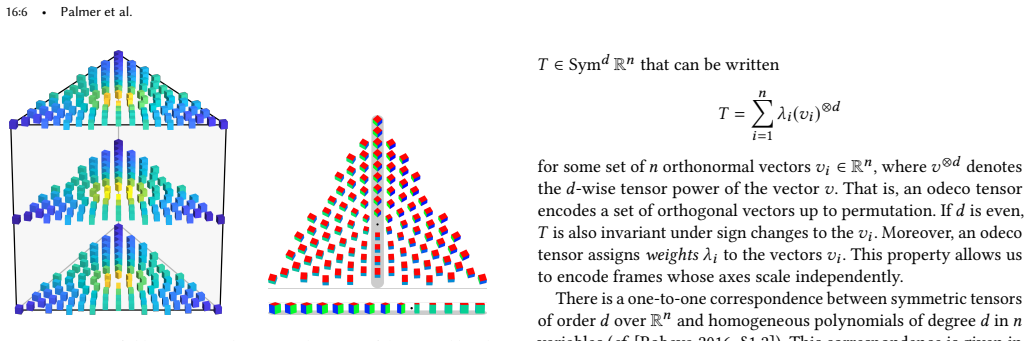
The central object is the octahedral variety $\mathcal{F} = \{\rho(r) q_0 : r \in SO(3)\}$ in $\mathbb{R}^9$, with canonical frame $q_0$; the identity $\langle L_i q, L_j q\rangle = \delta_{ij}$ for the induced Lie algebra action proves the embedding is isometric up to scale, so geodesics on the variety are push-forwards of geodesics on $SO(3)$. The second mechanism is the description of both frame spaces as quadratic varieties: 15 inhomogeneous quadrics cut out $\mathcal{F}$ and 27 homogeneous quadrics cut out the odeco variety $\widetilde{\mathcal{F}} \subset \mathbb{R}^{15}$. These equations convert Euclidean projection into a quadratically constrained quadratic program whose semidefinite relaxation is exact near smooth points by Theorem 4.1, and empirically returns rank-one globally optimal solutions generically; rank-one recovery is what turns a lower bound into an exact projection.
What would settle it
Take a random point in $\mathbb{R}^9$ (or $\mathbb{R}^{15}$ for odeco frames), especially a point reached by a diffusion step, solve the semidefinite program, and inspect the eigenvalue ratio $\lambda_2(Q^*)/\lambda_1(Q^*)$. A single instance where this ratio is not essentially zero and the recovered point is not the true Euclidean projection would refute Conjectures 4.2 and 4.3 and invalidate the exact-projection claim.
Extended reading notes
Core claim
The paper's central claim is that the rotation-orbit map $r \mapsto \rho(r) q_0$, where $\rho$ is the fourth-band spherical-harmonic representation and $q_0$ is the canonical octahedral frame in $\mathbb{R}^9$, is a local isometry from $SO(3)$ to the scaled octahedral variety $\mathcal{F}_\alpha$ with $\alpha=\sqrt{3/20}$, so the frame space is isometric to the quotient $SO(3)/O$ (Proposition 3.6). As a consequence geodesics on the octahedral variety have closed-form expressions. The paper further describes both the octahedral variety and the larger odeco variety—fourth-order orthogonally decomposable tensors whose axes scale independently—by explicit quadric equations, and casts Euclidean projection onto either variety as a semidefinite program. The relaxation is proven exact near smooth points via a stability theorem (Theorem 4.1), and the paper conjectures, with $10^6$ random trials per variety as evidence, that it is exact generically, so the SDP returns the globally closest frame. Odeco frames allow a singular curve to carry a nonzero tangent direction while the two normal directions shrink to zero, behavior that octahedral frames cannot represent.
Load-bearing premise
The whole projection pipeline rests on the assumption that the convex relaxation always finds the true closest frame—not just for points near the frame space but for every point the optimization will ever ask about; the paper proves this only locally and leaves the general case as a conjecture.
Editorial extensions
If this is right
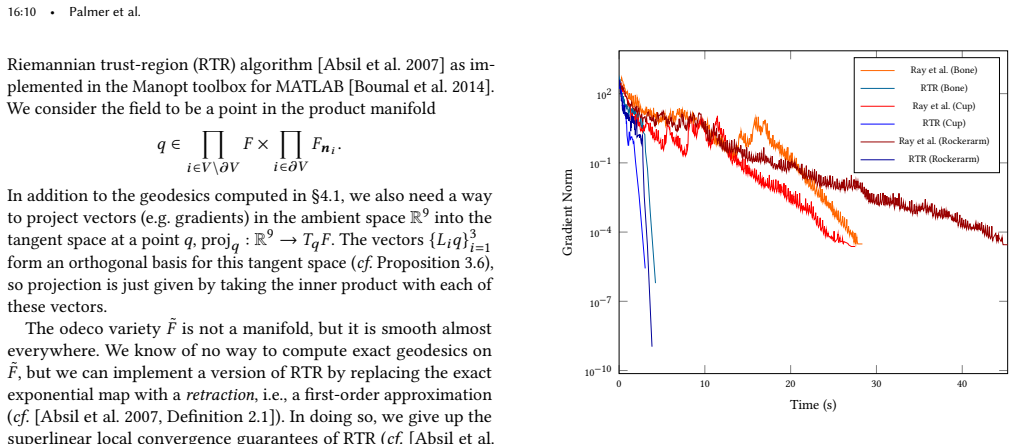
- Octahedral field optimization can be run as Riemannian trust-region optimization with closed-form geodesics, giving quadratic local convergence instead of slow Euler-angle optimization.
- Projection onto frame varieties becomes a polynomial-time, globally optimal operation in the regime where the relaxation is exact, removing the local-minimum failures of prior projection heuristics (about 0.6% of 100,000 trials in the paper's comparison).
- Odeco fields resolve singular curves with a nonzero tangent direction and vanishing normal directions, and their energy plateaus under mesh refinement, while octahedral energy diverges logarithmically.
- MBO-style diffusion-generated optimization using these projections, with an annealing schedule on the diffusion time, produces fields with lower Dirichlet energy and more regular singular structures, yielding hex meshes with fewer degeneracies.
- The algebraic equations for both varieties are quadratic, so boundary-aligned frames also form quadratically-defined varieties and admit the same SDP projection machinery.
Reading between the lines
- The same orbit-stabilizer construction could generate isometric embeddings and geodesic formulas for other frame symmetries, such as tetrahedral or icosahedral fields, by choosing the corresponding finite subgroup instead of O; the paper does not develop this.
- The SDP exactness conjectures likely fail at or near the odeco variety's singular origin, which is why the paper restricts the odeco conjecture to positive polynomials; a systematic probe of indefinite or near-zero queries would map the true exactness region.
- Because odeco fields have finite energy at singular curves, they may provide a continuum setting for studying hex-meshability conditions, potentially linking field energy to meshability more directly than Dirichlet energy alone.
- The closed-form frame geodesics could be used outside meshing, for example in interpolation and deformation of oriented microstructure or in any optimization over unoriented 3D frames.
Signed reviews
Editorial analysis
A structured set of objections, weighed in public.
Referee Report
Summary. The paper develops algebraic-geometric representations for 3D frame fields used in hexahedral meshing. It embeds the quotient SO(3)/O into R^9 via the fourth spherical-harmonic band, proves that this embedding is a local isometry up to scale (Proposition 3.6), and derives closed-form geodesics on the octahedral variety. It then introduces the larger 'odeco' variety of orthogonally decomposable fourth-order tensors, whose axes scale independently, and gives quadratic defining equations for both varieties. For these varieties the paper formulates Euclidean projection as a semidefinite program, proves local exactness via a stability theorem of Cifuentes et al., and conjectures global exactness supported by 10^6 random trials. These primitives are used in Riemannian trust-region and MBO-type diffusion-generated algorithms for computing smooth frame fields. Experiments on 15 models compare against Ray et al. and Gao et al., reporting lower Dirichlet energies, better symmetry, and fewer mesh degeneracies, with a MATLAB implementation provided.
Significance. If the conjectures hold, this is a substantial advance: the isometric embedding proof is elegant and parameter-free, the geodesic primitive is closed-form and reproducible, and the odeco generalization is a novel and natural representation for singular curves. The paper ships a MATLAB implementation and provides extensive experiments, including refinement studies showing that odeco field energy plateaus where octahedral energy diverges. The weaknesses are concentrated on the unproven global exactness of the SDP projection, which is the load-bearing primitive for the MBO algorithms; the reported evidence is broad but not targeted at the actual distribution of iterates, and no confidence intervals are given. Overall the theoretical core is sound and the practical claims are plausible, but the central computational guarantee needs to be either proven for the relevant input class or explicitly qualified.
major comments (2)
- [§4.2 (Conjectures 4.2–4.3) and §6.2 (Algorithm 1)] The exactness of the SDP projection is load-bearing for the MBO/mMBO algorithms, but Theorem 4.1 guarantees exactness only in a neighborhood of smooth points of the variety. The diffusion step (16) produces iterates that are not controlled by this neighborhood statement: they are smoothed fields that may lie near singular strata or far from the variety, especially early in the mMBO schedule with large τ. The paper's numerical support (10^6 random points for octahedral, and the positive-polynomial odeco case) does not sample the distribution of iterates generated by diffusion with boundary conditions. Conjecture 4.3 is explicitly restricted to positive polynomials, and §7 states that the authors initialize with octahedral frames to avoid negative-weight odeco frames; this avoids the failure class initially but does not prove that the MBO iterates remain in the positive region. The 60/10^6 non-exact odeco projections show that the universal statement is false without the positivity restriction. Please add a targeted experiment that records λ2(Q*)/λ1(Q*) for the actual diffusion outputs at every MBO iteration on the test models, and either prove that the iterates stay in the exactness region or state Theorem 4.1 as the only formal guarantee.
- [Abstract and Contributions] The phrase 'exact projection via semidefinite relaxation' is presented as a contribution, but the paper itself states in §8 that Conjectures 4.2 and 4.3 'remain to be proven.' Since the correctness of the projection primitive is central to the algorithm claims, the use of 'exact' without qualification is misleading. I recommend rewording to 'projection via semidefinite relaxation that is certified globally optimal under Conjectures 4.2/4.3 and empirically exact in 10^6 random trials,' or providing a proof for the class of inputs encountered during optimization.
minor comments (6)
- [§3.1] The notation F is used for the abstract quotient SO(3)/O and later for the variety ρ(SO(3))q0; please disambiguate these two objects, for example by using a different font or a subscript.
- [§3.2, Eq. (6)] The claim that the 27 defining equations are 'not redundant' and the Gröbner basis computation is only mentioned; since this is used to justify the size of the SDP, please provide the computation or a precise pointer to the supplemental document in the main text.
- [Figure 5] The captions report maximum eigenvalue ratios, but not the number of failures above 10^-8 for each distribution; the 60 failures for general odeco inputs are mentioned only in the text. Please add these counts to the caption or figure.
- [§6.2, Algorithm 1] The line 'Solve the linear system (M−τk L)q⊤k = Mq⊤k−1 with columns(qk)i constrained...' is ambiguous: it should be clarified that the boundary constraints are enforced per column and that qk denotes the matrix of vertex values. Also, the stopping criterion uses Δk before it is defined in the loop body; please reorder or define it before use.
- [§7] Quantitative comparisons in Table 1 are relegated to the supplemental document; for a journal paper, at least a summary table of energies and timings should appear in the main text, and error bars or standard deviations over the random initializations should be reported.
- [§6.2] The mMBO schedule β(k)=50k^{-3} is introduced without sensitivity analysis; a brief robustness study or a justification of the exponent would strengthen the claim that the heuristic 'produces a good balance.'
Circularity Check
No significant circularity: the central isometry and projection derivations are self-contained, and self-citations are contextual rather than load-bearing.
full rationale
The paper's main derivation is self-contained. Proposition 3.6 proves that pi_alpha composed with rho is a local isometry by pushing forward the right-invariant orthonormal frame of SO(3) and checking (5) using the adjoint representation and the two-point check (3); no assumption equivalent to the conclusion is imported. The octahedral variety is defined as the orbit of q0, itself obtained from the rank-one projection H averaging the octahedral rotations, so the quotient identification is constructed and then verified, not assumed. The odeco variety relies on the external characterization of Boralevi et al. (2017) and Robeva (2016), and the SDP relaxations (SDPF) and odeco analog are standard QCQP relaxations of the algebraic projection problems (PF); exactness is explicitly left as Conjectures 4.2 and 4.3, supported by independent random trials, rather than asserted as a derived prediction. The paper's own Section 8 states that these conjectures remain to be proven, an acknowledged limitation that affects robustness but is not circular. The self-citations to Solomon et al. (2017) and Liu et al. (2018) provide context, initialization conventions, and visualization tools; the central isometry proof and the algebraic equations do not reduce to those citations. Boundary-aligned frame formulas are cited to Huang et al. (2011) and Ray et al. (2016), external prior work. No fitted parameter is renamed as a prediction, and no equation reduces to its input by construction. Accordingly, the appropriate finding is no significant circularity.
Assumptions & free parameters
free parameters (1)
- MBO annealing schedule coefficient and exponent =
beta_0 = 50 with schedule beta(k) = 50 k^(-3)
assumptions (8)
- standard math SO(3) has a bi-invariant Riemannian metric and its matrix exponential is the Riemannian exponential map (Appendix A.1).
- standard math The octahedral group O is a maximal subgroup of SO(3), so a nonzero vector in Im(H) has stabilizer exactly O (Corollary 3.3).
- standard math Odeco tensor varieties are characterized by 27 quadratic equations (Boralevi et al. 2017, Theorem 4).
- standard math The semidefinite relaxation of Euclidean projection onto a smooth quadratic variety is exact near smooth points (Cifuentes et al. 2017, Theorem 1.2).
- standard math The Euclidean metric on spherical harmonic coefficients equals the L2 metric on the corresponding quartic polynomials over the sphere (Section 5.3).
- domain assumption The cotangent Laplacian on a tetrahedral mesh approximates the Dirichlet energy of a frame field over the domain (Section 5.3).
- domain assumption Frames at boundaries can be constrained to lie in the lower-dimensional variety of frames aligned to the boundary normal (Section 5.1).
- domain assumption The binary octahedral group classifies singular curves of octahedral fields, following the Mermin theory of defects (Section 3.1).
invented entities (1)
-
odeco frames (orthogonally decomposable tensor representation with independently scaling axes)
Cite this review
Pith. "Pith review of Algebraic Representations for Volumetric Frame Fields." pith.science (2026). https://pith.science/paper/ZEIYAAKA
@misc{pith2026190805411,
  author       = {Pith},
  title        = {Pith review of: Algebraic Representations for Volumetric Frame Fields},
  year         = {2026},
  howpublished = {\url{https://pith.science/paper/ZEIYAAKA}},
  note         = {Machine review of arXiv:1908.05411}
}
read the original abstract
Field-guided parametrization methods have proven effective for quad meshing of surfaces; these methods compute smooth cross fields to guide the meshing process and then integrate the fields to construct a discrete mesh. A key challenge in extending these methods to three dimensions, however, is representation of field values. Whereas cross fields can be represented by tangent vector fields that form a linear space, the 3D analog---an octahedral frame field---takes values in a nonlinear manifold. In this work, we describe the space of octahedral frames in the language of differential and algebraic geometry. With this understanding, we develop geometry-aware tools for optimization of octahedral fields, namely geodesic stepping and exact projection via semidefinite relaxation. Our algebraic approach not only provides an elegant and mathematically-sound description of the space of octahedral frames but also suggests a generalization to frames whose three axes scale independently, better capturing the singular behavior we expect to see in volumetric frame fields. These new odeco frames, so-called as they are represented by orthogonally decomposable tensors, also admit a semidefinite program--based projection operator. Our description of the spaces of octahedral and odeco frames suggests computing frame fields via manifold-based optimization algorithms; we show that these algorithms efficiently produce high-quality fields while maintaining stability and smoothness.
Figures


Figures from the paper (15 more)







Forward citations
Cited by 1 Pith paper
-
A variational method for generating $n$-cross fields using higher-order $Q$-tensors
The paper proposes a Ginzburg-Landau variational relaxation using fourth-order Q-tensors to generate n-cross fields on Lipschitz domains, with numerical 3D examples.
Reference graph
Works this paper leans on
-
[5]
Israel Journal of Mathematics 222, 1 (01 Oct 2017), 223–260
Orthogonal and unitary tensor decomposition from an algebraic perspective. Israel Journal of Mathematics 222, 1 (01 Oct 2017), 223–260. https://doi.org/10.1007/s11856-017- 1588-6 N. Boumal, B. Mishra, P.-A. Absil, and R. Sepulchre
-
[8]
arXiv preprint arXiv:1710.04287 (2017)
On the local stability of semidefinite relaxations. arXiv preprint arXiv:1710.04287 (2017). Diego Cifuentes, Corey Harris, and Bernd Sturmfels
arXiv 2017
-
[9]
The Geometry of SDP-Exactness in Quadratic Optimization
The Geometry of SDP- Exactness in Quadratic Optimization. arXiv preprint arXiv:1804.01796 (2018). Etienne Corman and Keenan Crane
work page Pith review arXiv 2018
- [10]
- [12]
-
[14]
A variational method for generating $n$-cross fields using higher-order $Q$-tensors
A variational method for generating n-cross fields using higher-order Q-tensors. arXiv preprint arXiv:1909.00922 (2019). Jin Huang, Yiying Tong, Hongyu Wei, and Hujun Bao
work page Pith review arXiv 2019
-
[16]
Frame Field Singularity Correction for Automatic Hexahedralization. IEEE Trans. on Visu- alization & Computer Graphics 20, 8 (Aug. 2014), 1189–1199. Jan Kautz, John Snyder, and Peter-Pike J Sloan
work page 2014
- [19]
Show all 37 references
-
[21]
ACM Trans
Singularity-constrained Octahedral Fields for Hexahedral Meshing. ACM Trans. Graph. 37, 4, Article 93 (July 2018), 17 pages. https://doi.org/10.1145/3197517. 3201344 Max Lyon, David Bommes, and Leif Kobbelt
2018 doi
-
[22]
ACM Trans
HexEx: Robust Hexahedral Mesh Extraction. ACM Trans. Graph. 35, 4, Article 123 (July 2016), 11 pages. Haggai Maron, Nadav Dym, Itay Kezurer, Shahar Kovalsky, and Yaron Lipman
2016
-
[23]
ACM Trans
Point registration via efficient convex relaxation. ACM Trans. Graph. 35, 4 (2016),
2016
-
[26]
arXiv preprint arXiv:1711.01365 (2017)
A generalized MBO diffusion generated motion for orthogonal matrix-valued fields. arXiv preprint arXiv:1711.01365 (2017). Onur Ozyesil, Amit Singer, and Ronen Basri
2017 arXiv
-
[27]
SIAM Journal on Imaging Sciences 8, 2 (2015), 1220–
Stable camera motion estimation using convex programming. SIAM Journal on Imaging Sciences 8, 2 (2015), 1220–
2015
-
[28]
ACM Trans
Tensor Field Design in Volumes. ACM Trans. Graph. 36, 6, Article 188 (Nov. 2017), 15 pages. https://doi.org/10.1145/ 3130800.3130844 Nicolas Ray, Dmitry Sokolov, and Bruno Lévy
2017
-
[29]
ACM Trans
Practical 3D Frame Field Generation. ACM Trans. Graph. 35, 6, Article 233 (Nov. 2016), 9 pages. https://doi.org/10.1145/ 2980179.2982408 E. Robeva
2016
-
[30]
Orthogonal Decomposition of Symmetric Tensors. SIAM J. Matrix Anal. Appl. 37, 1 (2016), 86–102. https://doi.org/10.1137/140989340 arXiv:https://doi.org/10.1137/140989340 Zhongwei Shen, Xianzhong Fang, Xinguo Liu, Hujun Bao, and Jin Huang
2016 doi
-
[31]
Applied and Computational Harmonic Analysis 30, 1 (2011),
Angular synchronization by eigenvectors and semidefinite program- ming. Applied and Computational Harmonic Analysis 30, 1 (2011),
2011
-
[32]
ACM Trans
Hexahedral- Dominant Meshing. ACM Trans. Graph. 35, 5, Article 157 (June 2016), 23 pages. Justin Solomon, Amir Vaxman, and David Bommes
2016
-
[33]
ACM Trans
Boundary Element Octahedral Fields in Volumes. ACM Trans. Graph. 36, 3, Article 114b (May 2017). https: //doi.org/10.1145/3065254 John Stillwell
2017 doi
-
[34]
Milan Journal of Mathematics 82, 1 (01 Jun 2014), 3–65
Mean Curvature, Threshold Dynamics, and Phase Field Theory on Finite Graphs. Milan Journal of Mathematics 82, 1 (01 Jun 2014), 3–65. https://doi.org/10.1007/s00032- 014-0216-8 Amir Vaxman, Marcel Campen, Olga Diamanti, Daniele Panozzo, David Bommes, Klaus Hildebrandt, and Mire...
2014 doi
-
[35]
SIAM Journal on Scien- tific Computing 41, 1 (2019), A452–A479
An Approach to Quad Meshing Based on Harmonic Cross-Valued Maps and the Ginzburg–Landau Theory. SIAM Journal on Scien- tific Computing 41, 1 (2019), A452–A479. https://doi.org/10.1137/17M1142703 arXiv:https://doi.org/10.1137/17M1142703 W. Yu, K. Zhang, and X. Li
2019 doi
-
[36]
In 2015 10th International Conference on Computer Science Education (ICCSE)
Recent algorithms on automatic hexahedral mesh generation. In 2015 10th International Conference on Computer Science Education (ICCSE). 697–702. Received August 2019; revised December 2019; accepted December 2019 ACM Trans. Graph., Vol. 39, No. 2, Article
2015
-
[37]
Publication date: March 2020
2020
-
[1976]
Indiana University Mathematics Journal 25, 3 (1976), 271–279
Equivariant Embeddings of Riemannian Homogeneous Spaces. Indiana University Mathematics Journal 25, 3 (1976), 271–279. http://www. jstor.org/stable/24891007 Matthias Nieser, Ulrich Reitebuch, and Konrad Polthier
1976
-
[1979]
Reviews of Modern Physics 51, 3 (July 1979), 591–648
The topological theory of defects in ordered media. Reviews of Modern Physics 51, 3 (July 1979), 591–648. https://doi.org/10.1103/RevModPhys.51. 591 ACM Trans. Graph., Vol. 39, No. 2, Article
1979 doi
-
[1995]
Jour- nal of the ACM (JACM) 42, 6 (1995), 1115–1145
Improved approximation algorithms for maximum cut and satisfiability problems using semidefinite programming. Jour- nal of the ACM (JACM) 42, 6 (1995), 1115–1145. Dmitry Golovaty, Jose Alberto Montero, and Daniel Spirn
1995
-
[2002]
Rendering Techniques 2, 291-296 (2002),
Fast Arbitrary BRDF Shading for Low-Frequency Lighting Using Spherical Harmonics. Rendering Techniques 2, 291-296 (2002),
2002
-
[2007]
Foundations of Computational Mathematics 7, 3 (01 Jul 2007), 303–330
Trust-Region Methods on Riemannian Manifolds. Foundations of Computational Mathematics 7, 3 (01 Jul 2007), 303–330. https://doi.org/10.1007/s10208-005-0179-9 Motilal Agrawal and Larry S Davis
2007 doi
-
[2011]
ACM Trans
Boundary Aligned Smooth 3D Cross-frame Field. ACM Trans. Graph. 30, 6, Article 143 (Dec. 2011), 8 pages. https://doi.org/10.1145/2070781.2024177 Qi-Xing Huang and Leonidas Guibas
2011
-
[2012]
ACM Trans
All-hex meshing using singularity-restricted field. ACM Trans. Graph. 31, 6 (2012),
2012
-
[2013]
ACM Trans
Globally optimal direction fields. ACM Trans. Graph. 32, 4 (2013),
2013
-
[2014]
Journal of Machine Learning Research 15 (2014), 1455–1459
Manopt, a Matlab Toolbox for Optimization on Manifolds. Journal of Machine Learning Research 15 (2014), 1455–1459. http://www.manopt.org A. Chemin, F. Henrotte, J.-F. Remacle, and J. Van Schaftingen
2014
-
[2015]
Pro- cedia Engineering 124, Supplement C (2015), 70 –
Common Themes in Multi-block Structured Quad/Hex Mesh Generation. Pro- cedia Engineering 124, Supplement C (2015), 70 –
2015
-
[2016]
ACM Trans
All-hex Meshing Using Closed-form Induced Polycube. ACM Trans. Graph. 35, 4, Article 124 (July 2016), 9 pages. https://doi.org/10.1145/2897824.2925957 Xifeng Gao, Wenzel Jakob, Marco Tarini, and Daniele Panozzo
2016
-
[2017]
Procedia Engineering 203 (2017), 219–231
Computing cross fields: A PDE ap- proach based on the Ginzburg–Landau theory. Procedia Engineering 203 (2017), 219–231. Grigoriy Blekherman, Pablo A Parrilo, and Rekha R Thomas
2017
-
[2018]
International Meshing Roundtable (Aug
Representing three- dimensional cross fields using 4th order tensors. International Meshing Roundtable (Aug. 2018). Diego Cifuentes, Sameer Agarwal, Pablo A Parrilo, and Rekha R Thomas
2018
-
[2019]
arXiv preprint arXiv:1910.06240 (2019)
Quaternionic octahedral fields: SU (2) parameterization of 3D frames. arXiv preprint arXiv:1910.06240 (2019). Pierre-Alexandre Beaufort, Jonathan Lambrechts, François Henrotte, Christophe Geuzaine, and Jean-François Remacle
2019 arXiv
Reviewed August 14, 2026 · model on record in the stance chip above.
Discussion (0). Continue with ORCID to comment.