REVIEW 3 major objections 5 minor 41 references
Painting the market: generative diffusion models for financial limit order book simulation and forecasting
T0 review · 3 major / 5 minor · reviewed 2026-08-05 · deepseek-v4-flash
Pith's one-line read Image diffusion model tops LOB-Bench without message data
desk verdict A genuinely new diffusion-inpainting approach for LOB images with credible GOOG results, but the abstract's SOTA claim outruns the evidence and the mask description is internally inconsistent. read the letter →
The pith
A machine-rendered reading of the paper's core claim, the machinery that carries it, and where it could break.
The reading
What carries the argument
The central object is a 2-channel image representation of the limit order book (prices and sizes over price levels and time) combined with an inpainting mask: the first 156 timesteps are kept unnoised as context, the next 100 are pure noise to be generated. The model is a DDPM-style UNet with 6 down/up blocks, self-attention at the fifth block, trained to predict the noise added to the image. The inpainting setup lets the model generate the entire future sequence in parallel, avoiding autoregressive compound error and enabling fast sampling with as few as 10–200 inference steps.
What would settle it
Train the same model on INTC with a longer history window (e.g., 256 or 512 timesteps). If mode collapse persists and LOB-Bench scores do not improve, the sparse-signal explanation is wrong; if they improve sharply, the fixed-window assumption is the binding constraint.
Extended reading notes
Core claim
The paper claims that representing a limit order book as a 2-channel image—with time as the width, price levels as the height, and separate channels for prices and sizes—turns the task of forecasting future order book states into an image inpainting problem. A UNet-based DDPM is trained to denoise a fully noised 100-timestep future region while keeping a 156-timestep history unnoised as context. On the LOB-Bench benchmark, this model achieves state-of-the-art performance under Wasserstein loss and competitive performance under L1 loss on GOOG despite using only Level-2 data; on INTC it exhibits mode collapse after the history boundary, attributed to sparse signal in large-tick stocks.
Load-bearing premise
The paper assumes a fixed 156-timestep history window contains all information needed to predict the next 100 states, so any longer-range dependence is ignored.
Editorial extensions
If this is right
- Level-2 data alone can match or beat Level-3-based generative models on distributional metrics, so practitioners without exchange message feeds can still build realistic order book simulators.
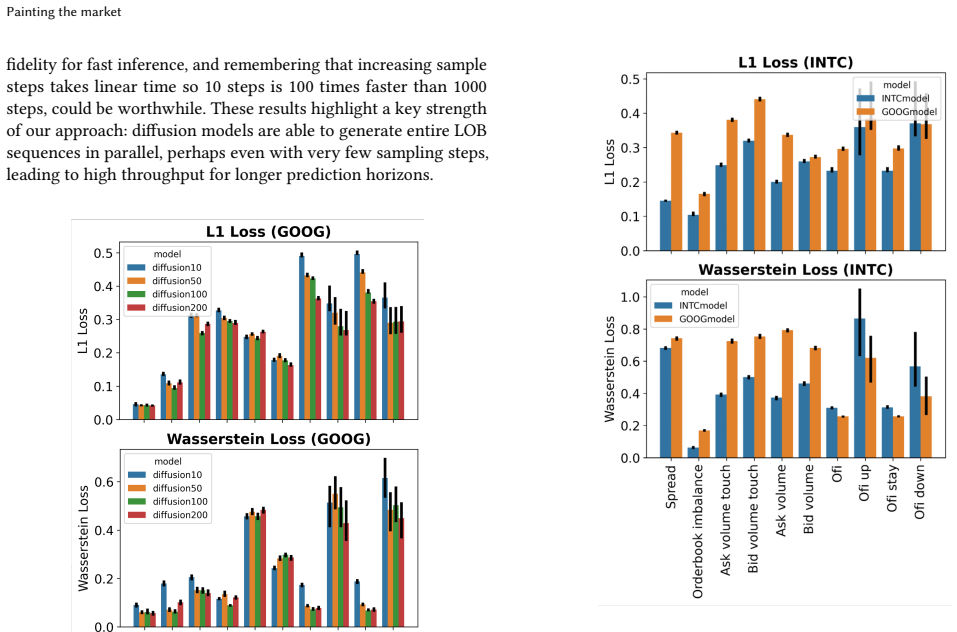
- Parallel, non-autoregressive generation lets inference be cut to 10–200 diffusion steps with small quality loss, making fast backtesting and high-throughput scenario generation practical.
- The new LOB-Bench extension allows direct, fair comparison between Level-2-only and Level-3-based generative models, closing a gap in the existing benchmark.
- The method prioritises coherent global structure over local detail: it wins on Wasserstein distance (distributional shape) while being less precise on L1 loss, guiding practitioners to use it for risk and scenario analysis rather than tick-exact prediction.
Reading between the lines
- The fixed 156-timestep history window is the most likely bottleneck on large-tick stocks like INTC; extending the context (via latent-space diffusion or downsampled history) is a direct, testable next step.
- The same image-inpainting recipe could transfer to other sequentially structured market data—crypto order books, trade-by-trade feeds—wherever a meaningful spatio-temporal layout can be defined.
- Volume smoothing in the generated outputs suggests that modelling heavy tails explicitly, for example with a size-quantile transform or a mixture objective, could repair local fidelity without sacrificing the Wasserstein advantage.
- A head-to-head ablation of inpainting versus plain conditional diffusion would isolate whether the history-fill inductive bias itself drives the gains over autoregressive models.
Editorial analysis
A structured set of objections, weighed in public.
Referee Report
Summary. The paper proposes representing limit order book states as a two-channel image over a 256-timestep window (156 history steps, 100 prediction steps) and training an unconditional UNet diffusion model with inpainting to generate future LOB states in parallel. The authors introduce an improved LOB-to-image layout, evaluate on GOOG and INTC from LOBSTER, and compare against Cont, Coletta, RWKV-6, and LOBS5 using the LOB-Bench benchmark. They report that the method is competitive under L1 loss and state-of-the-art under Wasserstein loss on GOOG, while performing poorly on INTC due to mode collapse. Ablations cover inference-step counts and cross-stock robustness. The central claim is that image-based diffusion with inpainting is a viable generative LOB model despite using only Level-2 data.
Significance. If the empirical results survive scrutiny, the paper is a useful contribution: it offers a cleaner image representation than DeepLOB, an inpainting formulation that generates 100 future LOB states in parallel, and a public extension of LOB-Bench comparing Level-2 and Level-3 models. The evaluation is fairly extensive, with confidence intervals, stylised facts, and ablations. However, the headline 'state-of-the-art on LOB-Bench' is broader than the reported results, and the inpainting-mask description is internally inconsistent. Once corrected and qualified, the paper would be a solid benchmark contribution; in its current form the main quantitative claims are not fully verifiable.
major comments (3)
- [Section 4.2 vs Section 5.2/Figure 1] The inpainting mask is defined as 'zeros in the first 64 timesteps and ones in the second 64 timesteps', i.e. 128 timesteps total. This contradicts Section 5.2 and Figure 1, where the setup is a 156-step history and a 100-step prediction (256 timesteps). Because the mask determines which timesteps are conditioned on and which are generated, a 64/64 mask would mean the model is trained for a 64-step condition/64-step horizon rather than the claimed 156/100 setting. This would change every reported LOB-Bench metric, especially the comparison with LOBS5's 100-step prediction window. The paper states code is released only if accepted, so the reader cannot determine which configuration was actually used. Please correct the description or specify the exact mask construction, and ideally release code/checkpoints so the reported results can be reproduced.
- [Abstract and Section 6.3] The blanket claim 'state-of-the-art performance on LOB-Bench' is not supported by the paper's own Figure 7 and Section 5.3. On INTC, LOBS5 dominates; on GOOG, the model is described as 'competitive under L1 loss' and state-of-the-art only under Wasserstein loss. The abstract and conclusion should be revised to state the qualified claim: the method achieves state-of-the-art Wasserstein performance on GOOG and is competitive but not state-of-the-art on L1, with clear failures on INTC. This is not merely a wording issue; it changes the paper's contribution from 'state-of-the-art on the full benchmark' to 'strong distributional fidelity on a small-tick stock'.
- [Section 5.2] The fixed history length of 156 timesteps is introduced for computational convenience and to match LOBS5's prediction window, with no experiment validating that this window captures the relevant LOB dynamics. The paper attributes INTC mode collapse to sparse signal, but an alternative explanation is that 156 states are insufficient context for a large-tick stock. Since the method's generalisability claim rests on this assumption, a history-length sensitivity analysis (e.g. shorter and longer contexts with appropriate padding or compression) or an explicit discussion of this limitation is needed before the approach can be called a strong foundation for LOB modelling.
minor comments (5)
- [Section 4.2] The input shape notation is inconsistent: the image is defined as X ∈ R^{2n×T×2}, but later the stacked input is described as '(batch-size, T, n, 5)'. Please clarify the axes, especially whether the level dimension is n or 2n and how the mask channel is concatenated.
- [Section 4.2] There is a typo in the mid-price definition: 'text mid' should be 'mid' in the equation.
- [Section 5.3] The phrase 'beats all models except LOBS5 when evaluated on L1 loss' in the text is clearer than the abstract; please use similarly precise language throughout.
- [Section 5.4] In Figure 8, many scores are within confidence intervals; the caption should state this explicitly rather than saying 'increasing inference steps generally leads to a very small improvement.'
- [General] The paper describes LOB-Bench as 'the industry benchmark'; it is an academic benchmark. Please use accurate terminology and disclose the author overlap with LOB-Bench and LOBS5.
Circularity Check
No circular derivation; overlapping-author benchmark is a minor self-reference but not load-bearing.
full rationale
I walked the derivation chain: LOB states are encoded as a 2-channel image, a UNet DDPM is trained with a standard denoising objective, and future states are generated by inpainting the masked (noised) region. The generated future is evaluated against held-out test data using LOB-Bench metrics; no benchmark metric is used as a training target or fitted parameter, and no equation defines the output in terms of the input. The only self-reference is that LOBS5 [26] and LOB-Bench [27] share authors with this paper (Li, Calinescu, Zohren, Foerster), so the headline "state-of-the-art on LOB-Bench" is measured on a benchmark developed by the same group. That is a normal self-benchmarking situation rather than a reduction: the benchmark metrics are external to the model's construction and are not fitted. I also note a non-circular reproducibility inconsistency: §4.2 describes the inpainting mask as "zeros in the first 64 timesteps and ones in the second 64 timesteps" (128 total), while §5.2 and Figure 1 specify a 156-step history and 100-step prediction (256 total). This is a correctness/reproducibility risk that prevents verification of the exact trained configuration, but it is not a circularity because the mask is not defined in terms of the predicted quantity. Self-citations to DeepLOB and diffusion literature are external prior art and do not smuggle in the result. Therefore no circular step is present; the low score reflects only the minor overlapping-author benchmark concern.
Assumptions & free parameters
free parameters (5)
- Number of price levels n =
not stated (DeepLOB uses 10)
- History length =
156
- Prediction length =
100
- Clipping percentile =
95
- Training epochs =
1
assumptions (4)
- standard math DDPM forward and reverse diffusion processes with Gaussian noise and the learned reverse conditional (Section 2.2).
- domain assumption Convolutional networks provide translation invariance, local feature extraction, weight sharing, and hierarchical feature extraction that are beneficial inductive biases for LOB data (Section 4.1).
- domain assumption The order book process is sufficiently stationary within the training window (1 July 2022 to 11 November 2022) to generalize to the test window (14-30 December 2022), and a single epoch of training is sufficient (Sections 5.1, 5.2).
- domain assumption LOB-Bench metrics and baselines are the appropriate and sufficient evaluation for generative LOB models (Section 5.3).
Cite this review
Pith. "Pith review of Painting the market: generative diffusion models for financial limit order book simulation and forecasting." pith.science (2026). https://pith.science/paper/ZFHDOYMV
@misc{pith2026250905107,
  author       = {Pith},
  title        = {Pith review of: Painting the market: generative diffusion models for financial limit order book simulation and forecasting},
  year         = {2026},
  howpublished = {\url{https://pith.science/paper/ZFHDOYMV}},
  note         = {Machine review of arXiv:2509.05107}
}
read the original abstract
Simulating limit order books (LOBs) has important applications across forecasting and backtesting for financial market data. However, deep generative models struggle in this context due to the high noise and complexity of the data. Previous work uses autoregressive models, although these experience error accumulation over longer-time sequences. We introduce a novel approach, converting LOB data into a structured image format, and applying diffusion models with inpainting to generate future LOB states. This method leverages spatio-temporal inductive biases in the order book and enables parallel generation of long sequences overcoming issues with error accumulation. We also publicly contribute to LOB-Bench, the industry benchmark for LOB generative models, to allow fair comparison between models using Level-2 and Level-3 order book data (with or without message level data respectively). We show that our model achieves state-of-the-art performance on LOB-Bench, despite using lower fidelity data as input. We also show that our method prioritises coherent global structures over local, high-fidelity details, providing significant improvements over existing methods on certain metrics. Overall, our method lays a strong foundation for future research into generative diffusion approaches to LOB modelling.
Figures


Figures from the paper (3 more)


Reference graph
Works this paper leans on
-
[1]
Samuel A Assefa, Danial Dervovic, Mahmoud Mahfouz, Robert E Tillman, Prashant Reddy, and Manuela Veloso. 2020. Generating synthetic data in fi- nance: opportunities, challenges and pitfalls. InProceedings of the First ACM International Conference on AI in Finance. 1–8
work page 2020
-
[2]
Leonardo Berti, Bardh Prenkaj, and Paola Velardi. 2025. TRADES: Generating Realistic Market Simulations with Diffusion Models. arXiv:2502.07071 [q-fin.TR] https://arxiv.org/abs/2502.07071
arXiv 2025
-
[3]
James Betker, Gabriel Goh, Li Jing, Tim Brooks, Jianfeng Wang, Linjie Li, Long Ouyang, Juntang Zhuang, Joyce Lee, Yufei Guo, Wesam Manassra, Prafulla Dhariwal, Casey Chu, Yunxin Jiao, and Aditya Ramesh. 2023. Improving Image Generation with Better Captions. Available at https://cdn.openai.com/papers/ better-captions/improving-image-generation-with-better-...
work page 2023
-
[4]
Tom Brown, Benjamin Mann, Nick Ryder, Melanie Subbiah, Jared D Kaplan, Prafulla Dhariwal, Arvind Neelakantan, Pranav Shyam, Girish Sastry, Amanda Askell, et al. 2020. Language models are few-shot learners.Advances in neural information processing systems33 (2020), 1877–1901
2020
-
[5]
Charles Cao, Oliver Hansch, and Xiaoxin Wang. 2008. The information content of an open limit-order book.Journal of Futures Markets29, 1 (Nov. 2008), 16–41. doi:10.1002/fut.20334
-
[6]
Andrea Coletta, Joseph Jerome, Rahul Savani, and Svitlana Vyetrenko. 2023. Con- ditional generators for limit order book environments: Explainability, challenges, and robustness. InProceedings of the Fourth ACM International Conference on AI in Finance. 27–35
work page 2023
-
[7]
Andrea Coletta, Aymeric Moulin, Svitlana Vyetrenko, and Tucker Balch. 2022. Learning to simulate realistic limit order book markets from data as a world agent. InProceedings of the Third ACM International Conference on AI in Finance. 428–436
work page 2022
-
[8]
Andrea Coletta, Matteo Prata, Michele Conti, Emanuele Mercanti, Novella Bar- tolini, Aymeric Moulin, Svitlana Vyetrenko, and Tucker Balch. 2021. Towards realistic market simulations: a generative adversarial networks approach. In Proceedings of the Second ACM International Conference on AI in Finance. 1–9
work page 2021
Show all 41 references
-
[9]
Rama Cont, Sasha Stoikov, and Rishi Talreja. 2010. A stochastic model for order book dynamics.Operations research58, 3 (2010), 549–563
2010
-
[10]
Guillaume Couairon, Jakob Verbeek, Holger Schwenk, and Matthieu Cord. 2022. Diffedit: Diffusion-based semantic image editing with mask guidance.arXiv preprint arXiv:2210.11427(2022)
2022 arXiv
-
[11]
Zoltan Eisler, Jean-Philippe Bouchaud, and Julien Kockelkoren. 2012. The price impact of order book events: market orders, limit orders and cancellations.Quan- titative Finance12, 9 (2012), 1395–1419
2012
-
[12]
Hugging Face. 2022. Diffusers: State-of-the-art diffusion models. https://github. com/huggingface/diffusers. Accessed: 2025-04-25
2022
-
[13]
Martin D Gould, Mason A Porter, Stacy Williams, Mark McDonald, Daniel J Fenn, and Sam D Howison. 2013. Limit order books.Quantitative Finance13, 11 (2013), 1709–1742
2013
-
[14]
Jonathan Ho, Ajay Jain, and Pieter Abbeel. 2020. Denoising diffusion probabilistic models.Advances in neural information processing systems33 (2020), 6840–6851
2020
-
[15]
Ruihong Huang and Tomas Polak. 2011. LOBSTER: Limit Order Book Recon- struction System.SSRN Electronic Journal(2011). doi:10.2139/ssrn.1977207
2011 doi
-
[16]
Damian Kisiel and Denise Gorse. 2022. Axial-lob: High-frequency trading with axial attention. In2022 IEEE Symposium Series on Computational Intelligence (SSCI). IEEE, 1327–1333
2022
-
[17]
Yaxuan Kong, Zepu Wang, Yuqi Nie, Tian Zhou, Stefan Zohren, Yuxuan Liang, Peng Sun, and Qingsong Wen. 2025. Unlocking the power of lstm for long term time series forecasting. InProceedings of the AAAI Conference on Artificial Intelligence, Vol. 39. 11968–11976
2025
-
[18]
Lecun, L
Y. Lecun, L. Bottou, Y. Bengio, and P. Haffner. 1998. Gradient-based learning applied to document recognition.Proc. IEEE86, 11 (1998), 2278–2324. doi:10. 1109/5.726791
1998
-
[19]
Junjie Li, Yang Liu, Weiqing Liu, Shikai Fang, Lewen Wang, Chang Xu, and Jiang Bian. 2025. MarS: a Financial Market Simulation Engine Powered by Generative Foundation Model. InThe Thirteenth International Conference on Learning Representations
2025
-
[20]
Xiang Li, John Thickstun, Ishaan Gulrajani, Percy S Liang, and Tatsunori B Hashimoto. 2022. Diffusion-lm improves controllable text generation.Advances in neural information processing systems35 (2022), 4328–4343
2022
-
[21]
Bryan Lim, Stefan Zohren, and Stephen Roberts. 2019. Enhancing time series mo- mentum strategies using deep neural networks.arXiv preprint arXiv:1904.04912 (2019)
2019 arXiv
-
[22]
Tom Liu, Stephen Roberts, and Stefan Zohren. 2023. Deep inception networks: A general end-to-end framework for multi-asset quantitative strategies.arXiv preprint arXiv:2307.05522(2023)
2023 arXiv
-
[23]
Yixin Liu, Kai Zhang, Yuan Li, Zhiling Yan, Chujie Gao, Ruoxi Chen, Zhengqing Yuan, Yue Huang, Hanchi Sun, Jianfeng Gao, et al . 2024. Sora: A review on background, technology, limitations, and opportunities of large vision models. arXiv preprint arXiv:2402.17177(2024)
2024 arXiv
-
[24]
Andreas Lugmayr, Martin Danelljan, Andres Romero, Fisher Yu, Radu Timofte, and Luc Van Gool. 2022. Repaint: Inpainting using denoising diffusion proba- bilistic models. InProceedings of the IEEE/CVF conference on computer vision and pattern recognition. 11461–11471
2022
-
[25]
Chenlin Meng, Yutong He, Yang Song, Jiaming Song, Jiajun Wu, Jun-Yan Zhu, and Stefano Ermon. 2021. Sdedit: Guided image synthesis and editing with stochastic differential equations.arXiv preprint arXiv:2108.01073(2021)
2021 arXiv
-
[26]
Peer Nagy, Sascha Frey, Silvia Sapora, Kang Li, Anisoara Calinescu, Stefan Zohren, and Jakob Foerster. 2023. Generative ai for end-to-end limit order book modelling: A token-level autoregressive generative model of message flow using a deep state space network. InProceedings o...
2023
-
[27]
Peer Nagy, Sascha Yves Frey, Kang Li, Bidipta Sarkar, Svitlana Vyetrenko, Stefan Zohren, Anisoara Calinescu, and Jakob Nicolaus Foerster. 2025. LOB-Bench: Benchmarking Generative AI for Finance – an Application to Limit Order Book Data. InForty-second International Conference ...
2025
-
[28]
OpenAI. 2024. Sora: Creating Video from Text. https://openai.com/sora/. Ac- cessed: 2025-04-19
2024
-
[29]
Bo Peng, Eric Alcaide, Quentin Anthony, Alon Albalak, Samuel Arcadinho, Stella Biderman, Huanqi Cao, Xin Cheng, Michael Chung, Matteo Grella, et al. 2023. Rwkv: Reinventing rnns for the transformer era.arXiv preprint arXiv:2305.13048 (2023)
2023 arXiv
-
[30]
Bo Peng, Daniel Goldstein, Quentin Anthony, Alon Albalak, Eric Alcaide, Stella Biderman, Eugene Cheah, Teddy Ferdinan, Haowen Hou, Przemysław Kazienko, et al. 2024. Eagle and finch: Rwkv with matrix-valued states and dynamic recurrence.arXiv preprint arXiv:2404.058923 (2024)
2024 arXiv
-
[31]
Dustin Podell, Zion English, Kyle Lacey, Andreas Blattmann, Tim Dockhorn, Jonas Müller, Joe Penna, and Robin Rombach. 2023. Sdxl: Improving latent diffu- sion models for high-resolution image synthesis.arXiv preprint arXiv:2307.01952 (2023)
2023 arXiv
-
[32]
Barry Quinn. 2023. Explaining ai in finance: Past, present, prospects.arXiv preprint arXiv:2306.02773(2023)
2023 arXiv
-
[33]
Robin Rombach, Andreas Blattmann, Dominik Lorenz, Patrick Esser, and Björn Ommer. 2022. High-resolution image synthesis with latent diffusion models. In Proceedings of the IEEE/CVF conference on computer vision and pattern recognition. 10684–10695
2022
-
[34]
Chitwan Saharia, William Chan, Saurabh Saxena, Lala Li, Jay Whang, Emily L Denton, Kamyar Ghasemipour, Raphael Gontijo Lopes, Burcu Karagol Ayan, Tim Salimans, et al. 2022. Photorealistic text-to-image diffusion models with deep Painting the market language understanding.Advan...
2022
-
[35]
Pierre Sermanet, David Eigen, Xiang Zhang, Michael Mathieu, Rob Fergus, and Yann LeCun. 2014. Overfeat: Integrated recognition, localization and detection using convolutional networks. InThe Second International Conference on Learning Representations
2014
-
[36]
Karen Simonyan, Andrea Vedaldi, and Andrew Zisserman. 2013. Deep inside convolutional networks: Visualising image classification models and saliency maps.arXiv preprint arXiv:1312.6034(2013)
2013 arXiv
-
[37]
Yichi Zhang, Mihai Cucuringu, Alexander Y Shestopaloff, and Stefan Zohren
- [38]
- [39]
-
[40]
Zihao Zhang, Stefan Zohren, and Stephen Roberts. 2019. Deeplob: Deep con- volutional neural networks for limit order books.IEEE Transactions on Signal Processing67, 11 (2019), 3001–3012. Received 18 July 2025
2019
-
[2025]
ClusterLOB: Enhancing Trading Strategies by Clustering Orders in Limit Order Books.arXiv preprint arXiv:2504.20349(2025)
2025 arXiv
Reviewed August 5, 2026 · model on record in the stance chip above.
Discussion (0). Sign in to comment.