REVIEW 3 major objections 7 minor 34 references
Gaia DR2 white dwarfs in the Hercules stream
T0 review · 3 major / 7 minor · reviewed 2026-08-14 · deepseek-v4-flash
Pith's one-line read The paper claims that the Hercules stream, a kinematic overdensity previously seen in main-sequence stars, is present in the Gaia white dwarf population within 100 pc, with three substreams whose ages favor a dynamical origin.
desk verdict First white-dwarf detection of the Hercules stream and a first age distribution, but the zero-RV assumption, small clusters, and missing error bars make the substructure and age peaks provisional. read the letter →
The pith
A machine-rendered reading of the paper's core claim, the machinery that carries it, and where it could break.
The reading
What carries the argument
The argument is carried by three tools. First, a nearly complete, volume-limited sample of Gaia white dwarfs within 100 pc, classified into thin-disk and thick-disk populations by a random-forest algorithm, provides the kinematic canvas. Second, the Hercules signature is isolated by kernel density estimation in the $UV$ velocity plane and then by HDBSCAN, a hierarchical density-based clustering algorithm, applied to a five-dimensional space of dynamical variables: $U$, $V$, the peculiar speed $V_{\mathrm{pec}}=(U^2+V^2+W^2)^{1/2}$, the Toomre velocity $V_{\mathrm{Toomre}}=(U^2+W^2)^{1/2}$, and $V_{\Delta E}=(U^2+2V^2)^{1/2}$, which is proportional to the square root of orbital eccentricity. Third, the ages come from matching Gaia absolute magnitudes and colors to white dwarf cooling sequences with hydrogen-rich atmospheres and metallicities $Z=0.01$ (thin disk) and $Z=0.001$ (thick disk); the total age is the cooling time plus the progenitor main-sequence lifetime, and objects below $0.53\,M_{\odot}$ are excluded as probable binary remnants.
What would settle it
Take spectra of the 57 white dwarfs assigned to Her a, Her b, and Her c, measure their radial velocities, recompute the full $(U,V,W)$ velocities, and rerun the kernel density estimation and HDBSCAN clustering. If the overdensity at $(U,V)=(-55,-50)$ km/s vanishes, or the three groups shift by more than their internal velocity dispersions (roughly 2–3 km/s) or change membership, the claimed substreams depend on the zero-radial-velocity assumption rather than on a real Galactic stream.
Extended reading notes
Core claim
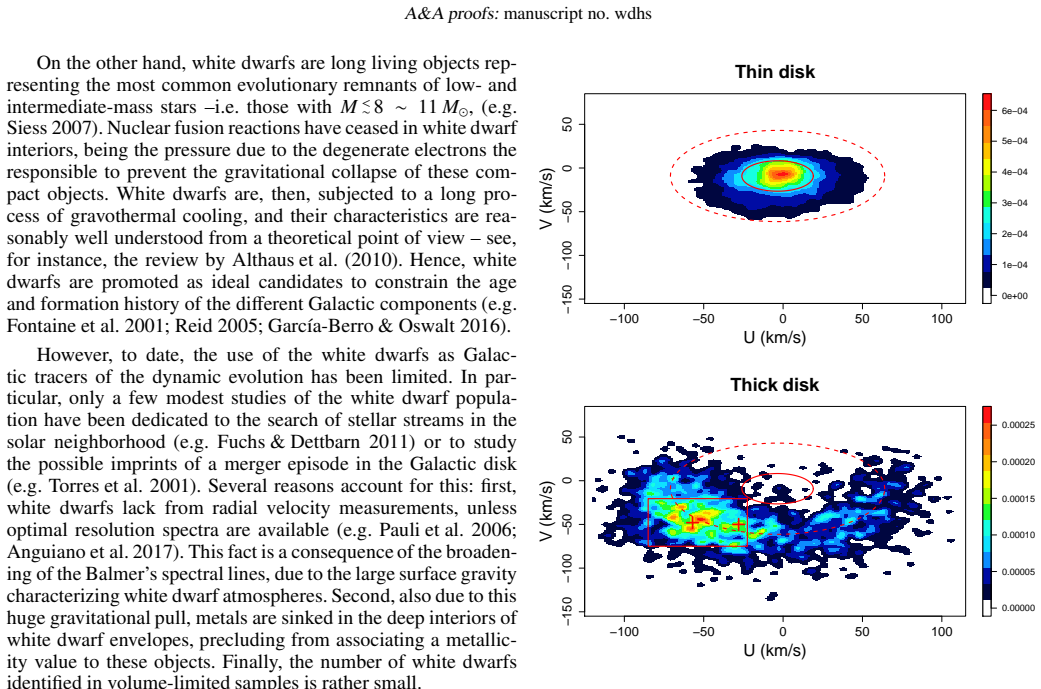
The central discovery is that the Hercules stream signature is visible in the kinematics of the Gaia DR2 white dwarf population within 100 pc. In the thick-disk subsample, kernel density estimation in the $(U,V)$ plane reveals an overdensity centered at $(U,V)=(-55,-50)\,\mathrm{km\,s^{-1}}$, spanning $(\Delta U,\Delta V)=(60,50)\,\mathrm{km\,s^{-1}}$ and containing roughly three times the average number density per $(\mathrm{km\,s^{-1}})^2$; in the same region 68% of the thick-disk white dwarfs have negative $U$. The authors then run HDBSCAN on a normalized five-dimensional space of dynamical variables and recover three compact groups: Her a (19 objects at $(-58.5,-54.7)$), Her b (18 objects at $(-69.3,-41.4)$), and Her c (20 objects at $(-29.9,-50.7)$), matching the previously known Hercules I/II and A8/A9 substructures. Her a is entirely thick-disk, Her b all but one thick-disk, and Her c is 65% thin-disk and 35% thick-disk. Photometric ages from white dwarf cooling sequences give a peak near 4 Gyr for Her a and b with tails to very old ages, while Her c is more uniform between 2 and 10 Gyr. The paper concludes that the Hercules stream is present in the white dwarf population and that the extended ages favor a dynamical origin for the stream over cluster disruption.
Load-bearing premise
The load-bearing premise is that assuming a zero radial velocity for every white dwarf—because these objects lack such measurements—does not create or distort the Hercules overdensity and its three substreams; the paper's own Monte Carlo estimate says the resulting shifts in $(U,V)$ are of the order of a few to tens of km/s, comparable to the separations between the claimed groups.
Editorial extensions
If this is right
- The Hercules stream can now be traced with white dwarfs, giving an independent, volume-complete sample of stream members that does not rely on main-sequence color-magnitude selection.
- The age estimates give the first age constraint on stream members: Her a and b peaked roughly 4 Gyr ago and extend to very old ages, while Her c is younger and more uniform, so any formation model must reproduce this age structure.
- The presence of Hercules-like kinematic structure in the thick disk is consistent with bar-resonance models that perturb the thick disk as well as the thin disk, supporting the dynamical-origin interpretation over cluster disruption.
- The three substreams correspond to the previously identified Hercules I/II and A8/A9 structures, confirming that the substructure appears in an independent tracer.
Reading between the lines
- If the zero-radial-velocity assumption shifts stream members' $U,V$ positions in a correlated way, the separation between Her a, b, and c could be partly an artifact: the paper's quoted systematic shifts are comparable to the inter-substream separations, so a targeted radial-velocity campaign is the decisive test.
- The same five-dimensional HDBSCAN strategy could be applied to the halo white dwarfs or to larger samples beyond 100 pc in future Gaia releases, potentially uncovering other moving groups among stellar remnants.
- Combining the estimated ages with orbit integrations in a barred potential could test whether stars of a given age were trapped at the relevant resonance at a particular time, connecting the stream's 4 Gyr peak to the bar's pattern speed.
Signed reviews
Editorial analysis
A structured set of objections, weighed in public.
Referee Report
Summary. The paper analyzes the velocity space of a nearly volume-limited 100 pc sample of Gaia DR2 white dwarf candidates, separated into thin-disk, thick-disk, and halo populations using the authors' earlier Random Forest classification. Heliocentric (U,V) velocities are computed from Gaia astrometry under the assumption that every white dwarf has zero radial velocity. A kernel density estimate of the thick-disk UV plane reveals an overdensity near (U,V)=(-55,-50) km/s with a claimed density about three times the average, which the authors identify with the Hercules stream. Restricting to this overdensity rectangle, the authors apply HDBSCAN to a 5D kinematic space and identify three groups of roughly 18-20 stars each (Her a, Her b, Her c), whose (U,V) positions are compared with previously published Hercules substructures. Using photometric cooling models, they derive age distributions: Her a and Her b are predominantly thick-disk with ages peaking near 4 Gyr, while Her c is 65% thin-disk and 35% thick-disk with a flatter age distribution. The paper concludes that the Hercules stream signature is present in the white dwarf population and provides first age estimates.
Significance. If the detection holds, the result is valuable: it extends a well-studied kinematic stream to a new tracer population, exploits a nearly complete census of white dwarfs in the solar neighborhood, and offers an age distribution that is plausibly consistent with a dynamical, bar-related origin rather than cluster disruption. The external anchor to previously published Hercules positions from Antoja et al. (2012) and Ramos et al. (2018) is a genuine strength and reduces concern that the identification is circular. The paper is also transparent about its assumptions, particularly the lack of radial velocities. However, the central detection currently rests on a zero-radial-velocity assumption whose defense is insufficient, and the substructure and age claims rely on small clusters whose robustness is not demonstrated. These issues are load-bearing and need to be addressed before the result can be considered established.
major comments (3)
- [Secs. 2-3] The defense against the zero-radial-velocity assumption is not sufficient for the claim being made. The quoted Monte Carlo results from Torres et al. (2019) report only mean reductions of the (U,V) components, with standard deviations of 17-32 km/s; they do not test whether applying the zero-RV projection to a smooth thick-disk velocity ellipsoid can create a localized overdensity of roughly three times the average density at (U,V)=(-55,-50) km/s. The detection statistic is the overdensity itself, not a global asymmetry, so the statement that the zero-RV effect 'does not generate any asymmetry' is not responsive. I request a dedicated null test: draw a smooth model of the thick-disk velocity distribution, apply the same astrometric projection with zero radial velocities, and verify that no comparable overdensity appears at the Hercules location. This is essential because the reported dispersions are comparable to the separation between Her a and Her b (about 17 km/s), meaning the substructure grouping could also be distorted by the assumption.
- [Sec. 3 and Fig. 1] The significance of the overdensity is not quantified. The text says the red rectangle region has a number of objects per (km/s)^2 'roughly 3 times larger than the average density,' but no uncertainty or significance is given. With only 1,410 thick-disk candidates and roughly 20 stars per claimed substructure, one needs a Poisson or bootstrap estimate of the overdensity significance, plus a statement of how many stars fall in the red rectangle versus the number expected from a smooth fit to the surrounding velocity distribution. The incompleteness/croissant-shape discussion is qualitative and does not replace this quantitative test.
- [Sec. 3, HDBSCAN application] The clustering step is not validated against false positives. HDBSCAN is applied with mPts in the range 10-30 and membership probability larger than 90%, and the three substreams contain only 18-20 stars each. No stability analysis is presented: the authors do not show how the number and positions of clusters vary with mPts, do not bootstrap the sample, and do not run the same pipeline on a smooth synthetic UV distribution to see how often HDBSCAN returns comparable clusters by chance. Because HDBSCAN is designed to find clusters in arbitrary density fields, the separation of Her a and Her b into distinct substreams, and the subsequent age differences, are not yet robust. I recommend a permutation or mock-catalog test with the same sample size and selection function.
minor comments (7)
- [Abstract] The word 'hierarchichal' should be 'hierarchical.'
- [Sec. 3] The 'croissant-shape' of the thick-disk distribution is mentioned but not defined or illustrated; please add a brief explanation or a reference where this shape is described.
- [Table 1] The claim of 'excellent agreement' with literature substructures should be quantified. Some of the literature positions have no quoted uncertainties, and offsets of 10-20 km/s are comparable to the separations between the newly claimed substreams, so visual agreement alone is not a strong test.
- [Fig. 2] The legend uses 'blue circles' for Her a and 'cyan circles' for Her c; these colors may be difficult to distinguish in print. Please use distinct symbols or more separated colors.
- [Sec. 4] The K-S test paragraph appears to contain an inconsistency: the text says Her a and Her c are consistent with a normal distribution, but then says 'the age distribution of Her c is unlikely normally distributed.' This likely should refer to Her a and Her b, or Her b and Her c; please correct.
- [Sec. 3] The list of white dwarfs in each substream is said to be 'available upon request'; for reproducibility and because the member list is a central product, please include it as a machine-readable table or in an appendix.
- [Conclusions] 'firstly revealed' should be 'first revealed' in the abstract and conclusions.
Circularity Check
No significant circularity: the Hercules overdensity and substreams are measured from Gaia data and validated against external catalogs; self-citations are independent prior work.
full rationale
The paper's derivation chain is self-contained and contains no step that reduces to its own inputs by construction. The central detection is a KDE overdensity measured from Gaia DR2 astrometry for the thick-disk white dwarf sample; the overdensity location and the HDBSCAN clusters (Her a/b/c) are outputs of the data and of an unsupervised clustering algorithm on a 5-D kinematic space, not parameters fitted to reproduce the literature positions of Hercules. Validation against Antoja et al. (2012), Bobylev & Bajkova (2016), and Ramos et al. (2018) is post-hoc. The ages are computed from photometry and published cooling tracks after cluster membership is fixed, so they cannot feed back into the clustering. The zero-radial-velocity concern is a possible correctness risk, but the paper's rebuttal cites Torres et al. (2019), a prior Monte Carlo control that does not include the Hercules overdensity as an input; citing one's own earlier external control does not make the detection definitionally circular. The same applies to the thin/thick-disk classification and the cooling tracks. No equation in the paper equates a fitted parameter with a claimed prediction, and no uniqueness or ansatz is imported from a self-citation to force the substream identification.
Assumptions & free parameters
free parameters (4)
- HDBSCAN mPts =
10-30, exact value not stated
- HDBSCAN cluster membership probability threshold =
>90%
- KDE bandwidth =
not stated
- Overdensity selection box =
centered (U,V)=(-55,-50), size (60,50) km/s
assumptions (6)
- domain assumption Radial velocity is zero for every white dwarf
- domain assumption Thin/thick-disk classification of Torres et al. (2019) is accurate
- domain assumption All white dwarfs in the sample have hydrogen-rich (DA) atmospheres
- domain assumption Thin-disk WDs have Z=0.01 and thick-disk WDs have Z=0.001
- domain assumption V_DeltaE = sqrt(U^2+2V^2) is a valid eccentricity proxy based on a flat rotation curve
- domain assumption Cooling tracks and initial-final mass relations of Althaus et al. (2015) and Camisassa et al. (2016, 2018) are accurate
Cite this review
Pith. "Pith review of Gaia DR2 white dwarfs in the Hercules stream." pith.science (2026). https://pith.science/paper/ZFLK3XLI
@misc{pith2026190802972,
  author       = {Pith},
  title        = {Pith review of: Gaia DR2 white dwarfs in the Hercules stream},
  year         = {2026},
  howpublished = {\url{https://pith.science/paper/ZFLK3XLI}},
  note         = {Machine review of arXiv:1908.02972}
}
abstract
We analyzed the velocity space of the thin and thick-disk Gaia white dwarf population within 100 pc looking for signatures of the Hercules stellar stream. We aimed to identify those objects belonging to the Hercules stream and, by taking advantage of white dwarf stars as reliable cosmochronometers, to derive a first age distribution. We applied a kernel density estimation to the $UV$ velocity space of white dwarfs. For the region where a clear overdensity of stars was found, we created a 5-D space of dynamic variables. We applied a hierarchichal clustering method, HDBSCAN, to this 5-D space, identifying those white dwarfs that share similar kinematic characteristics. Finally, under general assumptions and from their photometric properties, we derived an age estimate for each object. The Hercules stream was firstly revealed as an overdensity in the $UV$ velocity space of the thick-disk white dwarf population. Three substreams were then found: Hercules $a$ and Hercules $b$, formed by thick-disk stars with an age distribution peaked $4\,$Gyr in the past and extended to very old ages; and Hercules $c$, with a ratio of 65:35 thin:thick stars and a more uniform age distribution younger than 10 Gyr.
Figures


Reference graph
Works this paper leans on
-
[1]
Althaus, L. G., Camisassa, M. E., Miller Bertolami, M. M., Có rsico, A. H., & García-Berro, E. 2015, A&A, 576, A9
work page 2015
-
[2]
G., Córsico, A
Althaus, L. G., Córsico, A. H., Isern, J., & García-Berro, E. 2010, A&A Rev., 18, 471
2010
-
[3]
Anguiano, B., Rebassa-Mansergas, A., García-Berro, E., et al. 2017, MNRAS, 469, 2102
work page 2017
-
[4]
Antoja, T., Figueras, F., Fernández, D., & Torra, J. 2008, A& A, 490, 135
work page 2008
-
[5]
2010, Lecture Notes and Essays in Astrophysics, 4, 13
Antoja, T., Figueras, F., Torra, J., V alenzuela, O., & Picha rdo, B. 2010, Lecture Notes and Essays in Astrophysics, 4, 13
work page 2010
-
[6]
2012, MNRAS, 426, L1
Antoja, T., Helmi, A., Bienayme, O., et al. 2012, MNRAS, 426, L1
2012
-
[7]
S., Feltzing, S., & Gustafsson, B
Bensby, T., Oey, M. S., Feltzing, S., & Gustafsson, B. 2007, A pJ, 655, L89
work page 2007
-
[8]
Bobylev, V . V . & Bajkova, A. T. 2016, Astronomy Letters, 42, 90
work page 2016
Show all 34 references
-
[9]
& Hogg, D
Bovy, J. & Hogg, D. W. 2010, ApJ, 717, 617
2010
-
[10]
E., Althaus, L
Camisassa, M. E., Althaus, L. G., Córsico, A. H., et al. 2018, arXiv e-prints [arXiv:1807.03894]
2018 arXiv
-
[11]
E., Althaus, L
Camisassa, M. E., Althaus, L. G., Córsico, A. H., et al. 2016, ApJ, 823, 158 Cánovas, H., Cantero, C., Cieza, L., et al. 2019, arXiv e-pri nts [arXiv:1902.07600]
2016 arXiv
-
[12]
1997, A&A, 318 , 29
Chen, B., Asiain, R., Figueras, F., & Torra, J. 1997, A&A, 318 , 29
1997
-
[13]
1998, AJ, 115, 2384
Dehnen, W. 1998, AJ, 115, 2384
1998
-
[14]
Eggen, O. J. 1958, MNRAS, 118, 154
1958
-
[15]
2005, A&A, 430, 165
Famaey, B., Jorissen, A., Luri, X., et al. 2005, A&A, 430, 165
2005
-
[16]
2001, PASP , 113, 409
Fontaine, G., Brassard, P ., & Bergeron, P . 2001, PASP , 113, 409
2001
-
[17]
2019, MNRAS, 1815
Fragkoudi, F., Katz, D., Trick, W., et al. 2019, MNRAS, 1815
2019
-
[18]
& Dettbarn, C
Fuchs, B. & Dettbarn, C. 2011, AJ, 141, 5
2011
-
[19]
2001, A&A, 373, 511 Gaia Collaboration, Katz, D., Antoja, T., et al
Fux, R. 2001, A&A, 373, 511 Gaia Collaboration, Katz, D., Antoja, T., et al. 2018a, A&A, 616, A11 Gaia Collaboration, Katz, D., Antoja, T., et al. 2018b, A&A, 616, A11 García-Berro, E. & Oswalt, T. D. 2016, New A Rev., 72, 1 Gentile Fusillo, N. P ., Tremblay, P .-E., Gänsicke,...
2001
-
[20]
2019, MNRAS, 484, 4 540
Hattori, K., Gouda, N., Tagawa, H., et al. 2019, MNRAS, 484, 4 540
2019
-
[21]
Hunt, J. A. S. & Bovy, J. 2018, MNRAS, 477, 3945
2018
-
[22]
Hunt, J. A. S., Bovy, J., Pérez-Villegas, A., et al. 2018, MNR AS, 474, 95 Jiménez-Esteban, F. M., Torres, S., Rebassa-Mansergas, A. , et al. 2018, MN- RAS, 480, 4505
2018
-
[23]
2018, ApJ, 860, L1 1
Koppelman, H., Helmi, A., & V eljanoski, J. 2018, ApJ, 860, L1 1
2018
- [24]
-
[25]
L., Zhao, J
Liang, X. L., Zhao, J. K., Oswalt, T. D., et al. 2017, ApJ, 844, 152
2017
-
[26]
2006, A&A, 447, 173 Pérez-Villegas, A., Portail, M., Wegg, C., & Gerhard, O
Pauli, E.-M., Napiwotzki, R., Heber, U., Altmann, M., & Oden kirchen, M. 2006, A&A, 447, 173 Pérez-Villegas, A., Portail, M., Wegg, C., & Gerhard, O. 201 7, ApJ, 840, L2
2006
-
[27]
2015, MNRAS, 448, 713
Portail, M., Wegg, C., Gerhard, O., & Martinez-V alpuesta, I . 2015, MNRAS, 448, 713
2015
-
[28]
2018, A&A, 619, A72
Ramos, P ., Antoja, T., & Figueras, F. 2018, A&A, 619, A72
2018
-
[29]
R., Girven, J., & Gänsicke, B
Rebassa-Mansergas, A., Nebot Gómez-Morán, A., Schreiber, M. R., Girven, J., & Gänsicke, B. T. 2011, MNRAS, 413, 1121
2011
-
[30]
Reid, I. N. 2005, ARA&A, 43, 247
2005
-
[31]
2019, arXiv e-prints, arXiv:1906.08009
Tononi, J., Torres, S., García-Berro, E., et al. 2019, arXiv e-prints, arXiv:1906.08009
2019 arXiv
-
[32]
2019 , MNRAS, 485, 5573
Torres, S., Cantero, C., Rebassa-Mansergas, A., et al. 2019 , MNRAS, 485, 5573
2019
-
[33]
2001, MNRAS, 328, 492
Torres, S., García-Berro, E., Burkert, A., & Isern, J. 2001, MNRAS, 328, 492
2001
-
[34]
2015, MNRAS, 450, 4050 Article number, page 5 of 5
Wegg, C., Gerhard, O., & Portail, M. 2015, MNRAS, 450, 4050 Article number, page 5 of 5
2015
Reviewed August 14, 2026 · model on record in the stance chip above.
Discussion (0). Continue with ORCID to comment.