REVIEW 4 major objections 6 minor 3 references
Ultrahigh-Resolution Fiber-Optic Sensing Using a High-Finesse, Meter-Long Fiber Fabry-Perot Resonator
T0 review · 4 major / 6 minor · reviewed 2026-08-14 · deepseek-v4-flash
Pith's one-line read A meter-long fiber Fabry-Perot cavity, interrogated by a diode laser locked to a twin reference cavity, achieves strain resolutions down to 40 femtostrain per root hertz, matching or beating phase-shifted and slow-light fiber Bragg…
desk verdict Solid high-frequency fiber Fabry-Perot sensing demonstration; the 1–100 Hz resolution claim leans on an unquantified common-mode rejection assumption and a manufacturer-only strain calibration. read the letter →
The pith
A machine-rendered reading of the paper's core claim, the machinery that carries it, and where it could break.
The reading
What carries the argument
The central object is a pair of nominally identical meter-long fiber Fabry-Perot interferometers (FFPIs): one acts as the sensor and the other as the reference. A Pound-Drever-Hall servo with a deliberately low 10-Hz bandwidth locks the interrogation diode laser to the reference cavity, so the laser tracks the slow, common-mode drift of both cavities while ignoring fast jitter. The sensor is read out by parking the laser on the steep side of a transmission resonance, converting strain-induced resonance shifts into transmitted-power changes. The high finesse (about 902) and long cavity (1 meter, 105-MHz free spectral range, 116-kHz linewidth) create narrow resonances that make this side-of-fringe discriminator highly sensitive.
What would settle it
Measure the relative frequency drift between the two cavity resonances over the 1-100 Hz band while both are isolated and the laser is locked; if the residual drift exceeds the equivalent of 800 femtostrain per root hertz, the low-frequency resolution claim fails. Independently calibrate the PZT-applied strain with a known reference, such as a strain gauge or a fiber Bragg grating, and check whether the reported 75, 60, and 40 femtostrain per root hertz values change.
Extended reading notes
Core claim
The paper reports the first ultrahigh-resolution strain sensor based on a meter-long fiber Fabry-Perot cavity with finesse around 900. By locking a diode laser to a second, identical FFPI placed in the same isolation enclosure, the laser follows the slow environmental drift of the cavity resonances, so the sensor resonance and the probe laser stay together for extended periods. Interrogating on the side of the transmission fringe, the authors measure a noise-limited strain resolution of about 800 femtostrain per root hertz from 1 to 100 Hz, improving to 75 femtostrain per root hertz at 1 kHz, 60 femtostrain per root hertz at 2 kHz, and 40 femtostrain per root hertz at 23 kHz. These numbers are comparable to or better than published results for phase-shifted and slow-light fiber Bragg gratings, and they are obtained with off-the-shelf components and no additional laser stabilization.
Load-bearing premise
The result rests on the assumption that the two meter-long fiber cavities, sitting in the same insulated box, drift together so completely that locking the laser to the reference also cancels the sensor's slow drift; the paper does not report a direct measurement of how much of the sensor drift actually remains.
Editorial extensions
If this is right
- Meter-long FFPIs can serve as ultrahigh-resolution strain sensors at kilohertz frequencies, matching or exceeding the resolutions of phase-shifted and slow-light fiber Bragg gratings.
- The twin-cavity locking scheme removes the need for optical frequency combs or specially stabilized narrow-linewidth lasers in long-cavity fiber sensing.
- The low-frequency 1-100 Hz resolution is set by isolation quality and residual common-mode drift, so improving those should push the noise floor lower.
- The same locking architecture can be transferred to other long fiber cavities for temperature, acoustic, or quasi-static sensing.
- Side-of-fringe detection, despite its sensitivity to laser intensity noise, is sufficient for femtostrain-level dynamic measurements.
Reading between the lines
- A direct measurement of the residual relative drift between the two cavities would yield the common-mode rejection ratio and should predict the 1-100 Hz noise floor; the paper does not report such a measurement.
- If the sensor were read out with a Pound-Drever-Hall loop instead of side-of-fringe detection, laser intensity noise would be largely rejected, likely pushing the resolution toward the cavity's fundamental thermomechanical noise limit.
- The manufacturer-specified PZT strain calibration sets the absolute scale of every reported femtostrain value; an independent calibration against a known strain reference would tighten confidence in the absolute numbers.
- The scheme suggests a route to quasi-static or infrasonic strain sensing: with better thermal isolation and active drift compensation, the common-mode locking could hold for much longer timescales than demonstrated.
Signed reviews
Editorial analysis
A structured set of objections, weighed in public.
Referee Report
Summary. This manuscript reports an experimental fiber-optic strain sensor based on a 1-m long, finesse-902 fiber Fabry-Perot interferometer (FFPI). The interrogation laser is a free-running diode laser frequency-locked to an identical reference FFPI, and the sensor is read out by side-of-fringe detection of transmitted power. Dynamic strain is applied through the sensor's PZT stretcher, calibrated using the manufacturer's specified response. The authors report a nominal strain resolution of 800 fε/√Hz from 1 to 100 Hz and values of 75, 60, and 40 fε/√Hz at 1 kHz, 2 kHz, and 23 kHz, respectively, and argue these are comparable to or better than phase-shifted and slow-light FBG sensors. The central technical claims are direct laser locking to a meter-long fiber cavity and common-mode environmental drift rejection between twin cavities.
Significance. If the reported resolutions are correct, the work is significant because it demonstrates that meter-scale high-finesse FFPIs can be used as ultrahigh-resolution strain sensors with inexpensive lasers, a combination not previously shown. The direct strain-response data at 300 Hz and the linearity curve in Fig. 4 are real experimental evidence, and the finesse is independently characterized. The main limitations are that the two pillars of the headline numbers—the twin-cavity common-mode drift rejection and the PZT strain calibration—are not quantitatively demonstrated in the manuscript. Since both are directly measurable, the central claims are plausible but need additional evidence before the femtostrain-level resolutions can be considered established.
major comments (4)
- [Sec. II, Experimental Method] The common-mode rejection of environmental drift between FFPI-1 and FFPI-2 is a load-bearing assumption but is never quantified. The servo bandwidth is stated as 10 Hz, so below roughly 10 Hz the laser tracks the reference resonance and the sensor signal depends on the differential drift of the two cavities; between 10 and 100 Hz it depends on the absolute stability of the sensor cavity. The manuscript provides no common-mode rejection ratio, no residual differential frequency-noise spectrum, and no long-term drift trace for the two cavities. Please add a direct measurement of the relative frequency fluctuations between the two cavities under the actual isolation conditions, and report the resulting contribution to the strain-equivalent noise over 1–100 Hz.
- [Sec. III, Experimental Result, strain calibration] The absolute scale of every reported femtostrain resolution is set by the PZT strain calibration, but the manuscript only states that the manufacturer-specified response 'has also been independently verified in our experiment' without showing the verification. Please provide the independent calibration data, for example a comparison of commanded PZT displacement against a known interferometric or mechanical reference, including the uncertainty in the calibration factor and the frequency range over which it applies.
- [Sec. III, Fig. 5] The low-frequency portion of the resolution spectrum is derived from the sensor noise floor, not from calibrated strain injections at those frequencies. The only calibrated dynamic-strain measurement shown is at 300 Hz (Fig. 4), so the conversion of the 1–100 Hz noise floor to strain units assumes the sensitivity is frequency-independent. Because the PZT transfer function and the cavity response can vary with frequency, please add calibrated strain injections at representative frequencies in the 1–100 Hz band, or justify the flat sensitivity assumption with a measured transfer function.
- [Sec. III, Figs. 4–5] No error bars or uncertainty budget are given for the measured strain-response curve or for the reported resolutions. Given that the headline claim is a set of specific numerical resolutions and a comparison with other techniques, the authors should state the statistical uncertainty, including the number of averages, resolution bandwidth, and calibration uncertainty, for each reported value.
minor comments (6)
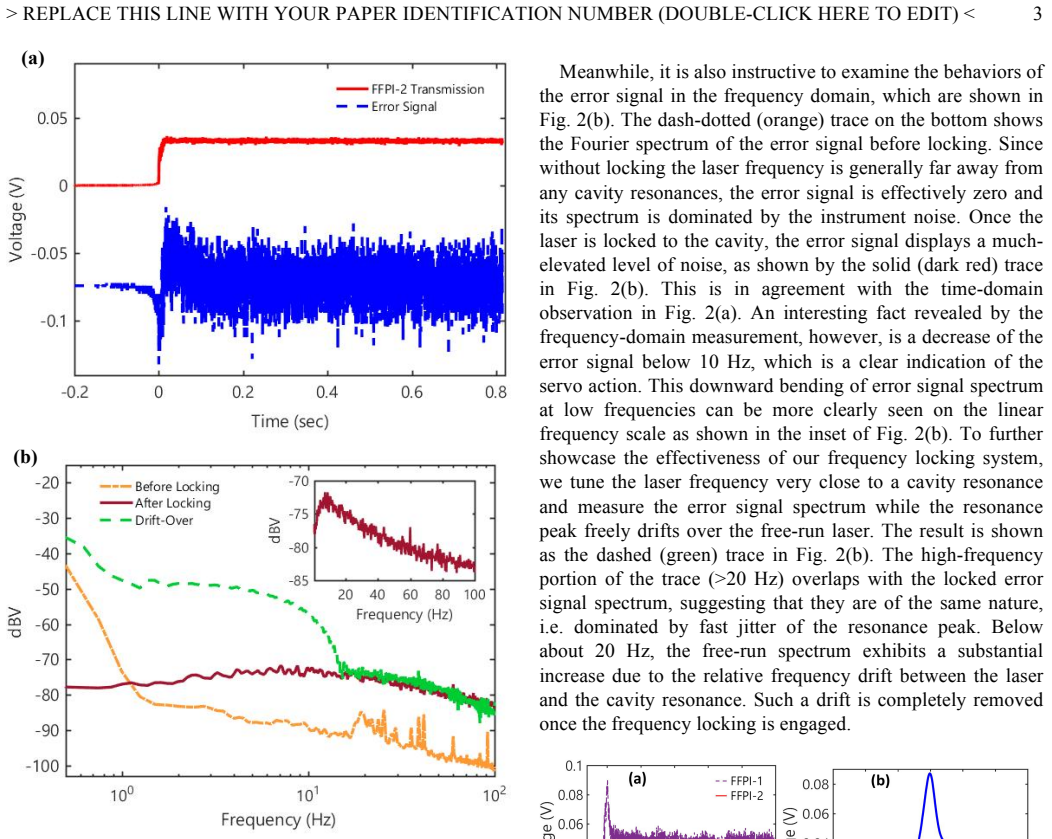
- [Sec. II, Fig. 2(b)] The 'drift-over' condition is mentioned but not defined; please describe how it was established and how the free-running drift spectrum was recorded.
- [Abstract and Sec. III] The abstract says 'within 1–100 Hz,' while the text says 'equal or below 800 fε/√Hz at any frequency above 2 Hz'; please reconcile the stated frequency range.
- [Introduction and Sec. II] The finesse is given as ~1000 in the introduction and as 902 in Sec. II; use the measured value consistently throughout.
- [Sec. III, Fig. 5] The spurious noise spikes are not all identified; labeling the 30-Hz spike and any others would help readers distinguish environmental artifacts from sensor noise.
- [Sec. IV, Conclusion] The attribution of the resolution limit to laser intensity and frequency noise is not backed by measurements; please add a relative intensity noise spectrum and a laser frequency-noise characterization, or soften the claim.
- [Sec. III, comparison with prior work] The comparison with prior FFPI sensors (e.g., Gagliardi et al. [34]) and with FBG-based sensors would be more informative if the quoted competing resolutions were given with their measurement bandwidths and any stated uncertainties.
Circularity Check
No significant circularity: the strain-resolution claims are direct measurements against a calibrated PZT strain source, not derived from the claimed result.
full rationale
The paper's central numbers (800 fε/√Hz at 1–100 Hz, 75 fε/√Hz at 1 kHz, 60 fε/√Hz at 2 kHz, 40 fε/√Hz at 23 kHz) come from an experimental noise-floor spectrum and a strain-response curve measured against known PZT-induced strains (Figs. 4–5), not from a fitted model or from the claimed resolutions themselves. The strain input scale is the manufacturer-specified PZT response, which is an external calibration input; whether it was truly verified is a correctness or uncertainty concern, not a circularity, because a different calibration would change the reported values rather than make them true by construction. The twin-cavity common-mode rejection premise ('Since both FFPIs experience the same environmental perturbations, their resonance peaks have similar drift') is an unquantified assumption that affects the low-frequency validity of the measurement, but it is not circular: the reported low-frequency noise floor is measured, not derived from that assumption. Self-citations to Duan's earlier thermal-noise and fiber-cavity work appear only as background and reference material and are not load-bearing support for the measured resolution. No equation in the paper reduces to an input, and no fitted parameter is renamed as a prediction. The strongest claim is a direct experimental comparison against published FBG benchmarks, leaving the derivation chain self-contained.
Assumptions & free parameters
free parameters (1)
- PZT strain calibration factor =
Manufacturer-specified, verified in-house (details not shown)
assumptions (3)
- domain assumption Both FFPIs experience the same environmental perturbations, so their resonance peaks drift similarly.
- domain assumption The PZT stretcher's manufacturer-specified length-change response accurately converts applied voltage to strain.
- domain assumption The 6-kHz diode laser linewidth is small compared with the 116-kHz cavity linewidth, so laser frequency noise does not dominate the side-of-fringe measurement.
Cite this review
Pith. "Pith review of Ultrahigh-Resolution Fiber-Optic Sensing Using a High-Finesse, Meter-Long Fiber Fabry-Perot Resonator." pith.science (2026). https://pith.science/paper/ZFZONL4S
@misc{pith2026190808595,
  author       = {Pith},
  title        = {Pith review of: Ultrahigh-Resolution Fiber-Optic Sensing Using a High-Finesse, Meter-Long Fiber Fabry-Perot Resonator},
  year         = {2026},
  howpublished = {\url{https://pith.science/paper/ZFZONL4S}},
  note         = {Machine review of arXiv:1908.08595}
}
read the original abstract
Ultrahigh-resolution fiber-optic sensing has been demonstrated with a meter-long, high-finesse fiber Fabry-Perot interferometer (FFPI). The main technical challenge of large, environment-induced resonance frequency drift is addressed by locking the interrogation laser to a similar meter-long FFPI, which, along with the FFPI sensor, is thermally and mechanically isolated from the ambient. A nominal, noise-limited strain resolution of 800 f{\epsilon} /sqrt(Hz) has been achieved within 1 to 100 Hz. Strain resolution further improves to 75 f{\epsilon} /sqrt(Hz) at 1 kHz, 60 f{\epsilon} /sqrt(Hz) at 2 kHz and 40 f{\epsilon} /sqrt(Hz) at 23 kHz, demonstrating comparable or even better resolutions than proven techniques such as {\pi}-phase-shifted and slow-light fiber Bragg gratings. Limitations of the current system are analyzed and improvement strategies are presented. The work lays out a feasible path toward ultrahigh-resolution fiber-optic sensing based on long FFPIs.
Figures


Reference graph
Works this paper leans on
-
[10]
Fiber strain sensor based on a π-phase-shifted Bragg grating and the Pound-Drever-Hall technique,
D. Gatti, G. Galzerano, D. Janner, S. Longhi, and P. Laporta, “Fiber strain sensor based on a π-phase-shifted Bragg grating and the Pound-Drever-Hall technique,” Opt. Express, vol. 16, no. 3, pp. 1945–1950, Feb. 2008
work page 1945
-
[18]
Measuring attostrains in a slow-light fiber Bragg grating,
G. Skolianos, A. Arora, M. Bernier, and M. Digonnet, “Measuring attostrains in a slow-light fiber Bragg grating,” Proc. SPIE 9763, Slow Light, Fast Light, and Opto-Atomic Precision Metrology IX, 976317 (23 March 2016)
work page 2016
-
[20]
Demonstration of a passive subpicostrain fiber strain sensor,
J. H. Chow, D. E. McClelland, M. B. Gray, and I. C. M. Littler, “Demonstration of a passive subpicostrain fiber strain sensor,” Opt. Lett., vol. 30, no. 15, pp. 1923-1925, Aug
work page 1923
Reviewed August 14, 2026 · model on record in the stance chip above.
Discussion (0). Continue with ORCID to comment.