REVIEW 5 major objections 7 minor 1 cited by
Reinforcement Fine-Tuning for Reasoning towards Multi-Step Multi-Source Search in Large Language Models
T0 review · 5 major / 7 minor · reviewed 2026-08-07 · deepseek-v4-flash
Pith's one-line read R-Search claims that a single LLM can match or beat multi-agent search frameworks by emitting one structured pass that reasons, plans a multi-source search, receives evidence, and answers, trained with GRPO-based reinforcement fine-tuning.
desk verdict R-Search is a clever single-LLM search framework with real efficiency gains, but the headline accuracy claim rests on benchmarks whose comparability and decontamination are not established. read the letter →
The pith
A machine-rendered reading of the paper's core claim, the machinery that carries it, and where it could break.
The reading
What carries the argument
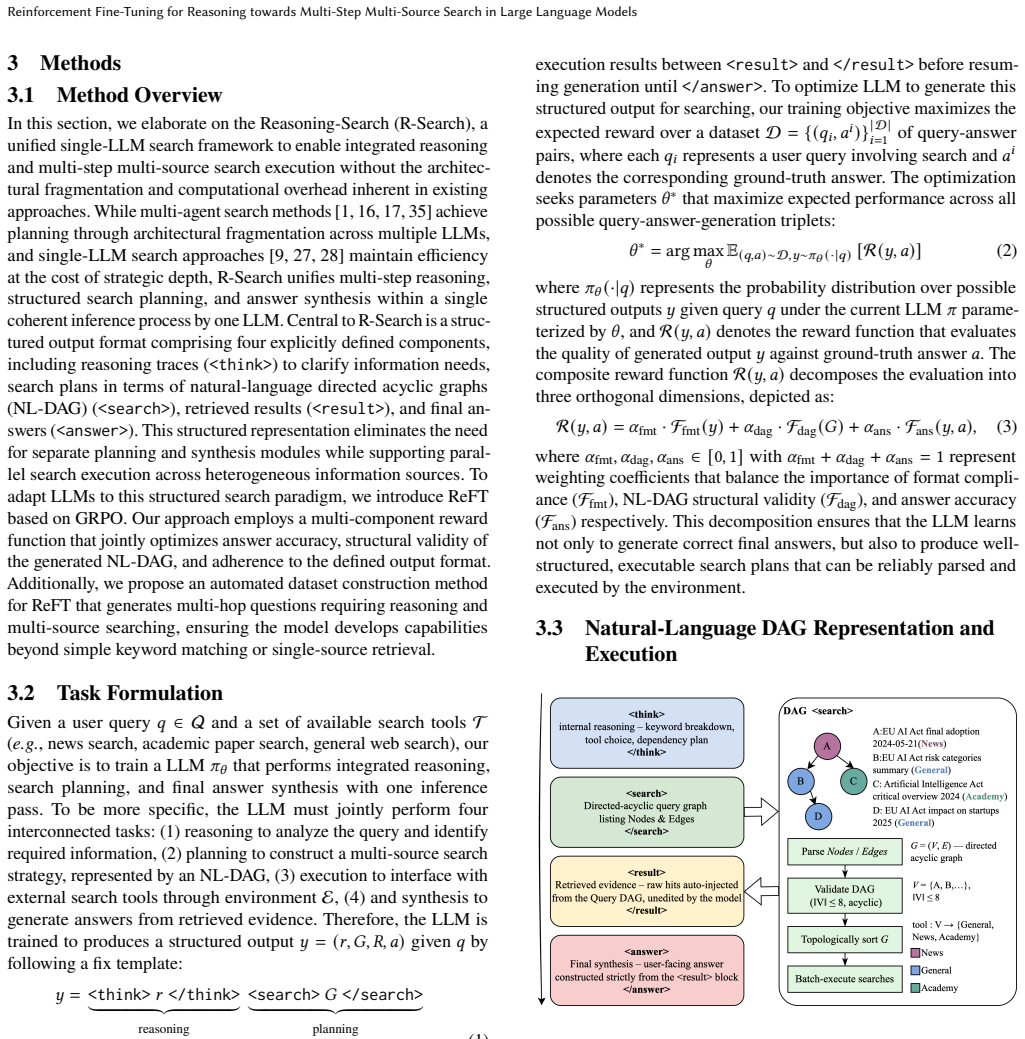
The load-bearing object is the natural-language directed acyclic graph (NL-DAG) embedded in a four-tag template (<think>, <search>, <result>, <answer>). Nodes are sub-query plus source-tool pairs such as "A: ... (News)"; edges are semicolon-separated dependencies like "A -> C; B -> C"; a parser validates acyclicity and tool availability, topologically sorts the nodes, and dispatches independent searches in parallel. This representation is what lets one LLM plan a multi-source search in a few hundred tokens while remaining executable by an external environment, and it is trained end-to-end by GRPO with a reward that checks format compliance, DAG validity, and answer accuracy.
What would settle it
Re-run FinSearch and SearchExpert with the same DeepSeek-R1-Distill-Qwen-7B backbone, the same GNews and Serper search tools, the same top-k retrieval settings, and the same evaluation harness as R-Search, and audit SearchExpertBench-25 for temporal overlap with the March-May 2025 news and arXiv corpus. If the accuracy advantage disappears or contamination is found, the claimed superiority is not established.
Extended reading notes
Core claim
The central discovery is that multi-step, multi-source search can be expressed as a single autoregressive structured output rather than as a pipeline of separate modules. The model first writes an explicit reasoning trace, then emits an NL-DAG whose nodes are natural-language query-tool pairs and whose edges are dependencies, then pauses while an environment parses, validates, topologically sorts, and executes the DAG across multiple search APIs in parallel, and finally resumes to synthesize an answer from the retrieved evidence. Training with GRPO and a composite reward—format compliance (weight 0.25), DAG structural validity (0.25), and judge-based answer accuracy (0.5)—is what makes the single model generate plans that are both executable and informative. The reported results show accuracy gains over multi-agent baselines and substantial token and latency savings, with ablations attributing most of the gain to the combination of multi-source planning and ReFT.
Load-bearing premise
The results depend on comparing R-Search's numbers with baseline numbers produced using different base models, search tools, and evaluation protocols, and on the March-May 2025 training corpus having no overlap with the SearchExpertBench-25 questions; if either comparability or non-contamination fails, the reported accuracy margins do not show that R-Search is better.
Editorial extensions
If this is right
- If the comparisons hold, a single-LLM structured trace replaces the three-stage planner-executor-synthesizer architecture, so search agents can be built and deployed as one model with one context window.
- The roughly 70% token and 50% latency reductions make search-augmented answering substantially cheaper, which matters for real-time financial and news queries where interactive latency is a constraint.
- The system's ability to surpass domain-specialized FinSearch while using general-purpose news, web, and academic search tools suggests that planning quality and integrated reasoning can compensate for the lack of domain-specific tooling.
- Because the NL-DAG is plain language, search plans are human-readable and debuggable without sacrificing executability, which aids transparency in high-stakes retrieval tasks.
Reading between the lines
- Editorial inference: The paper's design suggests that the plan-execution gap in agentic search is not intrinsic; one can test this directly by taking MindSearch or FinSearch-style planning and collapsing the stages into one model without changing the search tools, to see how much of the gain is unification versus the ReFT recipe.
- Editorial inference: The natural-language DAG might transfer to other tool-use settings such as database queries, code interpreter calls, and multi-API workflows as a token-efficient plan format; a simple test would be to replace JSON tool-call plans with NL-DAG plans under the same RL objective and compare parse success and downstream accuracy.
- Editorial inference: The automated dataset construction pipeline, which combines recent news and arXiv abstracts with semantic clustering and GPT-4.1-Mini question generation, points toward a general recipe for domain-specific search training; a testable extension is whether the same pipeline with medical or legal sources yields comparable gains.
- Editorial inference: The paper does not report search-API costs directly, and multi-source execution still makes multiple external calls; a fair cost comparison would separate model-side token savings from total search-API expenditure before concluding deployment cost falls by 70%.
Editorial analysis
A structured set of objections, weighed in public.
Referee Report
Summary. The paper proposes R-Search, a single-LLM search-augmented generation framework that unifies reasoning, multi-step search planning, search execution, and answer synthesis in one structured output comprising <think>, <search>, <result>, and <answer> components. The <search> component is a natural-language directed acyclic graph (NL-DAG) that specifies multi-source queries, which the environment parses, validates, and executes in parallel. The model is trained with a GRPO-based reinforcement fine-tuning (ReFT) method using a composite reward that combines format compliance, DAG validity, and answer accuracy, with training data automatically constructed from March–May 2025 news and arXiv abstracts. Experiments on FinSearchBench-24, SearchExpertBench-25, and seven QA benchmarks report that R-Search outperforms prior search-augmented methods while reducing token consumption by roughly 70% and latency by about 50%. The paper also includes an ablation study and a case study.
Significance. If the empirical claims hold, R-Search is a useful contribution: it shows that a single LLM can jointly reason, plan a multi-source search DAG, and synthesize an answer, avoiding the architectural overhead of multi-agent search frameworks. The paper ships code, proposes an automated training-data construction pipeline, and reports efficiency metrics, which are concrete strengths. The structured NL-DAG format and the selective gradient masking over <result> tokens are also sensible design choices. However, the central claim of state-of-the-art accuracy is currently not established because the headline comparisons use different base models across methods, no significance testing is reported, and no decontamination check is provided for the most important generalization benchmark. With controlled experiments and contamination analysis, the paper's contributions could be significant for the search-augmented LLM community.
major comments (5)
- [Sec. 4.2, Table 1] The headline comparisons are not controlled for base model. R-Search uses DeepSeek-R1-Distill-Qwen-7B, while the best FinSearch row uses ChatGPT-4o and the best SearchExpert row uses Llama-3.1-8B or Qwen2.5-7B. Because the base model strongly influences search-agent performance, the reported margins (78.13 vs 76.20 on FinSearchBench-24; 73.0 vs 64.0 on SearchExpertBench-25) conflate method with backbone. I request matched-backbone experiments, e.g., R-Search trained on Qwen2.5-7B-instruct and Llama-3.1-8B-instruct, and the baseline methods run on DeepSeek-R1-Distill-Qwen-7B, with the number of evaluation runs and a significance test for each comparison.
- [Sec. 3.5 vs Sec. 4.2] No decontamination check is reported between the ReFT training corpus (1,000 QA pairs constructed from March–May 2025 news articles and arXiv abstracts) and SearchExpertBench-25, whose questions are sourced from recent web content and whose reference [16] is dated May 2025. Since SearchExpertBench-25 provides the largest reported margin, the authors should report exact-match, n-gram, and embedding-level overlap between training bundles and benchmark items, or evaluate on a held-out set whose creation demonstrably postdates the training corpus. Without this, a memorization or near-duplicate explanation for the 73.0% result is not excluded.
- [Sec. 3.4 and Sec. 3.5] GPT-4.1-Mini is used both to generate the training questions and ground-truth answers and to implement the answer-accuracy reward Fans. This shared-provenance design creates a risk that the reward optimizes for answers matching the generator's style or content preferences rather than for objective correctness. Please validate the judge against human judgments on a sample, and if feasible use a different model for reward evaluation than for training-data generation.
- [Sec. 4.3, Table 2] No variance or significance information is reported for any of the seven Q&A benchmarks, and R-Search's average (41.87) exceeds ZeroSearch-base (40.93) by only 0.94 points. Moreover, R-Search uses a different backbone than the ZeroSearch baselines. Report per-dataset standard deviations, the number of runs, and paired significance tests, and either match backbones or explicitly justify why the comparison is meaningful despite the backbone difference.
- [Sec. 4.5, Table 3] The 'Multi-Source Search disabled' ablation is underspecified. It is not stated whether the ablated system uses a single search source, a single query, or no search at all, nor how the no-ReFT condition is trained. Without this information, the 23.5-point drop attributed to multi-source search cannot be interpreted. Please define the ablated configurations precisely, including the training procedure in each case.
minor comments (7)
- [Table 1] The column header 'Tokens (bit/ans)' should read 'Tokens/answer' or 'tokens per answer'; 'bit' appears to be a typo.
- [References [37] and Sec. 4.2] The text and Table 1 use 'ChatGPT-4o' with citation [37], but [37] is the FinLLMs paper; please cite the correct GPT-4o source.
- [Eq. (5)] The GRPO loss is written without the standard ratio clipping used in GRPO; please state explicitly whether clipping is applied, and if not, why it is omitted.
- [Sec. 4.3] The method 'RA-Agent' is listed in Table 2 and the text but only [18] (Search-o1) is cited; please add the RA-Agent reference.
- [Sec. 4.4] In the case study, the final answer is given as 'C' without listing the candidate answer choices; please include the full multiple-choice question so the trace is self-contained.
- [Sec. 3.5] The filtering step says queries must not be answerable from pretraining knowledge alone, but the mechanism for determining this is not described; please specify how this filter is implemented.
- [Abstract and Sec. 4.2] The claims of '70% reduction in context token usage' and '50% decrease in latency' should name the specific baseline row they are computed against, since the reductions vary across Table 1 entries.
Circularity Check
No circular derivation: R-Search's results are empirical evaluations on external benchmarks, and no fitted parameter or self-citation forces the central claim.
full rationale
The derivation chain in this paper is an RL training pipeline, not a closed-form prediction. Equations (1)-(5) define a structured-output template, a composite reward R(y,a) = 0.25 F_fmt + 0.25 F_dag + 0.5 F_ans, GRPO advantage estimation, and a KL-regularized loss; these equations do not contain the benchmark accuracies of Tables 1-2 as inputs. The policy is DeepSeek-R1-Distill-Qwen-7B, the training QA pairs are generated from document bundles of news/arXiv content, and the reward judge (GPT-4.1-Mini) grades against fixed ground-truth answers; using the same model family for data generation and reward is a standard RLAIF configuration and does not make the final evaluation self-referential. No parameter is fitted to FinSearchBench-24, SearchExpertBench-25, or the seven QA benchmarks, and the reported token/latency numbers are direct measurements rather than predictions derived from the training objective. The FinSearch and SearchExpert baselines do come from Refs. [16] and [17], which include the second author, but those are published external benchmark results and are not quantities constructed from R-Search, so this self-citation is minor and not load-bearing. The absence of a reported decontamination check between the March-May 2025 training corpus and SearchExpertBench-25 is a legitimate external-validity/memorization risk, but it is not a circularity defect in the derivation.
Assumptions & free parameters
free parameters (4)
- reward weights alpha_fmt, alpha_dag, alpha_ans =
0.25, 0.25, 0.5
- number of retrieved passages per query =
2
- GRPO group size M =
4
- KL coefficient beta schedule =
0.1 to 0.01 (linear annealing)
assumptions (4)
- standard math GRPO with a reference policy provides stable policy-gradient training for this mixed discrete-environment setting.
- domain assumption The GPT-4.1-Mini judge produces reliable semantic similarity scores for factual and reasoning answers.
- domain assumption The automated dataset construction filtering ensures queries are not answerable from parametric knowledge and require multi-source synthesis.
- domain assumption The three search tools (GNews, Serper Google, arXiv API) return sufficiently relevant and current results for the evaluation queries.
Cite this review
Pith. "Pith review of Reinforcement Fine-Tuning for Reasoning towards Multi-Step Multi-Source Search in Large Language Models." pith.science (2026). https://pith.science/paper/ZG6TP4Y2
@misc{pith2026250608352,
  author       = {Pith},
  title        = {Pith review of: Reinforcement Fine-Tuning for Reasoning towards Multi-Step Multi-Source Search in Large Language Models},
  year         = {2026},
  howpublished = {\url{https://pith.science/paper/ZG6TP4Y2}},
  note         = {Machine review of arXiv:2506.08352}
}
read the original abstract
Large language models (LLMs) can face factual limitations when responding to time-sensitive queries about recent events that arise after their knowledge thresholds in the training corpus. Existing search-augmented approaches fall into two categories, each with distinct limitations: multi-agent search frameworks incur substantial computational overhead by separating search planning and response synthesis across multiple LLMs, while single-LLM tool-calling methods restrict themselves to sequential planned, single-query searches from sole search sources. We present Reasoning-Search (R-Search), a single-LLM search framework that unifies multi-step planning, multi-source search execution, and answer synthesis within one coherent inference process. Innovatively, it structure the output into four explicitly defined components, including reasoning steps that guide the search process (<think>), a natural-language directed acyclic graph that represents the search plans with respect to diverse sources (<search>), retrieved results from executing the search plans (<result>), and synthesized final answers (<answer>). To enable effective generation of these structured outputs, we propose a specialized Reinforcement Fine-Tuning (ReFT) method based on GRPO, together with a multi-component reward function that optimizes LLM's answer correctness, structural validity of the generated DAG, and adherence to the defined output format. Experimental evaluation on FinSearchBench-24, SearchExpertBench-25, and seven Q and A benchmarks demonstrates that R-Search outperforms state-of-the-art methods, while achieving substantial efficiency gains through 70% reduction in context token usage and approximately 50% decrease in execution latency. Code is available at https://github.com/wentao0429/Reasoning-search.
Figures


Figures from the paper (1 more)

Forward citations
Cited by 1 Pith paper
-
Evaluating the Effectiveness of Large Language Models in Solving Simple Programming Tasks: A User-Centered Study
A within-subjects experiment with 15 high school students reports faster task completion with a collaborative ChatGPT-4o style than with a passive style, but the result is not significant versus proactive style and is...
Reference graph
Works this paper leans on
-
[16]
Jinzheng Li, Sibo Ju, Yanzhou Su, Hongguang Li, and Yiqing Shen. 2025. Enhancing LLMs’ Reasoning-Intensive Multimedia Search Capabilities through Fine-Tuning and Reinforcement Learning. arXiv:2505.18831 [cs.IR] https: //arxiv.org/abs/2505.18831
work page Pith review arXiv 2025
-
[1]
Zehui Chen, Kuikun Liu, Qiuchen Wang, Jiangning Liu, Wenwei Zhang, Kai Chen, and Feng Zhao. 2024. MindSearch: Mimicking Human Minds Elicits Deep AI Searcher. arXiv:2407.20183 [cs.CL] https://arxiv.org/abs/2407.20183
arXiv 2024
-
[2]
DeepSeek-AI. 2024. DeepSeek-V2: A Strong, Economical, and Efficient Mixture- of-Experts Language Model. arXiv:2405.04434 [cs.CL] https://arxiv.org/abs/ 2405.04434
arXiv 2024
-
[3]
DeepSeek-AI. 2025. DeepSeek-R1: Incentivizing Reasoning Capability in LLMs via Reinforcement Learning. arXiv:2501.12948 [cs.CL] https://arxiv.org/abs/ 2501.12948
arXiv 2025
-
[4]
Yunfan Gao, Yun Xiong, Xinyu Gao, Kangxiang Jia, Jinliu Pan, Yuxi Bi, Yixin Dai, Jiawei Sun, Haofen Wang, and Haofen Wang. 2023. Retrieval-augmented generation for large language models: A survey.arXiv preprint arXiv:2312.10997 2 (2023), 1
arXiv 2023
-
[5]
Gemini Team. 2024. Gemini: A Family of Highly Capable Multimodal Models. arXiv:2312.11805 [cs.CL] https://arxiv.org/abs/2312.11805
arXiv 2024
-
[6]
John A Hartigan and Manchek A Wong. 1979. Algorithm AS 136: A k-means clustering algorithm.Journal of the royal statistical society. series c (applied statistics)28, 1 (1979), 100–108
work page 1979
-
[7]
Xanh Ho, Anh-Khoa Duong Nguyen, Saku Sugawara, and Akiko Aizawa. 2020. Constructing a multi-hop qa dataset for comprehensive evaluation of reasoning steps.arXiv preprint arXiv:2011.01060(2020)
arXiv 2020
Show all 39 references
-
[8]
Dongzhi Jiang, Renrui Zhang, Ziyu Guo, Yanmin Wu, Jiayi Lei, Pengshuo Qiu, Pan Lu, Zehui Chen, Chaoyou Fu, Guanglu Song, et al. 2024. Mmsearch: Benchmarking the potential of large models as multi-modal search engines.arXiv preprint arXiv:2409.12959(2024). Wentao Shi and Yiqing...
2024 arXiv
-
[9]
Search-r1:Trainingllmstoreasonandlever- age search engines with reinforcement learning.arXiv preprint arXiv:2503.09516 (2025)
Bowen Jin, Hansi Zeng, Zhenrui Yue, Jinsung Yoon, Sercan Arik, Dong Wang, HamedZamani,andJiaweiHan.2025. Search-r1:Trainingllmstoreasonandlever- age search engines with reinforcement learning.arXiv preprint arXiv:2503.09516 (2025)
2025 arXiv
-
[10]
Triviaqa: A large scale distantly supervised challenge dataset for reading comprehension
MandarJoshi,EunsolChoi,DanielSWeld,andLukeZettlemoyer.2017. Triviaqa: A large scale distantly supervised challenge dataset for reading comprehension. arXiv preprint arXiv:1705.03551(2017)
2017 arXiv
-
[11]
Tom Kwiatkowski et al. 2019. Natural Questions: a Benchmark for Question AnsweringResearch.TransactionsoftheAssociationofComputationalLinguistics (2019)
2019
-
[12]
Harrison Lee, Samrat Phatale, Hassan Mansoor, Thomas Mesnard, Johan Ferret, Kellie Lu, Colton Bishop, Ethan Hall, Victor Carbune, Abhinav Rastogi, and Sushant Prakash. 2024. RLAIF vs. RLHF: Scaling Reinforcement Learning from Human Feedback with AI Feedback. arXiv:2309.00267 [...
2024 arXiv
-
[13]
Katherine Lee, Daphne Ippolito, Andrew Nystrom, Chiyuan Zhang, Douglas Eck, Chris Callison-Burch, and Nicholas Carlini. 2022. Deduplicating Training Data Makes Language Models Better. arXiv:2107.06499 [cs.CL] https://arxiv.org/abs/ 2107.06499
2022 arXiv
-
[14]
PatrickLewis,EthanPerez,AleksandraPiktus,FabioPetroni,VladimirKarpukhin, Naman Goyal, Heinrich Küttler, Mike Lewis, Wen-tau Yih, Tim Rocktäschel, et al. 2020. Retrieval-augmented generation for knowledge-intensive nlp tasks. Advances in neural information processing systems33 ...
2020
-
[15]
PatrickLewis,EthanPerez,AleksandraPiktus,FabioPetroni,VladimirKarpukhin, Naman Goyal, Heinrich Küttler, Mike Lewis, Wen tau Yih, Tim Rocktäschel, Sebastian Riedel, and Douwe Kiela. 2021. Retrieval-Augmented Generation for Knowledge-Intensive NLP Tasks. arXiv:2005.11401 [cs.CL]...
2021 arXiv
-
[17]
Jinzheng Li, Jingshu Zhang, Hongguang Li, and Yiqing Shen. 2024. An Agent Framework for Real-Time Financial Information Searching with Large Language Models. arXiv:2502.15684 [cs.IR] https://arxiv.org/abs/2502.15684
2024 arXiv
-
[18]
Xiaoxi Li, Guanting Dong, Jiajie Jin, Yuyao Zhang, Yujia Zhou, Yutao Zhu, Peitian Zhang, and Zhicheng Dou. 2025. Search-o1: Agentic search-enhanced large reasoning models.arXiv preprint arXiv:2501.05366(2025)
2025 arXiv
-
[19]
Lijia Ma, Xingchen Xu, and Yong Tan. 2024. Crafting Knowledge: Exploring the Creative Mechanisms of Chat-Based Search Engines. arXiv:2402.19421 [cs.IR] https://arxiv.org/abs/2402.19421
2024 arXiv
-
[20]
Alex Mallen, Akari Asai, Victor Zhong, Rajarshi Das, Daniel Khashabi, and Hannaneh Hajishirzi. 2022. When not to trust language models: Investigat- ing effectiveness of parametric and non-parametric memories.arXiv preprint arXiv:2212.10511(2022)
2022 arXiv
-
[21]
McInnes, J
L. McInnes, J. Healy, and J. Melville. 2018. UMAP: Uniform Manifold Approx- imation and Projection for Dimension Reduction.ArXiv e-prints(Feb. 2018). arXiv:1802.03426 [stat.ML]
2018 arXiv
-
[22]
OpenAI. 2024. GPT-4 Technical Report. arXiv:2303.08774 [cs.CL] https: //arxiv.org/abs/2303.08774
2024 arXiv
-
[23]
Long Ouyang, Jeff Wu, Xu Jiang, Diogo Almeida, Carroll L. Wainwright, Pamela Mishkin,ChongZhang,SandhiniAgarwal,KatarinaSlama,AlexRay,JohnSchul- man,JacobHilton,FraserKelton,LukeMiller,MaddieSimens,AmandaAskell,Pe- terWelinder,PaulChristiano,JanLeike,andRyanLowe.2022. Training...
2022 arXiv
-
[24]
Ofir Press, Muru Zhang, Sewon Min, Ludwig Schmidt, Noah A Smith, and Mike Lewis. 2022. Measuring and narrowing the compositionality gap in language models.arXiv preprint arXiv:2210.03350(2022)
2022 arXiv
-
[25]
Nils Reimers and Iryna Gurevych. 2019. Sentence-BERT: Sentence Embeddings using Siamese BERT-Networks. InProceedings of the 2019 Conference on EmpiricalMethodsinNaturalLanguageProcessingandthe9thInternationalJoint Conference on Natural Language Processing (EMNLP-IJCNLP), Kenta...
2019 doi
-
[26]
ZhihongShao,PeiyiWang,QihaoZhu,RunxinXu,JunxiaoSong,XiaoBi,Haowei Zhang, Mingchuan Zhang, Y. K. Li, Y. Wu, and Daya Guo. 2024. DeepSeekMath: Pushing the Limits of Mathematical Reasoning in Open Language Models. arXiv:2402.03300 [cs.CL] https://arxiv.org/abs/2402.03300
2024 arXiv
-
[27]
Huatong Song, Jinhao Jiang, Yingqian Min, Jie Chen, Zhipeng Chen, Wayne Xin Zhao, Lei Fang, and Ji-Rong Wen. 2025. R1-Searcher: Incentivizing the Search Capability in LLMs via Reinforcement Learning. arXiv:2503.05592 [cs.AI] https://arxiv.org/abs/2503.05592
2025 arXiv
-
[28]
Hao Sun, Zile Qiao, Jiayan Guo, Xuanbo Fan, Yingyan Hou, Yong Jiang, Pengjun Xie,FeiHuang,andYanZhang.2025.Zerosearch:Incentivizethesearchcapability of llms without searching.arXiv preprint arXiv:2505.04588(2025)
2025 arXiv
-
[29]
LLaMA:OpenandEfficientFoundation Language Models
HugoTouvron,ThibautLavril,etal .2023. LLaMA:OpenandEfficientFoundation Language Models. arXiv:2302.13971 [cs.CL] https://arxiv.org/abs/2302.13971
2023 arXiv
-
[30]
Harsh Trivedi, Niranjan Balasubramanian, Tushar Khot, and Ashish Sabharwal
-
[31]
TuVu,MohitIyyer,XuezhiWang,NoahConstant,JerryWei,JasonWei,ChrisTar, Yun-Hsuan Sung, Denny Zhou, Quoc Le, and Thang Luong. 2024. FreshLLMs: RefreshingLargeLanguageModelswithSearchEngineAugmentation.InFindings of the Association for Computational Linguistics: ACL 2024, Lun-Wei K...
2024 doi
-
[32]
Jason Wei, Xuezhi Wang, Dale Schuurmans, Maarten Bosma, Brian Ichter, Fei Xia, Ed Chi, Quoc Le, and Denny Zhou. 2023. Chain-of-Thought Prompting Elicits Reasoning in Large Language Models. arXiv:2201.11903 [cs.CL] https: //arxiv.org/abs/2201.11903
2023 arXiv
-
[33]
Haoyi Xiong, Jiang Bian, Yuchen Li, Xuhong Li, Mengnan Du, Shuaiqiang Wang, Dawei Yin, and Sumi Helal. 2024. When Search Engine Services meet Large Language Models: Visions and Challenges. arXiv:2407.00128 [cs.IR] https://arxiv.org/abs/2407.00128
2024 arXiv
-
[34]
An Yang, Baosong Yang, et al . 2024. Qwen2 Technical Report. arXiv:2407.10671 [cs.CL] https://arxiv.org/abs/2407.10671
2024 arXiv
-
[35]
Tiannuo Yang, Zebin Yao, Bowen Jin, Lixiao Cui, Yusen Li, Gang Wang, and Xiaoguang Liu. 2025. Demystifying and Enhancing the Efficiency of Large Language Model Based Search Agents. arXiv:2505.12065 [cs.AI] https://arxiv. org/abs/2505.12065
2025 arXiv
-
[36]
ZhilinYang,PengQi,SaizhengZhang,YoshuaBengio,WilliamW.Cohen,Ruslan Salakhutdinov, and Christopher D. Manning. 2018. HotpotQA: A Dataset for Diverse, Explainable Multi-hop Question Answering. InConference on Empirical Methods in Natural Language Processing (EMNLP)
2018
-
[37]
Ziqiang Yuan, Kaiyuan Wang, Shoutai Zhu, Ye Yuan, Jingya Zhou, Yanlin Zhu, and Wenqi Wei. 2024. FinLLMs: A Framework for Financial Reasoning Dataset Generation with Large Language Models. arXiv:2401.10744 [cs.AI] https://arxiv.org/abs/2401.10744
2024 arXiv
-
[38]
Penghao Zhao, Hailin Zhang, Qinhan Yu, Zhengren Wang, Yunteng Geng, Fangcheng Fu, Ling Yang, Wentao Zhang, Jie Jiang, and Bin Cui. 2024. Retrieval-augmentedgenerationforai-generatedcontent:Asurvey.arXivpreprint arXiv:2402.19473(2024)
2024 arXiv
-
[2022]
Transactions of the Association for Computational Linguistics(2022)
MuSiQue: Multihop Questions via Single-hop Question Composition. Transactions of the Association for Computational Linguistics(2022)
2022
Reviewed August 7, 2026 · model on record in the stance chip above.
Discussion (0). Sign in to comment.