Discovery of variable polarization in Hα profile of symbiotic star Y Gem: A case for orbital-phase dependent variation of Raman-scattered Lyβ emission
Pith reviewed 2026-05-20 00:00 UTC · model grok-4.3
The pith
Strong variable polarization detected in Hα of symbiotic star Y Gem is produced by Raman-scattered Lyβ photons varying with orbital phase.
A machine-rendered reading of the paper's core claim, the machinery that carries it, and where it could break.
Core claim
The central discovery is the detection of strongly variable polarization in the Hα profile of Y Gem, most likely arising from Raman-scattered Lyβ photons. Monte-Carlo simulations confirm that the underlying Raman scattering process produces the polarized line profile, while a simple orbital model incorporating typical system parameters from recent literature, together with complementary spectroscopic data, validates the polarization changes observed at different orbital phases corresponding to the epochs of the observations.
What carries the argument
Raman scattering of Lyβ photons by neutral hydrogen, shifting the emission to the Hα wavelength while imprinting polarization that depends on the changing line-of-sight geometry through the symbiotic binary.
If this is right
- Polarization at Hα can serve as a diagnostic for the presence and distribution of neutral hydrogen in the scattering region of symbiotic binaries.
- Similar orbital-phase dependent polarization signatures should appear in other symbiotic systems that share comparable geometries and UV radiation fields.
- The Raman scattering interpretation links UV line emission directly to optical polarization observables, enabling new constraints on mass-loss rates and envelope structure.
- Refined orbital models incorporating the polarization data can yield improved estimates of inclination and component separation in Y Gem.
Where Pith is reading between the lines
- If the Raman mechanism dominates, coordinated UV and optical polarimetry could test whether O VI Raman features and Lyβ features arise from overlapping scattering volumes in the same objects.
- Application of this approach to a larger sample of symbiotic stars might identify systems where Lyβ Raman scattering contributes measurably to optical line polarization, expanding the known cases beyond the current rare detections.
- High-cadence monitoring could reveal whether short-term changes in polarization track accretion-rate fluctuations in addition to the orbital modulation.
Load-bearing premise
The observed polarization variations are produced by Raman scattering of Lyβ rather than by electron scattering, dust, or intrinsic line polarization from the accretion region.
What would settle it
Future spectropolarimetric observations at multiple orbital phases that show polarization amplitude and position angle uncorrelated with the independently measured binary period, or Monte Carlo models that cannot reproduce the observed polarization degree using independently estimated neutral hydrogen column densities.
Figures
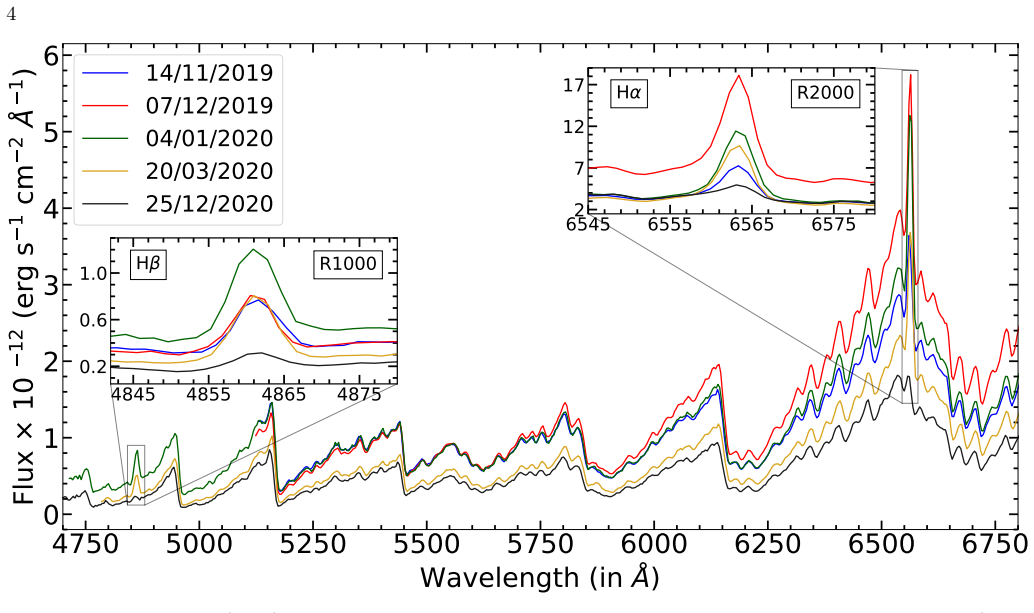


read the original abstract
The geometry and morphology of symbiotic stars are conducive to exhibit a variety of scattering phenomena. The prominent among them is the Raman scattering of O VI doublet $\lambda \lambda$ 1032,1038 angstrom, which often show strongly polarized features in the visible spectrum. Similar Raman scattering of Ly$\beta$ photons has also been predicted to occur in symbiotic stars, though with fewer detections and with weak polarization amplitudes. Here, we present the discovery of strong variable polarization in the H$\alpha$ profile of a recently established symbiotic system Y Gem, over a period of nearly 22 months. This is, most likely, a very rare detection of the strongly polarized Raman scattered Ly$\beta$ photons, falling at the H$\alpha$ emission. Monte-Carlo simulations have been conducted to confirm the underlying Raman scattering process causing the polarized line profile, and a simple orbital model is constructed with typical parameters available in the recent literature along with a complementary low-resolution spectroscopic data. These simulations and models are then used to validate the observed polarization variation of H$\alpha$ at different orbital phases corresponding to the epochs of observations. The possibility of such strong variable H$\alpha$ polarization, being caused by Raman scattering of Ly$\beta$, would thus open up avenues of exploring such effects in various other astrophysical situations having similar morphology.
Editorial analysis
A structured set of objections, weighed in public.
Referee Report
Summary. The manuscript reports the discovery of strong variable polarization in the Hα emission-line profile of the symbiotic star Y Gem, observed over a 22-month baseline. The authors interpret this variability as arising from Raman scattering of Lyβ photons and support the claim with Monte-Carlo simulations that reproduce the polarized line profile plus a simple orbital model constructed from typical literature parameters that is said to match the observed polarization changes at different orbital phases.
Significance. If the Raman-scattering interpretation is robust, the result would constitute a rare, high-amplitude detection of polarized Lyβ Raman features in a symbiotic system and could open new observational windows on binary geometry and neutral-hydrogen distributions in similar objects. The long temporal baseline and the use of both simulations and an orbital model are positive elements that, if strengthened with quantitative tests, would elevate the work’s impact.
major comments (3)
- [Abstract and §4] Abstract and §4 (simulations): the statement that the Monte-Carlo runs “confirm the underlying Raman scattering process” is not accompanied by any quantitative comparison (e.g., predicted vs. observed polarization amplitude, position-angle swing, or line-profile shape) or by explicit tests that rule out alternative mechanisms such as Thomson scattering in the accretion flow or dust scattering. Because this uniqueness is load-bearing for the central claim, the simulations must be shown to exclude those alternatives at a statistically meaningful level.
- [Orbital-model section] Orbital-model section: the model adopts “typical parameters available in the recent literature” without stating which values were chosen, whether they were adjusted to the Y Gem data, or what the resulting χ² or residual statistics are. The validation of phase-dependent polarization therefore remains post-hoc; a forward prediction from an independently constrained orbit followed by a blind comparison to the observed epochs would be required to strengthen the argument.
- [Abstract and results summary] Abstract and results summary: no error bars on the measured polarization amplitudes, no formal fit statistics, and no mention of the number of independent epochs or the spectral resolution are provided. These omissions make it impossible to judge whether the reported variability is statistically significant or consistent with the orbital model within uncertainties.
minor comments (2)
- [Abstract] The abstract would be clearer if it reported the observed polarization amplitudes (in percent) and their range across the 22-month baseline.
- [Orbital-model section] All literature parameters adopted for the orbital model should be cited with explicit references and numerical values in the text.
Simulated Author's Rebuttal
We thank the referee for the thoughtful and constructive report. The comments highlight important areas where the manuscript can be strengthened with additional quantitative details and clarifications. We address each major comment below and indicate the revisions we will make.
read point-by-point responses
-
Referee: [Abstract and §4] Abstract and §4 (simulations): the statement that the Monte-Carlo runs “confirm the underlying Raman scattering process” is not accompanied by any quantitative comparison (e.g., predicted vs. observed polarization amplitude, position-angle swing, or line-profile shape) or by explicit tests that rule out alternative mechanisms such as Thomson scattering in the accretion flow or dust scattering. Because this uniqueness is load-bearing for the central claim, the simulations must be shown to exclude those alternatives at a statistically meaningful level.
Authors: We agree that quantitative metrics are needed to support the interpretation. In the revised manuscript we will add direct comparisons between the Monte-Carlo output and the observed data, including polarization amplitude, position-angle rotation across the line, and overall profile shape, together with simple goodness-of-fit measures. We will also expand the discussion to explain why the observed polarization signature (wavelength shift, high degree, and phase dependence) is more consistent with Raman scattering of Lyβ than with Thomson scattering in an accretion flow or dust scattering. Additional Monte-Carlo runs for the alternative processes can be included to illustrate that they do not reproduce the data as closely. A full statistical exclusion at high significance may, however, require more extensive parameter exploration than is feasible within the present study. revision: partial
-
Referee: [Orbital-model section] Orbital-model section: the model adopts “typical parameters available in the recent literature” without stating which values were chosen, whether they were adjusted to the Y Gem data, or what the resulting χ² or residual statistics are. The validation of phase-dependent polarization therefore remains post-hoc; a forward prediction from an independently constrained orbit followed by a blind comparison to the observed epochs would be required to strengthen the argument.
Authors: We will revise the orbital-model section to list the exact parameter values taken from the literature (orbital period, inclination, component masses, etc.) and to report the model predictions for each observed epoch along with residuals. Because the published orbital elements for Y Gem remain only loosely constrained, the model is necessarily illustrative rather than a formal fit; we will make this limitation explicit and avoid claiming a blind test. A truly independent forward prediction would require new radial-velocity or astrometric data that are not currently available. revision: partial
-
Referee: [Abstract and results summary] Abstract and results summary: no error bars on the measured polarization amplitudes, no formal fit statistics, and no mention of the number of independent epochs or the spectral resolution are provided. These omissions make it impossible to judge whether the reported variability is statistically significant or consistent with the orbital model within uncertainties.
Authors: We will add error bars to all reported polarization amplitudes, derived from the photon-noise and instrumental uncertainties of the observations. The revised text will state the number of independent epochs obtained over the 22-month baseline, the spectral resolution of the polarimetric data, and any quantitative comparison (e.g., reduced χ²) between the orbital model and the observed polarization changes. These additions will allow readers to assess the significance of the variability directly. revision: yes
- A fully blind forward prediction from an orbit that is independently and precisely constrained by non-polarimetric data is not possible at present, because the orbital elements of Y Gem in the literature are not sufficiently accurate to permit such a test without reference to the polarization measurements themselves.
Circularity Check
No significant circularity in derivation chain
full rationale
The paper reports new observational data on variable Hα polarization over a 22-month baseline in Y Gem and interprets it as Raman-scattered Lyβ via Monte-Carlo simulations that confirm the scattering process plus a simple orbital model built from typical literature parameters to validate phase dependence. No step reduces by construction to self-definition, fitted inputs renamed as predictions, or a self-citation chain; the simulations and model function as interpretive tools applied to independent observations rather than tautological reproductions of their own inputs. The central claim therefore retains independent content grounded in the reported data and external parameter sources.
Axiom & Free-Parameter Ledger
free parameters (1)
- orbital parameters
axioms (1)
- domain assumption Raman scattering of Lyβ by neutral hydrogen produces polarized emission at Hα wavelength in symbiotic-star geometry
Reference graph
Works this paper leans on
-
[1]
arXiv preprint arXiv:2002.06500 , year=
The Formation of the Double Gaussian Line Profiles of the Symbiotic Star AG Peg , author=. arXiv preprint arXiv:2002.06500 , year=
-
[2]
The Astrophysical Journal , volume=
Polarized H Wings in the Symbiotic Stars AG Draconis and Z Andromedae , author=. The Astrophysical Journal , volume=. 2004 , publisher=
work page 2004
-
[3]
The Astrophysical Journal , volume=
Broad Wings around H and H in the Two S-type Symbiotic Stars Z Andromedae and AG Draconis , author=. The Astrophysical Journal , volume=. 2018 , publisher=
work page 2018
-
[4]
Astronomy & Astrophysics , volume=
Measuring the orbital inclination of Z Andromedae from Rayleigh scattering , author=. Astronomy & Astrophysics , volume=. 2012 , publisher=
work page 2012
-
[5]
Monthly Notices of the Royal Astronomical Society , volume=
Polarization of the broad H wing in symbiotic stars , author=. Monthly Notices of the Royal Astronomical Society , volume=. 2002 , publisher=
work page 2002
-
[6]
The Bulletin of The Korean Astronomical Society , volume=
A Monte Carlo Study of Polarization Structures in the Thomson Scattered Line Radiation , author=. The Bulletin of The Korean Astronomical Society , volume=. 2006 , publisher=
work page 2006
-
[7]
On the nature of the emission-line profiles of symbiotic stars--I. Accretion discs , author=. Monthly Notices of the Royal Astronomical Society , volume=. 1994 , publisher=
work page 1994
-
[8]
Monthly Notices of the Royal Astronomical Society , volume=
H and H Raman scattering line profiles of the symbiotic star AG Pegasi , author=. Monthly Notices of the Royal Astronomical Society , volume=. 2018 , publisher=
work page 2018
-
[9]
Astronomy & Astrophysics , volume=
Y Gem, a symbiotic star outshone by its asymptotic giant branch primary component , author=. Astronomy & Astrophysics , volume=. 2025 , publisher=
work page 2025
-
[10]
The Astrophysical Journal , volume=
Y Gem: A White Dwarf Symbiotic Star? , author=. The Astrophysical Journal , volume=. 2022 , publisher=
work page 2022
-
[11]
The Astrophysical Journal , volume=
Binarity and Accretion in AGB Stars: HST/STIS Observations of UV Flickering in Y Gem , author=. The Astrophysical Journal , volume=. 2018 , publisher=
work page 2018
-
[12]
The Astrophysical Journal Letters , volume=
Strong variable ultraviolet emission from y gem: accretion activity in an asymptotic giant branch star with a binary companion? , author=. The Astrophysical Journal Letters , volume=. 2011 , publisher=
work page 2011
-
[13]
The Astrophysical Journal , volume=
Binarity in cool asymptotic giant branch stars: a GALEX search for ultraviolet excesses , author=. The Astrophysical Journal , volume=. 2008 , publisher=
work page 2008
-
[14]
Astrophysical Journal, Part 1 (ISSN 0004-637X), vol
The relationship between infrared, optical, and ultraviolet extinction , author=. Astrophysical Journal, Part 1 (ISSN 0004-637X), vol. 345, Oct. 1, 1989, p. 245-256. , volume=
work page 1989
-
[15]
Astrophysical Journal, Part 1 (ISSN 0004-637X), vol
Radio emission from symbiotic stars-A binary model , author=. Astrophysical Journal, Part 1 (ISSN 0004-637X), vol. 286, Nov. 1, 1984, p. 263-268. Research supported by the Natural Sciences and Engineering Research Council of Canada. , volume=
work page 1984
-
[16]
The Astrophysical Journal , volume=
Raman-Scattering Wings of H in SymbioticStars , author=. The Astrophysical Journal , volume=. 2000 , publisher=
work page 2000
-
[17]
Astronomy and Astrophysics (ISSN 0004-6361), vol
Raman scattering as a diagnostic possibility in astrophysics , author=. Astronomy and Astrophysics (ISSN 0004-6361), vol. 211, no. 2, March 1989, p. L27-L30. Research supported by SNSF. , volume=
work page 1989
-
[18]
Astronomy and Astrophysics (ISSN 0004-6361), vol
Identification of the emission bands at 6830, 7088 A , author=. Astronomy and Astrophysics (ISSN 0004-6361), vol. 211, no. 2, March 1989, p. L31-L34. Research supported by SNSF. , volume=
work page 1989
-
[19]
Astronomy and Astrophysics (ISSN 0004-6361), vol
Raman scattered emission lines in symbiotic stars: a spectropolarimetric survey , author=. Astronomy and Astrophysics (ISSN 0004-6361), vol. 281, no. 1, p. 145-160 , volume=
-
[20]
Reviews in Modern Astronomy 11: Stars and Galaxies
Raman scattering and the geometric structure of symbiotic stars , author=. Reviews in Modern Astronomy 11: Stars and Galaxies. Edited by Reinhard E. Schielicke. Hamburg, Germany: Astronomische Gesellschaft, 1998. QB1. R48 v. 11, p. 297 , volume=
work page 1998
-
[21]
Raman scattering in symbiotic stars. I. Spectropolarimetric observations , author=. Astronomy and Astrophysics Supplement Series , volume=. 1996 , publisher=
work page 1996
-
[22]
Monthly Notices of the Royal Astronomical Society , volume=
Electron optical depths and temperatures of symbiotic nebulae from Thomson scattering , author=. Monthly Notices of the Royal Astronomical Society , volume=. 2012 , publisher=
work page 2012
- [23]
-
[24]
Monthly Notices of the Royal Astronomical Society , volume =
A Monte Carlo study of polarization structures in the Thomson-scattered line radiation , author =. Monthly Notices of the Royal Astronomical Society , volume =. 2006 , publisher=
work page 2006
-
[25]
Monthly Notices of the Royal Astronomical Society , volume=
First results from MFOSC-P: low-resolution optical spectroscopy of a sample of M dwarfs within 100 parsecs , author=. Monthly Notices of the Royal Astronomical Society , volume=. 2020 , publisher=
work page 2020
-
[26]
Abu faint object spectrograph and camera--Pathfinder (MFOSC-P) for PRL 1.2 m Mt
Design and development of Mt. Abu faint object spectrograph and camera--Pathfinder (MFOSC-P) for PRL 1.2 m Mt. Abu Telescope , author=. Experimental Astronomy , volume=. 2021 , publisher=
work page 2021
-
[27]
Designs of Mt. Abu faint object spectrograph and camera-echelle polarimeter (M-FOSC-EP) and its prototype: spectro-polarimeters for PRL 1.2 m and 2.5 m Mt. Abu Telescopes, India , author=. Ground-based and Airborne Instrumentation for Astronomy IX , volume=. 2022 , organization=
work page 2022
-
[28]
Monthly Notices of the Royal Astronomical Society , volume=
Optical and near-infrared spectroscopy of Nova V2891 Cygni: evidence for shock-induced dust formation , author=. Monthly Notices of the Royal Astronomical Society , volume=. 2022 , publisher=
work page 2022
-
[29]
Ground-based and Airborne Instrumentation for Astronomy X , volume=
Development of ProtoPol: a medium resolution echelle spectro-polarimeter for PRL 1.2 m and 2.5 m telescopes, Mt Abu, India , author=. Ground-based and Airborne Instrumentation for Astronomy X , volume=. 2024 , organization=
work page 2024
-
[30]
Modeling, Systems Engineering, and Project Management for Astronomy X , volume=
Mount Abu 2.5 m telescope: first light and performance assessment , author=. Modeling, Systems Engineering, and Project Management for Astronomy X , volume=. 2022 , organization=
work page 2022
-
[31]
Bulletin of the Astronomical Society of India , year = 1995, month = mar, volume =
A brief report on the Infrared Telescope at Gurushikhar, MT Abu. Bulletin of the Astronomical Society of India , year = 1995, month = mar, volume =
work page 1995
-
[32]
Contributions of the Astronomical Observatory Skalnat
Eruptive stars monitoring and the ARAS database , author=. Contributions of the Astronomical Observatory Skalnat
-
[33]
Symbiotic stars , author=. Interacting Binaries , pages=. 1986 , publisher=
work page 1986
-
[34]
The Impact of Binary Stars on Stellar Evolution , volume=
The symbiotic stars , author=. The Impact of Binary Stars on Stellar Evolution , volume=. 2019 , publisher=
work page 2019
-
[35]
Astronomy & Astrophysics , volume=
A photometric and spectroscopic study of the eclipsing symbiotic binary AX Persei , author=. Astronomy & Astrophysics , volume=. 2001 , publisher=
work page 2001
-
[36]
Astronomy and Astrophysics, Vol
Montecarlo simulations of Raman scattered OVI emission lines in symbiotic stars , author=. Astronomy and Astrophysics, Vol. 254, NO. FEB (I), P. 224, 1992 , volume=
work page 1992
-
[37]
Monthly Notices of the Royal Astronomical Society , volume=
Monte Carlo simulations of the Rayleigh scattering effects in symbiotic stars , author=. Monthly Notices of the Royal Astronomical Society , volume=. 1995 , publisher=
work page 1995
-
[38]
Monthly Notices of the Royal Astronomical Society , volume=
Simulations of the Raman-scattered O vI emission lines in symbiotic stars , author=. Monthly Notices of the Royal Astronomical Society , volume=. 1996 , publisher=
work page 1996
-
[39]
Raman scattering in symbiotic stars. II. Numerical models , author=. Astronomy and Astrophysics Supplement Series , volume=. 1997 , publisher=
work page 1997
-
[40]
Numerical simulations , author=
On the profiles and the polarization of Raman-scattered emission lines in symbiotic stars—II. Numerical simulations , author=. Monthly Notices of the Royal Astronomical Society , volume=. 1997 , publisher=
work page 1997
-
[41]
Monthly Notices of the Royal Astronomical Society , volume=
Rayleigh and Raman scattering cross-sections and phase matrices of the ground-state hydrogen atom, and their astrophysical implications , author=. Monthly Notices of the Royal Astronomical Society , volume=. 2024 , publisher=
work page 2024
-
[42]
The Astrophysical Journal , volume=
The Evolving Structure of AG Pegasi, Emerging from the Interpretation of the Emission Spectra at Different Phases , author=. The Astrophysical Journal , volume=. 1997 , publisher=
work page 1997
-
[43]
Journal of the Korean earth science society , volume=
An analysis of the symbiotic star Z And line profile , author=. Journal of the Korean earth science society , volume=. 2012 , publisher=
work page 2012
-
[44]
Monthly Notices of the Royal Astronomical Society , volume=
The remarkable properties of the symbiotic star AE Circinus , author=. Monthly Notices of the Royal Astronomical Society , volume=. 2008 , publisher=
work page 2008
-
[45]
Monthly Notices of the Royal Astronomical Society , volume=
TCP J18224935-2408280: a symbiotic star identified during outburst , author=. Monthly Notices of the Royal Astronomical Society , volume=. 2023 , publisher=
work page 2023
-
[46]
I-H-alpha profile variations in CH Cygni , author=
Observational studies of the symbiotic stars. I-H-alpha profile variations in CH Cygni , author=. Astrophysical Journal, Part 1, vol. 242, Nov. 15, 1980, p. 188-194. , volume=
work page 1980
-
[47]
Astrophysics and space science , volume=
High-dispersion spectroscopy of the symbiotic star AX Per: A binary model with rapid mass accretion , author=. Astrophysics and space science , volume=. 1988 , publisher=
work page 1988
- [48]
-
[49]
On the binary orbit and the geometric structure of V1016 Cygni
Spectropolarimetry of symbiotic stars. On the binary orbit and the geometric structure of V1016 Cygni. , author=. Astronomy and Astrophysics, v. 310, p. 211-220 , volume=
- [50]
-
[51]
II-Binary and multiple star envelopes and the determination of binary inclinations , author=
Polarisation by Thomson scattering in optically thin stellar envelopes. II-Binary and multiple star envelopes and the determination of binary inclinations , author=. Astronomy and Astrophysics, vol. 68, no. 3, Aug. 1978, p. 415-427. Research supported by the Science Research Council. , volume=
work page 1978
-
[52]
Astrophysical Journal, Part 1, vol
A polarimetric determination of binary inclinations-Results for five systems , author=. Astrophysical Journal, Part 1, vol. 221, Apr. 1, 1978, p. 200-210. , volume=
work page 1978
-
[53]
Astrophysical Journal, Part 1 (ISSN 0004-637X), vol
Polarization eclipse model of the Wolf-Rayet binary V444 Cygni with constraints on the stellar radii and an estimate of the Wolf-Rayet mass-loss rate , author=. Astrophysical Journal, Part 1 (ISSN 0004-637X), vol. 410, no. 1, p. 342-356. , volume=
-
[54]
The Astrophysical Journal Letters , volume=
Spectropolarimetry of the H line in Herbig Ae/Be stars , author=. The Astrophysical Journal Letters , volume=
-
[55]
Astrophysical Journal, Part 1, vol
Spectropolarimetry and the physical structure of proto-planetary nebulae , author=. Astrophysical Journal, Part 1, vol. 246, June 1, 1981, p. 444-454. Research supported by the University of Minnesota , volume=
work page 1981
-
[56]
Monthly Notices of the Royal Astronomical Society , volume=
H spectropolarimetry of B [e] and Herbig Be stars , author=. Monthly Notices of the Royal Astronomical Society , volume=. 1999 , publisher=
work page 1999
-
[57]
Astrophysical Journal, Part 1 (ISSN 0004-637X), vol
Approximations to the radii of Roche lobes , author=. Astrophysical Journal, Part 1 (ISSN 0004-637X), vol. 268, May 1, 1983, p. 368, 369. , volume=
work page 1983
-
[58]
An Atlas of High Resolution Line Profiles of Symbiotic Stars-Part One-Coud
Van Winckel, Hans and Duerbeck, Hilmar W and Schwarz, Hugo E , journal=. An Atlas of High Resolution Line Profiles of Symbiotic Stars-Part One-Coud
-
[59]
An atlas of high resolution line profiles of symbiotic stars. II. Echelle spectroscopy of northern sky objects , author=. Astronomy and Astrophysics Suppl., Vol. 103, p. 201-233 (1994) , volume=
work page 1994
-
[60]
The Astrophysical Journal Supplement Series , volume=
Broad H Wings in Nebulae around Evolved Stars and in Young Planetary Nebulae , author=. The Astrophysical Journal Supplement Series , volume=
-
[61]
The Astrophysical Journal , volume=
FORMATION OF RAMAN SCATTERING WINGS AROUND H , H , AND PA IN ACTIVE GALACTIC NUCLEI , author=. The Astrophysical Journal , volume=. 2015 , publisher=
work page 2015
-
[62]
Monthly Notices of the Royal Astronomical Society , volume=
On the centre shifts of Raman-scattered He ii and H wings in symbiotic stars , author=. Monthly Notices of the Royal Astronomical Society , volume=. 2004 , publisher=
work page 2004
-
[63]
The Astrophysical Journal , volume=
Raman-scattered He II 6545 line in the symbiotic star V1016 Cygni , author=. The Astrophysical Journal , volume=
-
[64]
The Astrophysical Journal , volume=
Raman Scattered He II 4332 in the Symbiotic Star V1016 Cygni , author=. The Astrophysical Journal , volume=. 2012 , publisher=
work page 2012
-
[65]
The Astrophysical Journal , volume=
The 2021 hot-type symbiotic outburst of YY herculis: An optical follow-up study , author=. The Astrophysical Journal , volume=. 2025 , publisher=
work page 2021
-
[66]
Abu, India—Part I: the design, development, and laboratory characterization , author=
Development of ProtoPol: a medium resolution echelle spectro-polarimeter for PRL telescopes, Mt. Abu, India—Part I: the design, development, and laboratory characterization , author=. Journal of Astronomical Telescopes, Instruments, and Systems , volume=. 2026 , publisher=
work page 2026
-
[67]
Development of ProtoPol: a medium-resolution echelle spectro-polarimeter for PRL telescopes, Mt. Abu, India—Part II: the data-reduction pipeline, on-sky characterization and performance verification, and first science results , author=. Journal of Astronomical Telescopes, Instruments, and Systems , volume=. 2026 , publisher=
work page 2026
-
[68]
Monthly Notices of the Royal Astronomical Society , volume=
On the unidentified bands 6830, 7088 in symbiotic stars , author=. Monthly Notices of the Royal Astronomical Society , volume=. 1980 , publisher=
work page 1980
-
[69]
Symbiotic stars in the era of modern ground-and space-based surveys , author=. Galaxies , volume=. 2025 , publisher=
work page 2025
-
[70]
The Astrophysical Journal , volume=
New Symbiotic Stars or Candidates in LAMOST Low-resolution Spectra , author=. The Astrophysical Journal , volume=. 2025 , publisher=
work page 2025
-
[71]
The Astrophysical Journal , volume=
New Symbiotic Stars from LAMOST DR10 Spectra and Multiband Photometry , author=. The Astrophysical Journal , volume=. 2025 , publisher=
work page 2025
-
[72]
The Astrophysical Journal , year=
Ultraviolet and optical spectroscopy of the R Aquarii symmetrical jet , author=. The Astrophysical Journal , year=
-
[73]
Astrophysical Journal, Part 1 (ISSN 0004-637X), vol
A radio survey of symbiotic stars , author=. Astrophysical Journal, Part 1 (ISSN 0004-637X), vol. 284, Sept. 1, 1984, p. 202-210. , volume=
work page 1984
-
[74]
arXiv preprint arXiv:2506.20505 , year=
Symbiotic star candidates in Gaia Data Release 3 , author=. arXiv preprint arXiv:2506.20505 , year=
-
[75]
Monthly Notices of the Royal Astronomical Society , pages=
Discovery of thirteen new symbiotic stars in Gaia DR3 , author=. Monthly Notices of the Royal Astronomical Society , pages=. 2026 , publisher=
work page 2026
-
[76]
Monthly Notices of the Royal Astronomical Society: Letters , volume=
SU Lyncis, a hard X-ray bright M giant: Clues point to a large hidden population of symbiotic stars , author=. Monthly Notices of the Royal Astronomical Society: Letters , volume=. 2016 , publisher=
work page 2016
-
[77]
Monthly Notices of the Royal Astronomical Society: Letters , volume=
UV spectroscopy confirms SU Lyn to be a symbiotic star , author=. Monthly Notices of the Royal Astronomical Society: Letters , volume=. 2020 , publisher=
work page 2020
-
[78]
Monthly Notices of the Royal Astronomical Society , volume=
SU Lyn-a transient symbiotic star , author=. Monthly Notices of the Royal Astronomical Society , volume=. 2022 , publisher=
work page 2022
-
[79]
Astronomy & Astrophysics , volume=
Spectroscopy of the symbiotic binary CH Cygni from 1996 to 2007 , author=. Astronomy & Astrophysics , volume=. 2009 , publisher=
work page 1996
discussion (0)
Sign in with ORCID, Apple, or X to comment. Anyone can read and Pith papers without signing in.