REVIEW 2 major objections 5 minor 18 references
Information Design for Regulating Traffic Flows under Uncertain Network State
T0 review · 2 major / 5 minor · reviewed 2026-08-14 · deepseek-v4-flash
Pith's one-line read The paper shows that a central authority can reach the minimum possible average spillover on a protected route by signaling only a fraction of travelers, provided that fraction exceeds a threshold below 1.
desk verdict A genuine partial-adoption insight for information design in two-route routing games, but the paper leans on unproved equilibrium lemmas and needs to show its work before the main theorem stands alone. read the letter →
The pith
A machine-rendered reading of the paper's core claim, the machinery that carries it, and where it could break.
The reading
What carries the argument
Three tools carry the argument. First, the equilibrium concept is Bayesian Wardrop equilibrium: each traveler chooses the route with minimum expected cost given the signal (for informed travelers) or the prior (for uninformed travelers), and no traveler can lower expected cost by switching. Second, the paper partitions all feasible information structures into two regimes via a function $g(\pi)$ that compares posterior beliefs against the adoption fraction $\lambda$; in regime $\Pi_1$, informed travelers switch routes with the signal and uninformed travelers split, while in regime $\Pi_2$ both populations split and flows depend on the belief difference induced by the signal. Third, Lemmas 1--3 transform the non-convex design problem into a tractable one: Lemma 1 characterizes which belief-signal pairs $(\beta,P)$ are feasible, Lemma 2 places the optimum inside $\Pi_1$ for small $\lambda$, and Lemma 3 shows the objective is linear because the optimal route-2 flow never falls below the threshold $\tau$. Theorem 1 then splits $\lambda$ into three intervals at $\underline{\lambda}$ and $\bar{\lambda}$ and gives closed-form optimal structures and flows in each.
What would settle it
Compute, for a fixed feasible $\pi$ and $\lambda$, all Bayesian Wardrop equilibria of the subgame by solving the best-response inequalities numerically across the parameter range; if any equilibrium flow on route 2 falls outside the two expressions in Proposition 1, or if two different equilibria exist for the same $\pi$, then Proposition 1 is false and the threshold $\underline{\lambda}$ in Theorem 1 does not guarantee the claimed minimum spillover.
Extended reading notes
Core claim
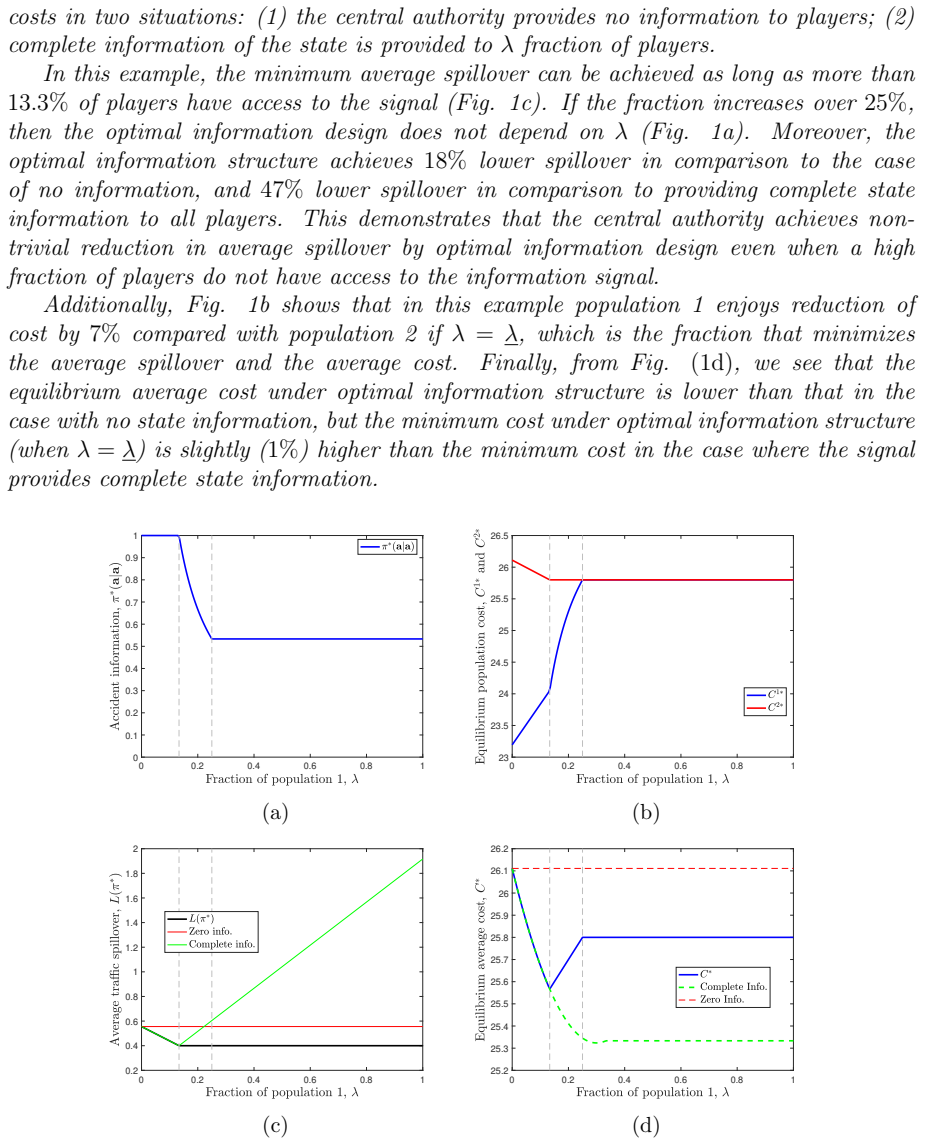
The central claim is that in this two-route Bayesian routing game, the authority's optimal information structure achieves the minimum possible average spillover on route 2 as soon as the adoption fraction $\lambda$ is at least a threshold $\underline{\lambda}<1$. For $p\leq \bar{p}$, the optimum is to provide no state information, yielding zero spillover. For $p>\bar{p}$, the paper characterizes the optimal signal piecewise over three regimes of $\lambda$: in the first regime ($\lambda<\underline{\lambda}$) the signal is fully revealing and spillover decreases with $\lambda$; in the second and third regimes ($\lambda\geq\underline{\lambda}$) the spillover is pinned at the floor, and the route-2 flow equals the threshold $\tau$ in the nominal state and exceeds it only in the accident state. The designer therefore never needs to reach every traveler to reach the best possible outcome.
Load-bearing premise
The load-bearing premise is Proposition 1's claim that, for every feasible information structure and adoption fraction, the Bayesian Wardrop equilibrium is unique and takes one of two closed-form flow regimes, and the paper does not prove that proposition here, attributing it to earlier work; if that characterization or its uniqueness fails, the optimality results in Theorem 1 are unsupported.
Editorial extensions
If this is right
- For $p\leq\bar{p}$, providing no information is optimal and achieves zero average spillover on route 2.
- For $p>\bar{p}$, the minimum possible average spillover is $\frac{(D-\tau)(\bar{\alpha}_1(\theta)+\alpha_2)-\alpha_2 D-b_2+b_1}{\alpha_1^a+\alpha_2}$, attained for every $\lambda\geq\underline{\lambda}$.
- In the optimal structure, the nominal state is revealed perfectly ($\pi^*(n|n)=1$), while the accident state is revealed only partially when $\lambda>\underline{\lambda}$, preventing too many travelers from being pushed onto route 2.
- The threshold $\underline{\lambda}$ decreases as the allowed flow $\tau$ on route 2 increases, so a city willing to tolerate more flow on the protected route needs fewer informed travelers to reach the spillover floor.
- When $\lambda<\bar{\lambda}$, informed travelers enjoy lower average cost than uninformed travelers; if travelers choose whether to adopt the signal, adoption will settle at or above $\bar{\lambda}$, equalizing the two populations' costs.
- The paper fixes $\lambda$ as an exogenous parameter; treating $\lambda$ as a second design variable is a natural extension, and the paper's numerical example suggests that $\lambda=\underline{\lambda}$ minimizes both spillover and average cost while leaving informed travelers better off.
- If the same two-regime equilibrium characterization extends to networks with more routes or more states, the qualitative result that a strictly partial adoption rate suffices for the regulator's optimum would likely persist.
- For a city negotiating with a navigation provider, $\lambda$ can be read as the app's market penetration rate; the threshold $\underline{\lambda}$ gives a concrete lower bound on reach that still delivers the spillover floor.
Signed reviews
Editorial analysis
A structured set of objections, weighed in public.
Referee Report
Summary. This paper studies a Bayesian persuasion design in a two-route, two-state non-atomic congestion game with partial adoption: a fraction λ of travelers receive a signal about the uncertain network state, while the remaining travelers do not. The authority chooses an information structure π to minimize the average spillover on route 2 at the induced Bayesian Wardrop equilibrium. The main results are Proposition 2, which states that for low accident probability no information is optimal and spillover is zero, and Theorem 1, which gives a piecewise characterization of the optimal information structure in three λ-regimes when the accident probability is high. The central claim is that the minimum possible average spillover is attained for any λ above a threshold λ with λ<1, and Section 5 adds results on equilibrium population costs together with a numerical example.
Significance. If the results are correct, the paper makes a clean and non-obvious contribution: it shows that a designer can achieve the best possible spillover regulation without informing all travelers, and it provides explicit closed-form formulas for the optimal signal and for the critical adoption fraction. The stylized model is clearly formulated, and the paper gives a concrete and internally consistent numerical illustration of the threshold behavior. The main weakness is that the equilibrium characterization and several optimality lemmas are not proved in this manuscript; the central results are therefore plausible and self-consistent but not fully verifiable from the text alone.
major comments (2)
- [Section 3, Proposition 1] Proposition 1 is load-bearing but not proved in this manuscript. The text only says that the idea of the proof follows Theorem 1 of [17] and Theorems 1-2 of [3], and both are prior papers by the same authors. The uniqueness of the Bayesian Wardrop equilibrium, the partition of information structures into Π1 and Π2, and the closed-form flows in (11)-(12) are used directly in the reformulation (16)-(18), in Theorem 1, and in the formula for the threshold λ in (21). A reader cannot verify the central claim without these results. Please make Proposition 1 self-contained, either by giving a full proof or by stating the exact cited result and proving that it applies to the present model.
- [Section 4, Lemmas 2 and 3; Section 5, Proposition 3] Lemmas 2 and 3 are stated with no proof and no proof sketch, yet they are essential for Theorem 1. Lemma 2 asserts that for λ<λ̄ the optimal information structure lies in Π1, and Lemma 3 asserts that f2*(s)≥τ for both signals under the optimal structure. These are not immediate consequences of Proposition 1 because the objective in (16) is non-convex and piecewise linear. The value of the minimum spillover in (24) and the threshold λ in (21) both depend on these lemmas. Section 5's Proposition 3, which underlies the cost comparisons and the claim that λ is also the average-cost-minimizing adoption level, is likewise unproved. Please provide complete proofs or detailed derivations for all of these results, and address explicitly how the non-convexity in (16) is handled.
minor comments (5)
- [Section 2.1, cost functions] The expression for c^n_1(f1) is written as α^n_1 f2 + b2, which would make the nominal-state cost on route 1 depend on f2 and equal to the cost structure of route 2. This appears to be a typo; it should presumably be α^n_1 f1 + b1, and it should be corrected.
- [Section 3, Eq. (10)] The definition of g(π) is typeset ambiguously: it is unclear whether D appears in the denominator of each fraction or only in the first term. Please rewrite (10) with clear parentheses so that the units and the claim g(π)∈[0,1] are unambiguous.
- [Section 2.2, Eq. (5)] In the definition of L(π,f), the formula uses f_r(s), but the loss is the spillover on route 2 only. Please replace f_r(s) with f_2(s), or clarify the notation.
- [Section 1 and Section 4] The introduction says the paper provides the optimal information structure 'for any given spillover threshold', but Theorem 1 is proved only for τ satisfying (14), with the extension for other τ deferred. Please qualify the introductory claim or include the extension.
- [Throughout] There are several wording slips, for example 'the fraction λ is induced by players' choice of accessing to the signal versus chosen by the designer versus' in Section 5. A careful proofreading pass is needed.
Circularity Check
No circularity: the information-design derivation is self-contained given the cited equilibrium characterization.
full rationale
The paper's central claim—that the minimum average spillover is achieved for all λ≥λ—follows from the equilibrium flow formulas in Proposition 1 and the subsequent optimization over feasible information structures. Proposition 1 is attributed to the authors' prior work [17] and [3], but that cited work establishes equilibrium uniqueness and flow characterization, not the optimal-signaling result; it is an independent, parameter-free equilibrium result whose assumptions do not include the spillover-minimization target. The present paper uses it as a premise, which is legitimate mathematical practice and does not make the derivation circular. Lemma 1 is cited to Kamenica–Gentzkow's standard Bayes-plausibility characterization, again an external, non-circular input. Lemmas 2 and 3 are stated without proof, and Proposition 1's proof is only sketched by reference; these are omissions of support rather than reductions of the target result to its own inputs. The threshold λ in (21) is not a fitted parameter: it is the unique fraction at which the complete-information signal exactly makes f2*(n)=τ, and regime Λ2's π*(a|a) is constructed to set f2*(n)=τ, yielding the constant spillover (24). No equation or definition in the paper defines the outcome in terms of the sought optimal value, and no prediction is obtained by renaming a fitted quantity. Thus there is no significant circularity.
Assumptions & free parameters
assumptions (5)
- domain assumption Cost functions are affine: c_a1(f1)=α_a1 f1+b1, c_n1(f1)=α_n1 f1+b1, c2(f2)=α2 f2+b2, with α_a1 > α_2 > α_n1, b1 < b2, D > (b2−b1)/α_n1.
- domain assumption Spillover threshold τ satisfies constraint (14), i.e., D − (α2D+b2−b1)/(α_n1+α2) ≤ τ ≤ D − (α2D+b2−b1)/(α_a1+α2).
- domain assumption Normalization constraint (2c): π(n|n) ≥ π(n|a), with signals labeled so that signal a is more likely in state a.
- domain assumption Equilibrium selection is the Bayesian Wardrop equilibrium defined by (8a)-(8b), with population 2 averaging over the joint state-signal measure µ(ω,s)=θ(ω)π(s|ω).
- domain assumption Proposition 1's two-regime equilibrium flow characterization (Π1 vs Π2) is correct and complete for all feasible π and λ.
Cite this review
Pith. "Pith review of Information Design for Regulating Traffic Flows under Uncertain Network State." pith.science (2026). https://pith.science/paper/ZI2MAMXJ
@misc{pith2026190807105,
  author       = {Pith},
  title        = {Pith review of: Information Design for Regulating Traffic Flows under Uncertain Network State},
  year         = {2026},
  howpublished = {\url{https://pith.science/paper/ZI2MAMXJ}},
  note         = {Machine review of arXiv:1908.07105}
}
read the original abstract
Traffic navigation services have gained widespread adoption in recent years. The route recommendations generated by these services often leads to severe congestion on urban streets, raising concerns from neighboring residents and city authorities. This paper is motivated by the question: How can a transportation authority design an information structure to induce a preferred equilibrium traffic flow pattern in uncertain network state conditions? We approach this question from a Bayesian persuasion viewpoint. We consider a basic routing game with two parallel routes and an uncertain state that affects the travel cost on one of the routes. The authority sends a noisy signal of the state to a given fraction of travelers. The information structure (i.e., distribution of signals in each state) chosen by the authority creates a heterogeneous information environment for the routing game. The solution concept governing the travelers' route choices is Bayesian Wardrop Equilibrium. We design an information structure to minimize the average traffic spillover -- the amount of equilibrium route flow exceeding a certain threshold -- on one of the routes. We provide an analytical characterization of the optimal information structure for any fraction of travelers receiving the signal. We find that it can achieve the minimum spillover so long as the fraction of travelers receiving the signal is larger than a threshold (smaller than 1).
Figures
Reference graph
Works this paper leans on
-
[17]
Informational aspects in a class of Bayesian congestion games,
M. Wu, J. Liu, and S. Amin, “Informational aspects in a class of Bayesian congestion games,” in 2017 American Control Conference (ACC). IEEE, 2017, pp. 3650–3657
work page 2017
-
[3]
Value of Information in Bayesian Routing Games
M. Wu, S. Amin, and A. E. Ozdaglar, “Value of information systems in routing games,” arXiv preprint arXiv:1808.10590 , 2018
work page Pith review arXiv 2018
-
[1]
Does providing information to drivers reduce traffic congestion?
R. Arnott, A. De Palma, and R. Lindsey, “Does providing information to drivers reduce traffic congestion?” Transportation Research Part A: General, vol. 25, no. 5, pp. 309–318, 1991
work page 1991
-
[2]
Informational Braess paradox: The effect of information on traffic congestion,
D. Acemoglu, A. Makhdoumi, A. Malekian, and A. Ozdaglar, “Informational Braess paradox: The effect of information on traffic congestion,” Operations Research, vol. 66, no. 4, pp. 893–917, 2018
work page 2018
-
[4]
Bottleneck model with heterogeneous information,
Z. Khan and S. Amin, “Bottleneck model with heterogeneous information,” Trans- portation Research Part B: Methodological, vol. 112, pp. 157–190, 2018
work page 2018
-
[5]
Waze is worsening traffic in some l.a. neighborhoods. what should the city do?
L. Bliss and L. Bliss, “Waze is worsening traffic in some l.a. neighborhoods. what should the city do?” Apr 2015. [Online]. Available: https://www.citylab.com/ transportation/2015/04/las-lovehate-relationship-with-waze-continues/391832/
work page 2015
-
[6]
Reporter analysis: Waze directions send traffic through quiet streets,
“Reporter analysis: Waze directions send traffic through quiet streets,” Sep 2016. [Online]. Available: https://www.reporternewspapers.net/2016/09/02/ reporter-analysis-waze-directions-send-traffic-quiet-streets/ 15
work page 2016
-
[7]
Waze, google maps make traf- fic matters worse during Skirball and Creek fires, officials say,
C. N. Service and C. N. Service, “Waze, google maps make traf- fic matters worse during Skirball and Creek fires, officials say,” Dec 2017. [Online]. Available: https://www.dailynews.com/2017/12/08/ waze-google-maps-make-traffic-matters-worse-during-skirball-and-creek-fires-officials-say/
work page 2017
Show all 18 references
-
[8]
Navigation apps are turning quiet neighborhoods into traffic nightmares,
L. W. Foderaro, “Navigation apps are turning quiet neighborhoods into traffic nightmares,” Dec 2017. [Online]. Available: https://www.nytimes.com/2017/12/24/ nyregion/traffic-apps-gps-neighborhoods.html
2017
-
[9]
Fremont: City takes steps to keep commuters on freeways and off its streets,
J. Geha, “Fremont: City takes steps to keep commuters on freeways and off its streets,” Nov 2016. [Online]. Available: https://www.eastbaytimes.com/2016/11/ 10/fremont-city-takes-steps-to-keep-commuters-on-freeways-and-off-its-streets/
2016
-
[10]
LA city council member wants to make waze useless,
B. Barragan, “LA city council member wants to make waze useless,” Apr 2015. [Online]. Available: https://la.curbed.com/2015/4/28/9966152/ la-city-councilmember-wants-to-make-waze-useless
2015
-
[11]
Reducing congestion through information de- sign,
S. Das, E. Kamenica, and R. Mirka, “Reducing congestion through information de- sign,” in 2017 55th Annual Allerton Conference on Communication, Control, and Computing (Allerton). IEEE, 2017, pp. 1279–1284
2017
-
[12]
Informational incentives for congestion games,
H. Tavafoghi and D. Teneketzis, “Informational incentives for congestion games,” in 2017 55th Annual Allerton Conference on Communication, Control, and Computing (Allerton). IEEE, 2017, pp. 1285–1292
2017
-
[13]
Bayesian persuasion and information design,
E. Kamenica, “Bayesian persuasion and information design,” Annual Review of Eco- nomics, vol. 11, 2018
2018
-
[14]
Bayes correlated equilibrium and the comparison of information structures in games,
D. Bergemann and S. Morris, “Bayes correlated equilibrium and the comparison of information structures in games,” Theoretical Economics, vol. 11, no. 2, pp. 487–522, 2016
2016
-
[15]
On information design in games,
L. Mathevet, J. Perego, and I. Taneva, “On information design in games,” Unpub- lished paper, Department of Economics, New York University.[1115] , 2017
2017
-
[16]
Persuasion of a privately informed receiver,
A. Kolotilin, T. Mylovanov, A. Zapechelnyuk, and M. Li, “Persuasion of a privately informed receiver,” Econometrica, vol. 85, no. 6, pp. 1949–1964, 2017
1949
-
[18]
Bayesian persuasion,
E. Kamenica and M. Gentzkow, “Bayesian persuasion,” American Economic Review, vol. 101, no. 6, pp. 2590–2615, 2011. 16
2011
Reviewed August 14, 2026 · model on record in the stance chip above.
Discussion (0). Continue with ORCID to comment.