A unification of graded and substructural logics
Pith reviewed 2026-05-20 14:44 UTC · model grok-4.3
The pith
GRASS unifies graded and substructural logics into one type system that tracks variable usage with arbitrary algebraic grades while supporting restrictions on weakening and contraction.
A machine-rendered reading of the paper's core claim, the machinery that carries it, and where it could break.
Core claim
GRASS is a type system incorporating mechanisms from both graded and substructural logics, allowing maximally flexible control over variable usage. It permits grades drawn from an arbitrary collection of grade algebras to coexist inside the same system, so different variables can be governed by different resource notions. On the level of categorical semantics, GRASS subsumes established systems such as LNL, Adjoint Logic, and mGL.
What carries the argument
The GRASS type system, which embeds both quantitative grading from semirings or algebras and substructural restrictions on contraction and weakening within a single syntax and its associated categorical semantics.
If this is right
- Different variables within one program can be subject to distinct resource algebras without requiring separate languages or embeddings.
- Categorical models of GRASS automatically provide models for LNL, Adjoint Logic, and mGL as instances.
- The system supports resource tracking that is both quantitative and structural in the same derivation.
- Arbitrary collections of grade algebras can be mixed inside one context without forcing a single global algebra.
Where Pith is reading between the lines
- Language designers could adopt GRASS as a common core and then instantiate only the grade algebras needed for a particular domain such as memory, energy, or information flow.
- Type checkers built on GRASS might allow incremental addition of new resource disciplines by extending the collection of algebras rather than rewriting the core rules.
- The categorical semantics suggest that future work could lift existing categorical constructions from the subsumed systems directly into the GRASS setting.
Load-bearing premise
A single coherent type system and its semantics can embed the core mechanisms of both graded and substructural approaches while preserving their individual properties and avoiding inconsistencies.
What would settle it
An explicit derivation or term that is valid in a standard graded system or a standard substructural system but cannot be typed in GRASS, or a semantic embedding of LNL, Adjoint Logic, or mGL that fails to preserve the expected morphisms.
Figures




read the original abstract
Type systems which account for resource sensitive computations can generally be split into two styles: First, substructural logics such as Linear Logic which seek to restrict weakening and contraction and reintroduce them in a controlled manner; And second, graded systems which allow weakening and contraction by default, but track the use of variables quantitatively in some algebraic structure -- usually a semiring. We present GRASS (Graded and substructural), a type system which incorporates mechanisms from both of these approaches, thus allowing maximally flexible control over variable usage. Furthermore, GRASS allows grades from an arbitrary collection of grade algebras to coexist in the same system, thus allowing different variables to be controlled with respect to different notions of resource within the same program. We develop the categorical semantics of \gyaru{}, and find that, on the level of categorical semantics, it subsumes multiple established systems such as LNL, Adjoint Logic, and mGL.
Editorial analysis
A structured set of objections, weighed in public.
Referee Report
Summary. The paper introduces GRASS, a type system that unifies graded and substructural logics by parameterizing contexts with multiple independent grade algebras, allowing arbitrary collections of grades to coexist while recovering weakening/contraction control from both styles. It defines combined resource-usage rules and develops functorial categorical semantics, with explicit embeddings showing that GRASS subsumes LNL, Adjoint Logic, and mGL as special cases.
Significance. If the embeddings and semantic constructions hold, the work supplies a single, parameterizable framework that recovers several established resource-sensitive systems without loss of expressiveness. The explicit functorial semantics and recovery of prior systems as instances constitute a clear technical contribution to the unification of graded and substructural type theories.
major comments (1)
- [§4.3] §4.3, Definition 4.7: the combined grade algebra construction for multiple independent grades is stated to preserve the original substructural restrictions, but the proof sketch does not explicitly verify that the induced weakening/contraction rules coincide exactly with those of mGL when all but one grade algebra are taken to be the trivial semiring; this step is load-bearing for the subsumption claim.
minor comments (3)
- [§3.2] Notation for the multi-grade context judgment is introduced in §3.2 but the precise arity of the grade tuple is not restated in the typing rules of Figure 2, making it easy to misread how many independent grades are active in a given derivation.
- [§5] The categorical semantics section (§5) uses the same symbol for the functor interpreting a GRASS judgment and the functor interpreting an embedded LNL judgment; a distinct notation or explicit coercion would improve readability.
- [Theorem 5.4] Theorem 5.4 states that the embedding of Adjoint Logic is full and faithful, yet the proof only sketches the faithfulness direction; supplying the missing direction or a reference to a standard lemma would strengthen the result.
Simulated Author's Rebuttal
Thank you for the positive review and the recommendation for minor revision. We address the single major comment below and have made the corresponding changes to the manuscript.
read point-by-point responses
-
Referee: [§4.3] §4.3, Definition 4.7: the combined grade algebra construction for multiple independent grades is stated to preserve the original substructural restrictions, but the proof sketch does not explicitly verify that the induced weakening/contraction rules coincide exactly with those of mGL when all but one grade algebra are taken to be the trivial semiring; this step is load-bearing for the subsumption claim.
Authors: We appreciate the referee highlighting this gap in the proof sketch. The comment is correct that an explicit verification is needed for the subsumption of mGL. In the revised version, we expand the proof in §4.3 to explicitly show that setting all but one grade algebra to the trivial semiring (where the only grade is 0 with no weakening or contraction beyond the base) induces exactly the weakening and contraction rules of mGL. This is done by demonstrating that the combined operations on grades reduce to the single algebra's rules, preserving the substructural restrictions precisely. We believe this strengthens the subsumption claim. revision: yes
Circularity Check
No significant circularity: new parameterized construction with explicit embeddings
full rationale
The paper defines GRASS by directly parameterizing typing contexts with an arbitrary collection of independent grade algebras and introducing combined usage rules that recover graded and substructural systems as special cases. The categorical semantics are built explicitly via functorial constructions that embed LNL, Adjoint Logic, and mGL while preserving their structural properties. No load-bearing step reduces to a self-definition, a fitted parameter renamed as a prediction, or a self-citation chain; the unification is a self-contained generalization whose correctness rests on the explicit rule definitions and semantic functors rather than on prior fitted results or imported uniqueness theorems from the same authors.
Axiom & Free-Parameter Ledger
axioms (1)
- standard math Standard rules and constructions of type theory and categorical semantics
invented entities (1)
-
GRASS type system
no independent evidence
Lean theorems connected to this paper
-
IndisputableMonolith/Cost/FunctionalEquation.leanwashburn_uniqueness_aczel unclear?
unclearRelation between the paper passage and the cited Recognition theorem.
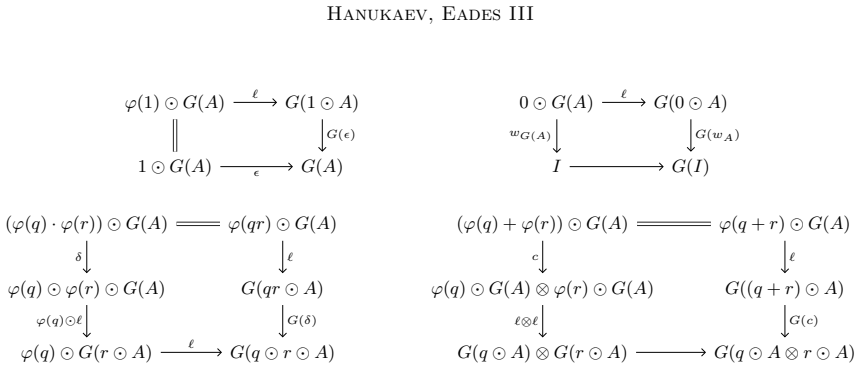
GRASS is parametrized by a functor S→Mode ... modes arranged in a preorder ... contraction controlled by ideals ... categorical semantics based on graded linear exponential comonads ... morphisms of actions via actegories
-
IndisputableMonolith/Foundation/AbsoluteFloorClosure.leanabsolute_floor_iff_bare_distinguishability unclear?
unclearRelation between the paper passage and the cited Recognition theorem.
exponential action ... colax monoidal ... c_{r,q} : D(r+q) → D(r) ˆ⊗ D(q) ... lineator ℓ
What do these tags mean?
- matches
- The paper's claim is directly supported by a theorem in the formal canon.
- supports
- The theorem supports part of the paper's argument, but the paper may add assumptions or extra steps.
- extends
- The paper goes beyond the formal theorem; the theorem is a base layer rather than the whole result.
- uses
- The paper appears to rely on the theorem as machinery.
- contradicts
- The paper's claim conflicts with a theorem or certificate in the canon.
- unclear
- Pith found a possible connection, but the passage is too broad, indirect, or ambiguous to say the theorem truly supports the claim.
Reference graph
Works this paper leans on
-
[1]
Abel, A. and J.-P. Bernardy,A unified view of modalities in type systems, Proceedings of the ACM on Programming Languages4, pages 1–28 (2020), ISSN 2475-1421. https://doi.org/10.1145/3408972
-
[2]
Free higher groups in homotopy type theory
Atkey, R.,Syntax and Semantics of Quantitative Type Theory, in:Proceedings of the 33rd Annual ACM/IEEE Symposium on Logic in Computer Science, LICS ’18, pages 56–65, Association for Computing Machinery, New York, NY, USA (2018), ISBN 978-1-4503-5583-4. https://doi.org/10.1145/3209108.3209189
-
[3]
Azevedo de Amorim, A., M. Gaboardi, J. Hsu, S.-y. Katsumata and I. Cherigui,A semantic account of metric preservation, SIGPLAN Not.52, pages 545–556 (2017), ISSN 0362-1340. https://doi.org/10.1145/3093333.3009890
-
[4]
N.,A mixed linear and non-linear logic: Proofs, terms and models, in: L
Benton, P. N.,A mixed linear and non-linear logic: Proofs, terms and models, in: L. Pacholski and J. Tiuryn, editors, Computer Science Logic, pages 121–135, Springer, Berlin, Heidelberg (1995), ISBN 978-3-540-49404-1. https://doi.org/10.1007/BFb0022251
-
[5]
Bianchini, R., F. Dagnino, P. Giannini and E. Zucca,A Java-like calculus with heterogeneous coeffects, Theoretical Computer Science971, page 114063 (2023), ISSN 0304-3975. https://doi.org/10.1016/j.tcs.2023.114063
-
[6]
Bianchini, R., F. Dagnino, P. Giannini and E. Zucca,Multi-Graded Featherweight Java, in:37th European Conference on Object-Oriented Programming (ECOOP 2023), pages 3:1–3:27, Schloss Dagstuhl – Leibniz-Zentrum f¨ ur Informatik (2023). https://doi.org/10.4230/LIPIcs.ECOOP.2023.3
-
[7]
Bierman, G. M. and V. d. Paiva,On an Intuitionistic Modal Logic, Stud Logica65, pages 383–416 (2000). https://doi.org/10.1023/A:1005291931660
-
[8]
Brunel, A., M. Gaboardi, D. Mazza and S. Zdancewic,A Core Quantitative Coeffect Calculus, in: Z. Shao, editor, Programming Languages and Systems, pages 351–370, Springer, Berlin, Heidelberg (2014), ISBN 978-3-642-54833-8. https://doi.org/10.1007/978-3-642-54833-8_19
-
[9]
Capucci, M. and B. Gavranovi´ c,Actegories for the Working Amthematician(2024). ArXiv:2203.16351 [math]. https://doi.org/10.48550/arXiv.2203.16351
-
[10]
Choudhury, P., H. Eades III, R. A. Eisenberg and S. Weirich,A graded dependent type system with a usage-aware semantics, Proceedings of the ACM on Programming Languages5, pages 1–32 (2021), ISSN 2475-1421. https://doi.org/10.1145/3434331
-
[11]
de Amorim, A. A., M. Gaboardi, E. J. Gallego Arias and J. Hsu,Really Natural Linear Indexed Type Checking, in: Proceedings of the 26nd 2014 International Symposium on Implementation and Application of Functional Languages, IFL ’14, pages 1–12, Association for Computing Machinery, New York, NY, USA (2014), ISBN 978-1-4503-3284-2. https://doi.org/10.1145/27...
-
[12]
Orchard, Flavien Breuvart, and Tarmo Uustalu
Gaboardi, M., S.-y. Katsumata, D. Orchard, F. Breuvart and T. Uustalu,Combining effects and coeffects via grading, in: Proceedings of the 21st ACM SIGPLAN International Conference on Functional Programming, ICFP 2016, pages 476–489, Association for Computing Machinery, New York, NY, USA (2016), ISBN 978-1-4503-4219-3. https://doi.org/10.1145/2951913.2951939
-
[13]
Ghica, D. R. and A. I. Smith,Bounded Linear Types in a Resource Semiring, in: Z. Shao, editor,Programming Languages and Systems, pages 331–350, Springer, Berlin, Heidelberg (2014), ISBN 978-3-642-54833-8. https://doi.org/10.1007/978-3-642-54833-8_18
-
[14]
Giannini, P. and G. Duso,Coeffects for MiniJava: Cf-Mj, in:Proceedings of the 26th ACM International Workshop on Formal Techniques for Java-like Programs, FTfJP 2024, pages 30–36, Association for Computing Machinery, New York, NY, USA (2024), ISBN 979-8-4007-1111-4. https://doi.org/10.1145/3678721.3686232
-
[15]
Girard, J.-Y.,Linear logic, Theoretical Computer Science50, pages 1–101 (1987), ISSN 0304-3975. https://doi.org/https://doi.org/10.1016/0304-3975(87)90045-4
-
[16]
Katsumata, S.-y.,A Double Category Theoretic Analysis of Graded Linear Exponential Comonads, in: C. Baier and U. Dal Lago, editors,Foundations of Software Science and Computation Structures, pages 110–127, Springer International Publishing, Cham (2018), ISBN 978-3-319-89366-2. https://doi.org/10.1007/978-3-319-89366-2_6
-
[17]
M.,Doctrinal adjunction, in: G
Kelly, G. M.,Doctrinal adjunction, in: G. M. Kelly, editor,Category Seminar, pages 257–280, Springer, Berlin, Heidelberg (1974), ISBN 978-3-540-37270-7. https://doi.org/10.1007/BFb0063105 16 Hanukaev, Eades III
-
[18]
https://doi.org/10.2307/2310058
Lambek, J.,The mathematics of sentence structure, The American Mathematical Monthly65, pages 154–170 (1958). https://doi.org/10.2307/2310058
-
[19]
https://doi.org/10.1007/978-1-4613-0041-0
Lang, S.,Algebra, Springer New York (2002). https://doi.org/10.1007/978-1-4613-0041-0
-
[20]
Liepelt, V.-B., D. Marshall, D. Orchard, V. Rajani and M. Vollmer,On Graded Coeffect Types for Information-Flow Control, in: D. Orchard, T. Petricek and J. Singer, editors,Languages, Compilers, Analysis - From Beautiful Theory to Useful Practice: Essays Dedicated to Alan Mycroft on the Occasion of His Retirement, pages 114–148, Springer Nature Switzerland...
-
[21]
https://hal.science/hal-00154229v1
Melli` es, P.-A.,Categorical semantics of linear logic, in:Interactive models of computation and program behaviour, number 27 in Panoramas et Synth` eses, pages 1 – 196, Soci´ et´ e Math´ ematique de France (2009). https://hal.science/hal-00154229v1
work page 2009
-
[22]
Moon, B., H. Eades III and D. Orchard,Graded Modal Dependent Type Theory, in: N. Yoshida, editor,Programming Languages and Systems, pages 462–490, Springer International Publishing, Cham (2021), ISBN 978-3-030-72019-3. https://doi.org/10.1007/978-3-030-72019-3_17
-
[23]
Orchard, D., V.-B. Liepelt and H. Eades III,Quantitative program reasoning with graded modal types, Language implementation for Quantitative Program Reasoning with Graded Modal Types3, pages 110:1–110:30 (2019). https://doi.org/10.1145/3341714
-
[24]
Petricek, T., D. Orchard and A. Mycroft,Coeffects: Unified Static Analysis of Context-Dependence, in: F. V. Fomin, R. Freivalds, M. Kwiatkowska and D. Peleg, editors,Automata, Languages, and Programming, pages 385–397, Springer Berlin Heidelberg, Berlin, Heidelberg (2013), ISBN 978-3-642-39212-2. https://doi.org/10.1007/978-3-642-39212-2_35
-
[25]
Petricek, T., D. Orchard and A. Mycroft,Coeffects: a calculus of context-dependent computation, ACM SIGPLAN Notices 49, pages 123–135 (2014), ISSN 0362-1340, 1558-1160. https://doi.org/10.1145/2692915.2628160
-
[26]
https://doi.org/10.1023/A:1015186718090
Petri´ c, Z.,Coherence in Substructural Categories, Studia Logica70, pages 271–296 (2002), ISSN 1572-8730. https://doi.org/10.1023/A:1015186718090
-
[27]
Pruiksma, K., W. Chargin, F. Pfenning and J. Reed,Adjoint logic(2018). https://www.cs.cmu.edu/~./fp/papers/adjoint18b.pdf
work page 2018
-
[28]
Rajani, V., G. Barthe and D. Garg,A Modal Type Theory of Expected Cost in Higher-Order Probabilistic Programs, Proc. ACM Program. Lang.8, pages 285:389–285:414 (2024). https://doi.org/10.1145/3689725
-
[29]
Uustalu, T. and T. Vene,Signals and Comonads, JUCS - Journal of Universal Computer Science11, pages 1310–1326 (2005), ISSN 0948-6968, 0948-695X. Number: 7. https://doi.org/10.3217/jucs-011-07-1311
-
[30]
Uustalu, T. and V. Vene,Comonadic Notions of Computation, Electronic Notes in Theoretical Computer Science203, pages 263–284 (2008), ISSN 1571-0661. https://doi.org/10.1016/j.entcs.2008.05.029
-
[31]
move scalars out of the tensor product,
Vollmer, V., D. Marshall, H. Eades III and D. Orchard,A Mixed Linear and Graded Logic: Proofs, Terms, and Models, in: J. Endrullis and S. Schmitz, editors,33rd EACSL Annual Conference on Computer Science Logic (CSL 2025), volume 326 ofLeibniz International Proceedings in Informatics (LIPIcs), pages 32:1–32:21, Schloss Dagstuhl – Leibniz-Zentrum f¨ ur Info...
discussion (0)
Sign in with ORCID, Apple, or X to comment. Anyone can read and Pith papers without signing in.