REVIEW 1 major objections 4 minor 1 cited by
The Interstellar Medium in IZw18 seen with JWST/MIRI: I. Highly Ionized Gas
T0 review · 1 major / 4 minor · reviewed 2026-08-05 · deepseek-v4-flash
Pith's one-line read JWST/MIRI shows that the extreme ionization of IZw18 is powered by X-ray binaries and ULXs, not shocks or an AGN.
desk verdict Solid JWST/MIRI dataset with a new [NeV] detection, but the 'not shocks' claim depends on a 0.2 dex metallicity extrapolation that the authors admit is shaky. read the letter →
The pith
A machine-rendered reading of the paper's core claim, the machinery that carries it, and where it could break.
The reading
What carries the argument
The load-bearing comparison is a set of mid-infrared fine-structure line ratios—[Ne iii]/[Ne ii], [S iv]/[S iii], [O iv]/[S iii], and [Ne v]/[Ne ii]—whose ionization potentials span 21.6 to 97.1 eV. These ratios are measured in eleven ~120 pc apertures and compared with photoionization models that include a self-consistent, metallicity- and age-dependent ULX population, and with radiative shock models spanning a range of magnetic field strengths and preshock densities. The high-ionization lines [O iv] and [Ne v] are what discriminate between the mechanisms, because only the ULX-bearing stellar models supply enough photons above 50 eV to match the observed ratios.
What would settle it
Measure the [Ne v] 24.32/14.32 flux ratio in the four NW apertures with deeper MIRI exposures. The photoionized-ULX interpretation requires low-density gas (ratio ≳ 1), whereas fast radiative shocks would predict a ratio closer to the high-density limit (~0.1); a ratio near 0.1 would break the ULX-only picture and reopen the shock case.
Extended reading notes
Core claim
The central discovery is that the interstellar medium of I Zw 18, a dwarf galaxy at roughly 3% solar metallicity, is in an extremely high ionization state that does not come from an active galactic nucleus. JWST/MIRI detects ten fine-structure lines, including [O iv] 25.9 µm (ionization potential 54.9 eV) and [Ne v] 14.3 µm (97.1 eV), and the measured line ratios place I Zw 18 at the extreme upper end of galaxy trends while remaining off the AGN locus. Comparing these ratios with photoionization models that include a self-consistent population of X-ray binaries and ULXs, and with radiative shock models, the authors conclude that shocks cannot reproduce the observations, whereas a roughly 25
Load-bearing premise
The result depends on the shock models being applicable to IZw18, but those models only go down to log(Z/Zsun) = -1.3 while IZw18 is at about -1.5; the authors note the comparison may not be strictly appropriate.
Editorial extensions
If this is right
- In I Zw 18, [O iv] and [Ne v] detections are reproduced by the ULX-bearing photoionization models but not by the shock grids, so shocks are not the driver of the extreme ionization.
- Because the [Ne v]/[Ne ii] ratio places I Zw 18 outside the AGN region of the diagnostic diagrams, [Ne v] emission alone cannot be treated as proof of an accreting massive black hole in low-metallicity dwarfs.
- A 25 Myr, 1% solar-metallicity stellar population with maximal ULX output nearly coincides with the observed ratios; a ~4% IMBH contribution is nearly degenerate with it, so the data cannot decisively separate the two.
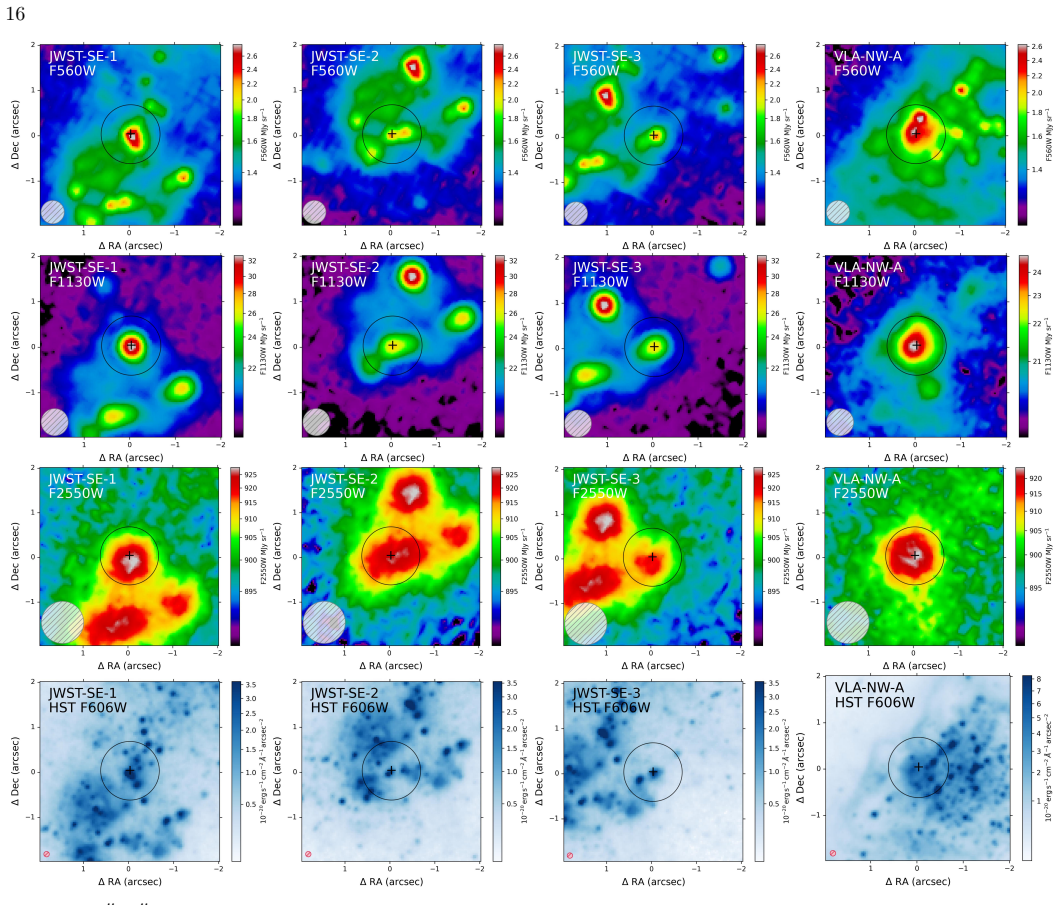
- The four 14 µm continuum sources have sizes ~30-100 pc and SEDs matching ~3-5 Myr star-cluster templates; the authors conclude they are H ii regions ionized by young, only slightly embedded clusters.
- The near-zero internal extinction means the MIR lines are unabsorbed tracers of the ionized gas, strengthening their use as benchmarks for high-redshift metal-poor dwarfs.
Reading between the lines
- If the ULX interpretation holds, JWST's [Ne v] detections in high-redshift dwarf galaxies should not be read as AGN signatures without modelling a ULX population; the same hard-photon mechanism could mimic black-hole accretion at z>7.
- The apparent youth (3-5 Myr) of the MIRI continuum sources implies that cluster formation proceeds efficiently at ~3% solar metallicity; this is testable with NIRSpec IFU spectroscopy targeting the embedded stellar continua.
- The ULX-1 photoionization model makes a quantitative prediction of a ~200 pc He iii region; narrowband He ii 4686 imaging across the NW complex would directly test whether ULX-1 alone can sustain the ionization.
- The resemblance of IZw18's line ratios to the SMC WR nebula N76 suggests that a single WR binary, rather than a distributed population, could power the SE [O iv] emission far from ULX-1; optical IFU spectroscopy can search for the WR signature in those apertures.
Editorial analysis
A structured set of objections, weighed in public.
Referee Report
Summary. This paper presents JWST/MIRI MRS aperture spectra of eleven 120-pc regions in the extremely metal-poor dwarf galaxy I Zw 18. The authors measure ten fine-structure lines, including [O IV] 25.9 μm and [Ne V] 14.3 μm, derive very low extinction from MIRI H I recombination lines combined with optical KCWI data, and compare aperture line ratios to published photoionization grids (Richardson et al. 2022, 2025) and shock grids (Flury et al. 2024). They conclude that the high-ionization state is not due to fast radiative shocks and is best reproduced by low-metallicity stellar populations with a self-consistent ULX contribution, with possible additional contributions from WR stars and a few-percent intermediate-mass black hole. The paper also identifies four compact 14 μm continuum sources, three of which are new, and interprets them as young H II regions around star clusters.
Significance. If the central interpretation holds, this is a valuable local benchmark for JWST studies of high-redshift metal-poor dwarfs. The paper provides the first clear MIRI detection of [Ne V] in an extremely metal-poor BCD and a useful caution against equating [Ne V] emission with an AGN in low-metallicity systems. The observational analysis is careful: S/N >= 3 detections with Gaussian fits, PSF-matched extraction, foreground-corrected extinction, and comparison against independent published model grids. The interpretation is model-dependent, but the paper does not overfit: f_AGN = 0.04 is explicitly presented as an illustrative choice. These strengths make the paper a credible addition to the dwarf-galaxy ISM literature, provided the shock-exclusion claim can be supported at I Zw 18's metallicity.
major comments (1)
- [§3.3, Fig. 6 and §5.1] The exclusion of shocks rests on the F24 MAPPINGS V grid, whose metallicity floor is log(Z/Zsun) = -1.3, while I Zw 18 has log(Z/Zsun) approximately -1.5. The authors acknowledge the grid may not be strictly appropriate, yet Sect. 5.1 asserts shocks are unable to reproduce the MIRI line ratios. This is load-bearing for the paper's central claim. At lower Z, shock cooling is less efficient and the precursor is harder, which pushes [O IV]/[S III] and [Ne V]/[Ne II] toward the observed extreme high-ionization locus. The alternate shock models are only cited via Mingozzi et al. (2025), not run at this metallicity. Please either run or obtain shock grids at Z ~ 0.03 Zsun, or soften the conclusion to 'not reproduced by current grids'.
minor comments (4)
- [§5.5, Eqs. (1)–(2)] The ULX plausibility estimate assumes an rms electron density of ~1 cm^-3, while Sect. 1 quotes 10–100 cm^-3 for the ionized gas. Please clarify whether this is a volume-averaged filling-factor-weighted value and discuss sensitivity to the adopted density.
- [§4, Fig. 10] The age estimates for the 14 μm continuum sources use Solar-metallicity templates with PAH and silicate features not seen in I Zw 18. The systematic uncertainty due to template metallicity could be emphasized more strongly.
- [§3.3] The f_AGN = 0.04 model is described as 'relatively arbitrary' later; please state earlier that it is illustrative, not a fitted parameter.
- [Throughout] Typos: 'identifed' in the intro; 'the extraction ... was performed' should be 'were performed'; Table 5 lists [P III] as a detection while text calls it a possible weak detection.
Circularity Check
No significant circularity: model comparisons are external grids, not fitted predictions; the F24 metallicity limitation is a robustness caveat, not a circular step.
full rationale
The derivation chain is observational and comparative: MIRI line fluxes are measured, extinction-corrected using H recombination lines and PyNeb emissivities, converted to line ratios, and then located on published model grids (R25, R22, F24) plus an empirical WR nebula (N76). No parameter is fitted to the IZw18 data in this paper; the fAGN=0.04 model is explicitly called a 'relatively arbitrary choice' made to 'illustrate the trends', not a fitted prediction. The R25/R22 grids are independent model calculations with stated assumptions (BPASS, metallicity, log U, ULX prescription) that do not take the IZw18 line ratios as input, so citing them is real evidence rather than circular. The main 'not due to shocks' claim rests on the F24 MAPPINGS V shock grids, which are external to this team; the paper itself flags that the F24 metallicities stop at log(Z/Zsun)=-1.3 and 'may not be strictly appropriate' for IZw18 at ~3% Zsun. That is a model-applicability limitation affecting robustness, not a self-referential reduction: the exclusion of shocks could be too strong if lower-metallicity shocks reach the observed locus, but the argument is still an external comparison rather than an identity between inputs and outputs. The self-citation overlap with Richardson et al. (2022, 2025) exists but is not load-bearing in a way that forces the conclusion: alternatives (shocks, WR stars, IMBHs, ULXs) are explicitly considered and the authors stress the ambiguity. No circular step can be exhibited by quoting an equation or a fitted parameter being renamed as a prediction.
Assumptions & free parameters
free parameters (2)
- fAGN (IMBH photon fraction) =
0.04
- rms electron density for ULX nebula =
~1 cm^-3
assumptions (5)
- domain assumption Case B recombination emissivities with Te=20,000 K and ne=100 cm^-3
- domain assumption The R25 BPASS+ULX photoionization models and F24 MAPPINGS shock models accurately describe the relevant physics at IZw18's metallicity
- domain assumption The MIRI PSF convolution to 27 um and 0.65 arcsec aperture extraction preserve the line flux ratios
- standard math The Garcia-Gordon (G23) and Weingartner-Draine (WD01) extinction curves are applicable to IZw18
- domain assumption Distance to IZw18 is 18.2 Mpc
Cite this review
Pith. "Pith review of The Interstellar Medium in IZw18 seen with JWST/MIRI: I. Highly Ionized Gas." pith.science (2026). https://pith.science/paper/ZIGX3RNZ
@misc{pith2026250809251,
  author       = {Pith},
  title        = {Pith review of: The Interstellar Medium in IZw18 seen with JWST/MIRI: I. Highly Ionized Gas},
  year         = {2026},
  howpublished = {\url{https://pith.science/paper/ZIGX3RNZ}},
  note         = {Machine review of arXiv:2508.09251}
}
abstract
We present JWST/MIRI spectra from the Medium-Resolution Spectrometer of IZw18, a nearby dwarf galaxy with a metallicity of $\sim$3% Solar. Its proximity enables a detailed study of highly ionized gas that can be interpreted in the context of newly discovered high-redshift dwarf galaxies. We derive aperture spectra centered on eleven regions of interest; the spectra show very low extinction, A_V $\lesssim 0.1$, consistent with optical determinations. The gas is highly ionized; we have detected 10 fine-structure lines, including [OIV] 25.9 micron with an ionization potential (IP) of $\sim$ 55 eV, and [NeV] 14.3 micron with an IP of $\sim$ 97 eV. The ionization state of IZw18 falls at the extreme upper end of all of the line ratios we analyzed, but not coincident with galaxies containing an accreting massive black hole (active galactic nucleus). Comparison of the line ratios with state-of-the-art photoionization and shock models suggests that the high ionization state in IZw18 is not due to shocks. Rather it can be attributed to metal-poor stellar populations with a self-consistent contribution of X-ray binaries or ultra-luminous X-ray sources. It could also be partially due to a small number of hot low-metallicity Wolf-Rayet stars ionizing the gas; a small fraction (a few percent) of the ionization could come from an intermediate-mass black hole. Our spectroscopy also revealed four 14 micron continuum sources, $\gtrsim 30-100$ pc in diameter, three of which were not previously identified. Their properties are consistent with HII regions ionized by young star clusters.
Figures


Figures from the paper (9 more)




Forward citations
Cited by 1 Pith paper
-
Resolving Emission from Small Dust Grains in the Blue Compact Dwarf II Zw 40 with JWST
In the low-metallicity dwarf II Zw 40, JWST resolves 3.3 um PAH emission, finds it concentrated at the northern star cluster, and shows the 3.3/11.3 PAH ratio correlates with radiation hardness.
Reference graph
Works this paper leans on
-
[1]
2019, RMxAA, 55, 377, doi: 10.22201/ia.01851101p.2019.55.02.21
Alarie, A., & Morisset, C. 2019, RMxAA, 55, 377, doi: 10.22201/ia.01851101p.2019.55.02.21
-
[2]
2007, ApJL, 667, L151, doi: 10.1086/522368
Aloisi, A., Clementini, G., Tosi, M., et al. 2007, ApJL, 667, L151, doi: 10.1086/522368
-
[3]
2013, AJ, 146, 144, doi: 10.1088/0004-6256/146/6/144
Annibali, F., Cignoni, M., Tosi, M., et al. 2013, AJ, 146, 144, doi: 10.1088/0004-6256/146/6/144
-
[4]
Argyriou, I., Glasse, A., Law, D. R., et al. 2023, A&A, 675, A111, doi: 10.1051/0004-6361/202346489 Astropy Collaboration, Robitaille, T. P., Tollerud, E. J., et al. 2013, A&A, 558, A33, doi: 10.1051/0004-6361/201322068 Astropy Collaboration, Price-Whelan, A. M., Sip˝ ocz, B. M., et al. 2018, AJ, 156, 123, doi: 10.3847/1538-3881/aabc4f
-
[5]
Atek, H., Furtak, L. J., Oesch, P., et al. 2022, MNRAS, 511, 4464, doi: 10.1093/mnras/stac360
-
[6]
Atek, H., Labb´ e, I., Furtak, L. J., et al. 2024, Nature, 626, 975, doi: 10.1038/s41586-024-07043-6
-
[7]
Babul, A., & Ferguson, H. C. 1996, ApJ, 458, 100, doi: 10.1086/176795
-
[8]
Behroozi, P., Wechsler, R. H., Hearin, A. P., & Conroy, C. 2019, MNRAS, 488, 3143, doi: 10.1093/mnras/stz1182
Show all 146 references
-
[9]
H., et al
Behroozi, P., Conroy, C., Wechsler, R. H., et al. 2020, MNRAS, 499, 5702, doi: 10.1093/mnras/staa3164 24 T able 5.Integrated line fluxes in the NW-region apertures with S/N ≥ 3 Line Rest λ NW VLA-NW-A VLA-NW-B VLA-NW-C CO2-1 ULX-1 (µm) (10 −21 W m−2) Hi recombination lines HI(...
2020 doi
-
[10]
T., Johnson, M
Berghea, C. T., Johnson, M. C., Secrest, N. J., et al. 2020, ApJ, 896, 117, doi: 10.3847/1538-4357/ab9108
2020 doi
-
[11]
Bernard-Salas, J., Spoon, H. W. W., Charmandaris, V., et al. 2009, ApJS, 184, 230, doi: 10.1088/0067-0049/184/2/230
2009 doi
-
[12]
K., Blecha, L., Torrey, P., et al
Bhowmick, A. K., Blecha, L., Torrey, P., et al. 2024, MNRAS, 531, 4311, doi: 10.1093/mnras/stae1386
2024 doi
-
[13]
A., & Tuohy, I
Binette, L., Dopita, M. A., & Tuohy, I. R. 1985, ApJ, 297, 476, doi: 10.1086/163544
1985 doi
-
[14]
D., Wolfire, M., & Leroy, A
Bolatto, A. D., Wolfire, M., & Leroy, A. K. 2013, ARA&A, 51, 207, doi: 10.1146/annurev-astro-082812-140944
2013 doi
-
[15]
2024, A&A, 689, A146, doi: 10.1051/0004-6361/202450632
Bortolini, G., ¨Ostlin, G., Habel, N., et al. 2024, A&A, 689, A146, doi: 10.1051/0004-6361/202450632
2024 doi
-
[16]
2024, astropy/photutils: 2.0.2, 2.0.2, Zenodo, doi: 10.5281/zenodo.13989456
Bradley, L., Sip˝ ocz, B., Robitaille, T., et al. 2024, astropy/photutils: 2.0.2, 2.0.2, Zenodo, doi: 10.5281/zenodo.13989456
2024 doi
-
[17]
2011, ARA&A, 49, 373, doi: 10.1146/annurev-astro-081710-102608
Bromm, V., & Yoshida, N. 2011, ARA&A, 49, 373, doi: 10.1146/annurev-astro-081710-102608
2011 doi
-
[18]
M., Heap, S
Brown, T. M., Heap, S. R., Hubeny, I., Lanz, T., & Lindler, D. 2002, ApJL, 579, L75, doi: 10.1086/345336
2002 doi
-
[19]
S., & Boylan-Kolchin, M
Bullock, J. S., & Boylan-Kolchin, M. 2017, ARA&A, 55, 343, doi: 10.1146/annurev-astro-091916-055313
2017 doi
-
[20]
2024, JWST Calibration Pipeline, 1.15.0, Zenodo, doi: 10.5281/zenodo.12556702
Bushouse, H., Eisenhamer, J., Dencheva, N., et al. 2024, JWST Calibration Pipeline, 1.15.0, Zenodo, doi: 10.5281/zenodo.12556702
2024 doi
-
[21]
L., & Storchi-Bergmann, T
Calzetti, D., Kinney, A. L., & Storchi-Bergmann, T. 1994, ApJ, 429, 582, doi: 10.1086/174346
1994 doi
-
[22]
1986, MNRAS, 223, 811, doi: 10.1093/mnras/223.4.811
Campbell, A., Terlevich, R., & Melnick, J. 1986, MNRAS, 223, 811, doi: 10.1093/mnras/223.4.811
1986 doi
-
[23]
M., Skillman, E
Cannon, J. M., Skillman, E. D., Garnett, D. R., & Dufour, R. J. 2002, ApJ, 565, 931, doi: 10.1086/324691
2002 doi
-
[24]
M., Walter, F., Skillman, E
Cannon, J. M., Walter, F., Skillman, E. D., & van Zee, L. 2005, ApJL, 621, L21, doi: 10.1086/428943 25 T able 6.Integrated line fluxes in the SE-region apertures with S/N ≥ 3 Line Rest λ JWST-SE-1 JWST-SE-2 JWST-SE-3 SE VLA-SE (µm) (10 −21 W m−2) Hi recombination lines HI(10-6...
2005 doi
-
[25]
C., Begley, R., McLeod, D
Carnall, A. C., Begley, R., McLeod, D. J., et al. 2023, MNRAS, 518, L45, doi: 10.1093/mnrasl/slac136 Cervi˜ no, M., Mas-Hesse, J. M., & Kunth, D. 2002, A&A, 392, 19, doi: 10.1051/0004-6361:20020785
2023 doi
-
[26]
A., & Clegg, A
Chevalier, R. A., & Clegg, A. W. 1985, Nature, 317, 44, doi: 10.1038/317044a0
1985 doi
-
[27]
A., Endsley, R., et al
Chisholm, J., Berg, D. A., Endsley, R., et al. 2024, MNRAS, 534, 2633, doi: 10.1093/mnras/stae2199
2024 doi
-
[28]
S., Allen, D., et al
Churchwell, E., Povich, M. S., Allen, D., et al. 2006, ApJ, 649, 759, doi: 10.1086/507015
2006 doi
-
[29]
J., Adams, N., Harvey, T., et al
Conselice, C. J., Adams, N., Harvey, T., et al. 2025, ApJ, 983, 30, doi: 10.3847/1538-4357/ada608
2025 doi
-
[30]
C., Lebouteiller, V., et al
Cormier, D., Madden, S. C., Lebouteiller, V., et al. 2015, A&A, 578, A53, doi: 10.1051/0004-6361/201425207
2015 doi
-
[31]
2023, MNRAS, 518, 425, doi: 10.1093/mnras/stac2737
Curti, M., D’Eugenio, F., Carniani, S., et al. 2023, MNRAS, 518, 425, doi: 10.1093/mnras/stac2737
2023 doi
-
[32]
2024, A&A, 684, A75, doi: 10.1051/0004-6361/202346698
Curti, M., Maiolino, R., Curtis-Lake, E., et al. 2024, A&A, 684, A75, doi: 10.1051/0004-6361/202346698
2024 doi
-
[33]
A., Smith, J
Dale, D. A., Smith, J. D. T., Schlawin, E. A., et al. 2009, ApJ, 693, 1821, doi: 10.1088/0004-637X/693/2/1821
2009 doi
-
[34]
2017, A&A, 605, A70, doi: 10.1051/0004-6361/201730419
Davidzon, I., Ilbert, O., Laigle, C., et al. 2017, A&A, 605, A70, doi: 10.1051/0004-6361/201730419
2017 doi
-
[35]
D., Andrews, J
Decleir, M., Gordon, K. D., Andrews, J. E., et al. 2022, ApJ, 930, 15, doi: 10.3847/1538-4357/ac5dbe Della Bruna, L., Adamo, A., McLeod, A. F., et al. 2022, A&A, 666, A29, doi: 10.1051/0004-6361/202243395
2022 doi
-
[36]
T., Calzetti, D., et al
Deshmukh, S., Linden, S. T., Calzetti, D., et al. 2024, ApJL, 974, L24, doi: 10.3847/2041-8213/ad7ba9
2024 doi
-
[37]
Draine, B. T. 2011, Physics of the Interstellar and Intergalactic Medium
2011
-
[38]
T., & Bertoldi, F
Draine, B. T., & Bertoldi, F. 1996, ApJ, 468, 269, doi: 10.1086/177689 26
1996 doi
-
[39]
T., & McKee, C
Draine, B. T., & McKee, C. F. 1993, ARA&A, 31, 373, doi: 10.1146/annurev.aa.31.090193.002105
1993
-
[40]
2020, astropy/specutils: v1.0, v1.0, Zenodo, doi: 10.5281/zenodo.3718589
Earl, N., Tollerud, E., Jones, C., et al. 2020, astropy/specutils: v1.0, v1.0, Zenodo, doi: 10.5281/zenodo.3718589
2020 doi
-
[41]
J., Stanway, E
Eldridge, J. J., Stanway, E. R., Xiao, L., et al. 2017, PASA, 34, e058, doi: 10.1017/pasa.2017.51
2017 doi
-
[42]
P., Whitler, L., et al
Endsley, R., Stark, D. P., Whitler, L., et al. 2024, MNRAS, 533, 1111, doi: 10.1093/mnras/stae1857
2024 doi
-
[43]
W., Gordon, K
Engelbracht, C. W., Gordon, K. D., Rieke, G. H., et al. 2005, ApJL, 628, L29, doi: 10.1086/432613
2005 doi
-
[44]
2016, MNRAS, 456, 3354, doi: 10.1093/mnras/stv2794
Feltre, A., Charlot, S., & Gutkin, J. 2016, MNRAS, 456, 3354, doi: 10.1093/mnras/stv2794
2016 doi
-
[45]
B., Bolatto, A
Fisher, D. B., Bolatto, A. D., Herrera-Camus, R., et al. 2014, Nature, 505, 186, doi: 10.1038/nature12765
2014 doi
-
[46]
Clayton, G. C. 2019, ApJ, 886, 108, doi: 10.3847/1538-4357/ab4c3a
2019 doi
-
[47]
2024, arXiv e-prints, arXiv:2412.06763, doi: 10.48550/arXiv.2412.06763
Einsig, A. 2024, arXiv e-prints, arXiv:2412.06763, doi: 10.48550/arXiv.2412.06763
2024 doi
-
[48]
2022, ApJ, 927, 212, doi: 10.3847/1538-4357/ac4fc2
Franeck, A., W¨ unsch, R., Mart ´ ınez-Gonz´ alez, S., et al. 2022, ApJ, 927, 212, doi: 10.3847/1538-4357/ac4fc2
2022 doi
-
[49]
R., & Hunt, L
Fumagalli, M., Krumholz, M. R., & Hunt, L. K. 2010, ApJ, 722, 919, doi: 10.1088/0004-637X/722/1/919
2010 doi
-
[50]
J., Shuntov, M., Atek, H., et al
Furtak, L. J., Shuntov, M., Atek, H., et al. 2023, MNRAS, 519, 3064, doi: 10.1093/mnras/stac3717 Gaia Collaboration, Brown, A. G. A., Vallenari, A., et al. 2021, A&A, 649, A1, doi: 10.1051/0004-6361/202039657
2023 doi
-
[51]
2021, A&A, 649, A18, doi: 10.1051/0004-6361/202039701
Galliano, F., Nersesian, A., Bianchi, S., et al. 2021, A&A, 649, A18, doi: 10.1051/0004-6361/202039701
2021 doi
-
[52]
R., Johnson, B
Garofali, K., Basu-Zych, A. R., Johnson, B. D., et al. 2024, ApJ, 960, 13, doi: 10.3847/1538-4357/ad0a6a Gil de Paz, A., Madore, B. F., & Pevunova, O. 2003, ApJS, 147, 29, doi: 10.1086/374737
2024 doi
-
[53]
2024, The Journal of Open Source Software, 9, 7023, doi: 10.21105/joss.07023
Gordon, K. 2024, The Journal of Open Source Software, 9, 7023, doi: 10.21105/joss.07023
2024 doi
-
[54]
D., Cartledge, S., & Clayton, G
Gordon, K. D., Cartledge, S., & Clayton, G. C. 2009, ApJ, 705, 1320, doi: 10.1088/0004-637X/705/2/1320
2009 doi
-
[55]
D., Clayton, G
Gordon, K. D., Clayton, G. C., Decleir, M., et al. 2023, ApJ, 950, 86, doi: 10.3847/1538-4357/accb59
2023 doi
-
[56]
D., Misselt, K
Gordon, K. D., Misselt, K. A., Bouwman, J., et al. 2021, ApJ, 916, 33, doi: 10.3847/1538-4357/ac00b7
2021 doi
-
[57]
2018, The Journal of Open Source Software, 3, 695, doi: 10.21105/joss.00695 G´ urpide, A., Parra, M., Godet, O., Contini, T., & Olive, J
Green, G. 2018, The Journal of Open Source Software, 3, 695, doi: 10.21105/joss.00695 G´ urpide, A., Parra, M., Godet, O., Contini, T., & Olive, J. F. 2022, A&A, 666, A100, doi: 10.1051/0004-6361/202142229
2018 doi
-
[58]
2009, ApJ, 704, 1159, doi: 10.1088/0004-637X/704/2/1159
Hao, L., Wu, Y., Charmandaris, V., et al. 2009, ApJ, 704, 1159, doi: 10.1088/0004-637X/704/2/1159
2009 doi
-
[59]
R., Millman, K
Harris, C. R., Millman, K. J., van der Walt, S. J., et al. 2020, Nature, 585, 357, doi: 10.1038/s41586-020-2649-2
2020 doi
-
[60]
K., et al
Hassani, H., Rosolowsky, E., Leroy, A. K., et al. 2023, ApJL, 944, L21, doi: 10.3847/2041-8213/aca8ab
2023 doi
-
[61]
E., Gim´ enez-Arteaga, C., Fujimoto, S., et al
Heintz, K. E., Gim´ enez-Arteaga, C., Fujimoto, S., et al. 2023, ApJL, 944, L30, doi: 10.3847/2041-8213/acb2cf
2023 doi
- [62]
-
[63]
S., Crouzet, N., Habel, N., et al
Hirschauer, A. S., Crouzet, N., Habel, N., et al. 2024, AJ, 168, 23, doi: 10.3847/1538-3881/ad4967
2024 doi
-
[64]
E., Barth, A
Hood, C. E., Barth, A. J., Ho, L. C., & Greene, J. E. 2017, ApJ, 838, 26, doi: 10.3847/1538-4357/aa60c9
2017 doi
-
[65]
K., Dyer, K
Hunt, L. K., Dyer, K. K., & Thuan, T. X. 2005, A&A, 436, 837, doi: 10.1051/0004-6361:20052915
2005 doi
-
[66]
K., Thuan, T
Hunt, L. K., Thuan, T. X., Izotov, Y. I., & Sauvage, M. 2010, ApJ, 712, 164, doi: 10.1088/0004-637X/712/1/164
2010 doi
-
[67]
K., Vanzi, L., & Thuan, T
Hunt, L. K., Vanzi, L., & Thuan, T. X. 2001, A&A, 377, 66, doi: 10.1051/0004-6361:20011088
2001 doi
-
[68]
K., Testi, L., Casasola, V., et al
Hunt, L. K., Testi, L., Casasola, V., et al. 2014, A&A, 561, A49, doi: 10.1051/0004-6361/201322739
2014 doi
-
[69]
A., & Thronson, Jr., H
Hunter, D. A., & Thronson, Jr., H. A. 1995, ApJ, 452, 238, doi: 10.1086/176295
1995 doi
-
[70]
2013, ApJ, 777, 156, doi: 10.1088/0004-637X/777/2/156
Inami, H., Armus, L., Charmandaris, V., et al. 2013, ApJ, 777, 156, doi: 10.1088/0004-637X/777/2/156
2013 doi
-
[71]
I., Chaffee, F
Izotov, Y. I., Chaffee, F. H., Foltz, C. B., et al. 1999, ApJ, 527, 757, doi: 10.1086/308119
1999 doi
-
[72]
Thuan, T. X. 1997, ApJL, 487, L37, doi: 10.1086/310872
1997 doi
-
[73]
I., & Thuan, T
Izotov, Y. I., & Thuan, T. X. 2016, MNRAS, 457, 64, doi: 10.1093/mnras/stv2957
2016 doi
-
[74]
I., Thuan, T
Izotov, Y. I., Thuan, T. X., & Guseva, N. G. 2021, MNRAS, 508, 2556, doi: 10.1093/mnras/stab2798
2021 doi
-
[75]
I., Thuan, T
Izotov, Y. I., Thuan, T. X., & Privon, G. 2012, MNRAS, 427, 1229, doi: 10.1111/j.1365-2966.2012.22051.x
2012
-
[76]
J., van Zee, L., Rosenberg, J
Janowiecki, S., Salzer, J. J., van Zee, L., Rosenberg, J. L., & Skillman, E. 2017, ApJ, 836, 128, doi: 10.3847/1538-4357/836/1/128
2017 doi
-
[77]
2013, ApJ, 770, 20, doi: 10.1088/0004-637X/770/1/20
Kaaret, P., & Feng, H. 2013, ApJ, 770, 20, doi: 10.1088/0004-637X/770/1/20
2013 doi
-
[78]
Kaaret, P., Feng, H., & Roberts, T. P. 2017, ARA&A, 55, 303, doi: 10.1146/annurev-astro-091916-055259
2017 doi
-
[79]
2021, ApJL, 908, L54, doi: 10.3847/2041-8213/abe41b
Ramos-Larios, G. 2021, ApJL, 908, L54, doi: 10.3847/2041-8213/abe41b
2021 doi
-
[80]
M., P´ erez-Montero, E., et al
Kehrig, C., V ´ ılchez, J. M., P´ erez-Montero, E., et al. 2015, ApJL, 801, L28, doi: 10.1088/2041-8205/801/2/L28 —. 2016, MNRAS, 459, 2992, doi: 10.1093/mnras/stw806
2015 doi
-
[81]
S., & Glover, S
Klessen, R. S., & Glover, S. C. O. 2023, ARA&A, 61, 65, doi: 10.1146/annurev-astro-071221-053453 27
2023 doi
-
[82]
R., McKee, C
Krumholz, M. R., McKee, C. F., & Bland-Hawthorn, J. 2019, ARA&A, 57, 227, doi: 10.1146/annurev-astro-091918-104430
2019 doi
-
[83]
Law, D. R., E. Morrison, J., Argyriou, I., et al. 2023, AJ, 166, 45, doi: 10.3847/1538-3881/acdddc
2023 doi
-
[84]
2013, A&A, 553, A16, doi: 10.1051/0004-6361/201220948
Lebouteiller, V., Heap, S., Hubeny, I., & Kunth, D. 2013, A&A, 553, A16, doi: 10.1051/0004-6361/201220948
2013 doi
-
[85]
2017, A&A, 602, A45, doi: 10.1051/0004-6361/201629675
Lebouteiller, V., P´ equignot, D., Cormier, D., et al. 2017, A&A, 602, A45, doi: 10.1051/0004-6361/201629675
2017 doi
- [86]
-
[87]
2014, ApJS, 212, 14, doi: 10.1088/0067-0049/212/1/14
Leitherer, C., Ekstr¨ om, S., Meynet, G., et al. 2014, ApJS, 212, 14, doi: 10.1088/0067-0049/212/1/14
2014 doi
-
[88]
2012, A&A, 537, A72, doi: 10.1051/0004-6361/201117867
Lelli, F., Verheijen, M., Fraternali, F., & Sancisi, R. 2012, A&A, 537, A72, doi: 10.1051/0004-6361/201117867
2012 doi
-
[89]
K., Bolatto, A
Leroy, A. K., Bolatto, A. D., Ostriker, E. C., et al. 2018, ApJ, 869, 126, doi: 10.3847/1538-4357/aaecd1
2018 doi
-
[90]
K., Schinnerer, E., Liu, D., et al
Leslie, S. K., Schinnerer, E., Liu, D., et al. 2020, ApJ, 899, 58, doi: 10.3847/1538-4357/aba044
2020 doi
-
[91]
C., Bolatto, A
Levy, R. C., Bolatto, A. D., Mayya, D., et al. 2024, ApJL, 973, L55, doi: 10.3847/2041-8213/ad7af3
2024 doi
-
[92]
T., Lai, T., Evans, A
Linden, S. T., Lai, T., Evans, A. S., et al. 2024, ApJL, 974, L27, doi: 10.3847/2041-8213/ad7eae
2024 doi
-
[93]
J., D’Eugenio, F., Maiolino, R., et al
Looser, T. J., D’Eugenio, F., Maiolino, R., et al. 2025, A&A, 697, A88, doi: 10.1051/0004-6361/202347102
2025 doi
-
[94]
Luridiana, V., Morisset, C., & Shaw, R. A. 2015, A&A, 573, A42, doi: 10.1051/0004-6361/201323152
2015 doi
-
[95]
C., Galliano, F., Jones, A
Madden, S. C., Galliano, F., Jones, A. P., & Sauvage, M. 2006, A&A, 446, 877, doi: 10.1051/0004-6361:20053890
2006 doi
-
[96]
C., R´ emy-Ruyer, A., Galametz, M., et al
Madden, S. C., R´ emy-Ruyer, A., Galametz, M., et al. 2014, An Overview of the Dwarf Galaxy Survey (PASP, 125, 600, [2013])—Corrigendum, IOP, doi: 10.1086/679312
2014 doi
-
[97]
Martin, C. L. 1996, ApJ, 465, 680, doi: 10.1086/177453
1996 doi
-
[98]
T., et al
McQuaid, T., Calzetti, D., Linden, S. T., et al. 2024, ApJ, 967, 102, doi: 10.3847/1538-4357/ad3e64
2024 doi
-
[99]
L., et al
Mingozzi, M., Garcia del Valle-Espinosa, M., James, B. L., et al. 2025, ApJ, 985, 253, doi: 10.3847/1538-4357/adc996
2025 doi
-
[100]
A., Cenko, S
Moon, D.-S., Harrison, F. A., Cenko, S. B., & Shariff, J. A. 2011, ApJL, 731, L32, doi: 10.1088/2041-8205/731/2/L32
2011 doi
-
[101]
2024, ApJ, 971, 43, doi: 10.3847/1538-4357/ad5290
Morishita, T., Stiavelli, M., Grillo, C., et al. 2024, ApJ, 971, 43, doi: 10.3847/1538-4357/ad5290
2024 doi
-
[102]
2023, ApJS, 269, 33, doi: 10.3847/1538-4365/acd556
Nakajima, K., Ouchi, M., Isobe, Y., et al. 2023, ApJS, 269, 33, doi: 10.3847/1538-4365/acd556
2023 doi
-
[103]
2020, A&A, 641, A168, doi: 10.1051/0004-6361/202037833 Naz´ e, Y., Rauw, G., Manfroid, J., Chu, Y
Hirashita, H. 2020, A&A, 641, A168, doi: 10.1051/0004-6361/202037833 Naz´ e, Y., Rauw, G., Manfroid, J., Chu, Y. H., & Vreux, J. M. 2003, A&A, 408, 171, doi: 10.1051/0004-6361:20030847
2020 doi
-
[104]
G., Weiner, B
Noeske, K. G., Weiner, B. J., Faber, S. M., et al. 2007, ApJL, 660, L43, doi: 10.1086/517926
2007 doi
-
[105]
M., & Schaerer, D
Oskinova, L. M., & Schaerer, D. 2022, A&A, 661, A67, doi: 10.1051/0004-6361/202142520
2022 doi
-
[106]
2005, MNRAS, 358, 1423, doi: 10.1111/j.1365-2966.2005.08862.x
Ott, J., Walter, F., & Brinks, E. 2005, MNRAS, 358, 1423, doi: 10.1111/j.1365-2966.2005.08862.x
2005
-
[107]
R., et al
Patapis, P., Argyriou, I., Law, D. R., et al. 2024, A&A, 682, A53, doi: 10.1051/0004-6361/202347339 Planck Collaboration, Aghanim, N., Ashdown, M., et al. 2016, A&A, 596, A109, doi: 10.1051/0004-6361/201629022 R´ emy-Ruyer, A., Madden, S. C., Galliano, F., et al. 2014, A&A, 56...
2024 doi
-
[108]
E., Wold, I
Rhoads, J. E., Wold, I. G. B., Harish, S., et al. 2023, ApJL, 942, L14, doi: 10.3847/2041-8213/acaaaf
2023 doi
-
[109]
T., Simpson, C., Polimera, M
Richardson, C. T., Simpson, C., Polimera, M. S., et al. 2022, ApJ, 927, 165, doi: 10.3847/1538-4357/ac510c
2022 doi
-
[110]
T., Wels, J., Garofali, K., et al
Richardson, C. T., Wels, J., Garofali, K., et al. 2025, arXiv e-prints, arXiv:2505.07749, doi: 10.48550/arXiv.2505.07749 Rickards Vaught, R. J., Sandstrom, K. M., & Hunt, L. K. 2021, ApJL, 911, L17, doi: 10.3847/2041-8213/abf09b Rickards Vaught, R. J., Hunt, L. K., Aloisi, A.,...
-
[111]
2023, PASP, 135, 048001, doi: 10.1088/1538-3873/acb293 Rodr ´ ıguez, M
Rigby, J., Perrin, M., McElwain, M., et al. 2023, PASP, 135, 048001, doi: 10.1088/1538-3873/acb293 Rodr ´ ıguez, M. J., Lee, J. C., Indebetouw, R., et al. 2025, ApJ, 983, 137, doi: 10.3847/1538-4357/adbb69
2023 doi
-
[112]
2008, ApJ, 677, 926, doi: 10.1086/529014
Heckman, T. 2008, ApJ, 677, 926, doi: 10.1086/529014
2008 doi
-
[113]
1999, A&AS, 136, 35, doi: 10.1051/aas:1999197
Schaerer, D., Contini, T., & Pindao, M. 1999, A&AS, 136, 35, doi: 10.1051/aas:1999197
1999 doi
-
[114]
Schaerer, D., Fragos, T., & Izotov, Y. I. 2019, A&A, 622, L10, doi: 10.1051/0004-6361/201935005
2019 doi
- [115]
-
[116]
Schaerer, D., & Vacca, W. D. 1998, ApJ, 497, 618, doi: 10.1086/305487
1998 doi
-
[117]
F., & Finkbeiner, D
Schlafly, E. F., & Finkbeiner, D. P. 2011, ApJ, 737, 103, doi: 10.1088/0004-637X/737/2/103
2011 doi
-
[118]
J., Finkbeiner, D
Schlegel, D. J., Finkbeiner, D. P., & Davis, M. 1998, ApJ, 500, 525, doi: 10.1086/305772
1998 doi
-
[119]
2011, A&A, 534, A96, doi: 10.1051/0004-6361/201117812
Palla, F. 2011, A&A, 534, A96, doi: 10.1051/0004-6361/201117812
2011 doi
-
[120]
2016, A&A, 591, A22, doi: 10.1051/0004-6361/201527916
Shenar, T., Hainich, R., Todt, H., et al. 2016, A&A, 591, A22, doi: 10.1051/0004-6361/201527916
2016 doi
-
[121]
J., Bajaj, V., Ryon, J., & Sabbi, E
Smith, L. J., Bajaj, V., Ryon, J., & Sabbi, E. 2020, ApJ, 896, 84, doi: 10.3847/1538-4357/ab8f94 28
2020 doi
-
[122]
W., Motch, C., et al
Soria, R., Pakull, M. W., Motch, C., et al. 2021, MNRAS, 501, 1644, doi: 10.1093/mnras/staa3784
2021 doi
-
[123]
Silverman, J. D. 2014, ApJS, 214, 15, doi: 10.1088/0067-0049/214/2/15
2014 doi
-
[124]
R., Eldridge, J
Stanway, E. R., Eldridge, J. J., & Becker, G. D. 2016, MNRAS, 456, 485, doi: 10.1093/mnras/stv2661
2016 doi
-
[125]
J., Labb´ e, I., et al
Stefanon, M., Bouwens, R. J., Labb´ e, I., et al. 2021, ApJ, 922, 29, doi: 10.3847/1538-4357/ac1bb6
2021 doi
-
[126]
2002, A&A, 393, 821, doi: 10.1051/0004-6361:20021043
Sturm, E., Lutz, D., Verma, A., et al. 2002, A&A, 393, 821, doi: 10.1051/0004-6361:20021043
2002 doi
-
[127]
2024, ApJ, 967, 133, doi: 10.3847/1538-4357/ad3de6
Sun, J., He, H., Batschkun, K., et al. 2024, ApJ, 967, 133, doi: 10.3847/1538-4357/ad3de6
2024 doi
-
[128]
2018, MAPPINGS V: Astrophysical plasma modeling code, Astrophysics Source Code Library, record ascl:1807.005
Sutherland, R., Dopita, M., Binette, L., & Groves, B. 2018, MAPPINGS V: Astrophysical plasma modeling code, Astrophysics Source Code Library, record ascl:1807.005
2018
-
[129]
S., & Dopita, M
Sutherland, R. S., & Dopita, M. A. 2017, ApJS, 229, 34, doi: 10.3847/1538-4365/aa6541
2017 doi
-
[130]
D., Indebetouw, R., et al
Tarantino, E., Bolatto, A. D., Indebetouw, R., et al. 2024, ApJ, 969, 101, doi: 10.3847/1538-4357/ad3def
2024 doi
-
[131]
D., F¨ orster Schreiber, N
Thornley, M. D., F¨ orster Schreiber, N. M., Lutz, D., et al. 2000, ApJ, 539, 641, doi: 10.1086/309261
2000 doi
-
[132]
X., Bauer, F
Thuan, T. X., Bauer, F. E., Papaderos, P., & Izotov, Y. I. 2004, ApJ, 606, 213, doi: 10.1086/382949
2004 doi
- [133]
-
[134]
R., Arrabal Haro, P., Simons, R
Trump, J. R., Arrabal Haro, P., Simons, R. C., et al. 2023, ApJ, 945, 35, doi: 10.3847/1538-4357/acba8a van Dishoeck, E. F., & Black, J. H. 1988, ApJ, 334, 771, doi: 10.1086/166877 van Dokkum, P. G. 2001, PASP, 113, 1420, doi: 10.1086/323894 van Hoof, P. A. M. 2018, Galaxies, ...
2023 doi
-
[135]
2003, A&A, 403, 829, doi: 10.1051/0004-6361:20030408
Verma, A., Lutz, D., Sturm, E., et al. 2003, A&A, 403, 829, doi: 10.1051/0004-6361:20030408
2003 doi
-
[136]
M., & Pagel, B
Vilchez, J. M., & Pagel, B. E. J. 1988, MNRAS, 231, 257, doi: 10.1093/mnras/231.2.257
1988 doi
-
[137]
E., et al
Virtanen, P., Gommers, R., Oliphant, T. E., et al. 2020, Nature Methods, 17, 261, doi: 10.1038/s41592-019-0686-2
2020 doi
-
[138]
W., Hao, L., Higdon, S
Weedman, D. W., Hao, L., Higdon, S. J. U., et al. 2005, ApJ, 633, 706, doi: 10.1086/466520
2005 doi
-
[139]
C., & Draine, B
Weingartner, J. C., & Draine, B. T. 2001, ApJ, 548, 296, doi: 10.1086/318651
2001 doi
-
[140]
E., Franx, M., Leja, J., et al
Whitaker, K. E., Franx, M., Leja, J., et al. 2014, ApJ, 795, 104, doi: 10.1088/0004-637X/795/2/104
2014 doi
-
[141]
White, S. D. M., & Frenk, C. S. 1991, ApJ, 379, 52, doi: 10.1086/170483
1991 doi
-
[142]
C., Chandar, R., Lee, J
Whitmore, B. C., Chandar, R., Lee, J. C., et al. 2025, ApJ, 982, 50, doi: 10.3847/1538-4357/adb3a2
2025 doi
- [143]
-
[144]
K., et al
Wu, Y., Charmandaris, V., Hunt, L. K., et al. 2007, ApJ, 662, 952, doi: 10.1086/517988
2007 doi
-
[145]
2024, ApJ, 970, 8, doi: 10.3847/1538-4357/ad4e34
Matsumoto, H. 2024, ApJ, 970, 8, doi: 10.3847/1538-4357/ad4e34
2024 doi
-
[146]
2021, A&A, 653, L10, doi: 10.1051/0004-6361/202039033
Zhou, L., Shi, Y., Zhang, Z.-Y., & Wang, J. 2021, A&A, 653, L10, doi: 10.1051/0004-6361/202039033
2021 doi
Reviewed August 5, 2026 · model on record in the stance chip above.
Discussion (0). Sign in to comment.