REVIEW 3 major objections 3 minor 24 references
Geometry of the space of phylogenetic trees with non-identical leaves
T0 review · 3 major / 3 minor · reviewed 2026-08-05 · deepseek-v4-flash
Pith's one-line read The paper introduces Towering space, a complete metric space that extends BHV tree space to phylogenetic trees with different leaf sets.
desk verdict The Towering space construction is a real new idea with mostly credible proofs, but the paper's headline claim—completeness of the metric—is never proved, and the algorithm's guarantee leans on that missing proof; conditionally worth serious refereeing. read the letter →
The pith
A machine-rendered reading of the paper's core claim, the machinery that carries it, and where it could break.
The reading
What carries the argument
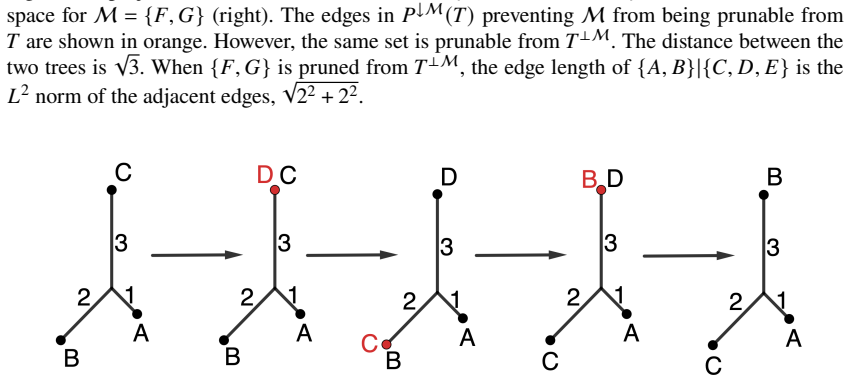
The load-bearing mechanism is the leaf-pruning map $\psi(T,M)$: a set $M$ of leaves can be pruned from $T$ only when its external edges have length zero and every internal edge maps to an internal edge of the smaller tree; merged edges receive the $\ell^2$-norm of the merged lengths. Regrafting produces sprouting spaces $\Lambda_L(T)$, the trees in a higher BHV space that prune down to $T$. The equivalence classes formed by these operations, combined with the BHV path-space support-pair distance, produce the quotient metric that defines Towering space.
What would settle it
Run the Section 4.4 iterative algorithm on a 5-leaf tree and a 4-leaf tree while exhaustively enumerating all partitions of the shared leaf set; if any enumeration yields a candidate path shorter than the algorithm's converged value, the claimed guarantee of finding a geodesic fails. A more direct check: attempt to build a Cauchy sequence of trees in Towering space whose equivalence classes converge to an object that is not a tree with $|L|\ge 3$ leaves; any such sequence would falsify completeness.
Extended reading notes
Core claim
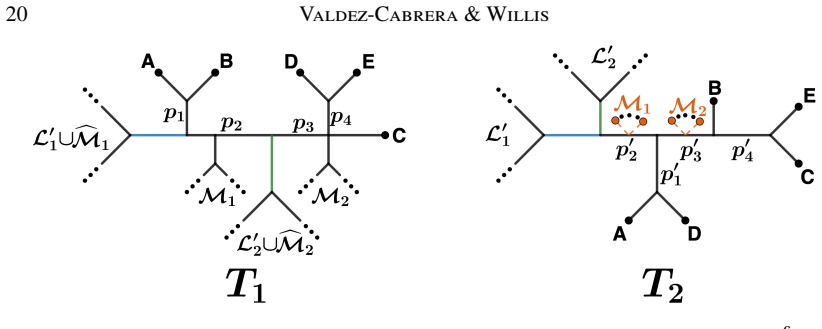
Towering space is the union $\bigcup_{L\subseteq N, |L|\ge 3} \mathcal T_L$ of BHV spaces over all leaf subsets, with an equivalence relation $\simeq$ generated by leaf prunings and regraftings. The Towering distance is the quotient pseudometric of the BHV distance, i.e. the infimum of sums $\sum_i d_{\mathrm{BHV}}(t_i,t'_i)$ over finite sequences with $T_1\simeq t_1$, $t'_i\simeq t_{i+1}$, $t'_k\simeq T_2$. Theorem 5 states that if $T_1$ has all external edges of strictly positive length and $d(T_1,T_2)=0$, then $T_1\simeq T_2$; this is what upgrades the pseudometric to a metric on equivalence classes. Geodesics are characterized as constant-rate morphs contained in the uppermost BHV level:
Load-bearing premise
The whole construction treats pruning and regrafting as zero-cost moves and then minimizes over finite sequences, while completeness of the resulting Towering space—needed to guarantee that the algorithm's search over partitions finds a geodesic—is asserted but never proved.
Editorial extensions
If this is right
- Comparisons of gene trees with different sampled gene sets become possible with a true metric, so methods that rely on the triangle inequality (Fr\'echet means, principal paths, clustering, confidence sets) can in principle be built on Towering space.
- A tree with all external edges positive is at distance zero only from trees in its own pruning/regrafting equivalence class, so the metric does not collapse distinct trees.
- Geodesics can be lifted to the highest shared BHV space, meaning the extra leaves that appear in one tree but not the other do not artificially shorten distances: adding arbitrary leaves never improves the BHV distance between two trees (Theorem 1).
- Each geodesic has a biological reading as a sequence of gene-loss (pruning) and gene-gain (regrafting) events combined with continuous branch-length change, and the $\ell^2$ merging rule preserves each tree's distance from the origin in its own BHV space.
- The paper's algorithm, while not efficient enough for large datasets, is the first explicit scheme to compute Towering distances and is argued to be faster than gradient-based alternatives because each update is closed-form.
Reading between the lines
- The text announces completeness of Towering space but gives no proof; the algorithm's guarantee in Section 4.4 ('By the completeness of Towering space...') therefore rests on an unproved premise, and the exhaustive search over partitions does not by itself rule out convergence to a local minimum.
- A natural next step, which the paper identifies but does not take, is a fast classification of edges into 'prune-preventing' and 'common' groups in the spirit of the Owen–Provan support-pair algorithm; that would turn the preliminary algorithm into a practical one.
- If the paper's conjecture that geodesics are unique for almost all tree pairs holds, then Fr\'echet means and principal-component-style analyses could be developed on Towering space without the complications of non-unique geodesics.
- The $\ell^2$ merging rule gives a testable conservation statement: pruning a set of leaves does not change the distance from the tree to the origin, so a gene-loss event alone contributes zero change in total branch-length divergence—an interpretable and checkable property for empirical gene-tree datasets.
Editorial analysis
A structured set of objections, weighed in public.
Referee Report
Summary. The paper introduces Towering space, a metric space on the union of BHV tree spaces for all leaf subsets L⊂N with |L|≥3. Trees with different leaf sets are connected by zero-cost pruning/regrafting operations; the distance is defined as the quotient pseudometric (Eq. 2) of the BHV distance, with an equivalence relation generated by these operations. The authors prove several structural inequalities: Theorem 1 (monotonicity under pruning), Theorem 2 (optimal single-prune path formula), Theorem 3 (shortest path through a common lower level), Lemma 5 (lifting geodesic segments), and Theorem 5 (separation of trees with positive external edge lengths). They also propose an iterative algorithm for computing the distance in Section 4.4. The abstract and discussion claim that Towering space is a complete metric space extending BHV space and that the algorithm provably finds a geodesic; however, completeness and global convergence of the algorithm are asserted but never proved.
Significance. If the completeness and geodesic-characterization claims are substantiated, the paper fills an important gap: a true metric on trees with non-identical leaf sets that accounts for both topology and branch lengths. The construction is parameter-free, and the lower-bound arguments via the Pythagorean inequality are coherent. The potential biological interpretation (pruning = gene loss, regrafting = HGT) is appealing. However, the manuscript's central advertised properties—completeness and algorithmic guarantee—currently lack proof; the paper is a promising framework rather than a finished complete-metric-space construction.
major comments (3)
- [Abstract, Definition 10, Section 4.4, Section 5] Completeness of (T P(N), d) is asserted but never proved. Theorem 5 only shows that for T1 with strictly positive external edges, d(T1,T2)=0 implies T1≃T2; it does not show every Cauchy sequence converges or that the infimum in Eq. (2) is attained. This is load-bearing: Section 4.4 states 'By the completeness of Towering space, Theorem 3 and Theorem 4, this procedure is guaranteed to find at least one geodesic.' Without completeness, there is no guarantee of geodesic existence or global convergence. A proof of completeness of the quotient pseudometric must be supplied, or the claims in the abstract and discussion must be weakened.
- [Theorem 4 (Section 4.3)] The geodesic characterization in Theorem 4 is the basis for the algorithm, but its proof in the supplement is a single sentence: 'Any path constructed using Theorem 3 and Lemmas 3 and 4 consists of segments fully contained in some BHV level... By Lemma 5, each of these segments can be lifted to an equal length segment in TN.' This does not prove that an arbitrary geodesic must have the stated alternating form with all positive-length segments in TN, nor that the independent lifts of consecutive segments can be chosen so that they meet at the required transition trees. The compatibility of the lifts is exactly what must be established. Please provide a complete proof or explicitly state Theorem 4 as a partial characterization.
- [Section 4.4 (Algorithm)] The iterative procedure (forward/backward passes, repeat until no improvement) is claimed to be 'guaranteed to find at least one geodesic' by completeness, Theorem 3, and Theorem 4. This is unjustified. Alternating minimization over a finite set of partitions and initial topologies may converge to a stationary point that is only locally optimal; no monotone-convergence or global-optimality proof is given. The enumeration over all partitions and all topologies in ΛN(T1), ΛN(T2) does not by itself rule out local minima. The algorithm section should be reframed as a heuristic, or a formal convergence proof supplied.
minor comments (3)
- [Section 5] Typographical errors: 'gain of of gene' and 'trees trees' appear in the biological interpretation paragraph. Please proofread.
- [Figure 11 caption] The caption says 'passing through (0,x)', but the minimum occurs at (x,0) with x = (ρ1 z2 + ρ2 z1)/(ρ1+ρ2). The notation should be corrected.
- [Section 4.1] The text introduces an equivalence relation in Definition 9 and then says 'We can further refine d into a proper metric function on T P(N)/≃ by defining T1≃T2 whenever d(T1,T2)=0.' If this creates a new equivalence relation, subsequent uses of ≃ (including Theorem 5) need to specify which relation is meant. This is not fatal, but the notation should be clarified.
Circularity Check
No significant circularity: Towering distance is constructed from BHV distance by an explicit quotient, and the separation theorem is proved rather than assumed.
full rationale
The paper's central construction is not circular. Definition 10 defines Towering distance as a quotient pseudometric built from BHV distance and the equivalence relation generated by pruning/regrafting operations (Definition 9). The key separation result, Theorem 5, is proved in the supplement via Lemmas 6–8, not assumed: it shows that d(T1,T2)=0 implies T1 and T2 are equivalent when T1 has strictly positive external edges. The arguments use the BHV metric and explicit projection/pruning inequalities rather than presupposing the Towering distance. There are no fitted constants, no parameter estimated from a subset and then 'predicted', and no load-bearing self-citation: the authors' own prior work (Valdez Cabrera & Willis 2025) is cited only as background on Extension-space dissimilarities, and the proofs do not reduce to it. The main weakness flagged in the text is that completeness of Towering space is asserted in the abstract and Section 5 but never proved, and Section 4.4 relies on it ('By the completeness of Towering space, Theorem 3 and Theorem 4, this procedure is guaranteed to find at least one geodesic'). This is a genuine correctness/rigor gap, but it is not circularity: an unproved completeness claim does not make the distance definition or the separation theorem equivalent to its own inputs. Therefore no circular step can be exhibited, and the appropriate score is 0.
Assumptions & free parameters
assumptions (5)
- standard math BHV tree space is a Hadamard (CAT(0)) complete geodesic space, and the Owen-Provan formula (Eq. 1) gives geodesic lengths.
- domain assumption Leaf pruning and regrafting are treated as zero-cost operations in the equivalence relation (Definition 9).
- ad hoc to paper Edge lengths of merged edges after pruning combine by the L2 norm (Definition 7).
- domain assumption Only trees with leaf set size at least 3 are included.
- ad hoc to paper Pruning is restricted so that every internal edge maps to an internal edge under the TDR map (Definition 5).
Cite this review
Pith. "Pith review of Geometry of the space of phylogenetic trees with non-identical leaves." pith.science (2026). https://pith.science/paper/ZIK2WIIN
@misc{pith2026250806747,
  author       = {Pith},
  title        = {Pith review of: Geometry of the space of phylogenetic trees with non-identical leaves},
  year         = {2026},
  howpublished = {\url{https://pith.science/paper/ZIK2WIIN}},
  note         = {Machine review of arXiv:2508.06747}
}
read the original abstract
Phylogenetic trees summarize evolutionary relationships. The Billera-Holmes-Vogtmann (BHV) space for comparing phylogenetic trees has many elegant mathematical properties, but it does not encompass trees with differing leaf sets. To overcome this, we introduce Towering space: a complete metric space that extends BHV space to trees with non-identical leaf sets. Towering space is a structured collection of BHV spaces connected via pruning and regrafting operations. We study the geometry of paths in Towering space and present an algorithm for computing metric distances. By addressing a major limitation of BHV space, Towering space facilitates the analysis of modern phylogenetic datasets such as multi-domain gene trees.
Figures


Figures from the paper (8 more)



Reference graph
Works this paper leans on
-
[1]
Computing medians and means in hadamard spaces.SIAM Journal on Optimization24, 1542–1566
Bac´ak, M.(2014). Computing medians and means in hadamard spaces.SIAM Journal on Optimization24, 1542–1566
work page 2014
- [2]
-
[3]
Point estimates in phylogenetic reconstructions.Bioinformatics 30, 534–540
Benner, P., Bac´ak, M.& Bourguignon, P.-Y.(2014). Point estimates in phylogenetic reconstructions.Bioinformatics 30, 534–540
work page 2014
-
[4]
Billera, L. J., Holmes, S. P. & Vogtmann, K. (2001). Geometry of the space of phylogenetic trees. Advances in Applied Mathematics 27, 733–767
work page 2001
-
[5]
Bridson, M. R. & Haefliger, A. (1999). Metric Spaces of Non-Positive Curvature , vol. 319 of Grundlehren der mathematischen Wissenschaften. Berlin, Heidelberg: Springer Berlin Heidelberg
work page 1999
-
[6]
Brown, D. G. & Owen, M. (2020). Mean and variance of phylogenetic trees. Systematic Biology 69, 139–154
work page 2020
-
[7]
Gori, K., Suchan, T., Alvarez, N., Goldman, N. & Dessimoz, C. (2016). Clustering genes of common evolutionary history. Molecular Biology and Evolution 33, 1590–1605
work page 2016
-
[8]
Grindstaff, G.& Owen, M. (2019). Representations of partial leaf sets in phylogenetic tree space. SIAM Journal on Applied Algebra and Geometry 3, 691–720. 26 Valdez-Cabrera & Willis
work page 2019
Show all 24 references
-
[9]
& Zhang, K
Hein, J., Jiang, T., Wang, L. & Zhang, K. (1996). On the complexity of comparing evolutionary trees. Discrete Applied Mathematics 71, 153–169
1996
-
[10]
Jain, R., Rivera, M. C. & Lake, J. A. (1999). Horizontal gene transfer among genomes: The complexity hypothesis. Proceedings of the National Academy of Sciences 96, 3801–3806
1999
-
[11]
V., Makarova, K
Koonin, E. V., Makarova, K. S. & Aravind, L. (2001). Horizontal Gene Transfer in Prokaryotes: Quantification and Classification. Annual Review of Microbiology 55, 709–742
2001
-
[12]
& Tahiri, N
Li, W., Koshkarov, A. & Tahiri, N. (2024). Comparison of phylogenetic trees defined on different but mutually overlapping sets of taxa: A review. Ecology and Evolution 14, e70054
2024
-
[13]
& Provan, J
Miller, E., Owen, M. & Provan, J. S.(2015). Polyhedral computational geometry for averaging metric phylogenetic trees. Advances in Applied Mathematics 68, 51–91
2015
-
[14]
Nye, T. (2011). Principal components analysis in the space of phylogenetic trees. The Annals of Statistics 39, 2716–2739
2011
-
[15]
& Yoshida, R.(2017)
Nye, T., Tang, X., Weyenberg, G. & Yoshida, R.(2017). Principal component analysis and the locus of the Fr´echet mean in the space of phylogenetic trees. Biometrika 104, 901–922
2017
-
[16]
Computing geodesic distances in tree space.SIAM Journal on Discrete Mathematics25, 1506–1529
Owen, M.(2011). Computing geodesic distances in tree space.SIAM Journal on Discrete Mathematics25, 1506–1529
2011
-
[17]
S.(2011)
Owen, M.& Provan, J. S.(2011). A fast algorithm for computing geodesic distances in tree space.IEEE Transactions on Computational Biology and Bioinformatics 8, 2–13
2011
-
[18]
& Sturmfels, B
Pachter, L. & Sturmfels, B. (2005). Algebraic statistics for computational biology
2005
-
[19]
A., Monical, C., Delcourt, M., Guzman, R
Ren, Y., Zha, S., Bi, J., Sanchez, J. A., Monical, C., Delcourt, M., Guzman, R. K. & Davidson, R. (2017). A combinatorial method for connecting bhv spaces representing different numbers of taxa. arXiv:1708.02626
2017 arXiv
-
[20]
Sturm, K.-T. (2003). Probability measures on metric spaces of nonpositive curvature. Contemporary Mathematics 338, 357–390. Valdez Cabrera, M. A. & Willis, A. D. (2025). Distances between extension spaces of phylogenetic trees. IEEE Transactions on Computational Biology and Bi...
2003
-
[21]
M., Schardl, C
Weyenberg, G., Huggins, P. M., Schardl, C. L., Howe, D. K. & Yoshida, R. (2014). Kdetrees: non-parametric estimation of phylogenetic tree distributions. Bioinformatics 30, 2280–2287
2014
-
[22]
Willis, A. (2019). Confidence sets for phylogenetic trees. Journal of the American Statistical Association 114, 235–244
2019
-
[23]
& Bell, R
Willis, A. & Bell, R. (2018). Uncertainty in phylogenetic tree estimates. Journal of Computational and Graphical Statistics 27, 542–552
2018
-
[24]
, Khiabanian, H
Zairis, S. , Khiabanian, H. , Blumberg, A. J. & Rabadan, R. (2016). Genomic data analysis in tree spaces. arXiv:1607.07503
2016 arXiv
Reviewed August 5, 2026 · model on record in the stance chip above.
Discussion (0). Sign in to comment.