REVIEW 4 major objections 6 minor 48 references
No Need of Data Pre-processing: A General Framework for Radio-Based Device-Free Context Awareness
T0 review · 4 major / 6 minor · reviewed 2026-08-14 · deepseek-v4-flash
Pith's one-line read This paper claims that a single deep neural network family can classify radio-based device-free contexts directly from raw, unprocessed WiFi channel state information, reaching roughly 100% accuracy on 276 gestures and matching a…
desk verdict Useful empirical finding that raw complex CSI can be classified directly, but the 'general framework' claim overreaches and the phase-offset invariance question is left unexamined. read the letter →
The pith
A machine-rendered reading of the paper's core claim, the machinery that carries it, and where it could break.
The reading
What carries the argument
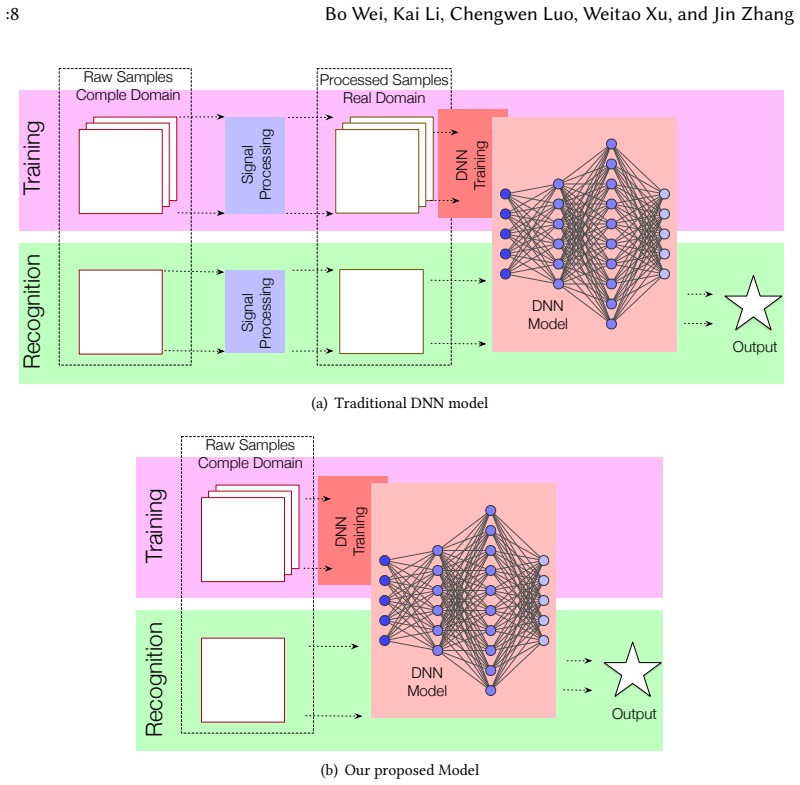
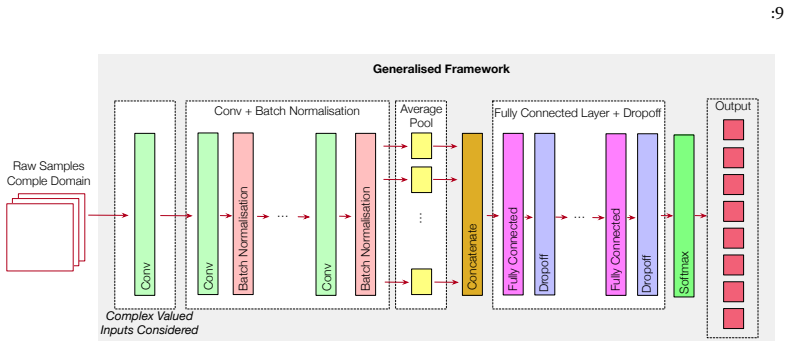
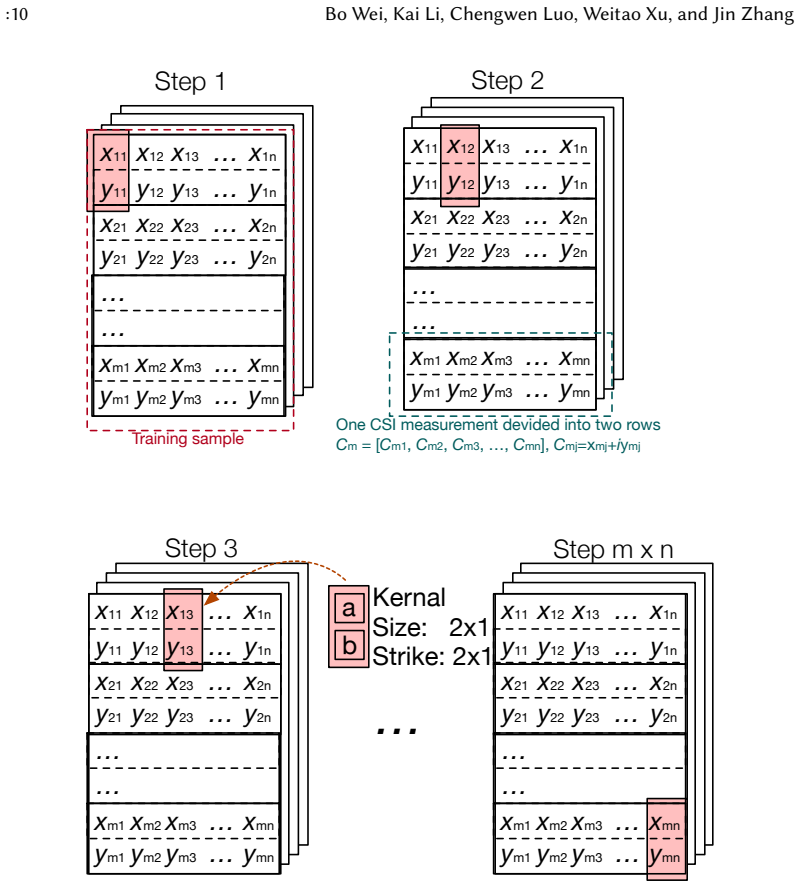
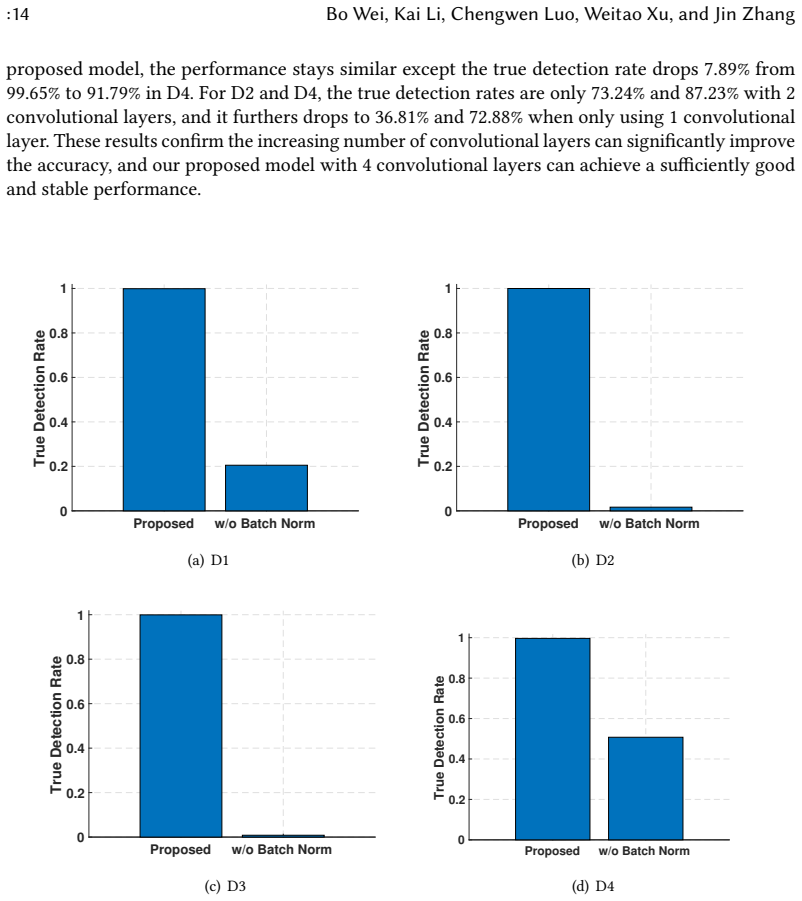
The central object is the raw complex CSI instance, arranged so that each subcarrier's real and imaginary parts form adjacent rows, and a first convolutional layer with kernel size 2x1 and stride 2x1 whose job is to combine a subcarrier's real and imaginary components. That layer is followed by stacks of convolutional layers, each with batch normalization, then multi-scale average pooling, a concatenation layer, dropout, a fully connected layer, and a softmax output. Batch normalization is the load-bearing component: the paper reports that removing it collapses accuracy to under 2% on some gesture datasets and under 20% on activity datasets, because it lets the network cope with the large received-signal-strength variation and per-packet phase offsets present in raw OFDM CSI. The framework's generality claim rests on re-using this same architecture family with only layer-count and kernel-size changes for different applications.
What would settle it
Collect raw CSI for the same set of gestures from a WiFi setup with a substantially different carrier-frequency offset or clock drift, such as a different WiFi chipset or a transmitter-receiver pair not used in the paper, and run the proposed framework without any phase sanitization. If accuracy drops far below the sanitized-input baseline while the same network architecture still does well on pre-processed data, the claim that raw input is always sufficient is falsified.
Extended reading notes
Core claim
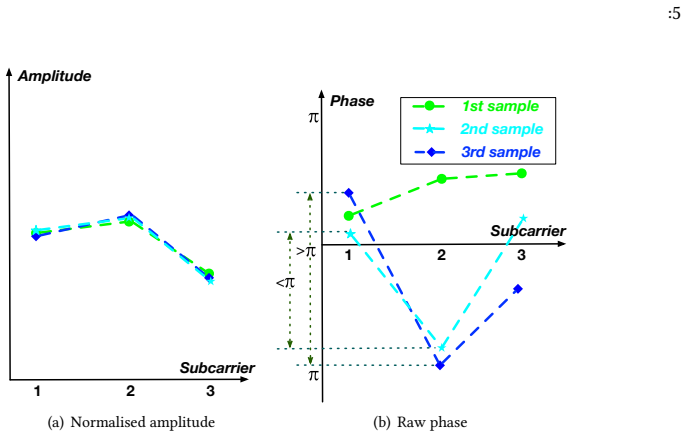
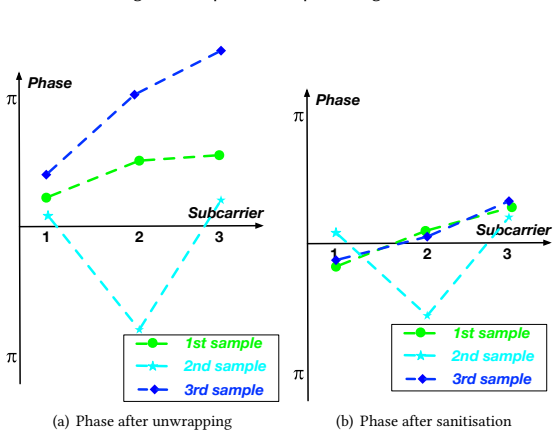
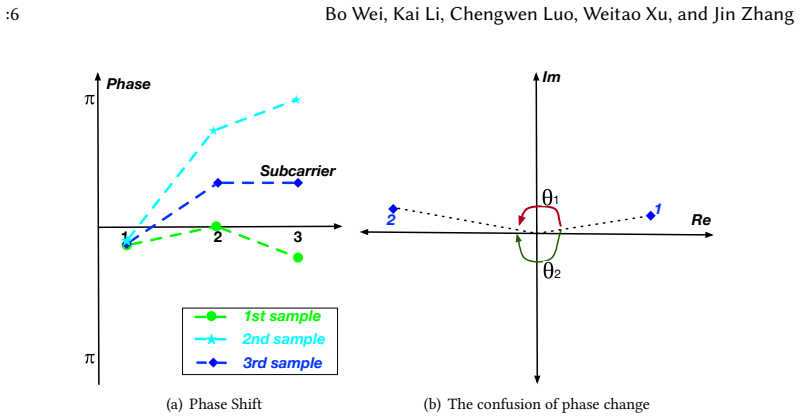
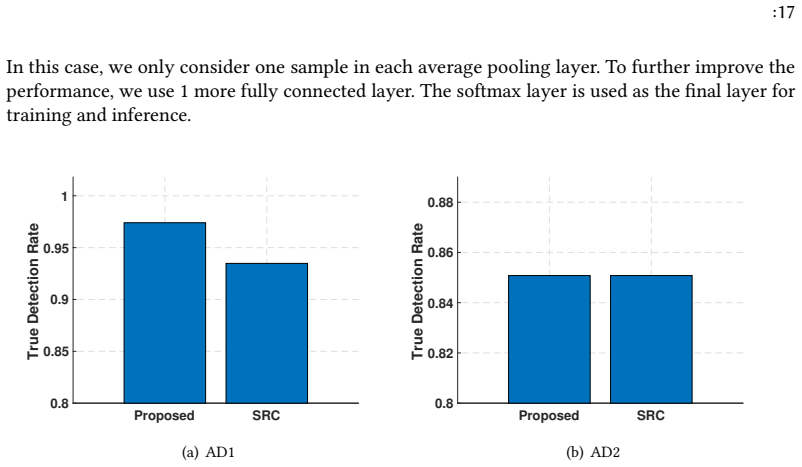
The paper's central claim is that raw, unprocessed complex channel state information is a sufficient input for radio-based device-free context awareness, provided the deep network is built around convolutional layers with batch normalization. The authors propose this as the first general framework for radio-based applications, and support it with experiments on two application families: sign-language gesture recognition and activity recognition under radio-frequency interference. On the SignFi gesture datasets (276 gesture classes), the framework achieves 99.89%, 99.98%, and 99.93% true detection rates on the home and lab datasets D1–D3, slightly above the pre-processing-based SignFi results; on activities, it reaches 97.40% without interference and 85.08% with interference, the latter matching the prior complex-valued CSI method while removing its sanitization step. The authors argue that preprocessing such as phase unwrapping hurts because threshold-based corrections make similar samples look dissimilar, whereas a deep network with batch normalization can absorb phase offsets, signal-strength changes, and interference directly.
Load-bearing premise
The load-bearing premise is that a deep network with batch normalization can learn usable patterns from raw complex CSI even though each WiFi packet carries a random phase offset from unsynchronized transmitter and receiver clocks; if a different hardware platform changes how that phase noise behaves, the no-preprocessing result may not transfer.
Editorial extensions
If this is right
- Gesture and activity recognition systems can be built from raw CSI without designing application-specific feature extractors.
- Phase sanitization and unwrapping can be removed, since these steps can introduce inconsistencies that make similar samples look different.
- Batch normalization should be considered a required component in CSI deep learning models, since its removal causes accuracy to collapse in the reported experiments.
- The same network family extends to multiple radio-based context awareness tasks with only architectural configuration changes, including in radio-frequency-interfered environments.
Reading between the lines
- The reported results suggest the network is implicitly learning a phase-tolerant representation from raw OFDM CSI; if confirmed, this would extend to other RF sensing tasks, such as localization or vital-sign monitoring, that currently rely on explicit phase sanitization.
- A stronger test of the 'general framework' claim than the paper provides would be cross-environment or cross-user evaluation: the SignFi D4 dataset is trained per user, so leave-one-user-out accuracy remains an open question.
- The framework could be tested on newer WiFi generations or 60 GHz radios; success there would support the claim that no pre-processing is needed across radio hardware, while failure would bound the claim to the specific OFDM configurations tested.
Signed reviews
Editorial analysis
A structured set of objections, weighed in public.
Referee Report
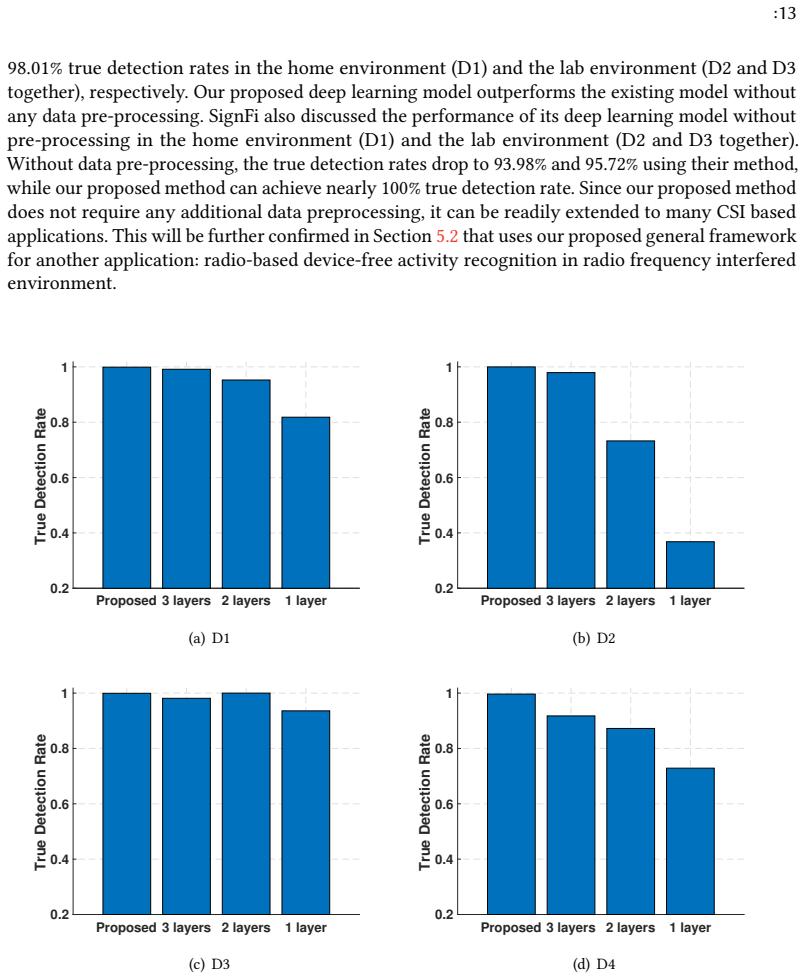
Summary. The paper proposes a deep learning framework for radio-based device-free context awareness that consumes raw complex CSI measurements directly as input, without conventional preprocessing such as amplitude extraction or phase sanitization. The framework uses convolutional layers, batch normalization, average pooling, dropout, fully connected layers, and softmax. It is instantiated for two applications: gesture recognition on the public SignFi datasets (276 gestures, ~100% reported accuracy) and activity recognition on the authors' prior WASP-based datasets with and without RF interference. Ablation studies examine the effects of the number of convolutional layers, batch normalization, and average pooling. The paper claims to be the first to propose a general framework for radio-based applications that directly trains on raw CSI without any pre-processing.
Significance. If the central claim is correct, the paper would make a useful practical contribution by showing that hand-crafted CSI preprocessing (e.g., phase sanitization) is unnecessary for deep-learning-based radio sensing. The use of public datasets, the cross-validation methodology, and the ablation studies are strengths, and the near-100% accuracy on 276-class SignFi is impressive. However, the 'general framework' claim is only loosely defined, the phase-invariance issue is not analyzed, and the empirical comparison has weaknesses. These gaps are substantial but addressable; the underlying idea of training directly on raw CSI is plausible and worth pursuing.
major comments (4)
- [Section 4 (Input and first conv layer); Section 3 (phase discussion)] The manuscript does not establish that the proposed network is invariant to the random per-packet phase offset and linear phase slope that characterize OFDM WiFi CSI. Section 3 only explains why phase unwrapping is unstable; it does not explain why a CNN that receives real and imaginary parts (Figure 7) should be robust to these transformations. The first 2x1 convolutional layer computes a fixed real linear combination of (Re, Im) and is not rotation-invariant by construction. Without an analysis of how the network achieves phase invariance, or a controlled experiment (e.g., applying synthetic phase rotations to test instances or evaluating on a different WiFi card), the near-100% accuracy may be an artifact of the particular phase-error distribution in the SignFi datasets, and the claim that the framework generalizes to all radio-based applications is unsupported.
- [Section 5.1.3, Figure 8] The 'SignFi w/o SP' baseline is taken from the original SignFi paper rather than being re-run under the same experimental pipeline, and no error bars or confidence intervals are reported for any accuracy value. Since the proposed model is evaluated with its own cross-validation splits and after architecture tuning, the comparison is not apples-to-apples. The authors should re-run the baseline using the same data folds and report means and standard deviations over the cross-validation runs.
- [Sections 5.1.2 and 5.2.2 (Tables 2 and 3)] The paper's 'general framework' is instantiated with substantially different architectures for the two applications: 4 convolutional layers for SignFi versus 7 for Activity, different pooling sizes, and different numbers of fully connected layers. The manuscript does not specify which components are fixed by the framework and which are application-specific, making the claim of a single general framework difficult to evaluate. The authors should define the framework more precisely—e.g., state the invariant architectural constraints—and ideally demonstrate that a single architecture, or a clearly specified search procedure, works across both tasks.
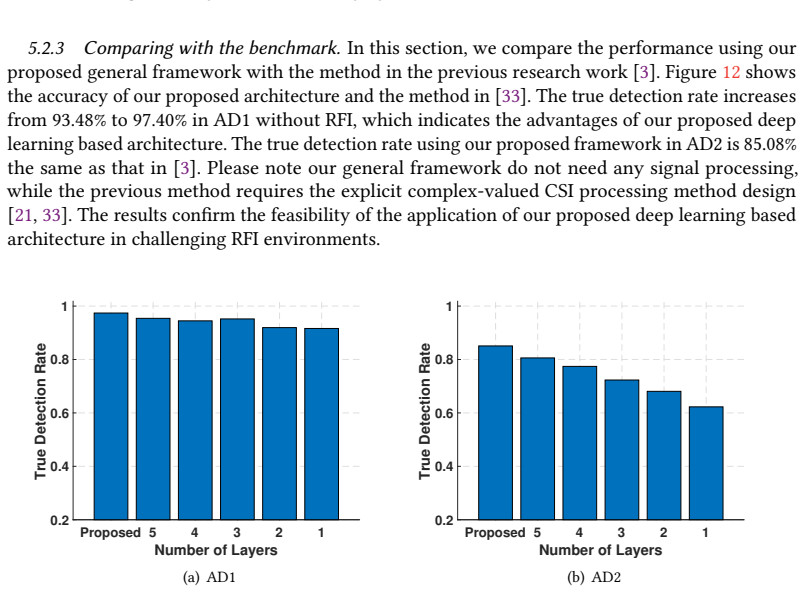
- [Sections 5.1.4-5.1.6 and 5.2.4-5.2.6] The final architecture appears to be selected based on the ablation experiments performed on the same datasets used for the reported accuracy numbers, without a separate validation set or nested cross-validation. This creates a risk of selection bias, and the near-100% figures may be optimistic. The authors should either use a nested resampling scheme or explicitly partition the data into model-selection and final-evaluation subsets.
minor comments (6)
- [Throughout] There are typographical errors: 'strike' should be 'stride' (Sections 4 and 5, Figure 7), 'dropoff' should be 'dropout' (Figure 6 and text), and 'Kernal' should be 'Kernel' (Figure 7).
- [Footnote 1, Section 3] The footnote reads '130 of the total 52 subcarriers' and appears to be a typo; it should likely say '30 of the total 52 subcarriers.'
- [Section 5.2.3] The text attributes the dataset to reference [3] but the baseline comparison is described as 'the method in [33]'; please clarify the relationship between references [3] and [33] and use consistent citations.
- [Section 5.1.1] The description of the D4 evaluation is ambiguous: 'each user's gestures are recognised by using his or her own CSI instances' could mean a separate model is trained per user; please clarify the evaluation protocol.
- [Figure 8] The axis labels and legends are inconsistent across panels (e.g., panel (d) omits the 'SignFi' and 'SignFi w/o SP' comparisons that the text discusses); please make all panels consistent and ensure the captions match the reported experiments.
- [General reproducibility] The paper does not state whether code or trained models are available. A data/code availability statement would improve reproducibility of the reported near-100% results.
Circularity Check
No significant circularity: the paper's claims are empirical and validated on external and transparently reused datasets, with no derivation that reduces to its own inputs.
full rationale
The paper's central contribution is an empirical machine-learning framework rather than a theoretical derivation, and no step in the paper reduces a claimed prediction to its input by construction. Raw complex CSI is not defined in terms of the output labels, the DNN output is not a fitted parameter renamed as a prediction, and no uniqueness theorem or self-citation chain is invoked to rule out alternative designs. The SignFi evaluation uses the public SignFi dataset from Ma et al. [14], providing an external benchmark. The Activity evaluation reuses the authors' own earlier dataset and SRC baseline from [3], but this is transparent benchmarking with an independently published algorithm and reused data, not a circular reduction: the baseline accuracy is not an output of the present model, and the dataset was collected in prior work rather than manufactured by the current framework. Architecture choices such as kernel sizes, pooling sizes, and layer counts were selected during cross-validation, which is normal model selection and does not make the reported accuracy statistically forced. The skeptic's concern that raw-CSI success may depend on the training phase-error distribution is a legitimate robustness and external-validity question, but it is not circularity, because the paper makes no formal claim of phase-invariance that would require proof from its own assumptions. No load-bearing self-citation, self-definitional quantity, or fitted-then-predicted quantity was found.
Assumptions & free parameters
free parameters (3)
- SignFi DNN configuration =
4 conv layers; kernels 2x1, 3x3, 5x5, 10x10; pools 3x3 to 40x3; dropout 0.8; FC 1000
- Activity DNN configuration =
7 conv layers; pools 1x2, 1x3, 1x4; dropout 0.8; FC 1000
- Input instance length m =
not specified
assumptions (3)
- domain assumption A deep network with batch normalization can learn to classify raw complex CSI despite the per-packet random phase offset.
- domain assumption The SignFi and Activity datasets are representative of radio-based device-free context awareness applications generally.
- standard math Standard supervised cross-validation estimates generalization adequately.
Cite this review
Pith. "Pith review of No Need of Data Pre-processing: A General Framework for Radio-Based Device-Free Context Awareness." pith.science (2026). https://pith.science/paper/ZJH6MXD2
@misc{pith2026190803398,
  author       = {Pith},
  title        = {Pith review of: No Need of Data Pre-processing: A General Framework for Radio-Based Device-Free Context Awareness},
  year         = {2026},
  howpublished = {\url{https://pith.science/paper/ZJH6MXD2}},
  note         = {Machine review of arXiv:1908.03398}
}
read the original abstract
Device-free context awareness is important to many applications. There are two broadly used approaches for device-free context awareness, i.e. video-based and radio-based. Video-based applications can deliver good performance, but privacy is a serious concern. Radio-based context awareness has drawn researchers attention instead because it does not violate privacy and radio signal can penetrate obstacles. Recently, deep learning has been introduced into radio-based device-free context awareness and helps boost the recognition accuracy. The present works design explicit methods for each radio based application. They also use one additional step to extract features before conducting classification and exploit deep learning as a classification tool. The additional initial data processing step introduces unnecessary noise and information loss. Without initial data processing, it is, however, challenging to explore patterns of raw signals. In this paper, we are the first to propose an innovative deep learning based general framework for both signal processing and classification. The key novelty of this paper is that the framework can be generalised for all the radio-based context awareness applications. We also eliminate the additional effort to extract features from raw radio signals. We conduct extensive evaluations to show the superior performance of our proposed method and its generalisation.
Figures

Figures from the paper (12 more)




Reference graph
Works this paper leans on
-
[1]
Fadel Adib, Zach Kabelac, Dina Katabi, and Robert C. Miller. 2014. 3D Tracking via Body Radio Reflections. In NSDI ’14. Seattle, WA
work page 2014
-
[2]
Fadel Adib and Dina Katabi. 2013. See Through Walls with WiFi!. In SIGCOMM ’13. ACM, New York, NY, USA, 75–86
work page 2013
-
[3]
Mingrui Yang Bo Wei, Wen Hu and Chun Tung Chou. 2019. From Real to Complex: Enhancing Radio-based 22 Activity Recognition Using Complex-Valued CSI. ACM Transactions on Sensor Networks 15, 3 (2019)
work page 2019
-
[4]
Yu Gu, Jinhai Zhan, Yusheng Ji, Jie Li, Fuji Ren, and Shangbing Gao. 2017. MoSense: An RF-based motion detection system via off-the-shelf WiFi devices. IEEE Internet of Things Journal 4, 6 (2017), 2326–2341
work page 2017
-
[5]
Daniel Halperin, Wenjun Hu, Anmol Sheth, and David Wetherall. 2011. Tool release: Gathering 802.11 n traces with channel state information. ACM SIGCOMM Computer Communication Review 41, 1 (2011), 53–53
work page 2011
-
[6]
Daniel Halperin, Wenjun Hu, Anmol Sheth, and David Wetherall. 2011. Tool Release: Gathering 802.11n Traces with Channel State Information. ACM SIGCOMM CCR 41, 1 (Jan. 2011), 53
work page 2011
-
[7]
Xiaofei He, Shuicheng Yan, Yuxiao Hu, Partha Niyogi, and Hong-Jiang Zhang. 2005. Face recognition using laplacian- faces. IEEE Transactions on Pattern Analysis & Machine Intelligence 3 (2005), 328–340
work page 2005
-
[8]
Jawbone. 2014. UP. https://jawbone.com/up. (2014). [Online; accessed 28-Agust-2014]
work page 2014
Show all 48 references
-
[9]
Ossi Kaltiokallio, Maurizio Bocca, and Neal Patwari. 2012. Enhancing the accuracy of radio tomographic imaging using channel diversity. In IEEE MASS 2012. IEEE, 254–262
2012
-
[10]
Bryce Kellogg, Vamsi Talla, and Shyamnath Gollakota. 2014. Bringing Gesture Recognition to All Devices. In NSDI 14. USENIX, Seattle, WA
2014
-
[11]
Keun-Chang Kwak and Witold Pedrycz. 2005. Face recognition using a fuzzy fisherface classifier. Pattern recognition 38, 10 (2005), 1717–1732
2005
-
[12]
Yann LeCun, Yoshua Bengio, and Geoffrey Hinton. 2015. Deep learning. nature 521, 7553 (2015), 436
2015
-
[13]
Jian Liu, Yingying Chen, Yan Wang, Xu Chen, Jerry Cheng, and Jie Yang. 2018. Monitoring vital signs and postures during sleep using WiFi signals. IEEE Internet of Things Journal 5, 3 (2018), 2071–2084
2018
-
[14]
Yongsen Ma, Gang Zhou, Shuangquan Wang, Hongyang Zhao, and Woosub Jung. 2018. SignFi: Sign Language Recognition Using WiFi. Proceedings of the ACM on Interactive, Mobile, Wearable and Ubiquitous Technologies 2, 1 (2018), 23. , Vol. 1, No. 1, Article . Publication date: August ...
2018
-
[15]
Pedro Melgarejo, Xinyu Zhang, Parameswaran Ramanathan, and David Chu. 2014. Leveraging directional antenna capabilities for fine-grained gesture recognition. In Proceedings of the 2014 ACM International Joint Conference on Pervasive and Ubiquitous Computing . ACM, 541–551
2014
-
[16]
Microsoft. 2014. Kinect. http://www.microsoft.com/en-us/kinectforwindows/. (2014). [Online; accessed 28-Agust-2014]
2014
-
[17]
Changwon Nam and Saewoong Bahk. 2015. ∆SNR-MAC: A priority-based multi-round contention scheme for MU- MIMO WLANs. Computer Networks 92 (2015), 24–40
2015
-
[18]
Omkar M Parkhi, Andrea Vedaldi, Andrew Zisserman, and others. 2015. Deep face recognition.. In bmvc, Vol. 1. 6
2015
-
[19]
Qifan Pu, Sidhant Gupta, Shyamnath Gollakota, and Shwetak Patel. 2013. Whole-home gesture recognition using wireless signals. In MobiCom 2013. 27–38
2013
-
[20]
Kun Qian, Chenshu Wu, Zimu Zhou, Yue Zheng, Zheng Yang, and Yunhao Liu. 2017. Inferring motion direction using commodity wi-fi for interactive exergames. In CHI 2017. ACM, 1961–1972
2017
-
[21]
Souvik Sen, Božidar Radunovic, Romit Roy Choudhury, and Tom Minka. 2012. You are facing the Mona Lisa: spot localization using PHY layer information. In MobiSys 2012. ACM, 183–196
2012
-
[22]
Karen Simonyan and Andrew Zisserman. 2014. Very deep convolutional networks for large-scale image recognition. arXiv preprint arXiv:1409.1556 (2014)
2014 arXiv
-
[23]
Jiancheng Sun, Chongxun Zheng, Xiaohe Li, and Yatong Zhou. 2010. Analysis of the distance between two classes for tuning SVM hyperparameters. IEEE transactions on neural networks 21, 2 (2010), 305–318
2010
-
[24]
Fangxin Wang, Wei Gong, and Jiangchuan Liu. 2018. On Spatial Diversity in WiFi-based Human Activity Recognition: A Deep Learning based Approach. IEEE Internet of Things Journal (2018)
2018
-
[25]
Guanhua Wang, Yongpan Zou, Zimu Zhou, Kaishun Wu, and Lionel M Ni. 2014. We can hear you with Wi-Fi!. In MobiCom 2014. ACM, 593–604
2014
-
[26]
Wei Wang, Alex X Liu, and Muhammad Shahzad. 2016. Gait recognition using wifi signals. In Proceedings of the 2016 ACM International Joint Conference on Pervasive and Ubiquitous Computing . ACM, 363–373
2016
-
[27]
Xuyu Wang, Lingjun Gao, Shiwen Mao, and Santosh Pandey. 2015. DeepFi: Deep learning for indoor fingerprinting using channel state information. In 2015 IEEE wireless communications and networking conference (WCNC) . IEEE, 1666–1671
2015
-
[28]
Xuyu Wang, Lingjun Gao, Shiwen Mao, and Santosh Pandey. 2017. CSI-based fingerprinting for indoor localization: A deep learning approach. IEEE Transactions on Vehicular Technology 66, 1 (2017), 763–776
2017
-
[29]
Xuyu Wang, Chao Yang, and Shiwen Mao. 2017. PhaseBeat: Exploiting CSI phase data for vital sign monitoring with commodity WiFi devices. In ICDCS. IEEE, 1230–1239
2017
-
[30]
Yan Wang, Jian Liu, Yingying Chen, Marco Gruteser, Jie Yang, and Hongbo Liu. 2014. E-eyes: device-free location- oriented activity identification using fine-grained WiFi signatures. In MobiCom 2014. ACM, 617–628
2014
-
[31]
Bo Wei, Wen Hu, Mingrui Yang, Chou, and Chun Tung. 2015. Radio-based Device-free Activity Recognition with Radio Frequency Interference. In IPSN ’15. ACM, Seattle, WA, USA, 12
2015
-
[32]
2015.Radio-based device-free activity recognition with radio frequency interference
Bo Wei, Wen Hu, Mingrui Yang, and Chun Tung Chou. 2015.Radio-based device-free activity recognition with radio frequency interference. ACM, New York, New York, USA
2015
-
[33]
Bo Wei, Wen Hu, Mingrui Yang, and Chun Tung Chou. 2015. Radio-based device-free activity recognition with radio frequency interference. In Proceedings of the 14th International Conference on Information Processing in Sensor Networks . ACM, 154–165
2015
-
[34]
Bo Wei, Wen Hu, Mingrui Yang, and Chun Tung Chou. 2018. From Real to Complex: Enhancing Radio-based Activity Recognition Using Complex-Valued CSI. arXiv preprint arXiv:1804.09588 (2018)
2018 arXiv
-
[35]
Bo Wei, Ambuj Varshney, Neal Patwari, Wen Hu, Thiemo Voigt, Chou, and Chun Tung. 2015. dRTI: Directional Radio Tomography. In IPSN ’15. ACM, Seattle, WA, USA, 12
2015
-
[36]
Wilson and N
J. Wilson and N. Patwari. 2010. Radio Tomographic Imaging with Wireless Networks. IEEE TMC 9, 5 (2010), 621–632. DOI:http://dx.doi.org/10.1109/TMC.2009.174
2010 doi
-
[37]
Xiaomi. 2014. Mi Band. http://www.mi.com/shouhuan. (2014). [Online; accessed 28-August-2014]
2014
-
[38]
Yaxiong Xie, Zhenjiang Li, and Mo Li. 2015. Precise Power Delay Profiling with Commodity WiFi. In Proceedings of the 21st Annual International Conference on Mobile Computing and Networking (MobiCom ’15) . ACM, New York, NY, USA, 53âĂŞ64. DOI:http://dx.doi.org/10.1145/2789168.2790124
2015
-
[39]
Chenren Xu, Mingchen Gao, Bernhard Firner, Yanyong Zhang, Richard Howard, and Jun Li. 2012. Towards Robust Device-Free Passive Localization Through Automatic Camera-Assisted Recalibration. In ACM SenSys
2012
-
[40]
Yunze Zeng, Parth H Pathak, and Prasant Mohapatra. 2016. WiWho: wifi-based person identification in smart spaces. In Proceedings of the 15th International Conference on Information Processing in Sensor Networks . IEEE Press, 4
2016
-
[41]
Dongheng Zhang, Yang Hu, Yan Chen, and Bing Zeng. 2019. BreathTrack: Tracking Indoor Human Breath Status via Commodity WiFi. IEEE Internet of Things Journal (2019)
2019
-
[42]
Jin Zhang, Bo Wei, Wen Hu, and Salil S Kanhere. 2016. Wifi-id: Human identification using wifi signal. In Distributed Computing in Sensor Systems (DCOSS), 2016 International Conference on . IEEE, 75–82. , Vol. 1, No. 1, Article . Publication date: August 2019. :21
2016
-
[43]
Jun Zhang, Yong Yan, and Martin Lades. 1997. Face recognition: eigenface, elastic matching, and neural nets. Proc. IEEE 85, 9 (1997), 1423–1435
1997
-
[44]
Mingmin Zhao, Fadel Adib, and Dina Katabi. 2016. Emotion recognition using wireless signals. In Proceedings of the 22nd Annual International Conference on Mobile Computing and Networking . ACM, 95–108
2016
-
[45]
Yang Zhao and N. Patwari. 2011. Noise reduction for variance-based device-free localization and tracking. In SECON
2011
-
[46]
Phillips, and Suresh Venkatasubramanian
Yang Zhao, Neal Patwari, Jeff M. Phillips, and Suresh Venkatasubramanian. 2013. Radio Tomographic Imaging and Tracking of Stationary and Moving People via Kernel Distance. In IPSN ’13. ACM, New York, NY, USA, 229–240. DOI: http://dx.doi.org/10.1145/2461381.2461410
2013
-
[47]
Zimu Zhou, Zheng Yang, Chenshu Wu, Longfei Shangguan, and Yunhao Liu. 2013. Omnidirectional Coverage for Device-free Passive Human Detection. IEEE TPDS (2013). Received February 2007; revised March 2009; accepted June 2009 , Vol. 1, No. 1, Article . Publication date: August 2019
2013
-
[2011]
DOI:http://dx.doi.org/10.1109/SAHCN.2011.5984895
179–187. DOI:http://dx.doi.org/10.1109/SAHCN.2011.5984895
2011
Reviewed August 14, 2026 · model on record in the stance chip above.
Discussion (0). Continue with ORCID to comment.