REVIEW 4 major objections 6 minor 46 references
Optimal Energy Dispatch of Grid-Connected Electric Vehicle Considering Lithium Battery Electrochemical Model
T0 review · 4 major / 6 minor · reviewed 2026-08-12 · deepseek-v4-flash
Pith's one-line read A linearized electrochemical battery model can make EV dispatch faster and gentler on cells.
desk verdict A novel and well-executed method paper embedding a linearized electrochemical battery model into MILP dispatch, but the quantitative benefits are in-sample and need independent confirmation. read the letter →
The pith
A machine-rendered reading of the paper's core claim, the machinery that carries it, and where it could break.
The reading
What carries the argument
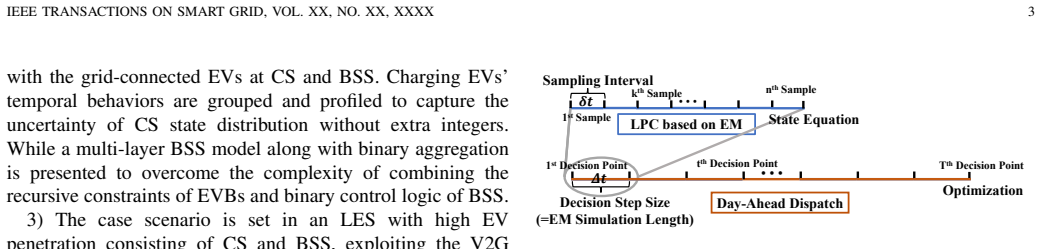
The load-bearing object is the linearized power characterization (LPC): a set of affine planes fitted to simulations of the electrochemical model over one decision step ($\Delta t = 15$ min), covering power dynamics ($I \approx a_0 + a_1 SOC + a_2 P$), heat dynamics (piecewise planes for charge and discharge), and state-of-power-thermal (SOPT) limits (piecewise planes in $SOC$ and temperature). Around these planes the paper builds two accelerators: a matrix-based, non-iterative update that propagates every battery's SOC and temperature over all time steps in one vectorized expression, and a multi-layer battery swapping station model with a virtual warehouse that keeps offline batteries at two discrete SOC levels and aggregates charging docks by shared control signals. Together they convert the otherwise non-convex, sequentially coupled electrochemical dynamics into constraints a mixed-integer linear program can carry.
What would settle it
Take the M2 dispatch plan produced for the cold-weather and degraded-cell cases, feed its per-step power commands back into the full electrochemical simulator on held-out trajectories (or run them on a real cell at 10 °C after many cycles), and check whether predicted SOC, cell temperature, and available power stay inside the operating limits; if voltage or lithium-concentration bounds are violated, or measured capacity loss does not beat ECM-based dispatch by about 24%, the central claim fails.
Extended reading notes
Core claim
The central claim is that embedding the electrochemical model through LPC makes the dispatch adapt to the battery's actual physical state: available power boundaries become functions of current state of charge and cell temperature, so the same battery is dispatched more conservatively when it is cold, degraded, or fast-charged. The paper validates this in a local energy system with 100 charging EVs and up to 750 swapping-station batteries, showing that the proposed M2 formulation keeps the problem solvable as a mixed-integer linear program, reduces solving time by 72.63% compared with the ordinary M1 formulation, and in full-order electrochemical re-simulation produces feasible plans, conversion efficiency above the set limit, lower internal heat, and up to 24.19% less capacity loss in low-temperature and degraded-cell scenarios.
Load-bearing premise
The load-bearing premise is that the fitted linear planes reproduce the electrochemical model well enough over the whole dispatch envelope—15-minute steps, cold ambient temperature, fast charging, and aged cells—even though the fits were checked only by $R^2$ on training samples and not on held-out simulations or real cells.
Editorial extensions
If this is right
- Dispatch plans from the electrochemical-aware model impose power limits that tighten as cells age and as temperature drops, so the same schedule would not over-discharge a battery in winter or after thousands of cycles.
- Because the SOC and temperature updates are matrix-based and the swapping logic is aggregated, the mixed-integer problem stays solvable at hundreds of batteries: the M2 model solves 72.63% faster than the ordinary M1 model at 500 batteries and handles 750 batteries where M1 cannot close the 5% gap within an hour.
- A full-order electrochemical re-simulation of the dispatch plans shows that SSM-based schedules can be physically infeasible under fast charging, while EM-based schedules keep cell energy conversion efficiency above the imposed limit and reduce internal heat generation by up to 69% in the degraded-cell case.
- Accumulative capacity loss is reduced by 14.41% at low temperature and 24.19% for degraded cells relative to ECM-based dispatch, which is the paper's evidence that considering the electrochemical model actively inhibits aging.
Reading between the lines
- Editorial extension: the same offline fitting pipeline could be rerun for other cell chemistries, ambient temperatures, and degradation levels to build a library of LPC planes, making electrochemical awareness a drop-in replacement for static power limits in any MILP-based dispatch or market bidding model.
- Editorial extension: because the LPC planes are fitted on simulated data with $R^2$ between 0.96 and 0.99 and the fitted coefficients are not disclosed, a natural stress test is to compare the plane fits against piecewise-linear or data-driven surrogates with more breakpoints; the reported 24.19% capacity-loss advantage could depend on fit granularity.
- Editorial extension: the virtual-warehouse aggregation collapses all offline batteries into two discrete SOC levels, which assumes uniformity within each warehouse class; under heterogeneous battery health or high swapping demand, tracking per-battery state would be a testable refinement and might change the cost or degradation estimates.
Editorial analysis
A structured set of objections, weighed in public.
Referee Report
Summary. The paper proposes a day-ahead optimal dispatch framework for grid-connected electric vehicles that embeds a linearized electrochemical battery model (termed LPC) into a mixed-integer linear program. The LPC consists of three fitted relationships obtained from electrochemical-model simulations: a power-dynamics plane relating current to SOC and power (Eq. (3)), a heat-dynamics plane relating temperature change to initial temperature and power (Eq. (7)), and piecewise-linear state-of-power-thermal (SOPT) limits (Eq. (10)). Matrix-based update formulas (Eqs. (11)-(16)) avoid recursive state updates. For battery swapping stations, a multi-layer model with a virtual warehouse and chronologically/individually aggregated charging docks (model M2) is proposed to reduce integer complexity. A local energy system case study compares M2 with an ordinary MILP formulation (M1) and compares EM-based dispatch with equivalent-circuit-model (ECM) and source-sink-model (SSM) dispatch, reporting a 72.63% solution-time reduction and capacity-loss reductions up to 24.19%.
Significance. If the claims hold, the paper is a useful step toward incorporating physics-based battery models into distribution-system dispatch. The matrix-based state update and the BSS aggregation are practical algorithmic contributions, and the paper demonstrates, at least in simulation, that state-dependent power limits can improve feasibility and reduce simulated degradation relative to simple battery models. However, the empirical validation is entirely in-sample and self-referential: the LPC surfaces are fitted to electrochemical-model simulations and the dispatch plans are then evaluated with that same model. The quantitative headline numbers (72.63% and 24.19%) are therefore conditional on the LPC approximation and on the electrochemical model as a proxy for real cells. The contribution is significant if external validation is added, but as it stands the evidence is not sufficient for the strength of the conclusions.
major comments (4)
- [Section V-D and Table I] The validation is circular in an important sense. The LPC fits in Eqs. (3), (7), and (10) are assessed only by in-sample R-squared values (Table I), and the battery-model comparison in Section V-D reevaluates all dispatch plans by simulating the full-order EM from which the LPC data were generated. Because a MILP optimizer will push power to the boundary of the fitted feasible region, fit errors at those boundaries are exactly where the constraints are most likely to be violated. R-squared values above 0.96 on training samples do not establish that the LPC planes are accurate on held-out operating points, especially for aged cells and 10°C ambient temperature. Please add out-of-sample validation, such as fitting on a subset of EM simulations and testing on held-out SOC/temperature/power combinations, and report maximum constraint violations of the resulting dispatch when simulated with the full-order EM. Without this, the reported capacity-loss reductions (e.g., 24.19% in Table V) cannot be distinguished from artifacts of the LPC approximation.
- [Section II-B1, Assumption 1] Assumption 1 states that the EVB current remains constant within each 15-minute decision step. This assumption directly underlies the current approximation in Eq. (2), the SOC update in Eq. (4), the heat-dynamics fit in Eq. (7), and the SOPT definition in Eq. (9). Under the fast-charging scheme (about 1C) and at low ambient temperature, cell voltage and current limits can change appreciably within 15 minutes, so a constant-current trajectory may not represent the realized operation of the battery. Since the LPC surfaces are fitted to constant-current EM simulations, a dispatch that is feasible in the LPC approximation may be infeasible when implemented with a realistic variable-current profile. Please quantify this effect, for example by simulating representative dispatch decisions under a variable-current EM controller and comparing SOC, temperature, and constraint violations against the constant-current assumption.
- [Section II-B and Table I] The fitted coefficients for the three LPC components are not reported. Equations (3), (7), and (10) depend on a0,a1,a2; e0,e1,e2,dis,e2,char; and the piecewise SOPT coefficients b_m0,b_m1,b_m2. Only R-squared values are given in Table I. Without these coefficients, the model cannot be reproduced, the claimed convexity of the heat-dynamics 'V' shape and of the piecewise SOPT cannot be checked, and the extrapolation behavior outside the sampled range cannot be assessed. Please provide the coefficients (or a public implementation) together with the fitting sample size, the ranges of SOC, temperature, and power used for fitting, and residual statistics.
- [Section V-D, Fig. 8 and Table V] The comparison between EM, ECM, and SSM is not fully matched. The SSM is described as a fixed empirical power limit, and the ECM uses a 'similar thermostatic SOPT estimation method' but without the temperature and aging state updates available to the EM. While this may be a fair representation of typical practice, the conclusion that 'considering EM is necessary and superior' would be stronger if the comparators were given equivalent information, for example state-dependent SOPT derived from the ECM with the same optimization procedure and with temperature/aging feedback where applicable. As written, the comparison conflates model fidelity with calibration effort, so the magnitude of the reported advantages (up to 24.19% capacity-loss reduction) is not fully attributable to the electrochemical model itself.
minor comments (6)
- [Section V-A] The text says 'n = 900 samplings with δt = 1 s interval are selected', which corresponds to a 15-minute window; please state the relationship explicitly to avoid ambiguity.
- [Section V-D, Fig. 8] The legend label 'Sink' appears to refer to the SSM model; please rename it to 'SSM' for consistency with the text.
- [Section III-B, Eq. (22)] The big-M constant M_b is not specified. Please state how it is chosen and verify that it is large enough not to cut off feasible operating points.
- [Section IV-B, Eq. (32)] The sign convention for charging power (negative values) in the efficiency terms P_ES,d γ + P_ES,c/γ should be stated explicitly, since otherwise the expression may be confusing to readers.
- [Section V-B, Case I] The 'thermostatic' scenario still uses the heat-dynamics update; the paper explains that the temperature variation is small (below 3°C), but the wording 'Case I is thermostatic' could be clarified to say that the temperature is modeled but has little effect.
- [General] There are several grammatical issues, e.g., 'the implementation of EM demonstrates significant efficacy...' should begin with a capital letter, and 'which is incapable in the dispatch utilizing ECM or SSM' is awkward; please proofread the final version.
Circularity Check
Validation is largely in-sample: the LPC constraints are fitted to the same EM that later referees all battery-model comparisons, and the capacity-loss benefit is partly enforced by explicit aging limits in the SOPT constraints.
-
fitted input called prediction
[Section V-D (Model Assessment: Battery Model Comparison); LPC fits in Section II-B, Eqs. (3),(7),(10)]
"To further evaluate the impact of employing different models, we reevaluate the entire day-ahead dispatch by full-order EM simulation with the obtained dispatch plans when considering different battery models."
The EM-based dispatch plan is generated with constraints (3), (7), and (10), which are fitted from simulations of the same EM: Section II-B states that 'EM is simulated with a uniform sampling of Θ0 and I0 bounded by feasible region as inputs' to obtain the fit. Table V then evaluates every plan by 'full-order EM simulation.' The EM plan is thus scored on the generator of its own LPC training distribution, while SSM and ECM are scored against a model they never saw. This can confirm internal consistency of the linearization, but it cannot independently establish that EM dispatch is more feasible or more battery-friendly; the comparison reduces to self-consistency on the fitted model.
-
self definitional
[Section II-B3, Eq. (8) and Section V-D, Table V]
"To prevent excess EVB aging, aging-related solution-solid interface potential (ϕ−se), and active lithium loss (τL) are set as limitations as well. ... In such scenarios, applying EM achieves a reduction of 14.41% and 24.19% in terms of accumulative capacity loss compared to ECM, respectively."
Equation (8) defines SOPT by requiring EM states to lie in Ω, which explicitly bounds active lithium loss τL and interface potential ϕ−se. The EM dispatch therefore cannot select plans that exceed these aging limits. The capacity loss CL reported in Table V is then computed by simulating the same EM, whose aging variable τL was already constrained during planning. The reported capacity-loss reductions (up to 24.19%) are thus substantially imposed by the constraint set rather than independently predicted; ECM and SSM plans lack these constraints and are expected to accumulate more loss. The magnitude is quantitative, but the direction is forced by construction.
full rationale
The paper has a genuine algorithmic contribution: the 72.63% speedup of M2 over M1 is a computational comparison in which both models embed the same LPC constraints, so that result is not circular. The battery-model comparison, however, is a self-consistency check. The LPC planes for current, temperature rise, and SOPT (Eqs. 3, 7, 10) are fitted from EM samples, with only in-sample R² values (Table I) and undisclosed coefficients, and the same EM is later used as the referee in Table V. Consequently, the EM plan is evaluated on its own training distribution, while the SSM and ECM plans are scored against a model they never used. Moreover, the aging benefit is partly built into the EM plan because Eq. (8) constrains active lithium loss τL and interface potential ϕ−se, the same aging variables that determine the capacity-loss metric. This does not make the derivation formally tautological, but it means the central claims about feasibility, efficiency, and 24.19% capacity-loss reduction are not independent predictions; they are in-sample demonstrations of the fitted surrogate. No load-bearing self-citation chain or uniqueness argument is present, so the score is moderate rather than extreme.
Assumptions & free parameters
free parameters (5)
- Power dynamics coefficients a0, a1, a2 =
not disclosed in text
- Heat dynamics coefficients e0, e1, e2,dis, e2,char =
not disclosed in text
- SOPT piecewise plane coefficients b_m0, b_m1, b_m2 =
not disclosed in text
- Cruising discharge ratio r_EV,D =
sampled in [0.15, 0.30]
- V2G interface lumped efficiency gamma =
0.85
assumptions (5)
- domain assumption The electrochemical model EM(.) from [41] accurately simulates real LiB voltage, temperature, and degradation.
- ad hoc to paper LPC linear fits generalize from training samples to the whole dispatch envelope, including aged cells and 10 degree Celsius ambient temperature.
- ad hoc to paper Assumption 1: EVB current remains constant within each 15-minute decision step, equal to the initial value.
- domain assumption Assumption 2: The V2G interface lumping efficiency gamma is stable and consistent in the day-ahead stage.
- domain assumption BSS operates thermostatically through cooling systems.
invented entities (2)
-
Virtual warehouse layer for offline BSS batteries
-
Charging dock (CD) as artificial state carrier
Cite this review
Pith. "Pith review of Optimal Energy Dispatch of Grid-Connected Electric Vehicle Considering Lithium Battery Electrochemical Model." pith.science (2026). https://pith.science/paper/ZLBRQ3HD
@misc{pith2026241114700,
  author       = {Pith},
  title        = {Pith review of: Optimal Energy Dispatch of Grid-Connected Electric Vehicle Considering Lithium Battery Electrochemical Model},
  year         = {2026},
  howpublished = {\url{https://pith.science/paper/ZLBRQ3HD}},
  note         = {Machine review of arXiv:2411.14700}
}
read the original abstract
The grid-connected electric vehicles (EVs) serve as a promising regulating resource in the distribution grid with Vehicle-to-Grid (V2G) facilities. In the day-ahead stage, electric vehicle batteries (EVBs) need to be precisely dispatched and controlled to ensure high efficiency and prevent degradation. This article focuses on considering a refined battery model, i.e. the electrochemical model (EM), in the optimal dispatch of the local energy system with high penetration of EVs which replenish energy through V2G-equipped charge station and battery swapping station (BSS). In this paper, to utilize the EM efficiently, recursive EVB constraints and a corresponding matrix-based state update method are proposed based on EM power characterization. The charging EV state distribution is profiled and a multi-layer BSS model along with binary aggregation is proposed, in order to overcome the computation complexity of combining the refined battery constraints with the mixed integer optimization. Finally, a local energy system scenario is investigated for evaluation. The efficiency and effectiveness of EM consideration are assessed from the perspective of both the system and battery.
Figures


Figures from the paper (5 more)


Reference graph
Works this paper leans on
-
[1]
A retrospective on lithium-ion batteries,
J. Xie and Y .-C. Lu, “A retrospective on lithium-ion batteries,” Nature Communications, vol. 11, 2020, Art. no. 2499
work page 2020
-
[2]
Opportunities and challenges of lithium ion batteries in automotive applications,
A. Masias, J. Marcicki, and W. A. Paxton, “Opportunities and challenges of lithium ion batteries in automotive applications,” ACS Energy Letters, vol. 6, no. 2, pp. 621–630, 2021
work page 2021
-
[3]
Electric vehicles revisited: a review of factors that affect adoption,
M. Coffman, P. Bernstein, and S. Wee, “Electric vehicles revisited: a review of factors that affect adoption,” Transport Reviews, vol. 37, no. 1, pp. 79–93, 2017
work page 2017
-
[4]
Electric vehicle charging infrastructure assignment and power grid impacts assessment in Beijing,
J. Liu, “Electric vehicle charging infrastructure assignment and power grid impacts assessment in Beijing,” Energy Policy, vol. 51, pp. 544– 557, 2012
work page 2012
-
[5]
Joint routing and scheduling for electric vehicles in smart grids with V2G,
A. Trivi ˜no-Cabrera, J. A. Aguado, and S. d. l. Torre, “Joint routing and scheduling for electric vehicles in smart grids with V2G,” Energy, vol. 175, pp. 113–122, 2019
work page 2019
-
[6]
Evaluation of achievable vehicle- to-grid capacity using aggregate PEV model,
H. Zhang, Z. Hu, Z. Xu, and Y . Song, “Evaluation of achievable vehicle- to-grid capacity using aggregate PEV model,” IEEE Transactions on Power Systems, vol. 32, no. 1, pp. 784–794, 2017
work page 2017
-
[7]
Y . Zheng, S. Niu, Y . Shang, Z. Shao, and L. Jian, “Integrating plug- in electric vehicles into power grids: A comprehensive review on power interaction mode, scheduling methodology and mathematical foundation,” Renewable and Sustainable Energy Reviews , vol. 112, pp. 424–439, 2019
work page 2019
-
[8]
Optimal charging strategies for unidirectional vehicle-to-grid,
E. Sortomme and M. A. El-Sharkawi, “Optimal charging strategies for unidirectional vehicle-to-grid,” IEEE Transactions on Smart Grid, vol. 2, no. 1, pp. 131–138, 2011
work page 2011
Show all 46 references
-
[9]
Operation modes for the electric vehicle in smart grids and smart homes: Present and proposed modes,
V . Monteiro, J. Pinto, and J. L. Afonso, “Operation modes for the electric vehicle in smart grids and smart homes: Present and proposed modes,” IEEE Transactions on Vehicular Technology , vol. 65, no. 3, pp. 1007– 1020, 2016
2016
-
[10]
Stochastic scheduling of local distribution systems considering high penetration of plug-in electric vehicles and renewable energy sources,
S. Tabatabaee, S. S. Mortazavi, and T. Niknam, “Stochastic scheduling of local distribution systems considering high penetration of plug-in electric vehicles and renewable energy sources,” Energy, vol. 121, pp. 480–490, 2017
2017
-
[11]
Integrated PV charging of EV fleet based on energy prices, V2G, and offer of reserves,
G. R. Chandra Mouli, M. Kefayati, R. Baldick, and P. Bauer, “Integrated PV charging of EV fleet based on energy prices, V2G, and offer of reserves,” IEEE Transactions on Smart Grid , vol. 10, no. 2, pp. 1313– 1325, 2019
2019
-
[12]
Optimal scheduling of vehicle-to- grid energy and ancillary services,
E. Sortomme and M. A. El-Sharkawi, “Optimal scheduling of vehicle-to- grid energy and ancillary services,” IEEE Transactions on Smart Grid , vol. 3, no. 1, pp. 351–359, 2012
2012
-
[13]
Smart household operation considering bi-directional EV and ESS utilization by real-time pricing-based DR,
O. Erdinc, N. G. Paterakis, T. D. P. Mendes, A. G. Bakirtzis, and J. P. S. Catal ˜ao, “Smart household operation considering bi-directional EV and ESS utilization by real-time pricing-based DR,” IEEE Transac- tions on Smart Grid , vol. 6, no. 3, pp. 1281–1291, 2015
2015
-
[14]
Vehicle-to-grid control for supplementary frequency regulation considering charging demands,
H. Liu, Z. Hu, Y . Song, J. Wang, and X. Xie, “Vehicle-to-grid control for supplementary frequency regulation considering charging demands,” IEEE Transactions on Power Systems , vol. 30, no. 6, pp. 3110–3119, 2015
2015
-
[15]
Coordinated power control of electric vehicles for grid frequency support: MILP-based hierarchical control design,
K. Kaur, N. Kumar, and M. Singh, “Coordinated power control of electric vehicles for grid frequency support: MILP-based hierarchical control design,” IEEE Transactions on Smart Grid , vol. 10, no. 3, pp. 3364–3373, 2019
2019
-
[16]
A distributed MPC to exploit reactive power V2G for real-time voltage regulation in distribution networks,
J. Hu, C. Ye, Y . Ding, J. Tang, and S. Liu, “A distributed MPC to exploit reactive power V2G for real-time voltage regulation in distribution networks,” IEEE Transactions on Smart Grid , vol. 13, no. 1, pp. 576– 588, 2022
2022
-
[17]
Optimal operation scheduling of a microgrid incorporating battery swapping stations,
S. Esmaeili, A. Anvari-Moghaddam, and S. Jadid, “Optimal operation scheduling of a microgrid incorporating battery swapping stations,” IEEE Transactions on Power Systems , vol. 34, no. 6, pp. 5063–5072, 2019
2019
-
[18]
Vehicle to grid frequency regulation capacity optimal scheduling for battery swapping station using deep Q- network,
X. Wang, J. Wang, and J. Liu, “Vehicle to grid frequency regulation capacity optimal scheduling for battery swapping station using deep Q- network,” IEEE Transactions on Industrial Informatics , vol. 17, no. 2, pp. 1342–1351, 2021. IEEE TRANSACTIONS ON SMART GRID, VOL. XX, NO....
2021
-
[19]
An efficient framework for improving microgrid resilience against islanding with battery swapping stations,
J. Najafi, A. Anvari-Moghaddam, M. Mehrzadi, and C.-L. Su, “An efficient framework for improving microgrid resilience against islanding with battery swapping stations,” IEEE Access, vol. 9, pp. 40 008–40 018, 2021
2021
-
[20]
An optimization model for electric vehicle battery charging at a battery swapping station,
H. Wu, G. K. H. Pang, K. L. Choy, and H. Y . Lam, “An optimization model for electric vehicle battery charging at a battery swapping station,” IEEE Transactions on Vehicular Technology, vol. 67, no. 2, pp. 881–895, 2018
2018
-
[21]
Centralized charging strategy and scheduling algorithm for electric vehicles under a battery swapping scenario,
Q. Kang, J. Wang, M. Zhou, and A. C. Ammari, “Centralized charging strategy and scheduling algorithm for electric vehicles under a battery swapping scenario,” IEEE Transactions on Intelligent Transportation Systems, vol. 17, no. 3, pp. 659–669, 2016
2016
-
[22]
Optimal charging schedule for a battery switching station serving electric buses,
P. You, Z. Yang, Y . Zhang, S. H. Low, and Y . Sun, “Optimal charging schedule for a battery switching station serving electric buses,” IEEE Transactions on Power Systems , vol. 31, no. 5, pp. 3473–3483, 2016
2016
-
[23]
Configuration and system operation for battery swapping stations in Beijing,
Y . Liang, H. Cai, and G. Zou, “Configuration and system operation for battery swapping stations in Beijing,” Energy, vol. 214, 2021, Art. no. 118883
2021
-
[24]
Integrated operation model for autonomous mobility-on-demand fleet and battery swapping station,
Z. Ding, W. Tan, W.-J. Lee, X. Pan, and S. Gao, “Integrated operation model for autonomous mobility-on-demand fleet and battery swapping station,” IEEE Transactions on Industry Applications, vol. 57, no. 6, pp. 5593–5602, 2021
2021
-
[25]
Inventory planning and real- time routing for network of electric vehicle battery-swapping stations,
L. Ni, B. Sun, X. Tan, and D. H. K. Tsang, “Inventory planning and real- time routing for network of electric vehicle battery-swapping stations,” IEEE Transactions on Transportation Electrification , vol. 7, no. 2, pp. 542–553, 2021
2021
-
[26]
Optimal oper- ation and services scheduling for an electric vehicle battery swapping station,
M. R. Sarker, H. Pand ˇzi´c, and M. A. Ortega-Vazquez, “Optimal oper- ation and services scheduling for an electric vehicle battery swapping station,” IEEE Transactions on Power Systems , vol. 30, no. 2, pp. 901– 910, 2015
2015
-
[27]
Hierarchical operation management of electric vehicles for depots with PV on-site generation,
Y . Deng, Y . Mu, X. Dong, H. Jia, J. Wu, and S. Li, “Hierarchical operation management of electric vehicles for depots with PV on-site generation,” IEEE Transactions on Smart Grid , vol. 13, no. 1, pp. 641– 653, 2022
2022
-
[28]
Op- timal scheduling of isolated microgrid with an electric vehicle battery swapping station in multi-stakeholder scenarios: A bi-level programming approach via real-time pricing,
Y . Li, Z. Yang, G. Li, Y . Mu, D. Zhao, C. Chen, and B. Shen, “Op- timal scheduling of isolated microgrid with an electric vehicle battery swapping station in multi-stakeholder scenarios: A bi-level programming approach via real-time pricing,” Applied Energy , vol. 232, pp. 5...
2018
-
[29]
Battery swapping station for electric vehicles: opportunities and challenges,
F. Ahmad, M. Saad Alam, I. Saad Alsaidan, and S. M. Shariff, “Battery swapping station for electric vehicles: opportunities and challenges,” IET Smart Grid, vol. 3, no. 3, pp. 280–286, 2020
2020
-
[30]
Electric vehicle battery charging/swap stations in distribution systems: Comparison study and optimal planning,
Y . Zheng, Z. Y . Dong, Y . Xu, K. Meng, J. H. Zhao, and J. Qiu, “Electric vehicle battery charging/swap stations in distribution systems: Comparison study and optimal planning,” IEEE Transactions on Power Systems, vol. 29, no. 1, pp. 221–229, 2014
2014
-
[31]
Cooperative oper- ation of battery swapping stations and charging stations with electricity and carbon trading,
X. Zhong, W. Zhong, Y . Liu, C. Yang, and S. Xie, “Cooperative oper- ation of battery swapping stations and charging stations with electricity and carbon trading,” Energy, vol. 254, 2022, Art. no. 124208
2022
-
[32]
Distributed operation management of battery swapping-charging systems,
X. Liu, T. Zhao, S. Yao, C. B. Soh, and P. Wang, “Distributed operation management of battery swapping-charging systems,” IEEE Transactions on Smart Grid , vol. 10, no. 5, pp. 5320–5333, 2019
2019
-
[33]
A Cost-Efficient Energy Management System for Battery Swapping Station,
F. Ahmad, M. S. Alam, and S. M. Shariff, “A Cost-Efficient Energy Management System for Battery Swapping Station,” IEEE Systems Journal, vol. 13, no. 4, pp. 4355–4364, 2019
2019
-
[34]
NIO 2021 ESG report,
NIO Inc., “NIO 2021 ESG report,” Tech. Rep., 2022. [Online]. Available: https://www.nio.com/esg
2021
-
[35]
Enhanced representations of lithium-ion batteries in power systems models and their effect on the valuation of energy arbitrage applications,
A. Sakti, K. G. Gallagher, N. Sepulveda, C. Uckun, C. Vergara, F. J. de Sisternes, D. W. Dees, and A. Botterud, “Enhanced representations of lithium-ion batteries in power systems models and their effect on the valuation of energy arbitrage applications,” Journal of Power Sour...
2017
-
[36]
Improv- ing optimal control of grid-connected lithium-ion batteries through more accurate battery and degradation modelling,
J. M. Reniers, G. Mulder, S. Ober-Bl ¨obaum, and D. A. Howey, “Improv- ing optimal control of grid-connected lithium-ion batteries through more accurate battery and degradation modelling,” Journal of Power Sources, vol. 379, pp. 91–102, Mar. 2018
2018
-
[37]
Multiscale model predictive control of battery systems for frequency regulation markets using physics-based models,
Y . Cao, S. B. Lee, V . R. Subramanian, and V . M. Zavala, “Multiscale model predictive control of battery systems for frequency regulation markets using physics-based models,” Journal of Process Control , vol. 90, pp. 46–55, Jun. 2020
2020
-
[38]
Lithium-ion Battery Instantaneous Available Power Prediction Using Surface Lithium Concentration of Solid Particles in a Simplified Electrochemical Model,
L. Zheng, J. Zhu, G. Wang, D. D.-C. Lu, and T. He, “Lithium-ion Battery Instantaneous Available Power Prediction Using Surface Lithium Concentration of Solid Particles in a Simplified Electrochemical Model,” IEEE Transactions on Power Electronics, vol. 33, no. 11, pp. 9551–956...
2018
-
[39]
Unlocking electrochemical model-based online power prediction for lithium-ion batteries via Gaussian process regression,
W. Li, Y . Fan, F. Ringbeck, D. J ¨ost, and D. U. Sauer, “Unlocking electrochemical model-based online power prediction for lithium-ion batteries via Gaussian process regression,” Applied Energy , vol. 306, p. 118114, Jan. 2022
2022
-
[40]
Enhancing dispatch- ability of lithium-ion battery sources in integrated energy-transportation systems with feasible power characterization,
Y . Gu, Y . Chen, J. Wang, W. Xiao, and Q. Chen, “Enhancing dispatch- ability of lithium-ion battery sources in integrated energy-transportation systems with feasible power characterization,” IEEE Transactions on Industrial Informatics, vol. 19, no. 2, pp. 1997–2007, 2023
1997
-
[41]
A simplified electro-chemical lithium-ion battery model applicable for in situ monitoring and online control,
Y . Gu, J. Wang, Y . Chen, W. Xiao, Z. Deng, and Q. Chen, “A simplified electro-chemical lithium-ion battery model applicable for in situ monitoring and online control,” Energy, vol. 264, p. 126192, 2023
2023
-
[42]
Lithium- ion battery thermal-electrochemical model-based state estimation using orthogonal collocation and a modified extended Kalman filter,
A. M. Bizeray, S. Zhao, S. R. Duncan, and D. A. Howey, “Lithium- ion battery thermal-electrochemical model-based state estimation using orthogonal collocation and a modified extended Kalman filter,” Journal of Power Sources, vol. 296, pp. 400–412, 2015
2015
-
[43]
Sufficient conditions for exact re- laxation of complementarity constraints for storage-concerned economic dispatch,
Z. Li, Q. Guo, H. Sun, and J. Wang, “Sufficient conditions for exact re- laxation of complementarity constraints for storage-concerned economic dispatch,” IEEE Transactions on Power Systems , vol. 31, no. 2, pp. 1653–1654, 2016
2016
-
[44]
Data package household data. Version 2020-04-15,
Open Power System Data, “Data package household data. Version 2020-04-15,” 2020, (Primary data from various sources, for a complete list see URL). [Online]. Available: https://data.open-power-system-data. org/household data/2020-04-15/
2020
-
[45]
ACN-data: Analysis and applications of an open EV charging dataset,
Z. J. Lee, T. Li, and S. H. Low, “ACN-data: Analysis and applications of an open EV charging dataset,” in Proceedings of the Tenth International Conference on Future Energy Systems , 2019
2019
-
[46]
Battery lifetime prognostics,
X. Hu, L. Xu, X. Lin, and M. Pecht, “Battery lifetime prognostics,” Joule, vol. 4, no. 2, pp. 310–346, 2020. Yuanbo Chen (Student Member, IEEE) received a B.S. degree in electrical engineering from Tsinghua University, Beijing, China, in 2022, where he is currently pursuing a ...
2020
Reviewed August 12, 2026 · model on record in the stance chip above.
Discussion (0). Continue with ORCID to comment.