Cryogenic RF characterization of the MAGO cavity for high-frequency gravitational-wave detection
Pith reviewed 2026-07-03 02:29 UTC · model grok-4.3
The pith
A prototype niobium cavity with unconventional geometry achieves 11 kHz mode splitting and high electromagnetic quality factors at 2 K.
A machine-rendered reading of the paper's core claim, the machinery that carries it, and where it could break.
Core claim
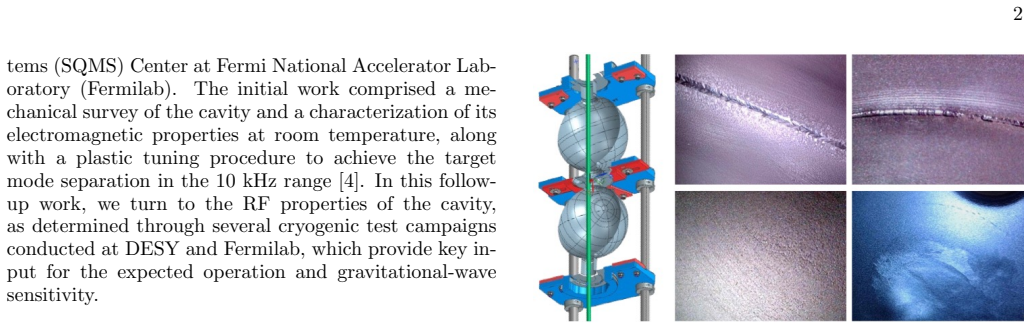
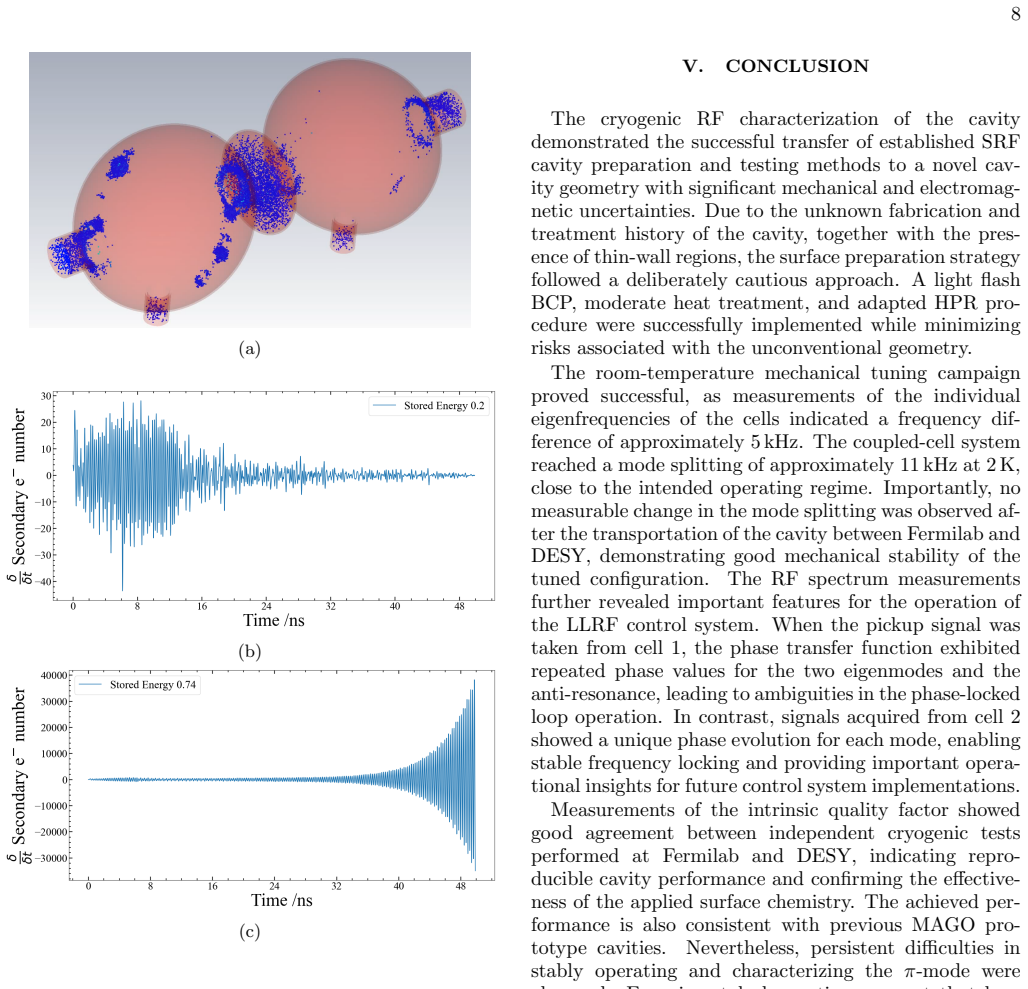
Following adapted surface preparation, cryogenic tests at temperatures down to 2 K on the MAGO cavity produced a mechanical tuning that yielded approximately 11 kHz electromagnetic mode splitting, high electromagnetic quality factors, phase transfer characteristics relevant for stable RF control, indications of mode coupling from one-point multipacting, and first measurements of mechanical eigenmodes with quality factors significantly below commonly assumed theoretical values. These outcomes demonstrate the successful application of established SRF preparation and characterization techniques to a non-standard resonator geometry and provide important experimental input for the development of
What carries the argument
The MAGO cavity: a superconducting niobium resonator with unconventional geometry engineered for narrow electromagnetic mode separation.
If this is right
- The cavity geometry can be scaled or arrayed in future SRF gravitational-wave detectors without requiring entirely new preparation methods.
- Electromagnetic performance supports integration with existing low-level RF control systems.
- Mechanical quality factor shortfalls must be addressed through further design or material work to reach target sensor performance.
- Mode coupling effects require targeted mitigation before long-term deployment.
Where Pith is reading between the lines
- The lower mechanical quality factors could reduce the cavity's response to gravitational-wave strain unless compensated by larger mode volume or improved surface treatment.
- Phase transfer data from this geometry may apply directly to control loops in other narrow-band cryogenic resonators.
- Similar non-standard shapes could be tested in existing SRF facilities to map how geometry affects multipacting thresholds.
Load-bearing premise
The observed mode coupling potentially caused by multipacting and the lower-than-expected mechanical quality factors will not prevent stable, long-term operation of the cavity as a gravitational-wave sensor.
What would settle it
A controlled test in which the cavity is operated continuously at 2 K while monitoring whether multipacting-induced mode coupling prevents stable low-level RF control or whether the measured mechanical quality factors fall short of the sensitivity needed to detect gravitational waves.
Figures
read the original abstract
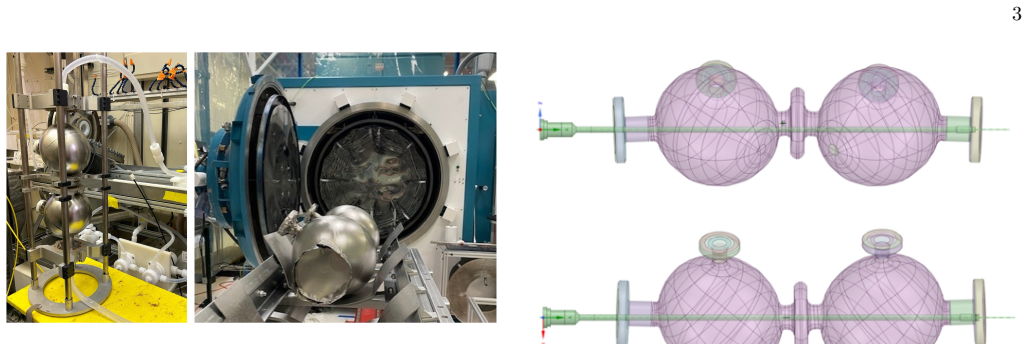
Superconducting radio-frequency (SRF) cavities are promising resonant sensors for gravitational-wave detection in the kHz-MHz frequency range. We report the cryogenic RF characterization of a prototype superconducting niobium cavity with an unconventional geometry designed for narrow electromagnetic mode separation. Following an adapted surface preparation procedure, cryogenic tests were performed at Fermilab and DESY at temperatures down to 2\,K. Mechanical tuning at room temperature achieved a mode splitting of approximately 11\,kHz at cryogenic temperature. High electromagnetic quality factors consistent with previous prototype cavities were measured. The measurements further revealed phase transfer characteristics relevant for stable low-level RF control as well as indications of mode coupling potentially caused by one-point multipacting. In addition, first cryogenic measurements of the mechanical eigenmodes yielded mechanical quality factors significantly below commonly assumed theoretical values. These results demonstrate the successful application of established SRF preparation and characterization techniques to a non-standard resonator geometry and provide important experimental input for the development of future SRF-based gravitational-wave detectors.
Editorial analysis
A structured set of objections, weighed in public.
Referee Report
Summary. The manuscript reports cryogenic RF and mechanical characterization of a prototype niobium MAGO cavity with unconventional geometry intended for high-frequency gravitational-wave detection. Mechanical tuning at room temperature produced an electromagnetic mode splitting of ~11 kHz at cryogenic temperatures (down to 2 K). High electromagnetic quality factors were measured, consistent with prior prototypes; phase-transfer data relevant to low-level RF control were obtained; indications of mode coupling possibly due to one-point multipacting were noted; and first cryogenic measurements of mechanical eigenmodes yielded quality factors significantly below theoretical expectations. The authors conclude that standard SRF preparation and characterization techniques were successfully applied to this non-standard resonator and that the results supply useful experimental input for future SRF-based gravitational-wave detectors.
Significance. If the reported measurements hold, the work supplies concrete experimental benchmarks on electromagnetic and mechanical performance of a non-standard SRF geometry in the kHz-MHz band. It demonstrates that established surface-preparation protocols can be adapted to this cavity shape and flags practical issues (multipacting signatures, sub-theoretical mechanical Q) that must be addressed in detector development. The direct experimental nature of the results, obtained at two facilities, constitutes a useful data point for the community even if the cavity is not yet at the performance level required for a gravitational-wave sensor.
minor comments (2)
- [Abstract] Abstract and results sections: the reported numerical values (11 kHz splitting, electromagnetic and mechanical Q factors) are given without accompanying uncertainties, data-selection criteria, or brief statements of analysis methods. Adding these would allow readers to assess the precision and robustness of the central measurements.
- The discussion of possible multipacting-induced mode coupling would benefit from a short description of the specific signatures observed in the RF data (e.g., which power levels or field configurations triggered the effect) to make the interpretation more traceable.
Simulated Author's Rebuttal
We thank the referee for the positive summary, significance assessment, and recommendation of minor revision. No specific major comments are listed in the report, so we have no individual points to address.
Circularity Check
No significant circularity
full rationale
This is a direct experimental measurement report presenting cryogenic RF test results (mode splitting of ~11 kHz, electromagnetic Q values, phase transfer data, multipacting indications, and mechanical Q measurements) from Fermilab and DESY tests on the MAGO cavity. No derivations, fitted predictions, or equations appear that reduce by construction to author-defined inputs or self-citations. The central claim of successful application of established SRF techniques to non-standard geometry is supported by the reported data without any load-bearing self-referential steps, making the paper self-contained.
Axiom & Free-Parameter Ledger
Reference graph
Works this paper leans on
-
[1]
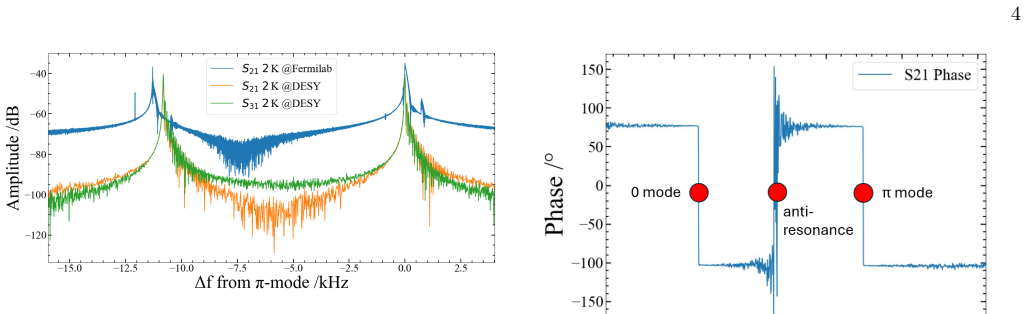
Mode Splitting As previously reported [4], it was necessary to plas- tically deform the two cells and tune their RF eigenfre- quency differences from the order ofO(MHz) down to the intendedO(kHz) to make the two individual resonating cells behave like a coupled system, for the given cell-to- cell couplingk cc. After tuning at room temperature, the two pea...
-
[2]
5a and 5b, the phase transfer functions mea- sured at cell 1 and 2, respectively (corresponding to the S21 andS 31 parameters), are presented
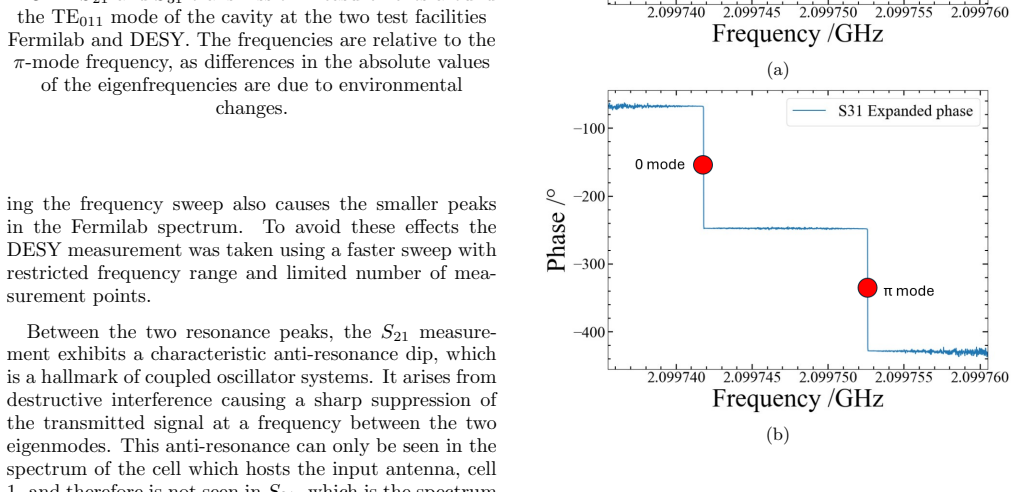
Phase Transfer Function In Figs. 5a and 5b, the phase transfer functions mea- sured at cell 1 and 2, respectively (corresponding to the S21 andS 31 parameters), are presented. It can be seen that the signal measured from cell 1 shows a repetition of the same value three times: in the phase transition region at each eigenmode and at the ‘anti-resonance’. A...
-
[3]
The 0-mode quenched around 1.3 J (hard quench)
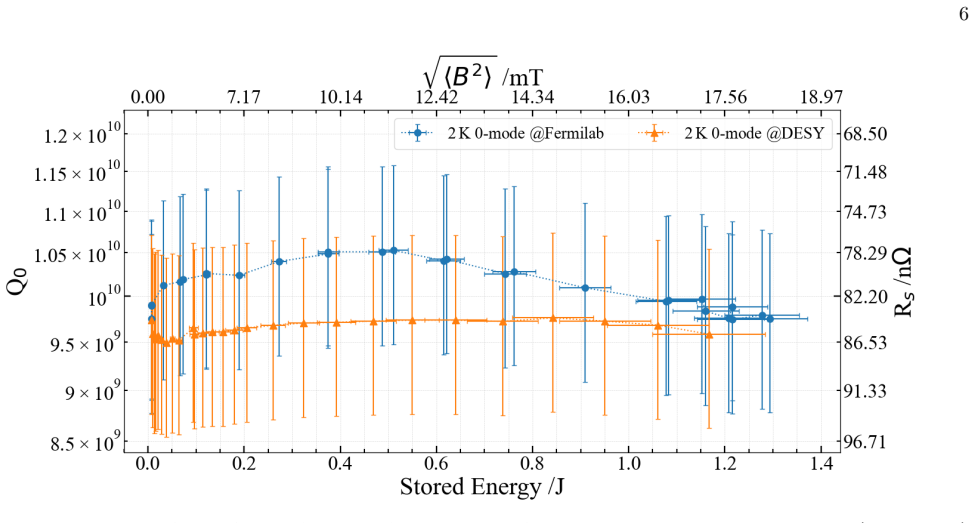
The cavity exhibits highQ 0, in line with the perfor- mance of the previous MAGO prototype cavity [3]. The 0-mode quenched around 1.3 J (hard quench). Measuring the antisymmetricπ-mode proved challenging through- out both test campaigns. At Fermilab, measurements were restricted to low input power due to an instability in the phase-locked loop (PLL), caus...
-
[4]
Ballantini, P
R. Ballantini, P. Bernard, E. Chiaveri, A. Chincarini, G. Gemme, R. Losito, R. Parodi, and E. Picasso, A detec- tor of high frequency gravitational waves based on cou- pled microwave cavities, Class. Quant. Grav.20, 3505 (2003)
2003
-
[5]
Ballantini, P
R. Ballantini, P. Bernard, A. Chincarini, G. Gemme, R. Parodi, and E. Picasso, Electromagnetic characteriza- tion of superconducting radio-frequency cavities for GW detection, Class. Quant. Grav.21, S1241 (2004)
2004
-
[6]
Microwave apparatus for gravitational waves observation
R. Ballantini, P. Bernard, S. Calatroni, E. Chiaveri, A. Chincarini, R. Croce, S. Cuneo, V. Galdi, G. Gemme, R. Losito, R. Parodi, E. Picasso, V. Pierro, I. Pinto, A. Podesta’, and R. Vaccarone’, Microwave apparatus for gravitational waves observation, arXiv preprint (2005), arXiv:gr-qc/0502054
work page internal anchor Pith review Pith/arXiv arXiv 2005
-
[7]
Fischer, B
L. Fischer, B. Giaccone, I. Gonin, A. Gras- sellino, W. Hillert, T. Khabiboulline, T. Krokotsch, G. Moortgat-Pick, A. Muhs, Y. Orlov,et al., First 11 characterisation of the mago cavity, a superconducting rf detector for khz–mhz gravitational waves, Class. Quant. Grav.42, 115015 (2025)
2025
-
[8]
Chouhan, D
V. Chouhan, D. Bice, D. Burk, S. Chandrasekaran, A. Cravatta, P. Dubiel, G. Eremeev, F. Furuta, B. Guil- foyle, M. Kelly, O. Melnychuk, A. Netepenko, M. Ng, J. Ozelis, H. Park, T. Reid, T. Ring, and G. Wu, Lat- est development of electropolishing optimization for 650 mhz cavity, inProc. 21th Int. Conf. RF Supercond. (SRF’23), International Conference on R...
-
[9]
Powers, Theory and practice of cavity test systems, inProc
T. Powers, Theory and practice of cavity test systems, inProc. 12th Int. Conf. RF Supercond. (SRF’05), In- ternational Conference on RF Superconductivity No. 12 (JACoW Publishing, Geneva, Switzerland, 2005) pp. 40– 70
2005
-
[10]
Uncertainty of data obtained in SRF cavity vertical test
F. He, Uncertainty of data obtained in srf cavity vertical test, arXiv preprint (2013), 1310.3900
work page internal anchor Pith review Pith/arXiv arXiv 2013
-
[11]
O. Melnychuk, A. Grassellino, and A. Romanenko, Error analysis for intrinsic quality factor measurement in super- conducting radio frequency resonators, Rev. Sci. Instrum. 85, 10.1063/1.4903868 (2014)
-
[12]
Holzbauer, Y
J. Holzbauer, Y. Pischalnikov, D. Sergatskov, W. Schap- pert, and S. Smith, Systematic uncertainties in rf-based measurement of superconducting cavity quality factors, Nucl. Instrum. Meth. A.830, 22 (2016)
2016
-
[13]
Marconato, J
G. Marconato, J. Branlard, L. Butkowski, V. Chouhan, C. Dokuyucu, M. Eberenz, L. Fischer, B. Giaccone, I. Go- nin, A. Grassellino,et al., Coming closer to high fre- quency gravitational wave detection with mago, inProc. 22th Int. Conf. RF Supercond. (SRF’25), International Conference on RF Superconductivity No. 22 (JACoW Publishing, Geneva, Switzerland, 2...
2025
-
[14]
Ballantini, A
R. Ballantini, A. Chincarini, G. Gemme, R. Parodi, O. Aberle, P. Bernard, S. Calatroni, E. Chiaveri, R. Los- ito, and E. Picasso, Experimental results on scrf cav- ity prototypes for gravitational wave detection, in11th Workshop on RF-Superconductivity, L¨ ubeck, Germany (2003) pp. 106–110
2003
-
[15]
Berlin, D
A. Berlin, D. Blas, R. Tito D’Agnolo, S. A. R. Ellis, R. Harnik, Y. Kahn, J. Sch¨ utte-Engel, and M. Wentzel, Electromagnetic cavities as mechanical bars for gravita- tional waves, Phys. Rev. D108, 084058 (2023)
2023
-
[16]
Volkov, J
V. Volkov, J. Knobloch, and A. Matveenko, Monopole passband excitation by field emitters in 9-cell TESLA- type cavities, Phys. Rev. ST Accel. Beams13, 084201 (2010)
2010
-
[17]
Kreps, A
G. Kreps, A. G¨ ossel, D. Proch, W. M¨ oller, D. Kostin, and K. Twarowski, Excitation of parasitic modes in cw cold tests of 1.3 ghz tesla-type cavities, inProc. 14th Int. Conf. RF Supercond. (SRF’09), International Conference on RF Superconductivity No. 14 (JACoW Publishing, Geneva, Switzerland, 2009) pp. 289–291
2009
- [18]
-
[19]
However, the following analysis would still remain valid, as long as the resonance fre- quencies and damping coefficients of the coupled EM- mechanical system are used instead
This approximation is not expected to hold anymore for higher couplingsC m ∼1 and larger stored energiesU 0 than in this test setup. However, the following analysis would still remain valid, as long as the resonance fre- quencies and damping coefficients of the coupled EM- mechanical system are used instead
discussion (0)
Sign in with ORCID, Apple, or X to comment. Anyone can read and Pith papers without signing in.