REVIEW 3 major objections 6 minor 1 cited by
New $\beta$ Cep pulsators discovered with K2 space photometry
T0 review · 3 major / 6 minor · reviewed 2026-08-14 · deepseek-v4-flash
Pith's one-line read Three new β Cephei pulsators are identified from K2 photometry, with complete frequency lists for future seismic modelling.
desk verdict Read this for the frequency lists, not for a guaranteed beta Cep classification: two of the three new candidates are photometric, and the paper admits it. read the letter →
The pith
A machine-rendered reading of the paper's core claim, the machinery that carries it, and where it could break.
The reading
What carries the argument
The load-bearing tool is iterative pre-whitening of the Lomb–Scargle periodogram: at each step the highest-amplitude peak is fitted together with all previously found frequencies by a non-linear least-squares sine model $x_i(t_i)=\sum_j A_j\sin\{2\pi[\nu_j(t_i-t_0)+\varphi_j]\}+C$, the model is subtracted from the light curve, and the search repeats until the next peak's signal-to-noise ratio within a $1\ \mathrm{d}^{-1}$ window falls below 5, a criterion calibrated for 90-day time bases by Baran et al. (2015). Two resolution limits govern what counts as a real mode: the Rayleigh resolution $1/\Delta T \approx 0.01\text{--}0.03\ \mathrm{d}^{-1}$ of the 64–77-day campaigns, and the Loumos–Deeming rule that peaks closer than $1.5/\Delta T$ are formally unresolved. Combination frequencies of the form $n\nu_i+m\nu_j$ are scanned semi-automatically so that harmonics and sums are flagged rather than counted as independent modes. The Gaia-DR2 colour-magnitude diagram, built from geometric distances and reddening-corrected colours and cross-checked in Appendix B against effective temperatures from spectral-type calibrations, is what turns the photometric frequencies into a claim about stellar class.
What would settle it
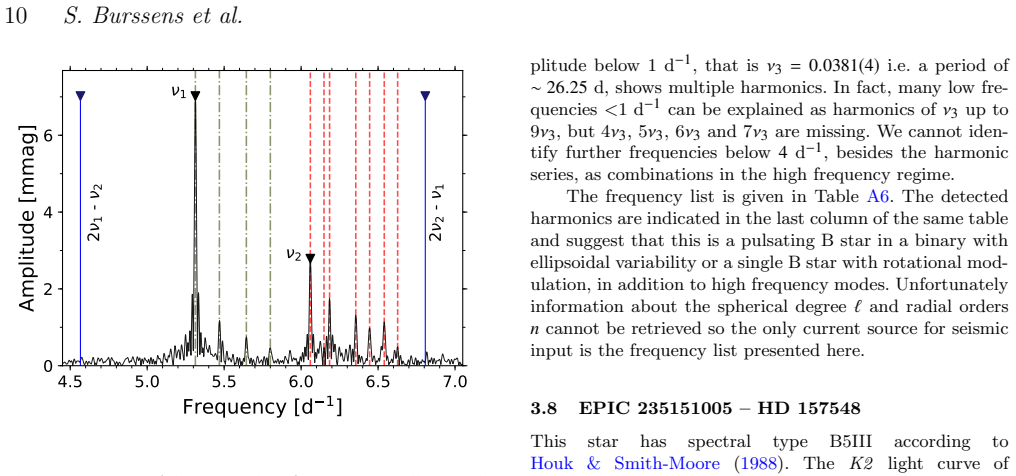
Take high-resolution spectra of EPIC 202691120 and EPIC 202929357: if the measured effective temperatures and surface gravities place them in the δ Scuti regime (roughly $T_{\rm eff} < 12000$ K, on the cool side of the β Cep strip) while the same high frequencies persist, the β Cep classification collapses, because δ Scuti stars oscillate in the same frequency range. For LS 3978, radial-velocity monitoring over the ~26-day period of $\nu_3$ would reveal whether the harmonic series up to $9\nu_3$ marks a binary or rotational modulation instead of pulsation.
Extended reading notes
Core claim
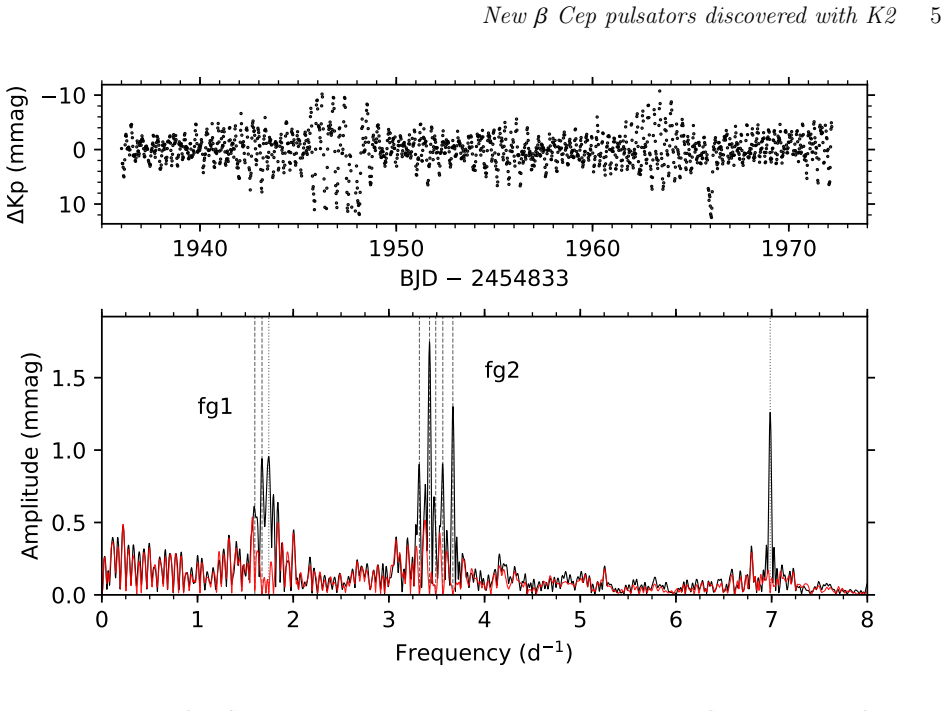
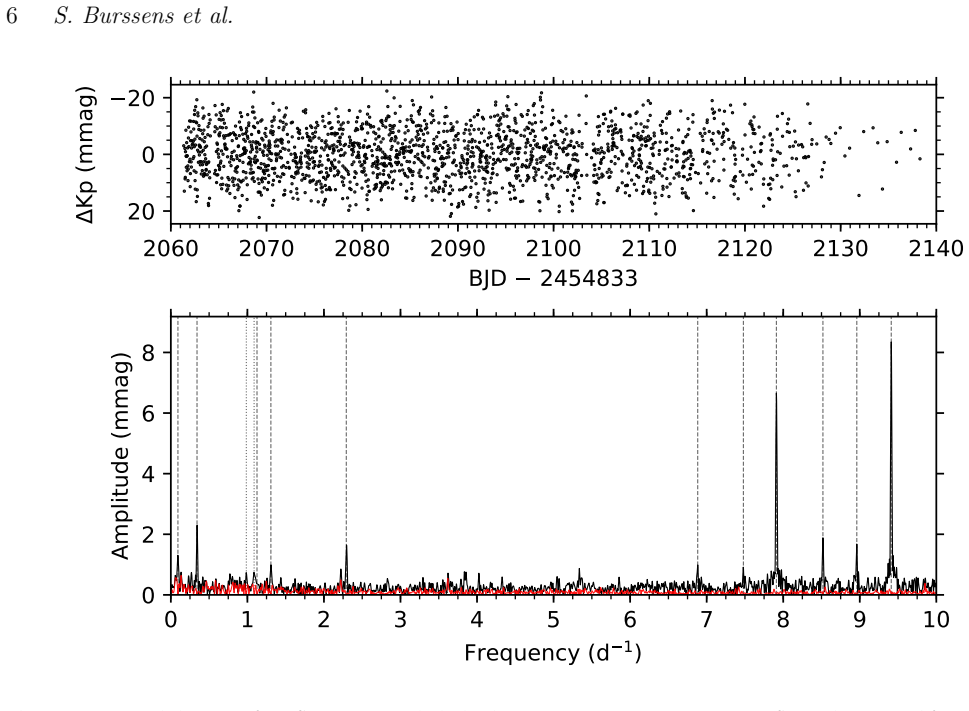
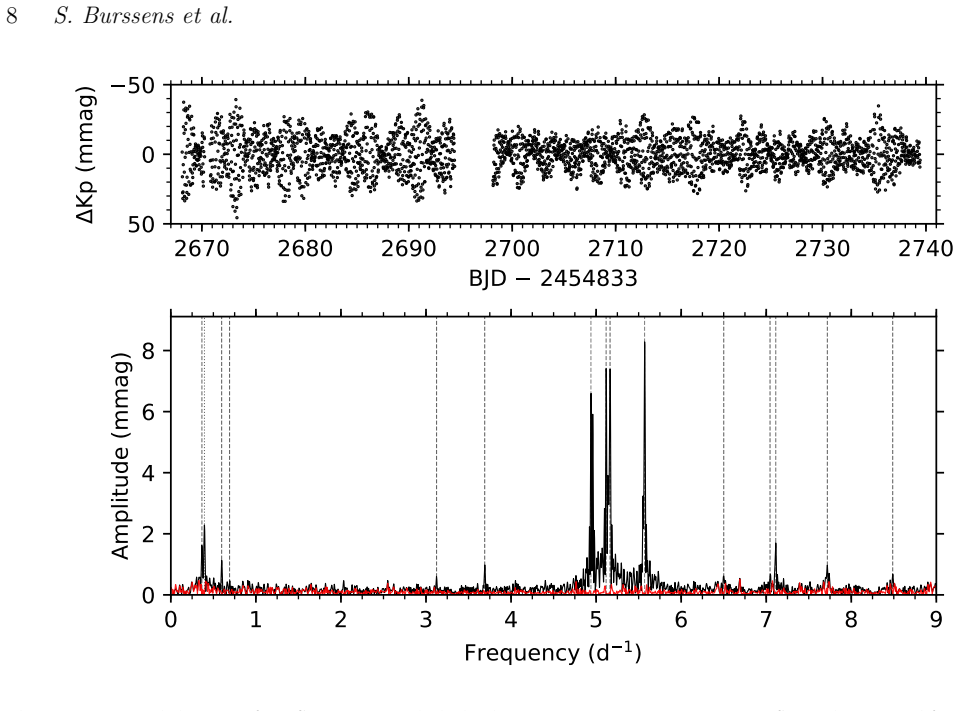
The paper's central claim is that three previously poorly characterised stars are β Cephei pulsators: the K2 Campaign 2 stars EPIC 202691120 (CD-28 12286) and EPIC 202929357 (CD-27 10876), classified only as 'OB−' on photographic plates, and the Campaign 11 star EPIC 235094159 (LS 3978, spectral type B2III). The evidence is the dominance of coherent high-frequency modes at about $7\text{--}17\ \mathrm{d}^{-1}$ with amplitudes of a few millimagnitudes, and the stars' places in a Gaia-DR2 colour-magnitude diagram, which the authors argue is a valid proxy for the theoretical Hertzsprung–Russell diagram in this temperature range. EPIC 202691120 is further classified as a hybrid β Cep/SPB pulsator — combining β Cep-style pressure modes with the gravity modes typical of slowly pulsating B stars — on the strength of independent low-frequency modes near $0.1\text{--}2.3\ \mathrm{d}^{-1}$ that cannot be explained as combinations of the p-modes. For HD 169173, the paper documents two series of nearly equally spaced frequencies — average spacing $\sim 0.16\ \mathrm{d}^{-1}$ in the first series and $\sim 0.08\text{--}0.09\ \mathrm{d}^{-1}$ in the second — and rules out non-linear resonant mode coupling as their origin, since combinations of the two dominant modes up to fifth order fall outside the frequency resolution.
Load-bearing premise
All three new β Cep classifications rest on the assumption that the stars' positions in the Gaia-DR2 colour-magnitude diagram, together with effective temperatures adopted from rough spectral types ($15000 \pm 5000$ K for the two OB− stars), place them inside the β Cep instability region rather than the δ Scuti region, which produces similar frequency ranges; the paper itself concedes that formal confirmation requires spectroscopy.
Editorial extensions
If this is right
- The complete frequency lists of EPIC 202691120, EPIC 202929357, and LS 3978 give forward seismic modelling specific targets: once at least one mode's geometry is identified from high-resolution spectroscopy or multi-colour photometry, the observed frequencies can be matched against pulsation models of massive main-sequence stars.
- EPIC 202691120's combination of independent g-modes near $0.1\text{--}2.3\ \mathrm{d}^{-1}$ with p-modes near $6.9\text{--}9.4\ \mathrm{d}^{-1}$ makes it a hybrid β Cep/SPB candidate that could probe both the envelope and the near-core region of a single massive star.
- The new low-amplitude frequencies for HD 164741 are consistent with the earlier ground-based mode set and extend it, so longer time bases from TESS sectors 3 and 4 can be merged with the K2 data to resolve the beating patterns and the currently unresolved doublets.
- The two nearly equally spaced series in HD 169173 supply a fresh observable for a B3Ib supergiant; the paper rules out non-linear resonant mode coupling as their origin but leaves the choice between a rotational quintuplet with a missing member and stochastic excitation open until spectroscopy is available.
Reading between the lines
- A testable extension: if the roughly $0.16\ \mathrm{d}^{-1}$ spacing in HD 169173 is an asymptotic p-mode large separation, it directly encodes the star's mean density; merging future photometry and searching for the missing series members would discriminate that interpretation from a rotational quintuplet.
- The near-regular splittings of about $0.44\ \mathrm{d}^{-1}$ and $0.60\ \mathrm{d}^{-1}$ that the paper notes in EPIC 202691120, if rotational in origin, would imply a rotation period of a few days; a prediction that follows is that high-resolution spectroscopy should measure a correspondingly large $v\sin i$ for low-degree modes.
- The paper's demonstration that the colour-magnitude diagram reproduces the relative positions of an HR diagram could be stress-tested on spectroscopically well-characterised B stars; if it holds broadly, CMD positions alone could pre-screen large-area photometric surveys for candidate β Cep stars.
- For LS 3978, the harmonic series up to $9\nu_3$ with $4\nu_3$ through $7\nu_3$ missing is the kind of pattern expected from tidal or rotational ellipsoidal modulation; a phase-locking test of the harmonics against $\nu_3$ would settle whether the low-frequency signal is geometric rather than pulsational.
Signed reviews
Editorial analysis
A structured set of objections, weighed in public.
Referee Report
Summary. The paper presents a K2 photometric survey of 130 OB-type stars, focusing on eight objects with coherent high-frequency pulsations. The authors use iterative pre-whitening with a S/N cutoff of 5 and the Loumos–Deeming resolution criterion to extract frequency lists. They claim the discovery of three new beta Cep pulsators (EPIC 202691120 / CD-28 12286, EPIC 202929357 / CD-27 10876, and EPIC 235094159 / LS 3978), additional frequencies for the known beta Cep star HD 164741, and regularly spaced frequency series in HD 169173. Three other stars showing frequency groupings are also characterized. The classification relies on spectral types from the literature, Gaia-DR2 photometry and parallaxes, and placement in a colour-magnitude diagram as a proxy for the Hertzsprung-Russell diagram, with effective temperatures adopted from spectral-type calibrations or assumed values. The paper explicitly acknowledges that spectroscopy is needed to formally confirm the beta Cep classification of the two OB- stars and to resolve the binary/rotation ambiguity in LS 3978.
Significance. If the classifications hold, the paper makes a useful contribution by expanding the small sample of beta Cep pulsators with space-photometry frequency lists, and the complete frequency tables provide a starting point for future seismic modelling. The frequency analysis follows established community criteria (S/N >= 5, Loumos–Deeming resolution limit) and the paper is honest about its limitations. The discovery of regularly spaced high-frequency patterns in HD 169173 is also of interest, and the comparison with known beta Cep and SPB stars in the CMD is a reasonable first step given the absence of spectroscopy. The main value is as a catalog paper: the frequency lists themselves are the deliverable, and the classifications are plausible but not yet spectroscopically confirmed for the two faintest candidates.
major comments (3)
- [Section 3.3 and Appendix B] The beta Cep classification of EPIC 202929357 is not established by the presented evidence. The star has no Gaia reddening or extinction values (Table B1), so it is absent from the CMD in Fig. 11. The paper replaces the missing CMD information with the statement that reddening is 'approximately similar' to EPIC 202691120 because both are in the K2 Campaign 2 field (Section 4.1); the two stars are separated by several degrees on the sky, so this is not a quantitative justification. The adopted Teff = 15000 +/- 5000 K (Appendix B, Table B2) is assumed rather than measured, and at the lower bound of ~10,000 K the observed high-frequency coherent modes (7.5-13.7 d^-1 in Table A2) are also consistent with delta Scuti pulsation, a possibility the paper itself raises in Section 3.3. The central claim that EPIC 202929357 is a new beta Cep pulsator therefore rests on an assumed temperature rather than on a measurement, and the paper's own conclusion in Section 4.1 concedes that spectroscopy is needed for formal confirmation. The title-level claim for this object should be softened or the classification explicitly labelled as tentative.
- [Section 4.1 and Section 3.7] For EPIC 235094159 (LS 3978), the classification as a beta Cep pulsator is complicated by the presence of a harmonic series up to 9*nu3 in the low-frequency regime (Table A6). The paper itself states that this points to 'a pulsating B star in a binary with ellipsoidal variability or a single B star with rotational modulation' (Section 3.7). A binary or rotating star can produce combination frequencies and amplitude modulation that mimic p-mode pulsation in the high-frequency regime, and the distance to this star is poorly constrained (d = 6000.2+2673.3/-1548.9 pc, Table B1), making its position in the CMD and HR diagram very uncertain (Section 4.1). The classification as a beta Cep star is therefore dependent on the assumption that the high-frequency peaks are independent pulsation modes of the B star rather than artifacts of binarity or rotation. This is a load-bearing gap for the central claim and should be addressed explicitly, e.g. by a discussion of whether the high-frequency modes could be combination frequencies of the harmonic series or by a quantitative test using the binary/rotational interpretation.
- [Section 3.2, Appendix B] The classification of EPIC 202691120 (CD-28 12286) as a beta Cep star is also sensitive to the adopted effective temperature. The star has a photographic OB- classification (Drilling & Bergeron 1995) that the paper notes is degenerate with late B/early A supergiants (Section 3.2). The Gaia CMD position in Fig. 11 places it among known beta Cep stars, and the adopted Teff = 15000 +/- 5000 K (Table B2) brackets the beta Cep instability strip. However, at the lower temperature bound the high-frequency modes (6.9-9.4 d^-1 in Table A1) are again consistent with delta Scuti pulsation. The paper's own discussion in Section 3.3 acknowledges this concern. Since beta Cep classification requires log Teff >~ 4.25, and the adopted temperature uncertainty spans the boundary, the classification should be reported as provisional unless spectroscopy is available. The paper does say this in Section 4.1, but the abstract and conclusions state the three new beta Cep pulsators without this caveat; the abstract should be adjusted to reflect the provisional nature of two of the three classifications.
minor comments (6)
- [Section 2.4] The description of the S/N criterion states that the S/N is calculated in an interval of width 1 d^-1 centred around the frequency; this should be clarified to say whether the interval excludes the frequency itself (as is standard in the literature), since this affects the noise estimate and hence the extracted frequency list.
- [Table 1] The spectral type column for EPIC 202691120 and EPIC 202929357 lists 'OB-' without an explanation in the table caption; the reader must search the text to understand that this is the Drilling & Bergeron (1995) photographic classification. A footnote in the table would improve clarity.
- [Section 3.4] The text states that 'the first four high amplitude frequencies all appear as a doublet structure in the periodogram' and that three of the eight members are unresolved, but it is not immediately clear how the count of eight members arises; a short clarification of the doublet structure and the Loumos-Deeming criterion applied to each pair would be helpful.
- [Section 3.5] The discussion of the two frequency series in EPIC 227552090 mentions that the second series could be a 'rotational quintuplet with a missing member'; the justification for the quintuplet hypothesis is not given, and a reference or a brief explanation of the expected spacing pattern for a rotational quintuplet would strengthen the statement.
- [Appendix B] Table B2 lists E(B-V) values with very small uncertainties (e.g. 0.00001 for EPIC 202929357) that appear unrealistically precise for values derived from a 3D dust map; these error bars should either be removed or recomputed.
- [General] There are a few typographical issues, including 'interpet' in Section 3.8 and 'expect' for 'except' in Appendix B ('For all stars, expect EPIC 202060092'). These should be corrected in a final proofread.
Circularity Check
No significant circularity: this is a data catalogue with classifications grounded in independent spectral-type and Gaia-DR2 data, and the paper itself flags the need for spectroscopy.
full rationale
The paper is a discovery catalogue built from K2 photometry. The central products are frequency lists extracted by iterative pre-whitening with a fixed S/N >= 5 stopping criterion (Section 2.4), and classifications of the stars as beta Cep pulsators. No fitted parameter is renamed as a prediction: the frequencies are directly measured peaks, and the beta Cep classification is applied after the frequency extraction rather than being used to select or fit the frequencies. The classification of EPIC 202691120 and EPIC 202929357 does rest on the adopted Teff = 15000 +/- 5000 K and Gaia-DR2 CMD positions (Appendix B), but this is an explicit, acknowledged assumption rather than a circular reduction; the paper states in Section 4.1 that 'Spectroscopy is ultimately needed to confirm the classification formally', and in Section 3.3 it explicitly addresses the competing delta Scuti interpretation. Likewise, the harmonic-series caveat for LS 3978 is raised by the authors themselves. Citations to prior work by the same group (e.g., Buysschaert et al. 2015; Pedersen et al. 2019a) are used for data-reduction and bolometric-correction methodology, not to import the conclusion. There is no equation in which an output is equal by construction to an input, and no self-citation chain that forces the claimed result. The paper is therefore self-contained as a frequency catalogue, with its classification caveats stated rather than hidden.
Assumptions & free parameters
assumptions (4)
- domain assumption Coherent high-frequency pulsations in early-B stars are p-modes driven by the kappa mechanism and are indicators of beta Cep pulsation.
- domain assumption The S/N at least 5 pre-whitening stop criterion (Baran et al. 2015) and the Loumos and Deeming (1978) resolution criterion separate real pulsation frequencies from noise.
- domain assumption For the OB- stars, the effective temperature is assumed to be 15000 +/- 5000 K, covering mid-B to early-A temperatures.
- domain assumption Gaia-DR2 parallaxes and photometric extinction/reddening corrections are accurate enough for placing the stars in the CMD.
Cite this review
Pith. "Pith review of New $\beta$ Cep pulsators discovered with K2 space photometry." pith.science (2026). https://pith.science/paper/ZLIN4B2H
@misc{pith2026190802836,
  author       = {Pith},
  title        = {Pith review of: New $\beta$ Cep pulsators discovered with K2 space photometry},
  year         = {2026},
  howpublished = {\url{https://pith.science/paper/ZLIN4B2H}},
  note         = {Machine review of arXiv:1908.02836}
}
abstract
We present the discovery of three new $\beta$ Cep pulsators, three new pulsators with frequency groupings, and frequency patterns in a B3Ib star, all of which show pulsations with frequencies as high as about 17 d$^{-1}$, with K2 space mission photometry. Based on a Fourier analysis and iterative pre-whitening we present a classification and evaluate the potential for asteroseismic modelling. We include the lists of pulsation frequencies for three new $\beta$ Cep pulsators, CD-28 12286, CD-27 10876, LS 3978, and additional pulsation mode frequencies for the known $\beta$ Cep pulsator HD 164741. In addition we characterise the regular frequency spacing found in the new pulsator HD 169173, and discuss its origin. We place the newly discovered variables in a colour-magnitude diagram using parallaxes from Gaia-DR2, showcasing their approximate location in the massive star domain. The identified frequency lists of these multiperiodic pulsators are a good starting point for future forward seismic modelling, after identification of at least one pulsation frequency from high-resolution time series spectroscopy and/or multi-colour photometry.
Figures

Figures from the paper (8 more)




Forward citations
Cited by 1 Pith paper
-
Asteroseismic forward modelling of 36 $\beta$ Cep pulsators and inferences on their internal differential rotation
Forward modelling of 36 β Cep stars with second-order rotation effects shows internal rotation declining with age and common radial differential rotation, often non-monotonic, in 17 stars.
Reference graph
Works this paper leans on
-
[1]
Aerts C., Rogers T. M., 2015, @doi [ ] 10.1088/2041-8205/806/2/L33 , http://adsabs.harvard.edu/abs/2015ApJ...806L..33A 806, L33
-
[2]
W., 2010, Asteroseismology
Aerts C., Christensen-Dalsgaard J., Kurtz D. W., 2010, Asteroseismology . Springer
2010
-
[3]
Aerts C., Briquet M., Degroote P., Thoul A., van Hoolst T., 2011, @doi [ ] 10.1051/0004-6361/201117629 , https://ui.adsabs.harvard.edu/#abs/2011A&A...534A..98A 534, A98
-
[4]
Aerts C., et al., 2018a, @doi [ ] 10.3847/1538-4365/aaccfb , http://adsabs.harvard.edu/abs/2018ApJS..237...15A 237, 15
-
[5]
Aerts C., et al., 2018b, @doi [ ] 10.1093/mnras/sty308 , http://adsabs.harvard.edu/abs/2018MNRAS.476.1234A 476, 1234
-
[6]
Aerts C., et al., 2019a, @doi [ ] 10.1051/0004-6361/201834762 , http://adsabs.harvard.edu/abs/2019A
-
[7]
Aerts C., Mathis S., Rogers T., 2019b, , https://ui.adsabs.harvard.edu/#abs/2018arXiv180907779A in press, arXiv:1809.07779
-
[8]
Aigrain S., Parviainen H., Pope B. J. S., 2016, @doi [ ] 10.1093/mnras/stw706 , http://adsabs.harvard.edu/abs/2016MNRAS.459.2408A 459, 2408
Show all 112 references
-
[9]
Andrae R., et al., 2018, @doi [ ] 10.1051/0004-6361/201732516 , http://adsabs.harvard.edu/abs/2018A
2018 doi
-
[10]
J., Scott P., 2009, @doi [ ] 10.1146/annurev.astro.46.060407.145222 , https://ui.adsabs.harvard.edu/abs/2009ARA
Asplund M., Grevesse N., Sauval A. J., Scott P., 2009, @doi [ ] 10.1146/annurev.astro.46.060407.145222 , https://ui.adsabs.harvard.edu/abs/2009ARA
2009
-
[11]
Auvergne M., et al., 2009, @doi [ ] 10.1051/0004-6361/200810860 , http://adsabs.harvard.edu/abs/2009A
2009 doi
-
[12]
Bailer-Jones C. A. L., Rybizki J., Fouesneau M., Mantelet G., Andrae R., 2018, @doi [ ] 10.3847/1538-3881/aacb21 , http://adsabs.harvard.edu/abs/2018AJ....156...58B 156, 58
2018 doi
-
[13]
A., 2016, , 457, 3724
Balona L. A., 2016, , 457, 3724
2016
-
[14]
A., et al., 2011, @doi [ ] 10.1111/j.1365-2966.2011.18311.x , http://adsabs.harvard.edu/abs/2011MNRAS.413.2403B 413, 2403
Balona L. A., et al., 2011, @doi [ ] 10.1111/j.1365-2966.2011.18311.x , http://adsabs.harvard.edu/abs/2011MNRAS.413.2403B 413, 2403
2011
-
[15]
S., Koen C., Pokrzywka B., 2015, @doi [ ] 10.1093/mnrasl/slu194 , http://adsabs.harvard.edu/abs/2015MNRAS.448L..16B 448, L16
Baran A. S., Koen C., Pokrzywka B., 2015, @doi [ ] 10.1093/mnrasl/slu194 , http://adsabs.harvard.edu/abs/2015MNRAS.448L..16B 448, L16
2015 doi
-
[16]
M., Steele I
Barnsley R. M., Steele I. A., 2013, @doi [ ] 10.1051/0004-6361/201220419 , https://ui.adsabs.harvard.edu/#abs/2013A&A...556A..81B 556, A81
2013 doi
-
[17]
Belkacem K., et al., 2009, @doi [Science] 10.1126/science.1171913 , http://adsabs.harvard.edu/abs/2009Sci...324.1540B 324, 1540
2009 doi
-
[18]
A., Noels A., 2010, @doi [ ] 10.1051/0004-6361/200913221 , http://adsabs.harvard.edu/abs/2010A
Belkacem K., Dupret M. A., Noels A., 2010, @doi [ ] 10.1051/0004-6361/200913221 , http://adsabs.harvard.edu/abs/2010A
2010 doi
-
[19]
Blomme R., et al., 2011, @doi [ ] 10.1051/0004-6361/201116949 , http://adsabs.harvard.edu/abs/2011A
2011 doi
-
[20]
J., et al., 2010, @doi [Science] 10.1126/science.1185402 , http://adsabs.harvard.edu/abs/2010Sci...327..977B 327, 977
Borucki W. J., et al., 2010, @doi [Science] 10.1126/science.1185402 , http://adsabs.harvard.edu/abs/2010Sci...327..977B 327, 977
2010 doi
-
[21]
Bouabid M.-P., Dupret M.-A., Salmon S., Montalb \'a n J., Miglio A., Noels A., 2013, @doi [ ] 10.1093/mnras/sts517 , http://adsabs.harvard.edu/abs/2013MNRAS.429.2500B 429, 2500
2013 doi
-
[22]
M., 2017, Amplitude Modulation of Pulsation Modes in Delta Scuti Stars
Bowman D. M., 2017, Amplitude Modulation of Pulsation Modes in Delta Scuti Stars . Springer Theses series. ISBN 978-3-319-66649-5. Springer International Publishing, @doi 10.1007/978-3-319-66649-5
2017 doi
-
[23]
M., Kurtz D
Bowman D. M., Kurtz D. W., Breger M., Murphy S. J., Holdsworth D. L., 2016, @doi [ ] 10.1093/mnras/stw1153 , http://adsabs.harvard.edu/abs/2016MNRAS.460.1970B 460, 1970
2016 doi
-
[24]
M., Buysschaert B., Neiner C., P \'a pics P
Bowman D. M., Buysschaert B., Neiner C., P \'a pics P. I., Oksala M. E., Aerts C., 2018, @doi [ ] 10.1051/0004-6361/201833037 , http://adsabs.harvard.edu/abs/2018A
2018 doi
-
[25]
M., et al., 2019a, @doi [Nature Astronomy] 10.1038/s41550-019-0768-1 , https://ui.adsabs.harvard.edu/abs/2019NatAs.tmp..320B
Bowman D. M., et al., 2019a, @doi [Nature Astronomy] 10.1038/s41550-019-0768-1 , https://ui.adsabs.harvard.edu/abs/2019NatAs.tmp..320B
-
[26]
M., et al., 2019b, @doi [ ] 10.1051/0004-6361/201833662 , http://adsabs.harvard.edu/abs/2019A
Bowman D. M., et al., 2019b, @doi [ ] 10.1051/0004-6361/201833662 , http://adsabs.harvard.edu/abs/2019A
-
[27]
Briquet M., et al., 2011, @doi [ ] 10.1051/0004-6361/201015690 , http://adsabs.harvard.edu/abs/2011A
2011 doi
-
[28]
R., Goupil M
Buchler J. R., Goupil M. J., Serre T., 1995, , http://adsabs.harvard.edu/abs/1995A
1995
-
[29]
Buysschaert B., et al., 2015, @doi [ ] 10.1093/mnras/stv1572 , http://adsabs.harvard.edu/abs/2015MNRAS.453...89B 453, 89
2015 doi
-
[30]
J., Aerts C., Bowman D
Buysschaert B., Neiner C., Martin A. J., Aerts C., Bowman D. M., Oksala M. E., Van Reeth T., 2018a, @doi [ ] 10.1093/mnras/sty1190 , http://adsabs.harvard.edu/abs/2018MNRAS.478.2777B 478, 2777
-
[31]
M., Johnston C., Van Reeth T., Pedersen M
Buysschaert B., Aerts C., Bowman D. M., Johnston C., Van Reeth T., Pedersen M. G., Mathis S., Neiner C., 2018b, @doi [ ] 10.1051/0004-6361/201832642 , http://adsabs.harvard.edu/abs/2018A
-
[32]
Cantiello M., et al., 2009, @doi [ ] 10.1051/0004-6361/200911643 , http://adsabs.harvard.edu/abs/2009A
2009 doi
-
[33]
Degroote P., et al., 2009, @doi [ ] 10.1051/0004-6361/200911782 , http://adsabs.harvard.edu/abs/2009A
2009 doi
-
[34]
Degroote P., et al., 2010, @doi [ ] 10.1051/0004-6361/201014543 , http://adsabs.harvard.edu/abs/2010A
2010 doi
-
[35]
R., 2001, @doi [ ] 10.1046/j.1365-8711.2001.04790.x , http://adsabs.harvard.edu/abs/2001MNRAS.327..881D 327, 881
Deng L., Xiong D. R., 2001, @doi [ ] 10.1046/j.1365-8711.2001.04790.x , http://adsabs.harvard.edu/abs/2001MNRAS.327..881D 327, 881
2001
-
[36]
D., et al., 2009, @doi [ ] 10.1051/0004-6361/200911901 , http://adsabs.harvard.edu/abs/2009A
Diago P. D., et al., 2009, @doi [ ] 10.1051/0004-6361/200911901 , http://adsabs.harvard.edu/abs/2009A
2009 doi
-
[37]
S., Bergeron L
Drilling J. S., Bergeron L. E., 1995, @doi [Publications of the Astronomical Society of the Pacific] 10.1086/133631 , https://ui.adsabs.harvard.edu/#abs/1995PASP..107..846D 107, 846
1995 doi
-
[38]
Dupret M.-A., Thoul A., Scuflaire R., Daszy \'n ska-Daszkiewicz J., Aerts C., Bourge P.-O., Waelkens C., Noels A., 2004, @doi [ ] 10.1051/0004-6361:20034143 , http://adsabs.harvard.edu/abs/2004A
2004 doi
-
[39]
Dziembowski W., 1977, , https://ui.adsabs.harvard.edu/abs/1977AcA....27..203D 27, 203
1977
-
[40]
A., Pamiatnykh A
Dziembowski W. A., Pamiatnykh A. A., 1993, @doi [ ] 10.1093/mnras/262.1.204 , http://adsabs.harvard.edu/abs/1993MNRAS.262..204D 262, 204
1993 doi
-
[41]
A., Moskalik P., Pamyatnykh A
Dziembowski W. A., Moskalik P., Pamyatnykh A. A., 1993, @doi [ ] 10.1093/mnras/265.3.588 , https://ui.adsabs.harvard.edu/abs/1993MNRAS.265..588D 265, 588
1993 doi
-
[42]
L., 1999, @doi [ ] 10.1086/316293 , http://adsabs.harvard.edu/abs/1999PASP..111...63F 111, 63
Fitzpatrick E. L., 1999, @doi [ ] 10.1086/316293 , http://adsabs.harvard.edu/abs/1999PASP..111...63F 111, 63
1999 doi
-
[43]
B., 1902, @doi [ ] 10.1086/140929 , http://adsabs.harvard.edu/abs/1902ApJ....15..340F 15
Frost E. B., 1902, @doi [ ] 10.1086/140929 , http://adsabs.harvard.edu/abs/1902ApJ....15..340F 15
1902 doi
-
[44]
Gaia Collaboration et al., 2016, @doi [ ] 10.1051/0004-6361/201629272 , http://adsabs.harvard.edu/abs/2016A
2016 doi
-
[45]
Gaia Collaboration et al., 2018, @doi [ ] 10.1051/0004-6361/201833051 , http://adsabs.harvard.edu/abs/2018A
2018 doi
-
[46]
Gautschy A., Saio H., 1993, @doi [ ] 10.1093/mnras/262.1.213 , http://adsabs.harvard.edu/abs/1993MNRAS.262..213G 262, 213
1993 doi
-
[47]
M., et al., 2018, @doi [ ] 10.1093/mnras/sty1008 , http://adsabs.harvard.edu/abs/2018MNRAS.478..651G 478, 651
Green G. M., et al., 2018, @doi [ ] 10.1093/mnras/sty1008 , http://adsabs.harvard.edu/abs/2018MNRAS.478..651G 478, 651
2018 doi
-
[48]
Guti \'e rrez-Soto J., et al., 2009, @doi [ ] 10.1051/0004-6361/200911915 , http://adsabs.harvard.edu/abs/2009A
2009 doi
-
[49]
Handler G., et al., 2004, @doi [ ] 10.1111/j.1365-2966.2004.07214.x , http://adsabs.harvard.edu/abs/2004MNRAS.347..454H 347, 454
2004
-
[50]
Handler G., et al., 2006, @doi [ ] 10.1111/j.1365-2966.2005.09728.x , http://adsabs.harvard.edu/abs/2006MNRAS.365..327H 365, 327
2006
-
[51]
M., Neuh \"a user R., Schutz B
Hohle M. M., Neuh \"a user R., Schutz B. F., 2010, @doi [Astronomische Nachrichten] 10.1002/asna.200911355 , https://ui.adsabs.harvard.edu/#abs/2010AN....331..349H 331, 349
2010 doi
-
[52]
Volume 4, Declinations -26.0 to -12.0
Houk N., Smith-Moore M., 1988, Michigan Catalogue of Two-dimensional Spectral Types for the HD Stars. Volume 4, Declinations -26.0 to -12.0
1988
-
[53]
B., et al., 2014, @doi [ ] 10.1086/676406 , http://adsabs.harvard.edu/abs/2014PASP..126..398H 126, 398
Howell S. B., et al., 2014, @doi [ ] 10.1086/676406 , http://adsabs.harvard.edu/abs/2014PASP..126..398H 126, 398
2014 doi
-
[54]
Huat A.-L., et al., 2009, @doi [ ] 10.1051/0004-6361/200911928 , http://adsabs.harvard.edu/abs/2009A
2009 doi
-
[55]
Huber D., et al., 2016, @doi [ ] 10.3847/0067-0049/224/1/2 , http://adsabs.harvard.edu/abs/2016ApJS..224....2H 224, 2
2016 doi
-
[56]
G., eds, IAU Symposium Vol
Jaschek M., Egret D., 1982, in Jaschek M., Groth H. G., eds, IAU Symposium Vol. 98, Be Stars. p. 261
1982
-
[57]
M., Pedersen M
Johnston C., Tkachenko A., Aerts C., Molenberghs G., Bowman D. M., Pedersen M. G., Buysschaert B., P \'a pics P. I., 2019, @doi [ ] 10.1093/mnras/sty2671 , https://ui.adsabs.harvard.edu/abs/2019MNRAS.482.1231J 482, 1231
2019 doi
-
[58]
F., Glatzel W., 1992, @doi [ ] 10.1093/mnras/255.1.1P , https://ui.adsabs.harvard.edu/abs/1992MNRAS.255P...1K 255, 1P
Kiriakidis M., El Eid M. F., Glatzel W., 1992, @doi [ ] 10.1093/mnras/255.1.1P , https://ui.adsabs.harvard.edu/abs/1992MNRAS.255P...1K 255, 1P
1992 doi
-
[59]
W., Shibahashi H., Murphy S
Kurtz D. W., Shibahashi H., Murphy S. J., Bedding T. R., Bowman D. M., 2015, @doi [ ] 10.1093/mnras/stv868 , http://adsabs.harvard.edu/abs/2015MNRAS.450.3015K 450, 3015
2015 doi
-
[60]
J., Weiss W
Lenz P., Breger M., 2004, in Zverko J., Ziznovsky J., Adelman S. J., Weiss W. W., eds, IAU Symposium Vol. 224, The A-Star Puzzle. pp 786--790, @doi 10.1017/S1743921305009750
2004 doi
-
[61]
R., 1976, @doi [ ] 10.1007/BF00648343 , http://adsabs.harvard.edu/abs/1976Ap
Lomb N. R., 1976, @doi [ ] 10.1007/BF00648343 , http://adsabs.harvard.edu/abs/1976Ap
1976 doi
-
[62]
L., Deeming T
Loumos G. L., Deeming T. J., 1978, @doi [ ] 10.1007/BF01879560 , http://adsabs.harvard.edu/abs/1978Ap
1978 doi
-
[63]
J., 1981, Astronomy and Astrophysics Supplement Series, https://ui.adsabs.harvard.edu/#abs/1981A&AS...44..387M 44, 387
MacConnell D. J., 1981, Astronomy and Astrophysics Supplement Series, https://ui.adsabs.harvard.edu/#abs/1981A&AS...44..387M 44, 387
1981
-
[64]
Springer Berlin Heidelberg, @doi 10.1007/978-3-540-76949-1
Maeder A., 2009, Physics, Formation and Evolution of Rotating Stars . Springer Berlin Heidelberg, @doi 10.1007/978-3-540-76949-1
2009 doi
-
[65]
L., 2004, @doi [ ] 10.1086/424933 , http://adsabs.harvard.edu/abs/2004AJ....128.2144M 128, 2144
McCall M. L., 2004, @doi [ ] 10.1086/424933 , http://adsabs.harvard.edu/abs/2004AJ....128.2144M 128, 2144
2004 doi
-
[66]
J., Jackiewicz J., McKeever J., 2012, @doi [ ] 10.1088/0004-6256/143/4/101 , http://adsabs.harvard.edu/abs/2012AJ....143..101M 143, 101
McNamara B. J., Jackiewicz J., McKeever J., 2012, @doi [ ] 10.1088/0004-6256/143/4/101 , http://adsabs.harvard.edu/abs/2012AJ....143..101M 143, 101
2012 doi
-
[67]
Miglio A., Montalb \'a n J., Dupret M.-A., 2007, @doi [Communications in Asteroseismology] 10.1553/cia151s48 , http://adsabs.harvard.edu/abs/2007CoAst.151...48M 151, 48
2007 doi
-
[68]
Miglio A., Montalb \'a n J., Noels A., Eggenberger P., 2008, @doi [ ] 10.1111/j.1365-2966.2008.13112.x , http://adsabs.harvard.edu/abs/2008MNRAS.386.1487M 386, 1487
2008
-
[69]
Moravveji E., 2016, @doi [ ] 10.1093/mnrasl/slv142 , http://adsabs.harvard.edu/abs/2016MNRAS.455L..67M 455, L67
2016 doi
-
[70]
I., Triana S
Moravveji E., Aerts C., P \'a pics P. I., Triana S. A., Vandoren B., 2015, @doi [ ] 10.1051/0004-6361/201425290 , http://adsabs.harvard.edu/abs/2015A
2015 doi
-
[71]
Moravveji E., Townsend R. H. D., Aerts C., Mathis S., 2016, @doi [ ] 10.3847/0004-637X/823/2/130 , http://adsabs.harvard.edu/abs/2016ApJ...823..130M 823, 130
2016 doi
-
[72]
A., 1992, , https://ui.adsabs.harvard.edu/abs/1992A
Moskalik P., Dziembowski W. A., 1992, , https://ui.adsabs.harvard.edu/abs/1992A
1992
-
[73]
J., Stephenson C
Nassau J. J., Stephenson C. B., 1960, @doi [ ] 10.1086/146906 , http://adsabs.harvard.edu/abs/1960ApJ...132..130N 132, 130
1960 doi
-
[74]
A., Bernabeu G., 2004, @doi [Astronomische Nachrichten] 10.1002/asna.200310258 , http://adsabs.harvard.edu/abs/2004AN....325..749N 325, 749
Negueruela I., Steele I. A., Bernabeu G., 2004, @doi [Astronomische Nachrichten] 10.1002/asna.200310258 , http://adsabs.harvard.edu/abs/2004AN....325..749N 325, 749
2004 doi
-
[75]
Neiner C., et al., 2009, @doi [ ] 10.1051/0004-6361/200911971 , http://adsabs.harvard.edu/abs/2009A
2009 doi
-
[76]
Neiner C., et al., 2012, @doi [ ] 10.1051/0004-6361/201219820 , http://adsabs.harvard.edu/abs/2012A
2012 doi
-
[77]
Ouazzani R.-M., Salmon S. J. A. J., Antoci V., Bedding T. R., Murphy S. J., Roxburgh I. W., 2017, @doi [ ] 10.1093/mnras/stw2717 , http://adsabs.harvard.edu/abs/2017MNRAS.465.2294O 465, 2294
2017 doi
-
[78]
A., 1999, , http://adsabs.harvard.edu/abs/1999AcA....49..119P 49, 119
Pamyatnykh A. A., 1999, , http://adsabs.harvard.edu/abs/1999AcA....49..119P 49, 119
1999
-
[79]
I., 2012, @doi [Astronomische Nachrichten] 10.1002/asna.201211809 , http://adsabs.harvard.edu/abs/2012AN....333.1053P 333, 1053
P \'a pics P. I., 2012, @doi [Astronomische Nachrichten] 10.1002/asna.201211809 , http://adsabs.harvard.edu/abs/2012AN....333.1053P 333, 1053
2012 doi
-
[80]
I., et al., 2012, @doi [ ] 10.1051/0004-6361/201218809 , http://adsabs.harvard.edu/abs/2012A
P \'a pics P. I., et al., 2012, @doi [ ] 10.1051/0004-6361/201218809 , http://adsabs.harvard.edu/abs/2012A
2012 doi
-
[81]
I., et al., 2017, @doi [ ] 10.1051/0004-6361/201629814 , http://adsabs.harvard.edu/abs/2017A
P \'a pics P. I., et al., 2017, @doi [ ] 10.1051/0004-6361/201629814 , http://adsabs.harvard.edu/abs/2017A
2017 doi
-
[82]
Paxton B., Bildsten L., Dotter A., Herwig F., Lesaffre P., Timmes F., 2011, @doi [ ] 10.1088/0067-0049/192/1/3 , http://adsabs.harvard.edu/abs/2011ApJS..192....3P 192, 3
2011 doi
-
[83]
Paxton B., et al., 2013, @doi [ ] 10.1088/0067-0049/208/1/4 , http://adsabs.harvard.edu/abs/2013ApJS..208....4P 208, 4
2013 doi
-
[84]
Paxton B., et al., 2015, @doi [ ] 10.1088/0067-0049/220/1/15 , http://adsabs.harvard.edu/abs/2015ApJS..220...15P 220, 15
2015 doi
-
[85]
Paxton B., et al., 2018, @doi [ ] 10.3847/1538-4365/aaa5a8 , http://adsabs.harvard.edu/abs/2018ApJS..234...34P 234, 34
2018 doi
-
[86]
G., Aerts C., P \'a pics P
Pedersen M. G., Aerts C., P \'a pics P. I., Rogers T. M., 2018, @doi [ ] 10.1051/0004-6361/201732317 , http://adsabs.harvard.edu/abs/2018A
2018 doi
-
[87]
G., et al., 2019a, submitted to A&A
Pedersen M. G., et al., 2019a, submitted to A&A
-
[88]
G., et al., 2019b, @doi [ ] 10.3847/2041-8213/ab01e1 , http://adsabs.harvard.edu/abs/2019ApJ...872L...9P 872, L9
Pedersen M. G., et al., 2019b, @doi [ ] 10.3847/2041-8213/ab01e1 , http://adsabs.harvard.edu/abs/2019ApJ...872L...9P 872, L9
-
[89]
Pigulski A., Pojma \'n ski G., 2008, @doi [ ] 10.1051/0004-6361:20078581 , http://adsabs.harvard.edu/abs/2008A
2008 doi
-
[90]
M., Rivinius T., 2003, @doi [ ] 10.1086/378307 , http://adsabs.harvard.edu/abs/2003PASP..115.1153P 115, 1153
Porter J. M., Rivinius T., 2003, @doi [ ] 10.1086/378307 , http://adsabs.harvard.edu/abs/2003PASP..115.1153P 115, 1153
2003 doi
-
[91]
R., et al., 2014, in Space Telescopes and Instrumentation 2014: Optical, Infrared, and Millimeter Wave
Ricker G. R., et al., 2014, in Space Telescopes and Instrumentation 2014: Optical, Infrared, and Millimeter Wave. p. 914320 ( @eprint arXiv 1406.0151 ), @doi 10.1117/12.2063489
2014 arXiv
-
[92]
Rodr \' guez E., Breger M., 2001, @doi [ ] 10.1051/0004-6361:20000205 , http://adsabs.harvard.edu/abs/2001A
2001 doi
-
[93]
Saio H., et al., 2007, @doi [ ] 10.1086/509315 , http://adsabs.harvard.edu/abs/2007ApJ...654..544S 654, 544
2007 doi
-
[94]
Salaris M., Cassisi S., 2017, @doi [Royal Society Open Science] 10.1098/rsos.170192 , http://adsabs.harvard.edu/abs/2017RSOS....470192S 4, 170192
2017 doi
-
[95]
D., 1982, @doi [ ] 10.1086/160554 , http://adsabs.harvard.edu/abs/1982ApJ...263..835S 263, 835
Scargle J. D., 1982, @doi [ ] 10.1086/160554 , http://adsabs.harvard.edu/abs/1982ApJ...263..835S 263, 835
1982 doi
-
[96]
292, Interplay of Periodic, Cyclic and Stochastic Variability in Selected Areas of the H-R Diagram
Schwarzenberg-Czerny A., 2003, in Sterken C., ed., Astronomical Society of the Pacific Conference Series Vol. 292, Interplay of Periodic, Cyclic and Stochastic Variability in Selected Areas of the H-R Diagram. p. 383
2003
-
[97]
Stankov A., Handler G., 2005, @doi [ ] 10.1086/429408 , http://adsabs.harvard.edu/abs/2005ApJS..158..193S 158, 193
2005 doi
-
[98]
A., Negueruela I., Clark J
Steele I. A., Negueruela I., Clark J. S., 1999, @doi [Astronomy and Astrophysics Supplement Series] 10.1051/aas:1999478 , https://ui.adsabs.harvard.edu/#abs/1999A&AS..137..147S 137, 147
1999 doi
-
[99]
Szewczuk W., Daszy \'n ska-Daszkiewicz J., 2017, @doi [ ] 10.1093/mnras/stx738 , http://adsabs.harvard.edu/abs/2017MNRAS.469...13S 469, 13
2017 doi
-
[100]
Szewczuk W., Daszy \'n ska-Daszkiewicz J., 2018, @doi [ ] 10.1093/mnras/sty1126 , http://adsabs.harvard.edu/abs/2018MNRAS.478.2243S 478, 2243
2018 doi
-
[101]
Tassoul M., 1980, @doi [ ] 10.1086/190678 , http://adsabs.harvard.edu/abs/1980ApJS...43..469T 43, 469
1980 doi
-
[102]
Van Reeth T., et al., 2015, @doi [ ] 10.1088/0067-0049/218/2/27 , http://adsabs.harvard.edu/abs/2015ApJS..218...27V 218, 27
2015 doi
-
[103]
Van Reeth T., Tkachenko A., Aerts C., 2016, @doi [ ] 10.1051/0004-6361/201628616 , http://adsabs.harvard.edu/abs/2016A
2016 doi
-
[104]
Van Reeth T., et al., 2018, @doi [ ] 10.1051/0004-6361/201832718 , http://adsabs.harvard.edu/abs/2018A
2018 doi
-
[105]
A., 2014, @doi [ ] 10.1086/678764 , http://adsabs.harvard.edu/abs/2014PASP..126..948V 126, 948
Vanderburg A., Johnson J. A., 2014, @doi [ ] 10.1086/678764 , http://adsabs.harvard.edu/abs/2014PASP..126..948V 126, 948
2014 doi
-
[106]
S., 1993, @doi [ ] 10.1086/191849 , http://adsabs.harvard.edu/abs/1993ApJS...89..293V 89, 293
Vijapurkar J., Drilling J. S., 1993, @doi [ ] 10.1086/191849 , http://adsabs.harvard.edu/abs/1993ApJS...89..293V 89, 293
1993 doi
-
[107]
Waelkens C., 1991, , http://adsabs.harvard.edu/abs/1991A
1991
-
[108]
J., Colgan J., Kilcrease D
Walczak P., Fontes C. J., Colgan J., Kilcrease D. P., Guzik J. A., 2015, @doi [ ] 10.1051/0004-6361/201526824 , https://ui.adsabs.harvard.edu/abs/2015A
2015 doi
-
[109]
R., et al., 2017, @doi [ ] 10.1093/mnras/stx1050 , http://adsabs.harvard.edu/abs/2017MNRAS.471.2882W 471, 2882
White T. R., et al., 2017, @doi [ ] 10.1093/mnras/stx1050 , http://adsabs.harvard.edu/abs/2017MNRAS.471.2882W 471, 2882
2017 doi
-
[110]
de Jager C., Nieuwenhuijzen H., 1987, , http://adsabs.harvard.edu/abs/1987A
1987
-
[111]
write newline
" write newline "" before.all 'output.state := FUNCTION fin.entry write newline FUNCTION new.block output.state before.all = 'skip after.block 'output.state := if FUNCTION new.sentence output.state after.block = 'skip output.state before.all = 'skip after.sentence 'output.stat...
-
[112]
write newline
" write newline "" before.all 'output.state := FUNCTION fin.entry write newline FUNCTION new.block output.state before.all = 'skip after.block 'output.state := if FUNCTION new.sentence output.state after.block = 'skip output.state before.all = 'skip after.sentence 'output.stat...
Reviewed August 14, 2026 · model on record in the stance chip above.
Discussion (0). Continue with ORCID to comment.