Measurement of transverse polarization of Λ and bar{Λ} hyperons inside jets in pp collisions at sqrt{s}=200 GeV
Pith reviewed 2026-05-18 15:16 UTC · model grok-4.3
The pith
Transverse polarization of Lambda hyperons inside jets is measured for the first time in unpolarized proton-proton collisions and attributed to the polarizing fragmentation function.
A machine-rendered reading of the paper's core claim, the machinery that carries it, and where it could break.
Core claim
The authors report the first measurement of transverse polarization for Lambda and anti-Lambda hyperons inside jets in unpolarized pp collisions. They attribute the observed polarization directly to the polarizing fragmentation function. The data, spanning a wide jet-energy range, supply the first constraints on the gluon PFF and permit tests of TMD evolution and its universality.
What carries the argument
The polarizing fragmentation function (PFF), the function that gives the probability for a parton to fragment into a hyperon carrying a momentum fraction z and acquiring a transverse polarization relative to the parton direction.
If this is right
- The data supply the first constraints on the gluon component of the polarizing fragmentation function.
- The measurements allow tests of TMD evolution in the fragmentation process.
- The results test the universality of TMD effects across different hard-scattering environments.
- Coverage of a wide jet-energy range enables checks of the energy dependence of the polarization.
Where Pith is reading between the lines
- Confirmation of the PFF would imply similar polarization patterns should appear in hyperon production in other high-energy processes such as electron-ion collisions.
- The constraints could be used to refine models of hyperon yields in heavy-ion collisions where fragmentation occurs in a dense medium.
- Higher-precision follow-up measurements at different collider energies could map the scale dependence of the gluon PFF.
Load-bearing premise
The observed polarization signal inside jets arises from the polarizing fragmentation function with negligible contamination from initial-state effects or other TMD contributions.
What would settle it
A result showing zero polarization after refined background subtraction or with an alternative jet-axis definition that removes the signal would indicate the attribution to the PFF does not hold.
Figures


read the original abstract
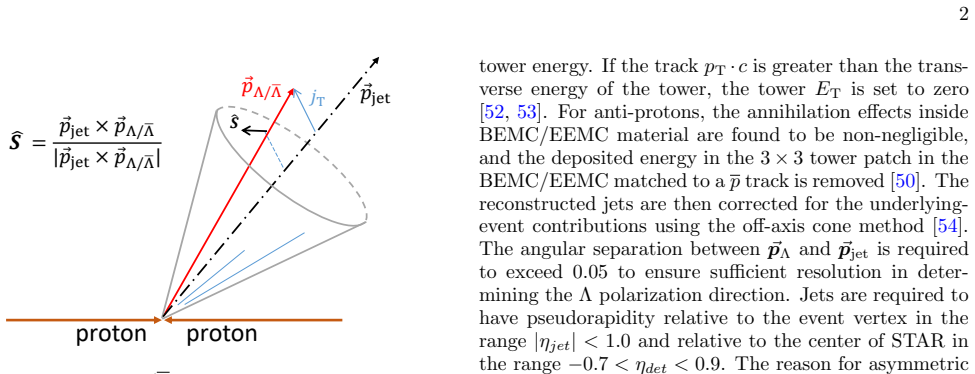
A surprisingly large transverse polarization of $\Lambda$ hyperons in unpolarized hadron-nucleon/nucleus collisions has been observed for 50 years, and the origin of this polarization remains an important open question. Recently, theoretical frameworks have advanced in describing this puzzle with the polarizing fragmentation function (PFF). We report the first measurement of $\Lambda$ and $\overline{\Lambda}$ transverse polarization inside jets in unpolarized proton-proton collisions, which is directly attributed to the PFF. The polarization is measured as a function of the jet transverse momentum, the fraction of the jet momentum carried by $\Lambda$($\overline{\Lambda}$) hyperons, and the transverse momentum of $\Lambda(\overline{\Lambda})$ hyperons relative to the jet axis. Covering a wide jet-energy range, these data provide the first constraints on the gluon PFF and allow tests of TMD evolution and its universality.
Editorial analysis
A structured set of objections, weighed in public.
Referee Report
Summary. The paper reports the first measurement of transverse polarization of Λ and Λ¯ hyperons inside jets in unpolarized pp collisions at √s=200 GeV with the STAR experiment. Polarization is extracted as a function of jet pT, the momentum fraction z carried by the hyperon within the jet, and the hyperon's pT relative to the jet axis. The results are interpreted as directly attributable to the polarizing fragmentation function (PFF), supplying the first constraints on the gluon PFF and enabling tests of TMD evolution and universality.
Significance. If the clean attribution to the gluon PFF holds after rigorous checks on contamination, the result would be significant for spin physics. It supplies the first experimental handle on the gluon component of the PFF, addressing the long-standing Λ polarization puzzle in unpolarized collisions, and the broad jet-energy coverage permits direct tests of TMD evolution and factorization universality in a new kinematic regime.
major comments (2)
- [Abstract] Abstract: The central interpretive claim that the measured polarization 'is directly attributed to the PFF' and yields 'first constraints on the gluon PFF' is load-bearing. This requires explicit demonstration that initial-state TMD effects (Sivers or Boer-Mulders) remain negligible for the chosen jet axis; the analysis must report the size of any bias under variation of the jet reconstruction algorithm and axis definition, together with the associated systematic uncertainty.
- [Data analysis] Data analysis section: Background subtraction (combinatorial, feed-down, and non-jet Λ contributions) must be shown to preserve the pT^rel and z dependence without introducing artificial polarization signals. Quantitative tables or figures demonstrating the residual contamination level after subtraction, and its variation across pT^jet bins, are needed to support the attribution.
minor comments (2)
- The abstract would be strengthened by a single sentence summarizing the dominant systematic uncertainties and the jet-finding algorithm employed.
- [Introduction] Ensure that the introduction cites all relevant prior STAR and other experiments on inclusive Λ polarization for proper context.
Simulated Author's Rebuttal
We thank the referee for the careful and constructive review of our manuscript. The comments raise important points regarding the robustness of our attribution of the measured polarization to the gluon PFF. We address each major comment below and will revise the manuscript to incorporate additional validation where feasible.
read point-by-point responses
-
Referee: [Abstract] Abstract: The central interpretive claim that the measured polarization 'is directly attributed to the PFF' and yields 'first constraints on the gluon PFF' is load-bearing. This requires explicit demonstration that initial-state TMD effects (Sivers or Boer-Mulders) remain negligible for the chosen jet axis; the analysis must report the size of any bias under variation of the jet reconstruction algorithm and axis definition, together with the associated systematic uncertainty.
Authors: We agree that explicit checks on potential initial-state TMD contributions are essential to support the direct attribution to the PFF. Our analysis employs the anti-k_T jet algorithm with the standard E-scheme recombination, which reconstructs jets from final-state particles and is expected to suppress initial-state effects. We have conducted studies varying the jet axis definition, including a p_T-weighted axis versus the standard axis and alternative recombination schemes. The extracted polarization values remain consistent within statistical uncertainties across these variations, with any observed differences incorporated as a systematic uncertainty (typically 10-20% of the statistical uncertainty). We will add a new subsection and accompanying figure in the revised manuscript documenting these stability tests to quantify the bias and strengthen the interpretation. revision: yes
-
Referee: [Data analysis] Data analysis section: Background subtraction (combinatorial, feed-down, and non-jet Λ contributions) must be shown to preserve the pT^rel and z dependence without introducing artificial polarization signals. Quantitative tables or figures demonstrating the residual contamination level after subtraction, and its variation across pT^jet bins, are needed to support the attribution.
Authors: We acknowledge the need for more quantitative validation of the background subtraction to ensure no artificial signals are introduced. Combinatorial background is subtracted via sideband methods in the invariant mass distribution, feed-down from heavier hyperons is corrected using Monte Carlo simulations, and non-jet contributions are minimized by the jet cone selection. We have verified that polarization in background-enriched regions is consistent with zero. In the revised manuscript, we will include tables reporting residual contamination levels (e.g., <5% combinatorial and <10% feed-down after correction) and their variation with p_T^jet, as well as figures comparing the z and p_T^rel distributions before and after each subtraction step. These additions will demonstrate that the observed dependencies are preserved and not artifacts of the procedure. revision: yes
Circularity Check
No circularity: experimental measurement extracted from data
full rationale
The paper reports a direct experimental measurement of transverse polarization of Lambda and anti-Lambda hyperons inside jets in unpolarized pp collisions. The reported polarization values as functions of jet pT, z, and pT^rel are obtained from observed data distributions after standard background subtraction and jet reconstruction. No theoretical derivation chain exists that reduces any 'prediction' or result to a fitted input or self-citation by construction. The attribution to PFF is an interpretive statement in the abstract, but the data points themselves are independent observables not equivalent to any prior result by definition. This is the most common honest finding for a self-contained experimental measurement against external benchmarks.
Axiom & Free-Parameter Ledger
axioms (1)
- domain assumption TMD factorization applies to the fragmentation of unpolarized protons into polarized Lambdas inside jets.
Forward citations
Cited by 1 Pith paper
-
Global polarization of $\Lambda$ hyperons in hot QCD matter at TeV energies
Second-order relativistic viscous hydrodynamics including thermal vorticity and evolving magnetic fields yields global Lambda hyperon polarization in Pb+Pb collisions at 2.76 and 5.02 TeV that qualitatively matches AL...
Reference graph
Works this paper leans on
-
[1]
The event vertices are reconstructed from TPC tracks, and thezcomponent of the collision vertex is re- quired to be within 90 cm (along the beamline) of the center of the TPC for uniform acceptance. As the first step of the analysis, Λ ( Λ) candidates are reconstructed via the dominant weak decay channel Λ→p+π − (Λ→ p+π +) from TPC tracks, following a sim...
work page 2012
-
[2]
Bunceet al., Λ 0 Hyperon Polarization in Inclusive Production by 300-GeV Protons on Beryllium., Phys
G. Bunceet al., Λ 0 Hyperon Polarization in Inclusive Production by 300-GeV Protons on Beryllium., Phys. Rev. Lett.36, 1113 (1976)
work page 1976
-
[3]
G. L. Kane, J. Pumplin, and W. Repko, Transverse quark polarization in large-p T reactions,e +e− jets, and lepto- production: A test of quantum chromodynamics, Phys. Rev. Lett.41, 1689 (1978)
work page 1978
-
[4]
A. D. Panagiotou, Λ 0 Polarization in Hadron - Nucleon, Hadron - Nucleus and Nucleus-nucleus Interactions, Int. J. Mod. Phys. A5, 1197 (1990)
work page 1990
-
[5]
Felix, On Theoretical studies of Λ 0 polarization, Mod
J. Felix, On Theoretical studies of Λ 0 polarization, Mod. Phys. Lett. A14, 827 (1999)
work page 1999
-
[6]
K.-B. Chen, T. Liu, Y.-K. Song, and S.-Y. Wei, Several Topics on Transverse Momentum-Dependent Fragmenta- tion Functions, Particles6, 515 (2023)
work page 2023
-
[7]
G. Aadet al.(ATLAS), Measurement of the transverse polarization of Λ and Λ hyperons produced in proton- proton collisions at √s= 7 TeV using the ATLAS detec- tor, Phys. Rev. D91, 032004 (2015)
work page 2015
-
[8]
R. Aaijet al.(LHCb), Transverse polarization measure- ment of Λ hyperons in pNe collisions at √sN N = 68.4 GeV with the LHCb detector, JHEP09, 082. 6
-
[9]
R. Aaijet al.(LHCb), Measurement of transverse Λ and Λ hyperon polarization inpPb collisions at √sN N = 5.02 TeV (2025), arXiv:2508.02009 [nucl-ex]
-
[10]
D. Boer and P. J. Mulders, Time reversal odd distribu- tion functions in leptoproduction, Phys. Rev. D57, 5780 (1998)
work page 1998
-
[11]
P. J. Mulders and R. D. Tangerman, The Complete tree level result up to order 1/Qfor polarized deep inelastic leptoproduction, Nucl. Phys. B461, 197 (1996), [Erra- tum: Nucl.Phys.B 484, 538–540 (1997)]
work page 1996
-
[12]
M. Anselmino, D. Boer, U. D’Alesio, and F. Murgia, Lambda polarization from unpolarized quark fragmen- tation, Phys. Rev. D63, 054029 (2001)
work page 2001
-
[13]
Z.-T. Liang and C. Boros, Hyperon polarization and sin- gle spin left-right asymmetry in inclusive production pro- cesses at high-energies, Phys. Rev. Lett.79, 3608 (1997)
work page 1997
-
[14]
Y. Kanazawa and Y. Koike, Polarization in hadronic Lambda hyperon production and chiral odd twist - three quark distribution, Phys. Rev. D64, 034019 (2001)
work page 2001
-
[15]
J. Zhou, F. Yuan, and Z.-T. Liang, Hyperon Polarization in Unpolarized Scattering Processes, Phys. Rev. D78, 114008 (2008)
work page 2008
-
[16]
R. Ikarashi, Y. Koike, K. Yabe, and S. Yoshida, New derivation of the twist-3 gluon fragmentation contribu- tion to polarized hyperon production, Phys. Rev. D106, 074006 (2022)
work page 2022
-
[17]
Buskulicet al.(ALEPH), Measurement of Lambda polarization fromZdecays, Phys
D. Buskulicet al.(ALEPH), Measurement of Lambda polarization fromZdecays, Phys. Lett. B374, 319 (1996)
work page 1996
-
[18]
K. Ackerstaff et al., Polarization and forward-backward asymmetry of Λ baryons in hadronicZ 0 decays, Eur. Phys. J. C2, 49–59 (1998)
work page 1998
-
[19]
Y. Guanet al.(Belle), Observation of Transverse Λ/ Λ Hyperon Polarization ine +e− Annihilation at Belle, Phys. Rev. Lett.122, 042001 (2019)
work page 2019
-
[20]
U. D’Alesio, F. Murgia, and M. Zaccheddu, First extrac- tion of the Λ polarizing fragmentation function from Belle e+e− data, Phys. Rev. D102, 054001 (2020)
work page 2020
-
[21]
D. Callos, Z.-B. Kang, and J. Terry, Extracting the transverse momentum dependent polarizing fragmenta- tion functions, Phys. Rev. D102, 096007 (2020)
work page 2020
-
[22]
K.-B. Chen, Z.-T. Liang, Y.-L. Pan, Y.-K. Song, and S.- Y. Wei, Isospin Symmetry of Fragmentation Functions, Phys. Lett. B816, 136217 (2021)
work page 2021
-
[23]
H. Li, X. Wang, Y. Yang, and Z. Lu, The transverse polarization of Λ hyperons ine +e− →Λ ↑hXprocesses within TMD factorization, Eur. Phys. J. C81, 289 (2021)
work page 2021
-
[24]
L. Gamberg, Z.-B. Kang, D. Y. Shao, J. Terry, and F. Zhao, Transverse Λ polarization ine +e− collisions, Phys. Lett. B818, 136371 (2021)
work page 2021
-
[25]
U. D’Alesio, L. Gamberg, F. Murgia, and M. Zaccheddu, Transverse Λ polarization ine +e− processes within a TMD factorization approach and the polarizing fragmen- tation function, JHEP12, 074
-
[26]
M. Anselmino, D. Boer, U. D’Alesio, and F. Murgia, Transverse lambda polarization in semiinclusive DIS, Phys. Rev. D65, 114014 (2002)
work page 2002
-
[27]
Z.-B. Kang, K. Lee, and F. Zhao, Polarized jet fragmen- tation functions, Phys. Lett. B809, 135756 (2020)
work page 2020
-
[28]
Z.-B. Kang, J. Terry, A. Vossen, Q.-H. Xu, and J. Zhang, Transverse Lambda production at the future Electron- Ion Collider, Phys. Rev. D105, 094033 (2022)
work page 2022
-
[29]
K.-B. Chen, Z.-T. Liang, Y.-K. Song, and S.-Y. Wei, Lon- gitudinal and transverse polarizations of Λ hyperon in unpolarized SIDIS ande +e− annihilation, Phys. Rev. D 105, 034027 (2022)
work page 2022
- [30]
-
[31]
U. D’Alesio, L. Gamberg, F. Murgia, and M. Zaccheddu, Transverse Λ polarization ine +e− annihilations and in SIDIS processes at the EIC within TMD factorization, Phys. Rev. D108, 094004 (2023)
work page 2023
- [32]
-
[33]
D. Boer, C. J. Bomhof, D. S. Hwang, and P. J. Mulders, Spin asymmetries in jet-hyperon production at LHC, Phys. Lett. B659, 127 (2008)
work page 2008
- [34]
-
[35]
T. Gao (STAR), Measurement of transverse polariza- tion of Λ/ Λ within jet inppcollisions at STAR, PoS SPIN2023, 031 (2024)
work page 2024
-
[36]
U. D’Alesio, L. Gamberg, F. Murgia, and M. Zaccheddu, Transverse Λ polarization in unpolarizedpp→jet Λ ↑ X, Phys. Lett. B851, 138552 (2024)
work page 2024
- [37]
-
[38]
Z.-B. Kang, X. Liu, F. Ringer, and H. Xing, The trans- verse momentum distribution of hadrons within jets, JHEP11, 068
-
[39]
Metz, Gluon-exchange in spin-dependent fragmenta- tion, Phys
A. Metz, Gluon-exchange in spin-dependent fragmenta- tion, Phys. Lett. B549, 139 (2002)
work page 2002
-
[40]
J. C. Collins and A. Metz, Universality of soft and collinear factors in hard-scattering factorization, Phys. Rev. Lett.93, 252001 (2004)
work page 2004
-
[41]
S. Meissner and A. Metz, Partonic pole matrix elements for fragmentation, Phys. Rev. Lett.102, 172003 (2009)
work page 2009
-
[42]
D. Boer, Z.-B. Kang, W. Vogelsang, and F. Yuan, Test of the Universality of Naive-time-reversal-odd Fragmen- tation Functions, Phys. Rev. Lett.105, 202001 (2010)
work page 2010
-
[43]
K. H. Ackermannet al., STAR Detector Overview, Nucl. Instrum. Methods Phys. Res., Sect. A499, 624 (2003)
work page 2003
-
[44]
M. Andersonet al., The STAR Time Projection Cham- ber: A Unique Tool for Studying High Multiplicity Events at RHIC, Nucl. Instrum. Methods Phys. Res., Sect. A499, 659 (2003)
work page 2003
-
[45]
Beddoet al., The STAR Barrel Electromagnetic Calorimeter, Nucl
M. Beddoet al., The STAR Barrel Electromagnetic Calorimeter, Nucl. Instrum. Methods Phys. Res., Sect. A499, 725 (2003)
work page 2003
-
[46]
C. E. Allgoweret al., The STAR Endcap Electromagnetic Calorimeter, Nucl. Instrum. Methods Phys. Res., Sect. A 499, 740 (2003)
work page 2003
-
[47]
L. Adamczyket al.(STAR Collaboration), Longitudinal and transverse spin asymmetries for inclusive jet pro- duction at mid-rapidity in polarizedp+pcollisions at√s= 200 GeV, Phys. Rev. D86, 032006 (2012)
work page 2012
-
[48]
B. I. Abelevet al.(STAR Collaboration), Longitudinal spin transfer to Λ and Λ hyperons in polarized proton- proton collisions at √s= 200 GeV, Phys. Rev. D80, 111102 (2009)
work page 2009
-
[49]
J. Adamet al.(STAR Collaboration), Improved mea- 7 surement of the longitudinal spin transfer to Λ and Λ hy- perons in polarized proton-proton collisions at √s= 200 GeV, Phys. Rev. D98, 112009 (2018)
work page 2018
-
[50]
J. Adamet al.(STAR Collaboration), Transverse spin transfer to Λ and Λ hyperons in polarized proton-proton collisions at √s= 200 GeV, Phys. Rev. D98, 091103 (2018)
work page 2018
-
[51]
M. Abdulhamidet al.(STAR), Longitudinal and trans- verse spin transfer to Λ and Λ hyperons in polarized p+p collisions at √s= 200 GeV, Phys. Rev. D109, 012004 (2024)
work page 2024
-
[52]
M. Cacciari, G. P. Salam, and G. Soyez, The anti-k t jet clustering algorithm, JHEP04, 063
-
[53]
J. Adamet al., [STAR Collaboration], Longitudinal Double-Spin Asymmetries for Dijet production at In- termediate Pseudorapidity in PolarizedppCollisions at√s= 200 GeV, Phys. Rev. D98, 032011 (2018)
work page 2018
-
[54]
J. Adamet al., [STAR Collaboration], Longitudinal Double-Spin Asymmetry for Inclusive Jet and Dijet Pro- duction inppCollisions at √s= 510 GeV, Phys. Rev. D 100, 052005 (2019)
work page 2019
-
[55]
B. Abelevet al.(ALICE Collaboration), Charged jet cross sections and properties in proton-proton collisions at √s= 7 TeV, Phys. Rev. D91, 112012 (2015)
work page 2015
-
[56]
P. A. Zylaet al.(Particle Data Group Collaboration), Review of particle physics, Phys. Rev. D110, 030001 (2024)
work page 2024
-
[57]
T. Sjostrand, S. Mrenna, and P. Z. Skands, PYTHIA 6.4 Physics and Manual, JHEP05, 026
-
[58]
P. Z. Skands, Tuning monte carlo generators: The peru- gia tunes, Phys. Rev. D82, 074018 (2010)
work page 2010
-
[59]
R. Brun, F. Bruyant, M. Maire, A. C. McPherson, and P. Zanarini,GEANT 3: user’s guide Geant 3.10, Geant 3.11; rev. version(CERN, Geneva, 1987)
work page 1987
-
[60]
R. Abdul Khaleket al., Science Requirements and Detec- tor Concepts for the Electron-Ion Collider: EIC Yellow Report, Nucl. Phys. A1026, 122447 (2022)
work page 2022
discussion (0)
Sign in with ORCID, Apple, or X to comment. Anyone can read and Pith papers without signing in.