REVIEW 2 major objections 6 minor 25 references
Adaptive Encoding Strategy for Quantum Annealing in Mixed-Variable Engineering Optimization
T0 review · 2 major / 6 minor · reviewed 2026-07-13 · grok-4.5
Pith's one-line read Adaptive range updates let quantum annealing refine continuous fields under a fixed binary budget, beating fixed encodings by orders of magnitude on a structural design benchmark.
desk verdict Solid practical fix for continuous encodings on QA: multi-order accuracy gain on a published rod benchmark under fixed binary budget, with honest hardware diagnostics. read the letter →
The pith
A machine-rendered reading of the paper's core claim, the machinery that carries it, and where it could break.
The reading
What carries the argument
Adaptive encoding update rules: five cases (three contraction rules driven by successive iterate signs or equality, two saturation-triggered expansions) that revise each continuous variable’s interval bounds while the number of binary variables N stays constant; the rules are applied inside a quadratic-penalty loop that re-encodes and re-solves the full coupled QUBO at every outer iteration.
What would settle it
Re-run the same composite-rod (or a larger multi-element) size-optimization problem with the adaptive rules and measure whether the final relative H1 error of the force field still falls below 10^{-5} under the original binary budget; a persistent plateau near the fixed-encoding error of ~10^{-2} would falsify the claimed precision gain.
Extended reading notes
Core claim
Simply increasing bit depth in a fixed continuous-variable encoding does not improve—and can degrade—solution quality on current quantum-annealing hardware. An adaptive strategy that contracts and expands representable ranges iteration by iteration, while holding the binary budget fixed, restores precision and yields orders-of-magnitude better continuous-field accuracy on a fully coupled structural design problem.
Load-bearing premise
The five simple range-update heuristics will keep concentrating resolution usefully and will not trap the iterates inside an infeasible or suboptimal interval when the problem becomes larger or more oscillatory than the two-element rod.
Editorial analysis
A structured set of objections, weighed in public.
Referee Report
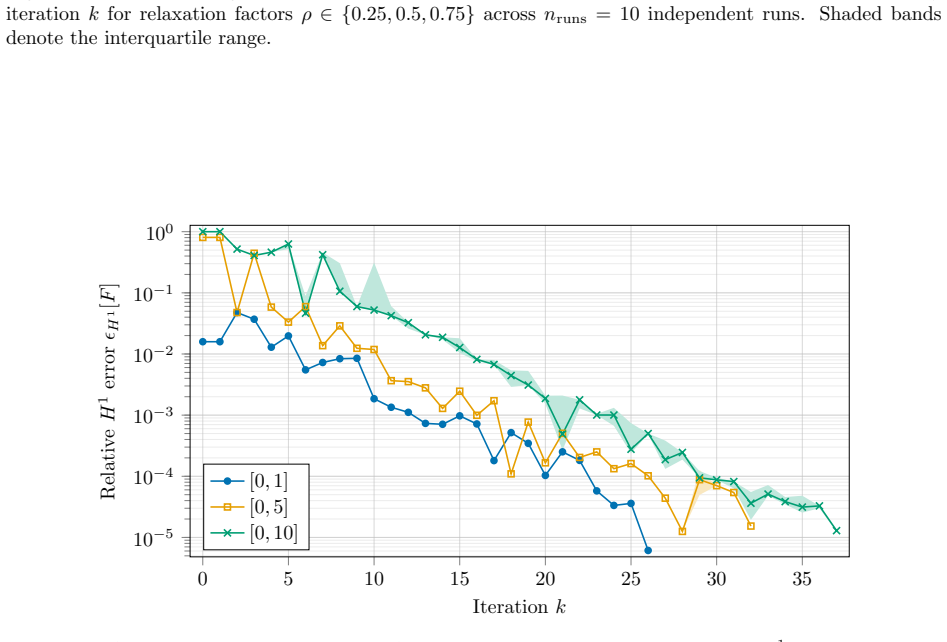
Summary. The paper addresses continuous-variable encoding for quantum annealing (QA) in mixed discrete–continuous engineering optimization. It first shows empirically, on a 1D fluid–structure interaction testbed, that increasing fixed bit depth per continuous variable improves the encoding-optimal resolution but, beyond moderate N, fails to improve (and can stall) QA solution quality on current hardware, consistent with size-dependent integrated control errors. It then introduces an adaptive encoding that keeps the binary budget fixed while updating each continuous variable’s representable interval via three contraction rules (driven by successive iterates) and two saturation-triggered expansions (Eqs. 7–8, Algorithm 1). The scheme is embedded in a quadratic-penalty treatment of a fully coupled minimum-complementary-energy QUBO for structural size optimization, so that each outer iteration re-solves the joint design–field objective. On the published two-element composite-rod benchmark, with the same N=26 binary budget as the fixed-encoding baseline, the method reduces the relative H1 error of the force field from 1.59×10⁻² to 6.12×10⁻⁶, with QA matching the encoding-optimal solution at each penalty step; parameter sweeps over ρ, initial ranges, and number of reads indicate robustness on this instance.
Significance. If the reported precision–resource trade-off holds, the work supplies concrete, hardware-aware guidance for encoding continuous fields in QA without inflating problem size or abandoning fully coupled global search—an issue that currently forces many applied-QA workflows into hybrid decoupling. Strengths that support credibility include: direct comparison to a published fixed-encoding baseline on the same D-Wave Advantage system; isolation of encoding gains via an explicit best-approximation reference; multi-run medians and interquartile ranges; open data (DOI) and reference to open-source tooling (EngiOptiQA). The update rules are heuristic and the structural benchmark is modest, so broader claims about general mixed-variable engineering problems remain provisional; within those bounds the empirical result is useful for the applied quantum-computing and computational-mechanics communities.
major comments (2)
- §2.6, Eq. (33) and Figs. 7 and 10: the “best approximation” is defined as the exact minimizer of H_QUBO over the encoded domain, and the design-optimization plots show QA coinciding with it. The manuscript never states how this reference is obtained in practice (exact classical enumeration, digital annealer, or projection of the analytic continuum solution onto the current grid). For the rod with N_total=26 this is feasible classically; for the FSI study with N up to 12 per coefficient it is not obviously so. Without that procedure, the claim that hardware (rather than encoding) limits fixed-depth performance, and that QA attains encoding-optimal solutions under adaptation, cannot be fully audited.
- §2.3.2 (Cases 1–5) and §3.2 / Conclusion: the five range-update rules are free heuristics (including the fixed 1/4 scale and tunable ρ). The central claim on the composite-rod benchmark is well supported, but the paper’s broader assertion of “practical guidance” and improved precision on current hardware rests on the untested assumption that these rules continue to concentrate resolution usefully and do not trap iterates in an infeasible or suboptimal interval for larger, more oscillatory, or higher-dimensional fields. A short, explicit discussion of failure modes (or a second, slightly larger example) would make the load-bearing extrapolation proportionate to the evidence.
minor comments (6)
- Fig. 6a: the range-update box writes both bounds as a^{(k+1)}_{i,min}; the second should be a^{(k+1)}_{i,max}.
- §2.3.2 / Algorithm 1: the text defines δ^{(k)}_{i,min} using y^{(k)}_{i,min} while the algorithm uses the previous bounds y^{(k−1)}_{i,min}; align the indexing to avoid confusion when implementing the rules.
- Table 1 and §2.4: the mapping of complementary-energy design optimization onto the generic template (1) is clear, but a one-line note that static admissibility is enforced by a quadratic penalty (rather than hard constraints in the QUBO) would help readers who skip to the results.
- Fig. 9: the two nearly identical row pairs appear redundant; a single pair with a clear inset for the a0 expansion event would improve readability.
- Abstract and §4: phrases such as “the framework generalizes beyond structural design” slightly overreach relative to the single structural benchmark; soft wording already present elsewhere (“indicates,” “offers practical guidance”) should be used consistently.
- Minor typographical issues: “as as gradient-based” (Introduction); “J¨ulich” encoding; ensure consistent use of H_1 vs H1 in figure labels.
Circularity Check
No significant circularity; adaptive encoding is a free heuristic whose reported H1 gains are measured against external analytic solutions and a prior fixed-encoding baseline.
full rationale
The paper’s central claim is an empirical precision–resource improvement obtained by a new adaptive range-update heuristic (Eqs. 7–8 / Algorithm 1) inside a quadratic-penalty loop that re-solves the full coupled complementary-energy QUBO at every iteration. The five update rules are not derived from, nor defined in terms of, the final relative H1 error they later report; that error is computed post-hoc against the known analytic force field of the two-element rod and against the encoding-optimal “best approximation.” Self-citations to the authors’ earlier complementary-energy formulation [15] merely supply the problem statement and the fixed-encoding baseline number 1.59e-2; the adaptive method, the hardware runs, the coincidence of QA solutions with the best approximation, and the multi-order-of-magnitude reduction are new experimental content. No parameter is fitted to the target quantity and then re-labeled a prediction, no uniqueness theorem is imported, and no ansatz is smuggled via citation. The derivation chain therefore does not reduce by construction to its inputs and remains self-contained against external benchmarks.
Assumptions & free parameters
free parameters (5)
- relaxation factor ρ =
0.5 (baseline)
- expansion/contraction scale 1/4 =
1/4
- initial penalty weight λ^(0) and growth η =
λ0=5, η=1.5
- binary depth N per continuous variable =
3
- annealing time and number of reads =
tA=10 µs, nreads=800 (baseline)
assumptions (4)
- domain assumption Principle of minimum complementary energy for linear elasticity yields a min–min problem over design and statically admissible stress.
- standard math Quadratic penalty method drives iterates of the unconstrained problem toward the feasible set of the original constrained problem as λ→∞.
- standard math Binary encoding of a continuous interval [ymin,ymax] with N bits via offset-and-scale formula (Eq. 4–5) is exact for the discrete set of 2^N representable values.
- domain assumption Hardware ICEs and chain-break statistics grow with problem size on the D-Wave Advantage architecture, so larger N can degrade solution quality even when representational resolution improves.
invented entities (1)
-
Adaptive range-update rules (Cases 1–5)
Cite this review
Pith. "Pith review of Adaptive Encoding Strategy for Quantum Annealing in Mixed-Variable Engineering Optimization." pith.science (2026). https://pith.science/paper/ZODKCKNW
@misc{pith2026260317506,
  author       = {Pith},
  title        = {Pith review of: Adaptive Encoding Strategy for Quantum Annealing in Mixed-Variable Engineering Optimization},
  year         = {2026},
  howpublished = {\url{https://pith.science/paper/ZODKCKNW}},
  note         = {Machine review of arXiv:2603.17506}
}
read the original abstract
Mixed discrete-continuous optimization is central to engineering design, where discrete choices interact with continuous fields. These problems are difficult due to high-dimensional, complex search spaces. To tackle them, Quantum Annealing (QA) is promising, yet its native binary nature supports only discrete variables, making accurate and efficient encodings of continuous quantities a central challenge. Existing approaches either split the coupled problem, mapping discrete decisions to QA while solving continuous fields classically, or use fixed-bit-depth encodings. The former compromises QA's global search advantages; the latter can underrepresent dynamic range or inflate the number of binary variables. We show that simply increasing bit depth can even degrade performance on current QA hardware, underscoring the need for alternative encodings. In response, we introduce an adaptive encoding strategy for continuous variables in QA that enables efficient treatment of coupled mixed-variable problems. We propose an update strategy for the representable ranges of the continuous variables and demonstrate its utility by integrating it into the minimum complementary energy formulation for structural design optimization, which provides a single, coupled constrained problem. We apply a quadratic penalty method where we update the representation of the continuous variables while targeting the full original objective, preserving QA's global search capability. On a published benchmark, the size optimization of a composite rod, our adaptive encoding improves solution quality under a fixed binary variable budget, demonstrating a superior precision-resource trade-off. Since the framework generalizes beyond structural design, it offers practical guidance for encoding continuous variables for QA and indicates that adaptive representations can enhance precision on current hardware.
Figures


Figures from the paper (10 more)



Reference graph
Works this paper leans on
-
[1]
Ising machines as hardware solvers of combinatorial optimization problems,
N. Mohseni, P. L. McMahon, and T. Byrnes, “Ising machines as hardware solvers of combinatorial optimization problems,”Nat Rev Phys, vol. 4, pp. 363–379, 6 2022.doi:10 . 1038 / s42254 - 022 - 00440-8
2022
-
[2]
Quantum stochastic optimization,
B. Apolloni, C. Carvalho, and D. de Falco, “Quantum stochastic optimization,”Stoch Process Their Appl, vol. 33, no. 2, pp. 233–244, 1989.doi:https://doi.org/10.1016/0304-4149(89)90040-9
-
[3]
Quantum annealing in the transverse ising model,
T. Kadowaki and H. Nishimori, “Quantum annealing in the transverse ising model,”Phys Rev E, vol. 58, no. 5, p. 5355, 1998.doi:10.1103/PhysRevE.58.5355
-
[4]
A quantum adiabatic evo- lution algorithm applied to random instances of an NP-complete problem,
E. Farhi, J. Goldstone, S. Gutmann, J. Lapan, A. Lundgren, and D. Preda, “A quantum adiabatic evo- lution algorithm applied to random instances of an NP-complete problem,”Science, vol. 292, no. 5516, pp. 472–475, 2001.doi:10.1126/science.1057726
-
[5]
Digital Annealer for High-Speed Solving of Combinatorial optimization Problems and Its Applications,
S. Matsubara et al., “Digital Annealer for High-Speed Solving of Combinatorial optimization Problems and Its Applications,” in2020 25th Asia and South Pacific Design Automation Conference (ASP- DAC), 2020, pp. 667–672.doi:10.1109/ASP-DAC47756.2020.9045100
-
[6]
Optimization by Simulated Annealing,
S. Kirkpatrick, C. D. Gelatt, and M. P. Vecchi, “Optimization by Simulated Annealing,”Science, vol. 220, pp. 671–680, 4598 1983.doi:10.1126/science.220.4598.671
-
[7]
Thermodynamical approach to the traveling salesman problem: An efficient simulation algorithm,
V. ˇCern´ y, “Thermodynamical approach to the traveling salesman problem: An efficient simulation algorithm,”J Optim Theory Appl, vol. 45, pp. 41–51, 1 1985.doi:10.1007/BF00940812
-
[8]
API Reference – Fixstars Amplify Annealing Engine,
Fixstars Amplify Corporation. “API Reference – Fixstars Amplify Annealing Engine,” Accessed: Feb. 25, 2026. [Online]. Available:https://amplify.fixstars.com/en/docs/amplify/v1/amplify_ ae.html
2026
Show all 25 references
-
[9]
Novel real number representations in Ising machines and performance evaluation: Combinatorial random number sum and constant division,
K. Endo, Y. Matsuda, S. Tanaka, and M. Muramatsu, “Novel real number representations in Ising machines and performance evaluation: Combinatorial random number sum and constant division,” PLoS One, vol. 19, no. 6, e0304594, 2024.doi:10.1371/journal.pone.0304594
2024 doi
-
[10]
An ising machine formulation for design updates in topology optimization of flow channels,
Y. Suzuki et al., “An ising machine formulation for design updates in topology optimization of flow channels,”Eng Comput, vol. 42, p. 15, 1 2026.doi:10.1007/s00366-025-02265-2
2026 doi
-
[11]
Power flow analysis using quantum and digital annealers: A discrete combinatorial optimization approach,
Z. Kaseb, M. M¨ oller, P. P. Vergara, and P. Palensky, “Power flow analysis using quantum and digital annealers: A discrete combinatorial optimization approach,”Sci Rep, vol. 14, p. 23 216, 1 2024.doi: 10.1038/s41598-024-73512-7
2024 doi
-
[12]
Combinatorial power flow analysis using adiabatic quantum algorithms,
Z. Kaseb, M. M¨ oller, M. Kirsch, P. Palensky, and P. P. Vergara, “Combinatorial power flow analysis using adiabatic quantum algorithms,” in2025 IEEE Kiel PowerTech, 2025, pp. 1–6.doi:10.1109/ PowerTech59965.2025.11180445 22
2025
-
[13]
Quantum topology optimization via quantum annealing,
Z. Ye, X. Qian, and W. Pan, “Quantum topology optimization via quantum annealing,”IEEE Trans Quantum Eng, vol. 4, pp. 1–15, 2023.doi:10.1109/TQE.2023.3266410
2023 doi
-
[14]
Development of optimization method for truss structure by quantum annealing,
R. Honda et al., “Development of optimization method for truss structure by quantum annealing,”Sci Rep, vol. 14, p. 13 872, 1 2024.doi:10.1038/s41598-024-64588-2
2024 doi
-
[15]
A formulation of structural design optimization problems for quantum annealing,
F. Key and L. Freinberger, “A formulation of structural design optimization problems for quantum annealing,”Mathematics, vol. 12, no. 3, p. 482, 2024.doi:10.3390/math12030482
2024 doi
-
[16]
Mapping structural topology optimization problems to quantum annealing,
X. Wang, Z. Wang, and B. Ni, “Mapping structural topology optimization problems to quantum annealing,”Struct Multidiscipl Optim, vol. 67, p. 74, 5 2024.doi:10.1007/s00158-024-03791-1
2024 doi
-
[17]
A novel design update framework for topology optimization with quantum annealing: Application to truss and continuum structures,
N. Sukulthanasorn, J. Xiao, K. Wagatsuma, R. Nomura, S. Moriguchi, and K. Terada, “A novel design update framework for topology optimization with quantum annealing: Application to truss and continuum structures,”Comput Methods Appl Mech Eng, vol. 437, p. 117 746, 2025.doi:http...
2025 doi
-
[18]
J. N. Reddy,Energy principles and variational methods in applied mechanics, 3rd ed. Hoboken, USA, Chichester, UK: John Wiley & Sons, 2017
2017
-
[19]
Topology optimization by distribution of isotropic material,
M. P. Bendsøe and O. Sigmund, “Topology optimization by distribution of isotropic material,” in Topology Optimization: Theory, Methods, and Applications. Berlin, Heidelberg, Germany: Springer Berlin Heidelberg, 2004, pp. 1–69.doi:10.1007/978-3-662-05086-6_1
2004 doi
-
[20]
Dattani,Quadratization in discrete optimization and quantum mechanics, 2019.doi:10.48550/ arXiv.1901.04405
N. Dattani,Quadratization in discrete optimization and quantum mechanics, 2019.doi:10.48550/ arXiv.1901.04405
2019 arXiv
- [21]
-
[22]
Fixstars Amplify SDK Documentation,
Fixstars Amplify Corporation. “Fixstars Amplify SDK Documentation,” Accessed: Feb. 25, 2026. [On- line]. Available:https://amplify.fixstars.com/en/docs/amplify/v1/
2026
-
[23]
Ocean SDK Documentation,
D-Wave Quantum Inc. “Ocean SDK Documentation,” Accessed: Feb. 25, 2026. [Online]. Available: https://docs.dwavequantum.com/en/latest/ocean/index.html
2026
-
[24]
Exploring quantum annealing for coupled structural analysis problems,
L. Freinberger, “Exploring quantum annealing for coupled structural analysis problems,” Diploma thesis, Technische Universit¨ at Wien, 2025.doi:10.34726/hss.2025.121267
2025 doi
-
[25]
Penalty and augmented lagrangian methods,
J. Nocedal and S. J. Wright, “Penalty and augmented lagrangian methods,” inNumerical Optimization. New York, NY: Springer New York, 2006, pp. 497–528.doi:10.1007/978-0-387-40065-5_17 23
2006 doi
Reviewed July 13, 2026 · model on record in the stance chip above.
Discussion (0). Continue with ORCID to comment.