REVIEW 3 major objections 6 minor 55 references
Photoionization time delays probe electron correlations
T0 review · 3 major / 6 minor · reviewed 2026-08-15 · deepseek-v4-flash
Pith's one-line read Electron correlations, not one-electron physics, set the sign of the photoionization time delay across argon's Amusia-Cooper minimum.
desk verdict Clean experimental measurement of Ar 3s time delays, but the theoretical sign flip rests on a channel selection whose robustness is deferred to the SM; deserves peer review. read the letter →
The pith
A machine-rendered reading of the paper's core claim, the machinery that carries it, and where it could break.
The reading
What carries the argument
Two complementary tools carry the argument. The first is the RPAE-shake-up (RPAE-SU) calculation: the random-phase approximation with exchange, augmented by coupling to shake-up channels in which a 3p hole is created and a second 3p electron is excited to the 4p or 3d orbital. This added coupling is what reverses the sign of the Wigner delay. The second is an analytical two-dipole model, $z_{\pm}(\omega) = z_0(\omega) + \delta z_{\pm}(\omega) = z_0(\omega) (1 - \kappa e^{\pm i\Delta\varphi} \arctan[(\omega - \epsilon_z)/\Delta\epsilon_z])$, where the uncorrelated dipole and a correlation correction interfere; the cross section depends on $|z_{\pm}|^2$ and is blind to the sign of the phase, while the Wigner delay is set by that sign. Fitting the model with $\Delta\varphi = 0.06\pi$ reproduces both the cross section and the negative delay, and the opposite sign reproduces the RPAE prediction.
What would settle it
Repeat the RPAE-SU calculation with a systematically enlarged set of shake-up and double-excitation channels and check whether the negative Wigner delay at 42 eV survives; if a consistent enlarged channel set restores a positive delay, the theoretical support for the measured negative dip would collapse. Independently, a different experimental technique, such as angular streaking, measuring the same 3s−3p delay difference between 34 and 42 eV would confirm that the negative dip is real and not an artifact of the RABBIT analysis.
Extended reading notes
Core claim
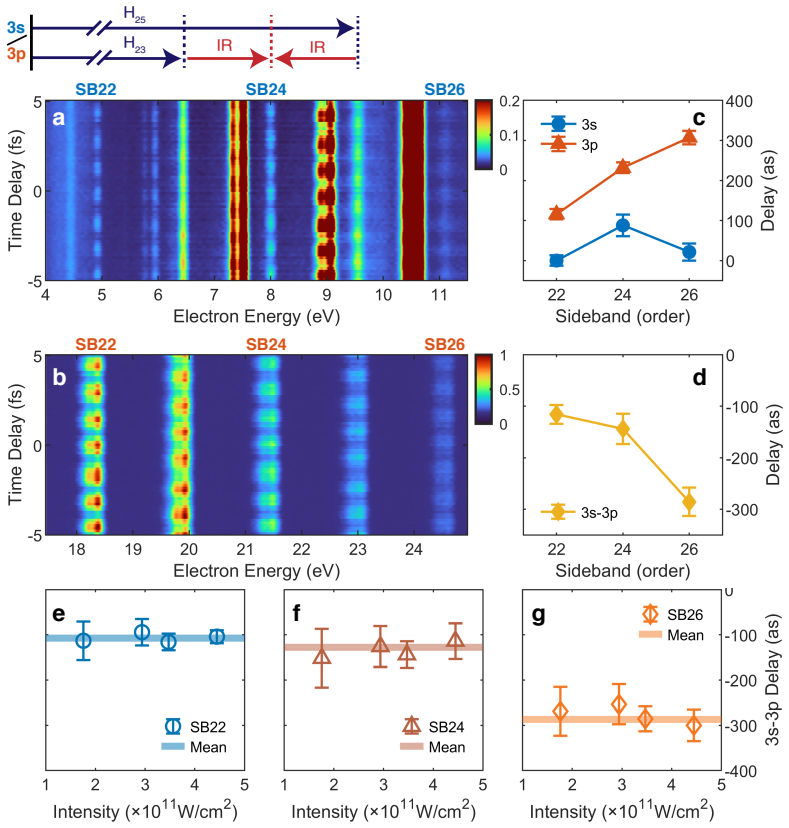
The central claim is that the negative photoionization time delay across the Amusia-Cooper minimum in argon has a many-body origin: coupling of the 3s channel to shake-up satellites, not the one-electron dynamics captured by standard RPAE. Standard RPAE, which reproduces the measured cross section and includes 3s–3p interchannel coupling, predicts a positive Wigner delay of about +380 attoseconds at 42 eV, opposite to the measured delay difference. When selected shake-up channels are added, the Wigner delay across the minimum becomes negative, the local outgoing flux is outward everywhere (instead of showing an inward, trapping region between 3 and 6 Bohr radii), and the calculated delay difference matches the measurement. The paper's conclusion is that high-order correlations advance the 3s photoelectron by roughly 240 attoseconds relative to a free electron, and that this advance is invisible in the cross section, making the time delay a uniquely phase-sensitive probe of electron correlation.
Load-bearing premise
The conclusion stands on the assumption that the selected shake-up channels (a 3p hole plus a 3p electron promoted to 4p or 3d) are the ones that control the phase, and that omitted channels would not flip the computed delay back to positive.
Editorial extensions
If this is right
- The standard RPAE prediction of a positive delay in argon's ACM region is incomplete; future theories of this spectrum must include coupling to shake-up channels to get the time delay right.
- Agreement with photoionization cross sections is no longer sufficient validation of a many-body calculation, since the phase of the correlation amplitude can change the delay without changing the cross section.
- In the ACM region the 3s electron reaches the detector earlier than a free electron, by up to about 240 attoseconds, so the observable is an advance set by correlation phase rather than a trapping delay.
- The measured 3s−3p delay difference from 30 to 70 eV, including the sign change near the 3p Cooper minimum, provides a quantitative benchmark for theory across two correlation-driven minima.
- For sufficiently short pulses, the correlation-induced phase produces double-peaked electron wave packets and negative regions in the Wigner time-frequency distribution, so sub-femtosecond experiments could observe the interference directly.
Reading between the lines
- Going beyond the paper: the robustness of the sign reversal to the choice of shake-up channels is not established in the main text, since the sensitivity analysis is deferred to the Supplement; a systematic scan including higher-np, nf, and double-excitation channels would test whether the negative Wigner delay survives.
- The same phase-ambiguity mechanism should apply to the analogous minima in other outer s-subshells, such as neon 2s or krypton 4s; measuring delay differences there would show whether similar shake-up channels play the same role.
- Because the cross section cannot distinguish the two signs of the correlation phase, this technique offers a general route to benchmarking correlation phases in molecules and condensed matter wherever minima or resonances in photoionization occur.
- The analytical model's arctangent form and the paper's citation of a topological interpretation suggest that the sign of the delay may be set by a topological phase of the ionization amplitude; if so, the sign change across a minimum could be predicted without solving the full many-body problem.
Signed reviews
Editorial analysis
A structured set of objections, weighed in public.
Referee Report
Summary. The manuscript reports an experimental and theoretical study of the photoionization time delay in argon in the region of the Amusia-Cooper minimum (ACM) of the 3s subshell. Using RABBIT interferometry with high spectral resolution, the authors measure the relative 3s-3p delay from harmonic orders around 30-45 eV and extend it to 70 eV with harmonics generated in neon. They find a negative relative delay in the ACM, from about -120 as at SB22 to -290 as at SB26, with no significant dependence on the infrared probe intensity. Standard RPAE calculations yield a positive 3s Wigner delay in this region, while an extended RPAE-shake-up (RPAE-SU) calculation, including coupling of the 3s channel to shake-up channels with a 3p hole and a 3p electron excited to 4p or 3d, produces a negative delay in good agreement with experiment. The authors further present an analytical two-dipole model (Eq. (2)) and wavepacket and Wigner-transform analyses to illustrate how a small correlation phase can reverse the delay without changing the cross section.
Significance. These results, if correct, would resolve a long-standing discrepancy between attosecond measurements and RPAE theory and would demonstrate that time-delay measurements are sensitive to correlation effects that leave the cross section almost unchanged. The experimental work has clear strengths: the individual delay points are stated with precision, the probe-intensity scan controls for multiphoton and laser-assisted Auger effects, and the comparison with two independent theoretical approaches is appropriate. The RPAE-SU calculation and the analytical model are, however, not documented in sufficient detail in the main text to verify the central sign reversal; the main text refers to a Supplementary Material that is not supplied in the arXiv version, and Eq. (2) is a fit rather than an independent derivation. These issues are fixable and do not undermine the value of the measurement.
major comments (3)
- [Theoretical calculations; Fig. 2] The central claim that shake-up correlations reverse the sign of the 3s Wigner delay across the ACM rests on the RPAE-SU calculation, but the main text provides no technical account of this calculation. The text only states that coupling of the 3s channel with shake-up channels "had a strong influence" and refers to reference 48, which is listed as "More Details in Supplementary Materials" and is not present in the arXiv version. I cannot verify the channel selection (3p hole plus 3p electron promoted to 4p or 3d), the level of relaxation included, or the convergence with respect to omitted shake-up configurations and higher-order corrections. Because Fig. 2c shows that the cross section is nearly insensitive to this inclusion, the sign change in Fig. 2b is not supported by an independent observable. Please provide, in the main text or a fully accessible supplement, the RPAE-SU equations, the explicit channel list, and a convergence or sensitivity test (e.g., adding 3p->np/nd shake-up states or other channels). Without this, the "excellent agreement" in Fig. 2a is not verifiable.
- [Wavepacket analysis; Eq. (2)] Equation (2) is a phenomenological model whose parameters (kappa, Delta_phi, epsilon_z, Delta_epsilon_z) are fitted to the experimental cross section and Wigner delay. The conclusion that a sign change of Delta_phi by 0.12pi reverses the delay is therefore an illustration of the phase sensitivity, not an independent confirmation that shake-up channels are the physical origin. The text should state this limitation explicitly, or constrain the model parameters from the RPAE-SU calculation so that the model becomes predictive. As written, the wavepacket analysis in Figs. 3 and 4 inherits its sign from the fitted phase and cannot by itself discriminate between correlation mechanisms.
- [Experimental results; Fig. 1d] The reported negative dip in the ACM rests on only three measured sidebands (SB22, SB24, SB26) in the 30-45 eV argon harmonic range. The individual points have small uncertainties, and the extension using neon harmonics provides useful context, but three points cannot establish the detailed shape of the dip. Please either add intermediate photon energies or state explicitly that the shape is inferred from the three-point trend and the theory. This is a limitation of the current data, not a reason to reject the comparison with a theoretical curve.
minor comments (6)
- [Fig. 2 caption] The caption contains the typo "Asumia-Cooper" and should read "Amusia-Cooper".
- [Author contributions] The author-contributions section contains an incomplete name "E.V."; this should be expanded or corrected.
- [Reference 48] Reference 48 is a placeholder ("More Details in Supplementary Materials"); the arXiv version does not include the supplementary document, so the theory, experimental methods, and analytical-model details are currently inaccessible.
- [Fig. 1] The error bars are not defined; please specify whether they are statistical only and how systematic uncertainties (e.g., in the XUV phase calibration) are included.
- [Eq. (3)] Equation (3) defines a Wigner transform but does not specify the normalization or the integration domain; since negative values are interpreted as interference, the normalization convention should be given.
- [Experimental results; Fig. 1c] The statement that the XUV contribution tau_XUV is identical for the 3s and 3p paths should be justified, as the two channels may sample different harmonic orders and different spectral regions.
Circularity Check
Main measurement and RPAE-SU theory are independent; the analytical wavepacket model is fitted to the Wigner delay it later reports as agreement.
-
fitted input called prediction
[Wavepacket analysis; Eq. (2) and Fig. 4e]
"The model parameters are fitted to reproduce the experimental and theoretical results for the cross section and the Wigner delay. ... The quasi-probability distribution for a 2 fs pulse (Fig. 4e) exhibits a Gaussian distribution that is shifted in time by −230 as (see + symbol) which is in excellent agreement with the obtained 3s Wigner delay (Fig. 2b)."
Equation (2) contains a free phase Δφ; the text states that its parameters are fitted to reproduce the cross section and the Wigner delay, and the value Δφ = 0.06π is chosen so that the model matches the negative RPAE-SU/experimental delay. The Wigner transform of the same fitted dipole in Fig. 4e therefore cannot independently confirm that delay: the reported −230 as shift is the group delay of the fitted amplitude and is predetermined by the fit. Similarly, the advance/delay sign in Fig. 4a,b is imposed by the sign of the fitted Δφ. This is a self-consistency check, not a prediction. It is confined to the illustrative analytical model; the RABBIT measurement and the RPAE-SU calculation remain independent.
full rationale
The central comparison in the paper is not circular: the measured τ3s−τ3p from RABBIT and the RPAE-SU calculation are independent, and their agreement in Fig. 2a is an external benchmark. The RPAE-SU channel selection is deferred to the Supplementary Material, but that is a completeness/robustness concern, not circularity. Self-citations to RABBIT and RPAE methodology are standard methodological references and are not load-bearing. The only circular element is the analytical model: Eq. (2) is explicitly fitted to the Wigner delay and cross section, and the wavepacket shift in Fig. 4e is then said to be in excellent agreement with that same Wigner delay; this restates the fitted input. The same fitted phase sets the sign of the wavepacket advance/delay. Because the wavepacket analysis is illustrative and the main experimental/theoretical result stands on independent evidence, the score is 4 rather than 6 or higher.
Assumptions & free parameters
free parameters (4)
- kappa (relative coupling strength) =
not stated numerically in main text
- epsilon_z (center of arc-tangent function) =
not stated numerically in main text
- Delta_epsilon_z (width of arc-tangent function) =
not stated numerically in main text
- Delta_phi (correlation phase) =
0.06*pi
assumptions (4)
- domain assumption Random phase approximation with exchange (RPAE) provides a valid zeroth-order description of Ar 3s and 3p photoionization, including 3s-3p channel coupling.
- domain assumption The shake-up channels included (a 3p hole plus a 3p electron excited to 4p or 3d) are the relevant additional correlations, and they can be treated perturbatively in the RPAE-SU approach; neglected channels and higher orders do not change the result.
- domain assumption The RABBIT sideband phase difference between the 3s and 3p paths measures the ionization time-delay difference, with the XUV attochirp cancelling and continuum-continuum corrections being small away from the 3s threshold.
- ad hoc to paper The arc-tangent functional form in Eq. (2) captures the energy dependence of the correlation-modified dipole near the Cooper minimum.
Cite this review
Pith. "Pith review of Photoionization time delays probe electron correlations." pith.science (2026). https://pith.science/paper/ZOIHEQQ7
@misc{pith2026250504837,
  author       = {Pith},
  title        = {Pith review of: Photoionization time delays probe electron correlations},
  year         = {2026},
  howpublished = {\url{https://pith.science/paper/ZOIHEQQ7}},
  note         = {Machine review of arXiv:2505.04837}
}
abstract
The photoelectric effect, explained by Einstein in 1905, is often regarded as a one-electron phenomenon. However, in multi-electron systems, the interaction of the escaping electron with other electrons, referred to as electron correlation, plays an important role. For example, electron correlations in photoionization of the outer $s$-subshells of rare gas atoms lead to a substantial minimum in the ionization probability, which was theoretically predicted in 1972 and experimentally confirmed using synchrotron radiation. However, recent attosecond photoionization time delay measurements in argon strongly disagree with theory, thus raising questions on the nature of electron correlations leading to this minimum. In this work, combining high-spectral resolution attosecond interferometry experiments and novel theoretical calculations allows us to identify the most essential electron correlations affecting the photoemission. The measurement of time delays gives unprecedented insight into the photoionization process, unraveling details of the atomic potential experienced by the escaping electron and capturing its dynamics.
Figures


Figures from the paper (1 more)

Reference graph
Works this paper leans on
-
[1]
J. C. Slater, Phys. Rev. 81, 385 (1951)
1951
- [2]
-
[3]
Dagotto, Rev
E. Dagotto, Rev. Mod. Phys. 66, 763 (1994)
1994
- [4]
- [5]
- [6]
-
[7]
J. W. Cooper, Phys. Rev. 128, 681 (1962)
1962
- [8]
Show all 55 references
-
[9]
J. M. Dahlstr ¨om, A. L’Huillier, A. Maquet, J. Phys. B: At. Mol. Opt. Phys. 45, 183001 (2012)
2012
-
[10]
Pazourek, S
R. Pazourek, S. Nagele, J. Burgd ¨orfer, Rev. Mod. Phys. 87, 765 (2015)
2015
-
[11]
Eisenbud, The formal properties of nuclear collisions (Princeton University, 1948)
L. Eisenbud, The formal properties of nuclear collisions (Princeton University, 1948)
1948
-
[12]
E. P. Wigner, Phys. Rev. 98, 145 (1955)
1955
-
[13]
F. T. Smith, Phys. Rev. 118, 349 (1960)
1960
-
[14]
Schultze, et al., Science 328, 1658 (2010)
M. Schultze, et al., Science 328, 1658 (2010)
2010
-
[15]
Isinger, et al., Science 358, 893 (2017)
M. Isinger, et al., Science 358, 893 (2017)
2017
-
[16]
Huppert, I
M. Huppert, I. Jordan, D. Baykusheva, A. von Conta, H. J. W ¨orner, Phys. Rev. Lett. 117, 093001 (2016)
2016
-
[17]
V os, et al., Science 360, 1326 (2018)
J. V os, et al., Science 360, 1326 (2018)
2018
-
[18]
Cattaneo, et al., Nat
L. Cattaneo, et al., Nat. Phys. 14, 733 (2018)
2018
-
[19]
Busto, et al., Phys
D. Busto, et al., Phys. Rev. Lett. 123, 133201 (2019)
2019
-
[20]
Biswas, et al., Nat
S. Biswas, et al., Nat. Phys. 16, 778 (2020). 11
2020
-
[21]
Peschel, et al., Nat
J. Peschel, et al., Nat. Commun. 13, 5205 (2022)
2022
-
[22]
Driver, et al., Nature 632, 762 (2024)
T. Driver, et al., Nature 632, 762 (2024)
2024
-
[23]
Loriot, et al., Nat
V . Loriot, et al., Nat. Phys. 20, 765 (2024)
2024
-
[24]
Nandi, et al., Sci
S. Nandi, et al., Sci. Adv. 6, eaba7762 (2020)
2020
-
[25]
V . J. Borr`as, J. Gonz´alez-V´azquez, L. Argenti, F. Mart´ın, Sci. Adv. 9, eade3855 (2023)
2023
-
[26]
Gruson, et al., Science 354, 734 (2016)
V . Gruson, et al., Science 354, 734 (2016)
2016
-
[27]
Kotur, et al., Nat
M. Kotur, et al., Nat. Commun. 7, 10566 (2016)
2016
-
[28]
Barreau, et al., Phys
L. Barreau, et al., Phys. Rev. Lett. 122, 253203 (2019)
2019
-
[29]
Luo, et al., Phys
S. Luo, et al., Phys. Rev. Res. 6, 043271 (2024)
2024
-
[30]
Feist, et al., Phys
J. Feist, et al., Phys. Rev. Lett. 103, 063002 (2009)
2009
-
[31]
E. P. Mansson, et al., Nat. Phys. 10, 207 (2014)
2014
-
[32]
Pazourek, J
R. Pazourek, J. Feist, S. Nagele, J. Burgd ¨orfer, Phys. Rev. Lett. 108, 163001 (2012)
2012
-
[33]
Ossiander, et al., Nat
M. Ossiander, et al., Nat. Phys. 13, 280–285 (2017)
2017
-
[34]
Kl ¨under, et al., Phys
K. Kl ¨under, et al., Phys. Rev. Lett. 106, 143002 (2011)
2011
-
[35]
Gu ´enot, et al., Phys
D. Gu ´enot, et al., Phys. Rev. A 85, 053424 (2012)
2012
-
[36]
Alexandridi, et al., Phys
C. Alexandridi, et al., Phys. Rev. Res. 3, L012012 (2021)
2021
-
[37]
J. M. Dahlstr ¨om, E. Lindroth, J. Phys. B-At. Mol. Opt. Phys. 47, 124012 (2014)
2014
-
[38]
Dixit, H
G. Dixit, H. S. Chakraborty, M. E.-A. Madjet, Phys. Rev. Lett. 111, 203003 (2013). 12
2013
-
[39]
Magrakvelidze, M
M. Magrakvelidze, M. E.-A. Madjet, G. Dixit, M. Ivanov, H. S. Chakraborty, Phys. Rev. A 91, 063415 (2015)
2015
-
[40]
L.-W. Pi, A. S. Landsman, Applied Sciences 8, 322 (2018)
2018
-
[41]
A. S. Kheifets, D. Toffoli, P. Decleva, J. Phys. B-At. Mol. Opt. Phys. 53, 115201 (2020)
2020
-
[42]
Ganesan, et al., Phys
A. Ganesan, et al., Phys. Rev. A 111, 052805 (2025)
2025
-
[43]
J. M. Dahlstr ¨om, T. Carette, E. Lindroth, Phys. Rev. A 86, 061402 (2012)
2012
-
[44]
A. S. Kheifets, Phys. Rev. A 87, 063404 (2013)
2013
-
[45]
Saha, et al., Phys
S. Saha, et al., Phys. Rev. A 90, 053406 (2014)
2014
-
[46]
P. M. Paul, et al., Science 292, 1689 (2001)
2001
-
[47]
Mairesse, et al., Science 302, 1540 (2003)
Y . Mairesse, et al., Science 302, 1540 (2003)
2003
-
[48]
More Details in Supplementary Materials
-
[49]
Ranitovic, et al., Phys
P. Ranitovic, et al., Phys. Rev. Lett. 106, 053002 (2011)
2011
-
[50]
Vinbladh, J
J. Vinbladh, J. M. Dahlstr ¨om, E. Lindroth, Phys. Rev. A 100, 043424 (2019)
2019
-
[51]
J. M. Dahlstr ¨om, et al., Chem. Phys. 414, 53 (2013)
2013
-
[52]
Busto, S
D. Busto, S. Zhong, J. M. Dahlstr ¨om, A. L’Huillier, M. Gisselbrecht, Ultrafast Electronic and Structural Dynamics (Springer, 2024), pp. 1–43
2024
-
[53]
J.-B. Ji, A. S. Kheifets, M. Han, K. Ueda, H. J. W ¨orner, New J. Phys. 26, 093014 (2024)
2024
-
[54]
Zhong, et al., Nat
S. Zhong, et al., Nat. Commun. 11, 5042 (2020)
2020
-
[55]
Busto, et al., Eur
D. Busto, et al., Eur . Phys. J. D76, 112 (2022). 13 Acknowledgments Funding: S. L. and D. D. acknowledge support from National Natural Science Foundation of China (Grants No.12450402, No.12134005, and No.11627807). A. L., M. G. and E. L. ac- knowledge support from the Swedish...
2022
Reviewed August 15, 2026 · model on record in the stance chip above.
Discussion (0). Continue with ORCID to comment.