REVIEW 2 major objections 4 minor 1 cited by
Consistent partial bosonization of the extended Hubbard model
T0 review · 2 major / 4 minor · reviewed 2026-08-14 · deepseek-v4-flash
Pith's one-line read A single interaction choice removes the Fierz ambiguity from bosonized Hubbard models.
desk verdict A new partial-bosonization scheme with a genuinely clever channel choice that likely sidesteps the Fierz ambiguity, but one uncontrolled algebraic step keeps it from being fully established. read the letter →
The pith
A machine-rendered reading of the paper's core claim, the machinery that carries it, and where it could break.
The reading
What carries the argument
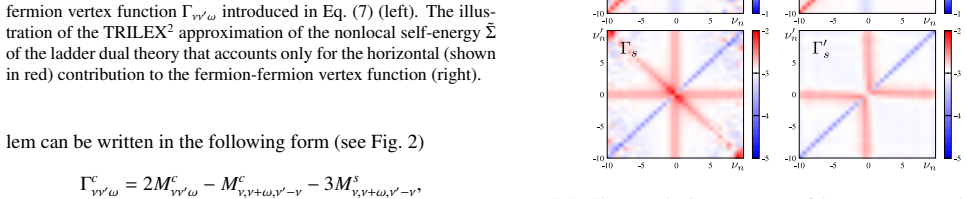
The carrying machinery is a decomposition of the local fermion-fermion vertex into horizontal (bosonic frequency $\omega$) and vertical (transfer frequency $\nu'-\nu$) boson-exchange pieces, combined with a unique choice of the bare channel interaction $U_c = -U_s = U/2$. The key identity is the reducible approximation $M^\varsigma_{\nu\nu'\omega} = \Lambda^\varsigma_{\nu\omega} \bar{w}^\varsigma_\omega \Lambda^\varsigma_{\nu'+\omega,-\omega}$ with $\bar{w}^\varsigma_\omega = w^\varsigma_\omega - U^\varsigma/2$, which packages the effect of a bosonic line dressed by two fermion-boson vertices. This $M$ is then generated by a second Hubbard-Stratonovich transformation, so that the full four-fermion vertex disappears from the action and is replaced by a shifted bosonic propagator $W^\varsigma = W^\varsigma_{\mathrm{EDMFT}} - U^\varsigma/2$. What this machinery does is to turn a problem with an expensive four-fermion vertex into a fermion-boson problem whose simplest self-energy diagram already contains the leading ladder physics, without any dependence on the decoupling recipe.
What would settle it
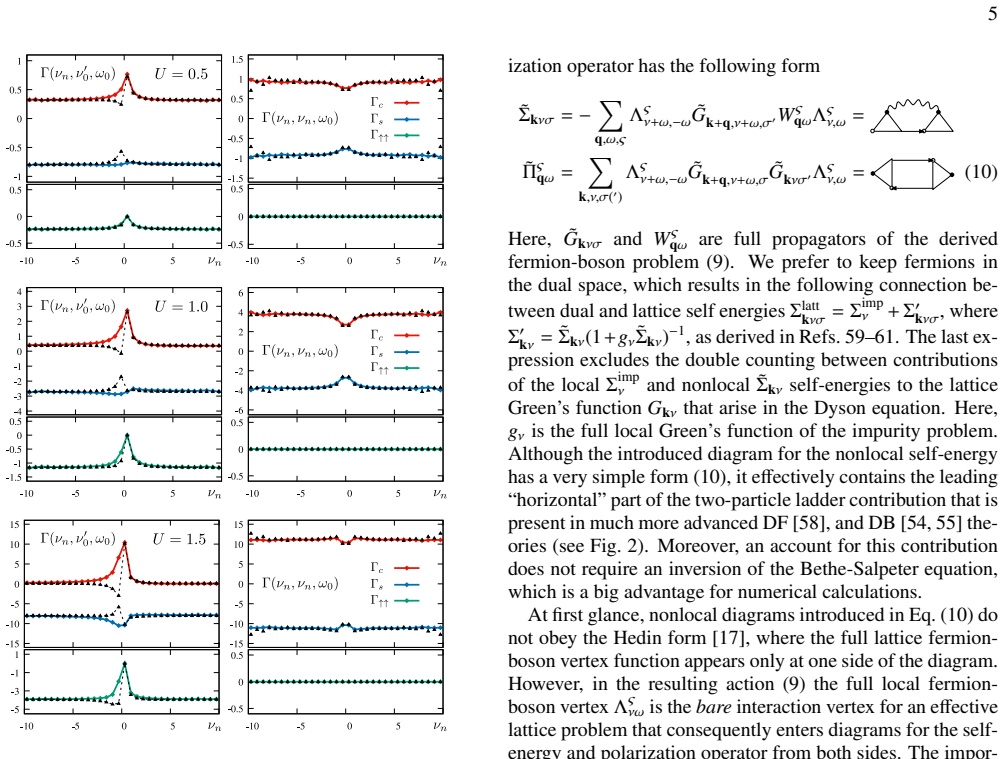
A decisive test is to compute, from an exact impurity solver, the difference between the full local vertex $\Gamma^\varsigma_{\nu\nu'\omega}$ and the proposed boson-exchange approximation at low Matsubara frequencies and stronger coupling (for example, $U = 2$ at lower temperature), or to compare the resulting nonlocal self-energy with a numerically exact lattice calculation such as diagrammatic Monte Carlo; if the difference is not small, the cancellation that eliminates the fermion-fermion vertex fails and the channel dependence should reappear.
Extended reading notes
Core claim
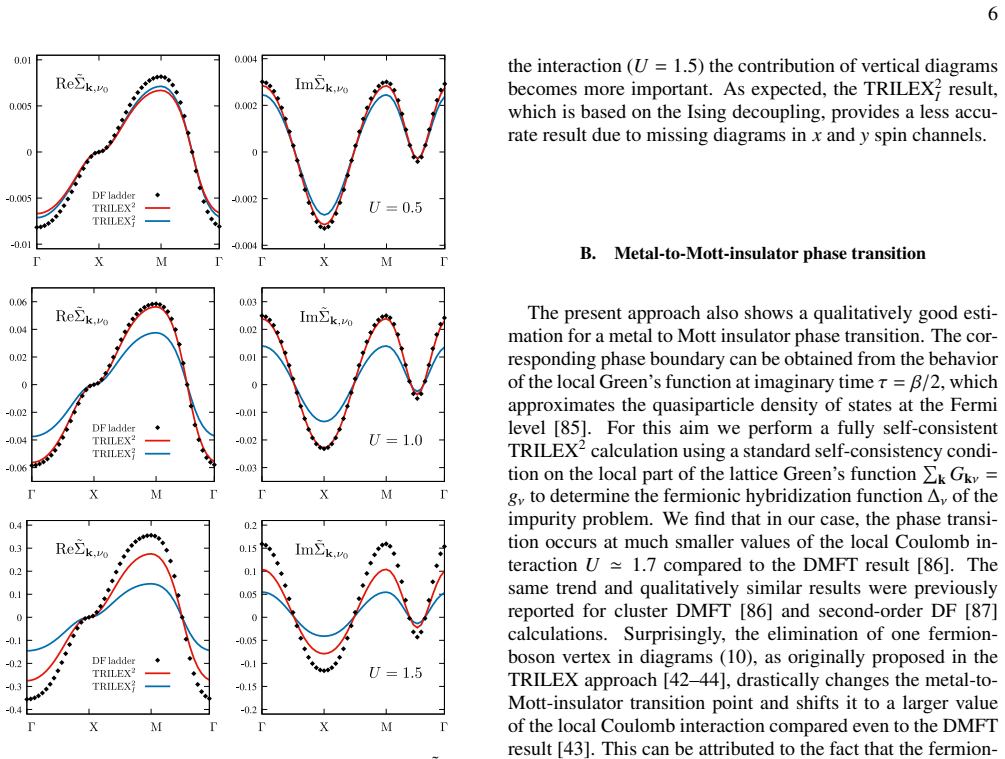
The central claim is that, for the extended Hubbard model, the Fierz ambiguity can be avoided entirely: the local Coulomb interaction $U$ is decoupled separately in every channel with the unique assignment $U_c = -U_s = U/2$ for all three spin components. Under this assignment the ladder-like irreducible contributions to the local fermion-fermion vertex are almost completely suppressed, and the reducible boson-exchange part $M^\varsigma_{\nu\nu'\omega} = \Lambda^\varsigma_{\nu\omega} \bar{w}^\varsigma_\omega \Lambda^\varsigma_{\nu'+\omega,-\omega}$, with $\bar{w}^\varsigma_\omega = w^\varsigma_\omega - U^\varsigma/2$, approximates the full vertex $\Gamma^\varsigma$ well enough that $\Gamma^\varsigma$ can be dropped from the dual action. The result is the effective action (9) for fermions interacting with bosons through the local vertex $\Lambda^\varsigma$, with bare boson propagator $W^\varsigma_{q\omega} = W^\varsigma_{\mathrm{EDMFT},q\omega} - U^\varsigma/2$. In the tested regime — half-filled two-dimensional Hubbard model, temperature $0.1$, $U = 0.5$, $1.0$, and $1.5$ — the nonlocal self-energy obtained from the simplest double-triangular diagrams agrees closely with ladder dual-fermion results, and a fully self-consistent solution gives a metal-to-Mott transition near $U \approx 1.7$, lower than the plain DMFT value.
Load-bearing premise
The argument assumes that the only important two-particle correlations are the ladder-like ones built from a single boson line, so the part of the local vertex that is not captured by exchanging one boson stays small.
Editorial extensions
If this is right
- The nonlocal self-energy and screened interaction can be obtained from a single simple diagram set, avoiding a Bethe-Salpeter inversion and making simultaneous charge and spin fluctuations numerically cheap.
- The screened interaction $W$ is improved in both charge and spin channels, which is precisely what a magnetic, realistic GW-style calculation needs.
- Because the fermion-fermion vertex is removed from the action, the effective fermion-boson model can be solved by fRG, parquet, or diagrammatic Monte Carlo without the usual Fierz-induced channel dependence.
- For the half-filled two-dimensional Hubbard model, the metal-to-Mott transition is found near $U \approx 1.7$, below the DMFT value, in line with cluster and second-order dual-fermion estimates.
Reading between the lines
- Editorial extension: The same cancellation could be tested for a particle-particle (superconducting) decoupling, where the paper notes the construction is possible in principle; a suppression check on the pairing vertex would show whether the method survives competing superconducting fluctuations.
- Editorial extension: The quality of the scheme should degrade where the fermion-boson vertex deviates strongly from unity; a systematic scan of $U$ and temperature would map the boundary of the regime where the Fierz-free action remains accurate.
- Editorial extension: A natural multiorbital generalization would assign channel-dependent bare interactions satisfying the same cancellation conditions; if it works, magnetic fluctuations and charge screening would enter realistic materials calculations on equal footing.
Signed reviews
Editorial analysis
A structured set of objections, weighed in public.
Referee Report
Summary. This manuscript proposes a partially bosonized dual action for the extended Hubbard model that is claimed to be free of the Fierz ambiguity. Starting from the dual-boson representation, the authors rewrite the local Coulomb interaction with channel-dependent bare couplings, argue that the choice Uc=-Us=U/2 removes the leading w-irreducible (ladder-like vertical) contributions to the local fermion-fermion vertex, and approximate that vertex by the boson-reducible form M^ς=Λ^ς w^ς Λ^ς - U^ς/2. They then replace M^ς by Λ^ς \bar{w}^ς Λ^ς with \bar{w}^ς=w^ς-U^ς/2, which permits a Hubbard-Stratonovich transformation that eliminates the fermion-fermion vertex from the effective action, leaving action (9) with a bare boson propagator W=W_EDMFT-U/2 and a local fermion-boson vertex Λ. The method is benchmarked by comparing the approximate local vertex with CT-HYB results (Figs. 3-4) and the nonlocal self-energy with ladder dual-fermion results (Fig. 5) for the 2D half-filled Hubbard model at U=0.5, 1.0 and 1.5; a self-consistent calculation locates the Mott transition around U≈1.7.
Significance. If the central claim is correct, the paper offers a computationally inexpensive TRILEX-like scheme that accounts for charge and spin fluctuations beyond EDMFT without the Fierz ambiguity, and the explicit form of the effective action (9) provides a concrete starting point for realistic GW-like implementations. The numerical benchmarks against exact CT-HYB impurity vertices and against ladder dual-fermion self-energies are independent references and are presented transparently, and the derivation is largely explicit. The main limitation is that the two key steps - the special channel decomposition and the replacement M≈Λ\bar{w}Λ - are justified only heuristically and by agreement in selected regimes, not by a controlled estimate of the neglected terms; the paper's strongest claim therefore goes beyond what is currently demonstrated.
major comments (2)
- [Sec. II.D, Appendix A, Eq. (B13)] The replacement M^ς_{νν'ω}≈Λ^ς_{νω} \bar{w}^ς_ω Λ^ς_{ν'+ω,-ω} is not an identity. From Eq. (8) and the definition \bar{w}^ς_ω=w^ς_ω-U^ς/2, the difference is (U^ς/2)(Λ^ς_{νω}Λ^ς_{ν'+ω,-ω}-1). The cancellation of the fermion-fermion vertex in Eq. (B13) therefore leaves a residual four-fermion term proportional to U(ΛΛ'-1), and Fig. 1 shows that Λ deviates substantially from 1 at low frequencies. The manuscript justifies this step only by the high-frequency asymptotics and by the final agreement with ladder dual fermion; it should provide a quantitative estimate of the dropped four-fermion vertex (for example, its magnitude over the Matsubara grid or its contribution to the TRILEX2 self-energy) to establish that the action (9) is actually equivalent to the original problem in the tested regime.
- [Sec. II.C, Eqs. (7)-(8), Fig. 4] The claim that the choice Uc=-Us=U/2 'almost fully suppresses' the missing w-irreducible contributions is not quantified. Fig. 4 shows only two frequency cuts of the vertex at zero bosonic frequency, which is not enough to establish that the irreducible remainder Γ^ς-Γ^ς_approx is small across the full Matsubara-frequency range, especially at U=1.5 where the text reports an increased role of vertical diagrams. Please provide a global measure of the irreducible remainder (e.g., a frequency-summed norm) and, ideally, a parquet-style decomposition of the remainder into particle-particle and other irreducible parts, so that the uniqueness claim is supported by more than selected cuts.
minor comments (4)
- [Sec. III.A, Fig. 5] The notation 'TRILEX2 I' appears in the text but is not defined; please explain that the superscript I denotes the Ising-decoupling version of the method.
- [Eq. (6)] The relation between Uc, Us and U that makes the second line of Eq. (6) follow from the first is not stated explicitly; please write the decoupling relation (e.g., the relevant Fierz identity connecting Uc and Us) so that the decoupling independence of Γ0 can be checked.
- [Appendix A, Eq. (A5)] The numerical prefactors in Eq. (A5) (the factor 4 in front of ΛUχUΛ and the term 2U) are introduced without derivation; since the text notes that the generalized susceptibility differs by a factor of 2 from Ref. [75], a short explanation of the channel normalization would remove ambiguity.
- [Sec. IV] There are several minor language issues (e.g., 'We find that in our case, the phase transition occurs', 'Surprisingly, the elimination...'); a careful proofread is recommended.
Circularity Check
No significant circularity: the unique channel choice is derived from an exact identity and the vertex approximation is benchmarked against independent CT-HYB and ladder dual-fermion references.
full rationale
The central claim—that the effective fermion-boson action (9), with W = W_EDMFT − U/2 and vertex Λ, avoids the Fierz ambiguity—does not reduce by construction to its inputs. The unique bare interaction choice Uc = −Us = U/2 is obtained from the exact decoupling-independence identity for the bare vertex in Eq. (6), not fitted to the target self-energy or vertex data. The subsequent approximation M ≈ Λ w̄ Λ (Sec. II D and Appendix A) is explicitly labeled an approximation and is justified by the stated high-frequency limit Λ → 1 and by numerical agreement with the exact CT-HYB impurity vertex (Figs. 3–4) and with ladder dual-fermion self-energies (Fig. 5). These are independent references rather than self-referential fits. The cancellation of the four-fermion term in Eq. (B13) is algebraically exact only under that approximation, so its quality is a correctness/accuracy concern, not a circularity: the paper acknowledges the step is approximate and validates it externally. The prior self-citations, including Refs. [76,77], provide motivation and an established framework, but the derivation in Appendix B is self-contained and does not rely on the citations as the load-bearing warrant. No identified step matches the required circularity patterns.
Assumptions & free parameters
free parameters (1)
- channel-decomposed bare interaction U^ς =
U^c = U/2, U^s = -U/2 for all s
assumptions (5)
- domain assumption The dual action can be truncated at the two-particle interaction level; six-fermion and higher vertices contribute negligibly to the self-energy.
- domain assumption The particle-particle channel contribution to the fermion-fermion vertex has only a minor effect on physical observables at general fillings.
- ad hoc to paper The additional approximation M^ς ≈ Λ^ς \bar{w}^ς Λ^ς, with the U/2 term absorbed into the boson propagator, is valid.
- ad hoc to paper The unique choice Uc=-Us=U/2 suppresses non-ladder irreducible contributions to the local vertex sufficiently well.
- domain assumption Ladder dual-fermion results are accurate benchmarks in the considered parameter regime U ≤ 2.0.
Cite this review
Pith. "Pith review of Consistent partial bosonization of the extended Hubbard model." pith.science (2026). https://pith.science/paper/ZPFSIA6P
@misc{pith2026190800536,
  author       = {Pith},
  title        = {Pith review of: Consistent partial bosonization of the extended Hubbard model},
  year         = {2026},
  howpublished = {\url{https://pith.science/paper/ZPFSIA6P}},
  note         = {Machine review of arXiv:1908.00536}
}
abstract
We design an efficient and balanced approach that captures major effects of collective electronic fluctuations in strongly correlated fermionic systems using a simple diagrammatic expansion on a basis of dynamical mean-field theory. For this aim we perform a partial bosonization of collective fermionic fluctuations in leading channels of instability. We show that a simultaneous account for different bosonic channels can be done in a consistent way that allows to avoid the famous Fierz ambiguity problem. The present method significantly improves a description of an effective screened interaction $W$ in both, charge and spin channels, and has a great potential for application to realistic $GW$-like calculations for magnetic materials.
Figures


Figures from the paper (2 more)
Forward citations
Cited by 1 Pith paper
-
Parquet-like equations for the Hedin three-leg vertex
A parquet-like scheme for the Hedin three-leg vertex self-consistently computes vertex corrections without four-point vertices or Bethe-Salpeter inversions, demonstrated on impurity models.
Reference graph
Works this paper leans on
-
[81]
Single-boson exchange decomposition of the vertex function
Friedrich Krien, Angelo Valli, and Massimo Capone, “Single- boson exchange decomposition of the vertex function,” arXiv e-prints , arXiv:1907.03581 (2019), arXiv:1907.03581 [cond- mat.str-el]
work page Pith review arXiv 2019
-
[1]
Fradkin, Field Theories of Condensed Matter Systems (West- view Press, Oxford, 1997)
E. Fradkin, Field Theories of Condensed Matter Systems (West- view Press, Oxford, 1997)
1997
-
[2]
S ´en´echal, A
D. S ´en´echal, A. M. Tremblay, and C. Bourbonnais, Theoretical methods for strongly correlated electrons(Springer Science and Business Media, 2006)
2006
-
[3]
Correlated electrons in high-temperature super- conductors,
Elbio Dagotto, “Correlated electrons in high-temperature super- conductors,” Rev. Mod. Phys.66, 763–840 (1994)
1994
-
[4]
Superexchange mechanism and d-wave superconductivity,
Gabriel Kotliar and Jialin Liu, “Superexchange mechanism and d-wave superconductivity,” Phys. Rev. B38, 5142–5145 (1988)
1988
-
[5]
Dynamical Model of Elemen- tary Particles Based on an Analogy with Superconductivity. I,
Y . Nambu and G. Jona-Lasinio, “Dynamical Model of Elemen- tary Particles Based on an Analogy with Superconductivity. I,” Phys. Rev. 122, 345–358 (1961)
1961
-
[6]
Dynamical Model of Elemen- tary Particles Based on an Analogy with Superconductivity. II,
Y . Nambu and G. Jona-Lasinio, “Dynamical Model of Elemen- tary Particles Based on an Analogy with Superconductivity. II,” Phys. Rev. 124, 246–254 (1961)
1961
-
[7]
Superfluidity and superconductivity in relativistic fermion systems,
D. Bailin and A. Love, “Superfluidity and superconductivity in relativistic fermion systems,” Physics Reports 107, 325 – 385 (1984)
1984
Show all 98 references
-
[8]
QCD at finite baryon density: nucleon droplets and color superconduc- tivity,
Mark Alford, Krishna Rajagopal, and Frank Wilczek, “QCD at finite baryon density: nucleon droplets and color superconduc- tivity,” Physics Letters B422, 247 – 256 (1998)
1998
-
[9]
Color superconductiv- ity and chiral symmetry restoration at non-zero baryon density and temperature,
J ¨urgen Berges and Krishna Rajagopal, “Color superconductiv- ity and chiral symmetry restoration at non-zero baryon density and temperature,” Nuclear Physics B 538, 215 – 232 (1999)
1999
-
[10]
Color- flavor locking and chiral symmetry breaking in high density QCD,
Mark Alford, Krishna Rajagopal, and Frank Wilczek, “Color- flavor locking and chiral symmetry breaking in high density QCD,” Nuclear Physics B 537, 443 – 458 (1999)
1999
-
[11]
Continuity of Quark and Hadron Matter,
Thomas Sch ¨afer and Frank Wilczek, “Continuity of Quark and Hadron Matter,” Phys. Rev. Lett.82, 3956–3959 (1999)
1999
-
[12]
Dynamical symmetry break- ing in asymptotically free field theories,
David J. Gross and Andr´e Neveu, “Dynamical symmetry break- ing in asymptotically free field theories,” Phys. Rev. D 10, 3235–3253 (1974)
1974
-
[13]
E ffective (2 +1)- dimensional field theory of fermions: fermion mass generation with Kaluza-Klein fermions and gauge field,
V . Ch. Zhukovsky and E. A. Stepanov, “E ffective (2 +1)- dimensional field theory of fermions: fermion mass generation with Kaluza-Klein fermions and gauge field,” Physics Letters B 718, 597 – 602 (2012)
2012
-
[14]
Flow equations without mean field ambiguity,
Joerg Jaeckel and Christof Wetterich, “Flow equations without mean field ambiguity,” Phys. Rev. D68, 025020 (2003)
2003
-
[15]
Temperature dependence of antiferromagnetic order in the Hubbard model,
Tobias Baier, Eike Bick, and Christof Wetterich, “Temperature dependence of antiferromagnetic order in the Hubbard model,” Phys. Rev. B 70, 125111 (2004)
2004
-
[16]
Understanding the Fierz Ambiguity of Partially Bosonized Theories,
Joerg Jaeckel, “Understanding the Fierz Ambiguity of Partially Bosonized Theories,” arXiv e-prints , hep-ph /0205154 (2002), arXiv:hep-ph/0205154 [hep-ph]
2002 arXiv
-
[17]
New Method for Calculating the One-Particle Green’s Function with Application to the Electron-Gas Prob- lem,
Lars Hedin, “New Method for Calculating the One-Particle Green’s Function with Application to the Electron-Gas Prob- lem,” Phys. Rev.139, A796–A823 (1965)
1965
-
[18]
The GW method,
F. Aryasetiawan and O. Gunnarsson, “The GW method,” Re- ports on Progress in Physics 61, 237 (1998)
1998
-
[19]
On correlation e ffects in electron spectroscopies and the GW approximation,
Lars Hedin, “On correlation e ffects in electron spectroscopies and the GW approximation,” Journal of Physics: Condensed Matter 11, R489 (1999)
1999
-
[20]
Dynamical mean-field theory of strongly correlated fermion systems and the limit of infinite di- mensions,
Antoine Georges, Gabriel Kotliar, Werner Krauth, and Marcelo J. Rozenberg, “Dynamical mean-field theory of strongly correlated fermion systems and the limit of infinite di- mensions,” Rev. Mod. Phys.68, 13–125 (1996)
1996
-
[21]
Non-Fermi-liquid behavior near a T =0 spin-glass transition,
Anirvan M. Sengupta and Antoine Georges, “Non-Fermi-liquid behavior near a T =0 spin-glass transition,” Phys. Rev. B 52, 10295–10302 (1995)
1995
-
[22]
Kosterlitz-Thouless Transition and Short Range Spatial Correlations in an Extended Hubbard Model,
Q. Si and J. L. Smith, “Kosterlitz-Thouless Transition and Short Range Spatial Correlations in an Extended Hubbard Model,” Phys. Rev. Lett. 77, 3391–3394 (1996)
1996
-
[23]
Spatial correlations in dynamical mean- field theory,
J. L. Smith and Q. Si, “Spatial correlations in dynamical mean- field theory,” Phys. Rev. B61, 5184–5193 (2000)
2000
-
[24]
Effect of Long Range Coulomb Inter- actions on the Mott Transition,
R. Chitra and G. Kotliar, “Effect of Long Range Coulomb Inter- actions on the Mott Transition,” Phys. Rev. Lett.84, 3678–3681 (2000)
2000
-
[25]
E ffective-action approach to strongly correlated fermion systems,
R. Chitra and Gabriel Kotliar, “E ffective-action approach to strongly correlated fermion systems,” Phys. Rev. B 63, 115110 (2001)
2001
-
[26]
Correlated Lattice Fermions in d =∞ Dimensions,
Walter Metzner and Dieter V ollhardt, “Correlated Lattice Fermions in d =∞ Dimensions,” Phys. Rev. Lett.62, 324–327 (1989)
1989
-
[27]
On the dan- gers of partial diagrammatic summations: Benchmarks for the two-dimensional hubbard model in the weak-coupling regime,
Jan Gukelberger, Li Huang, and Philipp Werner, “On the dan- gers of partial diagrammatic summations: Benchmarks for the two-dimensional hubbard model in the weak-coupling regime,” 11 Phys. Rev. B 91, 235114 (2015)
2015
-
[28]
Diagrammatic routes to nonlocal correlations beyond dynamical mean field theory,
G. Rohringer, H. Hafermann, A. Toschi, A. A. Katanin, A. E. Antipov, M. I. Katsnelson, A. I. Lichtenstein, A. N. Rubtsov, and K. Held, “Diagrammatic routes to nonlocal correlations beyond dynamical mean field theory,” Rev. Mod. Phys. 90, 025003 (2018)
2018
-
[29]
Magnetic Excitation Spectra in BaFe 2As2: A Two-Particle Approach within a Combination of the Density Functional Theory and the Dynamical Mean-Field Theory Method,
Hyowon Park, Kristjan Haule, and Gabriel Kotliar, “Magnetic Excitation Spectra in BaFe 2As2: A Two-Particle Approach within a Combination of the Density Functional Theory and the Dynamical Mean-Field Theory Method,” Phys. Rev. Lett. 107, 137007 (2011)
2011
-
[30]
Competing orders in Na xCoO2 from strong correlations on a two-particle level,
Lewin Boehnke and Frank Lechermann, “Competing orders in Na xCoO2 from strong correlations on a two-particle level,” Phys. Rev. B 85, 115128 (2012)
2012
-
[31]
Ab initio dynamical vertex approxi- mation,
Anna Galler, Patrik Thunstr ¨om, Patrik Gunacker, Jan M. Tom- czak, and Karsten Held, “Ab initio dynamical vertex approxi- mation,” Phys. Rev. B95, 115107 (2017)
2017
-
[32]
Multi-orbital nature of the spin fluctuations in Sr2RuO4,
Lewin Boehnke, Philipp Werner, and Frank Lechermann, “Multi-orbital nature of the spin fluctuations in Sr2RuO4,” EPL (Europhysics Letters) 122, 57001 (2018)
2018
-
[33]
Evening out the spin and charge parity to increase T c in unconventional superconductors,
Swagata Acharya, Dimitar Pashov, C ´edric Weber, Hyowon Park, Lorenzo Sponza, and Mark van Schilfgaarde, “Evening out the spin and charge parity to increase T c in unconventional superconductors,” arXiv e-prints , arXiv:1811.05143 (2018), arXiv:1811.05143 [cond-mat.str-el]
2018 arXiv
-
[34]
Magnetic response of Sr 2RuO4: quasi-local spin fluctuations due to Hund’s coupling,
Hugo U. R. Strand, Manuel Zingl, Nils Wentzell, Olivier Par- collet, and Antoine Georges, “Magnetic response of Sr 2RuO4: quasi-local spin fluctuations due to Hund’s coupling,” arXiv e-prints , arXiv:1904.07324 (2019), arXiv:1904.07324 [cond- mat.str-el]
2019 arXiv
-
[35]
Extended dynamical mean-field theory and GW method,
Ping Sun and Gabriel Kotliar, “Extended dynamical mean-field theory and GW method,” Phys. Rev. B66, 085120 (2002)
2002
-
[36]
First- Principles Approach to the Electronic Structure of Strongly Correlated Systems: Combining the GW Approximation and Dynamical Mean-Field Theory,
S. Biermann, F. Aryasetiawan, and A. Georges, “First- Principles Approach to the Electronic Structure of Strongly Correlated Systems: Combining the GW Approximation and Dynamical Mean-Field Theory,” Phys. Rev. Lett. 90, 086402 (2003)
2003
-
[37]
Spectral Properties of Correlated Materials: Local Vertex and Nonlocal Two-Particle Correlations from Combined GW and Dynamical Mean Field Theory,
Thomas Ayral, Philipp Werner, and Silke Biermann, “Spectral Properties of Correlated Materials: Local Vertex and Nonlocal Two-Particle Correlations from Combined GW and Dynamical Mean Field Theory,” Phys. Rev. Lett.109, 226401 (2012)
2012
-
[38]
Screen- ing and nonlocal correlations in the extended Hubbard model from self-consistent combined GW and dynamical mean field theory,
Thomas Ayral, Silke Biermann, and Philipp Werner, “Screen- ing and nonlocal correlations in the extended Hubbard model from self-consistent combined GW and dynamical mean field theory,” Phys. Rev. B87, 125149 (2013)
2013
-
[39]
Extended dynamical mean-field study of the Hubbard model with long-range interactions,
Li Huang, Thomas Ayral, Silke Biermann, and Philipp Werner, “Extended dynamical mean-field study of the Hubbard model with long-range interactions,” Phys. Rev. B90, 195114 (2014)
2014
-
[40]
When strong correlations become weak: Consistent merging of GW and DMFT,
L. Boehnke, F. Nilsson, F. Aryasetiawan, and P. Werner, “When strong correlations become weak: Consistent merging of GW and DMFT,” Phys. Rev. B94, 201106(R) (2016)
2016
-
[41]
Influence of Fock exchange in combined many-body perturbation and dynamical mean field theory,
Thomas Ayral, Silke Biermann, Philipp Werner, and Lewin Boehnke, “Influence of Fock exchange in combined many-body perturbation and dynamical mean field theory,” Phys. Rev. B95, 245130 (2017)
2017
-
[42]
Mott physics and spin fluctuations: A unified framework,
Thomas Ayral and Olivier Parcollet, “Mott physics and spin fluctuations: A unified framework,” Phys. Rev. B 92, 115109 (2015)
2015
-
[43]
Mott physics and spin fluctuations: A functional viewpoint,
Thomas Ayral and Olivier Parcollet, “Mott physics and spin fluctuations: A functional viewpoint,” Phys. Rev. B93, 235124 (2016)
2016
-
[44]
Fierz convergence criterion: A controlled approach to strongly inter- acting systems with small embedded clusters,
Thomas Ayral, Jaksa Vu ˇciˇcevi´c, and Olivier Parcollet, “Fierz convergence criterion: A controlled approach to strongly inter- acting systems with small embedded clusters,” Phys. Rev. Lett. 119, 166401 (2017)
2017
-
[45]
Dynamical Cor- relations and Screened Exchange on the Experimental Bench: Spectral Properties of the Cobalt Pnictide BaCo 2As2,
Ambroise van Roekeghem, Thomas Ayral, Jan M. Tomczak, Michele Casula, Nan Xu, Hong Ding, Michel Ferrero, Olivier Parcollet, Hong Jiang, and Silke Biermann, “Dynamical Cor- relations and Screened Exchange on the Experimental Bench: Spectral Properties of the Cobalt Pnictide BaC...
2014
-
[46]
Combined GW and dy- namical mean-field theory: Dynamical screening effects in tran- sition metal oxides,
Jan M. Tomczak, Michele Casula, Takashi Miyake, Ferdi Aryasetiawan, and Silke Biermann, “Combined GW and dy- namical mean-field theory: Dynamical screening effects in tran- sition metal oxides,” EPL (Europhysics Letters) 100, 67001 (2012)
2012
-
[47]
Comparing quasiparticleGW+DMFT and LDA+DMFT for the test bed material SrVO 3,
C. Taranto, M. Kaltak, N. Parragh, G. Sangiovanni, G. Kresse, A. Toschi, and K. Held, “Comparing quasiparticleGW+DMFT and LDA+DMFT for the test bed material SrVO 3,” Phys. Rev. B 88, 165119 (2013)
2013
-
[48]
Electronic structure of SrVO 3 within GW+DMFT,
R. Sakuma, Ph. Werner, and F. Aryasetiawan, “Electronic structure of SrVO 3 within GW+DMFT,” Phys. Rev. B 88, 235110 (2013)
2013
-
[49]
Tomczak, M
Jan M. Tomczak, M. Casula, T. Miyake, and S. Biermann, “Asymmetry in band widening and quasiparticle lifetimes in SrVO3: Competition between screened exchange and local cor- relations from combined GW and dynamical mean-field theory GW + DMFT,” Phys. Rev. B90, 165138 (2014)
2014
-
[50]
Nonequilibrium dynami- cal mean-field theory and its applications,
Hideo Aoki, Naoto Tsuji, Martin Eckstein, Marcus Kollar, Takashi Oka, and Philipp Werner, “Nonequilibrium dynami- cal mean-field theory and its applications,” Rev. Mod. Phys.86, 779–837 (2014)
2014
-
[51]
Nonequilibrium GW + EDMFT: Antiscreening and Inverted Populations from Nonlocal Corre- lations,
Denis Gole ˇz, Lewin Boehnke, Hugo U. R. Strand, Martin Eck- stein, and Philipp Werner, “Nonequilibrium GW + EDMFT: Antiscreening and Inverted Populations from Nonlocal Corre- lations,” Phys. Rev. Lett.118, 246402 (2017)
2017
-
[52]
On a method of calculating quantum dis- tribution functions,
R. L. Stratonovich, “On a method of calculating quantum dis- tribution functions,” inSoviet Physics Doklady, V ol. 2 (1957) p. 416
1957
-
[53]
Calculation of partition functions,
J. Hubbard, “Calculation of partition functions,” Phys. Rev. Lett. 3, 77–78 (1959)
1959
-
[54]
Continuous-time quantum Monte Carlo method for fermions,
A. N. Rubtsov, V . V . Savkin, and A. I. Lichtenstein, “Continuous-time quantum Monte Carlo method for fermions,” Phys. Rev. B 72, 035122 (2005)
2005
-
[55]
Continuous-time solver for quantum impurity models,
Philipp Werner, Armin Comanac, Luca de’ Medici, Matthias Troyer, and Andrew J. Millis, “Continuous-time solver for quantum impurity models,” Phys. Rev. Lett.97, 076405 (2006)
2006
-
[56]
Dynamical screening in correlated electron materials,
Philipp Werner and Andrew J. Millis, “Dynamical screening in correlated electron materials,” Phys. Rev. Lett. 104, 146401 (2010)
2010
-
[57]
Continuous-time monte carlo methods for quantum impurity models,
Emanuel Gull, Andrew J. Millis, Alexander I. Lichtenstein, Alexey N. Rubtsov, Matthias Troyer, and Philipp Werner, “Continuous-time monte carlo methods for quantum impurity models,” Rev. Mod. Phys.83, 349–404 (2011)
2011
-
[58]
Dual fermion approach to nonlocal correlations in the hubbard model,
A. N. Rubtsov, M. I. Katsnelson, and A. I. Lichtenstein, “Dual fermion approach to nonlocal correlations in the hubbard model,” Phys. Rev. B77, 033101 (2008)
2008
-
[59]
Dual boson approach to collective excitations in correlated fermionic systems,
A. N. Rubtsov, M. I. Katsnelson, and A. I. Lichtenstein, “Dual boson approach to collective excitations in correlated fermionic systems,” Annals of Physics 327, 1320 – 1335 (2012)
2012
-
[60]
Self-consistent dual boson approach to single-particle and collective excitations in correlated systems,
E. A. Stepanov, E. G. C. P. van Loon, A. A. Katanin, A. I. Licht- enstein, M. I. Katsnelson, and A. N. Rubtsov, “Self-consistent dual boson approach to single-particle and collective excitations in correlated systems,” Phys. Rev. B93, 045107 (2016)
2016
-
[61]
From local to nonlocal correla- tions: The Dual Boson perspective,
E. A. Stepanov, A. Huber, E. G. C. P. van Loon, A. I. Lichten- stein, and M. I. Katsnelson, “From local to nonlocal correla- tions: The Dual Boson perspective,” Phys. Rev. B 94, 205110 (2016). 12
2016
-
[62]
Di- agrammatic monte carlo approach for diagrammatic extensions of dynamical mean-field theory: Convergence analysis of the dual fermion technique,
Jan Gukelberger, Evgeny Kozik, and Hartmut Hafermann, “Di- agrammatic monte carlo approach for diagrammatic extensions of dynamical mean-field theory: Convergence analysis of the dual fermion technique,” Phys. Rev. B96, 035152 (2017)
2017
-
[63]
Dia- grammatic Monte Carlo for dual fermions,
Sergei Iskakov, Andrey E. Antipov, and Emanuel Gull, “Dia- grammatic Monte Carlo for dual fermions,” Phys. Rev. B 94, 035102 (2016)
2016
-
[64]
Momentum-space cluster dual-fermion method,
Sergei Iskakov, Hanna Terletska, and Emanuel Gull, “Momentum-space cluster dual-fermion method,” Phys. Rev. B 97, 125114 (2018)
2018
-
[65]
Efficient perturbation theory for quantum lattice models,
H. Hafermann, G. Li, A. N. Rubtsov, M. I. Katsnelson, A. I. Lichtenstein, and H. Monien, “Efficient perturbation theory for quantum lattice models,” Phys. Rev. Lett.102, 206401 (2009)
2009
-
[66]
Mul- titier self-consistent GW + EDMFT,
F. Nilsson, L. Boehnke, P. Werner, and F. Aryasetiawan, “Mul- titier self-consistent GW + EDMFT,” Phys. Rev. Materials 1, 043803 (2017)
2017
-
[67]
Many- Body Effects in Iron Pnictides and Chalcogenides: Nonlocal Versus Dynamic Origin of Effective Masses,
Jan M. Tomczak, M. van Schilfgaarde, and G. Kotliar, “Many- Body Effects in Iron Pnictides and Chalcogenides: Nonlocal Versus Dynamic Origin of Effective Masses,” Phys. Rev. Lett. 109, 237010 (2012)
2012
-
[68]
Effect of non-local correlations on the electronic structure of LiFeAs,
Karim Zantout, Ste ffen Backes, and Roser Valent ´ı, “Effect of non-local correlations on the electronic structure of LiFeAs,” arXiv e-prints , arXiv:1906.11853 (2019), arXiv:1906.11853 [cond-mat.str-el]
2019 arXiv
-
[69]
Generalized Hedin’s Equa- tions for Quantum Many-Body Systems with Spin-Dependent Interactions,
F. Aryasetiawan and S. Biermann, “Generalized Hedin’s Equa- tions for Quantum Many-Body Systems with Spin-Dependent Interactions,” Phys. Rev. Lett.100, 116402 (2008)
2008
-
[70]
Self-energies in itinerant magnets: A focus on Fe and Ni,
Lorenzo Sponza, Paolo Pisanti, Alena Vishina, Dimitar Pashov, Cedric Weber, Mark van Schilfgaarde, Swagata Acharya, Julien Vidal, and Gabriel Kotliar, “Self-energies in itinerant magnets: A focus on Fe and Ni,” Phys. Rev. B95, 041112(R) (2017)
2017
-
[71]
Ab initio calculations of quasiparticle band structure in correlated systems: LDA ++ approach,
A. I. Lichtenstein and M. I. Katsnelson, “Ab initio calculations of quasiparticle band structure in correlated systems: LDA ++ approach,” Phys. Rev. B57, 6884–6895 (1998)
1998
-
[72]
E ffective action for strongly correlated fermions from functional integrals,
H. J. Schulz, “E ffective action for strongly correlated fermions from functional integrals,” Phys. Rev. Lett. 65, 2462–2465 (1990)
1990
-
[73]
E fficient parametrization of the vertex function, Ω scheme, and the t, t ′ hubbard model at van hove filling,
C. Husemann and M. Salmhofer, “E fficient parametrization of the vertex function, Ω scheme, and the t, t ′ hubbard model at van hove filling,” Phys. Rev. B79, 195125 (2009)
2009
-
[74]
Four-point vertex in the Hubbard model and partial bosonization,
S. Friederich, H. C. Krahl, and C. Wetterich, “Four-point vertex in the Hubbard model and partial bosonization,” Phys. Rev. B 81, 235108 (2010)
2010
-
[75]
Fluctuation Di- agnostics of the Electron Self-Energy: Origin of the Pseudogap Physics,
O. Gunnarsson, T. Sch ¨afer, J. P. F. LeBlanc, E. Gull, J. Merino, G. Sangiovanni, G. Rohringer, and A. Toschi, “Fluctuation Di- agnostics of the Electron Self-Energy: Origin of the Pseudogap Physics,” Phys. Rev. Lett.114, 236402 (2015)
2015
-
[76]
E ffective Heisenberg Model and Exchange Interaction for Strongly Correlated Systems,
E. A. Stepanov, S. Brener, F. Krien, M. Harland, A. I. Lichten- stein, and M. I. Katsnelson, “E ffective Heisenberg Model and Exchange Interaction for Strongly Correlated Systems,” Phys. Rev. Lett. 121, 037204 (2018)
2018
-
[77]
Effective Ising model for correlated systems with charge ordering,
E. A. Stepanov, A. Huber, A. I. Lichtenstein, and M. I. Katsnel- son, “Effective Ising model for correlated systems with charge ordering,” Phys. Rev. B99, 115124 (2019)
2019
-
[78]
Local electronic cor- relation at the two-particle level,
G. Rohringer, A. Valli, and A. Toschi, “Local electronic cor- relation at the two-particle level,” Phys. Rev. B 86, 125114 (2012)
2012
-
[79]
High-frequency asymptotics of the vertex function: diagrammatic parametriza- tion and algorithmic implementation,
N. Wentzell, G. Li, A. Tagliavini, C. Taranto, G. Rohringer, K. Held, A. Toschi, and S. Andergassen, “High-frequency asymptotics of the vertex function: diagrammatic parametriza- tion and algorithmic implementation,” arXiv e-prints , arXiv:1610.06520 (2016), arXiv:1610.06520 [...
2016 arXiv
-
[80]
Renormalization-group ac- celeration of self-consistent field solutions: Two-dimensional hubbard model,
Chien-Hua Pao and N. E. Bickers, “Renormalization-group ac- celeration of self-consistent field solutions: Two-dimensional hubbard model,” Phys. Rev. B49, 1586–1599 (1994)
1994
-
[82]
E ffi- cient implementation of the continuous-time hybridization ex- pansion quantum impurity solver,
Hartmut Hafermann, Philipp Werner, and Emanuel Gull, “E ffi- cient implementation of the continuous-time hybridization ex- pansion quantum impurity solver,” Computer Physics Commu- nications 184, 1280 – 1286 (2013)
2013
-
[83]
Self-energy and vertex functions from hybridization-expansion continuous-time quantum monte carlo for impurity models with retarded interaction,
Hartmut Hafermann, “Self-energy and vertex functions from hybridization-expansion continuous-time quantum monte carlo for impurity models with retarded interaction,” Phys. Rev. B89, 235128 (2014)
2014
-
[84]
The ALPS project release 2.0: open source software for strongly correlated systems,
B. Bauer, L. D. Carr, H. G. Evertz, A. Feiguin, J. Freire, S. Fuchs, L. Gamper, J. Gukelberger, E. Gull, S. Guertler, A. Hehn, R. Igarashi, S. V . Isakov, D. Koop, P. N. Ma, P. Mates, H. Matsuo, O. Parcollet, G. Pawłowski, J. D. Picon, L. Pollet, E. Santos, V . W. Scarola, U. ...
2011
-
[85]
Be- yond extended dynamical mean-field theory: Dual boson ap- proach to the two-dimensional extended Hubbard model,
Erik G. C. P. van Loon, Alexander I. Lichtenstein, Mikhail I. Katsnelson, Olivier Parcollet, and Hartmut Hafermann, “Be- yond extended dynamical mean-field theory: Dual boson ap- proach to the two-dimensional extended Hubbard model,” Phys. Rev. B 90, 235135 (2014)
2014
-
[86]
Cluster Dynamical Mean Field Theory of the Mott Transition,
H. Park, K. Haule, and G. Kotliar, “Cluster Dynamical Mean Field Theory of the Mott Transition,” Phys. Rev. Lett. 101, 186403 (2008)
2008
-
[87]
Second-order dual fermion approach to the Mott transition in the two-dimensional Hubbard model,
Erik G. C. P. van Loon, Mikhail I. Katsnelson, and Hartmut Hafermann, “Second-order dual fermion approach to the Mott transition in the two-dimensional Hubbard model,” Phys. Rev. B 98, 155117 (2018)
2018
-
[88]
Functional renormal- ization group approach to correlated fermion systems,
Walter Metzner, Manfred Salmhofer, Carsten Honerkamp, V olker Meden, and Kurt Sch¨onhammer, “Functional renormal- ization group approach to correlated fermion systems,” Rev. Mod. Phys. 84, 299–352 (2012)
2012
-
[89]
Functional renormal- ization group for multi-orbital fermi surface instabilities,
C. Platt, W. Hanke, and R. Thomale, “Functional renormal- ization group for multi-orbital fermi surface instabilities,” Ad- vances in Physics 62, 453–562 (2013)
2013
-
[90]
From infinite to two dimensions through the functional renormalization group,
C. Taranto, S. Andergassen, J. Bauer, K. Held, A. Katanin, W. Metzner, G. Rohringer, and A. Toschi, “From infinite to two dimensions through the functional renormalization group,” Phys. Rev. Lett. 112, 196402 (2014)
2014
-
[91]
Correlated starting points for the functional renormal- ization group,
N. Wentzell, C. Taranto, A. Katanin, A. Toschi, and S. Ander- gassen, “Correlated starting points for the functional renormal- ization group,” Phys. Rev. B91, 045120 (2015)
2015
-
[92]
Extended dynamical mean field the- ory combined with the two-particle irreducible functional renormalization-group approach as a tool to study strongly cor- related systems,
A. A. Katanin, “Extended dynamical mean field the- ory combined with the two-particle irreducible functional renormalization-group approach as a tool to study strongly cor- related systems,” Phys. Rev. B99, 115112 (2019)
2019
-
[93]
Multiloop functional renormalization group for the two- dimensional Hubbard model: Loop convergence of the re- sponse functions,
Agnese Tagliavini, Cornelia Hille, Fabian B. Kugler, Sabine Andergassen, Alessandro Toschi, and Carsten Honerkamp, “Multiloop functional renormalization group for the two- dimensional Hubbard model: Loop convergence of the re- sponse functions,” SciPost Phys. 6, 9 (2019)
2019
-
[94]
E ffects of van hove singularities on magnetism and superconductivity in the t− t ′ hubbard model: A parquet approach,
V . Yu. Irkhin, A. A. Katanin, and M. I. Katsnelson, “E ffects of van hove singularities on magnetism and superconductivity in the t− t ′ hubbard model: A parquet approach,” Phys. Rev. B 64, 165107 (2001)
2001
-
[95]
Dynamical vertex approximation in its parquet implementation: Applica- 13 tion to hubbard nanorings,
A. Valli, T. Sch ¨afer, P. Thunstr ¨om, G. Rohringer, S. Ander- gassen, G. Sangiovanni, K. Held, and A. Toschi, “Dynamical vertex approximation in its parquet implementation: Applica- 13 tion to hubbard nanorings,” Phys. Rev. B91, 115115 (2015)
2015
-
[96]
E fficient implementation of the parquet equa- tions: Role of the reducible vertex function and its kernel ap- proximation,
Gang Li, Nils Wentzell, Petra Pudleiner, Patrik Thunstr¨om, and Karsten Held, “E fficient implementation of the parquet equa- tions: Role of the reducible vertex function and its kernel ap- proximation,” Phys. Rev. B93, 165103 (2016)
2016
-
[97]
Parquet decomposi- tion calculations of the electronic self-energy,
O. Gunnarsson, T. Sch ¨afer, J. P. F. LeBlanc, J. Merino, G. San- giovanni, G. Rohringer, and A. Toschi, “Parquet decomposi- tion calculations of the electronic self-energy,” Phys. Rev. B93, 245102 (2016)
2016
-
[98]
Conserving approximations for strongly fluctuating electron systems. I. Formalism and cal- culational approach,
N. E. Bickers and D. J. Scalapino, “Conserving approximations for strongly fluctuating electron systems. I. Formalism and cal- culational approach,” Annals of Physics193, 206 – 251 (1989)
1989
Reviewed August 14, 2026 · model on record in the stance chip above.
Discussion (0). Continue with ORCID to comment.