REVIEW 3 major objections 4 minor 41 references
Optimal Trading of Microstructure Mean Reversion
T0 review · 3 major / 4 minor · reviewed 2026-08-15 · deepseek-v4-flash
Pith's one-line read A symmetric band with half-width $\theta^*$ solving $\theta^*(\theta^*-\phi)=s_G^2$ is the optimal strategy for trading mid-price mean reversion in a large-tick book, earning $R^*=\alpha s_G\sqrt{2/\pi}\,e^{-\theta^{*2}/2s_G^2}$.
desk verdict Novel parity-lock and closed-form band for trading microstructure mean reversion; the surrogate math is rigorous, but exact-process claims rest on an unproved timing heuristic that the paper itself flags. read the letter →
The pith
A machine-rendered reading of the paper's core claim, the machinery that carries it, and where it could break.
The reading
What carries the argument
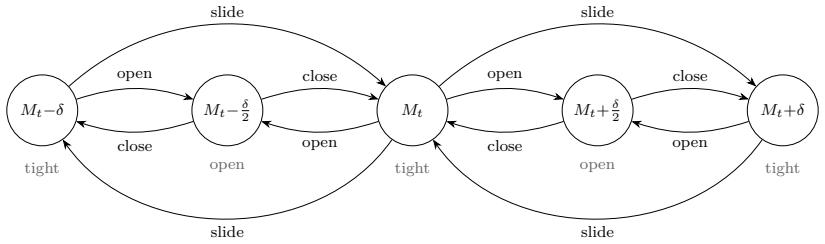
The machinery is the parity lock, the balanced-response condition, and the Gaussian-surrogate passage-time evaluation. The parity lock (Fact 1) makes the spread a deterministic function of the mid's parity, leaving $G$ as the only continuous state variable. The balanced-response condition $2\alpha_s+\alpha_o=\alpha_c=\alpha$ equalises the book's corrective drift across tight and open books, turning gap reversion into an exact theorem (equations (2.12)--(2.14)). The surrogate (3.4) is the unique Gaussian diffusion with the gap's exact conditional mean and stationary covariance; renewal--reward with Kramers' law on that surrogate yields the band equation and the closed-form rate. The layer decomposition (Proposition 2.2) reduces the full inventory problem to $\{-1,0,+1\}$ paths exactly, and the switching literature supplies threshold optimality on the surrogate.
What would settle it
Simulate the exact jump model with known parameters and measure the stationary mean time between opposite fills $m(\theta)$ alongside the surrogate passage time $\tilde{m}(\theta)=\frac{\pi}{\alpha}\operatorname{erfi}(u/\sqrt{2})$ for several $\theta/\delta$. If $|m(\theta)-\tilde{m}(\theta)|/m(\theta)$ does not shrink like $\delta/\theta$ as $\delta/\theta\to 0$, or if the exact rate peak deviates from $\theta_D$ by much more than the simulated ~20% inward shift, the paper's closed-form optimum is not the true book's optimum. Alternatively, on real tick data, estimate $\alpha$ and $s_G$ from the mid's autocovariance, implement the band, and check whether realized P&L exceeds the myopic rule's near-zero rate.
Extended reading notes
Core claim
The central discovery is that microstructure mean reversion reduces to a one-dimensional switching problem with a closed-form solution. The parity lock collapses bid, ask, spread, and mid into the gap $G$ plus a parity bit; Definition 2.2's linear intensities, under $2\alpha_s+\alpha_o=\alpha_c=\alpha$, make the gap's conditional mean and stationary covariance identical to an OU process with rate $\alpha$ and variance $s_G^2$ (Proposition 2.1), although paths jump. Passage times are evaluated on that Gaussian surrogate, and on it the symmetric band is optimal among all admissible strategies (Proposition 3.1 plus switching literature). The optimal band's half-width is $\theta^*(\theta^*-\phi)=s_G^2$, the rate is $R^*=\alpha s_G\sqrt{2/\pi}\,e^{-\theta^{*2}/2s_G^2}$, and the myopic $\theta=\phi$ rule earns exactly zero: all profit is the option value of waiting. The paper states clearly that on the jump process the band-class reduction and the $O(\delta/\theta)$ timing error are heuristic, and simulations show the exact-model peak sits about a fifth inside the surrogate optimum with small rate loss.
Load-bearing premise
The load-bearing premise is that the Gaussian-surrogate mean inter-fill time matches the true jump-process inter-fill time to relative error $O(\delta/\theta)$; the paper leaves this as a heuristic, and if it fails the closed-form $\theta^*$ and $R^*$ describe only the surrogate, not the real book.
Editorial extensions
If this is right
- If correct, a trader needs only the gap's autocovariance parameters $(\alpha, s_G)$ to set the band; the optimal half-width is $\theta^*=(\phi+\sqrt{\phi^2+4s_G^2})/2$.
- The myopic benchmark---trade as soon as the gap covers the half-spread---is worthless on the surrogate; the entire profit rate comes from waiting for a deeper reversion.
- Because the rate is flat at its maximum, a relative error $\varepsilon$ in the threshold costs only $O(\varepsilon^2)$ in rate, so the strategy is robust to estimation error in $\alpha$ and $s_G$.
- All assets with the same spread-to-dispersion ratio $\gamma=\phi/s_G$ share the same optimal band in gap units, so calibration reduces to one dimensionless number.
- Open-book fills are rare (occupancy $p$), so the tight-book cost convention loses $O(p)$; venue rules that act only on open books are second-order for this strategy.
Reading between the lines
- The surrogate timing approximation could be tested directly by simulating the exact jump book at several tick sizes and comparing measured mean inter-fill times $m(\theta)$ with the OU passage time $\tilde{m}(\theta)$ over a range of $\theta/\delta$; if the relative error is not $O(\delta/\theta)$, the closed forms still describe the surrogate but not a book with those parameters.
- The same moment-matching logic might extend to other cost structures---for example quadratic impact or inventory risk---where the optimal policy would no longer be a pure flip band; the paper's Proposition 2.2 already flags that interior positions can win under such costs.
- If the gap is not observable, the paper's state-space structure (Brownian state observed through linear point-process intensities) suggests a filter in which both moves and silences inform the gap estimate; quantifying the performance loss from filtering is an open continuation.
- The balanced-response condition is a genuine restriction, but the paper's bound via open-book occupancy suggests a testable prediction: in books with very small $p$, the parity-averaged rate $\alpha_{\mathrm{eff}}$ should approximate the fitted $\alpha$ well; a book violating (2.8) with large $p$ would split the reversion rate and break the closed form.
Signed reviews
Editorial analysis
A structured set of objections, weighed in public.
Referee Report
Summary. The paper constructs a limit order book model for liquid large-tick assets in which the spread is always one or two ticks and coincides with the parity of the mid on the half-tick grid, so the only continuous state is the gap G between the mid and a latent efficient price X, an exogenous Brownian martingale. Six event intensities are affine in the positive and negative parts of G. Under the balanced-response condition 2α_s+α_o=α_c=α, the paper proves that the gap's conditional mean decays as e^{-αh} and its stationary autocovariance is exactly that of an OU process with rate α and variance s_G^2. The trading problem maximizes long-run average profit net of half-spread; a pathwise layer decomposition reduces the search to positions in {-1,0,1}, and a symmetric threshold band is studied. The exact jump-process rate has a renewal-reward form, and passage times are evaluated on the OU surrogate with matched moments. On the surrogate, the band is optimal, with exact maximizer θ_D from a Dawson equation and Kramers approximation θ* solving θ*(θ*−φ)=s_G^2, with rate R*=αs_G√(2/π)e^{−θ*^2/(2s_G^2)}. The paper explicitly states that the timing error O(δ/θ) is heuristic and that optimality of the band on the jump process is a conjecture; Figure 4 reports Monte Carlo support.
Significance. If the advertised results are taken as statements about the Gaussian surrogate, the paper is a clean and useful contribution: exact moment matching, a rigorous layer reduction, exact renewal-reward accounting, and closed-form switching thresholds with a transparent separation of proved and heuristic parts. The book-level exact reversion theorem (Proposition 2.1) and the pathwise layer reduction (Proposition 2.2) are genuine and merit credit. The main formulas are simple and falsifiable, and the derivation introduces no fitted constants. The weakness is that the headline closed forms and the claimed optimal rule are not theorems for the jump-process model of Definitions 2.1–2.2; they depend on an unproved timing approximation and on a small-parameter regime that is not met by the paper's own large-tick calibration. These issues are acknowledged in the text, but they are precisely what must be resolved or explicitly disclaimed for the central claim to hold.
major comments (3)
- [§3, after Eq. (3.4); §5] The passage from the exact rate (3.3) to the surrogate rate (3.5) and hence to the closed forms (3.7)–(3.8) rests on the timing approximation |m̃(θ)−m(θ)|/m(θ)=O(δ/θ), which the paper explicitly leaves open (error (c)). Because this approximation is load-bearing, the statements in the abstract ('solve for the trading rule') and in Section 5 ('the result') overstate the status of θ* and R* as properties of the jump-process model: they are exact only for the Gaussian surrogate. The revision should either prove a bound on the timing error under stated conditions, or consistently present the exact-process claims as conjectures in the abstract, introduction, and conclusion, with the theorem-level results for the surrogate clearly separated.
- [§2.3 and §3 (regime after error (c))] The claimed regime δ≪θ−φ is not satisfied in the target calibration. The paper argues in Section 2.3 that for liquid large-tick assets the sampled |G| is of order a tick, s_G∼δ, and it sets φ=δ/2. At s_G=δ, the band equation (3.7) gives θ*≈1.28δ, so δ/(θ−φ)≈1.28 and δ/θ≈0.78 rather than ≪1. Consequently the proved reward-side error of order δ/(θ−φ) and the heuristic timing error of order δ/θ are both uncontrolled exactly in the empirically motivated regime. The Figure 4 Monte Carlo is suggestive, but without code or parameter sets the applicability of the closed forms to the stated asset class is not established.
- [§3.1, Figure 4] The Monte Carlo experiment is the only evidence that the surrogate performs well outside the asymptotic regime, but the manuscript gives no code, no seed, and no parameter values, and reports only 'one standard error' bands without a table of the baseline intensities and ramp slopes used. Since the sweep in Figure 4 is precisely where the asymptotic bounds are not available, the experiment should be reproducible: include the full parameter set (or code), the number of paths, and the standard-error construction.
minor comments (4)
- [§3, Eq. (3.7)–(3.8)] The displayed root θ* is the Kramers/large-threshold approximation, while the exact surrogate maximizer is u_D of Appendix B; Proposition B.2 should be cited at the first occurrence of (3.8) so that readers do not read R* as exact at θ*.
- [§5] The sentence 'Three assumptions carry the result' should also state that the two further open questions (timing error and band optimality) mean the headline formulas are surrogate theorems; as written, 'the result' is ambiguous.
- [Figures 2 and 5] The captions say 'illustrative parameters; nothing is calibrated,' but no parameter values are listed; providing them would help readers assess the claimed openness fraction of about 18 percent in Figure 2 and the visual behavior in Figure 5.
- [Fact 1, Section 2.2] The parity lock relies on the two-valued spread assumption; a sentence noting that assets with three or more spread values fall outside the lock would make the scope of the state-space reduction clearer.
Circularity Check
The derivation chain is self-contained: matched moments, not fitted outputs, produce the band; the self-citation is contextual and the timing heuristic is an acknowledged approximation.
full rationale
The paper's central derivation is not circular. The reversion identity (2.12) and the OU moment structure (2.13)-(2.14) are consequences of Definitions 2.1-2.2 and the balanced-response condition (2.8), which is an explicit model assumption and not a parameter fitted to the target formula. The Gaussian surrogate (3.4) is constructed to have exactly those derived conditional mean and stationary variance (uniqueness in Appendix A.9), and its passage-time closed form (Proposition B.1) is derived rather than imposed. Threshold optimality on the surrogate is cited from external switching literature [36, 35, 26, 4], not from the author's prior work; the band equation (3.7) and rate (3.8) follow from maximizing the surrogate rate, with the exact Dawson root in Appendix B. The only self-citation, [31], appears as architectural context ('we used the same family for the clustering of large-order flow [31]' and 'Our earlier work models precisely the impact of orders large enough to violate this [31]') and no equation depends on it. The unproved timing error O(delta/theta) and the conjectural optimality of the band class on the exact jump process are explicitly flagged as open ('a proof that |m_tilde(theta)-m(theta)|/m(theta)=O(delta/theta) is left open'; 'on the jump process itself that reduction remains a conjecture'), which is an honest limitation and a correctness risk, not a circular reduction. No fitted input is relabeled as a prediction, and no equation reduces by construction to its own input.
Assumptions & free parameters
assumptions (6)
- domain assumption Existence of a latent efficient price X as an exogenous Brownian martingale (Definition 2.1).
- ad hoc to paper Balanced-response condition 2 alpha_s + alpha_o = alpha_c = alpha (equation 2.8).
- domain assumption Small trader: orders fill at displayed quotes and do not enter the book's intensities (Section 2.5).
- domain assumption The gap G is observable to the trader (Section 2.4).
- ad hoc to paper The OU surrogate passage time approximates the true jump process's mean inter-fill time with relative error O(delta/theta) (after equation 3.4, error (c)).
- standard math Threshold optimality for the OU switching problem, cited from [36, 35, 26, 4].
invented entities (2)
-
Latent efficient price X (exogenous Brownian martingale)
-
Gaussian surrogate G_tilde (equation 3.4)
Cite this review
Pith. "Pith review of Optimal Trading of Microstructure Mean Reversion." pith.science (2026). https://pith.science/paper/ZPSRUFHP
@misc{pith2026260800885,
  author       = {Pith},
  title        = {Pith review of: Optimal Trading of Microstructure Mean Reversion},
  year         = {2026},
  howpublished = {\url{https://pith.science/paper/ZPSRUFHP}},
  note         = {Machine review of arXiv:2608.00885}
}
abstract
At the scale of seconds the observed mid carries a stationary, mean-reverting error around a latent efficient price. We build an order book whose own flow produces that error and solve for the trading rule that maximises the long-run average profit rate net of the bid-ask spread. In a liquid large-tick asset the spread is one tick or two, and it is exactly the parity of the mid on the half-tick grid: tight at a half-integer, open at an integer. One coordinate therefore carries the problem: the gap $G$ between the mid and the efficient price; the price is an exogenous Brownian martingale, and $G$ is observable. The mid is a pure jump process whose move intensities lean toward the efficient price. Under one balanced-response condition, which equalises the book's corrective drift across parities, mean reversion of $G$ is a theorem: its conditional mean and stationary covariance are exactly those of an Ornstein-Uhlenbeck process with reversion rate $\alpha$ and stationary standard deviation $s_G$. Its paths are not: the mid jumps. Passage times are therefore evaluated on the Gaussian diffusion those two moments define, at an error we bound on the reward side and leave heuristic on the timing side. A symmetric band of half-width $\theta$ buys when the gap reaches $-\theta$, sells at $+\theta$, and holds inside; on the surrogate it is optimal among all admissible strategies, on the jump process itself that reduction remains a conjecture. With $\phi$ the tight-book half-spread, the optimal half-width and its profit rate are $\theta^*(\theta^*-\phi)=s_G^2$ and $R^*=\alpha s_G\sqrt{2/\pi}\,e^{-\theta^{*2}/2s_G^2}$. Threshold times margin equals the stationary variance of the gap. Trading as soon as the gap covers the spread earns zero: all profit is the option value of waiting.
Figures


Figures from the paper (3 more)


Reference graph
Works this paper leans on
- [1]
-
[2]
R. Almgren and N. Chriss. Optimal execution of portfolio transactions.Journal of Risk, 3(2):5– 39, 2001
work page 2001
-
[3]
T. G. Andersen, T. Bollerslev, F. X. Diebold, and P. Labys. Modeling and forecasting realized volatility.Econometrica, 71(2):579–625, 2003
2003
-
[4]
A. Arapostathis, V. S. Borkar, and M. K. Ghosh.Ergodic Control of Diffusion Processes. Encyclopedia of Mathematics and its Applications 143, Cambridge University Press, Cambridge, 2012. 17
work page 2012
-
[5]
Asmussen.Applied Probability and Queues
S. Asmussen.Applied Probability and Queues. 2nd edition, Springer, New York, 2003
work page 2003
-
[6]
M. Avellaneda and S. Stoikov. High-frequency trading in a limit order book.Quantitative Finance, 8(3):217–224, 2008
work page 2008
- [7]
- [8]
Show all 41 references
-
[9]
W. K. Bertram. Analytic solutions for optimal statistical arbitrage trading.Physica A, 389(11):2234–2243, 2010
2010
-
[10]
Bouchaud, J
J.-P. Bouchaud, J. D. Farmer, and F. Lillo. How markets slowly digest changes in supply and demand. InHandbook of Financial Markets: Dynamics and Evolution, Elsevier, 2009
2009
-
[11]
Cartea, S
Á. Cartea, S. Jaimungal, and J. Penalva.Algorithmic and High-Frequency Trading. Cambridge University Press, 2015
2015
-
[12]
Cont and A
R. Cont and A. de Larrard. Price dynamics in a Markovian limit order market.SIAM Journal on Financial Mathematics, 4(1):1–25, 2013
2013
-
[13]
D. J. Daley and D. Vere-Jones.An Introduction to the Theory of Point Processes. 2nd edition, Springer, New York, 2003
2003
-
[14]
Dayri and M
K. Dayri and M. Rosenbaum. Large tick assets: implicit spread and optimal tick size.Market Microstructure and Liquidity, 1(1):1550003, 2015
2015
-
[15]
Delattre, C
S. Delattre, C. Y. Robert, and M. Rosenbaum. Estimating the efficient price from the order flow: a Brownian Cox process approach.Stochastic Processes and their Applications, 123(7):2603–2619, 2013
2013
-
[16]
Durbin and S
J. Durbin and S. J. Koopman.Time Series Analysis by State Space Methods. 2nd edition, Oxford University Press, Oxford, 2012
2012
-
[17]
Guéant, C.-A
O. Guéant, C.-A. Lehalle, and J. Fernandez-Tapia. Dealing with the inventory risk: a solution to the market making problem.Mathematics and Financial Economics, 7(4):477–507, 2013
2013
-
[18]
Guéant.The Financial Mathematics of Market Liquidity: From Optimal Execution to Market Making
O. Guéant.The Financial Mathematics of Market Liquidity: From Optimal Execution to Market Making. Chapman & Hall/CRC, 2016
2016
-
[19]
Guilbaud and H
F. Guilbaud and H. Pham. Optimal high-frequency trading with limit and market orders. Quantitative Finance, 13(1):79–94, 2013
2013
-
[20]
P. R. Hansen and A. Lunde. Realized variance and market microstructure noise.Journal of Business and Economic Statistics, 24(2):127–161, 2006
2006
-
[21]
Hasbrouck
J. Hasbrouck. One security, many markets: determining the contributions to price discovery. Journal of Finance, 50(4):1175–1199, 1995
1995
-
[22]
A. G. Hawkes. Spectra of some self-exciting and mutually exciting point processes.Biometrika, 58(1):83–90, 1971
1971
-
[23]
Huang, C.-A
W. Huang, C.-A. Lehalle, and M. Rosenbaum. Simulating and analyzing order book data: the queue-reactive model.Journal of the American Statistical Association, 110(509):107–122, 2015
2015
-
[24]
Karlin and H
S. Karlin and H. M. Taylor.A Second Course in Stochastic Processes. Academic Press, New York, 1981. 18
1981
-
[25]
H. A. Kramers. Brownian motion in a field of force and the diffusion model of chemical reactions. Physica, 7(4):284–304, 1940
1940
-
[26]
Leung and X
T. Leung and X. Li.Optimal Mean Reversion Trading: Mathematical Analysis and Practical Applications. World Scientific, 2016
2016
-
[27]
Lipton and M
A. Lipton and M. López de Prado. A closed-form solution for optimal mean-reverting trading strategies. Working paper, arXiv:2003.10502, 2020
2003 arXiv
-
[28]
S. P. Meyn and R. L. Tweedie. Stability of Markovian processes III: Foster–Lyapunov criteria for continuous-time processes.Advances in Applied Probability, 25(3):518–548, 1993
1993
-
[29]
Obizhaeva and J
A. Obizhaeva and J. Wang. Optimal trading strategy and supply/demand dynamics.Journal of Financial Markets, 16(1):1–32, 2013
2013
-
[30]
Pulido, M
S. Pulido, M. Rosenbaum, and E. Sfendourakis. Understanding the worst-kept secret of high- frequency trading.Finance and Stochastics, 30(2):329–396, 2026. doi:10.1007/s00780-026-00585- 9
2026 doi
-
[31]
Rabechini Amaral and A
L. Rabechini Amaral and A. Papanicolaou. Price impact of large orders using Hawkes processes. The ANZIAM Journal, 61(2):161–194, 2019
2019
-
[32]
C. Y. Robert and M. Rosenbaum. A new approach for the dynamics of ultra-high-frequency data: the model with uncertainty zones.Journal of Financial Econometrics, 9(2):344–366, 2011
2011
-
[33]
R. Roll. A simple implicit measure of the effective bid–ask spread in an efficient market.Journal of Finance, 39(4):1127–1139, 1984
1984
-
[34]
Sfendourakis
E. Sfendourakis. Multi-dimensional queue-reactive model and signal-driven models: a unified framework. Working paper, arXiv:2506.11843, 2025
2025 arXiv
-
[35]
Zervos, T
M. Zervos, T. C. Johnson, and F. Alazemi. Buy-low and sell-high investment strategies. Mathematical Finance, 23(3):560–578, 2013
2013
-
[36]
Zhang and Q
H. Zhang and Q. Zhang. Trading a mean-reverting asset: buy low and sell high.Automatica, 44(6):1511–1518, 2008
2008
-
[37]
exactlyk∈{ 0, 1} book events, with the Brownian increment in a prescribed interval
L. Zhang, P. A. Mykland, and Y. Aït-Sahalia. A tale of two time scales: determining integrated volatility with noisy high-frequency data.Journal of the American Statistical Association, 100(472):1394–1411, 2005. A Proofs The results quoted in the text are collected here with c...
2005
-
[38]
25 Proof
= 1/u+O(u −3). 25 Proof. By (3.5) and Proposition B.1, ˜R(u) = 2αsG π (u−γ )/erfi (u/ √ 2)for u > γ; since d du erfi(u/ √
-
[39]
Step 1 (a unique root).Puth(u) =u−γ− √ 2 D(u/ √ 2)
= √ 2/πeu2/2 and D(z) = √π 2 e−z2 erfi(z), the first-order condition˜R′(u) = 0 rearranges to (B.1). Step 1 (a unique root).Puth(u) =u−γ− √ 2 D(u/ √ 2). Thenh(γ) =− √ 2 D(γ/ √ 2)< 0, and h(u) → ∞because D(z) → 0. By the chain rule h′(u) = 1 −D′(u/ √ 2); since D′(z) = 1− 2zD (z)...
-
[40]
Step 3 (the asymptote).From D(z) = 1 2z + 1 4z3 +O(z−5)one gets √ 2 D(u/ √
= (uD−γ ) √ 2/πeu2 D/2, and substituting it back the factor(uD−γ )cancels: ˜R(uD) = 2αsG π (√ 2/πeu2 D/2)−1 =αs G √ 2/π e−u2 D/2, which is (3.8) atuD. Step 3 (the asymptote).From D(z) = 1 2z + 1 4z3 +O(z−5)one gets √ 2 D(u/ √
-
[41]
Kramers’ law(3.6) is the same asymptote read on the passage time itself:˜m(θ) =π α erfi(u/ √ 2)∼ √ 2π sG αθeθ2/2s2 G
= 1 u +O(u−3), so(B.1) becomes u−γ = 1/u, which is(3.7). Kramers’ law(3.6) is the same asymptote read on the passage time itself:˜m(θ) =π α erfi(u/ √ 2)∼ √ 2π sG αθeθ2/2s2 G. Lemma B.1(Second-order flatness). ˜R is twice continuously differentiable on(ϕ,∞ )with ˜R′′(θD)< 0, so...
Reviewed August 15, 2026 · model on record in the stance chip above.
Discussion (0). Continue with ORCID to comment.