REVIEW 4 major objections 5 minor 22 references
A new measure of modularity density for community detection
T0 review · 4 major / 5 minor · reviewed 2026-08-14 · deepseek-v4-flash
Pith's one-line read A new modularity density score, $M$, is claimed to be free from both large-cluster and small-cluster bias and to detect weakly separated communities in heterogeneous networks.
desk verdict New modularity-density variant with a clean two-clique comparison and an interesting normalized-cut relation, but the no-bias proofs only cover friendly cases on expected graphs, so the headline claim overreaches. read the letter →
The pith
A machine-rendered reading of the paper's core claim, the machinery that carries it, and where it could break.
The reading
What carries the argument
The load-bearing object is the normalized degree vector $\vec{d}_c = \hat{n}_c\cdot T$, whose entries are the adjacency-weighted connections of each node to cluster $c$, scaled by $1/\sqrt{n_c}$. Projecting $\vec{d}_c$ onto the cluster's own unit vector $\hat{n}_c$ gives the mean internal degree, while projecting onto another cluster's unit vector gives a normalized measure of external association. Summing internal minus external projections over all clusters yields Eq. (13): $M = \sum_c\left\{\frac{\sum_{i,j\in c} T_{ij}}{n_c} - \sum_{c'\neq c}\frac{\sum_{i\in c,j\in c'}T_{ij}}{\sqrt{n_c n_{c'}}}\right\}$. The no-bias proofs work by comparing $M$ for the true partition with $M$ for merged or split alternatives on Erdős–Rényi graphs, using the assumption that a natural community of $m$ nodes has at least $m$ edges, which fixes the minimum edge probability at $p_{\min}=2/(m-1)$; substituting that bound turns every difference into a positive algebraic expression.
What would settle it
On a single sampled Erdős–Rényi graph with $m$ nodes and edge probability $p=2/(m-1)$, compute $M$ for the whole graph and for every possible two-way split; if any split has $M_{\mathrm{split}} > M_{\mathrm{single}}$, the no-split guarantee fails on that sample. Similarly, on the two-clique network with a single connecting edge, exact maximization of $M$ should always return two clusters; one run that merges them would falsify the claimed improvement over Chen et al.'s modularity density.
Extended reading notes
Core claim
The central discovery is a score $M$ that combines each community's mean internal degree with its normalized external degree into a single number, and the main result is that this score is size-unbiased in the sense that matters for community detection. On an Erdős–Rényi random graph or a clique, the single-community value of $M$ is algebraically larger than the value of any split, so optimizing the score will not invent clusters. On a network of two or a ring of many random communities of different sizes connected by single edges, the separated value of $M$ is larger than every merged value for every subset of communities, which is exactly the regime where the resolution limit makes modularity and earlier modularity densities fail. In a two-clique network with $w$ connecting edges, the threshold $w_M$ below which the cliques are detected is always at least the threshold $w_D$ for Li et al.'s modularity density, with equality only for equal-sized cliques. Finally, the change in $M$ from a bipartition is shown to be $\hat{f}\cdot D_c\cdot\hat{f}\,[1-\lambda]-\beta$, a local Rayleigh quotient with a non-negative external penalty, which places optimization of $M$ as a constrained version of the normalized cut problem.
Load-bearing premise
The load-bearing premise is that an Erdős–Rényi random graph can be treated by its expected edge weights and that a natural community of $m$ nodes must contain at least $m$ edges; if real sampled graphs do not honor those assumptions, the inequalities proving $\Delta M>0$ may not hold for individual networks.
Editorial extensions
If this is right
- A community-detection algorithm that optimizes $M$ would not need a resolution parameter and could return both small and large clusters in a single run, addressing the main failure mode of modularity in heterogeneous networks.
- For two connected cliques, $M$ separates them for a wider range of connecting-edge counts than Li et al.'s modularity density, so weakly separated communities are detectable in a strictly larger regime.
- Because evaluating $M$ costs $O(|E|)$, it can be plugged into greedy or spectral search heuristics without an asymptotic slowdown relative to the earlier modularity density, and it avoids the $O(|C|^2)$ split-penalty cost of Chen et al.'s variant.
- The bipartition formula shows that recursive community detection by maximizing $M$ is a constrained normalized-cut problem, linking a parameter-free quality score to a well-studied spectral clustering objective.
Reading between the lines
- The unbiasedness proofs operate on expected edge counts of Erdős–Rényi graphs; a natural testable extension is to check on sampled graphs and on synthetic networks with power-law community sizes whether the inequalities survive finite-sample fluctuations.
- The normalized-cut connection suggests a spectral relaxation of $M$-maximization could be derived, in which leading eigenvectors of a modified Laplacian would approximate optimal partitions; the paper leaves this approximation as future work.
- The comparison with Li et al. is derived for unweighted cliques; extending the threshold calculation to weighted edges and to communities with internal edge-probability gradients would show whether $w_M \ge w_D$ persists in weighted heterogeneous networks.
- If $M$ really is bias-free, it offers a single-objective alternative to multiresolution methods, so practitioners would not need to scan a resolution parameter to find communities at all scales.
Signed reviews
Editorial analysis
A structured set of objections, weighed in public.
Referee Report
Summary. The paper proposes a new modularity density measure M, defined in Eq. (13), for detecting non-overlapping communities in undirected, weighted, non-negatively weighted networks. The measure is built from projections of a normalized degree vector onto community indicator vectors, combining internal cohesion and external separation terms. The authors claim that maximizing M is free from the two biases that affect other modularity density variants (favoring small clusters and favoring large clusters), that it detects weakly separated communities in heterogeneous networks better than the modularity densities of Li et al. (2008) and Chen et al. (2013), that it can be computed in O(|E|), and that its optimization is mathematically related to normalized cut minimization. The theoretical analysis consists of algebraic comparisons on small model networks: a random graph or clique, two connected random communities, a ring of communities, and two cliques connected by w edges. Section IV derives an expression for the change in M under bi-partitioning a cluster and relates it to the normalized cut criterion.
Significance. If the paper's central claims were established, the proposed measure M would be a useful parameter-free objective for community detection, particularly for networks with heterogeneous community sizes. The manuscript has genuine strengths: the derivation of M from cohesion and separation is self-contained, the algebra on the chosen examples is mostly explicit, the comparison with Li et al. on the two-clique example gives a concrete threshold inequality, and the normalized-cut connection in Section IV is a nontrivial and interesting observation. The measure has no fitted parameters, and the computational complexity argument is straightforward. However, the significance is substantially weakened by two gaps: the 'free from bias' theorem is not actually proven for the global maximizer of M, and the claimed superiority over prior modularity densities is not tested on any real or synthetic benchmark network. The contribution is therefore at the level of a promising proposal whose advertised properties require further proof and empirical validation.
major comments (4)
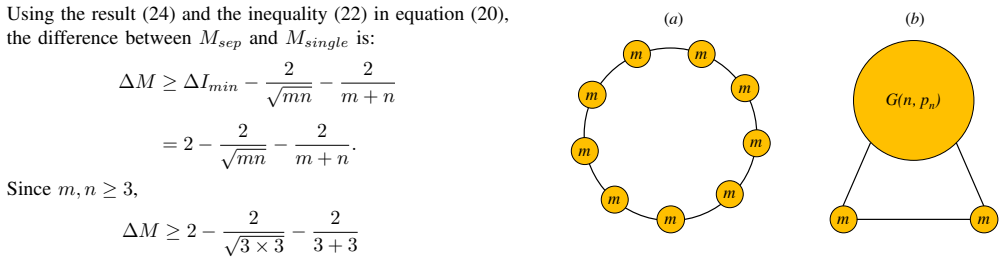
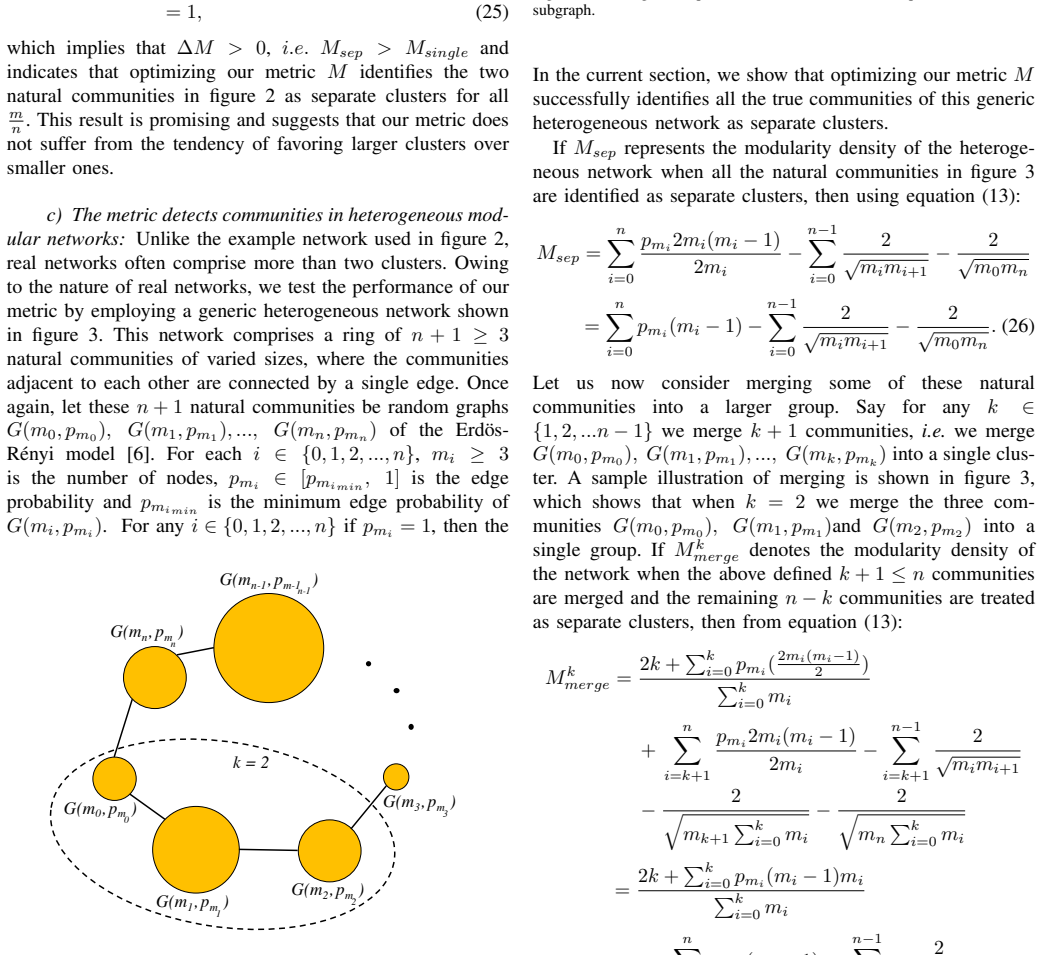
- [Section III-A(a)-(c), Eqs. (17), (34), (38)] The no-bias claim is about the global maximizer of M over all possible partitions, but the proofs only compare a small set of selected partitions. In III-A(a), only the single-community partition is compared with one arbitrary bisection; splits into three or more clusters are dismissed with 'it is not hard to show' and no argument is given. In III-A(b) and III-A(c), the only alternatives considered are the true partition and the partition obtained by merging adjacent communities into one cluster. Non-contiguous merges, partial boundary shifts, and partitions that simultaneously split some communities and merge others are never analyzed. Without excluding all such partitions, the statements 'optimizing M does not split a random graph' and 'M is free from bias' are not established.
- [Section III-A, Eqs. (15)-(25)] The computations replace the Erdős-Rényi random graph G(m,p) by the deterministic weighted complete graph in which every edge has weight p, i.e., by the expected adjacency matrix. Since M is linear in T, the expressions in Eqs. (15), (16), (18), and (19) are expected values E[M]. Inequalities such as Eq. (17) and Eq. (25) therefore concern E[M], not the realized M of an actual sampled graph. The expectation of the maximizer is not the maximizer of the expectation, so the sampled-graph behavior is genuinely left open. Additionally, Eq. (14) defines p_min = 2/(m-1) by asserting that a 'natural community' needs at least m edges; the footnote excludes path graphs, but no proof is given that a path graph is not a natural community. These assumptions are load-bearing for the claimed no-bias theorem.
- [Section III-B(a), Eqs. (44)-(50)] The claimed superiority over Li et al. (2008) is established only for the two-clique network of Fig. 5 connected by w edges; the analysis shows w_M >= w_D for that single family. Chen et al. (2013) is not directly compared in this section, and the statement that it suffers from the resolution limit problem relies entirely on prior work. More importantly, the abstract's claim that M 'better detect[s] weakly-separated communities particularly in heterogeneous networks' is not supported by any empirical evaluation on real or synthetic benchmark networks. The paper contains no experiments with community-size heterogeneity, no LFR-type benchmarks, and no comparison of detection accuracy with existing algorithms.
- [Section III-B(b)] The statement that the 'computational running time of our modularity density is found to be on par or faster' is not an empirical finding; Section III-B(b) provides only an asymptotic complexity argument (O(|E|) for M versus O(|E|) and O(|C|^2) for previous metrics). No algorithm for actually maximizing M is proposed, so the cost of optimization is not assessed and no runtime measurements are reported. As written, the claim overstates what has been shown.
minor comments (5)
- [References and notation] The reference to Shi and Malik is consistently written 'Shi & Mallik', and the journal name in reference [11] contains typos ('Patter analysis'). The reference list also has inconsistent formatting for arXiv entries and some author names.
- [Section III-A(a), Eq. (14)] The text states that for a connected graph at least m-1 edges are required and then asserts that a natural community needs at least m edges, but the distinction between 'connected' and 'natural community' is not formally defined. The footnote about path graphs is not a proof and should be clarified.
- [Figure 4 and surrounding text] The caption of Fig. 4 and the text around it use 'm' ambiguously for both the number of nodes and the label of a subgraph; the notation should be made consistent.
- [Section III-A(c), Eq. (33)-(34)] The algebraic manipulation in Eqs. (33)-(34) is quite dense and would benefit from an intermediate step that shows how the lower bound 4(k-1)/3 - 2k/[3(k+1)] is obtained from the preceding line. The current presentation is correct but hard to verify.
- [Section IV, Eq. (79)] The interpretation of Eq. (79) is clear, but the wording 'maximization of δM with respect to α requires minimization of λ' should be stated more carefully: the expression in parentheses contains a positive factor (1 + 4√(na nb)/nc) that depends on the partition sizes, so the comparison with the standard normalized cut Rayleigh quotient is only qualitative.
Circularity Check
No circularity: the metric is constructed directly and its properties are derived from its definition; no fitted parameter, self-citation chain, or definitional equivalence is present.
full rationale
The paper defines its modularity density M in Eqs. (8)-(13) directly from the cohesion/separation concept (projections of a normalized degree vector), with no parameter fitted to target results and no prior work by the same authors invoked as load-bearing. The subsequent sensitivity analysis compares M for specific partitions of random graphs and of networks of cliques (Eqs. 15-19 and 26-38) by algebraic inequalities; these comparisons use the definition of M and the assumed Erdős-Rényi weights, so the derivations are not equivalent to their inputs by construction. The comparison with Li et al. modularity density (Eqs. 41-50) is an analytic threshold calculation, not a fitted prediction. The normalized-cut relation in Section IV is derived after the fact as a mathematical identity, not used to define M. The main weakness — that the 'no bias' claim only checks selected partitions on expected edge weights rather than all partitions on sampled graphs — is a gap in proof strength or correctness risk, not circularity, because no claim reduces to its own input or to a self-citation.
Assumptions & free parameters
free parameters (1)
- p_min threshold for natural community =
2/(m-1)
assumptions (4)
- domain assumption A connected random graph G(m,p) can be represented by a complete graph with all edge weights p for the purpose of computing M.
- domain assumption A natural community of m nodes must contain at least m edges, so the minimum edge probability is 2/(m-1).
- domain assumption The network is undirected, connected, has non-negative edge weights, and each node belongs to exactly one community.
- standard math Standard vector/tensor algebra and the graph Laplacian identity for f·L·f are applied.
Cite this review
Pith. "Pith review of A new measure of modularity density for community detection." pith.science (2026). https://pith.science/paper/ZQFX6AO5
@misc{pith2026190808452,
  author       = {Pith},
  title        = {Pith review of: A new measure of modularity density for community detection},
  year         = {2026},
  howpublished = {\url{https://pith.science/paper/ZQFX6AO5}},
  note         = {Machine review of arXiv:1908.08452}
}
read the original abstract
Using an intuitive concept of what constitutes a meaningful community, a novel metric is formulated for detecting non-overlapping communities in undirected, weighted heterogeneous networks. This metric, modularity density, is shown to be superior to the versions of modularity density in present literature. Compared to the previous versions of modularity density, maximization of our metric is proven to be free from bias and better detect weakly-separated communities particularly in heterogeneous networks. In addition to these characteristics, the computational running time of our modularity density is found to be on par or faster than that of the previous variants. Our findings further reveal that community detection by maximization of our metric is mathematically related to partitioning a network by minimization of the normalized cut criterion.
Figures


Figures from the paper (3 more)


Reference graph
Works this paper leans on
-
[1]
Analysis of the structure of complex networks at different resolution levels,
A. Arenas, A. Fern ´andez and S. G ´omez, “Analysis of the structure of complex networks at different resolution levels,” New Journal of Physics, vol. 10, 053039, May 2008
work page 2008
-
[2]
Community detection via maximization of modularity and its variants,
M. Chen, K. Kuzmin and B.K. Szymanski, “Community detection via maximization of modularity and its variants,” IEEE Transactions on Computational Social Systems, vol. 1(1), pp. 46–65, March 2014
work page 2014
-
[3]
A new metric for quality of network community structure,
M. Chen, T. Nguyen and B. K. Szymanski “A new metric for quality of network community structure,” ASE Human Journal, vol. 2(4), pp. 226–240, 2013. 11
work page 2013
-
[4]
Network community detection using modularity density measures,
T. Chen, P. Singh and K. E. Bassler “Network community detection using modularity density measures,” Journal of Statistical Mechanics: Theory and Experiment, vol. 2018, May 2018
work page 2018
-
[5]
Effect of size heterogeneity on community identification in complex networks,
L. Danon, A. D ´ıaz-Guilera and A. Arenas, “Effect of size heterogeneity on community identification in complex networks,” Journal of Statistical Mechanics: Theory and Experiment, vol. 2006, November 2006
work page 2006
-
[6]
P. Erdos and A. R ´enyi, “On Random Graphs,” Publicationes Mathemat- icae (Debrecen), vol. 6, pp. 290–297, 1959
work page 1959
-
[7]
Resolution limit in community detection,
S. Fortunato and M. Barth ´elemy, “Resolution limit in community detection,” Proc. Natl. Acad. Sci. U.S.A., vol. 104(1), pp. 36–41, 2007
work page 2007
-
[8]
Community detection in graphs,
S. Fortunato, “Community detection in graphs,” Physics Reports, vol. 486, issues 3-5, pp. 75–176, 2010
work page 2010
Show all 22 references
-
[9]
Performance of modularity maximization in practical contexts,
B.H. Good, Y . de Montjoye and A. Clauset, “Performance of modularity maximization in practical contexts,” Physical Review E, vol. 81, 046106, April 2010
2010
-
[10]
Modularity from fluctuations in random graphs and complex networks,
R. Guimer, M. Sales-Pardo, and L. A. N. Amaral, “Modularity from fluctuations in random graphs and complex networks,” Physical Review E, vol. 70, 025101(R), August 2004
2004
-
[11]
Normalized cuts and image segmentation,
J. Shi and J. Mallik, “Normalized cuts and image segmentation,” IEEE Transactions on Patter analysis and Machine Intelligence,” vol. 22(8), pp. 888–905, August 2000
2000
-
[12]
Limits of modularity maximization in community detection,
A. Lancichinetti and S. Fortunato, “Limits of modularity maximization in community detection,” Physical Review E, vol. 84, 066122, December 2011
2011
-
[13]
Community detection algorithms: A comparative analysis,
A. Lancichinetti and S. Fortunato, “Community detection algorithms: A comparative analysis,” Physical Review E, 80, 056117, November 2009
2009
-
[14]
Benchmark graphs for testing community detection algorithms,
A. Lancichinetti, S. Fortunato, and F. Radicchi, “Benchmark graphs for testing community detection algorithms,” Physical Review E, 78, 046110, November 2008
2008
-
[15]
Quantitative function for community detection,
Z. Li, S. Zhang, R. Wang, X. Zhang and L. Chen “Quantitative function for community detection,” Physical Review E, 77, 036109, 2008
2008
-
[16]
A Tutorial on spectral clustering,
U. Luxburg, “A Tutorial on spectral clustering,” Statistics and Comput- ing, vol. 17(4), pp. 395–416, December 2007
2007
-
[17]
Fast algorithm for detecting community structure in networks,
M. E. J. Newman, “Fast algorithm for detecting community structure in networks,” Physical Review E, vol. 69, 066133, June 2004
2004
-
[18]
Analysis of weighted graphs,
M. E. J. Newman, “Analysis of weighted graphs,” Physical Review E, vol. 70, 056131, November 2004
2004
-
[19]
Finding and evaluating community structure in networks,
M. E. J. Newman and M. Girvan, “Finding and evaluating community structure in networks,” Physical Review E, vol. 69, 026113, February 2004
2004
-
[20]
Finding community structure in networks using the eigenvectors of matrices,
M. E. J. Newman, “Finding community structure in networks using the eigenvectors of matrices,” Physical Review E, vol. 74, 036104, September 2006
2006
-
[21]
Statistical mechanics of community detection,
J. Reichardt and S. Bornholdt, “Statistical mechanics of community detection,” Physical Review E, vol. 74, 016110, July 2006
2006
-
[22]
Community detection in complex networks using genetic algorithms,
M. Tasgin, A. Herdagdelen and H. Bingol, “Community detection in complex networks using genetic algorithms,” eprint arXiv:0711.0491, November 2007. 12
2007 arXiv
Reviewed August 14, 2026 · model on record in the stance chip above.
Discussion (0). Continue with ORCID to comment.