REVIEW 2 major objections 4 minor 61 references
The Sunspot Solar Observatory Data Archive: Continuing Operations at the Dunn Solar Telescope
T0 review · 2 major / 4 minor · reviewed 2026-08-07 · deepseek-v4-flash
Pith's one-line read The Sunspot Solar Observatory Data Archive gives the public access to roughly 374 TiB of Dunn Solar Telescope data, from raw frames to magnetic-field inversion maps, gathered over more than 520 observing days.
desk verdict A solid data-infrastructure paper that deserves peer review; fix the headline number inconsistencies and the 'all data publicly available' wording before it's final. read the letter →
The pith
A machine-rendered reading of the paper's core claim, the machinery that carries it, and where it could break.
The reading
What carries the argument
The carrying object is the archive's date-organized structure plus its metadata layer: daily landing pages, a searchable SQLite/Django observations database, and per-series records of Seykora scintillation, HSM (Helmli-Scherer mean) and MFGS (Median Filter Gradient Similarity) image-quality metrics, HEK events, IRIS FOV overlap, disk position mu, and NOAA active region numbers. This layer does the work of turning raw instrument output into a selective resource. The Level-2 products are carried by the Hazel 2.0 inversion code, with the SIR wrapper for photospheric Si I lines, which converts FIRS Level-1.5 Stokes spectra into physical parameter maps. The reduction pipelines themselves, including the KISIP speckle reconstruction for ROSA/HARDcam, are part of the machinery because they define what Level-1 and Level-1.5 mean.
What would settle it
Query the archive's own observations database and compare the returned total with the paper's figure of roughly 374 TiB and 520+ observing days, then retrieve one named example, such as the FIRS Level-2 mosaic from May 4, 2021, and check that the Hazel inversion extensions and maps shown in the paper are present. A mismatch in the totals or an empty, broken, or mislabeled example page would show the archive description is overstated.
Extended reading notes
Core claim
The paper's central claim, stated on its own terms, is that SSODA is an operational archive that stores data from the five instrument systems used at the Dunn Solar Telescope during Sunspot Solar Observatory Consortium operations: FIRS, ROSA/HARDcam, SPINOR, HSG, and IBIS. Data are organized by date with per-instrument data levels, from Level-0 raw files through Level-1.5 science-ready files; FIRS additionally has Level-2 files produced by Hazel 2.0 inversions, with SIR used for photospheric lines, giving maps of the non-disambiguated magnetic field vector, line-of-sight velocity, velocity width, temperature, optical depth, and chromospheric plasma beta. As of the dates quoted in the paper, the archive holds about 374 TiB (336 TiB at Level-0, 38 TiB at Level-1/1.5, and 170 GiB at Level-2), spans more than 520 observing days (about 550 by the figure and summary), and includes roughly 683 hours of science observations at 1,162 coordinate positions. SSODA is presented as publicly accessible with searchable metadata, automatic seeing-quality plots, and HEK event tracking, so the claim is not just that the data exist but that they are documented and usable.
Load-bearing premise
The load-bearing premise is that the public portal and its metadata database faithfully describe the stored data; if the stated volumes, observing-day counts, or access paths turn out to be inaccurate, the claim that SSODA is a reliable community resource weakens.
Editorial extensions
If this is right
- Researchers can select datasets by seeing quality, target type, and disk position, then download raw or reduced products without submitting a data request for each series.
- The Level-2 FIRS inversions make photospheric and chromospheric magnetic field, velocity, and temperature maps directly available, removing the need to run Hazel on every dataset.
- Coordination metadata, including IRIS overlap, HEK events, and Parker Solar Probe footpoint targets, allows observers to match ground-based DST data with space-based and in situ measurements for events such as flares and solar wind source regions.
- The archive is expected to keep growing as the DST remains operational, extending coverage through the rise and peak of Solar Cycle 25 and incorporating new instruments such as FRANCIS.
Reading between the lines
- If the metadata database is as complete as described, the archive could serve as a ready-made training set for machine-learning methods on solar data, since it spans hundreds of days with consistent quality metrics and multiple simultaneous instruments.
- The paper's coronal-hole boundary example suggests that re-analysis of existing SSODA datasets with time-distance or fibril-tracking methods could reveal additional small-scale flows that the original publication did not examine.
- The stated best-seeing tables imply that a user could build a good-seeing sample across years by thresholding the archived scintillation values, a selection strategy that could be tested against the image-quality metrics on the daily pages.
- Should the portal remain operational after the telescope's eventual decommissioning, the archive would become a historical record of Solar Cycle 25's active regions, whose long-term value depends on the offline Level-0 storage remaining accessible on request.
Editorial analysis
A structured set of objections, weighed in public.
Referee Report
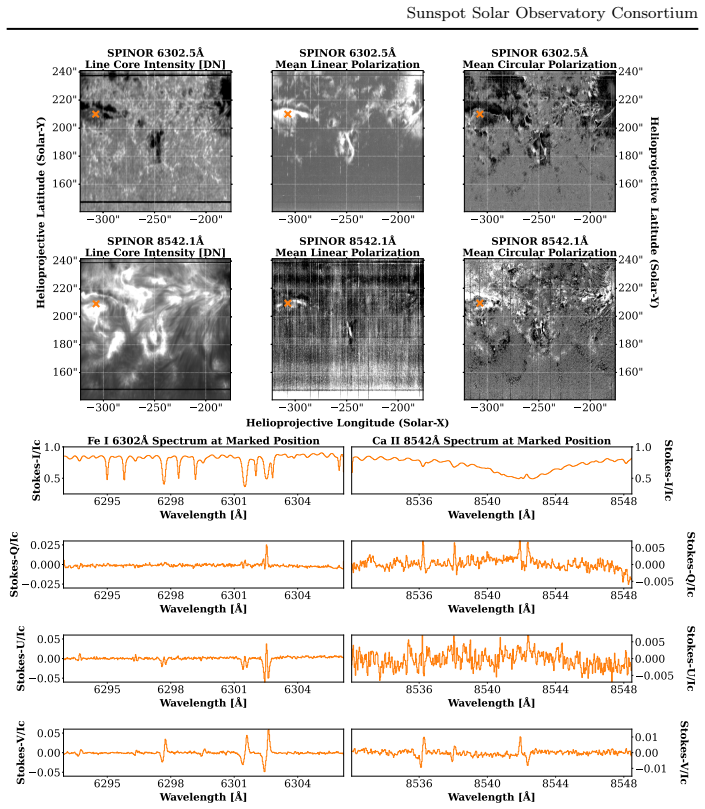
Summary. This manuscript describes the Sunspot Solar Observatory Data Archive (SSODA), a public archive of observations from the Dunn Solar Telescope (DST) under Sunspot Solar Observatory Consortium operations since February 2018. The paper defines data levels for FIRS, ROSA/HARDcam, SPINOR, HSG, and IBIS, describes the main synoptic observing campaigns, explains data-quality metrics (Seykora scintillation, HSM, MFGS), and documents metadata tracking and the public portal. A science use case presents FIRS Level-2 Hazel inversions from a May 2021 coronal-hole campaign as an illustration of the archive's products. The headline claims are that the archive contains approximately 374 TiB of data across more than 520 observing days, including raw and calibrated data; however, Section 3/Figure 7 report 374 TiB over more than 550 observing days, and Section 7 states over 375 TiB over more than 550 days.
Significance. If the archive matches the description, SSODA is a valuable community resource: it preserves a multi-instrument view of solar activity through the rise of Solar Cycle 25 and provides science-ready products, including speckle-reconstructed imaging, polarimetric reductions, and Hazel/SIR inversion maps. The paper's strengths are its detailed instrument-by-instrument data-level definitions, the public code repositories for the reduction pipelines, per-series seeing metrics, and the HEK/IRIS-aware metadata model. The Hazel inversion examples are not used to fit any parameter of this paper, so there is no circularity. The archive's usefulness hinges on the accuracy of the headline census and on the practical public accessibility of all data, which is exactly where the manuscript needs clarification.
major comments (2)
- [Abstract vs §3 (Fig. 7) and §7] The headline statistics for the archive are internally inconsistent. The Abstract states 'approximately 374 TiB of data across more than 520 observing days'; Figure 7 and Section 3 give a census 'as of April 24, 2025' of 374 TiB over 'over 550 observing days'; Section 7 states 'over 375 TiB of data taken over more than 550 observing days.' Because the central claim of this data-description paper is precisely the contents of the archive, the authors should harmonize these numbers, state a single census date, and ensure the Abstract and Summary quote the same quantities. As written, a reader cannot determine which figures describe the public archive.
- [§5 vs §7 and Abstract] The public-availability claim is qualified in a way that is not reflected in the Abstract or Summary. Section 5 states that 'certain observing series with oversized Level-0 data products may be housed in offline storage' and that these data are 'made accessible on specific request,' while Section 7 concludes that 'All archival data are publicly available.' Since the Abstract emphasizes that the SSODA 'includes both raw and calibrated data,' the manuscript should state how much of the 336 TiB of Level-0 data is offline, confirm whether those offline files are included in the headline totals, and describe the request procedure and typical turnaround time. Without this information, the abstract can be read as promising fully online access that the archive does not actually provide.
minor comments (4)
- [§2.4] The word 'Febraury' in the SPINOR example paragraph should be corrected to 'February'.
- [§4.2] The phrase 'if the the DST coverage' contains a duplicated 'the' and should be corrected.
- [Code Availability] The word 'depricated' should be 'deprecated' in the description of the firs-tools repository.
- [§5 and Data Availability] The archive is described only by bare URLs and date-directory paths; adding stable identifiers, such as a DOI for the SSODA top-level collection or per-series record identifiers, would make the holdings citable and the data-availability statement more reproducible.
Circularity Check
No circular reasoning: the paper is a descriptive data-archive report whose claims are external facts, not derived quantities.
full rationale
This paper describes the Sunspot Solar Observatory Data Archive (SSODA): its instruments, data levels, observing campaigns, quality metrics, and access routes. It makes no derivation of physical quantities from its own archive, and it presents no first-principles predictions that could reduce to fitted inputs. The archive volume and observing-day counts (Abstract: 'approximately 374 TiB' and 'more than 520 observing days'; §3/Figure 7: '374 TiB' and 'over 550 observing days'; Summary: 'over 375 TiB' and 'more than 550 observing days') are empirical reports of an external, live system, not outputs of a model fit to that system. The Hazel-2.0 inversion examples in Section 6 are illustrations of existing data products computed with an external code; they are not used to fit any parameter of this paper, so there is no self-definitional or fitted-input-called-prediction pattern. The only self-referential elements are citations to the authors' own GitHub repositories for pipeline code (SSOsoft, firs-tools) and references to prior DST science papers; these are code-availability statements and context citations, not load-bearing arguments that define the archive into existence. The internal inconsistency between '520' and '550' observing days is a factual consistency issue, not circularity, and the offline-storage caveat in Section 5 versus the Summary's 'All archival data are publicly available' is an external verification concern. Neither involves a derivation step that takes its conclusion as a premise. Accordingly, the paper is self-contained as a data description and warrants a circularity score of 0.
Assumptions & free parameters
assumptions (3)
- domain assumption Hazel 2.0 and SIR inversion codes produce trustworthy physical parameters from FIRS Stokes profiles.
- domain assumption HSM and MFGS image-quality metrics are reliable proxies for AO-corrected seeing quality.
- domain assumption The HEK event matching and metadata tracking in the archive are correct and complete.
Cite this review
Pith. "Pith review of The Sunspot Solar Observatory Data Archive: Continuing Operations at the Dunn Solar Telescope." pith.science (2026). https://pith.science/paper/ZR5UXVJ6
@misc{pith2026250521794,
  author       = {Pith},
  title        = {Pith review of: The Sunspot Solar Observatory Data Archive: Continuing Operations at the Dunn Solar Telescope},
  year         = {2026},
  howpublished = {\url{https://pith.science/paper/ZR5UXVJ6}},
  note         = {Machine review of arXiv:2505.21794}
}
read the original abstract
The Sunspot Solar Observatory Data Archive (SSODA) stores data acquired with the suite of instruments at the Richard B. Dunn Solar Telescope (DST) from February 2018 to the present. The instrumentation at the DST continues to provide high cadence imaging, spectroscopy, and polarimetry of the solar photosphere and chromosphere across a wavelength range from 3500\r{A} to 11,000\r{A}. At time of writing, the archive contains approximately 374 TiB of data across more than 520 observing days (starting on February 1, 2018). These numbers are approximate as the DST remains operational, and is actively adding new data to the archive. The SSODA includes both raw and calibrated data. A subset of the archive contains the results of photospheric and chromospheric spectropolarimetric inversions using the Hazel-2.0 code to obtain maps of magnetic fields, temperatures, and velocity flows. The SSODA represents a unique resource for the investigation of plasma processes throughout the solar atmosphere, the origin of space weather events, and the properties of active regions throughout the rise of Solar Cycle 25.
Figures


Figures from the paper (8 more)



Reference graph
Works this paper leans on
-
[1]
barticle Asensio Ramos , A. , Trujillo Bueno , J. , Landi Degl'Innocenti , E. : 2008 , Advanced Forward Modeling and Inversion of Stokes Profiles Resulting from the Joint Action of the Hanle and Zeeman Effects . ApJ 683 ( 1 ), 542 . 10.1086/589433 . barticle
doi:10.1086/589433 2008
-
[2]
barticle Bate , W. , Jess , D.B. , Nakariakov , V.M. , Grant , S.D.T. , Jafarzadeh , S. , Stangalini , M. , Keys , P.H. , Christian , D.J. , Keenan , F.P. : 2022 , High-frequency Waves in Chromospheric Spicules . 930 ( 2 ), 129 . 10.3847/1538-4357/ac5c53 . https://ui.adsabs.harvard.edu/abs/2022ApJ...930..129B . barticle
-
[3]
barticle Bate , W. , Jess , D.B. , Grant , S.D.T. , Hillier , A. , Skirvin , S.J. , Van Doorsselaere , T. , Jafarzadeh , S. , Wiegelmann , T. , Duckenfield , T. , Beck , C. , Moore , T. , Stangalini , M. , Keys , P.H. , Christian , D.J. : 2024 , Unveiling the True Nature of Plasma Dynamics from the Reference Frame of a Superpenumbral Fibril . 970 ( 1 ), 6...
-
[4]
barticle Borrero , J.M. , Jafarzadeh , S. , Sch \"u ssler , M. , Solanki , S.K. : 2017 , Solar Magnetoconvection and Small-Scale Dynamo. Recent Developments in Observation and Simulation . 210 ( 1-4 ), 275 . 10.1007/s11214-015-0204-5 . https://ui.adsabs.harvard.edu/abs/2017SSRv..210..275B . barticle
-
[5]
barticle Case , A.W. , Kasper , J.C. , Stevens , M.L. , Korreck , K.E. , Paulson , K. , Daigneau , P. , Caldwell , D. , Freeman , M. , Henry , T. , Klingensmith , B. , Bookbinder , J.A. , Robinson , M. , Berg , P. , Tiu , C. , Wright , J. K. H. , Reinhart , M.J. , Curtis , D. , Ludlam , M. , Larson , D. , Whittlesey , P. , Livi , R. , Klein , K.G. , Marti...
doi:10.3847/15 2020
-
[6]
barticle Casini , R. , White , S.M. , Judge , P.G. : 2017 , Magnetic Diagnostics of the Solar Corona: Synthesizing Optical and Radio Techniques . 210 ( 1-4 ), 145 . 10.1007/s11214-017-0400-6 . https://ui.adsabs.harvard.edu/abs/2017SSRv..210..145C . barticle
-
[7]
: 2006 , IBIS: A New Post-Focus Instrument for Solar Imaging Spectroscopy
barticle Cavallini , F. : 2006 , IBIS: A New Post-Focus Instrument for Solar Imaging Spectroscopy . 236 ( 2 ), 415 . 10.1007/s11207-006-0103-8 . https://ui.adsabs.harvard.edu/abs/2006SoPh..236..415C . barticle
-
[8]
barticle Christian , D.J. , Kuridze , D. , Jess , D.B. , Yousefi , M. , Mathioudakis , M. : 2019 , Multi-wavelength observations of the 2014 June 11 M3.9 flare: temporal and spatial characteristics . Research in Astronomy and Astrophysics 19 ( 7 ), 101 . 10.1088/1674-4527/19/7/101 . https://ui.adsabs.harvard.edu/abs/2019RAA....19..101C . barticle
Show all 61 references
-
[9]
, Title , A.M
barticle De Pontieu , B. , Title , A.M. , Lemen , J.R. , Kushner , G.D. , Akin , D.J. , Allard , B. , Berger , T. , Boerner , P. , Cheung , M. , Chou , C. , Drake , J.F. , Duncan , D.W. , Freeland , S. , Heyman , G.F. , Hoffman , C. , Hurlburt , N.E. , Lindgren , R.W. , Mathur...
2014
-
[10]
, Zhang , D
barticle Deng , H. , Zhang , D. , Wang , T. , Ji , K. , Wang , F. , Liu , Z. , Xiang , Y. , Jin , Z. , Cao , W. : 2015 , Objective Image-Quality Assessment for High-Resolution Photospheric Images by Median Filter-Gradient Similarity . 290 ( 5 ), 1479 . 10.1007/s11207-015-0676-...
2015 doi
-
[11]
, Dzif c \'a kov \'a , E
barticle Dud \' k , J. , Dzif c \'a kov \'a , E. , Meyer-Vernet , N. , Del Zanna , G. , Young , P.R. , Giunta , A. , Sylwester , B. , Sylwester , J. , Oka , M. , Mason , H.E. , Vocks , C. , Matteini , L. , Krucker , S. , Williams , D.R. , Mackovjak , S . : 2017 , Nonequilibriu...
2017 doi
-
[12]
: 1969 , Sacramento Peak's New Solar Telescope
barticle Dunn , R.B. : 1969 , Sacramento Peak's New Solar Telescope . Sky & Telescope 38 , 368 . https://ui.adsabs.harvard.edu/abs/1969S&T....38..368D . barticle
1969
-
[13]
, Giorgi , F
barticle Ermolli , I. , Giorgi , F. , Murabito , M. , Stangalini , M. , Guido , V. , Molinaro , M. , Romano , P. , Guglielmino , S.L. , Viavattene , G. , Cauzzi , G. , Criscuoli , S. , Reardon , K.P. , Tritschler , A. : 2022 , IBIS-A: The IBIS data Archive. High-resolution obs...
2022 doi
-
[14]
, Jess , D.B
barticle Gilchrist-Millar , C.A. , Jess , D.B. , Grant , S.D.T. , Keys , P.H. , Beck , C. , Jafarzadeh , S. , Riedl , J.M. , Van Doorsselaere , T. , Ruiz Cobo , B. : 2021 , Magnetoacoustic wave energy dissipation in the atmosphere of solar pores . Philosophical Transactions of...
2021
-
[15]
, van der Holst , B
barticle Gombosi , T.I. , van der Holst , B. , Manchester , W.B. , Sokolov , I.V. : 2018 , Extended MHD modeling of the steady solar corona and the solar wind . Living Reviews in Solar Physics 15 ( 1 ), 4 . 10.1007/s41116-018-0014-4 . https://ui.adsabs.harvard.edu/abs/2018LRSP...
2018 doi
-
[16]
, Jess , D.B
barticle Grant , S.D.T. , Jess , D.B. , Moreels , M.G. , Morton , R.J. , Christian , D.J. , Giagkiozis , I. , Verth , G. , Fedun , V. , Keys , P.H. , Van Doorsselaere , T. , Erd \'e lyi , R. : 2015 , Wave Damping Observed in Upwardly Propagating Sausage-mode Oscillations Conta...
2015 doi
-
[17]
, Jess , D.B
barticle Grant , S.D.T. , Jess , D.B. , Zaqarashvili , T.V. , Beck , C. , Socas-Navarro , H. , Aschwanden , M.J. , Keys , P.H. , Christian , D.J. , Houston , S.J. , Hewitt , R.L. : 2018 , Alfv \'e n wave dissipation in the solar chromosphere . Nature Physics 14 ( 5 ), 480 . 10...
2018 doi
-
[18]
, Jess , D.B
barticle Grant , S.D.T. , Jess , D.B. , Stangalini , M. , Jafarzadeh , S. , Fedun , V. , Verth , G. , Keys , P.H. , Rajaguru , S.P. , Uitenbroek , H. , MacBride , C.D. , Bate , W. , Gilchrist-Millar , C.A. : 2022 , The Propagation of Coherent Waves Across Multiple Solar Magnet...
2022 doi
-
[19]
, Carlsson , M
barticle Gudiksen , B.V. , Carlsson , M. , Hansteen , V.H. , Hayek , W. , Leenaarts , J. , Mart \' nez-Sykora , J. : 2011 , The stellar atmosphere simulation code Bifrost. Code description and validation . 531 , A154 . 10.1051/0004-6361/201116520 . https://ui.adsabs.harvard.ed...
2011 doi
-
[20]
, Scherer , S
bchapter Helmli , F.S. , Scherer , S. : 2001 , Adaptive shape from focus with an error estimation in light microscopy . In: ISPA 2001. Proceedings of the 2nd International Symposium on Image and Signal Processing and Analysis. In conjunction with 23rd International Conference ...
2001
-
[21]
, Lin , H
barticle Jaeggli , S.A. , Lin , H. , Mickey , D.L. , Kuhn , J.R. , Hegwer , S.L. , Rimmele , T.R. , Penn , M.J. : 2010 , FIRS: a new instrument for photospheric and chromospheric studies at the DST. Memorie della Societa Astronomica Italiana 81 , 763 . https://ui.adsabs.harvar...
2010
-
[22]
, Mathioudakis , M
barticle Jess , D.B. , Mathioudakis , M. , Christian , D.J. , Keenan , F.P. , Ryans , R.S.I. , Crockett , P.J. : 2010 , ROSA: A High-cadence, Synchronized Multi-camera Solar Imaging System . 261 ( 2 ), 363 . 10.1007/s11207-009-9500-0 . https://ui.adsabs.harvard.edu/abs/2010SoP...
2010 doi
-
[23]
, De Moortel , I
barticle Jess , D.B. , De Moortel , I. , Mathioudakis , M. , Christian , D.J. , Reardon , K.P. , Keys , P.H. , Keenan , F.P. : 2012 , The Source of 3 Minute Magnetoacoustic Oscillations in Coronal Fans . 757 ( 2 ), 160 . 10.1088/0004-637X/757/2/160 . https://ui.adsabs.harvard....
2012 doi
-
[24]
, Morton , R.J
barticle Jess , D.B. , Morton , R.J. , Verth , G. , Fedun , V. , Grant , S.D.T. , Giagkiozis , I. : 2015 , Multiwavelength Studies of MHD Waves in the Solar Chromosphere. An Overview of Recent Results . 190 ( 1-4 ), 103 . 10.1007/s11214-015-0141-3 . https://ui.adsabs.harvard.e...
2015 doi
-
[25]
, Van Doorsselaere , T
barticle Jess , D.B. , Van Doorsselaere , T. , Verth , G. , Fedun , V. , Krishna Prasad , S. , Erd \'e lyi , R. , Keys , P.H. , Grant , S.D.T. , Uitenbroek , H. , Christian , D.J. : 2017 , An Inside Look at Sunspot Oscillations with Higher Azimuthal Wavenumbers . 842 ( 1 ), 59...
2017 doi
-
[26]
, Snow , B
barticle Jess , D.B. , Snow , B. , Houston , S.J. , Botha , G.J.J. , Fleck , B. , Krishna Prasad , S. , Asensio Ramos , A. , Morton , R.J. , Keys , P.H. , Jafarzadeh , S. , Stangalini , M. , Grant , S.D.T. , Christian , D.J. : 2020 , A chromospheric resonance cavity in a sunsp...
2020 doi
-
[27]
, Grant , S.D.T
barticle Jess , D.B. , Grant , S.D.T. , Bate , W. , Liu , J. , Jafarzadeh , S. , Keys , P.H. , Vieira , L.E.A. , Dal Lago , A. , Guarnieri , F.L. , Christian , D.J. , Gilliam , D. , Banerjee , D. : 2023 a, The Fibre Resolved OpticAl and Near-Ultraviolet Czerny-Turner Imaging S...
2023 doi
-
[28]
, Jafarzadeh , S
barticle Jess , D.B. , Jafarzadeh , S. , Keys , P.H. , Stangalini , M. , Verth , G. , Grant , S.D.T. : 2023 b, Waves in the lower solar atmosphere: the dawn of next-generation solar telescopes . Living Reviews in Solar Physics 20 ( 1 ), 1 . 10.1007/s41116-022-00035-6 . https:/...
2023 doi
-
[29]
, Abiad , R
barticle Kasper , J.C. , Abiad , R. , Austin , G. , Balat-Pichelin , M. , Bale , S.D. , Belcher , J.W. , Berg , P. , Bergner , H. , Berthomier , M. , Bookbinder , J. , Brodu , E. , Caldwell , D. , Case , A.W. , Chandran , B.D.G. , Cheimets , P. , Cirtain , J.W. , Cranmer , S.R...
2016
-
[30]
, Furenlid , I
bbook Kurucz , R.L. , Furenlid , I. , Brault , J. , Testerman , L. : 1984 , Solar flux atlas from 296 to 1300 nm . https://ui.adsabs.harvard.edu/abs/1984sfat.book.....K . bbook
1984
-
[31]
, Title , A.M
barticle Lemen , J.R. , Title , A.M. , Akin , D.J. , Boerner , P.F. , Chou , C. , Drake , J.F. , Duncan , D.W. , Edwards , C.G. , Friedlaender , F.M. , Heyman , G.F. , Hurlburt , N.E. , Katz , N.L. , Kushner , G.D. , Levay , M. , Lindgren , R.W. , Mathur , D.P. , McFeaters , E...
2012
-
[32]
, Jess , D.B
barticle MacBride , C.D. , Jess , D.B. , Grant , S.D.T. , Khomenko , E. , Keys , P.H. , Stangalini , M. : 2021 , Accurately constraining velocity information from spectral imaging observations using machine learning techniques . Philosophical Transactions of the Royal Society ...
2021
-
[33]
, del Toro Iniesta , J.C
barticle Mart \' nez Pillet , V. , del Toro Iniesta , J.C. , \'A lvarez-Herrero , A. , Domingo , V. , Bonet , J.A. , Gonz \'a lez Fern \'a ndez , L. , L \'o pez Jim \'e nez , A. , Pastor , C. , Gasent Blesa , J.L. , Mellado , P. , Piqueras , J. , Aparicio , B. , Balaguer , M. ...
2011
-
[34]
, Jess , D.B
barticle Mathioudakis , M. , Jess , D.B. , Erd \'e lyi , R. : 2013 , Alfv \'e n Waves in the Solar Atmosphere. From Theory to Observations . 175 ( 1-4 ), 1 . 10.1007/s11214-012-9944-7 . https://ui.adsabs.harvard.edu/abs/2013SSRv..175....1M . barticle
2013 doi
-
[35]
, Verth , G
barticle Morton , R.J. , Verth , G. , Jess , D.B. , Kuridze , D. , Ruderman , M.S. , Mathioudakis , M. , Erd \'e lyi , R. : 2012 , Observations of ubiquitous compressive waves in the Sun's chromosphere . Nature Communications 3 , 1315 . 10.1038/ncomms2324 . https://ui.adsabs.h...
2012 doi
-
[36]
, Stangalini , M
barticle Murabito , M. , Stangalini , M. , Laming , J.M. , Baker , D. , To , A.S.H. , Long , D.M. , Brooks , D.H. , Jafarzadeh , S. , Jess , D.B. , Valori , G. : 2024 , Observation of Alfv \'e n Wave Reflection in the Solar Chromosphere: Ponderomotive Force and First Ionizatio...
2024 doi
-
[37]
: 1957 , Sweet's Mechanism for Merging Magnetic Fields in Conducting Fluids
barticle Parker , E.N. : 1957 , Sweet's Mechanism for Merging Magnetic Fields in Conducting Fluids . 62 ( 4 ), 509 . 10.1029/JZ062i004p00509 . https://ui.adsabs.harvard.edu/abs/1957JGR....62..509P . barticle
1957 doi
-
[38]
, Radlak , K
barticle Popowicz , A. , Radlak , K. , Bernacki , K. , Orlov , V. : 2017 , Review of Image Quality Measures for Solar Imaging . 292 ( 12 ), 187 . 10.1007/s11207-017-1211-3 . https://ui.adsabs.harvard.edu/abs/2017SoPh..292..187P . barticle
2017 doi
-
[39]
, Cavallini , F
barticle Reardon , K.P. , Cavallini , F. : 2008 , Characterization of Fabry-Perot interferometers and multi-etalon transmission profiles. The IBIS instrumental profile . 481 ( 3 ), 897 . 10.1051/0004-6361:20078473 . https://ui.adsabs.harvard.edu/abs/2008A&A...481..897R . barticle
2008 doi
-
[40]
: 2014 , Numerical Simulations of Quiet Sun Magnetism: On the Contribution from a Small-scale Dynamo
barticle Rempel , M. : 2014 , Numerical Simulations of Quiet Sun Magnetism: On the Contribution from a Small-scale Dynamo . 789 ( 2 ), 132 . 10.1088/0004-637X/789/2/132 . https://ui.adsabs.harvard.edu/abs/2014ApJ...789..132R . barticle
2014 doi
-
[41]
u ssler , M. , Kn \
barticle Rempel , M. , Sch \"u ssler , M. , Kn \"o lker , M. : 2009 , Radiative Magnetohydrodynamic Simulation of Sunspot Structure . 691 ( 1 ), 640 . 10.1088/0004-637X/691/1/640 . https://ui.adsabs.harvard.edu/abs/2009ApJ...691..640R . barticle
2009 doi
-
[42]
, Cavallini , F
barticle Righini , A. , Cavallini , F. , Reardon , K.P. : 2010 , Imaging performance of multi-etalon bidimensional spectrometers . 515 , A85 . 10.1051/0004-6361/200913302 . https://ui.adsabs.harvard.edu/abs/2010A&A...515A..85R . barticle
2010 doi
-
[43]
, Radick , R.R
bchapter Rimmele , T.R. , Radick , R.R. : 1998 , Solar adaptive optics at the National Solar Observatory . In: Bonaccini , D. , Tyson , R.K. (eds.) Adaptive Optical System Technologies , Society of Photo-Optical Instrumentation Engineers (SPIE) Conference Series 3353 , 72 . 10...
1998 doi
-
[44]
, Richards , K
bchapter Rimmele , T.R. , Richards , K. , Hegwer , S. , Fletcher , S. , Gregory , S. , Moretto , G. , Didkovsky , L.V. , Denker , C.J. , Dolgushin , A. , Goode , P.R. , Langlois , M. , Marino , J. , Marquette , W. : 2004 , First results from the NSO/NJIT solar adaptive optics ...
2004 doi
-
[45]
, Uritsky , V.M
barticle Roberts , M.A. , Uritsky , V.M. , DeVore , C.R. , Karpen , J.T. : 2018 , Simulated Encounters of the Parker Solar Probe with a Coronal-hole Jet . 866 ( 1 ), 14 . 10.3847/1538-4357/aadb41 . https://ui.adsabs.harvard.edu/abs/2018ApJ...866...14R . barticle
2018 doi
-
[46]
, del Toro Iniesta , J.C
barticle Ruiz Cobo , B. , del Toro Iniesta , J.C. : 1992 , Inversion of Stokes Profiles . 398 , 375 . 10.1086/171862 . https://ui.adsabs.harvard.edu/abs/1992ApJ...398..375R . barticle
1992 doi
-
[47]
, Schou , J
barticle Scherrer , P.H. , Schou , J. , Bush , R.I. , Kosovichev , A.G. , Bogart , R.S. , Hoeksema , J.T. , Liu , Y. , Duvall , T.L. , Zhao , J. , Title , A.M. , Schrijver , C.J. , Tarbell , T.D. , Tomczyk , S. : 2012 , The Helioseismic and Magnetic Imager (HMI) Investigation ...
2012 doi
-
[48]
: 1993 , Solar Scintillation and the Monitoring of Solar Seeing
barticle Seykora , E.J. : 1993 , Solar Scintillation and the Monitoring of Solar Seeing . 145 ( 2 ), 389 . 10.1007/BF00690664 . https://ui.adsabs.harvard.edu/abs/1993SoPh..145..389S . barticle
1993 doi
-
[49]
, Elmore , D
barticle Socas-Navarro , H. , Elmore , D. , Pietarila , A. , Darnell , A. , Lites , B.W. , Tomczyk , S. , Hegwer , S. : 2006 , Spinor: Visible and Infrared Spectro-Polarimetry at the National Solar Observatory . 235 ( 1-2 ), 55 . 10.1007/s11207-006-0020-x . https://ui.adsabs.h...
2006 doi
-
[50]
, Verth , G
barticle Stangalini , M. , Verth , G. , Fedun , V. , Aldhafeeri , A.A. , Jess , D.B. , Jafarzadeh , S. , Keys , P.H. , Fleck , B. , Terradas , J. , Murabito , M. , Ermolli , I. , Soler , R. , Giorgi , F. , MacBride , C.D. : 2022 , Large scale coherent magnetohydrodynamic oscil...
2022 doi
-
[51]
: 1958 , The production of high energy particles in solar flares
barticle Sweet , P.A. : 1958 , The production of high energy particles in solar flares . Il Nuovo Cimento 8 ( S2 ), 188 . 10.1007/BF02962520 . https://ui.adsabs.harvard.edu/abs/1958NCim....8S.188S . barticle
1958 doi
-
[52]
, Ichimoto , K
barticle Tsuneta , S. , Ichimoto , K. , Katsukawa , Y. , Nagata , S. , Otsubo , M. , Shimizu , T. , Suematsu , Y. , Nakagiri , M. , Noguchi , M. , Tarbell , T. , Title , A. , Shine , R. , Rosenberg , W. , Hoffmann , C. , Jurcevich , B. , Kushner , G. , Levay , M. , Lites , B. ...
2008 doi
-
[53]
, Klein , K.G
barticle Verscharen , D. , Klein , K.G. , Maruca , B.A. : 2019 , The multi-scale nature of the solar wind . Living Reviews in Solar Physics 16 ( 1 ), 5 . 10.1007/s41116-019-0021-0 . https://ui.adsabs.harvard.edu/abs/2019LRSP...16....5V . barticle
2019 doi
-
[54]
, Jackiewicz , J
barticle Vesa , O. , Jackiewicz , J. , Reardon , K. : 2023 , Multiheight Observations of Atmospheric Gravity Waves at Solar Disk Center . 952 ( 1 ), 58 . 10.3847/1538-4357/acd930 . https://ui.adsabs.harvard.edu/abs/2023ApJ...952...58V . barticle
2023 doi
-
[55]
o gler , A. , Shelyag , S. , Sch \
barticle V \"o gler , A. , Shelyag , S. , Sch \"u ssler , M. , Cattaneo , F. , Emonet , T. , Linde , T. : 2005 , Simulations of magneto-convection in the solar photosphere. Equations, methods, and results of the MURaM code . 429 , 335 . 10.1051/0004-6361:20041507 . https://ui....
2005 doi
-
[56]
, Hinkle , K
bbook Wallace , L. , Hinkle , K. , Livingston , W. : 2007 , An Atlas of the Spectrum of the Solar Photosphere from 13,500 to 33,980 cm ^ -1 (2942 to 7405 A ) . https://ui.adsabs.harvard.edu/abs/2007assp.book.....W . bbook
2007
-
[57]
, Jenkins , J.M
barticle Wang , S. , Jenkins , J.M. , Martinez Pillet , V. , Beck , C. , Long , D.M. , Prasad Choudhary , D. , Muglach , K. , McAteer , J. : 2020 , Magnetic Structure of an Erupting Filament . 892 ( 2 ), 75 . 10.3847/1538-4357/ab7380 . https://ui.adsabs.harvard.edu/abs/2020ApJ...
2020 doi
-
[58]
, Jenkins , J.M
barticle Wang , S. , Jenkins , J.M. , Muglach , K. , Martinez Pillet , V. , Beck , C. , Long , D.M. , Choudhary , D.P. , McAteer , J. : 2022 , Velocities of an Erupting Filament . 926 ( 1 ), 18 . 10.3847/1538-4357/ac3a04 . https://ui.adsabs.harvard.edu/abs/2022ApJ...926...18W ...
2022 doi
-
[59]
, Larson , D.E
barticle Whittlesey , P.L. , Larson , D.E. , Kasper , J.C. , Halekas , J. , Abatcha , M. , Abiad , R. , Berthomier , M. , Case , A.W. , Chen , J. , Curtis , D.W. , Dalton , G. , Klein , K.G. , Korreck , K.E. , Livi , R. , Ludlam , M. , Marckwordt , M. , Rahmati , A. , Robinson...
2020 doi
-
[60]
o ger , F. , von der L \
bchapter W \"o ger , F. , von der L \"u he , I. Oskar : 2008 , KISIP: a software package for speckle interferometry of adaptive optics corrected solar data . In: Bridger , A. , Radziwill , N.M. (eds.) Advanced Software and Control for Astronomy II , Society of Photo-Optical In...
2008 doi
-
[61]
o ger , F. , von der L \
barticle W \"o ger , F. , von der L \"u he , O. , Reardon , K. : 2008 , Speckle interferometry with adaptive optics corrected solar data . 488 ( 1 ), 375 . 10.1051/0004-6361:200809894 . https://ui.adsabs.harvard.edu/abs/2008A&A...488..375W . barticle
2008 doi
Reviewed August 7, 2026 · model on record in the stance chip above.
Discussion (0). Continue with ORCID to comment.