REVIEW 3 major objections 3 minor 45 references
A Detailed Spectral Study of Intermittent-Accreting Millisecond X-ray Pulsar Aql X-1 during Pulse-on and Pulse-off Stages
T0 review · 3 major / 3 minor · reviewed 2026-08-10 · deepseek-v4-flash
Pith's one-line read Aql X-1's pulse traces a 1.65 km hotspot on the neutron star
desk verdict The hotspot spectral component is plausible but not required: the data fit as well with a free continuum, and the paper never tests the two models statistically. read the letter →
The pith
A machine-rendered reading of the paper's core claim, the machinery that carries it, and where it could break.
The reading
What carries the argument
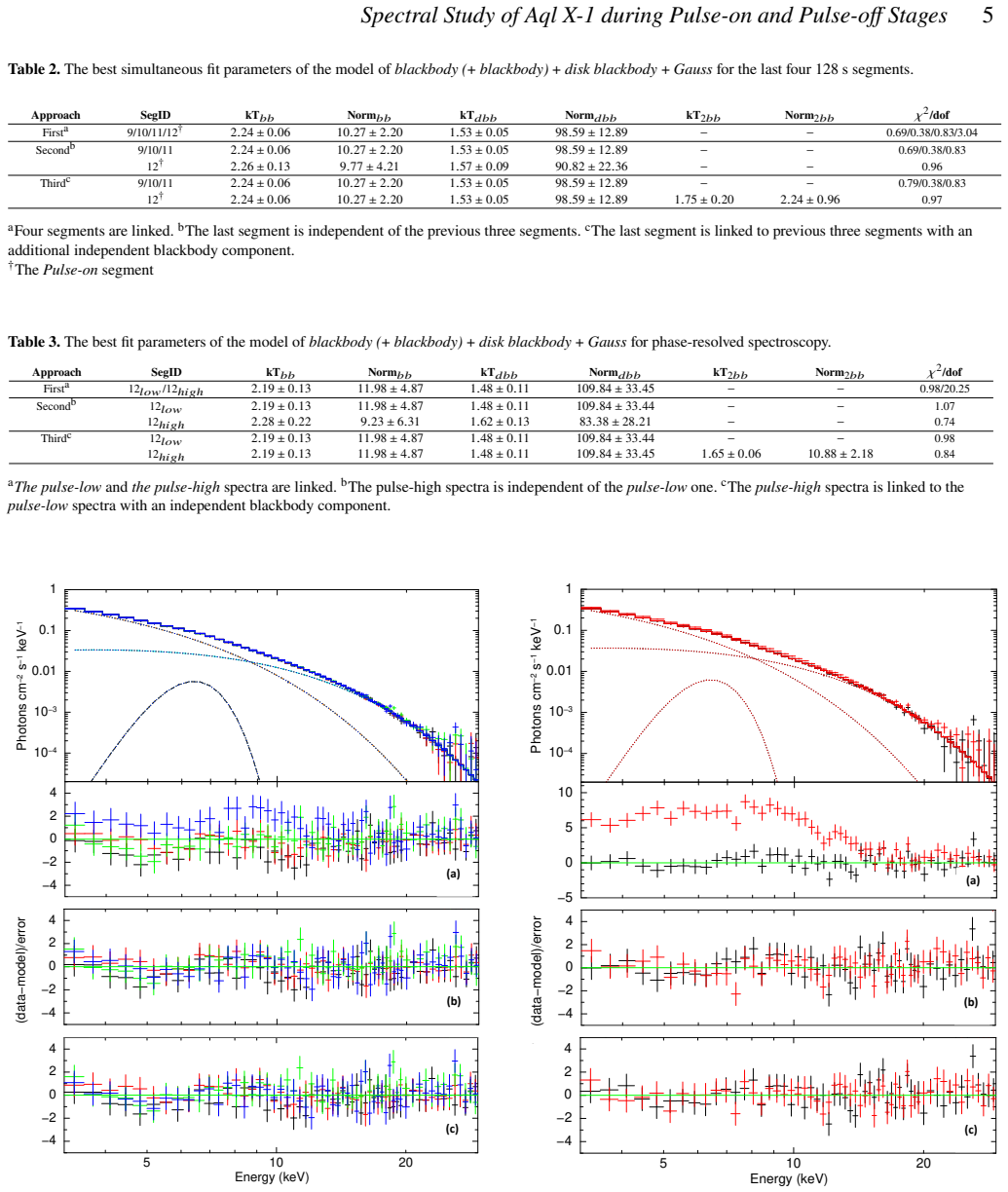
The carrier of the argument is phase-resolved spectroscopy on the last 128 s of the pulse-on observation, splitting the folded pulse into pulse-high (spin phase 0.75–0.25) and pulse-low (0.25–0.75) spectra. The diagnostic is an additive blackbody component (bbodyrad in XSPEC) appended only to the pulse-high spectrum while the shared continuum parameters are held fixed; the radius is recovered from the normalization through the assumed 5 kpc distance, assuming a circular emitting spot.
What would settle it
Re-fit the pulse-high spectrum of the same 128 s segment with all continuum parameters free and no added blackbody, then compare the improvement from adding the hotspot component; the paper's own Table 3 shows $\chi^2$/dof = 0.74 for the free-continuum fit versus 0.84 for the hotspot fit, so a decisive test needs higher signal-to-noise data where the two models separate. Alternatively, search for the expected sinusoidal modulation of the blackbody temperature or normalization over spin phase in a longer pulse-on episode.
Extended reading notes
Core claim
The central claim is that the coherent 550.27 Hz pulsation in Aql X-1 has a spectral signature: a small, hot blackbody component that appears only in the pulse-high phase. When pulse-high and pulse-low spectra are forced to share the same continuum parameters, a residual excess appears between roughly 3 and 13 keV in the pulse-high spectrum, matching the energy range where the pulse is temporally strongest. Modeling that excess with an additional blackbody gives a temperature of 1.65 ± 0.06 keV and, assuming a distance of 5 kpc, a radius of 1.65 ± 0.74 km as reported in the abstract. The authors interpret this as a hotspot, likely at high magnetic latitude, and note that its flux contribution of about 8.6% of the total is broadly consistent with the measured pulse fraction of about 4.5%.
Load-bearing premise
The hotspot's existence depends on the assumption that the non-pulsed continuum shape is identical in the pulse-high and pulse-low phases; if the continuum is allowed to differ, the 3–13 keV residual disappears without needing any extra component.
Editorial extensions
If this is right
- The hotspot radius of about 1.6 km is far smaller than the neutron star radius, consistent with a magnetic polar cap rather than a global surface component.
- The pulse fraction of about 4.5% and the blackbody flux fraction of about 8.6% of the total flux link the spectral excess to the rotational modulation.
- The pulse-on residual in the 3–13 keV band independently corroborates the temporal detection in the same band, strengthening the case that the pulse and the spectral excess share a common origin.
- If the hotspot is real, its temperature and size can be used to estimate the local accretion column geometry and, indirectly, the magnetic field strength at the neutron star surface.
Reading between the lines
- Because the extra blackbody is only required when the continuum is frozen, the hotspot interpretation is not unique: the paper's own second approach, with free continuum parameters, fits the pulse-high spectrum without any added component ($\chi^2$/dof = 0.74 versus 0.84 with the hotspot). A higher-signal observation should decide between these.
- If the hotspot is confirmed, the same phase-resolved technique applied to other intermittent AMXPs (HETE J1900.1-2455, SAX J1748.9-2021) could test whether hotspot size scales with pulse strength or duty cycle.
- The 8.6% flux fraction is computed from a blackbody component spread over the RXTE band, while the pulse fraction is measured only in a limited energy range; a direct comparison would require accounting for gravitational redshift and fast rotation, as the authors themselves note.
Editorial analysis
A structured set of objections, weighed in public.
Referee Report
Summary. The paper analyzes archival RXTE/PCA observations of the intermittent accreting millisecond X-ray pulsar Aql X-1 during its 1998 outburst, focusing on the pulse-on episode. The authors perform a Z^2_1 timing search in three energy bands, confirming the 550.27 Hz signal and showing that it is strongest in the 3.0-13.0 keV band. They then carry out spectral modeling with an absorbed blackbody plus disk blackbody plus Gaussian line, first on the last four 128 s segments and then with phase-resolved spectroscopy of the pulse-on segment. The central claim is that an additional blackbody component, present only in the pulse-high phase, represents a hotspot on the neutron star surface with a temperature of about 1.65 keV and a radius near 1.65 km.
Significance. If the hotspot detection were statistically robust, it would provide a useful measurement of the pulsed emission region in an intermittent AMXP and would strengthen the connection between timing and spectral behavior. The temporal analysis is a strength: the pulse detection, trial correction, and energy-dependent significance are presented carefully, and the estimated pulse fraction is consistent with earlier work. However, the main spectral claim is not supported by the paper's own fits: the pulse-high spectrum is adequately fitted without the extra blackbody when the continuum parameters are free, so the proposed hotspot is degenerate with continuum variation. This undercuts the abstract's primary conclusion and the discussion section.
major comments (3)
- [§2.2.3, Table 3] Approach (b), which lets the continuum parameters of the pulse-high spectrum vary independently, yields chi^2/dof = 0.74 without any additional blackbody component, while approach (c), which adds the proposed hotspot blackbody, yields chi^2/dof = 0.84. The reduced chi-square is therefore lower when the continuum is allowed to vary than when the extra component is included, so the data do not require the additional blackbody. The paper does not report raw chi-square and degrees-of-freedom values or an F-test, likelihood-ratio test, or AIC/BIC comparison between approaches (b) and (c), and without such a test the abstract's statement that the residual 'indicates a hotspot' is not justified.
- [§2.2.3, Table 3] The hotspot interpretation is built on the assumption that kT_bb, Norm_bb, kT_dbb, and Norm_dbb are identical between the pulse-low and pulse-high phases. This assumption is imposed rather than derived, and approach (b) demonstrates that a modest change in the continuum produces an acceptable fit without any extra component. Consequently, the extra blackbody is degenerate with continuum variation, and its fitted temperature and normalization are not independent measurements of a hotspot unless the continuum-linkage assumption is physically defended.
- [Abstract and §2.2.3] The reported hotspot radius is internally inconsistent: the abstract states 1.65 +/- 0.74 km, while Section 2.2.3 states 1.65 +/- 0.54 km. Since this radius is one of the two headline results, the discrepancy must be resolved and the correct uncertainty reported consistently.
minor comments (3)
- [§2.2.2, Table 2] In the first approach of Table 2, four separate chi^2/dof values are listed for the simultaneous fit; please clarify whether these are per-segment contributions to a joint chi-square or independent fits, as this affects how the reader interprets the quoted statistics.
- [§2.2.2] The sentence 'the parameters were improved physically and statistically' is vague; please specify which parameters changed and which statistic improved when the extra blackbody was added.
- [Throughout] The notation alternates between '12_low/12_high' and 'pulse-low/pulse-high', and the phase definitions in the text ('0.75 - 0.25' and '0.25 - 0.75') are stated twice with the same words in different order; a consistent definition with a single phase convention would improve readability.
Circularity Check
The hotspot 'indication' is a fitted extra blackbody component, and Table 3 shows a free-continuum fit removes the need for it, so the central result is partially a fitted construct rather than an independent prediction.
-
fitted input called prediction
[Section 2.2.3 (Step 3) and Table 3; Abstract]
"We finally refitted only the pulse-high segment by adding an extra blackbody component assuming that the extra radiation comes from the hotspot which is the cause of the observed coherent pulsation. The temperature of the extra blackbody component is obtained to be about 1.65±0.06 keV whose radius of 1.65±0.54 km indicated by its normalization."
The hotspot is not independently predicted: it is introduced as the assumed source of an extra blackbody that is added specifically to absorb the pulse-high residual. Its temperature and radius are therefore direct outputs of the very component that defines the hotspot, so they cannot confirm the hotspot interpretation. Table 3 makes the reduction explicit: approach (b) fits the pulse-high spectrum with the continuum parameters free and no extra component at chi2/dof=0.74, while approach (c) freezes the continuum to pulse-low values and adds the extra blackbody at chi2/dof=0.84; no F-test, likelihood-ratio test, or AIC/BIC is reported. The claimed hotspot radius/temperature consequently reduce to a fit choice rather than a derived prediction.
full rationale
The temporal analysis (Z^2_n detection of the 550.27 Hz pulse, strongest in 3-13 keV) is self-contained and provides independent support in the same energy range as the soft residual, which is why this is not a fully forced circularity. The spectral continuum modeling is also tested against several common models rather than being imposed by self-citation. However, the central phase-resolved claim that the extra blackbody 'indicates a hotspot' with a specific radius and temperature is partially circular: those numbers are parameters of the component added to fit the residual, and the alternative free-continuum model in Table 3 (approach b) fits at least as well without any hotspot component. The abstract reports the hotspot radius as 1.65±0.74 km while Section 2.2.3 gives 1.65±0.54 km, an inconsistency that does not change the circularity assessment but reinforces the fragility of the reported value.
Assumptions & free parameters
free parameters (2)
- Additional blackbody temperature (kT2bb) =
1.65 +/- 0.06 keV (phase-resolved); 1.75 +/- 0.20 keV (segmented)
- Additional blackbody normalization (Norm2bb) =
10.88 +/- 2.18 (phase-resolved); 2.24 +/- 0.96 (segmented)
assumptions (4)
- domain assumption The spectrum of Aql X-1 in the soft state is described by phabs * (bbodyrad + diskbb + gau).
- domain assumption The neutral hydrogen column density N_H = 3.4e21 cm^-2 is fixed from Maccarone & Coppi (2003).
- domain assumption The distance to the source is 5 kpc, taken from Jonker & Nelemans (2004).
- ad hoc to paper The continuum parameters are assumed to be identical between the pulse-low and pulse-high phases.
invented entities (1)
-
Extra blackbody component / hotspot on the neutron star surface
Cite this review
Pith. "Pith review of A Detailed Spectral Study of Intermittent-Accreting Millisecond X-ray Pulsar Aql X-1 during Pulse-on and Pulse-off Stages." pith.science (2026). https://pith.science/paper/ZR6FMXC5
@misc{pith2026250104542,
  author       = {Pith},
  title        = {Pith review of: A Detailed Spectral Study of Intermittent-Accreting Millisecond X-ray Pulsar Aql X-1 during Pulse-on and Pulse-off Stages},
  year         = {2026},
  howpublished = {\url{https://pith.science/paper/ZR6FMXC5}},
  note         = {Machine review of arXiv:2501.04542}
}
abstract
We present a detailed spectral study of an intermittent-AMXP Aql X-1 during the pulse-on and pulse-off stages by using the archival RXTE data. We first perform temporal analysis by using Z$_n^2$ technique in three different energy bands, 3.0 -- 13.0 keV, 13.0 -- 23.0 keV and 23.0 -- 33.0 keV, for the last 128 s time segment of the RXTE data including pulse-on region. We show that the pulse is the most significant in the softest band. We, then, show that the spectrum is represented the best via combination of absorbed blackbody, disk blackbody and a gaussian line. We modeled the last four segments of the data 30188-03-05-00 to better compare pulse-on and pulse-off stages. We found a vague residual in the spectral fit of the pulse-on segment between $\sim$3.0 -- 13.0 keV which agrees with the result of temporal analysis. We show that the residual may be represented with an extra blackbody component with the temperature of 1.75 keV and the radius of 0.75$\pm$0.49 km. For deeper analysis, we performed phase-resolved spectroscopy to the last 128 s, pulse-on, segment. We obtain two separate spectra for the spin phase range of 0.75 -- 0.25, pulse-high and 0.25 -- 0.75, pulse-low and followed the same procedure. We display that the residual becomes more clear for pulse-high compared to the pulse-low. We report that the additional blackbody component, which models the residual, indicates a hotspot from the surface of the neutron star with the radius of 1.65$\pm$0.74 km whose temperature is 1.65 keV.
Figures


Reference graph
Works this paper leans on
-
[1]
Abdelfatah A. S., Nasser M. A., Abdelbar A. M., Beheary M. M., 2021, @doi [Journal of High Energy Astrophysics] 10.1016/j.jheap.2021.05.001 , https://ui.adsabs.harvard.edu/abs/2021JHEAp..31...12A 31, 12
-
[2]
Alpar M. A., Cheng A. F., Ruderman M. A., Shaham J., 1982, @doi [ ] 10.1038/300728a0 , http://adsabs.harvard.edu/abs/1982Natur.300..728A 300, 728
doi:10.1038/300728a0 1982
-
[3]
Asai K., Dotani T., Nagase F., Mitsuda K., 2000, @doi [ ] 10.1086/317374 , https://ui.adsabs.harvard.edu/abs/2000ApJS..131..571A 131, 571
doi:10.1086/317374 2000
-
[4]
Bahramian A., Degenaar N., 2022, arXiv e-prints, https://ui.adsabs.harvard.edu/abs/2022arXiv220610053B p. arXiv:2206.10053
arXiv 2022
-
[5]
Bhattacharya D., van den Heuvel E. P. J., 1991, @doi [ ] 10.1016/0370-1573(91)90064-S , http://adsabs.harvard.edu/abs/1991PhR...203....1B 203, 1
-
[6]
V., Rothschild R
Bradt H. V., Rothschild R. E., Swank J. H., 1993, , https://ui.adsabs.harvard.edu/abs/1993A&AS...97..355B 97, 355
1993
-
[7]
Buccheri R., et al., 1983, , https://ui.adsabs.harvard.edu/abs/1983A&A...128..245B 128, 245
work page 1983
-
[8]
Bult P., et al., 2022, @doi [ ] 10.3847/2041-8213/ac87f9 , https://ui.adsabs.harvard.edu/abs/2022ApJ...935L..32B 935, L32
Show all 45 references
-
[9]
I., Rea N., Vida \ n a I., eds, Astrophysics and Space Science Library Vol
Campana S., Di Salvo T., 2018, in Rezzolla L., Pizzochero P., Jones D. I., Rea N., Vida \ n a I., eds, Astrophysics and Space Science Library Vol. 457, Astrophysics and Space Science Library. p. 149 ( @eprint arXiv 1804.03422 ), @doi 10.1007/978-3-319-97616-7_4
2018 arXiv
-
[10]
Campana S., Coti Zelati F., D'Avanzo P., 2013, @doi [ ] 10.1093/mnras/stt604 , http://adsabs.harvard.edu/abs/2013MNRAS.432.1695C 432, 1695
2013 doi
-
[11]
Casella P., Altamirano D., Patruno A., Wijnands R., van der Klis M., 2008, @doi [ ] 10.1086/528982 , http://adsabs.harvard.edu/abs/2008ApJ...674L..41C 674, L41
2008 doi
-
[12]
A., 1991, , https://ui.adsabs.harvard.edu/abs/1991A&A...251L..11C 251, L11
Chevalier C., Ilovaisky S. A., 1991, , https://ui.adsabs.harvard.edu/abs/1991A&A...251L..11C 251, L11
1991
-
[13]
arXiv:2010.09005
Di Salvo T., Sanna A., 2020, arXiv e-prints, https://ui.adsabs.harvard.edu/abs/2020arXiv201009005D p. arXiv:2010.09005
2020 arXiv
-
[14]
K., Swank J
Dib R., Ransom S., Ray P., Kaspi V., 2004, in Kaaret P., Lamb F. K., Swank J. H., eds, American Institute of Physics Conference Series Vol. 714, X-ray Timing 2003: Rossi and Beyond. pp 232--238 ( @eprint arXiv astro-ph/0401134 ), @doi 10.1063/1.1781033
2004 arXiv
-
[15]
Gierli \'n ski M., Poutanen J., 2005, @doi [ ] 10.1111/j.1365-2966.2005.09004.x , https://ui.adsabs.harvard.edu/abs/2005MNRAS.359.1261G 359, 1261
2005
-
[16]
Gierli \'n ski M., Done C., Barret D., 2002, @doi [ ] 10.1046/j.1365-8711.2002.05174.x , https://ui.adsabs.harvard.edu/abs/2002MNRAS.331..141G 331, 141
2002
-
[17]
A., Gilfanov M., 2007, @doi [ ] 10.1086/512028 , http://adsabs.harvard.edu/abs/2007ApJ...659..580G 659, 580
G \"o g \"u s E., Alpar M. A., Gilfanov M., 2007, @doi [ ] 10.1086/512028 , http://adsabs.harvard.edu/abs/2007ApJ...659..580G 659, 580
2007 doi
-
[18]
u ng \"o r C., Ek s i K. Y., G \
G \"u ng \"o r C., Ek s i K. Y., G \"o g \"u s E., 2017, @doi [ ] 10.1016/j.newast.2017.04.005 , http://adsabs.harvard.edu/abs/2017NewA...56....1G 56, 1
2017 doi
-
[19]
G \"u ng \"o r C., et al., 2020, @doi [Journal of High Energy Astrophysics] 10.1016/j.jheap.2019.12.001 , https://ui.adsabs.harvard.edu/abs/2020JHEAp..25...10G 25, 10
2020 doi
-
[20]
B., Radeva Y., Rots A
Jahoda K., Markwardt C. B., Radeva Y., Rots A. H., Stark M. J., Swank J. H., Strohmayer T. E., Zhang W., 2006, @doi [ ] 10.1086/500659 , https://ui.adsabs.harvard.edu/abs/2006ApJS..163..401J 163, 401
2006 doi
-
[21]
G., Nelemans G., 2004, @doi [ ] 10.1111/j.1365-2966.2004.08193.x , http://adsabs.harvard.edu/abs/2004MNRAS.354..355J 354, 355
Jonker P. G., Nelemans G., 2004, @doi [ ] 10.1111/j.1365-2966.2004.08193.x , http://adsabs.harvard.edu/abs/2004MNRAS.354..355J 354, 355
2004
-
[22]
Koyama K., et al., 1981, @doi [ ] 10.1086/183582 , http://adsabs.harvard.edu/abs/1981ApJ...247L..27K 247, L27
1981 doi
-
[23]
K., Boutloukos S., Van Wassenhove S., Chamberlain R
Lamb F. K., Boutloukos S., Van Wassenhove S., Chamberlain R. T., Lo K. H., Miller M. C., 2009, @doi [ ] 10.1088/0004-637X/705/1/L36 , https://ui.adsabs.harvard.edu/abs/2009ApJ...705L..36L 705, L36
2009 doi
-
[24]
A., Homan J., 2007, @doi [ ] 10.1086/521181 , http://adsabs.harvard.edu/abs/2007ApJ...667.1073L 667, 1073
Lin D., Remillard R. A., Homan J., 2007, @doi [ ] 10.1086/521181 , http://adsabs.harvard.edu/abs/2007ApJ...667.1073L 667, 1073
2007 doi
-
[25]
C., Remillard R
Lochner J. C., Remillard R. A., 1995, in American Astronomical Society Meeting Abstracts. p. 91.05
1995
-
[26]
J., Coppi P
Maccarone T. J., Coppi P. S., 2003, @doi [ ] 10.1051/0004-6361:20021881 , http://adsabs.harvard.edu/abs/2003A
2003 doi
-
[27]
Mata S \'a nchez D., Mu \ n oz-Darias T., Casares J., Jim \'e nez-Ibarra F., 2017, @doi [ ] 10.1093/mnrasl/slw172 , http://adsabs.harvard.edu/abs/2017MNRAS.464L..41M 464, L41
2017 doi
-
[28]
Messenger C., Patruno A., 2015, @doi [ ] 10.1088/0004-637X/806/2/261 , https://ui.adsabs.harvard.edu/abs/2015ApJ...806..261M 806, 261
2015 doi
-
[29]
Mitsuda K., Inoue H., Nakamura N., Tanaka Y., 1989, , https://ui.adsabs.harvard.edu/abs/1989PASJ...41...97M 41, 97
1989
-
[30]
L., 2021, in Belloni T
Patruno A., Watts A. L., 2021, in Belloni T. M., M \'e ndez M., Zhang C., eds, Astrophysics and Space Science Library Vol. 461, Astrophysics and Space Science Library. pp 143--208 ( @eprint arXiv 1206.2727 ), @doi 10.1007/978-3-662-62110-3_4
2021 arXiv
-
[31]
Poutanen J., 2006, @doi [Advances in Space Research] 10.1016/j.asr.2006.04.025 , https://ui.adsabs.harvard.edu/abs/2006AdSpR..38.2697P 38, 2697
2006 doi
-
[32]
E., Rees M
Pringle J. E., Rees M. J., 1972, , http://adsabs.harvard.edu/abs/1972A
1972
-
[33]
Raichur H., Misra R., Dewangan G., 2011, @doi [ ] 10.1111/j.1365-2966.2011.19075.x , http://adsabs.harvard.edu/abs/2011MNRAS.416..637R 416, 637
2011
-
[34]
Sakurai S., Yamada S., Torii S., Noda H., Nakazawa K., Makishima K., Takahashi H., 2012, , http://adsabs.harvard.edu/abs/2012PASJ...64...72S 64, 72
2012
-
[35]
Sanna A., et al., 2022, @doi [ ] 10.1093/mnrasl/slac093 , https://ui.adsabs.harvard.edu/abs/2022MNRAS.516L..76S 516, L76
2022 doi
-
[36]
E., Keek L., 2017, in AAS/High Energy Astrophysics Division \#16
Strohmayer T. E., Keek L., 2017, in AAS/High Energy Astrophysics Division \#16. p. 108.25
2017
-
[37]
Titarchuk L., 1994, @doi [ ] 10.1086/174760 , http://adsabs.harvard.edu/abs/1994ApJ...434..570T 434, 570
1994 doi
-
[38]
Titarchuk L., Lyubarskij Y., 1995, @doi [ ] 10.1086/176191 , http://adsabs.harvard.edu/abs/1995ApJ...450..876T 450, 876
1995 doi
-
[39]
A., et al., 1994, @doi [ ] 10.1086/174818 , https://ui.adsabs.harvard.edu/abs/1994ApJ...435..362V 435, 362
Vaughan B. A., et al., 1994, @doi [ ] 10.1086/174818 , https://ui.adsabs.harvard.edu/abs/1994ApJ...435..362V 435, 362
1994 doi
-
[40]
M., van der Klis M., Lewin W
Verbunt F., Belloni T., Johnston H. M., van der Klis M., Lewin W. H. G., 1994, , http://adsabs.harvard.edu/abs/1994A
1994
-
[41]
A., Ferland G
Verner D. A., Ferland G. J., Korista K. T., Yakovlev D. G., 1996, @doi [ ] 10.1086/177435 , https://ui.adsabs.harvard.edu/abs/1996ApJ...465..487V 465, 487
1996 doi
-
[42]
Wilms J., Allen A., McCray R., 2000, @doi [ ] 10.1086/317016 , https://ui.adsabs.harvard.edu/abs/2000ApJ...542..914W 542, 914
2000 doi
-
[43]
A., Johnson W
Zdziarski A. A., Johnson W. N., Magdziarz P., 1996, @doi [ ] 10.1093/mnras/283.1.193 , https://ui.adsabs.harvard.edu/abs/1996MNRAS.283..193Z 283, 193
1996 doi
-
[44]
T., Done C., Smith D
\.Z ycki P. T., Done C., Smith D. A., 1999, @doi [ ] 10.1046/j.1365-8711.1999.02885.x , https://ui.adsabs.harvard.edu/abs/1999MNRAS.309..561Z 309, 561
1999
-
[45]
S imon V., 2002, @doi [ ] 10.1051/0004-6361:20011470 , http://adsabs.harvard.edu/abs/2002A
2002 doi
Reviewed August 10, 2026 · model on record in the stance chip above.
Discussion (0). Continue with ORCID to comment.