REVIEW 3 major objections 5 minor 11 references
Distortion-Aware Hybrid Beamforming for Integrated Sensing and Communication
T0 review · 3 major / 5 minor · reviewed 2026-08-06 · deepseek-v4-flash
Pith's one-line read The paper proposes a distortion-aware hybrid beamforming algorithm for ISAC transmitters with nonlinear power amplifiers, and shows it achieves a higher weighted sum of communication rate and sensing mutual information than MRT, ZF, and…
desk verdict New combination of Bussgang distortion with hybrid ISAC, but the reported gains may come from a full-digital surrogate, not the feasible hybrid precoder. read the letter →
The pith
A machine-rendered reading of the paper's core claim, the machinery that carries it, and where it could break.
The reading
What carries the argument
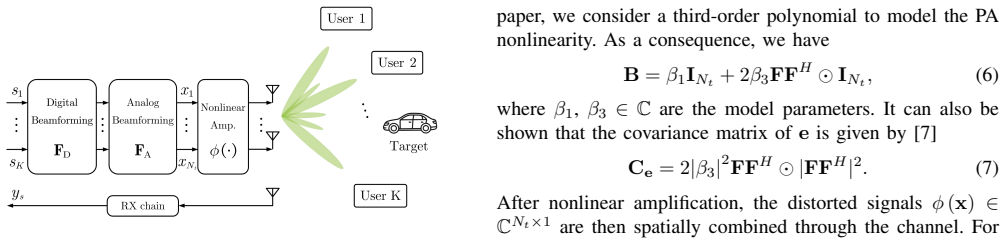
The engine of the method is the Bussgang decomposition of the nonlinear PA output, $\varphi(\mathbf{x}) = \mathbf{B}\mathbf{x} + \mathbf{e}$, which turns the distorted channel into an effective linear channel $\mathbf{B}\mathbf{F}$ plus a distortion covariance $\mathbf{C}_e = 2|\beta_3|^2 \mathbf{F}\mathbf{F}^H \odot |\mathbf{F}\mathbf{F}^H|^2$ that enters the SINR denominators. On top of that, the constrained optimization is recast with a penalty method into a problem over three coupled variables, and the full-digital update is run on a Riemannian manifold of matrices with fixed Frobenius norm, using the retraction $\operatorname{retr}_F(tL) = \sqrt{c_1}(F + tL)/\|F + tL\|_F$ to stay inside the power budget. The closed-form updates for the auxiliary variables are what make the alternating loop cheap, and the final hybrid decomposition converts the optimized full-digital precoder back into the partially-connected analog/digital structure.
What would settle it
Measure the distortion covariance at the output of a real or simulated nonlinear PA with non-Gaussian symbols, such as 16-QAM, and compare it with Eq. (7); if the observed covariance deviates materially from $2|\beta_3|^2 \mathbf{F}\mathbf{F}^H \odot |\mathbf{F}\mathbf{F}^H|^2$, the optimized weights are built on a model that does not describe the actual distortion, and the reported gains may not survive outside the Gaussian-symbol assumption.
Extended reading notes
Core claim
The central claim is that a hybrid beamformer designed with explicit knowledge of PA nonlinearity can substantially outperform conventional linear precoders in a monostatic ISAC system. The paper models nonlinear amplification with a third-order polynomial and applies Bussgang's theorem to split the output into a linear signal term plus an uncorrelated distortion term, yielding closed-form signal-to-interference-noise-and-distortion ratios for each user and for the sensing receiver. It then solves the non-convex weighted-sum problem by first finding a full digital matrix $\mathbf{F}$ through alternating optimization: a manifold-optimization step over the constant-Frobenius-norm manifold updates $\mathbf{F}$, and closed-form KKT solutions update two penalty auxiliary variables $\mathbf{U}$ and $\mathbf{V}$. The full digital solution is decomposed into constant-modulus analog weights and low-dimensional digital weights by a second alternating minimization. Numerical results show the known-PA-model version of the algorithm beats MRT, ZF, and RBF over the simulated range, with the gain growing with distortion strength and SNR.
Load-bearing premise
The whole distortion model is exact only for Gaussian transmit symbols; if the actual constellation is non-Gaussian, the distortion covariance and the SINR used for optimization no longer match the true transmitter behavior.
Editorial extensions
If this is right
- If the claim holds, practical ISAC transmitters can reclaim a large part of the rate loss caused by driving power amplifiers near saturation, without changing the array hardware.
- Because the gain widens with SNR, distortion-aware design matters most exactly in the high-SNR regime where ISAC links are expected to operate.
- The 42 dB suppression of nonlinear power at the user direction shown in the beam-pattern experiment means distortion-aware weights can shape not only the signal but also the distortion field, which is useful for interference-limited operation.
- The algorithm's decomposition stage means the improvement is available to partially-connected hybrid arrays with only a modest number of RF chains, not just to fully digital transmitters.
Reading between the lines
- A natural extension the paper does not run is a symbol-level simulation with QAM or PSK inputs: the Bussgang-based SINR expressions are exact for Gaussian symbols, and the achievable-rate gains could differ for finite constellations. One could test whether the distortion-aware precoder still dominates MRT and ZF under such inputs.
- The same Bussgang-plus-manifold recipe could be adapted to other PA models, such as memory polynomials or soft-limiter models, since only the expressions for $\mathbf{B}$ and $\mathbf{C}_e$ change; the optimization machinery would survive as long as the distortion covariance has a tractable form.
- The beam-pattern notch at the target direction suggests a distortion-aware design could deliberately steer nonlinear distortion away from sensitive directions, which the paper does not formulate as an explicit constraint but which follows from the objective.
Editorial analysis
A structured set of objections, weighed in public.
Referee Report
Summary. The paper considers a partially-connected hybrid beamforming transmitter for an ISAC system in which the power amplifiers are nonlinear. Using a third-order polynomial PA model and Bussgang's theorem, the authors derive a distortion-aware weighted sum-rate objective comprising communication rates and sensing mutual information, subject to a total power constraint. The optimization problem is nonconvex, so the paper proposes a two-stage solution: first, a full-digital beamforming matrix F is optimized via a penalty method combined with manifold optimization and closed-form updates for two auxiliary variables U and V; second, F is decomposed into analog and digital matrices by Frobenius-norm minimization. Numerical results compare the proposed algorithm with MRT, ZF, and RBF precoders and show gains that grow with PA nonlinearity.
Significance. If the reported gains are realized by the actual hybrid beamformer, the work addresses a relevant gap in the ISAC literature, where PA distortion is usually ignored. The paper contains useful derivations, including closed-form updates for the auxiliary variables and gradient expressions, and it uses PA coefficients extracted from a measured amplifier model, which is a strength. However, the significance is conditional on two load-bearing points: the Bussgang model requires Gaussian signaling to be exact, and the hybrid decomposition is not shown to preserve the performance of the optimized full-digital solution. The manuscript does not currently establish that the headline 'distortion-aware hybrid beamforming' gains are achievable by the feasible hybrid precoder, because the numerical evaluation does not state whether the full-digital or hybrid matrices are used. These issues need to be resolved before the contribution can be fully assessed.
major comments (3)
- [Section II-B, Eqs. (5)-(7)] The Bussgang decomposition in Eq. (5), with B given by Eq. (6) and the distortion covariance C_e given by Eq. (7), is exact only when the input signal x is Gaussian. The manuscript only states E{ss^H}=I in Section II-B and does not restrict the transmitted symbols to be Gaussian. For non-Gaussian signaling such as QPSK, the expressions for C_e and for the SINRs in Eqs. (9) and (11) are not exact, and the rate expression R_k = log2(1+gamma_k) treats the distortion e as additive Gaussian noise without justification. Please state the Gaussian assumption explicitly and discuss its practical relevance, or provide numerical evidence that the design maintains its performance for constellations used in the intended system.
- [Section III, P1/P2 and Section IV, Fig. 2] The central claim concerns hybrid beamforming, but the optimization in P1 is performed on the full-digital matrix F, and the hybrid matrices are obtained by solving the Frobenius-norm decomposition problem P2. This decomposition does not preserve the distortion terms B(F) and C_e(F), the SINRs, or the nonlinear power constraint in Eq. (14c). The manuscript does not state whether the numerical results in Fig. 2 evaluate the sum rate at the full-digital F or at the feasible hybrid precoder F_A F_D. If the evaluation uses the full-digital matrix, the reported gains are for a surrogate problem and do not support the hybrid claim; if it uses the hybrid matrices, the decomposition error and the recomputed objective at F_A F_D must be reported. Because each block of F_A is a rank-1 outer product in the partially-connected structure, the decomposition is generally not exact. Please clarify this point and, ideally, report the performance of the final hybrid precoder, including the decomposition error and the constraint violation for (14c).
- [Section III, Eq. (23)] The retraction formula in Eq. (23) defines c1 as the quotient [Ptot - 4Re{beta_1^* beta_3} Tr(U) - 6|beta_3|^2 Tr(V)] / |beta_1|^2 and states that c1 is the square of the desired Frobenius norm. Nothing in the algorithm ensures that c1 is nonnegative. If the auxiliary variables U and V grow large during the alternating optimization, c1 can become negative, in which case the retraction is undefined and the manifold update breaks. The paper should specify safeguards or prove that the penalty parameters and initialization guarantee c1 > 0, or the algorithm cannot be considered robust.
minor comments (5)
- [Section II-B] There is a typo in the sentence 'the signal vector at the input of the the PAs stage'; 'the the' should be 'the PA'.
- [Section III, P3 reformulation] The derivation of the power constraint in Eq. (17b) from the original constraint in Eq. (14c) is not shown. Since the constraint involves the auxiliary variables U and V, a short derivation or a reference would improve readability.
- [Section IV, Fig. 3 text] The statement that 'the convergence of this algorithm is guaranteed' because the MO method resembles the conjugate gradient method is not a proof. The objective is nonconvex and the penalty/AO framework has no convergence guarantee; please either provide a rigorous convergence argument or soften the claim.
- [Section IV, Fig. 4] The beam pattern figure is only for a single user and a single target angle. It would be helpful to state how the pattern is computed, especially whether the nonlinear pattern includes the hybrid precoder or the full-digital precoder, since this affects the interpretation of the 42 dB distortion reduction.
- [Section III, P2] The decomposition algorithm is attributed to [10], but the manuscript gives no details on initialization, number of iterations, or stopping criteria. For reproducibility, these details should be added.
Circularity Check
No significant circularity: the derivation is a model-based optimization loop with externally sourced PA parameters and independent baselines.
full rationale
The paper does not fit a parameter to data and then relabel it as a prediction. The proposed algorithm maximizes a Bussgang-model objective (P1/P3, Eq. 17a) and Fig. 2 evaluates the same family of sum-rate expressions, but this is a standard design-and-evaluation loop for algorithmic papers rather than a circular derivation: the PA coefficients beta1 and beta3 are taken from an external measured polynomial model in Ref. [11], the Bussgang decomposition and distortion covariance in Eqs. (5)-(7) come from external Ref. [7], and the MRT, ZF, and RBF baselines are independent and are not optimized against the same objective. The hybrid decomposition P2 is solved by an external alternating-minimization approach [10], and any gap between the full-digital surrogate and the feasible hybrid precoder is a correctness or implementation concern, not circularity. Self-citations [3], [4], and [6] are background references; the sensing mutual information metric from [4] is the standard log(1+SNR) form and is not load-bearing in a way that forces the reported gains. The unstated Gaussian-input requirement for Bussgang's theorem is a modeling-validity limitation, but it is not a circular step.
Assumptions & free parameters
free parameters (2)
- Penalty factors lambda_1 and lambda_2 =
not specified
- PA polynomial coefficients beta_1 and beta_3 =
beta_1 = 1.14 - 0.08j, beta_3 = -0.08 + 0.1j (from [11])
assumptions (4)
- domain assumption Bussgang decomposition applies to the PA input x, requiring x to be Gaussian.
- domain assumption The PA nonlinearity is a third-order polynomial with known coefficients beta_1 and beta_3.
- domain assumption AWGN, perfect CSI, and known single-snapshot target channel are assumed.
- domain assumption The analog beamformer FA is restricted to a block-diagonal partially-connected structure with unit-modulus entries.
Cite this review
Pith. "Pith review of Distortion-Aware Hybrid Beamforming for Integrated Sensing and Communication." pith.science (2026). https://pith.science/paper/ZRKDZ553
@misc{pith2026250714018,
  author       = {Pith},
  title        = {Pith review of: Distortion-Aware Hybrid Beamforming for Integrated Sensing and Communication},
  year         = {2026},
  howpublished = {\url{https://pith.science/paper/ZRKDZ553}},
  note         = {Machine review of arXiv:2507.14018}
}
read the original abstract
This paper investigates a practical partially-connected hybrid beamforming transmitter for integrated sensing and communication (ISAC) with distortion from nonlinear power amplification. For this ISAC system, we formulate a communication rate and sensing mutual information maximization problem driven by our distortion-aware hybrid beamforming design. To address this non-convex problem, we first solve for a fully digital beamforming matrix by alternatively solving three sub-problems using manifold optimization (MO) and our derived closed-form solutions. The analog and digital beamforming matrices are then obtained through a decomposition algorithm. Numerical results demonstrate that the proposed algorithm can improve overall ISAC performance compared to traditional beamforming methods.
Figures


Figures from the paper (1 more)

Reference graph
Works this paper leans on
-
[1]
X. Zhu, J. Liu, L. Lu, T. Zhang, T. Qiu, C. Wang, and Y. Liu, ``Enabling intelligent connectivity: A survey of secure ISAC in 6G networks,'' IEEE Commun. Surv. Tutor., 2024
work page 2024
-
[2]
K. Meng, Q. Wu, J. Xu, W. Chen, Z. Feng, R. Schober, and A. L. Swindlehurst, ``UAV-enabled integrated sensing and communication: Opportunities and challenges,'' IEEE Wirel. Commun., 2023
work page 2023
-
[3]
Y. Xiu, J. Zhao, W. Sun, M. Di Renzo, G. Gui, Z. Zhang, and N. Wei, ``Reconfigurable intelligent surfaces aided mmwave NOMA: Joint power allocation, phase shifts, and hybrid beamforming optimization,'' IEEE Trans. Wireless Commun., vol. 20, no. 12, pp. 8393--8409, 2021
work page 2021
-
[5]
X. Wang, Z. Fei, J. A. Zhang, and J. Xu, ``Partially-connected hybrid beamforming design for integrated sensing and communication systems,'' IEEE Trans. Commun., vol. 70, no. 10, pp. 6648--6660, 2022
work page 2022
-
[6]
Y. Xiu, Y. Zhao, R. Yang, D. Niyato, J. Jin, Q. Wang, G. Liu, and N. Wei, ``Movable antenna-aided cooperative ISAC network with time synchronization error and imperfect CSI,'' arXiv preprint arXiv:2501.15410, 2025
arXiv 2025
-
[7]
N. N. Moghadam, G. Fodor, M. Bengtsson, and D. J. Love, ``On the energy efficiency of MIMO hybrid beamforming for millimeter-wave systems with nonlinear power amplifiers,'' IEEE Trans. Wireless Commun., vol. 17, no. 11, pp. 7208--7221, 2018
work page 2018
-
[8]
J. Jee, G. Kwon, and H. Park, ``Joint precoding and power allocation for multiuser MIMO system with nonlinear power amplifiers,'' IEEE Trans. Veh. Technol., vol. 70, no. 9, pp. 8883--8897, 2021
work page 2021
-
[9]
S. R. Aghdam, S. Jacobsson, and T. Eriksson, ``Distortion-aware linear precoding for millimeter-wave multiuser MISO downlink,'' in 2019 IEEE International Conference on Communications Workshops (ICC Workshops). 1em plus 0.5em minus 0.4em IEEE, 2019, pp. 1--6
work page 2019
Show all 11 references
-
[10]
X. Yu, J. C. Shen, J. Zhang, and K. B. Letaief, ``Hybrid precoding design in millimeter wave MIMO systems: An alternating minimization approach,'' in 2015 IEEE global communications conference (GLOBECOM). 1em plus 0.5em minus 0.4em IEEE, 2015, pp. 1--6
2015
-
[11]
Brihuega, L
A. Brihuega, L. Anttila, M. Abdelaziz, T. Eriksson, F. Tufvesson, and M. Valkama, ``Digital predistortion for multiuser hybrid MIMO at mmwaves,'' IEEE Trans. Signal Process., vol. 68, pp. 3603--3618, 2020
2020
-
[12]
SjS4M/2t& 4z 2흍bV(!U]rV;P CT ԦT; ɱ Ev D |3j & fT0K
11em plus .33em minus .07em 4000 4000 100 4000 4000 500 `\.=1000 = #1 \@IEEEnotcompsoconly \@IEEEcompsoconly #1 * [1] 0pt [0pt][0pt] #1 * [1] 0pt [0pt][0pt] #1 * \| ** #1 \@IEEEauthorblockNstyle \@IEEEcompsocnotconfonly \@IEEEauthorblockAstyle \@IEEEcompsocnotconfonly \@IEEEco...
2024 arXiv
Reviewed August 6, 2026 · model on record in the stance chip above.
Discussion (0). Continue with ORCID to comment.