REVIEW 2 major objections 5 minor 1 cited by
Scott-Vogelius element and iterated penalty method for inhomogeneous Dirichlet boundary conditions
T0 review · 2 major / 5 minor · reviewed 2026-08-04 · deepseek-v4-flash
Pith's one-line read For Stokes flow with non-homogeneous Dirichlet data, the Scott–Vogelius element keeps its pressure-robust velocity error, provided the boundary data satisfies a zero-mean-normal-trace compatibility condition.
desk verdict Useful, honest conditional contribution: quasi-optimal inhomogeneous-Dirichlet estimates for Scott-Vogelius and a clean velocity contraction for IPM, but the pressure iterate bound in Lemma 4.2 reverses (42) and the central Fortin operator lives in an unpublished companion. read the letter →
The pith
A machine-rendered reading of the paper's core claim, the machinery that carries it, and where it could break.
The reading
What carries the argument
The load-bearing object is a trace-preserving Fortin operator Π_h : H^1(Ω)^d → X_h that (i) preserves the divergence against the discrete pressure space, (ii) is H^1-stable, and (iii) preserves discrete traces and maps the zero-mean-normal-trace space H^1_∼(Ω) into X_{h,∼}. In the proof of Theorem 3.4 this operator is used to repair an arbitrary v_h into a function z_h that is discretely divergence-free and matches the boundary data, so the constrained best-approximation infimum reduces to the unconstrained one. For Scott–Vogelius the analysis additionally assumes div V_h = div X_{h,∼} (Assumption 3.1), which holds in 2D when the mesh has no boundary singular vertices. The iterated penalty m
What would settle it
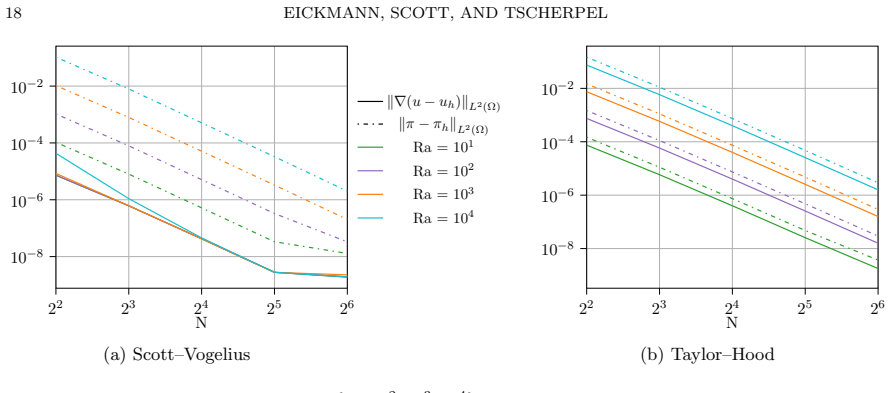
Run the Scott–Vogelius k=4 method on a mesh with no singular vertices, impose compatible boundary data g_h ∈ X_{h,∼}, and scale the pressure loading by a factor Ra; if the H1 velocity error grows with Ra, or the IPM iterates fail to reach the predicted contraction floor, Theorems 3.4 and 4.5 would be refuted.
Extended reading notes
Core claim
On its own terms, the central claim is Theorem 3.4: for the Scott–Vogelius discretization of the Stokes problem with compatible boundary data, the H1-seminorm velocity error is at most 2(1+c_F) times the best approximation error over the velocity space, uniform in mesh size, with no pressure contribution. This is the first such pressure-robust quasi-optimality result for inhomogeneous Dirichlet conditions for an exactly divergence-free element. The companion result, Theorem 4.5, shows that the iterated penalty method produces velocity iterates whose error is the sum of the same velocity best-approximation term plus an iteration-dependent term that decays geometrically with factor θ=ν/(ν+ρβ²)
Load-bearing premise
The results rest on the existence of a uniformly H1-stable Fortin operator that preserves the divergence, the discrete traces, and the zero-mean normal traces; for Scott–Vogelius this existence is deferred to an unpublished companion paper, and in 2D it requires meshes with no boundary singular vertices.
Editorial extensions
If this is right
- With compatible boundary data, inhomogeneous Dirichlet conditions can be imposed on Scott–Vogelius discretizations without sacrificing the pressure-robust velocity error that makes exactly divergence-free elements valuable.
- The iterated penalty method converges for inhomogeneous boundary data with a contraction factor θ = ν/(ν+ρβ²), and the divergence norm of the velocity iterates decreases monotonically, giving a stopping criterion that actually terminates.
- The compatibility condition is not a technicality: without enforcing zero mean normal trace, the discrete velocity is not exactly divergence-free and the error estimates lose their pressure-robust form.
- Other exactly divergence-free elements, such as the Falk–Neilan and Guzmán–Neilan elements, gain the same pressure-robust inhomogeneous-boundary estimates whenever a Fortin operator with the three trace/divergence properties can be constructed.
- Local mesh modification that removes (nearly) singular boundary vertices improves the inf-sup constant, which directly accelerates the IPM contraction, as confirmed by the numerical experiments.
Reading between the lines
- Because the linear Stokes analysis can be reduced to homogeneous boundary data via a divergence-free extension, the real payoff of this framework is for nonlinear equations such as Navier–Stokes, where such a reduction fails; the trace-preserving Fortin operator is the natural tool to carry the inhomogeneous setting there.
- The single-face correction of the boundary interpolation suggests a minimally invasive implementation recipe: take any existing Lagrange boundary interpolation and correct one face to restore the zero-mean normal trace, so existing codes could adopt the compatible treatment without a full rewrite.
- The contraction factor's dependence on 1/β means meshes with nearly singular vertices can make the IPM stagnate in practice; the numerical experiments show this plateau, implying mesh quality and iteration count interact more strongly than the asymptotic theory alone suggests.
- A testable prediction: on a sequence of meshes where a boundary vertex angle tends to zero, the number of IPM iterations to reach a fixed divergence tolerance should grow roughly like 1/β², providing a sharp experimental check of the contraction bound.
Signed reviews
Editorial analysis
A structured set of objections, weighed in public.
Referee Report
Summary. The paper studies mixed finite element methods for the Stokes equations with inhomogeneous Dirichlet boundary conditions, with emphasis on the Scott–Vogelius element. The main theoretical tools are Fortin-type operators that preserve the divergence, discrete traces, and zero mean normal traces. Under these assumptions the paper proves quasi-optimal a priori error estimates (Theorem 2.13) and, for Scott–Vogelius, a pressure-robust velocity estimate (Theorem 3.4). It then analyzes the iterated penalty method (IPM), proving convergence, a velocity contraction bound, an asymptotic pressure-robustness estimate, and monotone decay of the divergence norm (Lemma 4.2, Theorems 4.5 and 4.6). Numerical experiments in 2D illustrate the role of the compatibility condition and of mesh modifications removing (nearly) singular vertices.
Significance. If the results are valid, the paper is a useful contribution: it extends pressure-robust, exactly divergence-free discretizations to inhomogeneous Dirichlet data, clarifies the required compatibility condition, and provides explicit convergence rates for the IPM in this setting. The numerical experiments are well targeted and illustrate the main theoretical points. However, the central Fortin-operator existence result is deferred to an unpublished companion paper, and one key pressure estimate in the IPM analysis uses an inequality in the wrong direction. These issues must be resolved before the main claims can be accepted.
major comments (2)
- [Lemma 4.2, Step 3 (Eq. (52))] The step 'applying (42)' is invalid. Inequality (42) states β||∇v_h|| ≤ ||div v_h|| for v_h ∈ V_{h,div}^⊥, i.e., it bounds the gradient from above by the divergence. It cannot be used to conclude ρ||div e_{h,i}|| ≤ ρβ||∇e_{h,i}||, which is the reverse direction. Consequently the displayed pressure estimate (45) does not follow. A repair using the already-proved divergence bound (44) would give a pressure estimate of the form [ (ν/β) θ^{i-1} + (1/2)√(νρ) θ^{i-2} ] ||∇e_{h,1}||, not the stated (ν+ρβ)/β θ^{i-1}||∇e_{h,1}||. Since Theorem 4.5's pressure inequality relies directly on (45), that part of the theorem is unsupported as stated. The velocity contraction (43) and divergence bound (44) are unaffected.
- [Proposition 3.3 and Assumption 2.10] The existence of a Fortin operator preserving divergence, discrete traces, and zero mean normal traces with uniform H^1-stability is the load-bearing assumption for Theorem 3.4 and, through the first-iterate estimate, for Theorem 4.5. Proposition 3.3 states this existence for the Scott–Vogelius element but defers the proof entirely to [ET], an unpublished companion paper by two of the same authors. The manuscript therefore is not self-contained and the central claim cannot be verified from the submitted material. The authors should either provide a full construction and proof (e.g., in an appendix) or replace the reference with a published or otherwise publicly available source.
minor comments (5)
- [Abstract] Typo: 'error stimates' should be 'error estimates'.
- [Tables 1 and 2] The column alignment is confusing: each row appears to contain five numeric entries for four error columns plus N, and the values cited in the text (e.g., ||div u_h||=6.74e-12 for corrected data) do not clearly match the printed headers. Please relabel the tables or insert explicit column separators.
- [Section 3.2.2] The numerical implementation uses the interpolation operator Ĩ_h defined on C(Ω)^d, whereas Proposition 3.3 and Assumption 2.14 concern an operator I_h on H^1(Ω)^d. The text notes this difference, but it would help to state explicitly that the manufactured boundary data are smooth enough that the C^0-based construction is covered by the same arguments.
- [Assumption 2.10 (iiib)] The wording 'preserves zero mean normal traces' is slightly stronger than the stated property Π_h(H^1_∼(Ω)) ⊂ X_{h,∼}. Consider rephrasing to 'maps zero-mean-normal-trace functions into the corresponding discrete subspace' to avoid possible confusion.
- [Remark 2.16(a)] The statement that tr(g_h)=tr(Π_h g) and tr(g_h)=tr(I_h g) 'imply g_h ∈ X_{h,∼}' is true only because the exact data g is assumed to lie in H^1_∼(Ω) and the operators map H^1_∼(Ω) into X_{h,∼}. This could be made explicit in the remark.
Circularity Check
One load-bearing self-citation ([ET]) supplies the Fortin operator; the derivation is otherwise non-circular.
-
self citation load bearing
[Section 3.1, Proposition 3.3; relied on by Theorems 3.4 and 4.5]
"Proposition 3.3 ([ET]). For k∈N let X_h, X_{h,∼,div}, V_h, Q_h as in (27), (30), (25) and (29) be the discrete spaces of the Scott–Vogelius element and let Assumptions 2.7 and 3.1 be satisfied. (i) If k≥d, then there exists an operator I_h satisfying Assumption 2.14. (ii) There exists a Fortin operator Π_h as in Assumption 2.10 with the property that tr(Π_h v)=tr(I_h v) for all v∈H^1(Ω)^d."
The paper's central pressure-robust estimates are conditional on the existence of the trace-preserving Fortin operator Π_h and interpolation operator I_h. Theorem 3.4 uses the Fortin operator to remove the constraints in the infimum, and Theorem 4.5 explicitly invokes Proposition 3.3 for the constants c_F and c_I. Proposition 3.3 is not proved in this manuscript; it is attributed to [ET], an in-preparation paper by two of the same authors (Eickmann and Tscherpel). Thus the load-bearing premise is imported from the authors' own unpublished companion rather than derived or externally verified in the present paper. This is a self-citation dependency, not a definitional equivalence or a fitted-input prediction, so it makes the standalone derivation chain incomplete without making the whole arg
full rationale
No definitional circularity is present: The error estimates in Theorems 2.13, 3.4, and 4.5 are obtained from the stated assumptions (inf-sup stability, Assumption 2.10 Fortin operator, Assumption 3.1) by standard Galerkin and contraction arguments. No fitted parameter is renamed as a prediction, no known empirical pattern is repackaged as new, and no uniqueness theorem from the authors is used to forbid alternatives. The one circularity-relevant feature is the delegation of Proposition 3.3 to [ET], an in-preparation companion by two of the authors. Theorem 3.4's pressure-robust velocity estimate and Theorem 4.5's IPM estimate both depend on the existence of the trace-preserving Fortin operator and interpolation operator asserted there, and the paper gives no proof or external verification of that existence. That makes the manuscript not fully self-contained and raises the circularity score to 4, because some self-citation is load-bearing while the central analytic content still has independent structure. Separately, the pressure estimate in Lemma 4.2 and Theorem 4.5 appears to apply inequality (42) in the reverse direction when bounding ρ||div e_{h,i}||; that is a potential correctness gap, not a circularity, and is not counted in the score.
Assumptions & free parameters
free parameters (1)
- IPM penalty/step parameter rho =
rho > 0; experiments use 10^2 and 10^4
assumptions (6)
- domain assumption Omega is a bounded Lipschitz polyhedral domain with shape-regular conforming simplicial triangulations
- domain assumption Discrete inf-sup stability of (V_h, Q_h) with h-uniform constant beta
- ad hoc to paper Existence of a trace-preserving, divergence-preserving Fortin operator Pi_h with uniform stability, and for Scott-Vogelius an interpolation operator I_h with the corresponding properties
- domain assumption Assumption 3.1: div V_h = div X_{h,sim}
- standard math Existence and stability of the discrete Bogovskii operator B_h
- standard math Continuous Bogovskii operator and divergence-free extension operator
Cite this review
Pith. "Pith review of Scott-Vogelius element and iterated penalty method for inhomogeneous Dirichlet boundary conditions." pith.science (2026). https://pith.science/paper/ZRUQPOFL
@misc{pith2026250917899,
  author       = {Pith},
  title        = {Pith review of: Scott-Vogelius element and iterated penalty method for inhomogeneous Dirichlet boundary conditions},
  year         = {2026},
  howpublished = {\url{https://pith.science/paper/ZRUQPOFL}},
  note         = {Machine review of arXiv:2509.17899}
}
read the original abstract
We present quasi-optimal a priori error estimates for general mixed finite element methods to approximate solutions of the Stokes problem subject to inhomogeneous Dirichlet boundary conditions. For the Scott--Vogelius element this yields pressure-robust a priori error stimates. Due to the exact divergence constraint, this requires a compatibility condition for the boundary data to hold. A key tool is a modified Fortin operator, capable of preserving this compatibility condition. Furthermore, we analyse the iterated penalty method, an Uzawa-type algorithm and we show its convergence and asymptotic pressure robustness. Numerical experiments support the theory and highlight the importance of the compatibility condition and the appropriate treatment of nearly singular vertices.
Figures


Figures from the paper (1 more)

Forward citations
Cited by 1 Pith paper
-
A local Fortin projection for the Scott-Vogelius elements on general meshes
A local Fortin projection for Scott-Vogelius k>=4 elements is constructed on general 2D shape-regular triangulations, including singular vertices, with divergence, trace, and stability properties.
Reference graph
Works this paper leans on
-
[1]
A stable finite element for the Stokes equa- tions
[ABF84] D. N. Arnold, F. Brezzi, and M. Fortin. “A stable finite element for the Stokes equa- tions”.Calcolo21.4 (1984), 337–344 (1985).doi:10.1007/BF02576171. [ADKL01] P. Amestoy, I. S. Duff, J. Koster, and J.-Y. L’Excellent. “A Fully Asynchronous Mul- tifrontal Solver Using Distributed Dynamic Scheduling”.SIAM Journal on Matrix Analysis and Applications...
-
[5]
Springer Series in Computational Mathematics. Springer-Verlag, Berlin, 1986, pp. x+374.doi:10.1007/978-3-642-61623-5. [GR VZ23] P. G. Geredeli, L. G. Rebholz, D. Vargun, and A. Zytoon. “Improved convergence of the Arrow–Hurwicz iteration for the Navier–Stokes equation via grad–div stabilization and Anderson acceleration”.Journal of Computational and Appli...
arXiv 1986
-
[15]
Texts in Applied Mathematics. Springer, 2008.doi:10.1007/978- 0- 387- 75934-0. [CHS15] P. Chen, J. Huang, and H. Sheng. “Some Uzawa methods for steady incompressible Navier-Stokes equations discretized by mixed element methods”.J. Comput. Appl. Math.273 (2015), pp. 313–325.doi:10.1016/j.cam.2014.06.019. REFERENCES 31 [Cia02] P. G. Ciarlet.The Finite Eleme...
arXiv 2008
-
[73]
Texts in Applied Mathematics. Springer, Cham, 2021, p. 492.doi:10.1007/978-3-030-56923-5. [ESW14] H. C. Elman, D. J. Silvester, and A. J. Wathen.Finite elements and fast iterative solvers: with applications in incompressible fluid dynamics. Oxford University Press, 2014.doi:10.1093/acprof:oso/9780199678792.001.0001. [ET] F. Eickmann and T. Tscherpel.Forti...
arXiv 2021
-
[84]
Finite element subspaces with optimal rates of convergence for the stationary Stokes problem
Lecture Notes in Computational Science and Engineering. The FEniCS book. Springer, Heidelberg, 2012, pp. xiv+723.doi: 10.1007/978-3-642-23099-8. [Man82] L. Mansfield. “Finite element subspaces with optimal rates of convergence for the stationary Stokes problem”.ESAIM: Mathematical Modelling and Numerical Analysis - Mod´ elisation Math´ ematique et Analyse...
arXiv 2012
-
[1983]
Exact smooth piecewise polynomial sequences on Alfeld splits
[FGN20] G. Fu, J. Guzm´ an, and M. Neilan. “Exact smooth piecewise polynomial sequences on Alfeld splits”.Math. Comp.89.323 (2020), pp. 1059–1091.doi:10.1090/mcom/3520. [FGNZ22] M. Fabien, J. Guzm´ an, M. Neilan, and A. Zytoon. “Low-order divergence-free approx- imations for the Stokes problem on Worsey-Farin and Powell-Sabin splits”.Comput. Methods Appl....
arXiv 2020
-
[2003]
The FEniCS Project Version 1.5
[Aln+15] M. Alnæs et al. “The FEniCS Project Version 1.5”.Archiv of Numerical Software3.100 (2015).doi:10.11588/ans.2015.100.20553. [AP22] M. Ainsworth and C. Parker. “Unlocking the secrets of locking: Finite element analysis in planar linear elasticity”.Computer Methods in Applied Mechanics and Engineering 395 (2022), p. 115034.doi:10.1016/j.cma.2022.115...
arXiv 2015
-
[2011]
doi:10.1007/978-3-642-15564-2. [Nei20] M. Neilan. “The Stokes complex: A review of exactly divergence-free finite element pairs for incompressible flows.”75 years of Mathematics of Computation754 (2020), pp. 141–158.doi:10.1090/conm/754/15142. [NP04] R. H. Nochetto and J.-H. Pyo. “Optimal relaxation parameter for the Uzawa method”. Numer. Math.98.4 (2004)...
arXiv 2020
Show all 12 references
-
[2013]
Analysis of some finite elements for the Stokes problem
doi:10.1007/978-3-642-36519-5. [BGHRR24] C. Bernardi, V. Girault, F. Hecht, P.-A. Raviart, and B. Rivi` ere.Mathematics and Finite Element Discretizations of Incompressible Navier—Stokes Flows. Philadelphia, PA: SIAM, 2024.doi:10.1137/1.9781611978124. [BR85] C. Bernardi and G....
2024 doi
-
[2018]
Ann-dimensional Clough-Tocher interpolant
[WF87] A. J. Worsey and G. Farin. “Ann-dimensional Clough-Tocher interpolant”.Constr. Approx.3.2 (1987), pp. 99–110.doi:10.1007/BF01890556. [Zha05] S. Zhang. “A new family of stable mixed finite elements for the 3D Stokes equations”. Math. Comp.74.250 (2005), pp. 543–554.doi:1...
1987 doi
-
[2021]
Dimensions of Exactly Divergence-Free Finite Element Spaces in 3D
[ST24] L. R. Scott and T. Tscherpel. “Dimensions of Exactly Divergence-Free Finite Element Spaces in 3D”.SIAM J. Sci. Comput.46.2 (2024), A1102–A1131.doi:10 . 1137 / 22M1544579. [SV85] L. R. Scott and M. Vogelius. “Norm estimates for a maximal right inverse of the divergence o...
2024
-
[2025]
[EG21] A
arXiv:2411.09485 [math.NA]. [EG21] A. Ern and J.-L. Guermond.Finite elements. II. Vol
Reviewed August 4, 2026 · model on record in the stance chip above.
Discussion (0). Continue with ORCID to comment.