Magnetic Bloch Oscillations in Odd-Wave Magnets and the Nonlinear Edelstein Effect
Pith reviewed 2026-07-01 01:57 UTC · model grok-4.3
The pith
Magnetization in odd-wave magnets undergoes Bloch oscillations before reaching the steady-state Edelstein value.
A machine-rendered reading of the paper's core claim, the machinery that carries it, and where it could break.
Core claim
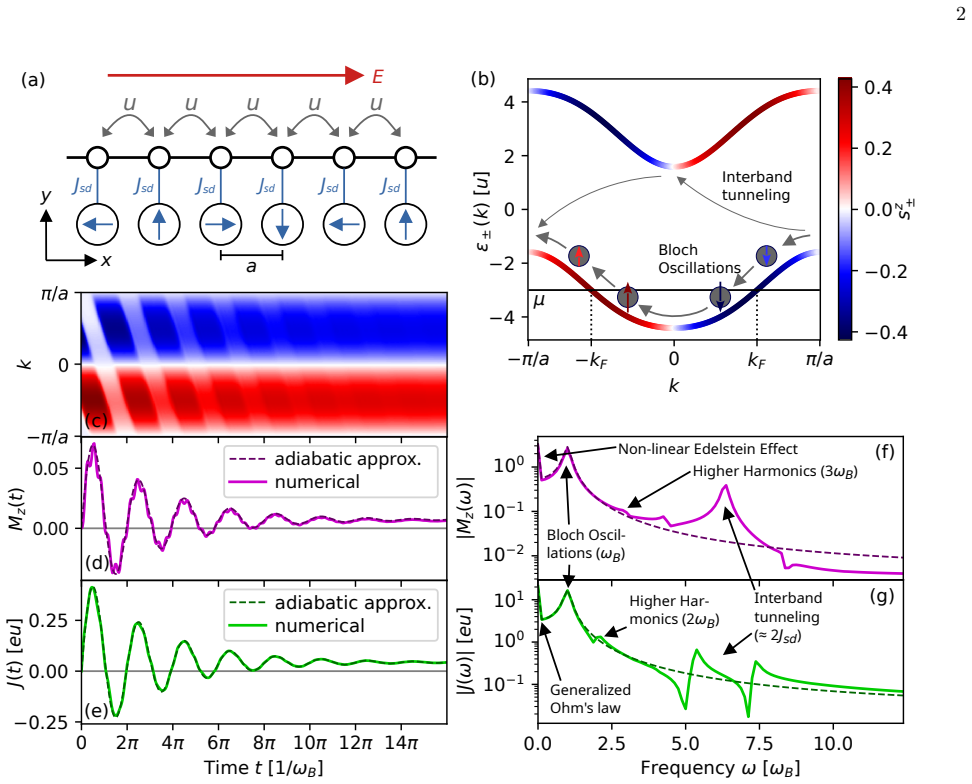
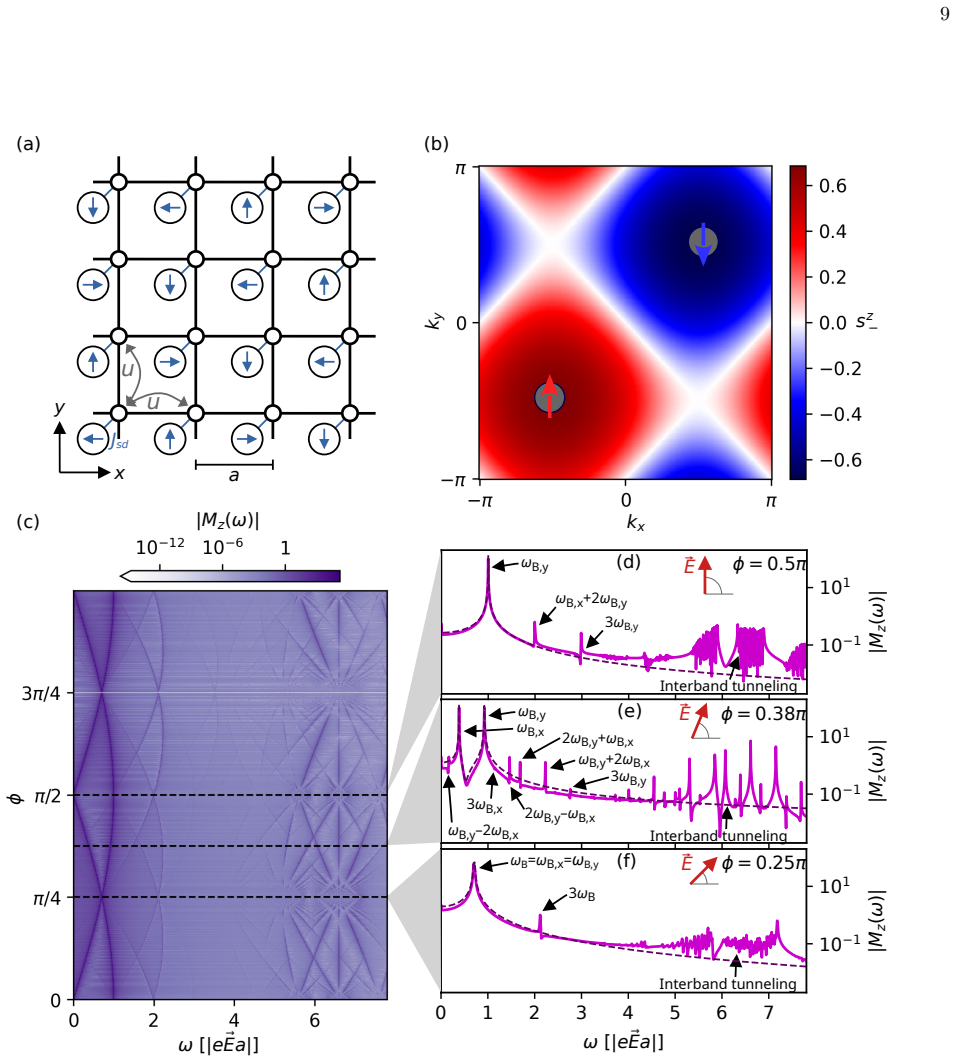
The magnetization of odd-wave magnets can undergo Bloch oscillations before relaxing to the steady-state Edelstein value. This is demonstrated analytically and numerically in a minimal one-dimensional model of a p-wave magnet and generalized to two dimensions. The Edelstein magnetization is generically nonlinear in the applied electric field. Magnetic Bloch oscillations provide a genuine non-equilibrium signature of spin-charge coupling and can be detected in materials through higher-harmonic generation in THz sub-cycle lightwave spectroscopy.
What carries the argument
Magnetic Bloch oscillations driven by the combination of electric-field acceleration of electrons and the odd-parity spin texture of the magnet, which produces transient oscillations in magnetization before scattering destroys coherence.
If this is right
- The Edelstein magnetization is nonlinear in the applied electric field.
- Oscillatory magnetization precedes relaxation whenever coherence time is long enough relative to the Bloch period.
- Higher-harmonic generation in THz spectroscopy serves as an experimental signature of the oscillations.
- The effect persists when the one-dimensional model is extended to two dimensions.
Where Pith is reading between the lines
- Transient oscillatory regimes could appear in other magnets with strong spin-momentum locking whenever scattering is weak on the Bloch timescale.
- Time-resolved probes may reveal non-equilibrium spin dynamics that steady-state measurements would miss.
- The nonlinearity of the Edelstein response implies that linear-response assumptions break down at moderate field strengths in these systems.
Load-bearing premise
The minimal one-dimensional model of a p-wave magnet and its two-dimensional generalization capture the essential physics of odd-wave magnets and the coherence conditions required for magnetic Bloch oscillations.
What would settle it
Time-resolved measurement of magnetization in a candidate odd-wave magnet under a sudden electric field that shows no oscillatory component before the DC Edelstein value is reached, or THz spectra lacking higher harmonics attributable to these oscillations.
Figures
read the original abstract
Bloch oscillations (BOs) are a quantum phenomenon in which electrons subjected to an electric field in a periodic potential exhibit an oscillating current without a net drift. In real conductors, scattering reduces the coherence required for BOs driving the system toward a steady state with a DC current. While previous studies have focused on charge transport, charge carriers also possess spin, raising the question of whether BOs can emerge in magnetic observables. Here, we show that the magnetization of odd-wave magnets can undergo BOs before relaxing to the steady-state Edelstein value, a phenomenon we term $\textit{magnetic}$ BOs. Using analytical and numerical methods, we demonstrate this effect in a minimal one-dimensional model of a p-wave magnet and generalize it to two dimensions. Our analysis further reveals that the Edelstein magnetization is generically nonlinear in the applied electric field. Finally, we argue that magnetic BOs can be detected in materials through higher-harmonic generation in THz sub-cycle lightwave spectroscopy. Magnetic BOs provide a genuine non-equilibrium signature of spin-charge coupling in unconventional magnets.
Editorial analysis
A structured set of objections, weighed in public.
Referee Report
Summary. The paper claims that the magnetization of odd-wave magnets undergoes transient magnetic Bloch oscillations (BOs) under an applied electric field before relaxing to the steady-state nonlinear Edelstein magnetization. This is demonstrated analytically and numerically in a minimal 1D p-wave magnet model, generalized to 2D, with the effect proposed as detectable via higher-harmonic generation in THz sub-cycle lightwave spectroscopy, providing a non-equilibrium signature of spin-charge coupling.
Significance. If the minimal model correctly encodes the required spin-momentum locking and coherence conditions, the result would introduce a novel extension of Bloch oscillations to magnetic observables in unconventional magnets and offer a falsifiable prediction for experiment. The analytical/numerical demonstration within the model and the explicit detection proposal are strengths. However, the significance for real materials is limited by the toy-model nature of the 1D Hamiltonian and its 2D extension.
major comments (2)
- [minimal one-dimensional model] The central claim that magnetic BOs appear before relaxation to the Edelstein value is load-bearing on the relaxation mechanism having a timescale longer than the BO period set by the electric field and lattice. The 1D model section must explicitly detail the scattering implementation (e.g., how the relaxation term is added to the equations of motion or density matrix) and verify that oscillations survive without extraneous dephasing from interband transitions or disorder.
- [two-dimensional generalization] The 2D generalization must show that the odd-parity spin-momentum locking is preserved and that magnetic BOs are not suppressed by additional channels present in higher dimensions. Without this, the claim that the effect is generic to odd-wave magnets rather than an artifact of the 1D toy model remains unestablished.
minor comments (2)
- The abstract and introduction could include a brief explicit definition of 'odd-wave magnets' and the precise form of the odd-parity spin-momentum locking to aid readers unfamiliar with the terminology.
- Figure captions for the numerical results should state the specific parameter values (field strength, relaxation rate) used to generate the plotted oscillations.
Simulated Author's Rebuttal
We thank the referee for their careful reading and constructive comments on our manuscript. We address each major comment below and will revise the manuscript to provide the requested details and analysis.
read point-by-point responses
-
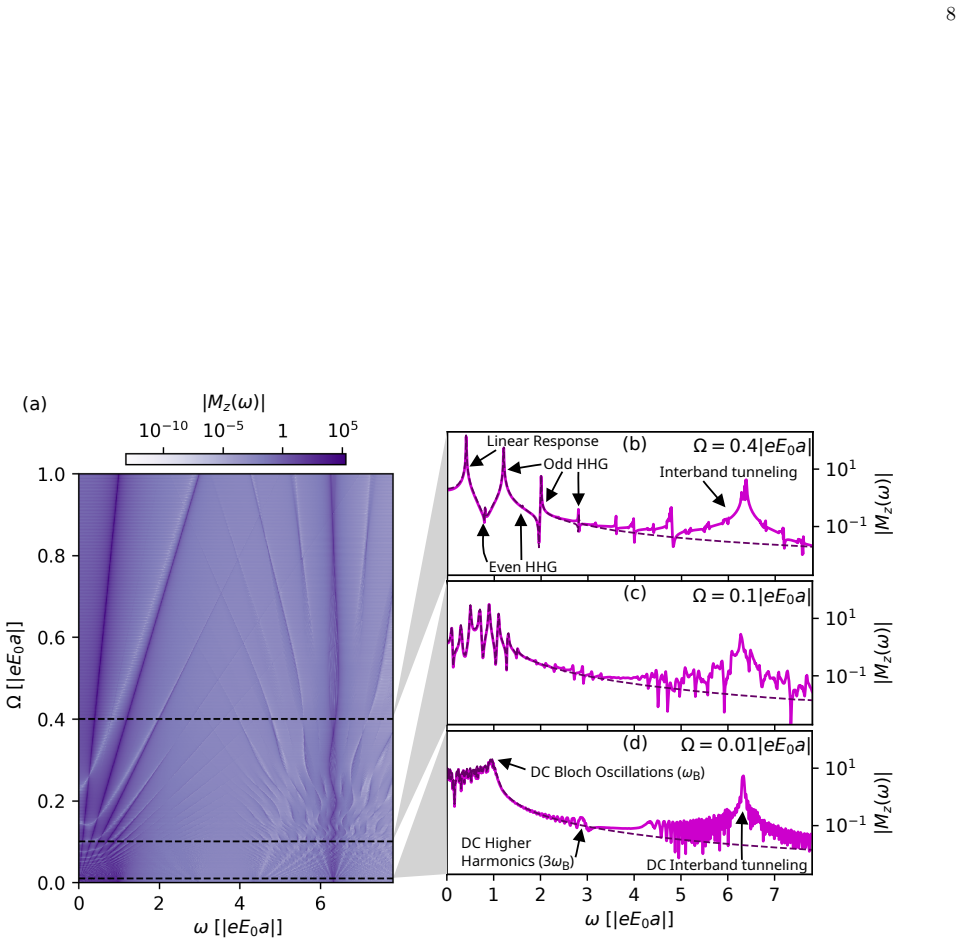
Referee: [minimal one-dimensional model] The central claim that magnetic BOs appear before relaxation to the Edelstein value is load-bearing on the relaxation mechanism having a timescale longer than the BO period set by the electric field and lattice. The 1D model section must explicitly detail the scattering implementation (e.g., how the relaxation term is added to the equations of motion or density matrix) and verify that oscillations survive without extraneous dephasing from interband transitions or disorder.
Authors: We agree that the relaxation mechanism and its timescale relative to the BO period are central to the claim. In the revised manuscript we will expand the 1D model section with an explicit description of the scattering implementation, including the precise form of the relaxation term added to the equations of motion or density matrix. We will also add numerical checks confirming that the oscillations remain visible for relaxation times longer than the BO period and that interband transitions or disorder do not introduce extraneous dephasing within the minimal-model assumptions. revision: yes
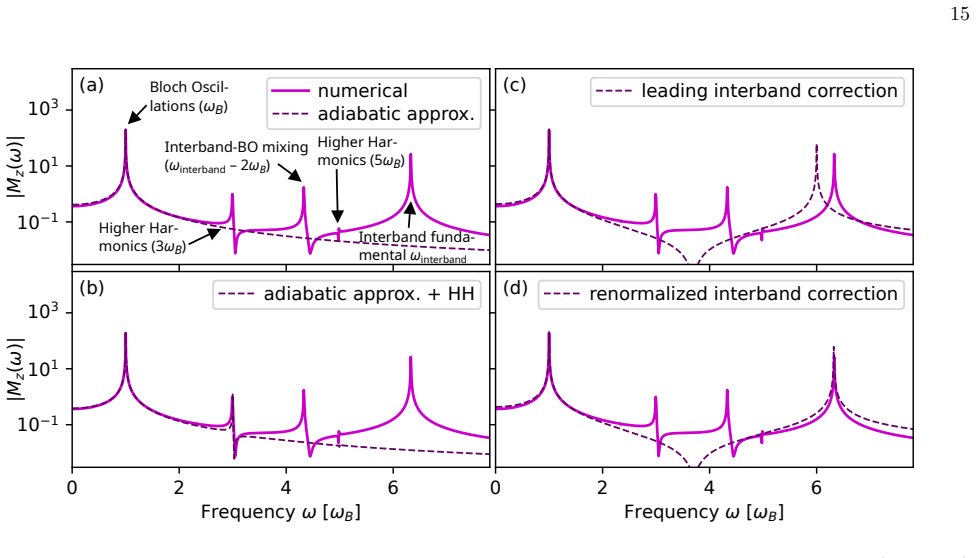
-
Referee: [two-dimensional generalization] The 2D generalization must show that the odd-parity spin-momentum locking is preserved and that magnetic BOs are not suppressed by additional channels present in higher dimensions. Without this, the claim that the effect is generic to odd-wave magnets rather than an artifact of the 1D toy model remains unestablished.
Authors: We acknowledge the need for a clearer demonstration that the effect is not an artifact of one dimension. The 2D Hamiltonian is constructed to retain the required odd-parity spin-momentum locking. In the revision we will add explicit analysis showing that this locking is preserved and that magnetic BOs survive the additional scattering channels present in 2D, by comparing relevant timescales and confirming that the oscillations are not suppressed under the model conditions. This will strengthen the argument for generality to odd-wave magnets. revision: yes
Circularity Check
No significant circularity; claims rest on explicit model calculations
full rationale
The paper defines a minimal 1D p-wave magnet Hamiltonian (and 2D extension), then analytically and numerically computes magnetization dynamics under electric field, showing transient oscillations that relax to a nonlinear Edelstein magnetization. This is a direct forward calculation from the stated model equations; no step reduces a claimed prediction to a fitted input by construction, no uniqueness theorem is imported via self-citation, and no ansatz is smuggled. The abstract and description indicate the result is demonstrated within the chosen model rather than asserted as model-independent, so the derivation chain is self-contained.
Axiom & Free-Parameter Ledger
Reference graph
Works this paper leans on
-
[1]
Bloch, ¨Uber die quantenmechanik der elektronen in kristallgittern, Zeitschrift F¨ ur Physik52, 555 (1929)
F. Bloch, ¨Uber die quantenmechanik der elektronen in kristallgittern, Zeitschrift F¨ ur Physik52, 555 (1929)
1929
-
[2]
Esaki and R
L. Esaki and R. Tsu, Superlattice and negative differ- ential conductivity in semiconductors, IBM Journal of Research and Development14, 61 (1970)
1970
-
[3]
Leo, Interband optical investigation of bloch oscilla- tions in semiconductor superlattices, Semiconductor Sci- ence and Technology13, 249 (1998)
K. Leo, Interband optical investigation of bloch oscilla- tions in semiconductor superlattices, Semiconductor Sci- ence and Technology13, 249 (1998)
1998
-
[4]
Feldmann, K
J. Feldmann, K. Leo, J. Shah, D. A. Miller, J. Cunning- ham, T. Meier, G. Von Plessen, A. Schulze, P. Thomas, and S. Schmitt-Rink, Optical investigation of bloch oscil- lations in a semiconductor superlattice, Physical Review B46, 7252 (1992)
1992
-
[5]
Waschke, H
C. Waschke, H. G. Roskos, R. Schwedler, K. Leo, H. Kurz, and K. K¨ ohler, Coherent submillimeter-wave emission from bloch oscillations in a semiconductor su- perlattice, Physical Review Letters70, 3319 (1993)
1993
-
[6]
Fahimniya, Z
A. Fahimniya, Z. Dong, E. I. Kiselev, and L. Levitov, Synchronizing bloch-oscillating free carriers in moir´ e flat bands, Physical Review Letters126, 256803 (2021)
2021
-
[7]
De Beule and E
C. De Beule and E. J. Mele, Berry curvature spectroscopy from bloch oscillations, Physical Review Letters131, 196603 (2023)
2023
-
[8]
De Beule, S
C. De Beule, S. Gassner, S. Talkington, and E. Mele, Floquet-bloch theory for nonperturbative response to a static drive, Physical Review B109, 235421 (2024)
2024
-
[9]
Ghimire, A
S. Ghimire, A. D. DiChiara, E. Sistrunk, P. Agostini, L. F. DiMauro, and D. A. Reis, Observation of high-order harmonic generation in a bulk crystal, Nature physics7, 138 (2011)
2011
-
[10]
Schubert, M
O. Schubert, M. Hohenleutner, F. Langer, B. Urbanek, C. Lange, U. Huttner, D. Golde, T. Meier, M. Kira, S. W. Koch, and R. Huber, Sub-cycle control of terahertz high- harmonic generation by dynamical bloch oscillations, Na- ture Photonics8, 119
-
[11]
Hohenleutner, F
M. Hohenleutner, F. Langer, O. Schubert, M. Knorr, U. Huttner, S. W. Koch, M. Kira, and R. Huber, Real- time observation of interfering crystal electrons in high- harmonic generation, Nature523, 572 (2015)
2015
-
[12]
Peschel, T
U. Peschel, T. Pertsch, and F. Lederer, Optical bloch oscillations in waveguide arrays, Optics Letters23, 1701 (1998)
1998
-
[13]
Neder, C
I. Neder, C. Sirote-Katz, M. Geva, Y. Lahini, R. Ilan, and Y. Shokef, Bloch oscillations, landau–zener transi- tion, and topological phase evolution in an array of cou- pled pendula, Proceedings of the National Academy of Sciences121, e2310715121 (2024)
2024
-
[14]
M. B. Dahan, E. Peik, J. Reichel, Y. Castin, and C. Sa- lomon, Bloch oscillations of atoms in an optical potential, Physical Review Letters76, 4508 (1996)
1996
-
[15]
Gustavsson, E
M. Gustavsson, E. Haller, M. Mark, J. G. Danzl, G. Rojas-Kopeinig, and H.-C. N¨ agerl, Control of interaction-induced dephasing of bloch oscillations, Phys- ical Review Letters100, 080404 (2008)
2008
-
[16]
H. M. Price and N. Cooper, Mapping the berry curvature from semiclassical dynamics in optical lattices, Physical Review A—Atomic, Molecular, and Optical Physics85, 033620 (2012)
2012
-
[17]
Dauphin and N
A. Dauphin and N. Goldman, Extracting the chern num- ber from the dynamics of a fermi gas: Implementing a quantum hall bar for cold atoms, Physical Review Let- ters111, 135302 (2013)
2013
-
[18]
Atala, M
M. Atala, M. Aidelsburger, J. T. Barreiro, D. Abanin, T. Kitagawa, E. Demler, and I. Bloch, Direct measure- ment of the zak phase in topological bloch bands, Nature Physics9, 795 (2013)
2013
-
[19]
Aidelsburger, M
M. Aidelsburger, M. Lohse, C. Schweizer, M. Atala, J. T. Barreiro, S. Nascimb` ene, N. Cooper, I. Bloch, and N. Goldman, Measuring the chern number of hofstadter bands with ultracold bosonic atoms, Nature Physics11, 162 (2015)
2015
-
[20]
Brekke, P
B. Brekke, P. Sukhachov, H. G. Giil, A. Brataas, and J. Linder, Minimal models and transport properties of unconventional p -wave magnets, Physical Review Let- ters133, 236703
-
[21]
ˇSmejkal, J
L. ˇSmejkal, J. Sinova, and T. Jungwirth, Emerging re- search landscape of altermagnetism, Physical Review X 12, 040501 (2022)
2022
-
[22]
Jungwirth, R
T. Jungwirth, R. M. Fernandes, E. Fradkin, A. H. Mac- Donald, J. Sinova, and L. ˇSmejkal, Altermagnetism: An unconventional spin-ordered phase of matter, Newton1 (2025)
2025
-
[23]
Jungwirth, J
T. Jungwirth, J. Sinova, R. M. Fernandes, Q. Liu, H. Watanabe, S. Murakami, S. Nakatsuji, and L.ˇSmejkal, Symmetry, microscopy and spectroscopy signatures of al- termagnetism, Nature649, 837 (2026)
2026
-
[24]
Hayami, Y
S. Hayami, Y. Yanagi, and H. Kusunose, Spontaneous an- tisymmetric spin splitting in noncollinear antiferromag- nets without spin-orbit coupling, Physical Review B101, 220403 (2020)
2020
-
[25]
M. Naka, S. Hayami, H. Kusunose, Y. Yanagi, Y. Mo- tome, and H. Seo, Spin current generation in organic an- tiferromagnets, Nature communications10, 4305 (2019)
2019
-
[26]
Gonz´ alez-Hern´ andez, P
R. Gonz´ alez-Hern´ andez, P. Ritzinger, K. V` yborn` y, J. ˇZelezn` y, and A. Manchon, Non-relativistic torque and edelstein effect in non-collinear magnets, Nature Com- munications15, 7663 (2024)
2024
-
[27]
Chakraborty, A
A. Chakraborty, A. Birk Hellenes, R. Jaeschke-Ubiergo, T. Jungwirth, L. ˇSmejkal, and J. Sinova, Highly efficient non-relativistic edelstein effect in nodal p-wave magnets, Nature Communications16, 7270 (2025)
2025
-
[28]
V. Leeb and J. Knolle, Collinearp-wave magnetism and hidden orbital ferrimagnetism, arXiv preprint arXiv:2601.07418 (2026)
-
[29]
Aronov and Y
A. Aronov and Y. B. Lyanda-Geller, Nuclear electric res- onance and orientation of carrier spins by an electric field, Soviet Journal of Experimental and Theoretical Physics Letters50, 431 (1989)
1989
-
[30]
V. M. Edelstein, Spin polarization of conduction elec- trons induced by electric current in two-dimensional asymmetric electron systems, Solid State Communica- tions73, 233 (1990)
1990
-
[31]
Sinova, S
J. Sinova, S. O. Valenzuela, J. Wunderlich, C. H. Back, and T. Jungwirth, Spin hall effects, Reviews of Modern Physics87, 1213 (2015)
2015
-
[32]
Kampfrath, A
T. Kampfrath, A. Sell, G. Klatt, A. Pashkin, S. M¨ ahrlein, T. Dekorsy, M. Wolf, M. Fiebig, A. Leitenstorfer, and 7 R. Huber, Coherent terahertz control of antiferromag- netic spin waves, Nature Photonics5, 31 (2011)
2011
-
[33]
Kimel, B
A. Kimel, B. Ivanov, R. Pisarev, P. Usachev, A. Kirilyuk, and T. Rasing, Inertia-driven spin switching in antiferro- magnets, Nature Physics5, 727 (2009)
2009
-
[34]
M. Hudl, M. d’Aquino, M. Pancaldi, S.-H. Yang, M. G. Samant, S. S. Parkin, H. A. D¨ urr, C. Serpico, M. C. Hoff- mann, and S. Bonetti, Nonlinear magnetization dynamics driven by strong terahertz fields, Physical Review Letters 123, 197204 (2019)
2019
-
[35]
Reisl¨ ohner, D
J. Reisl¨ ohner, D. Kim, I. Babushkin, and A. N. Pfeif- fer, Onset of bloch oscillations in the almost-strong-field regime, Nature Communications13, 7716
-
[36]
Reimann, S
J. Reimann, S. Schlauderer, C. Schmid, F. Langer, S. Baierl, K. Kokh, O. Tereshchenko, A. Kimura, C. Lange, J. G¨ udde, U. H¨ ofer, and R. Huber, Subcycle observation of lightwave-driven dirac currents in a topo- logical surface band, Nature562(2018)
2018
-
[37]
C. P. Schmid, L. Weigl, P. Gr¨ ossing, V. Junk, C. Gorini, S. Schlauderer, S. Ito, M. Meierhofer, N. Hofmann, D. Afanasiev, J. Crewse, K. A. Kokh, O. E. Tereshchenko, J. G¨ udde, F. Evers, J. Wilhelm, K. Richter, U. H¨ ofer, and R. Huber, Tunable non-integer high-harmonic generation in a topological insulator, Na- ture593, 385
-
[38]
Hardt, R
D. Hardt, R. Doostani, S. Diehl, N. Del Ser, and A. Rosch, Propelling ferrimagnetic domain walls by dy- namical frustration, Nature Communications16, 3817 (2025)
2025
-
[39]
slow enough
G. Vampa, C. McDonald, G. Orlando, D. Klug, P. Corkum, and T. Brabec, Theoretical analysis of high- harmonic generation in solids, Physical Review Letters 113, 073901. 8 (d) DC Bloch Oscillations (ωB) DC Interband tunneling DC Higher Harmonics (3ωB) 0 1 2 3 4 5 6 7 ωeE a [| |]0 10−1 101 | ( )|Mωz Ω= 0.01| |eE a0 (c) 10−1 101 | ( )|Mωz Ω= 0.1| |eE a0 (b) O...
-
[40]
If the electric field amplitude is furthermore weak, eE0a≪Ω, the outer sine function can be ex- panded, yielding magnetization and current that oscillate only at the driving frequency Ω, as ex- pected within linear response theory. Physically, the field induces only a small deviation of the elec- trons from their equilibrium distribution, prevent- ing the...
-
[41]
If, on the contrary, the oscillation frequency is small, Ω≪eE 0a, the inner sine function can instead be expanded, yielding oscillations at the Bloch frequencyeE 0a. Physically, the electric field is then nearly static and can accelerate electrons across the Brillouin zone boundary, giving rise to Bloch oscillations in the same way as a static elec- 15 (d...
-
[42]
For intermediate field strengths,eE 0a∼Ω, we can access the frequency spectrum ofM z andJ via the Jacobi-Anger expansion sin(zsin(Ωt)) = 2P n∈Nodd Jn(z) sin(nΩt), whereJ n is then-th Bessel function of the first kind. The acceleration of the electrons beyond the Brillouin zone bound- aries generates odd higher harmonics of the driving frequency, as observ...
discussion (0)
Sign in with ORCID, Apple, or X to comment. Anyone can read and Pith papers without signing in.