Convergence Rates for Semistochastic Processes
Pith reviewed 2026-06-25 21:49 UTC · model grok-4.3
The pith
Semistochastic processes that mix deterministic evolution with random disturbances admit a unique stationary distribution whose approach rate can be bounded by a new technique.
A machine-rendered reading of the paper's core claim, the machinery that carries it, and where it could break.
Core claim
Under appropriate assumptions a semistochastic process admits a unique stationary distribution, and a technique exists for deriving bounds on the rate at which the distribution of the process converges to this stationary distribution.
What carries the argument
A technique for establishing bounds on the rate of convergence to the stationary distribution.
If this is right
- The distribution of any qualifying semistochastic process converges to its stationary distribution at a rate that can be bounded explicitly.
- Models of forest carbon dynamics can obtain quantitative estimates of recovery time after random disturbances.
- The same bounding technique applies to any system whose evolution consists of deterministic segments separated by random shocks.
- Existence and uniqueness of the stationary distribution follow once the appropriate assumptions are verified.
Where Pith is reading between the lines
- The technique may supply error estimates for long-run Monte Carlo simulations of hybrid systems.
- Similar bounding arguments could be tested on related processes in which the deterministic part is replaced by a fast stochastic component.
- Verification of the assumptions in a specific application would immediately yield usable numerical bounds on mixing time.
Load-bearing premise
The unspecified appropriate assumptions that guarantee both the existence of a unique stationary distribution and the applicability of the convergence-rate technique.
What would settle it
A concrete semistochastic process obeying the paper's setup yet possessing either no unique stationary distribution or a convergence rate that violates the derived bounds.
Figures
read the original abstract
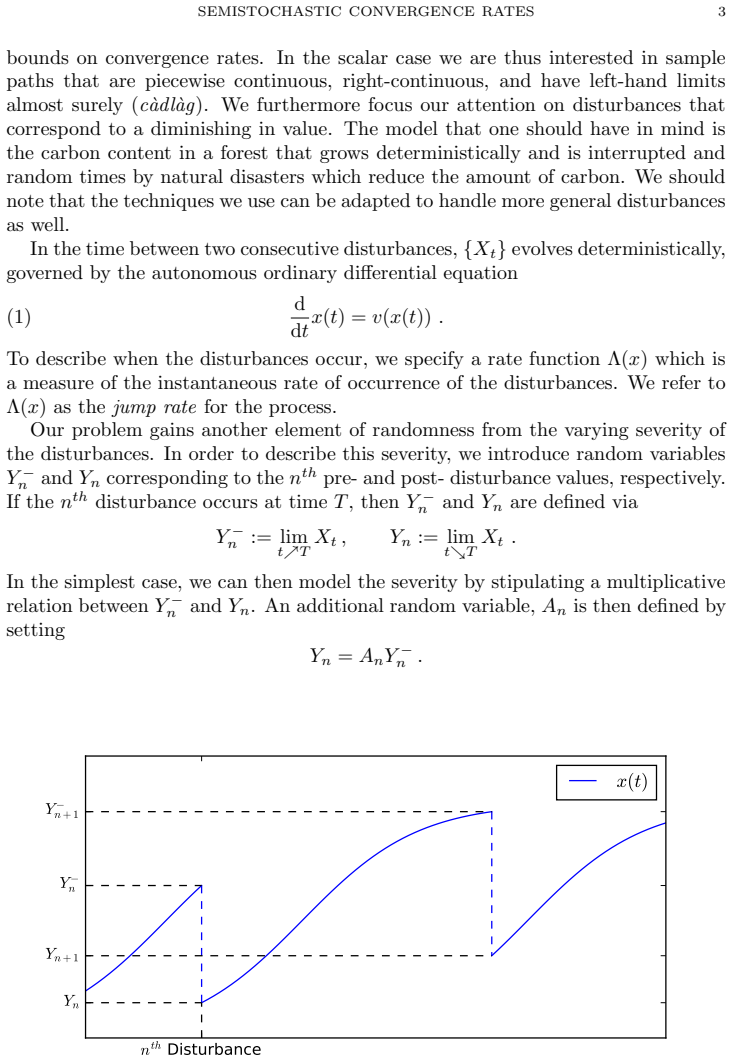
We study processes that consist of deterministic evolution punctuated at random times by disturbances with random severity; we call such processes semistochastic. Under appropriate assumptions such a process admits a unique stationary distribution. We develop a technique for establishing bounds on the rate at which the distribution of the random process approaches the stationary distribution. An important example of such a process is the dynamics of the carbon content of a forest whose deterministic growth is interrupted by natural disasters (fires, droughts, insect outbreaks, etc.).
Editorial analysis
A structured set of objections, weighed in public.
Referee Report
Summary. The paper introduces 'semistochastic processes' consisting of deterministic evolution interrupted at random times by random disturbances. It claims that under appropriate (unspecified) assumptions such processes admit a unique stationary distribution and develops a technique for bounding the rate at which the process distribution converges to stationarity. The motivating example is forest carbon dynamics subject to natural disasters.
Significance. If a general, verifiable technique for convergence rates were supplied, the work could be useful for applied probability models with intermittent shocks (ecology, reliability, finance). No such technique, assumptions, or proofs are visible in the provided manuscript, so significance cannot be assessed.
major comments (1)
- [Abstract] Abstract: the central claims rest on 'appropriate assumptions' that are never stated, and no derivation, ergodicity condition, contraction argument, or proof sketch is supplied. Without these, the existence of a unique stationary distribution and the convergence-rate technique cannot be evaluated.
Simulated Author's Rebuttal
We thank the referee for the review. We address the single major comment below.
read point-by-point responses
-
Referee: [Abstract] Abstract: the central claims rest on 'appropriate assumptions' that are never stated, and no derivation, ergodicity condition, contraction argument, or proof sketch is supplied. Without these, the existence of a unique stationary distribution and the convergence-rate technique cannot be evaluated.
Authors: The assumptions (Lipschitz continuity of the deterministic flow, moment bounds and positive density on the shock distribution, and a uniform lower bound on the probability of large shocks) are stated explicitly in Section 2. The convergence-rate technique is a contraction argument in a suitable Wasserstein metric and is developed in Section 3 with the full proof in Appendix A. We agree the abstract is too terse and does not convey this information; we will revise it to include a one-sentence statement of the main assumptions and a brief indication of the contraction method. revision: yes
Circularity Check
No significant circularity; derivation relies on external assumptions and standard techniques
full rationale
The abstract and available description state that the process admits a unique stationary distribution and convergence-rate bounds hold 'under appropriate assumptions,' without exhibiting any self-definitional reduction, fitted parameter renamed as prediction, or load-bearing self-citation chain. No equations or steps are quoted that reduce the claimed result to its own inputs by construction. The work presents a general technique for semistochastic processes (with an ecological example) whose validity is conditioned on external assumptions that are not shown to be tautological within the paper itself. This is the expected non-finding for a mathematical derivation paper whose central claims remain open to verification against independent benchmarks such as ergodic theory or coupling methods.
Axiom & Free-Parameter Ledger
Reference graph
Works this paper leans on
-
[1]
K. B. Athreya, D. McDonald and P. Ney, Limit theorems for semi-Markov processes and renewal theory for Markov chains.The Annals of Probability,6(1978), 788–797. 16 JAMES BRODA AND ALEXANDER GRIGO AND NIKOLA P. PETROV
1978
-
[2]
K. B. Athreya and P. Ney, A new approach to the limit theory of recurrent Markov chains, Transactions of the American Mathematical Society,245(1978), 493–501
1978
-
[3]
R. Aza¨ ıs and A. Genadot, A new characterization of the jump rate for piecewise-deterministic Markov processes with discrete transitions, arXiv:1606.06130v2 [stat.ME]
-
[4]
Aza¨ ıs and A
R. Aza¨ ıs and A. Muller-Guedin, Optimal choice among a class of nonparametric estimators of the jump rate for piecewise-deterministic Markov processes,Electronic Journal of Statistics, 10(2016), 3648–3692
2016
-
[5]
Bartoszy´ nski, On the risk of rabies,Mathematical Biosciences,24(1975), 355–377
R. Bartoszy´ nski, On the risk of rabies,Mathematical Biosciences,24(1975), 355–377
1975
-
[6]
Beckage, W
B. Beckage, W. J. Platt and L. J. Gross, Vegetation, fire, and feedbacks: a disturbance- mediated model of savannas,The American Naturalist,174(2009), 805–818
2009
-
[7]
I. Ben-Ari, A. Roitershtein and R. B. Schinazi, A random walk with catastrophes, arXiv:1709.04780v1 [math.PR]
-
[8]
Bertail, S
P. Bertail, S. Cl´ emen¸ con and J. Tressou, Statistical analysis of a dynamic model for dietary contaminant exposure,Journal of Biological Dynamics,4(2010), 212–234
2010
-
[9]
Biedrzycka and M
W. Biedrzycka and M. Tyran-Kam´ ınska, Existence of invariant densities for semiflows with jumps,Journal of Mathematical Analysis and Applications,435(2016), 61–84
2016
-
[10]
Bond-Lamberty, S
B. Bond-Lamberty, S. D. Peckham, D. E. Ahl and S. T. Gower, Fire as the dominant driver of central Canadian boreal forest carbon balance,Nature,450(2007), 89–92
2007
-
[11]
Bourgeron, M
T. Bourgeron, M. Doumic and M. Escobedo, Estimating the division rate of the growth- fragmentation equation with a self-similar kernel,Inverse Problems,30(2014), 025007 (28pp)
2014
-
[12]
P. J. Brockwell, J. Gani and S. I. Resnick, Birth, immigration and catastrophe process, Advances in Applied Probability,14(1982), 709–731
1982
-
[13]
P. J. Brockwell, J. M. Gani and S. I. Resnick, Catastrophe processes with continuous state- space,Australian Journal of Statistics,25(1983), 208–226
1983
-
[14]
B. J. Cairns, Evaluating the expected time to population extinction with semi-stochastic models,Mathematical Population Studies,16(2009), 199–220
2009
-
[15]
Calvez, M
V. Calvez, M. Doumic and P. Gabriel, Self-similarity in a general aggregation-fragmentation problem. Application to fitness analysis,Journal de Math´ ematiques Pures et Appliqu´ ees (9), 98(2012), 1–27
2012
-
[16]
J. S. Clark, Ecological disturbance as a renewal process: theory and application to fire history, Oikos,56(1989), 17–30
1989
-
[17]
J. N. Corcoran and R. L. Tweedie. Perfect sampling from independent Metropolis-Hastings chains,Journal of statistical planning and inference,104(2002), 297–314
2002
-
[18]
M. H. A. Davis, Piecewise-deterministic Markov processes: a general class of nondiffusion stochastic models,Journal of the Royal Statistical Society B,46(1984), 353–388
1984
-
[19]
M. H. A. Davis,Markov Models and Optimization, Chapman & Hall, London, 1993
1993
-
[20]
J. I. Doob,Stochastic Processes, Wiley, New York, 1953
1953
-
[21]
Economou and D
A. Economou and D. Fakinos, Alternative approaches for the transient analysis of Markov chains with catastrophes,Journal of Statistical Theory and Practice,2(2008), 183–197
2008
-
[22]
Gripenberg, A stationary distribution for the growth of a population subject to random catastrophes,Journal of Mathematical Biology,17(1983), 371–379
G. Gripenberg, A stationary distribution for the growth of a population subject to random catastrophes,Journal of Mathematical Biology,17(1983), 371–379
1983
-
[23]
G. Gripenberg, Extinction in a model for the growth of a population subject to catastrophes, Stochastics: An International Journal of Probability and Stochastic Processes,14(1985), 149–163
1985
-
[24]
F. B. Hanson and D. Ryan, Optimal harvesting with exponential growth in an environment with random disasters and bonanzas,Mathematical Biosciences,74(1985), 37–57
1985
-
[25]
F. B. Hanson and D. Ryan, Optimal harvesting of a logistic population in an environment with stochastic jumps,Journal of Mathematical Biology,24(1986), 259–277
1986
-
[26]
F. B. Hanson and H. C. Tuckwell, Persistence times of populations with large random fluc- tuations,Theoretical Population Biology,14(1978), 46–61
1978
-
[27]
F. B. Hanson and H. C. Tuckwell, Logistic growth with random density independent disasters, Theoretical Population Biology,19(1981), 1–18
1981
-
[28]
F. B. Hanson and H. C. Tuckwell, Population growth with randomly distributed jumps, Journal of Mathematical Biology,36(1997), 169–187
1997
-
[29]
Kapodistria, T
S. Kapodistria, T. Phung-Duc and J. Resing, Linear birth/immigration-death process with binomial catastrophes, The stationary distribution of a stochastic clearing process,Probability in the Engineering and Informational Sciences,30(2016), 79–111
2016
-
[30]
Lande, Risks of population extinction from demographic and environmental stochasticity and random catastrophes,The American Naturalist,142(1993), 911–927
R. Lande, Risks of population extinction from demographic and environmental stochasticity and random catastrophes,The American Naturalist,142(1993), 911–927. SEMISTOCHASTIC CONVERGENCE RATES 17
1993
-
[31]
Lauren¸ cot and B
P. Lauren¸ cot and B. Perthame, Exponential decay for the growth-fragmentation/cell-division equation.Communications in Mathematical Sciences,7(2009), 503–510
2009
-
[32]
M. C. A. Leite, N. P. Petrov and E. Weng, Stationary distributions of semistochastic processes with disturbances at random times and with random severity,Nonlinear Analysis: Real World Applications,13(2012), 497–512
2012
-
[33]
Malrieu, Some simple but challenging Markov processes,Annales de la Facult´ e des Sciences de Toulouse
F. Malrieu, Some simple but challenging Markov processes,Annales de la Facult´ e des Sciences de Toulouse. Math´ ematiques (6),24(2015), 857–883
2015
-
[34]
S. P. Meyn and R. L. Tweedie, Computable bounds for geometric convergence rates of Markov chains,Annals of Applied Probability,4(1994), 981–1011
1994
-
[35]
S. P. Meyn and R. L. Tweedie,Markov Chains and Stochastic Stability, Springer-Verlag, London, 1993
1993
-
[36]
Nummelin, A splitting technique for Harris recurrent Markov chains,Zeitschrift f¨ ur Wahrscheinlichkeitstheorie und verwandte Gebiete,43(1978), 309–318
E. Nummelin, A splitting technique for Harris recurrent Markov chains,Zeitschrift f¨ ur Wahrscheinlichkeitstheorie und verwandte Gebiete,43(1978), 309–318
1978
-
[37]
Nummelin,General Irreducible Markov Chains and Non-Negative Operators, Cambridge University Press, Cambridge, 1984
E. Nummelin,General Irreducible Markov Chains and Non-Negative Operators, Cambridge University Press, Cambridge, 1984
1984
-
[38]
A. G. Pakes, A. C. Trajstman and P. J. Brockwell, A stochastic model for a replicating pop- ulation subjected to mass emigration due to population pressure,Mathematical Biosciences, 45(1979), 137–157
1979
-
[39]
K. S. Pregitzer and E. S. Euskirchen, Carbon cycling and storage in world forests: biome patterns related to forest age,Global Change Biology,10(2004), 2052–2077
2004
-
[40]
D. H. Reed, J. J. O’Grady, J. D. Ballou and R. Frankham, The frequency and severity of catastrophic die-offs in vertebrates,Animal Conservation,6(2003), 109–114
2003
-
[41]
G. O. Roberts and J. S. Rosenthal, Quantitative bounds for convergence rates of continuous time Markov processes,Electronic Journal of Probability,1(1996), 1–21
1996
-
[42]
G. O. Roberts and R. L. Tweedie, Rates of convergence of stochastically monotone and continuous time Markov models,Journal of Applied Probability,37(2000), 359–373
2000
-
[43]
W. H. Romme, E. H. Everham, L. E. Frelich, M. A. Moritz and R. E. Sparks, Are large, infrequent disturbances qualitatively different from small, frequent disturbances?Ecosystems, 1(1998), 524–534
1998
-
[44]
J. S. Rosenthal, Minorization conditions and convergence rates for Markov chain Monte Carlo, Journal of the American Statistical Association,90(1995), 558–566
1995
-
[45]
S. W. Running, Ecosystem disturbance, carbon, and climate,Science,321(2008), 652–653
2008
-
[46]
A. R. Teel, A. Subbaramana and A. Sferlazza, Stability analysis for stochastic hybrid systems: A survey,Automatica,50(2014), 2435–2456
2014
-
[47]
P. E. Thornton, B. E. Law, H. L. Gholz, K. L. Clark, E. Falge, D. S. Ellsworth, A. H. Goldstein, R. K. Monson, D. Hollinger, M. Falk, J. Chen and J. P. Sparks, Modeling and measuring the effects of disturbance history and climate on carbon and water budgets in evergreen needleleaf forests,Agricutural and Forest Meteorology,113(2002), 185–222
2002
-
[48]
W. Whitt. The stationary distribution of a stochastic clearing process,Operations Research, 29(1981), 294–308. Email address:jbroda@wlu.edu Email address:alexander.grigo@ou.edu Email address:npetrov@ou.edu
1981
discussion (0)
Sign in with ORCID, Apple, or X to comment. Anyone can read and Pith papers without signing in.