Exploring Feasible Design Spaces for Heterogeneous Constraints
Pith reviewed 2026-05-25 11:03 UTC · model grok-4.3
The pith
Pointwise constraints define feasible design subspaces as first-class entities via their maximal feasible elements, which can be intersected to prune the space before optimization.
A machine-rendered reading of the paper's core claim, the machinery that carries it, and where it could break.
Core claim
Pointwise constraints define feasible design subspaces that can be represented and computed as first-class entities by their maximal feasible elements. The design space is pruned upfront by intersecting maximal elements, without premature optimization. To solve for other constraints, topology optimization (TO) is applied starting from the pruned feasible space. The optimization is steered by a topological sensitivity field (TSF) that measures the global changes in violation of constraints with respect to local topological punctures. The TSF for global objective functions is augmented with TSF for global constraints, and penalized/filtered to incorporate local constraints, including set ones.
What carries the argument
Maximal feasible elements that represent pointwise constraint subspaces and are intersected for upfront pruning, together with the topological sensitivity field (TSF) that steers topology optimization from the resulting space.
If this is right
- The pruned space obtained by intersecting maximal elements becomes the starting point for topology optimization.
- The topological sensitivity field can be augmented for global constraints and penalized or filtered for local and set constraints after conversion to differentiable form.
- Examples show simultaneous satisfaction of physics-based goals such as minimized compliance and mass together with kinematics-based goals such as maximized machining accessibility.
- Constraint classification separates pruning operations from exploration operations so that optimization occurs only after the feasible region has been reduced.
Where Pith is reading between the lines
- Separating early pruning via maximal elements from later topology optimization may shorten iteration cycles when many heterogeneous constraints must be met.
- The same pruning-plus-TSF pattern could be tested on constraint sets arising in other domains such as structural assembly or robotic motion planning.
- Converting set constraints into differentiable inequalities inside the TSF step might allow direct incorporation of discrete manufacturing rules without custom solvers.
Load-bearing premise
Maximal feasible elements for pointwise constraints can be computed and intersected in practice for nontrivial geometries without exponential cost or loss of important feasible regions.
What would settle it
A nontrivial geometry together with a collection of pointwise constraints for which the intersection of maximal feasible elements either requires exponential time or excludes at least one design that satisfies every constraint.
Figures




read the original abstract
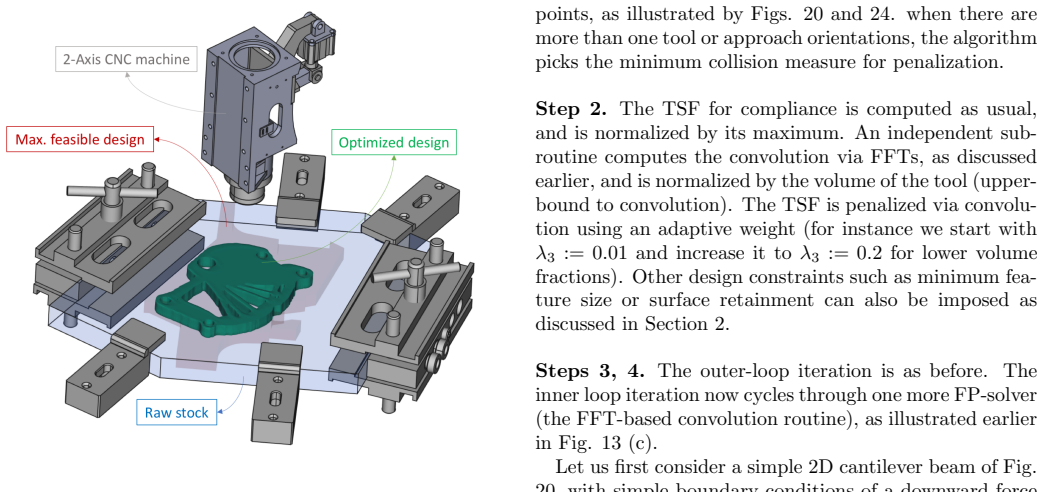
We demonstrate an approach of exploring design spaces to simultaneously satisfy kinematics- and physics-based requirements. We present a classification of constraints and solvers to enable postponing optimization as far down the design workflow as possible. The solvers are organized into two broad classes of design space 'pruning' and 'exploration' by considering the types of constraints they can satisfy. We show that pointwise constraints define feasible design subspaces that can be represented and computed as first-class entities by their maximal feasible elements. The design space is pruned upfront by intersecting maximal elements, without premature optimization. To solve for other constraints, we apply topology optimization (TO), starting from the pruned feasible space. The optimization is steered by a topological sensitivity field (TSF) that measures the global changes in violation of constraints with respect to local topological punctures. The TSF for global objective functions is augmented with TSF for global constraints, and penalized/filtered to incorporate local constraints, including set constraints converted to differentiable (in)equality constraints. We demonstrate application of the proposed workflow to nontrivial examples in design and manufacturing. Among other examples, we show how to explore pruned design spaces via TO to simultaneously satisfy physics-based constraints (e.g., minimize compliance and mass) as well as kinematics-based constraints (e.g., maximize accessibility for machining).
Editorial analysis
A structured set of objections, weighed in public.
Referee Report
Summary. The paper claims to demonstrate an approach for exploring feasible design spaces under heterogeneous kinematics- and physics-based constraints. It classifies constraints and solvers into pruning and exploration categories. Pointwise constraints are represented as first-class entities by their maximal feasible elements; these are intersected to prune the design space upfront without premature optimization. Topology optimization is then applied from the pruned space, steered by a topological sensitivity field (TSF) that is augmented for global constraints, penalized/filtered for local constraints, and used to satisfy remaining requirements such as compliance, mass, and machining accessibility. The workflow is illustrated on nontrivial design and manufacturing examples.
Significance. If the central claims hold, the framing of feasible subspaces via maximal feasible elements as first-class entities, combined with upfront pruning before TSF-guided topology optimization, could enable more systematic handling of mixed constraint types in early-stage design. This would be a useful contribution to computational geometry and topology optimization workflows for manufacturing, particularly if it avoids loss of feasible regions. The classification of constraints and the TSF augmentation for both objectives and constraints are constructive ideas.
major comments (2)
- [Abstract and section on classification of constraints and solvers] Abstract and section on classification of constraints and solvers: The claim that pointwise constraints define feasible design subspaces represented and computed by their maximal feasible elements, which can then be intersected to prune the space exactly, lacks any algorithm, data structure, or complexity bound. For nontrivial 3D geometries this step is load-bearing, as determining maximal elements under constraints such as machining accessibility generally requires searching over admissible configurations, risking exponential cost or incomplete pruning that discards feasible regions before optimization begins.
- [Abstract (TSF description)] Abstract (TSF description): The claim that the topological sensitivity field (TSF) correctly steers the optimizer to satisfy remaining global and local constraints after pruning rests on an unshown derivation or verification. The abstract states that the TSF for global objectives is augmented with TSF for global constraints and penalized/filtered for local constraints, but provides no error analysis or demonstration that this augmentation measures global changes in violation with respect to local punctures without introducing premature loss of feasibility.
minor comments (1)
- [Abstract] The abstract would be strengthened by including at least one quantitative outcome or specific metric from the demonstrated examples to illustrate the effectiveness of the pruning and TSF steps.
Simulated Author's Rebuttal
We thank the referee for the constructive feedback and for recognizing the potential utility of framing feasible subspaces via maximal elements and the TSF augmentation approach. We address each major comment below with clarifications from the manuscript and indicate planned revisions.
read point-by-point responses
-
Referee: [Abstract and section on classification of constraints and solvers] Abstract and section on classification of constraints and solvers: The claim that pointwise constraints define feasible design subspaces represented and computed by their maximal feasible elements, which can then be intersected to prune the space exactly, lacks any algorithm, data structure, or complexity bound. For nontrivial 3D geometries this step is load-bearing, as determining maximal elements under constraints such as machining accessibility generally requires searching over admissible configurations, risking exponential cost or incomplete pruning that discards feasible regions before optimization begins.
Authors: The manuscript presents the conceptual representation of pointwise constraints via maximal feasible elements as first-class entities (see classification section and examples), with intersection used for upfront pruning in the demonstrated cases. For the specific constraints in our examples (e.g., kinematics and machining accessibility), maximal elements are obtained via configuration-space analysis and bounding-volume computations rather than exhaustive search. We agree, however, that a general algorithm, data structure, and complexity bound for arbitrary 3D pointwise constraints are not supplied, as the emphasis is on the workflow rather than a universal solver. We will revise the relevant section to include pseudocode for the example-specific computations, note the dependence on constraint type, and add a brief discussion of computational considerations for 3D cases to mitigate the risk of incomplete pruning. revision: yes
-
Referee: [Abstract (TSF description)] Abstract (TSF description): The claim that the topological sensitivity field (TSF) correctly steers the optimizer to satisfy remaining global and local constraints after pruning rests on an unshown derivation or verification. The abstract states that the TSF for global objectives is augmented with TSF for global constraints and penalized/filtered for local constraints, but provides no error analysis or demonstration that this augmentation measures global changes in violation with respect to local punctures without introducing premature loss of feasibility.
Authors: The full manuscript derives the augmented TSF (methods section) by combining the sensitivity of the global objective with constraint sensitivities and applying penalization/filtering for local constraints, with the examples showing that the resulting field steers the optimizer to feasible designs from the pruned space. We acknowledge that a formal error analysis or general proof that the augmentation avoids premature loss of feasibility is absent. We will expand the methods section with the explicit mathematical steps for the augmentation, add a discussion of the conditions under which global changes are correctly measured, and note any limitations observed in the examples. revision: yes
Circularity Check
No circularity in derivation chain
full rationale
The paper classifies constraints into pruning and exploration categories, represents pointwise constraints via maximal feasible elements that are intersected to prune the space, and then applies topology optimization driven by a topological sensitivity field (TSF) augmented for constraints. No equations, definitions, or steps reduce any claimed prediction or result to a fitted quantity or self-referential input by construction. The workflow is described as building on external topology-optimization literature rather than depending on self-citation chains or ansatzes imported from the authors' prior work. The derivation remains self-contained against external benchmarks with no load-bearing reductions to the paper's own inputs.
Axiom & Free-Parameter Ledger
Reference graph
Works this paper leans on
-
[1]
O. Sigmund, K. Maute, Topology optimization approaches, Structural and Multidisciplinary Optimization 48 (6) (2013) 1031–1055
work page 2013
-
[2]
N. P. van Dijk, K. Maute, M. Langelaar, F. van Keulen, Level- set methods for structural topology optimization: A review, Structural and Multidisciplinary Optimization 48 (3) (2013) 437–472
work page 2013
-
[3]
G. I. N. Rozvany, A critical review of established methods of structural topology optimization, Structural and Multidis- ciplinary Optimization 37 (3) (2009) 217–237
work page 2009
-
[4]
J. C. Latombe, Robot Motion Planning, Vol. 124, Springer Sci- ence & Business Media, 2012
work page 2012
-
[5]
T. Lozano-Perez, Spatial planning: A configuration space ap- proach, IEEE Transactions on Computers C-32 (2) (1983) 108–
work page 1983
-
[6]
doi:10.1109/TC.1983.1676196
-
[7]
S. Nelaturi, M. Lysenko, V. Shapiro, Rapid mapping and ex- ploration of configuration space, Journal of Computing and In- formation Science in Engineering 12 (2) (2012) 021007
work page 2012
-
[8]
S. Nelaturi, G. Burton, C. Fritz, T. Kurtoglu, Automatic spa- tial planning for machining operations, in: Proceedings of the 2015 IEEE International Conference on Automation Sci- ence and Engineering (CASE’2015), 2015, pp. 677–682. doi: 10.1109/CoASE.2015.7294158
-
[9]
M. Behandish, S. Nelaturi, M. Allard, Automated process plan- ning for turning: A feature-free approach, in: Advances in Manufacturing Techonology XXXII, Advances in Transdisci- plinary Engineering Series, Volume 8, 2018, pp. 45–50, proceed- ings of the International Conference on Manufacturing Researh (ICMR’2018)
work page 2018
-
[10]
S. Nelaturi, W. Kim, T. Kurtoglu, Manufacturability feedback and model correction for additive manufacturing, Journal of Manufacturing Science and Engineering 137 (2) (2015) 021015. doi:10.1115/1.4029374
-
[11]
S. Nelaturi, V. Shapiro, Representation and analysis of addi- tively manufactured parts, Computer-Aided Design 67 (2015) 13–23
work page 2015
-
[12]
M. Behandish, S. Nelaturi, Characterizing topological dis- crepancies in additive manufacturing, in: Proceedings of the 28th Annual Fall Workshop on Computational Geometry (FWCG’2018), Association of Computing Machinery (ACM), 2018, pp. 71–74
work page 2018
-
[13]
M. Behandish, A. M. Mirzendehdel, S. Nelaturi, Detection and correction of topological errors in additive manufacturing, 2019, special Issue on the 23rd ACM Symposium on Solid and Phys- ical Modeling (SPM’2019)
work page 2019
-
[14]
M. Behandish, S. Nelaturi, J. de Kleer, Automated process plan- ning for hybrid manufacturing, Vol. 102, 2018, pp. 11–22, spe- cial Issue on the 22nd ACM Symposium on Solid and Physical Modeling (SPM’2018)
work page 2018
-
[15]
H. T. Ilie¸ s, V. Shapiro, On shaping with motion, Journal of Mechanical Design 122 (4) (2000) 567–574
work page 2000
-
[16]
W. M. Lai, D. Rubinlor, E. Krempl, Introduction to Contin- uum Mechanics, 4th Edition, Butterworth-Heinemann Elsevier, 2009
work page 2009
-
[17]
S. Nelaturi, M. Behandish, A. M. Mirzendehdel, Automatic sup- port removal for additive manufacturing post processing, 2019, special Issue on the 23rd ACM Symposium on Solid and Phys- ical Modeling (SPM’2019)
work page 2019
-
[18]
J. G. Michopoulos, A. P. Iliopoulos, J. C. Steuben, A. J. Birn- baum, S. G. Lambrakos, On the multiphysics modeling chal- lenges for metal additive manufacturing processes, Additive Manufacturing 22 (2018) 784–799
work page 2018
-
[19]
A. M. Mirzendehdel, K. Suresh, Support structure constrained topology optimization for additive manufacturing, Computer- Aided Design 81 (2016) 1–13
work page 2016
-
[20]
H. T. Ilie¸ s, V. Shapiro, The dual of sweep, Computer-Aided Design 31 (3) (1999) 185–201. doi:10.1016/S0010-4485(99) 00015-9
-
[21]
K. Suresh, Efficient generation of large-scale Pareto-optimal topologies, Structural and Multidisciplinary Optimization 47 (1) (2013) 49–61
work page 2013
-
[22]
M. L. Scott, Programming Language Pragmatics, Morgan Kauf- mann, 2000
work page 2000
-
[23]
J. Nocedal, S. J. Wright, Numerical Optimization, 2nd Edition, Springer, 2006
work page 2006
-
[24]
M. R. Garey, D. S. Johnson, Computers and Intractability, Vol. 29, WH Freeman New York, 2002
work page 2002
-
[25]
T. C. Koopmans, An analysis of production as an efficient com- bination of activities, Activity Analysis of Production and Al- location
-
[26]
A. Charnes, W. W. Cooper, B. Golany, L. Seiford, J. Stutz, Foundations of data envelopment analysis for Pareto-Koopmans efficient empirical production functions, Journal of econometrics 30 (1-2) (1985) 91–107
work page 1985
-
[27]
O. B. Augusto, F. Bennis, S. Caro, Multiobjective engineering design optimization problems: A sensitivity analysis approach, Pesquisa Operacional 32 (3) (2012) 575–596
work page 2012
-
[28]
S. Sra, S. Nowozin, S. J. Wright, Optimization for Machine Learning, Mit Press, 2012
work page 2012
-
[29]
S. Lienhard, C. Lau, P. M¨ uller, P. Wonka, M. Pauly, Design transformations for rule-based procedural modeling, in: Com- puter Graphics Forum, Vol. 36, Wiley Online Library, 2017, pp. 39–48
work page 2017
-
[30]
E. K. Burke, G. Kendall, J. Newall, E. Hart, P. Ross, S. Schulen- burg, Hyper-heuristics: An emerging direction in modern search technology, in: Handbook of metaheuristics, Springer, 2003, pp. 457–474
work page 2003
-
[31]
E. K. Burke, M. Gendreau, M. Hyde, G. Kendall, G. Ochoa, E. ¨Ozcan, R. Qu, Hyper-heuristics: A survey of the state of the art, Journal of the Operational Research Society 64 (12) (2013) 1695–1724
work page 2013
-
[32]
P. A. Vikhar, Evolutionary algorithms: A critical review and its future prospects, in: The 2016 International Conference on Global Trends in Signal Processing, Information Computing and Communication (ICGTSPICC), IEEE, 2016, pp. 261–265
work page 2016
-
[33]
Z. Michalewicz, Genetic algorithms, numerical optimization, and constraints, in: Proceedings of the 6th International Con- ference on Genetic Algorithms, Vol. 195, Citeseer, 1995, pp. 151–158
work page 1995
-
[34]
J. Kennedy, Swarm intelligence, in: Handbook of Nature- Inspired and Innovative Computing, Springer, 2006, pp. 187– 219
work page 2006
-
[35]
Shi, Particle swarm optimization, IEEE Connections 2 (1) (2004) 8–13
Y. Shi, Particle swarm optimization, IEEE Connections 2 (1) (2004) 8–13
work page 2004
- [36]
-
[37]
H. A. Eschenauer, N. Olhoff, Topology optimization of contin- uum structures: A review, Applied Mechanics Reviews 54 (4) (2001) 331
work page 2001
-
[38]
J. D. Deaton, R. V. Grandhi, A survey of structural and multidisciplinary continuum topology optimization: Post 2000, Structural and Multidisciplinary Optimization 49 (1) (2013) 1– 38
work page 2000
-
[39]
L. Wang, P. K. Basu, J. P. Leiva, Automobile body reinforce- ment by finite element optimization, Finite Elements in Analy- sis and Design 40 (8) (2004) 879–893
work page 2004
-
[40]
E. Kesseler, W. J. Vankan, Multidisciplinary design analysis and multi-objective optimisation applied to aircraft wing (2006)
work page 2006
-
[41]
J. J. Alonso, P. LeGresley, V. Pereyra, Aircraft design optimiza- tion, Mathematics and Computers in Simulation 79 (6) (2009) 1948–1958
work page 2009
-
[42]
V. Coverstone-Carroll, J. W. Hartmann, W. J. Mason, Op- timal multi-objective low-thrust spacecraft trajectories, Com- puter Methods in Applied Mechanics and Engineering 186 (2-4) (2000) 387–402
work page 2000
-
[43]
L. Harzheim, G. Graf, A review of optimization of cast parts using topology optimization, Structural and Multidisciplinary Optimization 31 (5) (2005) 388–399
work page 2005
-
[44]
O. Sigmund, On the design of compliant mechanisms using 27 topology optimization, Journal of Structural Mechanics 25 (4) (1997) 493–524
work page 1997
-
[45]
M. P. Bendsøe, O. Sigmund, Material interpolation schemes in topology optimization, Archive of Applied Mechanics 69 (9-10) (1999) 635–654
work page 1999
-
[46]
O. Sigmund, Design of multiphysics actuators using topology optimization-part II: Two-material structures, Computer Meth- ods in Applied Mechanics and Engineering 190 (49-50) (2001) 6605–6627
work page 2001
-
[47]
M. P. Bendsøe, O. Sigmund, Topology Optimization, Springer Berlin Heidelberg, Berlin, Heidelberg, 2004
work page 2004
-
[48]
G. Allaire, F. Jouve, A. M. Toader, A level-set method for shape optimization, Comptes Rendus Mathematique 334 (12) (2002) 1125–1130
work page 2002
-
[49]
G. Allaire, F. De Gournay, F. Jouve, A. Toader, Structural optimization using topological and shape sensitivity via a level set method, Control and Cybernetics 34 (1) (2005) 59
work page 2005
-
[50]
D. N. Chu, Y. M. Xie, A. Hira, G. P. Steven, Evolutionary structural optimization for problems with stiffness constraints, Finite Elements in Analysis and Design 21 (4) (1996) 239–251
work page 1996
- [51]
-
[52]
X. Liu, W. J. Yi, Q. S. Li, P. S. Shen, Genetic evolutionary structural optimization, Journal of Constructional Steel Re- search 64 (3) (2008) 305–311
work page 2008
-
[53]
M. K. Thompson, G. Moroni, T. Vaneker, G. Fadel, R. I. Camp- bell, I. Gibson, A. Bernard, J. Schulz, P. Graf, B. Ahuja, F. Mar- tinaj, Design for additive manufacturing: Trends, opportuni- ties, considerations, and constraints, CIRP Annals 65 (2) (2016) 737–760
work page 2016
-
[54]
I. Pandelidis, Q. Zou, Optimization of injection molding design. part I: Gate location optimization, Polymer Engineering & Sci- ence 30 (15) (1990) 873–882
work page 1990
-
[55]
B. H. Lee, B. H. Kim, Optimization of part wall thicknesses to reduce warpage of injection-molded parts based on the modified complex method, Polymer-Plastics Technology and Engineering 34 (5) (1995) 793–811
work page 1995
-
[56]
J. Petersson, O. Sigmund, Slope constrained topology optimiza- tion, International Journal for Numerical Methods in Engineer- ing 41 (8) (1998) 1417–1434
work page 1998
-
[57]
P. M. Pandey, K. Thrimurthulu, N. V. Reddy, Optimal part deposition orientation in FDM by using a multicriteria genetic algorithm, International Journal of Production Research 42 (19) (2004) 4069–4089
work page 2004
-
[58]
A. S. Nezhad, F. Barazandeh, A. R. Rahimi, M. Vatani, Pareto- based optimization of part orientation in stereolithography, Pro- ceedings of the Institution of Mechanical Engineers, Part B: Journal of Engineering Manufacture 224 (10) (2010) 1591–1598
work page 2010
-
[59]
R. Paul, S. Anand, Optimization of layered manufacturing pro- cess for reducing form errors with minimal support structures, Journal of Manufacturing Systems 36 (2015) 231–243
work page 2015
-
[60]
A. T. Gaynor, J. K. Guest, Topology optimization considering overhang constraints: Eliminating sacrificial support material in additive manufacturing through design, Structural and Mul- tidisciplinary Optimization 54 (5) (2016) 1157–1172
work page 2016
-
[61]
M. Langelaar, Topology optimization of 3D self-supporting structures for additive manufacturing, Additive Manufacturing 12 (2016) 60–70
work page 2016
-
[62]
X. Qian, Undercut and overhang angle control in topology op- timization: A density gradient based integral approach, Inter- national Journal for Numerical Methods in Engineering 111 (3) (2017) 247–272
work page 2017
-
[63]
A. M. Mirzendehdel, K. Suresh, A Hands-On Introduction to Topology Optimization, CreateSpace Independent Publishing Platform, 2017
work page 2017
-
[64]
C. Schmutzler, F. Bayerlein, S. Janson, C. Seidel, M. F. Zaeh, Pre-compensation of warpage for additive manufacturing, in: Fraunhofer Direct Digital Manufacturing Conference (DDMC), 2016, pp. 392–399
work page 2016
-
[65]
A. M. Mirzendehdel, B. Rankouhi, K. Suresh, Strength-based topology optimization for anisotropic parts, Additive Manufac- turing 19 (2018) 104–113
work page 2018
-
[66]
M. Lysenko, S. Nelaturi, V. Shapiro, Group morphology with convolution algebras, in: Proceedings of the 14th ACM Sympo- sium on Solid and Physical Modeling (SMP’2010), ACM, 2010, pp. 11–22
work page 2010
-
[67]
M. Behandish, H. T. Ilie¸ s, Analytic methods for geometric mod- eling via spherical decomposition, Computer-Aided Design 70 (2015) 100–115, special Issue on the 19th ACM Symposium on Solid and Physical Modeling (SPM’2015)
work page 2015
-
[68]
K. D. Wise, A. Bowyer, A survey of global configuration-space mapping techniques for a single robot in a static environment, The International Journal of Robotics Research 19 (8) (2000) 762–779
work page 2000
-
[69]
P. Y. Papalambros, The optimization paradigm in engineer- ing design: Promises and challenges, Computer-Aided Design 34 (12) (2002) 939–951
work page 2002
-
[70]
N. D. Mankame, G. K. Ananthasuresh, Topology optimization for synthesis of contact-aided compliant mechanisms using reg- ularized contact modeling, Computers & structures 82 (15-16) (2004) 1267–1290
work page 2004
- [71]
-
[72]
M. Luo, Y.and Li, Z. Kang, Topology optimization of hypere- lastic structures with frictionless contact supports, International Journal of Solids and Structures 81 (2016) 373–382
work page 2016
-
[73]
K. Suresh, A 199-line Matlab code for Pareto-optimal tracing in topology optimization, Structural and Multidisciplinary Op- timization 42 (5) (2010) 665–679
work page 2010
-
[74]
A. A. G. Requicha, Representations for rigid solids: Theory, methods, and systems, ACM Computing Surveys (CSUR) 12 (4) (1980) 437–464
work page 1980
-
[75]
L. E. Kavraki, Computation of configuration-space obstacles us- ing the fast Fourier transform, IEEE Transactions on Robotics and Automation 11 (3) (1995) 408–413. doi:10.1109/70. 388783
work page doi:10.1109/70 1995
-
[76]
R. B. Tilove, A. A. G. Requicha, Closure of Boolean operations on geometric entities, Computer-Aided Design 12 (5) (1980) 219–220
work page 1980
-
[77]
Serra, Image Analysis and Mathematical Morphology, Aca- demic Press, Inc., 1983
J. Serra, Image Analysis and Mathematical Morphology, Aca- demic Press, Inc., 1983
work page 1983
-
[78]
S. Nelaturi, V. Shapiro, Configuration products and quotients in geometric modeling, Computer-Aided Design 43 (7) (2011) 781–794
work page 2011
-
[79]
A. A. Novotny, R. A. Feijoo, E. Taroco, C. Padra, Topological sensitivity analysis for three-dimensional linear elasticity prob- lem, Computer Methods in Applied Mechanics and Engineering 196 (41) (2007) 4354–4364
work page 2007
-
[80]
R. L. Burden, J. D. Faires, Numerical analysis, brooks, Cole, Belmont, CA
discussion (0)
Sign in with ORCID, Apple, or X to comment. Anyone can read and Pith papers without signing in.