REVIEW 1 major objections 4 minor 1 cited by
A comprehensive separation of dark matter and baryonic mass components in galaxy clusters I: Mass constraints from Abell S1063
T0 review · 1 major / 4 minor · reviewed 2026-08-04 · deepseek-v4-flash
Pith's one-line read This paper measures the light, stellar mass, and velocity dispersions of cluster members and the BCG/ICL in Abell S1063, producing the constraint dataset needed to separate dark matter from baryonic mass in a multi-probe cluster mass model.
desk verdict A solid measurement release for AS1063 with a genuinely useful crowded-field fitting method; the outer Vrms bin rejection is the one spot that needs better defense. read the letter →
The pith
A machine-rendered reading of the paper's core claim, the machinery that carries it, and where it could break.
The reading
What carries the argument
Two parametrisations carry the argument. For cluster members the paper uses the dual Pseudo-Isothermal Elliptical (dPIE) profile, chosen because its lensing quantities are analytic, so the fitted light profiles can be inserted directly into the lensing mass model that scales them to stellar mass. For the BCG and ICL it uses the Multi-Gaussian Expansion (MGE), the standard input for axisymmetric Jeans (JAM) kinematic modelling, enabling the Vrms profile to be turned into mass constraints. The supporting mechanism is a two-stage crowded-field fitting procedure: regions of overlapping galaxies are fitted simultaneously, then each galaxy is re-fitted individually with Bayesian sampling after sub
What would settle it
Re-extract the BCG/ICL spectra in the two outer annuli from the public MUSE cube with an alternative background subtraction or wider annuli. If the measured sigma_e values remain near 394 and 574 km/s (rather than dropping to the ~465 km/s trend of the inner ten points), the rejection is unjustified, and mass models that include those points will yield a steeper total mass profile beyond ~90 kpc.
Extended reading notes
Core claim
On its own terms, this paper claims to deliver the mass-constraint datasets needed to separate dark matter from baryonic mass in Abell S1063. Using dPIE profiles fitted to HST F160W imaging, it recovers light profiles for 289 spectroscopically confirmed cluster members; the brightest cluster galaxy and the intra-cluster light are modelled together as a single multi-Gaussian expansion. From MUSE integral-field spectroscopy it measures member line-of-sight velocity dispersions at their half-light radii and a twelve-point, reduced to ten-point, Vrms profile for the BCG/ICL in elliptical annuli. Stellar masses are estimated with three SED models, bracketing systematic differences. The paper's ce
Load-bearing premise
The paper's mass constraints assume the two outermost BCG/ICL velocity measurements are dominated by systematic error rather than by a real rise in velocity dispersion; if those points are astrophysical, the Vrms profile steepens at large radius and the inferred total mass changes.
Editorial extensions
If this is right
- The released catalogue lets the companion model assign separate stellar and dark matter components to each of the 289 members, rather than treating them as a single mass sheet.
- The BCG/ICL Vrms profile adds a kinematic probe in the cluster centre, where strong lensing has no image constraints, so the inner mass distribution can be tested.
- Modelling the BCG/ICL MGE with several mass-to-light components allows a radially varying stellar mass-to-light ratio, connecting colour/metallicity gradients to the mass model.
- The light-profile fitting method transfers to other HST-imaged clusters, providing homogeneous stellar mass constraints for cluster samples.
- The three SED models bracket the stellar mass systematic, so the final dark matter profile can be quoted with a stellar population uncertainty.
Reading between the lines
- The two outermost Vrms points (sigma_e = 394 and 574 km/s) were rejected as systematic noise without a quantitative criterion; if they are real, the Vrms profile rises steeply beyond ~90 kpc, which would imply a higher total mass at those radii than the paper's adopted profile suggests.
- The same public data could be re-analysed with a different background treatment for the BCG/ICL spectra; if the high outer sigma_e values persist, the rejection should be reconsidered.
- The Vrms values rise from ~341 km/s in the BCG to ~465 km/s in the ICL; this gradient, if extended to larger radii with deeper data, could test whether the ICL traces the cluster potential or a distinct dynamical component.
- The paper's finding that MUSE-inclusive SED fits give higher stellar masses for the BCG/ICL than photometry-only fits (opposite to the cluster-member trend) suggests that including spectra can systematically shift stellar masses, a point worth propagating into the mass model's uncertainty budget.
Editorial analysis
A structured set of objections, weighed in public.
Referee Report
Summary. The paper presents the data-acquisition and measurement pipeline for a two-paper programme aimed at separating dark matter from baryonic components in galaxy clusters, applied to Abell S1063. It develops a GPU-accelerated crowded-field light-profile fitting method using dPIE profiles for 289 cluster members and MGE models for the BCG+ICL, measures line-of-sight velocity dispersions of cluster members at their half-light radii, derives a 10-point Vrms profile for the BCG+ICL in elliptical annuli, and estimates stellar masses with three SED codes (two Bagpipes settings and LePhare). The measurements are released publicly and are intended to feed the joint lensing/X-ray/JAM mass model in the companion paper B25b.
Significance. If the measurements are correct, this is a useful and fairly comprehensive data paper: it combines new light-profile fitting in a crowded cluster field, kinematic extraction from MUSE, and SED-based stellar masses, with explicit residual diagnostics, mock-based calibration of the velocity-dispersion fitting, and public data release. The methodological care—three SED models, masking of neighbouring galaxies, Bayesian profile fitting, and release of intermediate products—is a genuine strength. The central risk is that the outermost BCG/ICL Vrms bins, which are the most relevant to the total-mass constraint at large radii, are rejected by an undocumented judgement call; a related inconsistency in the reported BCG/ICL stellar masses also needs attention. The paper is best seen as a methods/data paper whose full value will be demonstrated in B25b.
major comments (1)
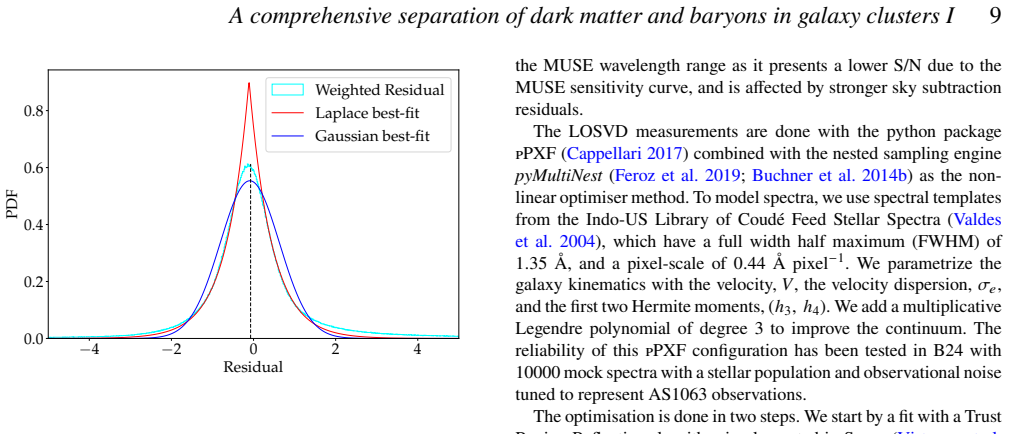
- [§4.2] For cluster members, the σ_e errors are not rescaled for systematics because the scatter is added in the scaling relations. This is a reasonable choice, but the text says 'On average, this scatter is one order of magnitude larger than the total error of σ_e.' If that is the case, the individual σ_e errors have only a minor role in the scaling relations; please state this explicitly so that the reader can judge the impact of the 1.33 factor when the same pipeline is used for the BCG/ICL Vrms.
minor comments (4)
- [§5.2 / Fig. 9] Add markers or shading to distinguish the two failed annuli from the two rejected annuli; the phrase 'last four rejected data points' is ambiguous.
- [Appendix C] The 'axis ratio' bound is printed as U(1,20); for a physical axis ratio this range is inverted or the parameter is an inverse axis ratio. Please define and correct.
- [Throughout] Minor typographical and formatting issues: 'Morphofit' is used inconsistently; 'Figure2.Diagram' lacks a space; 'HSTimaging' in the abstract; several instances of missing spaces before references.
- [Table 1] The prior listed as 'Calibration: log10 σ_e (2.30,2.84)' is likely a range for the calibration of the spectral resolution, not a prior on the astrophysical velocity dispersion; please clarify in the table or text.
Circularity Check
No circular derivation: measurements are anchored to external data and standard libraries; the Vrms bin rejection is a data-quality judgement, not a circular step.
full rationale
This is a data paper that presents measurements — light profiles, stellar kinematics, and stellar masses — for cluster members and the BCG/ICL. The measurements are anchored to external HST, MUSE, and Chandra data, and to standard SED libraries and fitting codes (SExtractor, pPXF, UltraNest, JAX, etc.). The light-profile fits are validated against residuals rather than against any mass model, and stellar masses are derived with three independent SED models. The only self-referential elements are the Vrms error rescaling factor (1.33) and the LOSVD polynomial correction, both taken from the authors' own prior mock-calibration papers (B24, Beauchesne et al. 2025); these are calibrations derived from 10,000 mock spectra, not fits to the present data, so they do not make the measurements circular. The rejection of the two outermost Vrms bins in Sect. 5.2 ('the last two points do not follow the same pattern... thus we reject these last two data points as they appear to be dominated by systematic error') is a potentially debatable data-quality cut, and the paper itself notes ambiguity about 'the last four rejected data points,' but this is a selection/robustness concern, not a circular derivation: the accepted profile is not used to predict the rejected points. The companion paper B25b will use these measurements, but no mass-model result is derived here. No uniqueness theorem or ansatz is smuggled in via self-citation, and no fitted parameter is renamed as a prediction. Overall, the derivation chain is self-contained with respect to the data products presented; minor self-calibration warrants a low non-zero score.
Assumptions & free parameters
free parameters (4)
- Vrms error rescaling factor =
1.33
- Photometric homogenisation systematic =
5%
- Bagpipes SED priors =
ranges in Table 1
- Annulus construction choices =
S/N > 5; R < 100 kpc; width = MUSE PSF
assumptions (6)
- domain assumption Cluster member light is well represented by dPIE profiles and field galaxy light by Sersic profiles in F160W
- domain assumption The BCG and ICL light is a single MGE component (normal or twisted) within the fitting aperture
- domain assumption SED-derived stellar masses with Chabrier/Kroupa IMFs and the adopted SFH priors are unbiased enough for mass modelling
- domain assumption Measured LOSVD and Vrms can be interpreted as tracers of the gravitational potential via Jeans modelling using the fitted light profile
- domain assumption The ICL is not removed as background in the BCG/ICL kinematics extraction, while member galaxy spectra have local background subtracted
- domain assumption Flat LambdaCDM with Omega_m=0.3, Omega_L=0.7, H0=70 km/s/Mpc
Cite this review
Pith. "Pith review of A comprehensive separation of dark matter and baryonic mass components in galaxy clusters I: Mass constraints from Abell S1063." pith.science (2026). https://pith.science/paper/ZUDJPEDO
@misc{pith2026250907762,
  author       = {Pith},
  title        = {Pith review of: A comprehensive separation of dark matter and baryonic mass components in galaxy clusters I: Mass constraints from Abell S1063},
  year         = {2026},
  howpublished = {\url{https://pith.science/paper/ZUDJPEDO}},
  note         = {Machine review of arXiv:2509.07762}
}
abstract
In this two-part series, we present a multi-probe mass modelling method for massive galaxy clusters, designed to disentangle the contributions of individual mass components (Dark matter, intra-cluster gas, stellar masses). In this first paper, we focus on recovering the mass constraint datasets required for the modelling approach introduced in the second paper. Specifically, we measure the light distribution, stellar mass, and kinematics of the cluster members, the brightest cluster galaxy (BCG), and the intra-cluster light (ICL) in Abell S1063. To that end, we developed a new method to extract the light profiles of the cluster members, BCG, and ICL, while accounting for contamination from nearby foreground and background galaxies in \textsc{Hubble Space Telescope} (HST) imaging. We obtained light profiles for $289$ cluster members using a dual Pseudo-Isothermal Elliptical (dPIE) model based on the HST F160W filter, while the BCG \& ICL is modelled as a single component using a multi-Gaussian expansion. To estimate stellar masses and velocity dispersions, we rely on multi-band HST photometry and \textsc{VLT/MUSE} integral field spectroscopy, respectively. Stellar masses are derived using three different spectral energy distribution (SED) models. We measure the line-of-sight velocity dispersions of the cluster members at their half-light radii, as determined from their light profiles, while for the BCG \& ICL components, we use elliptical annular apertures. Thanks to these measurements, we will be able to constrain the cluster stellar mass content, which is detailed in the second paper of the series. We publicly release these measurements with intermediary data products.
Figures


Figures from the paper (6 more)


Forward citations
Cited by 1 Pith paper
-
SLICE -- Combining Strong Lensing and X-ray in AC 114. Further Insights into the Merger Scenario
Combined JWST lensing and X-ray analysis shows AC114 as the main cluster in a late post-collisional major merger with a gas-stripped companion AC114b located about 1 Mpc to the northwest.
Reference graph
Works this paper leans on
-
[1]
, " * write output.state after.block = add.period write newline
ENTRY address archiveprefix author booktitle chapter edition editor howpublished institution eprint journal key month note number organization pages publisher school series title type volume year label extra.label sort.label short.list INTEGERS output.state before.all mid.sentence after.sentence after.block FUNCTION init.state.consts #0 'before.all := #1 ...
-
[2]
write newline
" write newline "" before.all 'output.state := FUNCTION n.dashify 't := "" t empty not t #1 #1 substring "-" = t #1 #2 substring "--" = not "--" * t #2 global.max substring 't := t #1 #1 substring "-" = "-" * t #2 global.max substring 't := while if t #1 #1 substring * t #2 global.max substring 't := if while FUNCTION word.in bbl.in " " * FUNCTION format....
-
[3]
write newline
" write newline "" before.all 'output.state := FUNCTION fin.entry write newline FUNCTION new.block output.state before.all = 'skip after.block 'output.state := if FUNCTION new.sentence output.state after.block = 'skip output.state before.all = 'skip after.sentence 'output.state := if if FUNCTION not #0 #1 if FUNCTION and 'skip pop #0 if FUNCTION or pop #1...
-
[4]
Abell G. O., Corwin Harold G. J., Olowin R. P., 1989, @doi [ ] 10.1086/191333 , https://ui.adsabs.harvard.edu/abs/1989ApJS...70....1A 70, 1
doi:10.1086/191333 1989
-
[5]
Amara A., Quanz S. P., 2012, @doi [ ] 10.1111/j.1365-2966.2012.21918.x , https://ui.adsabs.harvard.edu/abs/2012MNRAS.427..948A 427, 948
arXiv 2012
-
[6]
E., Fuson J., Gad-Nasr S., Kong D., Minor Q., Roberts M
Andrade K. E., Fuson J., Gad-Nasr S., Kong D., Minor Q., Roberts M. G., Kaplinghat M., 2022, @doi [ ] 10.1093/mnras/stab3241 , https://ui.adsabs.harvard.edu/abs/2022MNRAS.510...54A 510, 54
-
[7]
Arnouts S., et al., 2013, @doi [ ] 10.1051/0004-6361/201321768 , https://ui.adsabs.harvard.edu/abs/2013A&A...558A..67A 558, A67
-
[8]
Bacon R., et al., 2010, in McLean I. S., Ramsay S. K., Takami H., eds, Society of Photo-Optical Instrumentation Engineers (SPIE) Conference Series Vol. 7735, Ground-based and Airborne Instrumentation for Astronomy III. p. 773508 ( @eprint arXiv 2211.16795 ), @doi 10.1117/12.856027
arXiv 2010
Show all 96 references
-
[9]
Bacon R., Piqueras L., Conseil S., Richard J., Shepherd M., 2016, MPDAF: MUSE Python Data Analysis Framework , Astrophysics Source Code Library, record ascl:1611.003
2016
-
[10]
Beauchesne B., 2025, A comprehensive separation of dark matter and baryonic mass components in galaxy clusters II: an overview of the mass distribution in Abell S1063
2025
-
[11]
Beauchesne B., et al., 2024, @doi [ ] 10.1093/mnras/stad3308 , https://ui.adsabs.harvard.edu/abs/2024MNRAS.527.3246B 527, 3246
2024 doi
-
[12]
Beauchesne B., et al., 2025, @doi [ ] 10.1093/mnras/stae2695 , https://ui.adsabs.harvard.edu/abs/2025MNRAS.536.2086B 536, 2086
2025 doi
-
[13]
Bergamini P., et al., 2019, @doi [ ] 10.1051/0004-6361/201935974 , https://ui.adsabs.harvard.edu/abs/2019A&A...631A.130B 631, A130
2019 doi
-
[14]
Bertin E., Arnouts S., 1996, @doi [ ] 10.1051/aas:1996164 , https://ui.adsabs.harvard.edu/abs/1996A&AS..117..393B 117, 393
1996 doi
-
[15]
R., Mol J
Bertin E., Schefer M., Apostolakos N., \'A lvarez-Ayll \'o n A., Dubath P., K \"u mmel M., 2020, in Pizzo R., Deul E. R., Mol J. D., de Plaa J., Verkouter H., eds, Astronomical Society of the Pacific Conference Series Vol. 527, Astronomical Data Analysis Software and Systems X...
2020
-
[16]
Bonamigo M., et al., 2017, @doi [ ] 10.3847/1538-4357/aa75cc , https://ui.adsabs.harvard.edu/abs/2017ApJ...842..132B 842, 132
2017 doi
-
[17]
Bonamigo M., et al., 2018, @doi [ ] 10.3847/1538-4357/aad4a7 , https://ui.adsabs.harvard.edu/abs/2018ApJ...864...98B 864, 98
2018 doi
-
[18]
W., Treu T., Ebeling H., Massey R., Morris R
Brada c M., Allen S. W., Treu T., Ebeling H., Massey R., Morris R. G., von der Linden A., Applegate D., 2008, @doi [ ] 10.1086/591246 , https://ui.adsabs.harvard.edu/abs/2008ApJ...687..959B 687, 959
2008 doi
-
[19]
Bradbury J., et al., 2021, JAX: Autograd and XLA , Astrophysics Source Code Library, record ascl:2111.002
2021
-
[20]
R., Moffat J
Brownstein J. R., Moffat J. W., 2007, @doi [ ] 10.1111/j.1365-2966.2007.12275.x , https://ui.adsabs.harvard.edu/abs/2007MNRAS.382...29B 382, 29
2007
-
[22]
Buchner J., 2019, @doi [ ] 10.1088/1538-3873/aae7fc , https://ui.adsabs.harvard.edu/abs/2019PASP..131j8005B 131, 108005
2019 doi
-
[23]
Buchner J., 2021, @doi [The Journal of Open Source Software] 10.21105/joss.03001 , https://ui.adsabs.harvard.edu/abs/2021JOSS....6.3001B 6, 3001
2021 doi
-
[25]
Buchner J., et al., 2014b, @doi [ ] 10.1051/0004-6361/201322971 , https://ui.adsabs.harvard.edu/abs/2014A&A...564A.125B 564, A125
-
[26]
C., Kinney A
Calzetti D., Armus L., Bohlin R. C., Kinney A. L., Koornneef J., Storchi-Bergmann T., 2000, @doi [ ] 10.1086/308692 , https://ui.adsabs.harvard.edu/abs/2000ApJ...533..682C 533, 682
2000 doi
-
[27]
B., et al., 2016, @doi [ ] 10.1051/0004-6361/201527670 , https://ui.adsabs.harvard.edu/abs/2016A&A...587A..80C 587, A80
Caminha G. B., et al., 2016, @doi [ ] 10.1051/0004-6361/201527670 , https://ui.adsabs.harvard.edu/abs/2016A&A...587A..80C 587, A80
2016 doi
-
[28]
Cappellari M., 2002, @doi [ ] 10.1046/j.1365-8711.2002.05412.x , https://ui.adsabs.harvard.edu/abs/2002MNRAS.333..400C 333, 400
2002
-
[29]
Cappellari M., 2008, @doi [ ] 10.1111/j.1365-2966.2008.13754.x , https://ui.adsabs.harvard.edu/abs/2008MNRAS.390...71C 390, 71
2008
-
[30]
Cappellari M., 2017, @doi [ ] 10.1093/mnras/stw3020 , https://ui.adsabs.harvard.edu/abs/2017MNRAS.466..798C 466, 798
2017 doi
-
[31]
Cappellari M., Copin Y., 2003, @doi [ ] 10.1046/j.1365-8711.2003.06541.x , https://ui.adsabs.harvard.edu/abs/2003MNRAS.342..345C 342, 345
2003
-
[32]
C., McLure R
Carnall A. C., McLure R. J., Dunlop J. S., Dav \'e R., 2018, @doi [ ] 10.1093/mnras/sty2169 , https://ui.adsabs.harvard.edu/abs/2018MNRAS.480.4379C 480, 4379
2018 doi
-
[33]
C., Leja J., Johnson B
Carnall A. C., Leja J., Johnson B. D., McLure R. J., Dunlop J. S., Conroy C., 2019, @doi [ ] 10.3847/1538-4357/ab04a2 , https://ui.adsabs.harvard.edu/abs/2019ApJ...873...44C 873, 44
2019 doi
-
[34]
C., et al., 2023, @doi [ ] 10.1038/s41586-023-06158-6 , https://ui.adsabs.harvard.edu/abs/2023Natur.619..716C 619, 716
Carnall A. C., et al., 2023, @doi [ ] 10.1038/s41586-023-06158-6 , https://ui.adsabs.harvard.edu/abs/2023Natur.619..716C 619, 716
2023 doi
- [35]
-
[36]
Chabrier G., 2003, @doi [ ] 10.1086/376392 , https://ui.adsabs.harvard.edu/abs/2003PASP..115..763C 115, 763
2003 doi
-
[37]
Clowe D., Gonzalez A., Markevitch M., 2004, @doi [ ] 10.1086/381970 , https://ui.adsabs.harvard.edu/abs/2004ApJ...604..596C 604, 596
2004 doi
-
[38]
H., Markevitch M., Randall S
Clowe D., Brada c M., Gonzalez A. H., Markevitch M., Randall S. W., Jones C., Zaritsky D., 2006, @doi [ ] 10.1086/508162 , https://ui.adsabs.harvard.edu/abs/2006ApJ...648L.109C 648, L109
2006 doi
-
[39]
E., et al., 2018, @doi [Science] 10.1126/science.aao2469 , https://ui.adsabs.harvard.edu/abs/2018Sci...360.1342C 360, 1342
Collett T. E., et al., 2018, @doi [Science] 10.1126/science.aao2469 , https://ui.adsabs.harvard.edu/abs/2018Sci...360.1342C 360, 1342
2018 doi
-
[40]
Conroy C., 2013, @doi [ ] 10.1146/annurev-astro-082812-141017 , https://ui.adsabs.harvard.edu/abs/2013ARA&A..51..393C 51, 393
2013 doi
-
[41]
Da Rocha C., Mendes de Oliveira C., 2005, @doi [ ] 10.1111/j.1365-2966.2005.09641.x , https://ui.adsabs.harvard.edu/abs/2005MNRAS.364.1069D 364, 1069
2005
-
[42]
Dai D.-C., Matsuo R., Starkman G., 2008, @doi [ ] 10.1103/PhysRevD.78.104004 , https://ui.adsabs.harvard.edu/abs/2008PhRvD..78j4004D 78, 104004
2008 doi
-
[43]
M., Broadhurst T., Wong J., Silk J., Lim J., Zheng W., Lam D., Ford H., 2016, @doi [ ] 10.1093/mnras/stw865 , https://ui.adsabs.harvard.edu/abs/2016MNRAS.459.3447D 459, 3447
Diego J. M., Broadhurst T., Wong J., Silk J., Lim J., Zheng W., Lam D., Ford H., 2016, @doi [ ] 10.1093/mnras/stw865 , https://ui.adsabs.harvard.edu/abs/2016MNRAS.459.3447D 459, 3447
2016 doi
-
[44]
G., 2022, @doi [ ] 10.1051/0004-6361/202243205 , https://ui.adsabs.harvard.edu/abs/2022A&A...666A..41E 666, A41
Eckert D., Ettori S., Robertson A., Massey R., Pointecouteau E., Harvey D., McCarthy I. G., 2022, @doi [ ] 10.1051/0004-6361/202243205 , https://ui.adsabs.harvard.edu/abs/2022A&A...666A..41E 666, A41
2022 doi
-
[45]
Ellien A., et al., 2021, @doi [ ] 10.1051/0004-6361/202038419 , https://ui.adsabs.harvard.edu/abs/2021A&A...649A..38E 649, A38
2021 doi
-
[46]
H., Giodini S., Lovisari L., Schmidt R
Ettori S., Donnarumma A., Pointecouteau E., Reiprich T. H., Giodini S., Lovisari L., Schmidt R. W., 2013, @doi [ ] 10.1007/s11214-013-9976-7 , https://ui.adsabs.harvard.edu/abs/2013SSRv..177..119E 177, 119
2013 doi
-
[47]
N., et al., 2010, @doi [ ] 10.1088/0067-0049/189/1/37 , https://ui.adsabs.harvard.edu/abs/2010ApJS..189...37E 189, 37
Evans I. N., et al., 2010, @doi [ ] 10.1088/0067-0049/189/1/37 , https://ui.adsabs.harvard.edu/abs/2010ApJS..189...37E 189, 37
2010 doi
-
[48]
J., Gorgas J., Peletier R
Falc \'o n-Barroso J., S \'a nchez-Bl \'a zquez P., Vazdekis A., Ricciardelli E., Cardiel N., Cenarro A. J., Gorgas J., Peletier R. F., 2011, @doi [ ] 10.1051/0004-6361/201116842 , https://ui.adsabs.harvard.edu/abs/2011A&A...532A..95F 532, A95
2011 doi
-
[49]
P., Cameron E., Pettitt A
Feroz F., Hobson M. P., Cameron E., Pettitt A. N., 2019, @doi [The Open Journal of Astrophysics] 10.21105/astro.1306.2144 , https://ui.adsabs.harvard.edu/abs/2019OJAp....2E..10F 2, 10
2019 arXiv
-
[50]
Giallongo E., et al., 2014, @doi [ ] 10.1088/0004-637X/781/1/24 , https://ui.adsabs.harvard.edu/abs/2014ApJ...781...24G 781, 24
2014 doi
-
[51]
Granata G., et al., 2022, @doi [ ] 10.1051/0004-6361/202141817 , https://ui.adsabs.harvard.edu/abs/2022A&A...659A..24G 659, A24
2022 doi
-
[52]
Harvey D., Massey R., Kitching T., Taylor A., Tittley E., 2015, @doi [Science] 10.1126/science.1261381 , https://ui.adsabs.harvard.edu/abs/2015Sci...347.1462H 347, 1462
2015 doi
-
[53]
Herbel J., Kacprzak T., Amara A., Refregier A., Lucchi A., 2018, @doi [ ] 10.1088/1475-7516/2018/07/054 , https://ui.adsabs.harvard.edu/abs/2018JCAP...07..054H 2018, 054
2018 doi
-
[54]
Horne K., 1986, @doi [ ] 10.1086/131801 , https://ui.adsabs.harvard.edu/abs/1986PASP...98..609H 98, 609
1986 doi
-
[55]
Ilbert O., et al., 2015, @doi [ ] 10.1051/0004-6361/201425176 , https://ui.adsabs.harvard.edu/abs/2015A&A...579A...2I 579, A2
2015 doi
-
[56]
C., Harding P., Feldmeier J
Janowiecki S., Mihos J. C., Harding P., Feldmeier J. J., Rudick C., Morrison H., 2010, @doi [ ] 10.1088/0004-637X/715/2/972 , https://ui.adsabs.harvard.edu/abs/2010ApJ...715..972J 715, 972
2010 doi
-
[57]
Jim \'e nez-Teja Y., Dupke R., 2016, @doi [ ] 10.3847/0004-637X/820/1/49 , https://ui.adsabs.harvard.edu/abs/2016ApJ...820...49J 820, 49
2016 doi
-
[58]
L., Sharon K., Bayliss M
Johnson T. L., Sharon K., Bayliss M. B., Gladders M. D., Coe D., Ebeling H., 2014, @doi [ ] 10.1088/0004-637X/797/1/48 , https://ui.adsabs.harvard.edu/abs/2014ApJ...797...48J 797, 48
2014 doi
-
[59]
Kassiola A., Kovner I., 1993, @doi [ ] 10.1086/173325 , https://ui.adsabs.harvard.edu/abs/1993ApJ...417..450K 417, 450
1993 doi
-
[60]
Kluge M., et al., 2020, @doi [ ] 10.3847/1538-4365/ab733b , https://ui.adsabs.harvard.edu/abs/2020ApJS..247...43K 247, 43
2020 doi
-
[61]
Kneib J.-P., Natarajan P., 2011, @doi [ ] 10.1007/s00159-011-0047-3 , https://ui.adsabs.harvard.edu/abs/2011A&ARv..19...47K 19, 47
2011 doi
-
[62]
M., et al., 2011, @doi [ ] 10.1088/0067-0049/197/2/36 , https://ui.adsabs.harvard.edu/abs/2011ApJS..197...36K 197, 36
Koekemoer A. M., et al., 2011, @doi [ ] 10.1088/0067-0049/197/2/36 , https://ui.adsabs.harvard.edu/abs/2011ApJS..197...36K 197, 36
2011 doi
-
[63]
Kroupa P., 2001, @doi [ ] 10.1046/j.1365-8711.2001.04022.x , https://ui.adsabs.harvard.edu/abs/2001MNRAS.322..231K 322, 231
2001
-
[64]
Limousin M., Kneib J.-P., Natarajan P., 2005, @doi [ ] 10.1111/j.1365-2966.2004.08449.x , https://ui.adsabs.harvard.edu/abs/2005MNRAS.356..309L 356, 309
2005
-
[65]
Limousin M., Beauchesne B., Jullo E., 2022, @doi [ ] 10.1051/0004-6361/202243278 , https://ui.adsabs.harvard.edu/abs/2022A&A...664A..90L 664, A90
2022 doi
-
[66]
Longobardi A., Arnaboldi M., Gerhard O., Pulsoni C., S \"o ldner-Rembold I., 2018, @doi [ ] 10.1051/0004-6361/201832729 , https://ui.adsabs.harvard.edu/abs/2018A&A...620A.111L 620, A111
2018 doi
-
[67]
M., et al., 2017, @doi [ ] 10.3847/1538-4357/837/1/97 , https://ui.adsabs.harvard.edu/abs/2017ApJ...837...97L 837, 97
Lotz J. M., et al., 2017, @doi [ ] 10.3847/1538-4357/837/1/97 , https://ui.adsabs.harvard.edu/abs/2017ApJ...837...97L 837, 97
2017 doi
-
[68]
A., 2022, MAMPOSSt: Mass/orbit modeling of spherical systems , Astrophysics Source Code Library, record ascl:2203.020
Mamon G. A., 2022, MAMPOSSt: Mass/orbit modeling of spherical systems , Astrophysics Source Code Library, record ascl:2203.020
2022
-
[69]
A., Biviano A., Boué G., 2013, @doi [Monthly Notices of the Royal Astronomical Society] 10.1093/mnras/sts565 , 429, 3079–3098
Mamon G. A., Biviano A., Boué G., 2013, @doi [Monthly Notices of the Royal Astronomical Society] 10.1093/mnras/sts565 , 429, 3079–3098
2013 doi
-
[70]
Meneghetti M., et al., 2020, @doi [Science] 10.1126/science.aax5164 , https://ui.adsabs.harvard.edu/abs/2020Sci...369.1347M 369, 1347
2020 doi
-
[71]
Mercurio A., et al., 2021, @doi [ ] 10.1051/0004-6361/202142168 , https://ui.adsabs.harvard.edu/abs/2021A&A...656A.147M 656, A147
2021 doi
- [72]
-
[73]
Monna A., et al., 2014, @doi [ ] 10.1093/mnras/stt2284 , https://ui.adsabs.harvard.edu/abs/2014MNRAS.438.1417M 438, 1417
2014 doi
-
[74]
Montes M., 2022, @doi [Nature Astronomy] 10.1038/s41550-022-01616-z , https://ui.adsabs.harvard.edu/abs/2022NatAs...6..308M 6, 308
2022 doi
-
[75]
Montes M., Trujillo I., 2014, @doi [ ] 10.1088/0004-637X/794/2/137 , https://ui.adsabs.harvard.edu/abs/2014ApJ...794..137M 794, 137
2014 doi
-
[76]
Montes M., Trujillo I., 2018, @doi [ ] 10.1093/mnras/stx2847 , https://ui.adsabs.harvard.edu/abs/2018MNRAS.474..917M 474, 917
2018 doi
-
[77]
E., Treu T., Schmidt K
Morishita T., Abramson L. E., Treu T., Schmidt K. B., Vulcani B., Wang X., 2017, @doi [ ] 10.3847/1538-4357/aa8403 , https://ui.adsabs.harvard.edu/abs/2017ApJ...846..139M 846, 139
2017 doi
-
[78]
Natarajan P., et al., 2017, @doi [ ] 10.1093/mnras/stw3385 , https://ui.adsabs.harvard.edu/abs/2017MNRAS.468.1962N 468, 1962
2017 doi
-
[79]
Natarajan P., Williams L. L. R., Brada c M., Grillo C., Ghosh A., Sharon K., Wagner J., 2024, @doi [ ] 10.1007/s11214-024-01051-8 , https://ui.adsabs.harvard.edu/abs/2024SSRv..220...19N 220, 19
2024 doi
-
[80]
B., Treu T., Ellis R
Newman A. B., Treu T., Ellis R. S., Sand D. J., 2013, @doi [ ] 10.1088/0004-637X/765/1/25 , https://ui.adsabs.harvard.edu/abs/2013ApJ...765...25N 765, 25
2013 doi
-
[81]
Pedregosa F., et al., 2011, Journal of Machine Learning Research, 12, 2825
2011
-
[82]
Postman M., et al., 2012, @doi [ ] 10.1088/0067-0049/199/2/25 , https://ui.adsabs.harvard.edu/abs/2012ApJS..199...25P 199, 25
2012 doi
-
[83]
Richard J., et al., 2014, @doi [ ] 10.1093/mnras/stu1395 , https://ui.adsabs.harvard.edu/abs/2014MNRAS.444..268R 444, 268
2014 doi
-
[84]
Rix H.-W., et al., 2004, @doi [ ] 10.1086/420885 , https://ui.adsabs.harvard.edu/abs/2004ApJS..152..163R 152, 163
2004 doi
-
[85]
Robertson A., Massey R., Eke V., Schaye J., Theuns T., 2021, @doi [ ] 10.1093/mnras/staa3954 , https://ui.adsabs.harvard.edu/abs/2021MNRAS.501.4610R 501, 4610
2021 doi
-
[86]
Sagunski L., Gad-Nasr S., Colquhoun B., Robertson A., Tulin S., 2021, @doi [ ] 10.1088/1475-7516/2021/01/024 , https://ui.adsabs.harvard.edu/abs/2021JCAP...01..024S 2021, 024
2021 doi
-
[87]
Sereno M., Lubini M., Jetzer P., 2010, @doi [ ] 10.1051/0004-6361/200913843 , https://ui.adsabs.harvard.edu/abs/2010A&A...518A..55S 518, A55
2010 doi
-
[88]
L., 1963, Boletin de la Asociacion Argentina de Astronomia La Plata Argentina, https://ui.adsabs.harvard.edu/abs/1963BAAA....6...41S 6, 41
S \'e rsic J. L., 1963, Boletin de la Asociacion Argentina de Astronomia La Plata Argentina, https://ui.adsabs.harvard.edu/abs/1963BAAA....6...41S 6, 41
1963
-
[89]
S., Steinhardt C
Speagle J. S., Steinhardt C. L., Capak P. L., Silverman J. D., 2014, @doi [ ] 10.1088/0067-0049/214/2/15 , https://ui.adsabs.harvard.edu/abs/2014ApJS..214...15S 214, 15
2014 doi
-
[90]
N., Steinhardt P
Spergel D. N., Steinhardt P. J., 2000, @doi [ ] 10.1103/PhysRevLett.84.3760 , https://ui.adsabs.harvard.edu/abs/2000PhRvL..84.3760S 84, 3760
2000 doi
-
[91]
L., et al., 2020, @doi [ ] 10.3847/1538-4365/ab75ed , https://ui.adsabs.harvard.edu/abs/2020ApJS..247...64S 247, 64
Steinhardt C. L., et al., 2020, @doi [ ] 10.3847/1538-4365/ab75ed , https://ui.adsabs.harvard.edu/abs/2020ApJS..247...64S 247, 64
2020 doi
-
[92]
Tortorelli L., Mercurio A., 2023, @doi [Frontiers in Astronomy and Space Sciences] 10.3389/fspas.2023.989443 , https://ui.adsabs.harvard.edu/abs/2023FrASS..1089443T 10, 51
2023
-
[93]
Tortorelli L., et al., 2018, @doi [ ] 10.1093/mnras/sty617 , https://ui.adsabs.harvard.edu/abs/2018MNRAS.477..648T 477, 648
2018 doi
-
[94]
A., Singh H
Valdes F., Gupta R., Rose J. A., Singh H. P., Bell D. J., 2004, @doi [ ] 10.1086/386343 , https://ui.adsabs.harvard.edu/abs/2004ApJS..152..251V 152, 251
2004 doi
-
[95]
Virtanen P., et al., 2020, @doi [Nature Methods] 10.1038/s41592-019-0686-2 , https://ui.adsabs.harvard.edu/abs/2020NatMe..17..261V 17, 261
2020 doi
-
[96]
Willmer C. N. A., 2018, @doi [ ] 10.3847/1538-4365/aabfdf , https://ui.adsabs.harvard.edu/abs/2018ApJS..236...47W 236, 47
2018 doi
-
[97]
Xie Y., et al., 2024, @doi [ ] 10.1093/mnras/stae1221 , https://ui.adsabs.harvard.edu/abs/2024MNRAS.531.1179X 531, 1179
2024 doi
-
[98]
Zitrin A., et al., 2015, @doi [ ] 10.1088/0004-637X/801/1/44 , https://ui.adsabs.harvard.edu/abs/2015ApJ...801...44Z 801, 44
2015 doi
Reviewed August 4, 2026 · model on record in the stance chip above.
Discussion (0). Sign in to comment.