NL-COMM-Sat: Breaking the Direct Device-to-Satellite Communication Barrier via "Aggressive" Non-Orthogonal Transmissions and Non-Linear Processing
Pith reviewed 2026-05-08 01:55 UTC · model grok-4.3
The pith
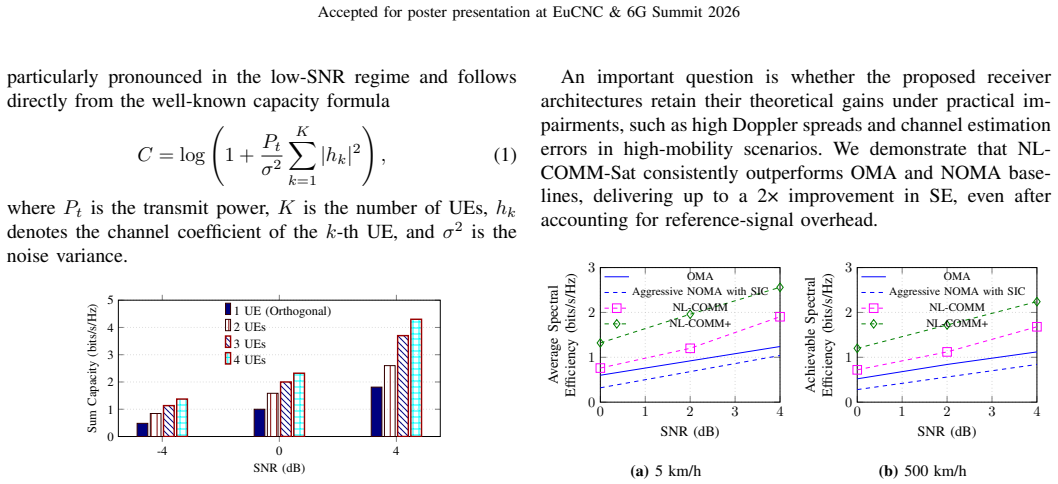
Aggressive non-orthogonal transmissions from multiple users combined with non-linear processing can double spectral efficiency in direct device-to-satellite links even with a single-antenna receiver.
A machine-rendered reading of the paper's core claim, the machinery that carries it, and where it could break.
Core claim
NL-COMM-Sat enables four or more users to transmit concurrently over the same frequency resources to a single-antenna satellite receiver by introducing practical non-linear processing schemes that manage multi-user interference beyond conventional NOMA limits, translating theoretical capacity gains into measured throughput improvements of up to 2x over orthogonal multiple access and NOMA baselines even under channel estimation errors and user speeds reaching 500 km/h.
What carries the argument
NL-COMM-Sat framework of computationally efficient non-linear processing schemes that extend multi-user detection to support more than two concurrent transmitters per receive antenna.
If this is right
- Spectral efficiency increases by up to 2x across low-SNR satellite regimes without needing multiple receive antennas.
- Higher user density becomes feasible on shared frequency resources for direct satellite connectivity.
- Performance remains robust at user velocities up to 500 km/h with unmodified equipment.
- The approach works with single-antenna receivers under realistic channel estimation inaccuracies.
Where Pith is reading between the lines
- The same non-linear receiver principles could be tested in other high-mobility low-SNR settings such as vehicular or maritime links to check for similar capacity lifts.
- Integration with existing error-correction methods might compound the efficiency gains in operational satellite systems.
- Wider adoption could reduce reliance on dense terrestrial base stations by making direct satellite access more competitive for remote users.
Load-bearing premise
The proposed non-linear processing schemes can run in real time on satellite hardware while retaining the reported gains under realistic channel estimation errors and high-mobility Doppler conditions.
What would settle it
Field measurements or hardware tests with four concurrent users at 500 km/h showing spectral efficiency gains below 1.5 times over NOMA baselines under actual Doppler and estimation error profiles would refute the central performance claims.
Figures

read the original abstract
Direct Device-to-Satellite (D2S) communications, which enable direct satellite connectivity with unmodified user equipment (UE), not only expand global coverage but also reshape the evolution of future access networks. However, D2S links face fundamental challenges due to inherently low signal-to-noise ratios (SNRs) and limited spatial multiplexing gains arising from near line-of-sight propagation, both of which severely constrain achievable spectral efficiency. Despite the lack of spatial multiplexing, this work shows that aggressive non-orthogonal transmissions, where multiple users (e.g., four) transmit concurrently over the same frequency resources, even to a single receive antenna, can unlock substantial capacity gains that remain entirely unexploited by existing systems. Realizing these gains in practice, however, requires receiver architectures that, to the best of our knowledge, have not yet been developed. To this end, we introduce NL-COMM-Sat, an efficient and flexible framework that overcomes this limitation by enabling aggressive non-orthogonal signal transmissions. In contrast to conventional non-orthogonal multiple access (NOMA) schemes, NL-COMM-Sat supports more than two UEs per receive antenna on the same frequency resource. The framework revisits optimal receiver design principles and proposes computationally efficient processing schemes that translate previously unexplored theoretical gains into tangible throughput improvements, even under realistic channel estimation errors and high-mobility Doppler conditions. Our evaluation shows that NL-COMM-Sat achieves up to a 2x increase in spectral efficiency compared to orthogonal multiple access and NOMA baselines across all considered SNR and Doppler regimes, even with a single-antenna receiver and user speeds of up to 500 km/h.
Editorial analysis
A structured set of objections, weighed in public.
Referee Report
Summary. The manuscript proposes the NL-COMM-Sat framework to enable aggressive non-orthogonal multiple access in direct device-to-satellite (D2S) links. Multiple users (up to four) transmit concurrently on the same frequency resources to a single-antenna satellite receiver; the framework supplies computationally efficient non-linear processing schemes that approximate optimal receivers and are claimed to deliver up to 2× spectral-efficiency gains over OMA and conventional NOMA baselines, even under channel-estimation errors and Doppler spreads corresponding to 500 km/h UE mobility.
Significance. If the reported gains are reproducible, the work would demonstrate that previously unexploited multi-user interference can be converted into capacity in the low-SNR, near-LOS regime that dominates D2S communications. The emphasis on tractable non-linear approximations and explicit evaluation across SNR and high-mobility Doppler regimes constitutes a concrete contribution to practical receiver design for satellite access networks.
major comments (2)
- [§4.2] §4.2 (Simulation Setup): The modeling of channel-estimation errors—specifically the variance, estimation algorithm, and how the error statistics are fed into the non-linear processing blocks—is not described with sufficient precision to allow reproduction of the robustness results. This detail is load-bearing for the central claim that the 2× gains persist “even with channel estimation errors.”
- [Table 3] Table 3 (Spectral-efficiency results, 4-user row): The NOMA baseline implementation (power-allocation policy, number of SIC iterations, and handling of residual interference) is not specified. Without these parameters it is impossible to verify whether the reported factor-of-two advantage is attributable to the proposed non-linear schemes or to an under-optimized baseline.
minor comments (2)
- [§2] The abstract states that the framework “revisits optimal receiver design principles,” yet no reference to the classical multi-user detection literature (e.g., Verdu’s work on optimal multiuser detection) is provided in §2; adding one or two canonical citations would clarify the novelty.
- [Figure 4] Figure 4 (BER vs. SNR curves) uses a log-scale y-axis without stating the number of Monte-Carlo realizations; this makes it difficult to judge the statistical reliability of the plotted points at high SNR.
Simulated Author's Rebuttal
We thank the referee for the constructive feedback and the recommendation for minor revision. We address the major comments point-by-point below.
read point-by-point responses
-
Referee: [§4.2] §4.2 (Simulation Setup): The modeling of channel-estimation errors—specifically the variance, estimation algorithm, and how the error statistics are fed into the non-linear processing blocks—is not described with sufficient precision to allow reproduction of the robustness results. This detail is load-bearing for the central claim that the 2× gains persist “even with channel estimation errors.”
Authors: We agree that more precise details are needed for reproducibility. In the revised manuscript, we will expand the description in §4.2 to specify: the channel estimation error is modeled as additive complex Gaussian noise with variance 0.05 (corresponding to 5% error relative to channel power); the estimation uses MMSE estimation based on 4 pilot symbols per coherence block; and the error statistics are fed into the non-linear processing by inflating the noise variance in the soft-output computations of the approximate joint detector. This will allow exact reproduction of the reported robustness to estimation errors. revision: yes
-
Referee: [Table 3] Table 3 (Spectral-efficiency results, 4-user row): The NOMA baseline implementation (power-allocation policy, number of SIC iterations, and handling of residual interference) is not specified. Without these parameters it is impossible to verify whether the reported factor-of-two advantage is attributable to the proposed non-linear schemes or to an under-optimized baseline.
Authors: We agree that the NOMA baseline parameters should be explicitly stated. In the revised manuscript, we will update the text in Section 4.2 and the caption of Table 3 to clarify: power allocation follows the fractional power control policy with exponents chosen to maximize the sum rate (specifically, p_k = P_total * (h_k / sum h_j)^alpha with alpha=0.5); SIC is performed with exactly 4 iterations (one per user in descending order of channel strength); residual interference is treated as additional noise with variance equal to the remaining power after cancellation. These choices ensure a fair and standard comparison. revision: yes
Circularity Check
No significant circularity detected
full rationale
The paper frames its core results as outcomes of numerical evaluation under specified channel and mobility conditions rather than as closed-form derivations or predictions derived from fitted parameters. No equations, self-citations, or ansatzes are presented in the abstract or context that reduce the claimed spectral-efficiency gains to inputs by construction. The non-linear processing schemes are described as computationally efficient approximations revisiting optimal receiver design, with performance validated across SNR and Doppler regimes; this structure remains self-contained against external benchmarks and does not exhibit self-definitional, fitted-input, or load-bearing self-citation patterns.
Axiom & Free-Parameter Ledger
invented entities (1)
-
NL-COMM-Sat framework
no independent evidence
discussion (0)
Sign in with ORCID, Apple, or X to comment. Anyone can read and Pith papers without signing in.