REVIEW 4 major objections 6 minor 22 references
Chaos suppression in a Gompertz-like discrete system of fractional order
T0 review · 4 major / 6 minor · reviewed 2026-08-14 · deepseek-v4-flash
Pith's one-line read This paper shows that periodic impulses can suppress chaos in a fractional-order Gompertz-like discrete map.
desk verdict A modest but real niche contribution: new fractional-order Gompertz map with honest numerical evidence of impulse-induced chaos suppression, yet the case rests on short parameter-selected runs and an LE whose sign the authors themselves leave open. read the letter →
The pith
A machine-rendered reading of the paper's core claim, the machinery that carries it, and where it could break.
The reading
What carries the argument
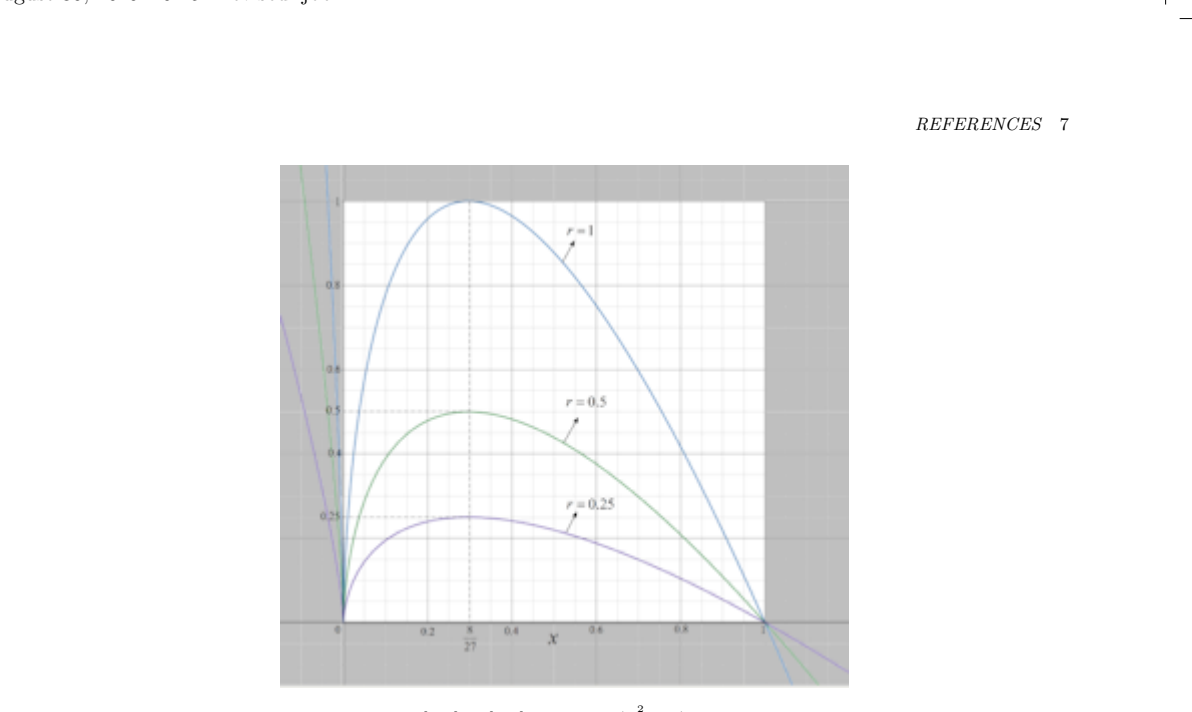
The central mechanism is the discrete fractional integral (9), $$x(n)=x(0)+\frac{6.75r}{\Gamma(q)}\sum_{j=1}^{n}\frac{\Gamma(n-j+q)}{\Gamma(n-j+1)}\left(x_{j-1}^{2/3}-x_{j-1}\right),$$ which encodes the memory of the Caputo delta fractional difference (7)–(8). The control is the periodic impulse (12), which multiplies the next state by $1+\gamma$ at every $\delta$-th step. The verification uses the natural linearization (11) to define a finite-time Lyapunov exponent $\lambda\simeq(1/n)\ln|a(n-1)|$, and the 0-1 test, whose value $K\approx 0$, disc-like $(p,q)$ graphs, and bounded mean-square displacement $M$ are taken to indicate regular motion. Because of the memory term, the target states are called numerically stable periodic orbits (NSPOs), i.e., closed trajectories whose closing error stays within a prescribed bound.
What would settle it
Recompute the finite-time Lyapunov exponent for the same three controlled parameter sets using a full numerical Jacobian of (9) or a perturbation-tracking method, and extend the 0-1 test beyond 1000 iterations. If the exponent becomes clearly positive, or if $K$ drifts toward 1 on longer time series, the reported chaos suppression would be shown to be an artifact of the chosen simulation window.
Extended reading notes
Core claim
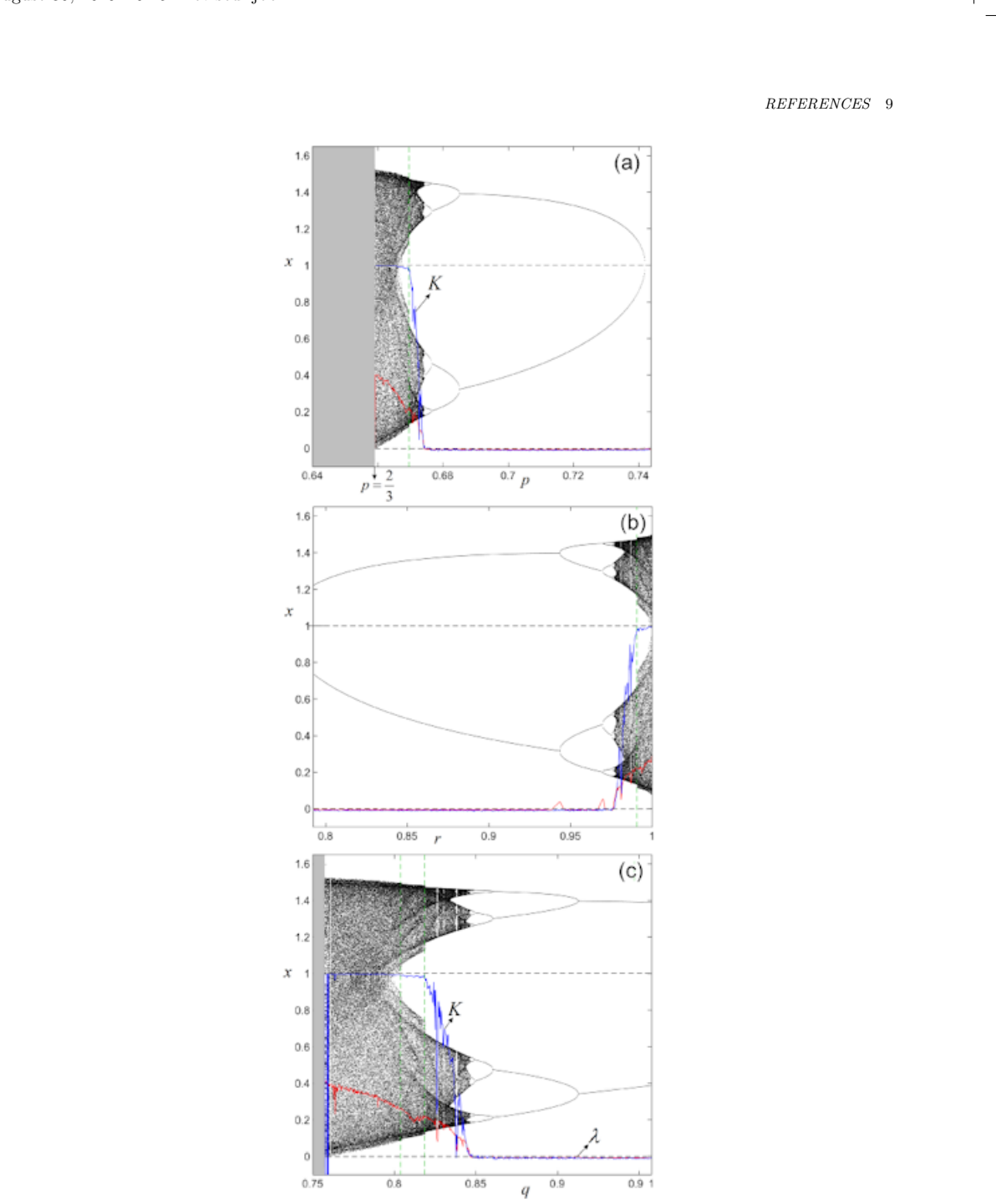
The paper claims that the fractional-order discrete Gompertz-like system (8), built from the Caputo delta fractional difference with $q=0.8$ and $r=1$, is chaotic, and that the impulsive algorithm (12) suppresses that chaos for properly chosen $\gamma$. The algorithm acts as $x_{n+1}\leftarrow (1+\gamma)x_{n+1}$ whenever $n$ is a multiple of $\delta$. For $\delta=1$, $\gamma=-0.0132$ yields a numerically stable period-10 orbit; for $\delta=3$, $\gamma=-0.04$ yields a period-5 orbit; and for $\delta=5$, $\gamma=-0.0722$ yields a period-19 orbit, with no controlled orbits found for $\delta>5$. The paper emphasizes that these are numerically stable periodic orbits, not genuine periodic solutions, because fractional-order discrete systems admit no nonconstant periodic solutions. The numerical confirmation combines the finite-time Lyapunov exponent from the natural linearization (11) with the 0-1 test output: $K$ near zero, disc-like $(p,q)$, and bounded $M$.
Load-bearing premise
The load-bearing premise is that the finite-time Lyapunov exponent computed from the scalar linearization (11) is a valid measure of the stability of the fractional integral (9) along the controlled orbit; the paper itself leaves open whether the exponent is genuinely negative or merely zero, and if the linearization is not the true variational equation, the Lyapunov-based evidence for chaos suppression loses its force.
Editorial extensions
If this is right
- For $\delta=1,3,5$, the controlled system settles onto numerically stable periodic orbits of periods 10, 5, and 19, respectively, and no controlled orbits are found for $\delta>5$.
- Under the multiplicative algorithm (12), only negative values of $\gamma$ suppress chaos, suggesting the controlled system must shed energy every $\delta$ steps.
- The alternative additive algorithm (13) suppresses chaos for both negative and positive $\gamma$, showing that either energy loss or energy gain can stabilize the system.
- Over wide ranges of $\gamma$, the finite-time Lyapunov exponent stays constant and close to zero, leaving open whether the true exponent is negative or zero.
- In both integer- and fractional-order versions, increasing the power exponent $p$ produces reverse period-doubling and extinction of chaos, with exterior crises visible in the fractional-order bifurcation diagram.
Reading between the lines
- An extension the paper does not pursue is that the same periodic-impulse scheme could be tested on other memory-carrying discrete maps, such as the fractional logistic map, to see whether the reported $\delta\le 5$ control window is a general feature of fractional discrete systems.
- If the scalar linearization (11) is not the exact variational equation, the finite-time Lyapunov exponent may understate the true instability; a full Jacobian or perturbation-based exponent for (9) would settle whether the controlled orbits are genuinely stable or merely slow on the simulated horizon.
- The near-zero plateau of the Lyapunov exponent across broad parameter ranges hints that the suppressed regime may be a slow nonchaotic dynamics inherited from the memory kernel rather than true periodicity; spectral analysis of the NSPO would distinguish these cases.
- The observed sign asymmetry of algorithm (12) versus the symmetry of algorithm (13) suggests an energy-balance explanation for the control, which could in principle be derived analytically for unimodal maps with a power-law memory.
Signed reviews
Editorial analysis
A structured set of objections, weighed in public.
Referee Report
Summary. The paper introduces a fractional-order discrete Gompertz-like system, obtained by replacing the integer-order map with a Caputo delta fractional difference, and proposes an impulsive control algorithm (12) that periodically perturbs the state by a factor (1+gamma). The central claim is that for q=0.8, r=1, and suitable negative values of gamma, the chaotic dynamics of (8) is suppressed and replaced by numerically stable periodic orbits (NSPOs), with examples for delta=1,3,5 giving periods 10, 5, and 19. The numerical evidence consists of bifurcation diagrams, finite-time Lyapunov exponents from Eq. (11), the 0-1 test values K, p-and-q plots, and mean-square displacement M. The paper explicitly acknowledges that fractional-order discrete systems cannot have nonconstant periodic solutions, so only NSPOs are claimed, and it also states that the sign of the Lyapunov exponent remains an open problem.
Significance. If the numerical claims are correct, this is a modest but useful case study in chaos suppression for a fractional-order discrete biological model, extending earlier work by the same authors on impulsive control in continuous and discrete systems. The paper has the strength of being explicit about the nonexistence of true periodic solutions and about the NSPO interpretation, and it uses multiple diagnostics rather than relying on a single indicator. However, the central claim is under-supported as presented: the primary diagnostic, the finite-time Lyapunov exponent, is openly questioned by the authors themselves; no closing errors are reported for the claimed NSPOs; the simulations are limited to 1000 iterations; and the control parameters are selected from the controlled system's own bifurcation diagrams, making the verification partly in-sample. Since the paper releases no code or data, the reproducibility of the numerical results cannot be independently checked.
major comments (4)
- [§3 and Conclusion] The central diagnostic used to certify regular dynamics is the finite-time Lyapunov exponent obtained from Eq. (11), but the Conclusion states that whether this LE is really negative or zero remains an open problem. Since the reported K values (0.0033, -0.0035, -0.0048, 0.0317) are all of the same order as the paper's own stated 1e-2 error margin for K close to zero, and since all runs use only 1000 iterations, the presented evidence does not distinguish regular motion from a slowly decaying transient that inherits the pre-control chaotic history through the memory kernel in (9). Please provide a reliable LE estimate with a corrected linearization and confidence bounds, or replace the LE with a direct quantitative regularity measure such as long-horizon closing errors and drift.
- [§3, Remark 2] The definition of an NSPO requires a closing error within a bound of the form 1E-n, but no closing error is reported for any of the three claimed NSPOs (10-period for delta=1, 5-period for delta=3, 19-period for delta=5). Without these numbers, the statements '10-period,' '5-period,' and '19-period' are only visual classifications of the time series. Please report the maximal closing errors, the chosen bound, and the segment over which they are measured.
- [§3, '1000 iterations' and Eq. (9)] The suppression claim is based on 1000-iteration runs, and the control parameter gamma is selected from the bifurcation diagram of the very same controlled system on which the diagnostics are then computed. Because the fractional kernel in (9) carries the full history, the apparent periodicity could be a transient that decays on a longer time scale. Please extend the runs to at least 10^4-10^5 iterations, report the diagnostics on a hold-out segment not used for parameter selection, and test several initial conditions. This would also reduce the in-sample character of the current confirmation.
- [Eq. (11)] As typeset, the variational equation (11) contains the factor (2/3)x(j) - 1/3 - 1, which is not the derivative 6.75r((2/3)x(j)^(-1/3) - 1) of the map f_r used in (9). If the exponent -1/3 is missing from the printed formula, then all reported LE values are computed from the wrong linearization and should be recomputed; if the formula is intentional, a derivation should be provided. This matters because the LE is the paper's main quantitative chaos indicator.
minor comments (6)
- [§3, Fig. 5] The text states that for delta=3 and gamma=-0.04 a 'numerically 5-period orbit' is obtained, while the caption of Fig. 5 says the zoomed area reveals 'the six elements of the NSPO'; please reconcile this discrepancy.
- [§2 and Appendix] The symbol p is used both for the power exponent in f_{r,p} and for the translation variable in the 0-1 test; this notation collision is confusing and should be resolved, for instance by using a different letter for one of them.
- [§2, Remark 1] In Remark 1, 'divergency' should be 'divergence', and the notation '1E-n' in Remark 2 should be replaced with a clearly defined bound such as 1 times 10^{-n}; the required value of n should also be quantified in relation to the examples.
- [Appendix] The description of the 0-1 test omits implementation details essential for reproducibility: the number of iterations N, the number of randomly chosen c values, and the regression procedure used to estimate K. Please add these details.
- [General] No code or data are made available, and no data-availability statement is provided; for a purely numerical paper this strongly limits reproducibility and verification of the reported bifurcation diagrams and diagnostics.
- [Front matter and references] There are several editorial errors, including 'Institute od Science and Technology' in the affiliation and a reference list that begins with Nicol et al. rather than following the chronological order of citations; the reference formatting should be made consistent with the journal style.
Circularity Check
Gamma is selected from the same LE/K bifurcation diagram used as validation, so the reported LE/K values are confirmations on the fitting set rather than independent predictions.
-
fitted input called prediction
[Section 3, algorithm implementation and Figs. 4-6 (paragraphs beginning 'To implement numerically the algorithm (12)...' and 'For example, for gamma = -0.0132...')]
"Thus, fixing δ in (12) to some value, to obtain the algorithm parameters values γ which suppress the chaos, one determines the bifurcation diagram versus γ∈[γ1,γ2] ... All experiments have been realized for q = 0.8. ... For example, for γ = −0.0132 (see the zoomed area), the system is forced to evolve along the NSPO of 10-period ... As can be seen in Fig. 4 (a), for γ within a small neighborhood of −0.0132, LE and K are close to zero (K = 0.0033), ... underlying the numerically periodic motion."
The paper chooses gamma precisely from ranges of its own bifurcation diagram where LE is non-positive and K is close to zero ('the ranges of γ where the LE is not positive, K is (close to) zero ... represent the admissible values of γ for chaos suppressing'). It then reports the LE and K values at those same chosen gamma values as numerical verification of suppression. Thus the 'verification' restates the selection criterion on the same finite trajectory used for the scan; it is not an independent out-of-sample test. The 0-1 test values (e.g. K = 0.0033, -0.0035, -0.0048, 0.0317) are computed on the same parameter-selected orbits used to identify the windows, so they are partly confirmations on the fitting set.
full rationale
The paper is primarily a numerical demonstration rather than a derivation, so the main circularity risk lies in the validation protocol, not in the mathematics. The fractional integral (9), the 'natural linearization' (11), and the 0-1 test are imported from external prior work (Wu & Baleanu 2014/2015; Gottwald & Melbourne 2004), and the control algorithm (6) is originally due to Guemez & Matias (1993), so those elements are not circular. The self-citations (Diblik et al. 2015; Danca et al. 2018) are used for terminology and for the expected non-existence of true periodic solutions; they do not by themselves force the suppression result and are not load-bearing in the central numerical claim. The paper itself flags the LE-sign issue as open ('The question if the LE is really negative, or is zero, remains an open problem'), which is a correctness risk rather than circularity. The main partial circularity is that gamma is selected from a diagram whose plotted diagnostics (LE/K) are then reported as verification for the same trajectories, so one of the central evidence chains reduces to a selection-criterion restatement. This warrants a moderate circularity score of 5, not higher, because the paper transparently presents the scan and the existence of regular windows has independent numerical content.
Assumptions & free parameters
free parameters (4)
- gamma (γ) =
-0.0132 (δ=1), -0.05 (δ=1), -0.04 (δ=3), -0.0722 (δ=5)
- delta (δ) =
1, 3, 5
- q =
0.8
- r =
1
assumptions (4)
- standard math Equation (9) is the correct numerical solution of the Caputo delta fractional difference IVP (8).
- domain assumption Equation (11), the natural linearization, yields the finite-time local Lyapunov exponent for the fractional-order map.
- domain assumption Nonconstant periodic solutions do not exist for discrete FO systems, so NSPOs are accepted as regular motion.
- standard math The 0-1 test distinguishes regular dynamics (K close to 0) from chaotic dynamics (K close to 1) in finite samples.
Cite this review
Pith. "Pith review of Chaos suppression in a Gompertz-like discrete system of fractional order." pith.science (2026). https://pith.science/paper/ZUV4WOUV
@misc{pith2026190811195,
  author       = {Pith},
  title        = {Pith review of: Chaos suppression in a Gompertz-like discrete system of fractional order},
  year         = {2026},
  howpublished = {\url{https://pith.science/paper/ZUV4WOUV}},
  note         = {Machine review of arXiv:1908.11195}
}
read the original abstract
In this paper we introduce the fractional-order variant of a Gompertz-like discrete system. The chaotic behavior is suppressed with an impulsive control algorithm. The numerical integration and the Lyapunov exponent are obtained by means of the discrete fractional calculus. To verify numerically the obtained results, beside the Lyapunov exponent, the tools offered by the 0-1 test are used.
Figures

Figures from the paper (5 more)


Reference graph
Works this paper leans on
-
[1]
Nicol M., Melbourne I. and Ashwin P. ``Euclidean extensions of dynamical systems'', Nonlinearity 14 (2) (2001) 275--300
work page 2001
-
[2]
Gompertz, B. [1825] ``On the nature of the function expressive of the law of human mortality, and on a new mode of determining the value of life contingencies'', Phil. Trans. Roy. Soc. London 115, 513-583
-
[3]
[1932] ``The Gompertx curve as a growth equation'', Proc
Winsor, C. [1932] ``The Gompertx curve as a growth equation'', Proc. Nat. Acad. Sciences, 18, 1-8
work page 1932
-
[4]
[1990] ``Role of optimal control theory in cancer chemotherapy'', Math
Swan, G.W. [1990] ``Role of optimal control theory in cancer chemotherapy'', Math. Biosciences 101, 237-284
work page 1990
-
[5]
[1992] ``Fractals and chaos in cancer models'', Int
Ahmed E. [1992] ``Fractals and chaos in cancer models'', Int. J. Theor. Phys. 32(2), 353-355
work page 1992
-
[6]
2014 ``Discrete fractional logistic map and its chaos'', Nonlinear Dynam
Wu, G.-C., Baleanu, D. 2014 ``Discrete fractional logistic map and its chaos'', Nonlinear Dynam. 75(1-2), 283--287
work page 2014
-
[7]
[2015] Discrete Fractional Calculus (Springer)
Goodrich, C., Peterson, A.C. [2015] Discrete Fractional Calculus (Springer)
work page 2015
-
[8]
[2014] ``Note on fractional difference Gronwall inequalities'', Electron
Feckan, M., Pospisil, M. [2014] ``Note on fractional difference Gronwall inequalities'', Electron. J. Qual. Theo. 44, 118
work page 2014
Show all 22 references
-
[9]
and Codreanu, S
Danca, M.-F. and Codreanu, S. [1997] ``Suppression of chaos in a one-dimensional mapping'', J. Biol. Phys. 23, 19
1997
-
[10]
and Matias, M.A
Guemez, J. and Matias, M.A. [1993] ``Control of chaos in unidimensional maps'', Phys. Lett. A 181, 29-32
1993
-
[11]
[2016] ``Suppressing chaos in a simplest autonomous memristorbased circuit of fractional order by periodic impulses'', Chaos Soliton Fract
Danca, M.-F., Tang, W., Chen, G. [2016] ``Suppressing chaos in a simplest autonomous memristorbased circuit of fractional order by periodic impulses'', Chaos Soliton Fract. 84, 31-40
2016
-
[12]
[2015] ``Suppressing chaos in discontinuous systems of fractional order by active control'', Appl
Danca, M.-F., Garrappa, R. [2015] ``Suppressing chaos in discontinuous systems of fractional order by active control'', Appl. Math. Comput. 257, 89-102
2015
-
[13]
[2015] ``Jacobian matrix algorithm for Lyapunov exponents of the discrete fractional maps'', Commun
Wu, G.-C., Baleanu, D. [2015] ``Jacobian matrix algorithm for Lyapunov exponents of the discrete fractional maps'', Commun. Nonlinear Sci. 22(1-3), 95-100
2015
-
[14]
[2012] ``Chaos suppression via periodic change of variables in a class of discontinuous dynamical systems of fractional order'', Nonlinear Dynam
Danca, M.-F. [2012] ``Chaos suppression via periodic change of variables in a class of discontinuous dynamical systems of fractional order'', Nonlinear Dynam. 70 (1), 815-823
2012
-
[15]
and Schreiber I
Marek M. and Schreiber I. [1991] Chaotic Behavior of Deterministic Dissipative Systems (Cambridge Univ. Press)
1991
-
[16]
``Nonexistence of periodic solutions and S-asymptotically periodic solutions in fractional diff erence equations'', Appl
Diblik, J., Fe ckan, M., Posp\' s il, M. ``Nonexistence of periodic solutions and S-asymptotically periodic solutions in fractional diff erence equations'', Appl. Math. Comput. 257, 230-240
-
[17]
and Chen G
Danca M.-F., Feckan M., Kuznetsov N. and Chen G. [2018] ``Fractional-order PWC systems without zero Lyapunov exponents'', Nonlinear Dynam., 92(3), 10611078
2018
-
[18]
[2004] ``A new test for chaos in deterministic systems'', Proceedings of the Royal Society A: Mathematical, Physical and Engineering Sciences 460(2042)603--611
Gottwald G., Melbourne I. [2004] ``A new test for chaos in deterministic systems'', Proceedings of the Royal Society A: Mathematical, Physical and Engineering Sciences 460(2042)603--611
2004
-
[19]
[2009] ``On the implementation of the 0-1 test for chaos'', SIAM J
Gottwald G., Melbourne I. [2009] ``On the implementation of the 0-1 test for chaos'', SIAM J. Appl. Dyn. Syst. 8(1) 129--145
2009
-
[20]
and Lakshmanan M
Gopal R., Venkatesan, A. and Lakshmanan M. [2013] ``Applicability of 0-1 test for strange nonchaotic attractors'', Chaos 23, 023123
2013
-
[21]
Baogui Xin, Li Liu, Guisheng Hou, Yuan Ma [2017] ``Chaos Synchronization of Nonlinear Fractional Discrete Dynamical Systems via Linear Control'', Entropy 19(7), 351
2017
-
[22]
[2004] ``Controlling chaos in discontinuous dynamical systems'', Chaos Soliton Fract
Danca M.-F. [2004] ``Controlling chaos in discontinuous dynamical systems'', Chaos Soliton Fract. 22(3) 605-612
2004
Reviewed August 14, 2026 · model on record in the stance chip above.
Discussion (0). Continue with ORCID to comment.