Internal stresses in low-Reynolds-number fractal aggregates
Pith reviewed 2026-05-23 17:47 UTC · model grok-4.3
The pith
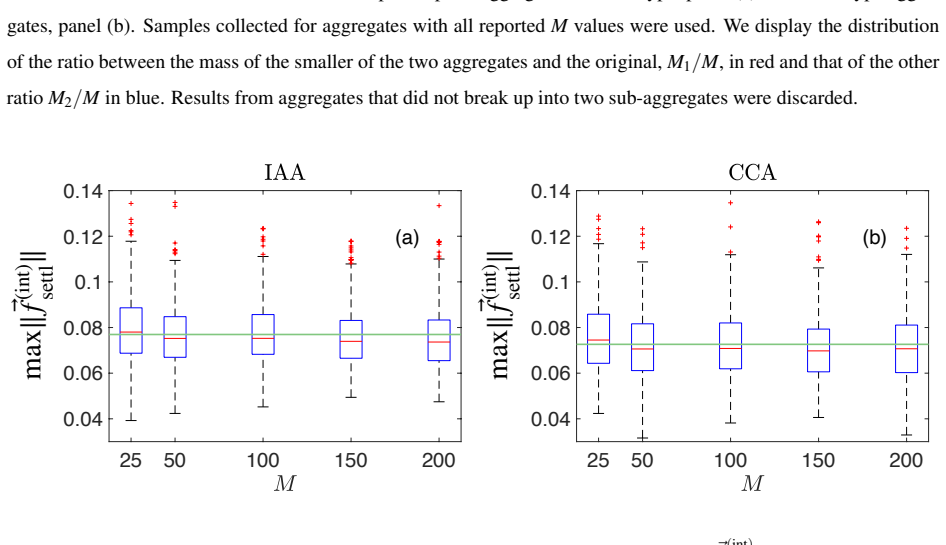
Fractal aggregates under settling develop maximum internal stress equal to about 7.5 percent of apparent weight divided by connection area, while shear produces quadratic scaling with radius.
A machine-rendered reading of the paper's core claim, the machinery that carries it, and where it could break.
Core claim
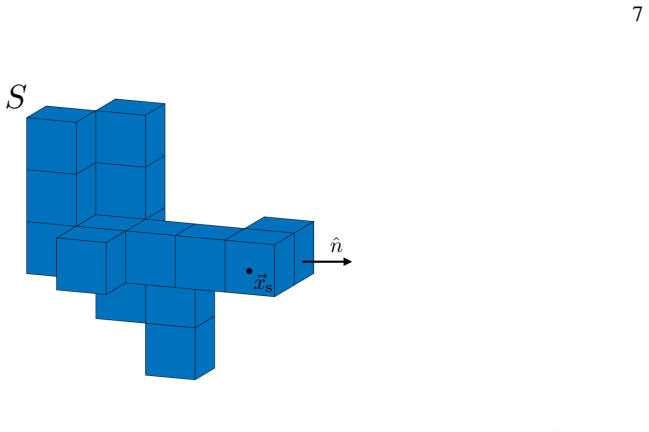
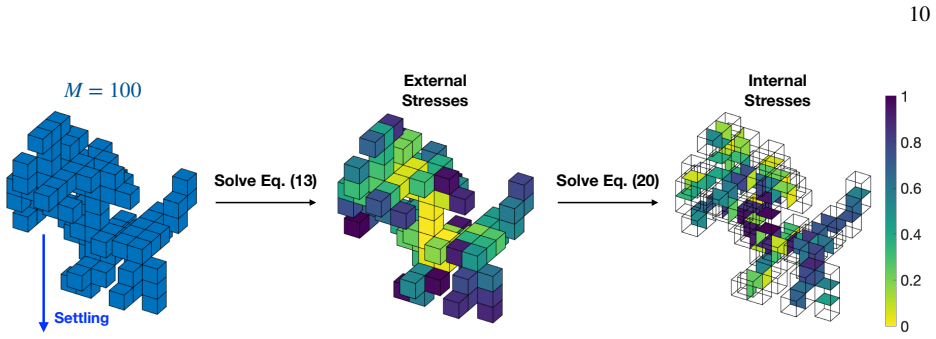
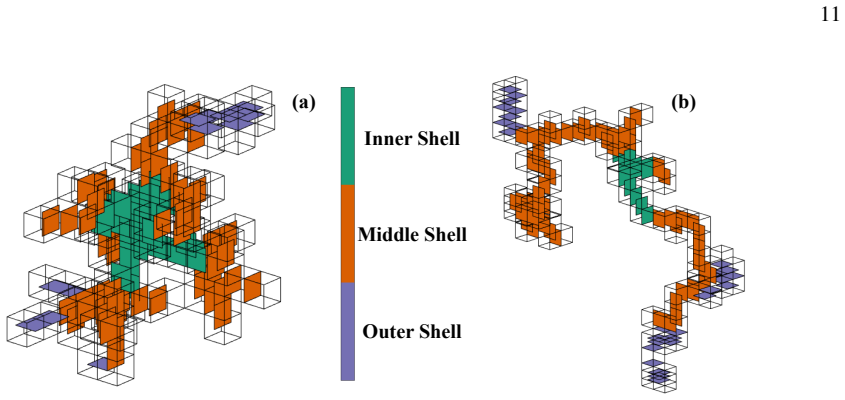
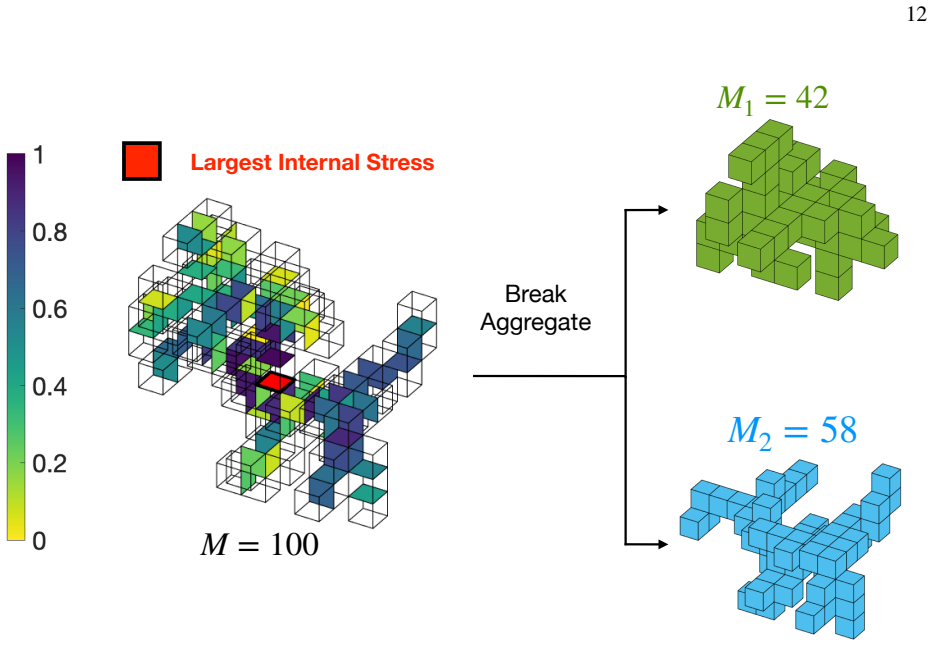
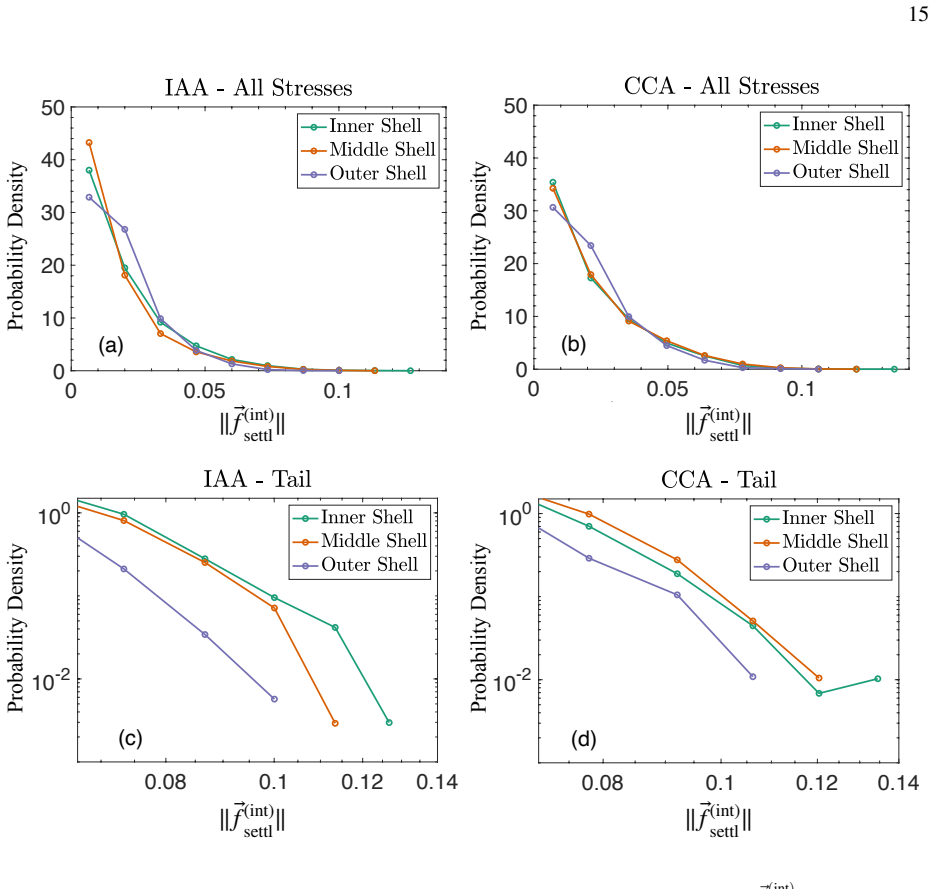
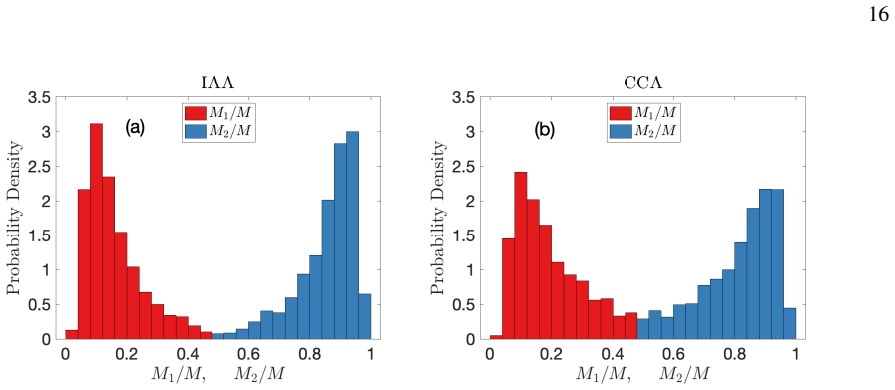
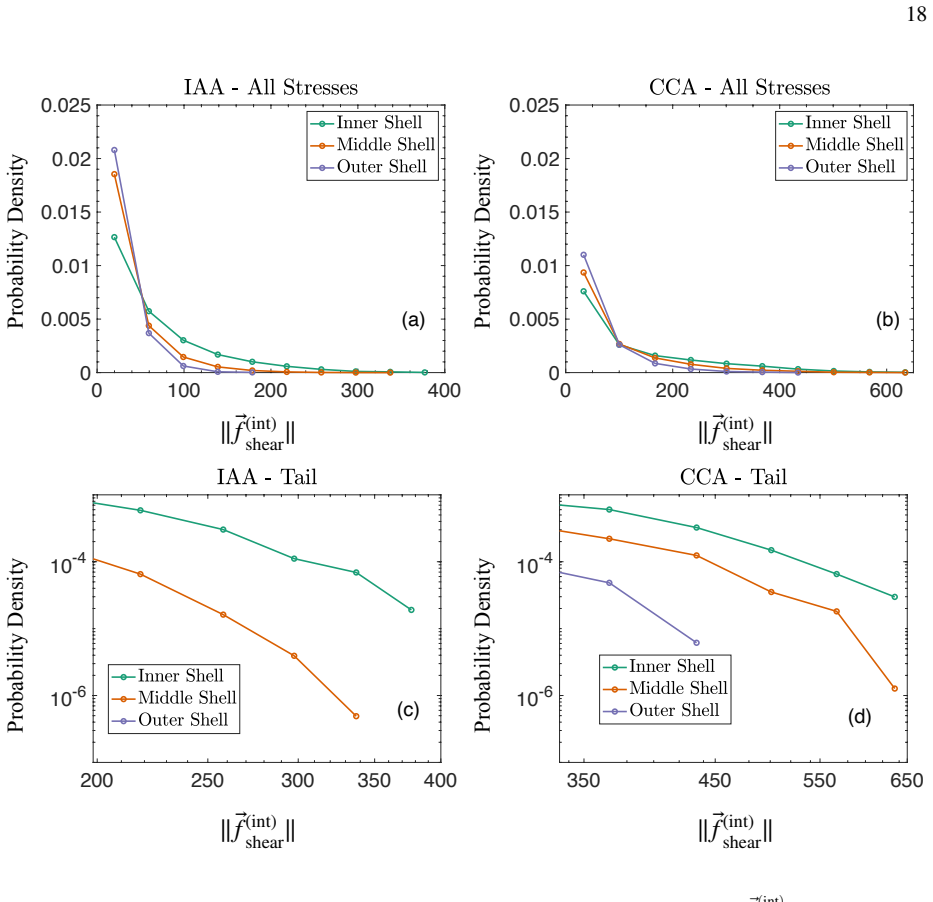
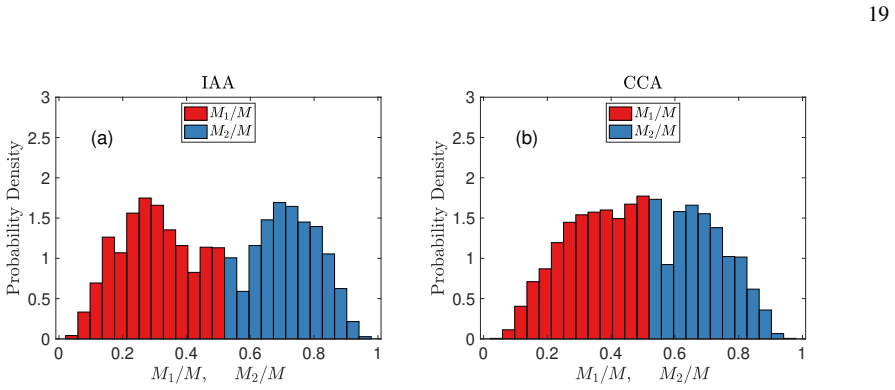
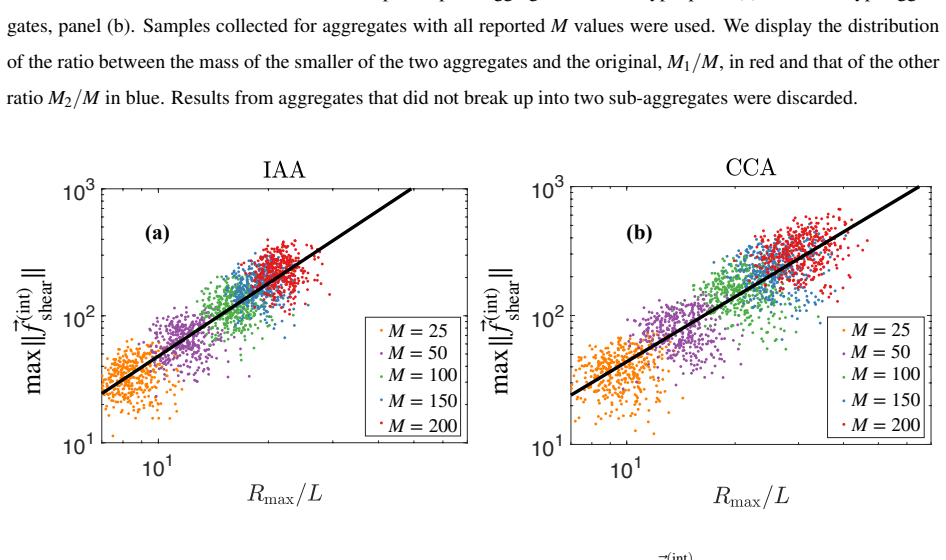
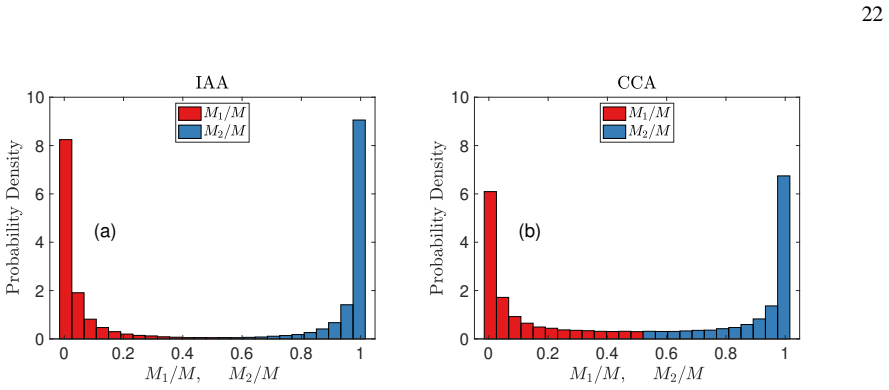
External stresses are first computed on the surfaces of the rigid cubes that form the fractal aggregate. Internal stresses are then obtained by enforcing local force and torque balance across each connecting face. Partitioning the aggregate into concentric shells shows that the largest stresses are least likely to occur near the outer edges. For settling aggregates the maximum internal stress is approximately 7.5 percent of the aggregate's apparent weight divided by the area of one cube face. Under shear the same maximum scales roughly as the square of the aggregate radius. When the aggregate is broken at the face of highest stress, the resulting sub-aggregate mass distributions differ for a
What carries the argument
Boundary integral evaluation of hydrodynamic stresses on individual rigid cubic particles, followed by static equilibrium calculation of transmitted forces across connecting faces.
If this is right
- Large internal stresses concentrate away from the outer edges of the aggregate.
- Aggregates with fractal dimension slightly less than two are more likely to split into pieces of comparable mass than those with dimension slightly above two.
- The mass distributions of fragments differ systematically between settling and shear flows.
- The computed stress scalings can be used to construct simplified dynamical models that include disaggregation without resolving every internal connection.
Where Pith is reading between the lines
- The reported scalings could be inserted directly into population-balance or transport models to estimate aggregate lifetimes in environmental flows.
- A controlled experiment that measures both stress distribution and actual breakup sites on model cubic aggregates would test the single-face failure assumption.
- Quadratic growth of stress with radius under shear implies that larger aggregates become progressively more susceptible to breakup in any flow containing velocity gradients.
Load-bearing premise
That the internal stress computed at the single strongest connecting face accurately identifies the location of breakup and that severing only that face produces representative sub-aggregate mass distributions.
What would settle it
Laboratory observation of the precise location of the first fracture in a physical fractal aggregate of connected rigid cubes under controlled settling or shear would show whether the computed maximum-stress face coincides with the actual break point.
Figures
read the original abstract
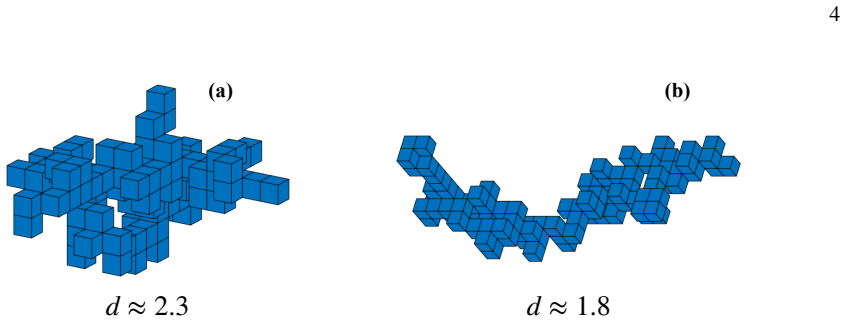
We present a numerical model of fractal-structured aggregates in low-Reynolds-number flows. Assuming that aggregates are made of cubic particles, we first use a boundary integral method to compute the stresses acting on the boundary of the aggregates. From these external stresses, we compute the stresses within the aggregates in order to gain insights on their breakup, or disaggregation. We focus on systems in which aggregates are either settling under gravity or subjected to a background shear flow and study two types of aggregates, one with fractal dimension slightly less than two and one with fractal dimension slightly above two. We partition the aggregates into multiple shells based on the distance between the individual cubes in the aggregates and their center of mass and observe the distribution of internal stresses in each shell. Our findings indicate that large stresses are least likely to occur near the far edges of the aggregates. We also find that, for settling aggregates, the maximum internal stress scales as about 7.5% of the ratio of an aggregate's apparent weight to the area of the thinnest connection, here a single square. For aggregates exposed to a shear flow, we find that the maximum internal stress scales roughly quadratically with the aggregate radius. In addition, after breaking aggregates at the face with the maximum internal stress, we compute the mass distribution of sub-aggregates and observe significant differences between the settling and shear setups for the two types of aggregates, with the low-fractal-dimension aggregates being more likely to split approximately evenly. Information obtained by our numerical model can be used to develop more refined dynamical models that incorporate disaggregation.
Editorial analysis
A structured set of objections, weighed in public.
Referee Report
Summary. The manuscript develops a boundary-integral numerical model for rigid cubic-particle fractal aggregates (D_f slightly below and above 2) in low-Re flows. External stresses on aggregate boundaries are computed for both gravitational settling and background shear; internal stresses are then reconstructed to identify likely breakup sites. Aggregates are partitioned into radial shells from the center of mass to examine stress distributions. The central results are that maximum internal stress in settling aggregates scales as ~7.5% of apparent weight divided by the area of the thinnest (single-square) connection, while in shear the maximum stress scales quadratically with aggregate radius. Sub-aggregate mass distributions are obtained by breaking exclusively at the single face of globally maximum internal stress, with reported differences in even-split probability between flow types and fractal dimensions.
Significance. If the single-break post-processing rule and the rigid-body stress reconstruction are shown to be representative, the reported scalings supply quantitative, flow-specific inputs that can be incorporated into population-balance or Lagrangian breakup models for low-Re aggregation processes (e.g., marine snow, flocculation). The shell-wise stress analysis and the contrast between settling and shear provide mechanistic distinctions that are not available from purely empirical breakup kernels. The boundary-integral treatment of Stokes flow around discretized cubes is a technically appropriate choice for the regime studied.
major comments (2)
- [Abstract and post-break analysis] Abstract and post-break analysis: the mass-distribution claims rest on the rule of breaking exclusively at the single face of globally maximum internal stress. For D_f ≈ 2 aggregates the connectivity is sparse; small changes in which connection is selected can shift the fragment mass ratio from near-even to highly asymmetric. No comparison to multi-site failure criteria, DEM simulations, or experimental fragment statistics is provided to establish that this single-break procedure yields representative sub-aggregate distributions.
- [Results on scaling of maximum internal stress] Results on scaling of maximum internal stress: the factor of ~7.5% for settling aggregates and the quadratic radius dependence for shear are presented as numerical findings, yet the manuscript supplies neither the explicit fitting procedure across realizations, the variability of the prefactor, nor mesh-convergence or analytic validation (e.g., against a solid sphere or known Stokes solutions) that would confirm the scalings are robust to the cubic discretization and boundary-integral resolution.
minor comments (1)
- The precise definition of the radial shells (distance metric, bin widths, and whether stresses are volume- or surface-averaged within each shell) is not stated explicitly; adding this detail would aid reproducibility of the shell-wise stress distributions.
Simulated Author's Rebuttal
We thank the referee for the thorough review and valuable comments on our manuscript. We address the major comments point by point below, indicating the revisions we will make to strengthen the paper.
read point-by-point responses
-
Referee: [Abstract and post-break analysis] Abstract and post-break analysis: the mass-distribution claims rest on the rule of breaking exclusively at the single face of globally maximum internal stress. For D_f ≈ 2 aggregates the connectivity is sparse; small changes in which connection is selected can shift the fragment mass ratio from near-even to highly asymmetric. No comparison to multi-site failure criteria, DEM simulations, or experimental fragment statistics is provided to establish that this single-break procedure yields representative sub-aggregate distributions.
Authors: We agree that the single-break rule at the location of maximum internal stress is a simplifying assumption, particularly for sparsely connected aggregates with D_f ≈ 2 where connectivity is limited. This choice is motivated by the expectation that failure initiates at the weakest (highest stress) link. However, we recognize that without comparisons to multi-site failure models, DEM simulations, or experimental data, the representativeness of the resulting mass distributions cannot be fully validated. We will revise the manuscript to explicitly state this assumption and its limitations in the methods and discussion sections, and to emphasize that the reported differences between flow types and fractal dimensions are indicative rather than definitive. A more comprehensive validation would require additional studies beyond the scope of the current work. revision: partial
-
Referee: [Results on scaling of maximum internal stress] Results on scaling of maximum internal stress: the factor of ~7.5% for settling aggregates and the quadratic radius dependence for shear are presented as numerical findings, yet the manuscript supplies neither the explicit fitting procedure across realizations, the variability of the prefactor, nor mesh-convergence or analytic validation (e.g., against a solid sphere or known Stokes solutions) that would confirm the scalings are robust to the cubic discretization and boundary-integral resolution.
Authors: The referee correctly identifies that additional details on the scaling analysis are needed. We will revise the results section to include: (i) the explicit procedure used to fit the scalings across multiple aggregate realizations, (ii) the observed variability in the prefactors, and (iii) a mesh-convergence study for the boundary-integral discretization. While we do not have direct analytic validation against a solid sphere in the current simulations (as the aggregates are fractal and discretized into cubes), we will add a brief discussion of how the method recovers expected behaviors in limiting cases and note this as a direction for future work. These additions will confirm the robustness of the reported scalings. revision: yes
Circularity Check
No circularity in derivation chain
full rationale
The paper computes external stresses via boundary integral method on rigid cubic aggregates, reconstructs internal stresses, and reports numerical scalings (7.5% of apparent weight over connection area for settling; quadratic in radius for shear) as direct simulation outputs. Mass distributions after single-face breakup at max stress are likewise post-processing results from the described procedure. No equations reduce these outputs to fitted parameters or inputs by construction, and no load-bearing self-citations or ansatzes are invoked to justify the central claims. The derivation chain remains independent of its reported results.
Axiom & Free-Parameter Ledger
axioms (2)
- domain assumption Aggregates are rigid assemblies of cubic particles
- domain assumption Boundary integral method computes external stresses that can be mapped to internal stresses for breakup analysis
Reference graph
Works this paper leans on
-
[1]
A. B. Burd and G. A. Jackson, Particle aggregation, Ann. Rev. Mar. Sci. 1, 65 (2009)
work page 2009
-
[2]
S. Honjo, T. Eglinton, C. Taylor, K. Ulmer, S. Sievert, A. Bracher, C. German, V . Edgcomb, R. François, M. Iglesias-Rodriguez, B. Van Mooy, and D. Rapeta, Understanding the role of the biological pump in the global carbon cycle: An imperative for ocean science, Oceanography 27, 10 (2014)
work page 2014
- [3]
-
[4]
P. Meakin, Diffusion-limited aggregation in three dimensions: Results from a new cluster-cluster aggregation model, J. Colloid Interface Sci. 102, 491 (1984)
work page 1984
-
[5]
S. Jungblut, J.-O. Joswig, and A. Eychmüller, Diffusion-limited cluster aggregation: Impact of rotational diffu- sion, J. Phys. Chem. C 123, 950 (2019)
work page 2019
-
[6]
M. Polimeno, C. Kim, and F. Blanchette, Toward a realistic model of diffusion-limited aggregation: Rotation, size-dependent diffusivities, and settling, ACS Omega 7, 40826 (2022)
work page 2022
-
[7]
Y . Song and M. J. Rau, Viscous fluid flow inside an oscillating cylinder and its extension to Stokes’ second problem, Phys. Fluids 32, 043601 (2020)
work page 2020
-
[8]
H. M. De La Rosa Zambrano, G. Verhille, and P. Le Gal, Fragmentation of magnetic particle aggregates in turbulence, Phys. Rev. Fluids 3, 084605 (2018)
work page 2018
-
[9]
Y . Song and M. J. Rau, A novel method to study the fragmentation behavior of marine snow aggregates in controlled shear flow, Limnol. Oceanogr.: Methods 20, 618 (2022)
work page 2022
-
[10]
C. Brouzet, R. Guiné, M.-J. Dalbe, B. Favier, N. Vandenberghe, E. Villermaux, and G. Verhille, Laboratory model for plastic fragmentation in the turbulent ocean, Phys. Rev. Fluids 6, 024601 (2021)
work page 2021
-
[11]
G. Frungieri and M. Vanni, Aggregation and breakup of colloidal particle aggregates in shear flow: A combined Monte Carlo–Stokesian dynamics approach, Powder Technol. 388, 357 (2021). 24
work page 2021
-
[12]
K. Zhao, B. V owinckel, T.-J. Hsu, B. Bai, and E. Meiburg, Cohesive sediment: Intermediate shear produces maximum aggregate size, J. Fluid Mech. 965, A5 (2023)
work page 2023
-
[13]
Kolb, Reversible diffusion-limited cluster aggregation, J
M. Kolb, Reversible diffusion-limited cluster aggregation, J. Phys. A: Math. Gen. 19, L263 (1986)
work page 1986
-
[14]
A. Zaccone, M. Soos, M. Lattuada, H. Wu, M. U. Bäbler, and M. Morbidelli, Breakup of dense colloidal aggre- gates under hydrodynamic stresses, Phys. Rev. E 79, 061401 (2009)
work page 2009
-
[15]
A. Gastaldi and M. Vanni, The distribution of stresses in rigid fractal-like aggregates in a uniform flow field, J. Colloid Interface Sci. 357, 18 (2011)
work page 2011
-
[16]
J. Happel and H. Brenner, Low Reynolds Number Hydrodynamics: With Special Applications to Particulate Media (Springer, Dordrecht, 1983)
work page 1983
-
[17]
R. M. German, Coordination number changes during powder densification, Powder Technol. 253, 368 (2014)
work page 2014
-
[18]
C. Pozrikidis, Boundary Integral and Singularity Methods for Linearized Viscous Flow (Cambridge University Press, 1992)
work page 1992
- [19]
-
[20]
T. A. Witten and L. M. Sander, Diffusion-limited aggregation, a kinetic critical phenomenon, Phys. Rev. Lett. 47, 1400 (1981)
work page 1981
-
[21]
Meakin, Diffusion-controlled cluster formation in 2–6-dimensional space, Phys
P. Meakin, Diffusion-controlled cluster formation in 2–6-dimensional space, Phys. Rev. A 27, 1495 (1983)
work page 1983
-
[22]
E. Yoo, S. Khatri, and F. Blanchette, Hydrodynamic forces on randomly formed marine aggregates, Phys. Rev. Fluids 5, 044305 (2020)
work page 2020
-
[23]
Z. V . Finkel, J. Beardall, K. J. Flynn, A. Quigg, T. A. V . Rees, and J. A. Raven, Phytoplankton in a changing world: Cell size and elemental stoichiometry, J. Plankton Res. 32, 119 (2009)
work page 2009
-
[24]
A. L. Alldredge and C. Gotschalk, In situ settling behavior of marine snow, Limnol. Oceanogr. 33, 339 (1988)
work page 1988
-
[25]
D. P. Bertsekas, Constrained Optimization and Lagrange Multiplier Methods (Academic Press, 1982)
work page 1982
-
[26]
A. Muqtadir, S. Al-Dughaimi, and J. Dvorkin, Deformation of granular aggregates: Static and dynamic bulk moduli, J. Geophys. Res. Solid Earth 125, e2019JB018604 (2020)
work page 2020
discussion (0)
Sign in with ORCID, Apple, or X to comment. Anyone can read and Pith papers without signing in.