REVIEW 4 major objections 6 minor 53 references
Reduced-order control using low-rank Dynamic Mode Decomposition
T0 review · 4 major / 6 minor · reviewed 2026-08-14 · deepseek-v4-flash
Pith's one-line read The paper proposes lrDMD, a rank-constrained linear model with distinct input and output subspaces, and shows it builds full-state LQR controllers that stabilize the Ginzburg-Landau system at lower rank and suppress flat-plate vortex…
desk verdict lrDMD is a solid application of a known rank-constrained idea; the GL results are clean, but the flat-plate 'cost lower' claim is not backed by any computed cost. read the letter →
The pith
A machine-rendered reading of the paper's core claim, the machinery that carries it, and where it could break.
The reading
What carries the argument
The load-bearing object is the rank-constrained least-squares surrogate with the closed-form optimal $D^{*}$ and the observation that the objective depends only on the subspaces spanned by $L$ and $R$. The paper solves it with two methods: a fast subspace-projection iteration that alternates between an optimal $L$ for a fixed projected basis and an Orthogonal Procrustes update for $R$, initialized from the DMD/POD subspace, and a Riemannian trust-region gradient method on the product Grassmann manifold initialized by the subspace projection. In the controller construction, the LQR Riccati equation is solved by Galerkin projection onto the row-space basis of the rank-$r$ model, which for lrDMD is the right subspace $R$; the same projection choice is made for DMD and OMD, so the comparison isolates the learned model rather than the controller projection.
What would settle it
On a small linear system where the global rank-$r$ optimum can be found by exhaustive search, run the lrDMD solvers from many random initial subspaces instead of the DMD subspace and compare reconstruction error and the smallest rank of a stabilizing LQR controller. If a substantial fraction of random starts land in local minima with errors no better than DMD or OMD, or fail to stabilize at the rank the paper reports, the central improvement is initialization-dependent rather than a property of the rank-constrained formulation.
Extended reading notes
Core claim
The paper's central claim is that the best rank-$r$ linear model of a dynamical system from snapshot data is not generally obtained by projecting onto one subspace, as DMD and OMD do, but by solving the rank-constrained least-squares problem $\min_{L,D,R}\|Y-LDR^{T}X\|_F^2$ over orthonormal $L,R\in\mathbb{R}^{m\times r}$. For fixed $L$ and $R$ the optimal middle factor is $D^{*}=(L^{T}YX^{T}R)(R^{T}XX^{T}R)^{-1}$, and the remaining problem depends only on the subspaces spanned by $L$ and $R$, so it lives on a product of Grassmann manifolds. The freedom to choose the input subspace $R$ and output subspace $L$ separately is what the paper identifies as the source of improvement: it fits the data more closely, represents the adjoint mode of the unstable Ginzburg-Landau eigenmode more faithfully, and yields full-state LQR controllers that stabilize that system at rank 5, suppress vortex shedding behind a 35-degree flat plate from later nonlinear initial conditions, and recover the true optimal actuator location at lower rank than DMD or OMD.
Load-bearing premise
The load-bearing premise is that the numerical solvers for the non-convex problem find a good enough local minimum; the paper states that the gradient method has no global convergence guarantee and that the subspace-projection method is a heuristic initialized from the DMD subspace. If those solvers often land in poor local minima on other systems, the claimed advantages over DMD and OMD would not generalize.
Editorial extensions
If this is right
- At a fixed rank, lrDMD achieves lower snapshot reconstruction error than DMD and OMD on the flat-plate data, and in several cases the fast subspace-projection solver is both more accurate and cheaper than the gradient solver.
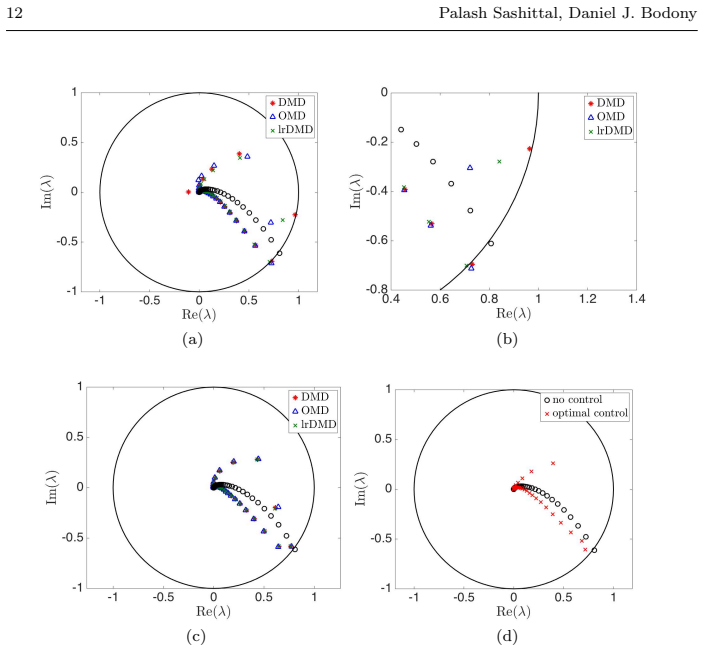
- lrDMD stabilizes the Ginzburg-Landau system with a rank-5 LQR controller, while DMD and OMD leave an unstable eigenvalue at rank 5; at rank 9 all three approaches approach the full-order optimal controlled spectrum.
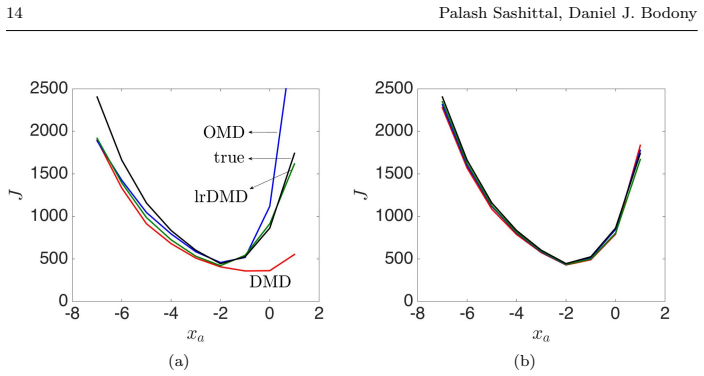
- lrDMD recovers the true optimal actuator location for the Ginzburg-Landau system at rank 5, where DMD selects the wrong location until rank 9.
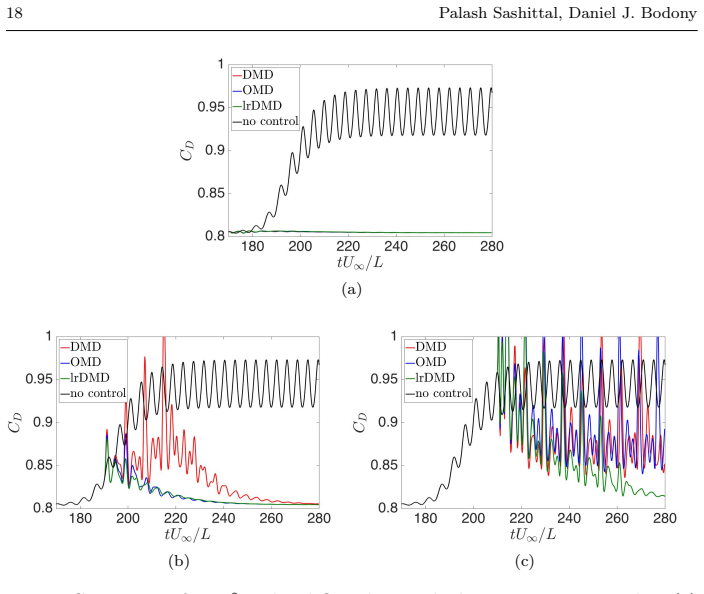
- For flow over the inclined flat plate, lrDMD returns the flow to the steady state from later, more nonlinear initial conditions and does so with lower actuation cost than DMD, while also giving a lower projection error for the unstable adjoint mode at a given rank.
Reading between the lines
- If the separate input and output subspaces are the active ingredient, lrDMD-type models should also improve other data-driven tasks in which the row space matters, such as non-intrusive receptivity and sensitivity analysis of nonnormal flows.
- The comparison inherits whatever local minima the non-convex solvers find; a natural stress test is to initialize the Grassmannian optimization from many random subspaces and measure how often reconstruction error and stabilizing controller rank stay better than OMD.
- The rank-constrained model is not tied to LQR, so the same lrDMD representation could be plugged into other controller designs, such as output-feedback or $\mathcal{H}_\infty$ synthesis, for problems where full-state measurements are unavailable.
Signed reviews
Editorial analysis
A structured set of objections, weighed in public.
Referee Report
Summary. The paper proposes low-rank Dynamic Mode Decomposition (lrDMD), a reduced-order modeling method that solves the rank-constrained least-squares problem min_{L,D,R} ||Y - LDR^T X||_F^2 with separate input and output subspaces, and compares it with DMD and OMD. Two numerical solvers are presented: a heuristic subspace-projection method and a Riemannian trust-region gradient method. The reduced-order models are used to design full-state LQR feedback controllers, which are tested on the linearized complex Ginzburg-Landau equation in the globally unstable regime and on two-dimensional incompressible flow past an inclined flat plate at Re=100. The paper claims that lrDMD achieves lower reconstruction error, stabilizes the GL system at lower rank, provides improved estimates of adjoint modes, and suppresses flat-plate vortex shedding at lower control cost than DMD or OMD.
Significance. The core idea of using separate input and output subspaces for data-driven reduced-order models is a meaningful extension of DMD and OMD, particularly for non-normal flow systems where adjoint information matters for control. The GL experiments provide a clean, full-order-validated demonstration: lrDMD stabilizes the system at rank 5 where DMD and OMD fail, and the adjoint-mode projection error is reduced. The authors are also honest about the non-convexity of the optimization problem in Remark 2. However, the strongest comparative claims—lower reconstruction error in general and lower control cost on the flat plate—are not yet supported by the evidence as presented. The flat-plate comparison rests on single deterministic runs with no quantified cost, and the reconstruction-error comparison is in-sample. If these gaps are fixed, the paper could make a solid contribution to data-driven flow control.
major comments (4)
- [Section 5.2.3, Figs. 7-8, Table 5; abstract] The abstract claims that lrDMD suppresses vortex shedding from the inclined flat plate "at a cost lower than either DMD or OMD," but no quantitative control cost is reported anywhere in Section 5.2. The evidence consists of CD vs. time plots and actuation-strength plots for three activation times (t0 = 170, 190, 210) and a binary pass/fail table (Table 5) for two snapshot spacings. This is insufficient to establish a cost ordering. The authors should compute and report an integrated cost, such as the actual LQR objective J = sum (q^T Q q + u^T S u) evaluated on the closed-loop nonlinear trajectories, or an equivalent metric (e.g., time-integrated deviation of CD from the steady-state value plus control effort), for each method, activation time, and snapshot spacing. Without such a quantitative comparison, the headline "cost lower" claim is not load-bearing evidence and may not generalize.
- [Section 3.1, Table 2] The reconstruction errors reported in Table 2 are computed as epsilon = ||Y - A_hat X||_F on the same data matrices X, Y that were used to construct each reduced-order model. This is an in-sample evaluation of a training objective, and lrDMD has more degrees of freedom than DMD or OMD in optimizing that objective, so its lower error is partly expected. This does not demonstrate better predictive accuracy or a generally superior model. The paper should include an out-of-sample test, for example by withholding a portion of the time series or snapshots from a different initial condition, and reporting the prediction error on that held-out data. Without such evidence, the "lower reconstruction error" claim in the abstract is overstated.
- [Appendix A.1, Algorithm 1, line 10] The formula for D in Algorithm 1, line 10, includes an extra factor R^T L: D = (L^T Y X^T R)(R^T X X^T R)^{-1}(R^T L). This is inconsistent with Eq. (7), which gives D*(L,R) = (L^T Y X^T R)(R^T X X^T R)^{-1}. Since L and R are generally different orthogonal matrices, R^T L is not the identity, and as printed the algorithm does not compute the least-squares optimal D for the given L and R. Please correct the formula or explicitly clarify whether R^T L is an intentional part of a different definition. If the implementation actually uses Eq. (7), then this is a typo that should be fixed; otherwise the algorithm and the numerical results may be based on a different model than the one analyzed in Section 2.3.
- [Remark 2 and Section 3] All claimed advantages of lrDMD over DMD and OMD depend on the non-convex optimization problem (6) being solved to a sufficiently good local minimum. Remark 2 states that the gradient method has no global convergence guarantee, and Algorithm 1 is a heuristic initialized from the DMD subspace. The paper does not report any sensitivity analysis with respect to initialization or convergence diagnostics. For example, one could initialize from the OMD solution, from random orthogonal matrices, or from several perturbed DMD bases and quantify the spread in reconstruction error and closed-loop control performance. Without this, the single-run comparisons in Sections 3.1 and 5 cannot rule out the possibility that the observed lrDMD advantages are artifacts of the particular local minimum found by the proposed initialization. This is a load-bearing concern for the generality of the central claim.
minor comments (6)
- [Section 2 heading] The heading "Mathematical F ormulation" contains an erroneous space; it should read "Mathematical Formulation."
- [Section 5.1.3] In the paragraph after Eq. (14), the sentence "the eigenvector of X that corresponds to the largest eigenvalue" should refer to the eigenvector of F, not X.
- [Section 3.1] The notation Y = U^T Y and X = U^T X reuses symbols X and Y for the projected data matrices; this is confusing and should be clarified, for example with new symbols X_p, Y_p.
- [Table 5] The check and cross symbols in Table 5 do not render correctly in the text version (they appear as box glyphs); ensure that the caption and symbols display properly in the final PDF.
- [Section 5.2.3] The paper should clarify that T in Eq. (15) is the number of timesteps advanced by the nonlinear solver between control updates, and that Table 5 varies this parameter for the snapshot data matrices; this distinction is implicit but not stated clearly.
- [References] Reference [36] is listed as "forthcoming"; if the associated CDC paper has appeared, the complete publication details should be provided.
Circularity Check
No significant circularity: control claims are tested against independent full-order benchmarks.
full rationale
The paper's central control claims are not circular. lrDMD is a rank-constrained least-squares problem (Eq. 6). The Ginzburg-Landau comparisons in Secs. 5.1.2 and 5.1.3 evaluate the LQR gains on the full-order complex Ginzburg-Landau dynamics and compare optimal actuator locations against the full-order system's Lyapunov cost, not against the reduced model's own reconstruction. Likewise, the flat-plate tests in Sec. 5.2.3 apply the reduced-order gains to the nonlinear immersed-boundary solver and report closed-loop vorticity and drag trajectories; the benchmark is the full-order nonlinear flow, so the lrDMD controller's success is not forced by its training objective. The adjoint-mode comparison in Sec. 5.1.1 uses the true adjoint mode of the discretized system as an external target. The only self-citation, [36], is for implementation details of the Riemannian gradient method and is outlined in Appendix A.2; it is not load-bearing, and the closed-form reduction of the lrDMD problem is credited to the independent work [37]. Remark 2 honestly states that the gradient method has no global convergence guarantee; this is a numerical limitation, not a circularity. The lower reconstruction error of lrDMD relative to DMD/OMD follows from the larger feasible set in (6) over (3), but the paper presents this as a property of the optimization rather than as an independent prediction. I find no prediction or derivation that reduces to its own inputs.
Assumptions & free parameters
free parameters (5)
- Reduced-order model rank r =
5, 9 (Ginzburg-Landau); 20 (flat plate)
- Number of snapshots n =
15 (GL), 200 (flat plate)
- Snapshot time separation T =
20, 50, 100 for flat plate
- GL actuator center xa and width sigma =
xa=8, sigma=5
- Flat plate actuator constants =
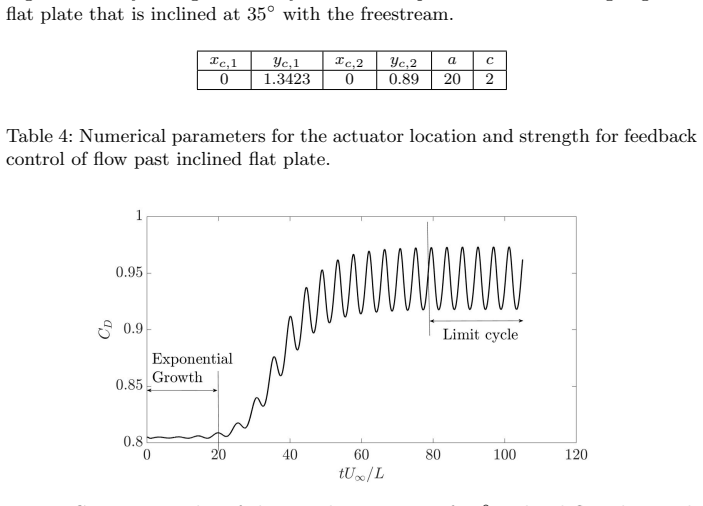
Table 4: xc1=0, yc1=1.3423, xc2=0, yc2=0.89, a=20, c=2
assumptions (5)
- domain assumption The flow dynamics of interest are well approximated, in the region of state space used for data collection, by a linear time-invariant discrete-time system x_{k+1} = A x_k + B u_k.
- ad hoc to paper The rank-r linear least-squares problem min_{L,D,R} ||Y - LDR^T X||_F^2 has its global minimizer attained and the proposed algorithms find a sufficiently good local minimum.
- domain assumption The immersed boundary method simulation [50] and the Newton-GMRES steady-state computation are accurate enough to generate trustworthy snapshots.
- domain assumption The unstable eigenmode and adjoint mode of the Ginzburg-Landau system are the relevant modes for control, and the projection errors of these modes measure controller-relevant fidelity.
- standard math Standard results from numerical linear algebra (SVD, least squares, Lyapunov and Riccati solvers) and Riemannian optimization (ManOpt trust-region) are correct.
Cite this review
Pith. "Pith review of Reduced-order control using low-rank Dynamic Mode Decomposition." pith.science (2026). https://pith.science/paper/ZW4ISXBI
@misc{pith2026190802249,
  author       = {Pith},
  title        = {Pith review of: Reduced-order control using low-rank Dynamic Mode Decomposition},
  year         = {2026},
  howpublished = {\url{https://pith.science/paper/ZW4ISXBI}},
  note         = {Machine review of arXiv:1908.02249}
}
read the original abstract
In this work we perform full-state LQR feedback control of fluid flows using non-intrusive data-driven reduced-order models. We propose a model reduction method called low-rank Dynamic Mode Decomposition (lrDMD) that solves for a rank-constrained linear representation of the dynamical system. lrDMD is shown to have lower data reconstruction error compared to standard Optimal Mode Decomposition (OMD) and Dynamic Mode Decomposition (DMD), but with an increased computational cost arising from solving a non-convex matrix optimization problem. We demonstrate model order reduction on the complex linearized Ginzburg-Landau equation in the globally unstable regime and on the unsteady flow over a flat plate at a high angle of attack. In both cases, low-dimensional full-state feedback controller is constructed using reduced-order models constructed using DMD, OMD and lrDMD. It is shown that lrDMD stabilizes the Ginzburg-Landau system with a lower order controller and is able to suppress vortex shedding from an inclined flat plate at a cost lower than either DMD or OMD. It is further shown that lrDMD yields an improved estimate of the adjoint system, for a given rank, relative to DMD and OMD.
Figures

Figures from the paper (5 more)



Reference graph
Works this paper leans on
-
[1]
Adjoint-based control of loud events in a turbulent jet
Jeonglae Kim, Daniel J Bodony, and Jonathan B Freund. Adjoint-based control of loud events in a turbulent jet. Journal of Fluid Mechanics , 741:28–59, 2014. 22 Palash Sashittal, Daniel J. Bodony
work page 2014
-
[2]
Model reduction for flow analysis and control
Clarence W Rowley and Scott TM Dawson. Model reduction for flow analysis and control. Annual Review of Fluid Mechanics , 49:387–417, 2017
work page 2017
-
[3]
Kevin Carlberg, Charbel Bou-Mosleh, and Charbel Farhat. Efficient non-linear model reduction via a least-squares petrov–galerkin projection and compressive tensor approx- imations. International Journal for Numerical Methods in Engineering , 86(2):155–181, 2011
work page 2011
-
[4]
Balanced model reduction via the proper orthogonal decomposition
Karen Willcox and Jaime Peraire. Balanced model reduction via the proper orthogonal decomposition. AIAA journal, 40(11):2323–2330, 2002
2002
-
[5]
Model reduction for fluids, using balanced proper orthogonal decom- position
Clarence W Rowley. Model reduction for fluids, using balanced proper orthogonal decom- position. International Journal of Bifurcation and Chaos , 15(03):997–1013, 2005
work page 2005
-
[6]
Input-output analysis and control design applied to a linear model of spatially developing flows
Shervin Bagheri, DS Henningson, J Hoepffner, and PJ Schmid. Input-output analysis and control design applied to a linear model of spatially developing flows. Applied Mechanics Reviews, 62(2):020803, 2009
work page 2009
-
[7]
Feedback con- trol of three-dimensional optimal disturbances using reduced-order models
Onofrio Semeraro, Shervin Bagheri, Luca Brandt, and Dan S Henningson. Feedback con- trol of three-dimensional optimal disturbances using reduced-order models. Journal of Fluid Mechanics, 677:63–102, 2011
work page 2011
-
[8]
Transition delay in a boundary layer flow using active control
Onofrio Semeraro, Shervin Bagheri, Luca Brandt, and Dan S Henningson. Transition delay in a boundary layer flow using active control. Journal of Fluid Mechanics , 731:288–311, 2013
work page 2013
Show all 53 references
-
[9]
Model-based control of vortex shedding at low reynolds numbers
Simon J Illingworth. Model-based control of vortex shedding at low reynolds numbers. Theoretical and Computational Fluid Dynamics , 30(5):429–448, 2016
2016
-
[10]
A linear systems approach to flow control
John Kim and Thomas R Bewley. A linear systems approach to flow control. Annu. Rev. Fluid Mech., 39:383–417, 2007
2007
-
[11]
Control and system identification of a separated flow
Shao-Ching Huang and John Kim. Control and system identification of a separated flow. Physics of Fluids , 20(10):101509, 2008
2008
-
[12]
A physics-based approach to flow control using system identification
Aurelien Herv´ e, Denis Sipp, Peter J Schmid, and Manuel Samuelides. A physics-based approach to flow control using system identification. Journal of Fluid Mechanics , 702:26– 58, 2012
2012
-
[13]
Fitting autoregressive models for prediction
Hirotugu Akaike. Fitting autoregressive models for prediction. Annals of the institute of Statistical Mathematics, 21(1):243–247, 1969
1969
-
[14]
N4sid: Subspace algorithms for the identification of combined deterministic-stochastic systems
Peter Van Overschee and Bart De Moor. N4sid: Subspace algorithms for the identification of combined deterministic-stochastic systems. Automatica, 30(1):75–93, 1994
1994
-
[15]
Subspace identification for linear systems: Theo- ryImplementationApplications
Peter Van Overschee and BL De Moor. Subspace identification for linear systems: Theo- ryImplementationApplications. Springer Science & Business Media, 2012
2012
-
[16]
A dynamic observer to capture and control perturbation energy in noise amplifiers
Juan Guzm´ an I˜ nigo, Denis Sipp, and Peter J Schmid. A dynamic observer to capture and control perturbation energy in noise amplifiers. Journal of Fluid Mechanics , 758:728–753, 2014
2014
-
[17]
An overview of subspace identification
S Joe Qin. An overview of subspace identification. Computers & chemical engineering , 30(10-12):1502–1513, 2006
2006
-
[18]
An eigensystem realization algorithm for modal pa- rameter identification and model reduction
J-N Juang and Richard S Pappa. An eigensystem realization algorithm for modal pa- rameter identification and model reduction. Journal of guidance, control, and dynamics , 8(5):620–627, 1985
1985
-
[19]
State-space model iden- tification and feedback control of unsteady aerodynamic forces
Steven L Brunton, Scott TM Dawson, and Clarence W Rowley. State-space model iden- tification and feedback control of unsteady aerodynamic forces. Journal of Fluids and Structures, 50:253–270, 2014
2014
-
[20]
Feedback control of unstable flows: a di- rect modelling approach using the eigensystem realisation algorithm
Thibault LB Flinois and Aimee S Morgans. Feedback control of unstable flows: a di- rect modelling approach using the eigensystem realisation algorithm. Journal of Fluid Mechanics, 793:41–78, 2016
2016
-
[21]
Feedback control of unstable steady states of flow past a flat plate using reduced-order estimators
Sunil Ahuja and Clarence W Rowley. Feedback control of unstable steady states of flow past a flat plate using reduced-order estimators. Journal of fluid mechanics , 645:447–478, 2010
2010
-
[22]
Feedback control of cavity flow oscillations using simple linear models
Simon J Illingworth, Aimee S Morgans, and Clarence W Rowley. Feedback control of cavity flow oscillations using simple linear models. Journal of Fluid Mechanics , 709:223– 248, 2012
2012
-
[23]
Feedback control of instabilities in the two-dimensional blasius boundary layer: the role of sensors and actuators
Brandt A Belson, Onofrio Semeraro, Clarence W Rowley, and Dan S Henningson. Feedback control of instabilities in the two-dimensional blasius boundary layer: the role of sensors and actuators. Physics of fluids , 25(5):054106, 2013
2013
-
[24]
Active control of vortex shedding: an explanation of the gain window
Simon J Illingworth, Hiroshi Naito, and Koji Fukagata. Active control of vortex shedding: an explanation of the gain window. Physical Review E, 90(4):043014, 2014. Reduced-order control using low-rank DMD 23
2014
-
[25]
Dynamic mode decomposition of numerical and experimental data
Peter J Schmid. Dynamic mode decomposition of numerical and experimental data. Jour- nal of Fluid Mechanics , 656:5–28, 2010
2010
-
[26]
On dynamic mode decomposition: theory and applications
Jonathan H Tu, Clarence W Rowley, Dirk M Luchtenburg, Steven L Brunton, and J Nathan Kutz. On dynamic mode decomposition: theory and applications. arXiv preprint arXiv:1312.0041, 2013
2013 arXiv
-
[27]
Optimal mode decomposition for high dimensional systems
Paul J Goulart, Andrew Wynn, and David Pearson. Optimal mode decomposition for high dimensional systems. In Decision and Control (CDC), 2012 IEEE 51st Annual Conference on, pages 4965–4970. IEEE, 2012
2012
-
[28]
H2 optimal actuator and sensor placement in the linearised complex ginzburg–landau system
Kevin K Chen and Clarence W Rowley. H2 optimal actuator and sensor placement in the linearised complex ginzburg–landau system. Journal of Fluid Mechanics , 681:241–260, 2011
2011
-
[29]
Dynamic mode decom- position for large and streaming datasets
Maziar S Hemati, Matthew O Williams, and Clarence W Rowley. Dynamic mode decom- position for large and streaming datasets. Physics of Fluids , 26(11):111701, 2014
2014
-
[30]
De-biasing the dynamic mode decomposition for applied koopman spectral analysis of noisy datasets
Maziar S Hemati, Clarence W Rowley, Eric A Deem, and Louis N Cattafesta. De-biasing the dynamic mode decomposition for applied koopman spectral analysis of noisy datasets. Theoretical and Computational Fluid Dynamics , 31(4):349–368, 2017
2017
-
[31]
Char- acterizing and correcting for the effect of sensor noise in the dynamic mode decomposition
Scott TM Dawson, Maziar S Hemati, Matthew O Williams, and Clarence W Rowley. Char- acterizing and correcting for the effect of sensor noise in the dynamic mode decomposition. Experiments in Fluids , 57(3):42, 2016
2016
-
[32]
Feedback control for systems with uncertain parameters using online-adaptive reduced models
Boris Kramer, Benjamin Peherstorfer, and Karen Willcox. Feedback control for systems with uncertain parameters using online-adaptive reduced models. SIAM Journal on Ap- plied Dynamical Systems, 16(3):1563–1586, 2017
2017
-
[33]
Experimental implementation of modal approaches for autonomous reattachment of separated flows
Eric A Deem, Louis N Cattafesta, Huaijin Yao, Maziar Hemati, Hao Zhang, and Clarence W Rowley. Experimental implementation of modal approaches for autonomous reattachment of separated flows. In 2018 AIAA Aerospace Sciences Meeting , page 1052, 2018
2018
-
[34]
Improving separation control with noise-robust variants of dynamic mode decomposition
Maziar Hemati, Eric Deem, Matthew Williams, Clarence W Rowley, and Louis N Cattafesta. Improving separation control with noise-robust variants of dynamic mode decomposition. In 54th AIAA Aerospace Sciences Meeting, page 1103, 2016
2016
-
[35]
Optimal actu- ator selection for airfoil separation control
Debraj Bhattacharjee, Maziar Hemati, Bjoern Klose, and Gustaaf Jacobs. Optimal actu- ator selection for airfoil separation control. In 2018 Flow Control Conference , page 3692, 2018
2018
-
[36]
Low-rank dynamic mode decomposition using Rie- mannian manifold optimization
Palash Sashittal and Daniel Bodony. Low-rank dynamic mode decomposition using Rie- mannian manifold optimization. (forthcoming) 57th IEEE Conference in Decision and Control (CDC), 2018
2018
-
[37]
Low-rank approximation and dynamic mode decomposi- tion
Patrick H´ eas and C´ edric Herzet. Low-rank approximation and dynamic mode decomposi- tion. arXiv preprint arXiv:1610.02962 , 2016
2016 arXiv
-
[38]
Op- timal mode decomposition for unsteady flows
Andrew Wynn, DS Pearson, Bharathram Ganapathisubramani, and Paul J Goulart. Op- timal mode decomposition for unsteady flows. Journal of Fluid Mechanics , 733:473–503, 2013
2013
-
[39]
Optimization algorithms on matrix manifolds
P-A Absil, Robert Mahony, and Rodolphe Sepulchre. Optimization algorithms on matrix manifolds. Princeton University Press, 2009
2009
-
[40]
The geometry of algorithms with orthogonality constraints
Alan Edelman, Tom´ as A Arias, and Steven T Smith. The geometry of algorithms with orthogonality constraints. SIAM Journal on Matrix Analysis and Applications, 20(2):303– 353, 1998
1998
-
[41]
Manopt, a matlab toolbox for optimization on manifolds
Nicolas Boumal, Bamdev Mishra, Pierre-Antoine Absil, Rodolphe Sepulchre, et al. Manopt, a matlab toolbox for optimization on manifolds. Journal of Machine Learn- ing Research, 15(1):1455–1459, 2014
2014
-
[42]
Trust-region methods on rieman- nian manifolds
P-A Absil, Christopher G Baker, and Kyle A Gallivan. Trust-region methods on rieman- nian manifolds. Foundations of Computational Mathematics , 7(3):303–330, 2007
2007
-
[43]
Linear optimal control systems, volume 1
Huibert Kwakernaak and Raphael Sivan. Linear optimal control systems, volume 1. Wiley- Interscience New York, 1972
1972
-
[44]
Analysis of the rational krylov subspace projection method for large- scale algebraic riccati equations
Valeria Simoncini. Analysis of the rational krylov subspace projection method for large- scale algebraic riccati equations. SIAM Journal on Matrix Analysis and Applications , 37(4):1655–1674, 2016
2016
-
[45]
Order reduction approaches for the algebraic riccati equation and the lqr problem
Alessandro Alla and Valeria Simoncini. Order reduction approaches for the algebraic riccati equation and the lqr problem. arXiv preprint arXiv:1711.01077 , 2017
2017 arXiv
-
[46]
Stability and transition in shear flows , volume
Peter J Schmid and Dan S Henningson. Stability and transition in shear flows , volume
-
[47]
Peter J Schmid and Luca Brandt. Analysis of fluid systems: Stability, receptivity, sensi- tivitylecture notes from the flow-nordita summer school on advanced instability methods for complex flows, stockholm, sweden, 2013. Applied Mechanics Reviews , 66(2):024803, 2014
2013
-
[48]
Adjoint equations in stability analysis
Paolo Luchini and Alessandro Bottaro. Adjoint equations in stability analysis. Annual Review of fluid mechanics , 46, 2014
2014
-
[49]
Actuator selection and placement for localized feedback flow control
Mahesh Natarajan, Jonathan B Freund, and Daniel J Bodony. Actuator selection and placement for localized feedback flow control. Journal of Fluid Mechanics , 809:775–792, 2016
2016
-
[50]
A fast immersed boundary method using a nullspace approach and multi-domain far-field boundary conditions
Tim Colonius and Kunihiko Taira. A fast immersed boundary method using a nullspace approach and multi-domain far-field boundary conditions. Computer Methods in Applied Mechanics and Engineering, 197(25-28):2131–2146, 2008
2008
-
[51]
Reduction methods for feedback stabilization of fluid flows
Sunil Ahuja. Reduction methods for feedback stabilization of fluid flows . PhD thesis, PhD thesis, Princeton University, New Jersey, 2009
2009
-
[52]
A generalized solution of the orthogonal procrustes problem
Peter H Sch¨ onemann. A generalized solution of the orthogonal procrustes problem. Psy- chometrika, 31(1):1–10, 1966
1966
-
[142]
24 Palash Sashittal, Daniel J
Springer Science & Business Media, 2012. 24 Palash Sashittal, Daniel J. Bodony
2012
Reviewed August 14, 2026 · model on record in the stance chip above.
Discussion (0). Continue with ORCID to comment.