Multidimensional constructs and moderated linear and nonlinear factor analysis
Pith reviewed 2026-05-22 13:22 UTC · model grok-4.3
The pith
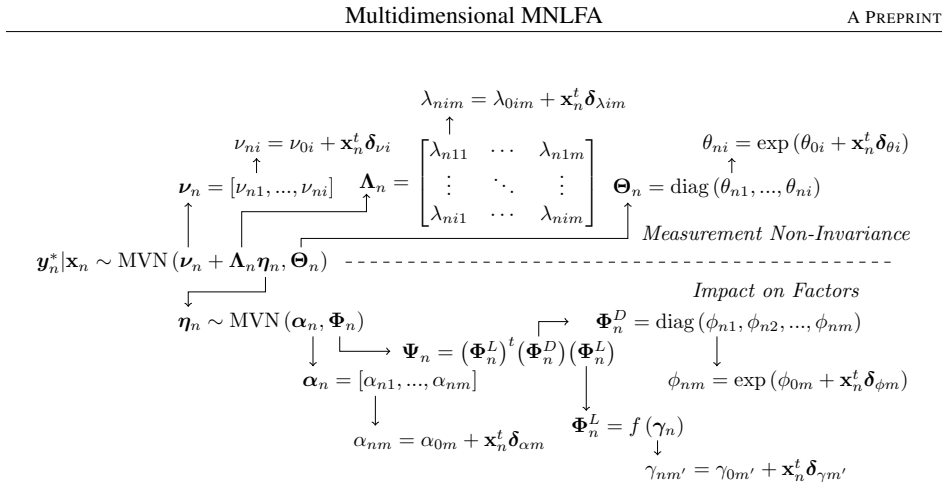
A multidimensional MNLFA model now permits moderation of intercepts, loadings, variances, means and correlations for three or more latent factors.
A machine-rendered reading of the paper's core claim, the machinery that carries it, and where it could break.
Core claim
The author introduces a multidimensional MNLFA model that permits the moderation of item intercepts, loadings, residual variances, factor means, variances, and correlations across three or more latent factors, implemented with Bayesian methods through Stan and penalized maximum likelihood to achieve stable estimation and detect partial non-invariance.
What carries the argument
The multidimensional MNLFA model, which extends moderation to every model parameter (intercepts, loadings, residual variances, factor means, variances, and correlations) when three or more factors are present.
If this is right
- Multi-dimensional psychological scales can now be tested for measurement invariance on all parameters rather than only means or loadings.
- Penalization provides a practical route to partial invariance detection without sacrificing overall model interpretability.
- Closed-form gradients make the likelihood tractable for larger numbers of factors and moderators.
- The framework directly supports applied research on constructs that are already designed around three to five latent dimensions.
Where Pith is reading between the lines
- The same penalization logic might be tested on categorical item responses to see whether the stability gains transfer.
- Longitudinal extensions could reveal whether moderated factor correlations change systematically over time.
Load-bearing premise
The full-moderation model for three or more factors remains stably estimable and interpretable when fitted by Bayesian methods or penalized maximum likelihood.
What would settle it
A three-factor simulation or real-data example in which the model fails to converge, produces uninterpretable parameters, or loses the ability to detect partial non-invariance under the proposed Bayesian or penalized estimators would falsify the claim.
Figures

read the original abstract
Multidimensional factor models with moderations on all model parameters have so far been limited to single-factor and two-factor models. This does not align well with existing psychological measures, which are commonly intended to assess 3-5 dimensions of a latent construct. In this paper, I introduce a multidimensional MNLFA model that permits the moderation of item intercepts, loadings, residual variances, factor means, variances, and correlations across three or more latent factors. I describe efforts to implement the model using Bayesian methods through Stan and penalized maximum likelihood approaches to stabilize estimation and detect partial measurement non-invariance while preserving model interpretability. Closed-form analytic gradients of the likelihood, eliminating the need for costly numerical or MCMC-based approximations. We conclude by discussing the theoretical implications of penalization for measurement invariance, computational considerations, and future directions for extending the framework to categorical indicators, longitudinal data, and applied research contexts.
Editorial analysis
A structured set of objections, weighed in public.
Referee Report
Summary. The manuscript introduces a multidimensional MNLFA model extending moderation to all parameters (item intercepts, loadings, residual variances, factor means, variances, and correlations) for three or more latent factors. Implementation relies on Bayesian estimation in Stan and penalized maximum likelihood, with closed-form analytic gradients claimed to stabilize estimation, detect partial measurement non-invariance, and preserve interpretability. The work concludes with discussion of theoretical implications, computational issues, and extensions to categorical indicators and longitudinal data.
Significance. If the identification and estimation claims hold, the extension would address a practical gap for psychological measures with 3-5 dimensions by permitting full moderation without restricting to 1- or 2-factor cases. The combination of penalization for non-invariance detection and analytic gradients for computational tractability represents a potentially useful methodological advance, provided interpretability is maintained.
major comments (1)
- [Abstract and model implementation sections] Abstract and model implementation sections: the central claim that the fully moderated model for three or more factors can be stably estimated and interpreted rests on the assertion that analytic gradients and penalization resolve estimation issues, yet no explicit identification scheme (e.g., normalization of moderated factor variances or constraints on the moderated correlation matrix that itself varies with moderators) is provided to address the scaling indeterminacy that arises when both loadings and factor variances/correlations are moderated simultaneously.
minor comments (2)
- [Abstract] Abstract: the phrase 'Closed-form analytic gradients of the likelihood, eliminating the need for costly numerical or MCMC-based approximations' appears as a sentence fragment and should be integrated into a complete statement with reference to the specific likelihood or section where the gradients are derived.
- [Discussion section] Discussion section: the treatment of how penalization affects measurement invariance interpretation in the multidimensional setting would benefit from a brief illustrative example showing the effect on a specific parameter (e.g., a moderated loading) before and after penalization.
Simulated Author's Rebuttal
We thank the referee for the detailed and constructive review. The comment on identification is well-taken and we address it directly below, with plans to revise the manuscript accordingly.
read point-by-point responses
-
Referee: [Abstract and model implementation sections] Abstract and model implementation sections: the central claim that the fully moderated model for three or more factors can be stably estimated and interpreted rests on the assertion that analytic gradients and penalization resolve estimation issues, yet no explicit identification scheme (e.g., normalization of moderated factor variances or constraints on the moderated correlation matrix that itself varies with moderators) is provided to address the scaling indeterminacy that arises when both loadings and factor variances/correlations are moderated simultaneously.
Authors: We agree that an explicit identification scheme must be stated clearly when loadings, factor variances, and correlations are all moderated simultaneously. In the submitted manuscript the Stan implementation and penalized ML routine enforce identification implicitly via fixed factor variances normalized to 1 across moderator values together with a Cholesky parameterization of the moderated correlation matrix that guarantees positive definiteness for every moderator value. These constraints were verified in the simulation studies but were not described in a dedicated subsection. In the revised version we will add an “Identification Constraints” subsection to the Model Implementation section that (i) states the normalization of moderated factor variances to unity, (ii) details the moderated Cholesky factorization used for the correlation matrix, and (iii) explains why these choices preserve the interpretability of the moderated loadings and residual variances. We have re-run the analytic-gradient derivations under these constraints and confirm that the closed-form gradients remain valid. revision: yes
Circularity Check
No significant circularity; model extension is self-contained
full rationale
The paper introduces a multidimensional MNLFA model extending prior single- and two-factor versions to three or more factors with moderation on intercepts, loadings, residuals, means, variances, and correlations. It specifies implementation via Stan Bayesian estimation and penalized maximum likelihood with closed-form analytic gradients to stabilize fitting and preserve interpretability. No derivation chain, equation, or result reduces by construction to its own inputs, fitted parameters renamed as predictions, or load-bearing self-citations. The central claims concern model specification and computational stabilization rather than tautological re-expression of prior fitted quantities, rendering the contribution self-contained against external benchmarks of factor model identification.
Axiom & Free-Parameter Ledger
Lean theorems connected to this paper
-
IndisputableMonolith/Cost/FunctionalEquation.leanwashburn_uniqueness_aczel unclear?
unclearRelation between the paper passage and the cited Recognition theorem.
Inducing moderation in the person-specific factor covariance matrices is the core limitation... modified Cholesky decomposition... partial correlation parameterization... θ∗=tanh(γ)
-
IndisputableMonolith/Foundation/AlexanderDuality.leanalexander_duality_circle_linking unclear?
unclearRelation between the paper passage and the cited Recognition theorem.
Extending beyond two latent factors... ensuring the latent variable covariance matrix is valid for all subgroups
What do these tags mean?
- matches
- The paper's claim is directly supported by a theorem in the formal canon.
- supports
- The theorem supports part of the paper's argument, but the paper may add assumptions or extra steps.
- extends
- The paper goes beyond the formal theorem; the theorem is a base layer rather than the whole result.
- uses
- The paper appears to rely on the theorem as machinery.
- contradicts
- The paper's claim conflicts with a theorem or certificate in the canon.
- unclear
- Pith found a possible connection, but the passage is too broad, indirect, or ambiguous to say the theorem truly supports the claim.
Reference graph
Works this paper leans on
-
[1]
Anderson, T. W. (1973). Asymptotically efficient estimation of covariance matrices with linear structure.Annals of statistics, 1(1):135–141. 19 Multidimensional MNLFAA PREPRINT
work page 1973
-
[2]
Archakov, I. and Hansen, P. R. (2021). A new parametrization of correlation matrices.Econometrica: journal of the Econometric Society, 89(4):1699–1715
work page 2021
-
[3]
Asparouhov, T. and Muthén, B. (2024). Penalized structural equation models.Structural equation modeling: a multidisciplinary journal, 31(3):429–454
work page 2024
-
[4]
Bauer, D. J. (2017). A more general model for testing measurement invariance and differential item functioning.Psychological methods, 22(3):507–526
work page 2017
-
[5]
Bauer, D. J. (2023). Enhancing measurement validity in diverse populations: Modern approaches to evaluating differential item functioning.The British journal of mathematical and statistical psychology, 76(3):435–461
work page 2023
-
[6]
Bauer, D. J., Belzak, W. C. M., and Cole, V . (2020). Simplifying the assessment of measurement invariance over multiple background variables: Using regularized moderated nonlinear factor analysis to detect differential item functioning.Structural equation modeling: a multidisciplinary journal, 27(1):43–55
work page 2020
-
[7]
Belzak, W. C. M. (2023). The regDIF R package: Evaluating complex sources of measurement bias using regularized differential item functioning.Structural equation modeling: a multidisciplinary journal, 30(6):974–984
work page 2023
-
[8]
Belzak, W. C. M. and Bauer, D. J. (2020). Improving the assessment of measurement invariance: Us- ing regularization to select anchor items and identify differential item functioning.Psychological methods, 25(6):673–690
work page 2020
-
[9]
Bollen, K. A. (1989).Structural equations with latent variables. John Wiley & Sons
work page 1989
-
[10]
Brandt, H., Cambria, J., and Kelava, A. (2018). An adaptive bayesian lasso approach with spike- and-slab priors to identify multiple linear and nonlinear effects in structural equation models. Structural equation modeling: a multidisciplinary journal, 25(6):946–960
work page 2018
-
[11]
Brandt, H., Chen, S. M., and Bauer, D. J. (2023). Bayesian penalty methods for evaluating measurement invariance in moderated nonlinear factor analysis.Psychological methods
work page 2023
-
[12]
Brandt, H., Chen, S. M., and Bauer, D. J. (2025). Bayesian penalty methods for evaluating measure- ment invariance in moderated nonlinear factor analysis.Psychological methods, 30(3):482–512
work page 2025
-
[13]
Bucci, A., Ippoliti, L., and Valentini, P. (2022). Comparing unconstrained parametrization methods for return covariance matrix prediction.Statistics and computing, 32(5)
work page 2022
-
[14]
Guo, J., Li, P., and Riddell, A. (2017). Stan: A probabilistic programming language.Journal of statistical software, 76(1)
work page 2017
-
[15]
Chen, S. M. and Bauer, D. J. (2024). Modeling construct change over time amidst potential changes in construct measurement: A longitudinal moderated factor analysis approach.Psychological methods
work page 2024
-
[16]
Chen, S. M., Bauer, D. J., Belzak, W. C. M., and Brandt, H. (2021). Advantages of spike and slab priors for detecting differential item functioning relative to other bayesian regularizing priors and frequentist lasso.Structural Equation Modeling: A Multidisciplinary Journal, 29(1):122–139
work page 2021
-
[17]
Choi, J. W. (2010).Penalized maximum likelihood factor analysis. PhD thesis, University of Minnesota
work page 2010
-
[18]
Clauser, B. E. and Mazor, K. M. (1998). Using statistical procedures to identify differentially functioning test items. an NCME instructional module.Educational Measurement: Issues and Practice, 17(1):31–44. 20 Multidimensional MNLFAA PREPRINT
work page 1998
-
[19]
Zucker, R. (2014). A moderated nonlinear factor model for the development of commensurate measures in integrative data analysis.Multivariate behavioral research, 49(3):214–231
work page 2014
-
[20]
Freedman, D. A. (2006). On the so-called “huber sandwich estimator” and “robust standard errors”. The American statistician, 60(4):299–302
work page 2006
-
[21]
Geminiani, E., Marra, G., and Moustaki, I. (2021). Penalized factor analysis: A flexible approach for modeling measurement invariance.Psychometrika, 86(2):422–448
work page 2021
-
[22]
Gottfredson, N. C., Cole, V . T., Giordano, M. L., Bauer, D. J., Hussong, A. M., and Ennett, S. T. (2019). Simplifying the implementation of modern scale scoring methods with an automated R package: Automated moderated nonlinear factor analysis (aMNLFA).Addictive behaviors, 94:65–73
work page 2019
-
[23]
Hirose, K. and Yamamoto, M. (2012). Sparse estimation via nonconcave penalized likelihood in factor analysis model.ArXiv preprint
work page 2012
-
[24]
Joe, H. (2006). Generating random correlation matrices based on partial correlations.Journal of multivariate analysis, 97(10):2177–2189
work page 2006
-
[25]
Kolbe, L., Molenaar, D., Jak, S., and Jorgensen, T. D. (2024). Assessing measurement invariance with moderated nonlinear factor analysis using the R package OpenMx.Psychological methods, 29(2):388–406
work page 2024
-
[26]
Lewandowski, D., Kurowicka, D., and Joe, H. (2009a). Generating random correlation matrices based on vines and extended onion method.Journal of multivariate analysis, 100(9):1989–2001
work page 1989
-
[27]
Lewandowski, D., Kurowicka, D., and Joe, H. (2009b). Generating random correlation matrices based on vines and extended onion method.Journal of Multivariate Analysis, 100(9):1989–2001. Lüdtke, O., Ulitzsch, E., and Robitzsch, A. (2021). A comparison of penalized maximum likelihood estimation and markov chain monte carlo techniques for estimating confirmat...
work page 1989
-
[28]
Molenaar, D. (2021). A flexible moderated factor analysis approach to test for measurement invariance across a continuous variable.Psychological methods, 26(6):660–679
work page 2021
-
[29]
Pinheiro, J. C. and Bates, D. M. (1996). Unconstrained parametrizations for variance-covariance matrices.Statistics and computing, 6(3):289–296
work page 1996
-
[30]
Pourahmadi, M. (1999). Joint mean-covariance models with applications to longitudinal data: unconstrained parameterisation.Biometrika, 86(3):677–690
work page 1999
-
[31]
Pourahmadi, M. (2011). Covariance estimation: The GLM and regularization perspectives.Statisti- cal science: a review journal of the Institute of Mathematical Statistics, 26(3):369–387
work page 2011
-
[32]
Pourahmadi, M. and Wang, X. (2015). Distribution of random correlation matrices: Hyperspherical parameterization of the cholesky factor.Statistics & probability letters, 106:5–12
work page 2015
-
[33]
Rapisarda, F., Brigo, D., and Mercurio, F. (2007). Parameterizing correlations: a geometric interpretation.IMA journal of management mathematics, 18(1):55–73
work page 2007
-
[34]
Raudenbush, S. W. and Bryk, A. S. (2002).Hierarchical linear models: Applications and data analysis methods. SAGE Publications, Thousand Oaks, CA, 2nd edition
work page 2002
-
[35]
(2023).mnlfa: Moderated Nonlinear Factor Analysis
Robitzsch, A. (2023).mnlfa: Moderated Nonlinear Factor Analysis. R package version 0.1-1
work page 2023
-
[36]
Rosseel, Y . (2012). lavaan: An R package for structural equation modeling.Journal of Statistical Software, 48(2):1–36. 21 Multidimensional MNLFAA PREPRINT
work page 2012
-
[37]
Rosseel, Y . (2021). Evaluating the observed log-likelihood function in two-level structural equation modeling with missing data: From formulas to R code.Psych, 3(2):197–232
work page 2021
-
[38]
Thissen, D. (2025). A review of some of the history of factorial invariance and differential item functioning.Multivariate behavioral research, 60(2):211–235
work page 2025
-
[39]
Thomson, W., Jabbari, S., Taylor, A. E., Arlt, W., and Smith, D. J. (2019). Simultaneous parameter estimation and variable selection via the logit-normal continuous analogue of the spike-and-slab prior.Journal of the Royal Society, Interface, 16(150):20180572. van de Vijver, F. J. R., Avvisati, F., Davidov, E., Eid, M., Fox, J.-P., Le Donné, N., Lek, K.,
work page 2019
-
[40]
(2019).Invariance analyses in large-scale studies
Meuleman, B., Paccagnella, M., and van de Schoot, R. (2019).Invariance analyses in large-scale studies. Organisation for Economic Co-operation and Development OECD, Paris, France. van Erp, S., Mulder, J., and Oberski, D. L. (2018). Prior sensitivity analysis in default bayesian structural equation modeling.Psychological Methods, 23(2):363–388
work page 2019
-
[41]
Vandenberg, R. J. and Lance, C. E. (2000). A review and synthesis of the measurement invariance lit- erature: Suggestions, practices, and recommendations for organizational research.Organizational research methods, 3(1):4–70. 22
work page 2000
discussion (0)
Sign in with ORCID, Apple, or X to comment. Anyone can read and Pith papers without signing in.