REVIEW 3 major objections 6 minor 1 cited by
The Theory of Economic Complexity
T0 review · 3 major / 6 minor · reviewed 2026-08-15 · deepseek-v4-flash
Pith's one-line read The Economic Complexity Index is a monotonic estimate of an economy's stock of capabilities, derived from first principles in a model where production requires the joint presence of capabilities.
desk verdict A real first: ECI is actually derived from a Kremer–Shockley production function through the Balassa threshold, but the multi-capability monotonicity claim is only established under a one-factor correlation structure and the abstract oversells it. read the letter →
The pith
A machine-rendered reading of the paper's core claim, the machinery that carries it, and where it could break.
The reading
What carries the argument
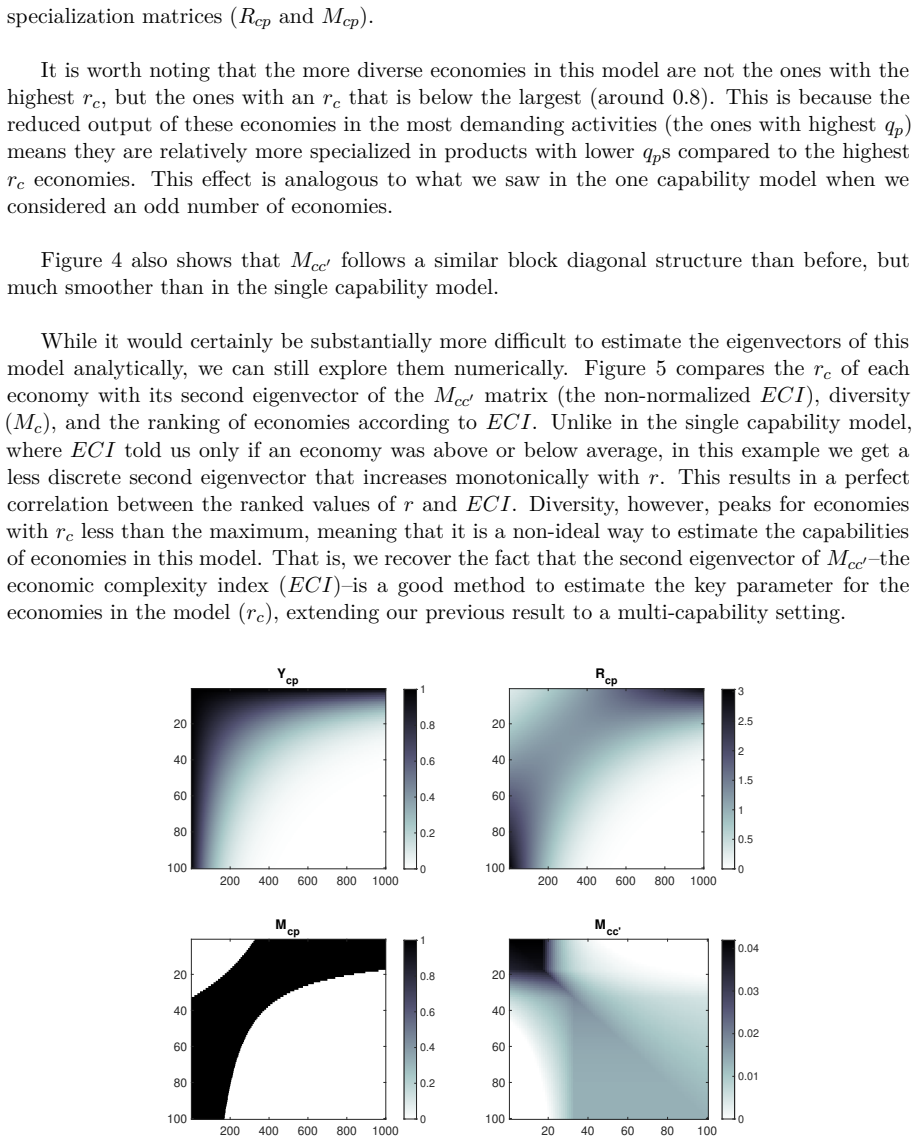
The load-bearing object is the chain of matrices computed from observed output: the RCA matrix $R_{cp}=Y_{cp}Y/(Y_cY_p)$, the binary specialization matrix $M_{cp}=\mathbf{1}[R_{cp}\ge 1]$, and the economy-similarity matrix $M_{cc'}=\frac{1}{M_c}\sum_p M_{cp}M_{c'p}/M_p$. ECI is the second eigenvector of $M_{cc'}$, the first being the trivial constant eigenvector because each row sums to one. In the single-capability model the binary matrix is exactly block structured, making the eigenvector separation analytic; in the additive non-separable case the RCA inequality factorizes as $(g_p-\langle g\rangle)(\langle B\rangle f_c-B_c\langle f\rangle)\ge0$, which is what produces the two-block structure from which the eigenvector recovers the latent ranking.
What would settle it
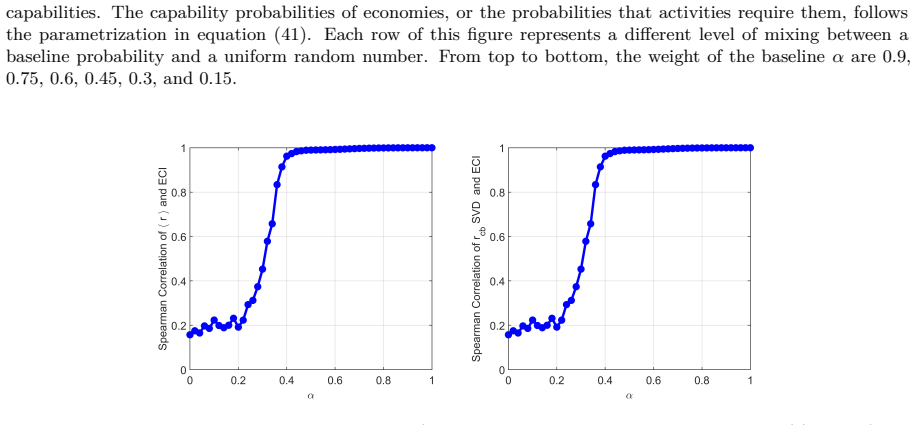
Simulate the model's own equations with capabilities drawn independently for each economy and activity, the limit where the common baseline weight is zero, and ask whether ECI still ranks economies by average capability in large samples. The paper's simulations say the rank correlation collapses below a baseline weight near 0.35; if it stayed near one, the claimed phase transition would be wrong.
Extended reading notes
Core claim
The central claim, stated on the paper's own terms, is that ECI measures the combined presence of capabilities in the model $Y_{cp}=A\prod_b(1-q_{p,b}(1-r_{c,b}))$, after the data transformations actually used in empirical work. For a single capability, the binary specialization matrix divides economies and activities into two blocks, the economy-similarity matrix $M_{cc'}$ becomes block diagonal, and its second eigenvector is $+1$ for economies above the mean capability and $-1$ for those below; the same separation holds in odd/even matrix dimensions, with the average-capability economy receiving zero. With many capabilities, ECI becomes a smooth monotonic function of an economy's average capability and aligns with the first singular vector of the capability matrix, provided capabilities are sufficiently correlated across economies. The paper further claims that the class of production functions compatible with informative ECI is characterized by non-separability: any multiplicatively separable $Y_{cp}=A f(K_c)g(K_p)$ makes RCA identically one, while additive forms $Y_{cp}=B_c+f_c g_p$ generate the needed block structure, and log-supermodularity is neither necessary nor sufficient once the RCA and binarization steps are included.
Load-bearing premise
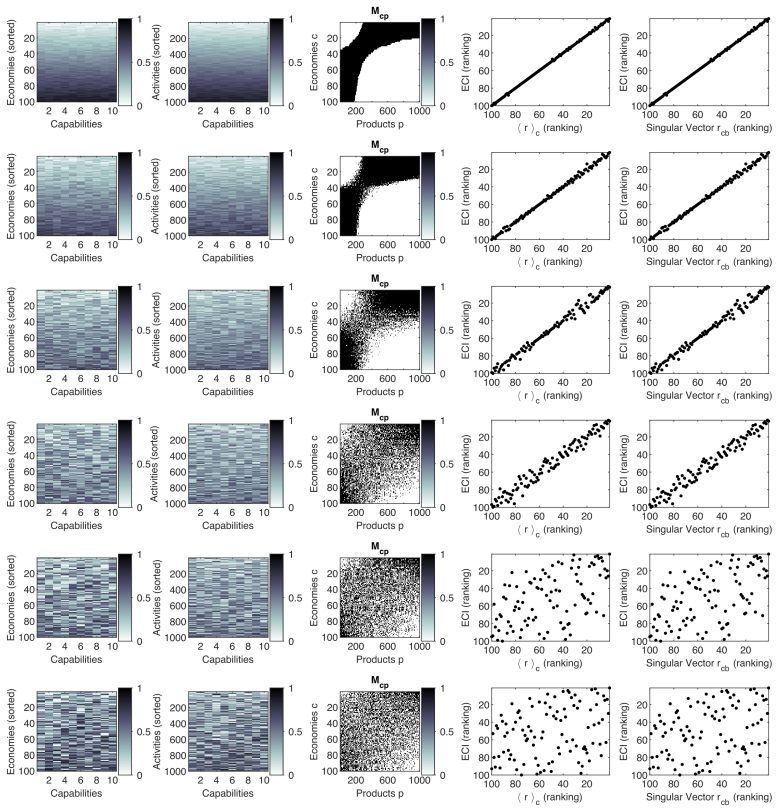
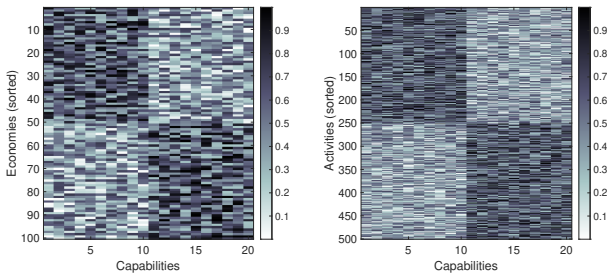
The multi-capability result depends on capabilities being correlated across economies: the model builds capabilities as a common baseline plus random noise, and the paper's own simulations show ECI stops tracking average capability when that baseline falls below about 35 percent, with no deeper reason given for why real capabilities should be correlated that strongly.
Editorial extensions
If this is right
- ECI can be read as a monotonic estimate of capability stock, so its documented correlation with subsequent growth can be rationalized as an equilibrium wage effect: economies with more capabilities earn higher wages and face higher prices for complex goods.
- Because multiplicatively separable production functions produce an uninformative RCA matrix, the empirical success of ECI is evidence that real production is not multiplicatively separable.
- Additive non-separable production functions are sufficient for ECI to recover latent rankings, including log-submodular cases, so log-supermodularity of production levels is not the right condition for economic complexity.
- Measures of diversity are non-monotonic functions of capability in the model, explaining why diversity underperforms ECI and why economies diversify only up to a point before specializing, a pattern observed in empirical work.
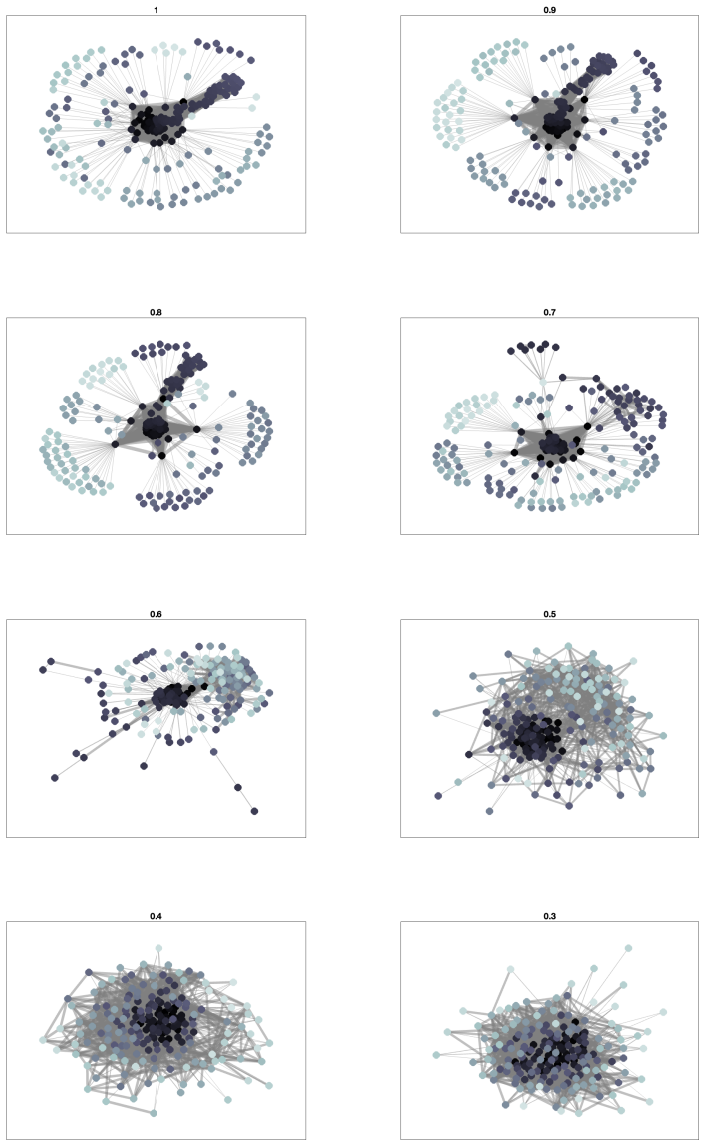
- The shape of relatedness networks is determined by the correlation structure of capabilities: correlated capabilities give the product space's dense core, Toeplitz circulant capability matrices give the research space's ring, and overlapping blocks give the skills network's dumbbell structure.
Reading between the lines
- Editorial extension: because the mechanism depends only on normalization and binarization of a bipartite participation matrix, the same derivation should carry over to any system where a latent complementarity structure produces specialization, such as ecology, health, or scientometrics; the paper hints at this but does not prove it.
- Editorial extension: the phase transition near $\alpha\approx0.35$ suggests an empirically testable prediction: ECI's growth-forecasting power should degrade in samples where capabilities are weakly correlated, and measuring capability correlations directly would provide a sharper test than any aggregate growth regression.
- Editorial extension: the two-block characterization links ECI to spectral clustering and diffusion maps, implying that what ECI extracts is not necessarily a continuous one-dimensional capability scale but a soft cluster assignment; this suggests ECI and continuous 'ability' indices may diverge exactly when capability distributions are multimodal.
Signed reviews
Editorial analysis
A structured set of objections, weighed in public.
Referee Report
Summary. The paper proposes a generative model in which output is Ycp = A ∏_b (1 − qp,b(1 − rc,b)) and asks whether the second eigenvector of the economy similarity matrix Mcc' (the Economic Complexity Index, ECI) recovers latent capability levels. For a single capability, the authors derive the RCA threshold condition (Eq. 10), construct the binary specialization matrix Mcp as a two-block matrix, and show analytically that ECI separates economies with rc above and below the average, provided averages and medians coincide. For multiple capabilities, they simulate a one-factor-plus-noise parametrization (Eq. 41) and report a monotone relation between ECI and average capability and with the leading singular vector of rcb, with a sharp degradation near α ≈ 0.35. They then study production-function compatibility, showing that multiplicatively separable functions make RCA uninformative, that additive non-separable functions generate a sufficient block structure, and that a Leontief threshold case may still work through a diversity staircase. The paper closes with an equilibrium extension for wages and prices and with simulations showing that different capability-matrix shapes generate core-periphery, ring, and dumbbell networks of related activities.
Significance. The single-capability analytical result is a clean formal contribution: it connects the RCA thresholding step to a block-structured Mcc' and explains why, in that model, ECI is not a diversity measure. The negative result for multiplicatively separable production functions is sharp and likely to be useful. The multi-capability and network-shape results are suggestive but, as they stand, are conditional numerical demonstrations rather than theorems. The paper's strengths are its explicit treatment of the RCA normalization and binarization steps, the transparent single-capability eigenvector computation, and the concrete falsifiable prediction of a phase transition in the mixing parameter α. However, the abstract and conclusion currently make unconditional claims that the manuscript's own simulations qualify, so the headline contribution needs to be restated to match the evidence.
major comments (3)
- [Abstract; Section 2, Eqs. (17), (26), (35)] The claim that ECI separates economies "independent of how capabilities are distributed" is not established by the derivation. The text explicitly assumes that averages and medians coincide: "Let ⟨r⟩ and ⟨q⟩ be the medians of their distributions" (before Eq. 17) and "where the averages of r and q are still their medians" in the odd-even case. For skewed or tied distributions, the threshold rc = ⟨r⟩ in Eq. (10) does not bisect the economy set, the block structure of Mcp becomes unbalanced, and the eigenvectors in Eqs. (19), (25), and (32) no longer have the stated clustered form. The theorem should be stated for balanced distributions, or a proof should be supplied for general distributions.
- [Section 3, Eqs. (36)-(41), Fig. 13; Conclusion] The multi-capability monotonicity result is only demonstrated numerically for the one-factor parametrization rc,b = α rc + (1−α) random(0,1), qp,b = α qp + (1−α) random(0,1). Because that parametrization makes the leading singular vector of rcb approximately equal to the common factor rc, the reported recovery of the first singular vector is largely built into the simulation design. Figure 13 shows the correlation between ECI and both ⟨r⟩c and the first singular vector collapsing near α ≈ 0.35, yet the abstract and conclusion state that ECI is a monotonic estimator of the average capability level without this qualification. The paper should either prove monotonicity analytically for the model in Eq. (36) under stated conditions, or restrict the headline claim to the correlated regime and provide error bars or confidence intervals for the phase-transition plot.
- [Section 4, Leontief example (after Eq. 57)] The claim that ECI recovers the latent ordering in the Leontief case because diversity is monotone in Kc is not a valid inference: ECI is the second eigenvector of Mcc', not the diversity vector, and monotone diversity does not by itself imply that the eigenvector is monotone. For a Ferrers-type binary matrix Mcp = 1[Kc ≥ Kp], this should be verified directly, either analytically or by simulation, before the Leontief case is presented as an example where ECI works.
minor comments (6)
- [Fig. 13 caption] The caption contains a typo: "A verage" should be "Average."
- [Section 5, Eq. (61)] The notation "ECI_Y = first eig. of Mcc' = ∑_p Ycp Yc'p" conflates a matrix with its eigenvector; please define the matrix entries first and then take its leading eigenvector.
- [Section 7, Figs. 15-19] The claim that the model reproduces the empirical product space, research space, and skill networks is based on visual inspection; quantitative comparisons (e.g., core-periphery scores, ringness measures, degree distributions) would make the claim testable.
- [Section 2, before Eq. (17)] The derivation assumes not only mean-median equality but also the absence of ties at rc = ⟨r⟩ and qp = ⟨q⟩; this no-ties assumption should be stated explicitly, since ties change the block enumeration in Eqs. (21) and (27).
- [Introduction, multi-capability summary] The phrase "even when more than 50 percent of the capabilities are assigned at random" is ambiguous relative to α: α = 0.45 corresponds to 55 percent random and works, while α = 0.3 corresponds to 70 percent random and does not; the text should be precise about the threshold.
- [Conclusion] There is a typo: "economys" should be "economy's."
Circularity Check
No significant circularity: the ECI-capability relationship is derived from the model, not assumed.
full rationale
The central derivation is a mathematical consequence of the model, not an input. Starting from the single-capability production function Ycp = A(1 - qp(1 - rc)), the paper derives the RCA threshold condition (rc - ⟨r⟩)(qp - ⟨q⟩) ≥ 0 (Eq. 10), which yields a two-block binary specialization matrix Mcp. The complexity matrix Mcc' built from Mcp is then explicitly block diagonal, and the second eigenvector is computed to be the sign vector separating rc above and below ⟨r⟩ (Eqs. 19-20, 25-26, 32-35). Each step follows from the previous one by algebra or direct eigenvector verification; ECI is not defined in terms of rc, nor is any parameter fitted to the capability ordering. The multi-capability section is explicitly numerical and conditional on the one-factor parameterization rc,b = α rc + (1 - α)random(0,1), qp,b = α qp + (1 - α)random(0,1) (Eq. 41). This limits the generality of the abstract's unqualified monotonicity claim, but the simulations compute ECI independently from the generated specialization matrix and then compare it with ⟨r⟩c; there is no fitting of ECI to the target, so the result is not a tautology. The network-shape section chooses capability-matrix structures (correlated, Toeplitz circulant, block-diagonal-plus-noise) to reproduce core-periphery, ring, and dumbbell topologies; this is transparent reverse-engineering of sufficient conditions rather than a prediction smuggled in through self-citation. Self-citations (e.g., footnote 24 citing Hausmann-Hidalgo [69] for an earlier diversity monotonicity equation) are contextual and not load-bearing for the new derivations. Hence no circular step is present.
Assumptions & free parameters
free parameters (4)
- mixing parameter alpha (Eq. 41) =
threshold ~0.35
- output noise parameter alpha (Eq. 60) =
0.7 in Section 5 examples
- CES distribution parameters rho and delta (Eq. 42) =
rho in {1, 0, to -infinity}; delta unspecified
- network mixing proportions (Section 7) =
80/20 Toeplitz/random; 25/75 block/random
assumptions (6)
- domain assumption Production is complementary: output requires joint presence of all capabilities (Eq. 36).
- domain assumption Balassa RCA with threshold 1 defines revealed specialization (Eqs. 4-11).
- standard math ECI is the second eigenvector of the row-stochastic matrix Mcc' (Eqs. 14-15).
- ad hoc to paper Capabilities of an economy are correlated across activities according to Eq. (41).
- domain assumption In the price-wage model, labor is the only factor, all income is wages, and utility is logarithmic (Eqs. 63, 73).
- domain assumption Network relatedness is measured by the unnormalized co-occurrence matrix (Eqs. 87-88).
Cite this review
Pith. "Pith review of The Theory of Economic Complexity." pith.science (2026). https://pith.science/paper/ZY7UZ4FU
@misc{pith2026250618829,
  author       = {Pith},
  title        = {Pith review of: The Theory of Economic Complexity},
  year         = {2026},
  howpublished = {\url{https://pith.science/paper/ZY7UZ4FU}},
  note         = {Machine review of arXiv:2506.18829}
}
read the original abstract
We provide a mechanistic foundation for economic complexity methods. In our model, an economy's ability to produce an activity depends on the joint presence of required capabilities. We analytically derive the Economic Complexity Index (ECI) for this model and show that it is a monotonic function of the stock of capabilities in an economy. We then explore the family of functions and conditions that are compatible with economic complexity estimates and show that multiplicatively separable production functions are incompatible with economic complexity estimates. By contrast, additive non-separable functions are sufficient regardless of whether they are log super-modular. We also show that this model explains differences in the shape of networks of related activities, such as the product space or research space. These findings solve long standing puzzles in the literature on economic complexity.
Figures


Figures from the paper (16 more)






Forward citations
Cited by 1 Pith paper
-
AC-VLA: Robust Out-of-Distribution Action Execution via Compositional Learning
AC-VLA trains VLA policies on full demonstrations plus decomposed sub-task segments and masks wrist views during place phases, improving LIBERO OOD success by about 28 absolute points over pi0.5.
Reference graph
Works this paper leans on
-
[1]
Alabdulkareem, M
A. Alabdulkareem, M. R. Frank, L. Sun, B. AlShebli, C. Hidalgo, and I. Rahwan. Un- packing the polarization of workplace skills. Science Advances, 4(7):eaao6030, July 2018
2018
-
[2]
Almeida-Neto, P
M. Almeida-Neto, P. Guimaraes, P. R. Guimaraes Jr, R. D. Loyola, and W. Ulrich. A consistent metric for nestedness analysis in ecological systems: reconciling concept and measurement. Oikos, 117(8):1227–1239, 2008
2008
-
[3]
A. M. AlQurtas. A New Indicator of Economic Complexity to Guide Industrial Policies, 2018
2018
-
[4]
Alshamsi, F
A. Alshamsi, F. L. Pinheiro, and C. A. Hidalgo. Optimal diversification strategies in the networks of related products and of related research areas. Nature Communications, 9(1):1328, Apr. 2018
2018
-
[5]
Atkin, A
D. Atkin, A. Costinot, and M. Fukui. Globalization and the ladder of development: Pushed to the top or held at the bottom? Technical report, National Bureau of Economic Research, 2021
2021
-
[6]
Bahar, R
D. Bahar, R. Hausmann, and C. A. Hidalgo. Neighbors and the evolution of the compar- ative advantage of nations: Evidence of international knowledge diffusion? Journal of International Economics , 92(1):111–123, Jan. 2014
2014
-
[7]
B. Balassa. Trade liberalisation and revealed comparative advantage 1. The manchester school, 33(2):99–123, 1965. ISBN: 1463-6786 Publisher: Wiley Online Library
1965
-
[8]
B. Balassa. Exports, policy choices, and economic growth in developing countries after the 1973 oil shock. Journal of Development Economics , 18(1):23–35, May 1985
1973
Show all 174 references
-
[9]
Balland, J
P.-A. Balland, J. A. Belso-Martínez, and A. Morrison. The dynamics of technical and business knowledge networks in industrial clusters: Embeddedness, status, or proximity? Economic geography, 92(1):35–60, 2016
2016
-
[10]
Balland, T
P.-A. Balland, T. Broekel, D. Diodato, E. Giuliani, R. Hausmann, N. O’Clery, and D. Rigby. The new paradigm of economic complexity. Research Policy , 51(3):104450,
-
[11]
Balsalobre-Lorente, C
D. Balsalobre-Lorente, C. C. dos Santos Parente, N. C. Leitão, and J. M. Cantos-Cantos. The influence of economic complexity processes and renewable energy on co2 emissions of brics. what about industry 4.0? Resources Policy, 82:103547, 2023
2023
-
[12]
Bandeira Morais, J
M. Bandeira Morais, J. Swart, and J. A. Jordaan. Economic Complexity and Inequality: Does Productive Structure Affect Regional Wage Differentials in Brazil? USE Working Paper series , 18(11), 2018. Publisher: USE Research Institute
2018
-
[13]
Barza, E
R. Barza, E. L. Glaeser, C. A. Hidalgo, and M. Viarengo. Cities as Engines of Opportu- nities: Evidence from Brazil, May 2024
2024
-
[14]
Barza, C
R. Barza, C. Jara-Figueroa, C. A. Hidalgo, and M. Viarengo. Knowledge intensity and gender wage gaps: Evidence from linked employer–employee data. Working paper, CESifo, 2020
2020
-
[15]
Basile and G
R. Basile and G. Cicerone. Economic complexity and productivity polarization: Evidence from Italian provinces. German Economic Review , Mar. 2022. Publisher: De Gruyter
2022
-
[16]
Basile, G
R. Basile, G. Cicerone, and L. Iapadre. Economic complexity and regional labor productiv- ity distribution: evidence from Italy. Economic complexity and regional labor productivity distribution: evidence from Italy , 2019
2019
-
[17]
Baudena, A
M. Baudena, A. Sánchez, C.-P. Georg, P. Ruiz-Benito, M. Á. Rodríguez, M. A. Zavala, and M. Rietkerk. Revealing patterns of local species richness along environmental gradients with a novel network tool. Scientific Reports, 5(1):11561, 2015
2015
-
[18]
Ben Saâd and G
M. Ben Saâd and G. Assoumou-Ella. Economic Complexity and Gender Inequality in Education: An Empirical Study. Economics Bulletin , 39(1):321–334, 2019
2019
-
[19]
Boccaletti, V
S. Boccaletti, V. Latora, Y. Moreno, M. Chavez, and D.-U. Hwang. Complex networks: Structure and dynamics. Physics reports, 424(4-5):175–308, 2006
2006
-
[20]
Borggren, R
J. Borggren, R. H. Eriksson, and U. Lindgren. Knowledge flows in high-impact firms: How does relatedness influence survival, acquisition and exit? Journal of Economic Geography , 16(3):637–665, 2016. ISBN: 1468-2710 Publisher: Oxford University Press
2016
-
[21]
Boschma and G
R. Boschma and G. Capone. Institutions and diversification: Related versus unrelated diversification in a varieties of capitalism framework. Research Policy, 44(10):1902–1914, Dec. 2015
1902
-
[22]
Boschma, A
R. Boschma, A. Minondo, and M. Navarro. The Emergence of New Industries at the Regional Level in Spain: A Proximity Approach Based on Product Relatedness. Economic Geography, 89(1):29–51, Jan. 2013
2013
-
[23]
Bottai, J
C. Bottai, J. Di Iorio, and M. Iori. Reinterpreting Economic Complexity: A co-clustering approach, June 2024. arXiv:2406.16199 [econ, q-fin, stat]
2024 arXiv
-
[24]
Bustos, C
S. Bustos, C. Gomez, R. Hausmann, and C. A. Hidalgo. The Dynamics of Nestedness Predicts the Evolution of Industrial Ecosystems. PLOS ONE , 7(11):e49393, Nov. 2012
2012
-
[25]
Bustos and M
S. Bustos and M. A. Yldrm. Production ability and economic growth. Research Policy, 51(8):104153, 2022. ISBN: 0048-7333 Publisher: Elsevier
2022
-
[26]
Börner, R
K. Börner, R. Klavans, M. Patek, A. M. Zoss, J. R. Biberstine, R. P. Light, V. Larivière, and K. W. Boyack. Design and update of a classification system: The UCSD map of science. PloS one , 7(7):e39464, 2012. ISBN: 1932-6203 Publisher: Public Library of Science. 48
2012
-
[27]
Cakir, I
B. Cakir, I. Schluep, P. Aerni, and I. Cakir. Amalgamation of export with import informa- tion: The economic complexity index as a coherent driver of sustainability. Sustainability, 13(4):2049, 2021
2021
-
[28]
Caldarola, D
B. Caldarola, D. Mazzilli, L. Napolitano, A. Patelli, and A. Sbardella. Economic complex- ity and the sustainability transition: A review of data, methods, and literature. Journal of Physics: Complexity , 2024
2024
-
[29]
Can and B
M. Can and B. Doan. The effects of economic structural transformation on employ- ment: an evaluation in the context of economic complexity and product space theory. In Handbook of research on unemployment and labor market sustainability in the era of globalization, pages 275–30...
2017
-
[30]
B.-H. F. Cardoso, E. Y. d. S. Catela, G. Viegas, F. L. Pinheiro, and D. Hartmann. Export complexity, industrial complexity and regional economic growth in brazil. arXiv preprint arXiv:2312.07469, 2023
2023 arXiv
-
[31]
Z. Chen, S. Poncet, and R. Xiong. Inter-industry relatedness and industrial-policy effi- ciency: Evidence from Chinas export processing zones. Journal of Comparative Economics, 45(4):809–826, Dec. 2017
2017
-
[32]
Chinazzi, B
M. Chinazzi, B. Gonçalves, Q. Zhang, and A. Vespignani. Mapping the physics research space: a machine learning approach. EPJ Data Science , 8(1):33, 2019. ISBN: 2193-1127 Publisher: Springer Berlin Heidelberg
2019
-
[33]
J. C. Chávez, M. T. Mosqueda, and M. Gómez-Zaldívar. Economic complexity and re- gional growth performance: Evidence from the Mexican Economy. Review of Regional Studies, 47(2):201–219, 2017
2017
-
[34]
Cicerone, P
G. Cicerone, P. McCann, and V. A. Venhorst. Promoting regional growth and innovation: relatedness, revealed comparative advantage and the product space. Journal of Economic Geography, 20(1):293–316, 2020. ISBN: 1468-2702 Publisher: Oxford University Press
2020
-
[35]
N. D. Coniglio, R. Lagravinese, and D. Vurchio. Production sophisticatedness and growth: evidence from Italian provinces before and during the crisis, 19972013. Cambridge Journal of Regions, Economy and Society , 9(2):423–442, July 2016. Publisher: Oxford Academic
2016
-
[36]
Cortinovis, J
N. Cortinovis, J. Xiao, R. Boschma, and F. G. van Oort. Quality of government and social capital as drivers of regional diversification in Europe. Journal of Economic Geography , 17(6):1179–1208, 2017. ISBN: 1468-2702 Publisher: Oxford University Press
2017
-
[37]
Costinot
A. Costinot. On the origins of comparative advantage. Journal of International Economics , 77(2):255–264, 2009
2009
-
[38]
Cristelli, A
M. Cristelli, A. Gabrielli, A. Tacchella, G. Caldarelli, and L. Pietronero. Measuring the intangibles: A metrics for the economic complexity of countries and products. PloS one , 8(8):e70726, 2013
2013
-
[39]
Cross, A
L. Cross, A. Famà, P. Pagnottoni, N. Pecora, and A. Spelta. The complexity of pharma- ceutical expenditures across us states. Scientific Reports, 15(1):17541, 2025
2025
-
[40]
Desmarchelier, P
B. Desmarchelier, P. J. Regis, and N. Salike. Product space and the development of nations: A model of product diversification. Journal of Economic Behavior and Organi- zation, 145:34–51, 2018. 49
2018
-
[41]
I. S. Dhillon. Co-clustering documents and words using bipartite spectral graph partition- ing. In Proceedings of the seventh ACM SIGKDD international conference on Knowledge discovery and data mining , pages 269–274, 2001
2001
-
[42]
Djeunankan, S
R. Djeunankan, S. Tadadjeu, H. Njangang, and U. Mazhar. The hidden cost of sophis- tication: economic complexity and obesity. The European Journal of Health Economics , 26(2):243–265, 2025
2025
-
[43]
Domínguez-García and M
V. Domínguez-García and M. A. Munoz. Ranking species in mutualistic networks. Scien- tific reports, 5(1):8182, 2015
2015
-
[44]
G. Domini. Patterns of specialization and economic complexity through the lens of uni- versal exhibitions, 1855-1900. Explorations in Economic History , 83:101421, 2022. ISBN: 0014-4983 Publisher: Elsevier
1900
-
[45]
Dordmond, H
G. Dordmond, H. C. de Oliveira, I. R. Silva, and J. Swart. The complexity of green job creation: An analysis of green job development in Brazil. Environment, Development and Sustainability, pages 1–24, 2020. ISBN: 1573-2975 Publisher: Springer
2020
-
[46]
G. Dosi. Technological paradigms and technological trajectories: a suggested interpreta- tion of the determinants and directions of technical change. Research policy, 11(3):147–162, 1982
1982
-
[47]
M. Draghi. The future of european competitiveness, part a: A competitiveness strategy for europe. Report, European Commission, 2024
2024
-
[48]
Erkan and E
B. Erkan and E. Yildirimci. Economic Complexity and Export Competitiveness: The Case of Turkey. Procedia-Social and Behavioral Sciences , 195:524–533, 2015. ISBN: 1877-0428 Publisher: Elsevier
2015
-
[50]
Farinha, P.-A
T. Farinha, P.-A. Balland, A. Morrison, and R. Boschma. What drives the geography of jobs in the us? unpacking relatedness. Industry and Innovation , 26(9):988–1022, 2019. ISBN: 1366-2716 Publisher: Taylor & Francis
2019
-
[51]
Fawaz and M
F. Fawaz and M. Rahnama-Moghadamm. Spatial dependence of global income inequality: The role of economic complexity. The International Trade Journal , 33(6):542–554, 2019. ISBN: 0885-3908 Publisher: Taylor & Francis
2019
-
[52]
Felipe and J
J. Felipe and J. S. McCombie. The Aggregate Production Function and the Measurement of Technical Change: ŠNot Even Wrong . Edward Elgar Publishing, 2013
2013
-
[53]
Ferrarini and P
B. Ferrarini and P. Scaramozzino. The product space revisited: China’s trade profile. The World Economy , 38(9):1368–1386, 2015. ISBN: 0378-5920 Publisher: Wiley Online Library
2015
-
[54]
Ferraz, H
D. Ferraz, H. F. Moralles, J. S. Campoli, F. C. R. d. Oliveira, and D. A. d. N. Rebelatto. Economic complexity and human development: Dea performance measurement in asia and latin america. Gestão & Produção , 25(4):839–853, 2018
2018
-
[55]
Ferreira-Coimbra and M
N. Ferreira-Coimbra and M. Vaillant. Evolución del espacio de productos exportados:£ está Uruguay en el lugar equivocado? Revista de economía , 16(2):97–146, 2009. ISBN: 0797-5546 Publisher: Banco Central del Uruguay. 50
2009
-
[56]
T. M. A. Fink and M. Reeves. How much can we influence the rate of innovation? Science Advances, 5(1):eaat6107, Jan. 2019
2019
-
[57]
L. Fleming. Recombinant uncertainty in technological search. Management science , 47(1):117–132, 2001
2001
-
[58]
Fraccascia, I
L. Fraccascia, I. Giannoccaro, and V. Albino. Green product development: What does the country product space imply? Journal of cleaner production , 170:1076–1088, 2018
2018
-
[59]
Garas, S
A. Garas, S. Guthmuller, and A. Lapatinas. The development of nations conditions the disease space. Plos one , 16(1):e0244843, 2021
2021
-
[60]
Gerschenkron
A. Gerschenkron. The early phases of industrialization in Russia: afterthoughts and coun- terthoughts. In The economics of take-off into sustained growth , pages 151–169. Springer, 1963
1963
-
[61]
Gnecco, F
G. Gnecco, F. Nutarelli, and M. Riccaboni. A machine learning approach to economic complexity based on matrix completion. Scientific Reports, 12(1):9639, 2022. ISBN: 2045- 2322 Publisher: Nature Publishing Group UK London
2022
-
[62]
Gómez-Zaldívar, M
M. Gómez-Zaldívar, M. I. Osorio-Caballero, and E. J. Saucedo-Acosta. Income inequality and economic complexity: Evidence from mexican states. Regional Science Policy & Practice, 14(6):344–364, 2022
2022
-
[63]
W. M. Gorman. Community preference fields. Econometrica, 21(1):63–80, 1953
1953
-
[64]
M. R. Guevara, D. Hartmann, M. Aristarán, M. Mendoza, and C. A. Hidalgo. The research space: using career paths to predict the evolution of the research output of individuals, institutions, and nations. Scientometrics, 109(3):1695–1709, Dec. 2016
2016
-
[65]
Güneri and A
B. Güneri and A. Y. Yalta. Does economic complexity reduce output volatility in develop- ing countries? Bulletin of Economic Research . ISBN: 0307-3378 Publisher: Wiley Online Library
-
[66]
Hamilton
A. Hamilton. Report on manufactures, 1791. Report
-
[67]
Hamwey, H
R. Hamwey, H. Pacini, and L. Assunção. Mapping green product spaces of nations. The Journal of Environment & Development , 22(2):155–168, 2013
2013
-
[68]
Hartmann, M
D. Hartmann, M. R. Guevara, C. Jara-Figueroa, M. Aristarán, and C. A. Hidalgo. Linking Economic Complexity, Institutions, and Income Inequality. World Development, 93:75–93, May 2017
2017
-
[69]
Hausmann and C
R. Hausmann and C. A. Hidalgo. The network structure of economic output. Journal of Economic Growth, pages 1–34, 2011
2011
-
[70]
Hausmann, C
R. Hausmann, C. A. Hidalgo, S. Bustos, M. Coscia, A. Simoes, and M. A. Yildirim. The atlas of economic complexity: Mapping paths to prosperity . MIT Press, 2014
2014
-
[71]
Hausmann, J
R. Hausmann, J. Hwang, and D. Rodrik. What you export matters. Journal of Economic Growth, 12(1):1–25, Mar. 2007
2007
-
[72]
Balland, R
Hidalgo, P.-A. Balland, R. Boschma, M. Delgado, M. Feldman, K. Frenken, E. Glaeser, C. He, D. F. Kogler, A. Morrison, F. Neffke, D. Rigby, S. Stern, S. Zheng, and S. Zhu. The Principle of Relatedness. In A. J. Morales, C. Gershenson, D. Braha, A. A. Minai, and Y. Bar-Yam, edito...
2018
-
[73]
Hidalgo, B
C. Hidalgo, B. Klinger, A.-L. Barabási, and R. Hausmann. The Product Space Conditions the Development of Nations. Science, 317(5837):482–487, July 2007
2007
-
[74]
C. A. Hidalgo. Economic complexity theory and applications. Nature Reviews Physics , pages 1–22, 2021. ISBN: 2522-5820 Publisher: Nature Publishing Group
2021
-
[75]
C. A. Hidalgo. The policy implications of economic complexity. Research Policy , 52(9):104863, 2023. ISBN: 0048-7333 Publisher: Elsevier
2023
-
[76]
C. A. Hidalgo, E. Castañer, and A. Sevtsuk. The amenity mix of urban neighborhoods. Habitat International , page 102205, 2020
2020
-
[77]
C. A. Hidalgo and R. Hausmann. The building blocks of economic complexity. Proceedings of the National Academy of Sciences , 106(26):10570–10575, June 2009
2009
-
[78]
A. O. Hirschman. A generalized linkage approach to development, with special reference to staples. Economic development and cultural change , 25:67, 1977. ISBN: 0013-0079 Publisher: University of Chicago Press
1977
-
[79]
Hoeriyah, N
L. Hoeriyah, N. Nuryartono, and S. H. Pasaribu. Economic complexity and sustainable growth in developing countries. Economics Development Analysis Journal , 11(1):23–33, 2022
2022
-
[80]
Huang and S
Y. Huang and S. Zhu. Regional industrial dynamics under the environmental pressures in China. Journal of Cleaner Production , page 121917, 2020. ISBN: 0959-6526 Publisher: Elsevier
2020
-
[81]
Huberty and G
M. Huberty and G. Zachmann. Green exports and the global product space: prospects for EU industrial policy. Technical report, Bruegel working paper, 2011
2011
-
[82]
Imbs and R
J. Imbs and R. Wacziarg. Stages of diversification. American economic review, 93(1):63– 86, 2003. ISBN: 0002-8282
2003
-
[83]
Ivanova, N
I. Ivanova, N. Smorodinskaya, and L. Leydesdorff. On measuring complexity in a post- industrial economy: The ecosystems approach. Quality & Quantity , 54(1):197–212, 2020. ISBN: 1573-7845 Publisher: Springer
2020
-
[84]
Ivanova, Ø
I. Ivanova, Ø. Strand, D. Kushnir, and L. Leydesdorff. Economic and technological com- plexity: A model study of indicators of knowledge-based innovation systems. Technological Forecasting and Social Change , 120:77–89, 2017
2017
-
[85]
Jara-Figueroa, B
C. Jara-Figueroa, B. Jun, E. L. Glaeser, and C. A. Hidalgo. The role of industry-specific, occupation-specific, and location-specific knowledge in the growth and survival of new firms. Proceedings of the National Academy of Sciences , 115(50):12646–12653, Dec. 2018
2018
-
[86]
G. Jones. The o-ring sector and the foolproof sector: An explanation for skill externalities. Journal of Economic Behavior and Organization , 85:1–10, 2013
2013
-
[87]
Juhász, T
S. Juhász, T. Broekel, and R. Boschma. Explaining the dynamics of relatedness: the role of colocation and complexity. Papers in Regional Science , 2020
2020
-
[88]
B. Jun, A. Alshamsi, J. Gao, and C. A. Hidalgo. Bilateral relatedness: knowledge diffusion and the evolution of bilateral trade. Journal of Evolutionary Economics , pages 1–31, 2019. ISBN: 0936-9937 Publisher: Springer
2019
-
[89]
S. A. Kauffman. The origins of order: Self-organization and selection in evolution . Oxford University Press, USA, 1993. 52
1993
-
[90]
Klement and S
B. Klement and S. Strambach. Innovation in creative industries: Does (related) variety matter for the creativity of urban music scenes? Economic Geography, 95(4):385–417, 2019
2019
-
[91]
Knuepling and T
L. Knuepling and T. Broekel. Does relatedness drive the diversification of countries success in sports? European Sport Management Quarterly , 22(2):182–204, 2022
2022
-
[92]
P. Koch. Economic Complexity and Growth: Can value-added exports better explain the link? Economics Letters, 198:109682, 2021. ISBN: 0165-1765 Publisher: Elsevier
2021
-
[93]
D. F. Kogler, D. L. Rigby, and I. Tucker. Mapping Knowledge Space and Technological Relatedness in US Cities. European Planning Studies , 21(9):1374–1391, Sept. 2013
2013
-
[94]
D. F. Kogler, D. L. Rigby, and I. Tucker. Mapping knowledge space and technologi- cal relatedness in US cities. In Global and Regional Dynamics in Knowledge Flows and Innovation, pages 58–75. Routledge, 2015
2015
-
[95]
M. Kremer. The O-ring theory of economic development. The Quarterly Journal of Economics, 108(3):551–575, 1993. ISBN: 1531-4650 Publisher: MIT Press
1993
-
[96]
S. Lall. Technological capabilities and industrialization. World development , 20(2):165– 186, 1992
1992
-
[97]
Lapatinas, A
A. Lapatinas, A. Garas, E. Boleti, and A. Kyriakou. Economic complexity and envi- ronmental performance: Evidence from a world sample, Mar. 2019. Library Catalog: mpra.ub.uni-muenchen.de
2019
-
[98]
Lapatinas and M.-S
A. Lapatinas and M.-S. Katsaiti. EU MECI: A Network-Structured Indicator for a Union of Equality. Social Indicators Research, Feb. 2023
2023
-
[99]
Latapy, C
M. Latapy, C. Magnien, and N. Del Vecchio. Basic notions for the analysis of large two-mode networks. Social networks , 30(1):31–48, 2008
2008
-
[100]
Le Caous and F
E. Le Caous and F. Huarng. Economic Complexity and the Mediating Effects of Income Inequality: Reaching Sustainable Development in Developing Countries. Sustainability, 12(5):2089, Jan. 2020. Number: 5 Publisher: Multidisciplinary Digital Publishing Insti- tute
2020
-
[101]
Lee and E.-Z
C.-C. Lee and E.-Z. Wang. Economic complexity and income inequality: Does country risk matter? Social Indicators Research, 154(1):35–60, 2021
2021
-
[102]
O. Lizardo. The mutual specification of genres and audiences: Reflective two-mode cen- tralities in person-to-culture data. Poetics, 68:52–71, 2018. ISBN: 0304-422X Publisher: Elsevier
2018
-
[103]
Lyubimov, M
I. Lyubimov, M. Gvozdeva, M. Kazakova, and K. Nesterova. Economic Complexity of Rus- sian Regions and their Potential to Diversify. Journal of the New Economic Association , 34(2):94–122, 2017
2017
-
[104]
I. L. Lyubimov, M. V. Lysyuk, and M. A. Gvozdeva. Atlas of economic complexity, Russian regional pages. VOPROSY ECONOMIKI , 6, 2018
2018
-
[105]
F. Ma, H. Wang, A. Tzachor, C. A. Hidalgo, H. Schandl, Y. Zhang, J. Zhang, W.-Q. Chen, Y. Zhao, Y.-G. Zhu, et al. The disparities and development trajectories of nations in achieving the sustainable development goals. Nature Communications, 16(1):1107, 2025
2025
-
[106]
Mao and Q
Z. Mao and Q. An. Economic complexity index and economic development level under globalization: An empirical study. Journal of Korea Trade , 25(7):41–55, 2021. 53
2021
-
[107]
M. S. Mariani, Z.-M. Ren, J. Bascompte, and C. J. Tessone. Nestedness in complex networks: Observation, emergence, and implications. Physics Reports, 2019. ISBN: 0370- 1573 Publisher: Elsevier
2019
-
[108]
McNerney, J
J. McNerney, J. D. Farmer, S. Redner, and J. E. Trancik. Role of design complexity in technology improvement. Proceedings of the National Academy of Sciences , 108(22):9008– 9013, 2011
2011
-
[109]
McNerney, Y
J. McNerney, Y. Li, A. Gomez-Lievano, and F. Neffke. Bridging the short-term and long-term dynamics of economic structural change, Mar. 2023. arXiv:2110.09673 [physics, q-fin]
2023 arXiv
-
[110]
Mealy, J
P. Mealy, J. D. Farmer, and A. Teytelboym. Interpreting economic complexity. Science Advances, 5(1):eaau1705, Jan. 2019
2019
-
[111]
Mealy and A
P. Mealy and A. Teytelboym. Economic complexity and the green economy. Available at SSRN 3111644 , 2017
2017
-
[112]
Mealy and A
P. Mealy and A. Teytelboym. Economic complexity and the green economy. Research Policy, page 103948, 2020. ISBN: 0048-7333 Publisher: Elsevier
2020
-
[113]
M. J. Melitz and S. J. Redding. Missing gains from trade? American Economic Review , 104(5):317–321, 2014
2014
-
[114]
Montresor and F
S. Montresor and F. Quatraro. Green technologies and Smart Specialisation Strategies: a European patent-based analysis of the intertwining of technological relatedness and key enabling technologies. Regional Studies, pages 1–12, 2019
2019
-
[115]
Muneepeerakul, J
R. Muneepeerakul, J. Lobo, S. T. Shutters, A. Goméz-Liévano, and M. R. Qubbaj. Urban economies and occupation space: Can they get there from here? PloS one , 8(9):e73676, 2013
2013
-
[116]
Muneepeerakul, J
R. Muneepeerakul, J. Lobo, S. T. Shutters, A. Goméz-Liévano, and M. R. Qubbaj. Ur- ban Economies and Occupation Space: Can They Get There from Here? PloS one , 8(9):e73676, 2013
2013
-
[117]
Nadler, S
B. Nadler, S. Lafon, I. Kevrekidis, and R. Coifman. Diffusion maps, spectral clustering and eigenfunctions of fokker-planck operators. Advances in neural information processing systems, 18, 2005
2005
-
[118]
O. Neagu. The Link between Economic Complexity and Carbon Emissions in the Eu- ropean Union Countries: A Model Based on the Environmental Kuznets Curve (EKC) Approach. Sustainability, 11(17):4753, 2019
2019
-
[119]
Neagu and M
O. Neagu and M. C. Teodoru. The relationship between economic complexity, energy consumption structure and greenhouse gas emission: Heterogeneous panel evidence from the eu countries. Sustainability, 11(2):497, 2019
2019
-
[120]
Neffke and M
F. Neffke and M. Henning. Skill relatedness and firm diversification. Strategic Management Journal, 34(3):297–316, 2013
2013
-
[121]
Neffke, M
F. Neffke, M. Henning, and R. Boschma. How Do Regions Diversify over Time? Industry Relatedness and the Development of New Growth Paths in Regions. Economic Geography, 87:237–265, 2011
2011
-
[122]
R. R. Nelson and S. G. Winter. An Evolutionary Theory of Economic Change . Belknap Press of Harvard University Press, 1982. Google-Books-ID: uRm5AAAAIAAJ. 54
1982
-
[123]
of Investment Trade and I
M. of Investment Trade and I. of Malaysia. New industrial master plan. https://www. nimp2030.gov.my/. [Accessed 16-06-2025]
2025
-
[124]
G. Ourens. Can the Method of Reflections help predict future growth? Documento de Trabajo/FCS-DE; 17/12, 2012. Publisher: UR. FCS-DE
2012
-
[125]
OClery, M
N. OClery, M. A. Yıldırım, and R. Hausmann. Productive ecosystems and the arrow of development. Nature communications, 12(1):1479, 2021
2021
-
[126]
Pérez-Balsalobre, C
S. Pérez-Balsalobre, C. Llano Verduras, and J. Díaz-Lanchas. Measuring subnational economic complexity: An application with spanish data. Technical report, JRC Working Papers on Territorial Modelling and Analysis, 2019
2019
-
[127]
Perruchas, D
F. Perruchas, D. Consoli, and N. Barbieri. Specialisation, diversification and the ladder of green technology development. Research Policy, 49(3):103922, 2020
2020
-
[128]
Pichler, F
A. Pichler, F. Lafond, and J. D. Farmer. Technological interdependencies predict innova- tion dynamics. arXiv preprint arXiv:2003.00580 , 2020
2003 arXiv
-
[129]
Poncet and F
S. Poncet and F. S. de Waldemar. Economic Complexity and Growth. Revue économique, 64(3):495–503, 2013. ISBN: 0035-2764 Publisher: Presses de Sciences Po
2013
-
[130]
Prebisch
R. Prebisch. The economic development of Latin America and its principal problems. Economic Bulletin for Latin America , 1962
1962
-
[131]
C. C. Pérez Hernández, B. C. Salazar Hernández, and J. Mendoza Moheno. Diagnóstico de la complejidad económica del estado de Hidalgo: de las capacidades a las oportunidades. Revista mexicana de economía y finanzas, 14(2):261–277, 2019. ISBN: 1665-5346 Publisher: Instituto Mexic...
2019
-
[132]
Resnick and H
P. Resnick and H. R. Varian. Recommender systems, Mar. 1997
1997
-
[133]
Reynolds, M
C. Reynolds, M. Agrawal, I. Lee, C. Zhan, J. Li, P. Taylor, T. Mares, J. Morison, N. An- gelakis, and G. Roos. A sub-national economic complexity analysis of Australias states and territories. Regional Studies, 52(5):715–726, 2018. ISBN: 0034-3404 Publisher: Taylor & Francis
2018
-
[134]
D. Rodrik. What’s so special about China’s exports? China & World Economy , 14(5):1– 19, 2006. ISBN: 1671-2234 Publisher: Wiley Online Library
2006
-
[135]
Romero, E
J. Romero, E. Freitas, F. Silveira, G. Britto, F. Cimini, and G. Jayme. Economic complex- ity and regional economic development: evidence from brazil. EAEPE, Online Proceedings, pages 1–22, 2021
2021
-
[136]
J. P. Romero and C. Gramkow. Economic complexity and greenhouse gas emissions. World Development, 139:105317, Mar. 2021
2021
-
[137]
P. N. Rosenstein-Rodan. Problems of industrialisation of eastern and south-eastern Eu- rope. The economic journal , 53(210/211):202–211, 1943. ISBN: 0013-0133 Publisher: JSTOR
1943
-
[138]
P. N. Rosenstein-Rodan. Notes on the theory of the big push. In Economic Development for Latin America , pages 57–81. Springer, 1961
1961
-
[139]
W. W. Rostow. The stages of economic growth. The economic history review , 12(1):1–16,
-
[140]
Santoalha and R
A. Santoalha and R. Boschma. Diversifying in green technologies in European regions: does political support matter? Regional Studies , pages 1–14, 2020. ISBN: 0034-3404 Publisher: Routledge
2020
-
[141]
Sbardella, E
A. Sbardella, E. Pugliese, and L. Pietronero. Economic development and wage inequality: A complex system analysis. PloS one , 12(9), 2017. Publisher: Public Library of Science
2017
-
[142]
Schetter
U. Schetter. A structural ranking of economic complexity. CID Research Fellow & Grad- uate Student Working Paper , (119), 2019
2019
-
[143]
Schetter
U. Schetter. A measure of countries distance to frontier based on comparative advantage. CID Research Fellow and Graduate Student Working Paper , (135), 2022
2022
-
[144]
Sciarra, G
C. Sciarra, G. Chiarotti, L. Ridolfi, and F. Laio. Reconciling contrasting views on eco- nomic complexity. Nature communications, 11(1):1–10, 2020. ISBN: 2041-1723 Publisher: Nature Publishing Group
2020
-
[145]
Sciarra, G
C. Sciarra, G. Chiarotti, L. Ridolfi, and F. Laio. Reconciling contrasting views on eco- nomic complexity. Nature communications, 11(1):3352, 2020. ISBN: 2041-1723 Publisher: Nature Publishing Group UK London
2020
-
[146]
V. D. Servedio, A. Bellina, E. Calò, and G. De Marzo. Economic Complexity in Mono- Partite Networks. arXiv preprint arXiv:2405.04158 , 2024
2024 arXiv
-
[147]
Shockley
W. Shockley. On the statistics of individual variations of productivity in research labora- tories. Proceedings of the IRE , 45(3):279–290, 1957
1957
-
[148]
Silveira, J
F. Silveira, J. P. Romero, A. Queiroz, E. Freitas, and A. Stein. Economic complexity and deforestation in the brazilian amazon. World Development, 185:106804, 2025
2025
-
[149]
Stephany and O
F. Stephany and O. Teutloff. What is the price of a skill? the value of complementarity. Research Policy, 53(1):104898, 2024
2024
-
[150]
Stojkoski and C
V. Stojkoski and C. A. Hidalgo. Optimizing economic complexity. arXiv preprint arXiv:2503.04476, 2025
2025
-
[151]
Stojkoski and L
V. Stojkoski and L. Kocarev. The relationship between growth and economic complexity: Evidence from southeastern and central europe, 2017
2017
-
[152]
Stojkoski, P
V. Stojkoski, P. Koch, and C. A. Hidalgo. Multidimensional Economic Complexity: How the Geography of Trade, Technology, and Research Explain Inclusive Green Growth, Sept
-
[153]
Stojkoski, Z
V. Stojkoski, Z. Utkovski, and L. Kocarev. The Impact of Services on Economic Complex- ity: Service Sophistication as Route for Economic Growth. PLOS ONE , 11(8):e0161633, Aug. 2016
2016
-
[154]
Tacchella, M
A. Tacchella, M. Cristelli, G. Caldarelli, A. Gabrielli, and L. Pietronero. A New Metrics for Countries’ Fitness and Products’ Complexity. Scientific Reports , 2:srep00723, Oct. 2012
2012
-
[155]
arXiv:2209.08382 [cond-mat, q-fin]
-
[156]
F. O. Teixeira, F. J. Missio, and R. Dathein. Economic complexity, structural transfor- mation and economic growth in a regional context: Evidence for brazil. PSL Quarterly Review, 75(300):63–79, 2022. 56
2022
-
[157]
F. Tria, V. Loreto, V. D. P. Servedio, and S. H. Strogatz. The dynamics of correlated novelties. Scientific reports, 4:5890, 2014. ISBN: 2045-2322 Publisher: Nature Publishing Group
2014
-
[158]
D. J. Teece, G. Pisano, and A. Shuen. Dynamic capabilities and strategic management. Strategic management journal , 18(7):509–533, 1997
1997
-
[159]
Valverde-Carbonell
J. Valverde-Carbonell. Rethinking the Literature on Economic Complexity Indexes. Eco- nomic Analysis and Policy , May 2025
2025
-
[160]
Van Dam and K
A. Van Dam and K. Frenken. Variety, complexity and economic development. Research Policy, 51(8):103949, 2022
2022
-
[161]
Utkovski, M
Z. Utkovski, M. F. Pradier, V. Stojkoski, F. Perez-Cruz, and L. Kocarev. Economic complexity unfolded: Interpretable model for the productive structure of economies. PloS one, 13(8):e0200822, 2018
2018
-
[162]
T. V. Vu. Does LGBT Inclusion Promote National Innovative Capacity? SSRN Scholarly Paper ID 3523553, Social Science Research Network, Rochester, NY, Jan. 2020
2020
-
[163]
Wang and E
Y. Wang and E. Turkina. Economic complexity, product space network and Quebec’s global competitiveness. Canadian Journal of Administrative Sciences/Revue Canadienne des Sciences de l’Administration , 37(3):334–349, 2020. ISBN: 0825-0383 Publisher: Wiley Online Library
2020
-
[164]
Von Luxburg
U. Von Luxburg. A tutorial on spectral clustering. Statistics and computing , 17(4):395– 416, 2007
2007
-
[165]
M. L. Weitzman. Recombinant Growth. The Quarterly Journal of Economics , 113(2):331– 360, May 1998
1998
-
[166]
Yenilmez
T. Yenilmez. Understanding complexity in the author-journal space. Scientometrics, pages 1–28, 2025
2025
-
[167]
Waniek, K
M. Waniek, K. Elbassioni, F. L. Pinheiro, C. A. Hidalgo, and A. Alshamsi. Computational aspects of optimal strategic network diffusion. Theoretical Computer Science, 2020. ISBN: 0304-3975 Publisher: Elsevier
2020
-
[168]
M. A. Yildirim. Sorting, Matching and Economic Complexity. CID Working Paper Series ,
-
[169]
F. G. Zaldívar, E. Molina, M. Flores, and M. d. J. G. Zaldívar. Economic Complexity of the Special Economic Zones in Mexico: Opportunities for Diversification and Industrial Sophistication. Ensayos Revista de Economía (Ensayos Journal of Economics) , 38(1):1– 40, 2019. ISBN: 2448-8402
2019
-
[170]
Yildirim
M. Yildirim. Sorting, matching and economic complexity. Working paper, Center for International Development at Harvard University, 2021
2021
-
[171]
S. Zhu, C. Yu, and C. He. Export structures, income inequality and urban-rural divide in China. Applied Geography, 115:102150, Feb. 2020. 57 Acknowledgments This work owes a very special acknowledgment to Cristian Jara-Figueroa. In 2014, Cristian joined my (César’s) group at t...
2020
-
[174]
S. Zhu, C. He, and Y. Zhou. How to jump further and catch up? Path-breaking in an uneven industry space. Journal of Economic Geography , 17(3):521–545, May 2017
2017
-
[1959]
ISBN: 0013-0117 Publisher: JSTOR. 55
-
[2021]
Publisher: Center for International Development at Harvard University
-
[2022]
ISBN: 0048-7333 Publisher: Elsevier. 47
Reviewed August 15, 2026 · model on record in the stance chip above.
Discussion (0). Continue with ORCID to comment.