REVIEW 2 major objections 4 minor 11 references
The asymptotic number of zeros of exponential sums in critical strips
T0 review · 2 major / 4 minor · reviewed 2026-08-14 · deepseek-v4-flash
Pith's one-line read In a normalized exponential sum, the zeros in each individual critical strip obey the linear asymptotic $|w_j-w_k|r/(2\pi)+O(1)$, refining the older whole-strip estimate.
desk verdict The per-strip zero count for exponential sums is genuinely new and the proof is sound; one small gap in the step-function extension needs a patch, but it's an easy one. read the letter →
The pith
A machine-rendered reading of the paper's core claim, the machinery that carries it, and where it could break.
The reading
What carries the argument
The argument runs through the argument principle on a rectangle whose vertical sides sit deep inside two adjacent zero-free regions, where one exponential term dominates all others. The logarithmic derivative $f'/f$ on the vertical sides is asymptotic to the dominating frequency, giving the linear term $w_k r/(2\pi)$ on one side and $-w_j r/(2\pi)$ on the other. On the horizontal sides, the change of argument is controlled by a classical lemma (originally devised for zeta-function zero counting) that bounds the real part of the logarithmic-derivative integral along a zero-free segment by the logarithmic growth of $f$; this yields the $O(1)$ contribution. The lemma is proved in full inside the paper, and the rectangle is chosen so that $f$ has no zeros on its boundary.
What would settle it
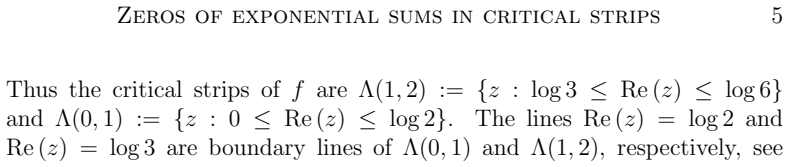
Take the factorized example $f(z)=6-5e^z+e^{2z}$, whose zeros lie exactly on the vertical lines $\operatorname{Re}z=\log 2$ and $\operatorname{Re}z=\log 3$; in the critical strip $\{0\le\operatorname{Re}z\le\log 2\}$, rectangles of height $r$ should contain $r/(2\pi)+O(1)$ zeros. Directly counting the zeros for $r=10^3,10^4,\dots$ either keeps the correction bounded or refutes the theorem.
Extended reading notes
Core claim
The central discovery is a per-strip refinement of the classical whole-strip counting result. The paper proves Theorem 2.1: all zeros of $f$ lie in finitely many critical strips $\Lambda(j,k)$, and if $R$ is a rectangle obtained by cutting $\Lambda(j,k)$ with two horizontal lines $y_2-y_1=r>0$, then $n(r,\Lambda_{jk})=|w_j-w_k|r/(2\pi)+O(1)$. The error term is bounded independently of $r$, so the average vertical density of zeros in that strip is exactly $|w_j-w_k|/(2\pi)$. In addition, the almost-everywhere statement in Example 3 says that, with zeros $z_n$ listed by increasing modulus and discs of radius $r_n=(1+|z_n|)^{-1}\log^{-2}(e+|z_n|)$, the set of real $c$ whose vertical line $\operatorname{Re}z=c$ meets infinitely many of these discs has linear measure zero.
Load-bearing premise
The proof needs the rectangle's vertical sides to lie strictly inside zero-free regions, where a single exponential term is larger than the sum of all the others by a margin that stays bounded away from zero as $y$ varies; if a side is placed on a boundary line or too close to a zero, the $O(1)$ control on the horizontal integrals can fail.
Editorial extensions
If this is right
- The strip count gives the asymptotic density of zeros along every vertical line inside a critical strip: roughly $|w_j-w_k|/(2\pi)$ zeros per unit height.
- A one-unit vertical shift of the counting rectangle adds about $|w_j-w_k|/(2\pi)$ zeros as $r\to\infty$, a precise version of the number of new zeros per unit height.
- The almost-every-line disc result strengthens the density statement: although the zero set may be dense in each strip, a typical vertical line misses all but finitely many of the small zero-centered discs.
- Because the theorem holds for every individual strip, the sum of the per-strip counts is consistent with the older global count for the whole strip system.
Reading between the lines
- The proof's only structural input is a uniform dominance margin on the vertical sides; a natural test is whether the same per-strip formula persists for exponential sums with slowly varying polynomial coefficients, where the strips are replaced by logarithmic strips.
- The radius $r_n=(1+|z_n|)^{-1}\log^{-2}(e+|z_n|)$ is one member of a family of summable radii; any $r_n$ with $\sum r_n<\infty$ would yield the same almost-everywhere conclusion, so the logarithmic power is not special.
- The $O(1)$ term is not identified; a numerical experiment across many $r$ could reveal whether the correction is bounded oscillation or has a limiting distribution, which the theorem does not address.
Signed reviews
Editorial analysis
A structured set of objections, weighed in public.
Referee Report
Summary. The paper studies normalized exponential sums f(z)=1+H_1 e^{w_1 z}+...+H_n e^{w_n z} with 0<w_1<...<w_n. Its main result, Theorem 2.1, states that all zeros lie in finitely many vertical critical strips and that for any rectangle R cut from a critical strip Lambda(j,k) by two horizontal lines at distance r, the number of zeros satisfies n(r,Lambda_{jk})=|w_j-w_k| r/(2 pi)+O(1). The proof uses the argument principle: vertical sides are placed in adjacent zero-free regions where one exponential term dominates, yielding the linear main term, while Backlund's lemma is used to bound the contributions of the horizontal sides by O(1). The paper also proves a measure-zero counterpart to Moreno's density result: almost every vertical line meets at most finitely many of the small discs centered at the zeros with radius r_n=(1+|z_n|)^{-1} log^{-2}(e+|z_n|).
Significance. If the main theorem is correct, it sharpens Langer's global estimate by giving the asymptotic count in each individual critical strip rather than in one wide strip, with an explicit O(1) error and a clean dependence on the difference of the adjacent dominating frequencies. The proof is self-contained and includes a full proof of Backlund's lemma, which is a useful expository addition. The measure-zero disc result is a nice quantitative counterpart to Moreno's theorem and does not require rational independence of the frequencies. The main formula is explicit and testable, for instance on the example f(z)=6-5e^z+e^{2z}, where it recovers the correct vertical spacing of zeros. However, the proof of the step-function extension at the end of Section 4 is incomplete, and the geometry stated in Theorem 2.1 does not exactly match the contour used in the proof; both issues are local and repairable.
major comments (2)
- [Section 4, final paragraph] The extension from the exceptional set to all rectangles is not justified as written. Up to the final paragraph, (2.4) is proved only for those y1 and r for which the horizontal sides Gamma1 and Gamma3 contain no zeros. The sentence that 'all counting functions are step functions' only yields the extension if the jumps of the counting function n(r,Lambda_{jk}) when a horizontal line crosses a zero are uniformly bounded, and no such bound is given. This is load-bearing because Theorem 2.1 asserts the O(1) estimate for every rectangle. The gap is repairable: for each fixed y, Re f(x+iy) is a real exponential polynomial in x with at most n+1 terms, so by the standard Descartes rule for exponential sums with real exponents it has at most n real zeros, and the same holds for Im f (or Im f vanishes identically, in which case the real part controls the zeros). Hence every horizontal line contains O(1) zeros and all jumps of the counting function are O(1). This argument should be incorporated explicitly, and the phrase 'piecewise continuity' should be corrected to 'piecewise constant with uniformly bounded jumps'.
- [Theorem 2.1 and Section 4] The statement of Theorem 2.1 and the proof use different rectangles. The theorem says R is a rectangle cut from the critical strip Lambda(j,k) by two horizontal lines, while the proof places the vertical sides at x1 and x2 lying in the middle of the two adjacent zero-free regions. Since zero-free regions contain no zeros, the count in the larger rectangle equals the count in the closed portion of the critical strip, but this identification is never stated. If R is intended to have vertical sides on the boundary lines of Lambda(j,k), the proof should say explicitly that zeros on those boundary lines are included in the count and that the contour is placed away from them; if R is intended to have vertical sides inside the adjacent zero-free regions, the theorem should say so. As written, the geometry of the rectangle is ambiguous and the argument-principle contour does not correspond literally to the rectangle in the statement.
minor comments (4)
- [Introduction, page 3] The word 'sayhing' should be 'saying'.
- [Section 3, Backlund's lemma proof] The notation 'F(z)=F(z)' in the paragraph after the Taylor expansion is not meaningful in the text; it should be written as an overline or as \overline{F(\bar z)} to indicate the entire function used in the symmetry argument.
- [Equations (1.3) and (1.4), and Theorem 2.1] The notation for the largest frequency is inconsistent: the introduction uses w_m, while Theorem 2.1 uses w_n. The authors should unify this notation.
- [Example 3] The Riemann-Stieltjes estimate leading to the factor 3 in the bound is not explained; a one-line justification via integration by parts would improve readability.
Circularity Check
No circularity: the main count is derived from the argument principle and a fully proved Backlund lemma; self-citations are bibliographic only.
full rationale
The central claim, Theorem 2.1, is not an input in disguise. Section 4 computes the zero count by the argument principle on a rectangle whose vertical sides lie in zero-free regions. The horizontal side integrals are O(1) by Backlund's lemma, which is proved completely in Section 3, and the vertical side integrals are dominated by the two exponentials of the strip, yielding (w_k - w_j)r/(2\pi) + O(1). No coefficient of the formula is fitted from zero-count data; the constants are the frequencies w_j, w_k already present in the original exponential sum. The zero-free regions and critical strips are defined by the dominance inequality (2.1), and the statement that all zeros are in critical strips is a direct consequence of (2.2), not a separate empirical prediction. Example 3 uses the classical Langer bound (1.4) and a Borel-Cantelli argument, so it is an application of an external theorem rather than a tautology. The only self-citations ([2], [3]) occur in historical remarks and are not load-bearing. A rigor caveat, not a circularity, is the final step-function extension in Section 4: the paper asserts that the formula extends from countably many admissible r to all r because counting functions are step functions, but it does not explicitly prove that the jumps are uniformly bounded. This is a missing justification in an otherwise self-contained proof; it does not make the conclusion an input of the derivation. Accordingly, there is no significant circularity.
Assumptions & free parameters
assumptions (4)
- standard math Argument principle relates the number of zeros inside a contour to the integral of f'/f around it.
- standard math Jensen's formula connects the count of zeros of an entire function in a disc to the average of log|F| on the circle.
- standard math Zeros of a non-zero entire function are isolated and countable, so horizontal lines can be chosen to avoid zeros.
- domain assumption The zero-free region condition (2.1) is derived from the triangle inequality and correctly identifies regions where f has no zeros.
Cite this review
Pith. "Pith review of The asymptotic number of zeros of exponential sums in critical strips." pith.science (2026). https://pith.science/paper/ZYKNWCOA
@misc{pith2026190809491,
  author       = {Pith},
  title        = {Pith review of: The asymptotic number of zeros of exponential sums in critical strips},
  year         = {2026},
  howpublished = {\url{https://pith.science/paper/ZYKNWCOA}},
  note         = {Machine review of arXiv:1908.09491}
}
abstract
Normalized exponential sums are entire functions of the form $$ f(z)=1+H_1e^{w_1z}+\cdots+H_ne^{w_nz}, $$ where $H_1,\ldots, H_n\in\C$ and $0<w_1<\ldots<w_n$. It is known that the zeros of such functions are in finitely many vertical strips $S$. The asymptotic number of the zeros in the union of all these strips was found by R. E. Langer already in 1931. In 1973, C. J. Moreno proved that there are zeros arbitrarily close to any vertical line in any strip $S$, provided that $1,w_1,\ldots,w_n$ are linearly independent over the rational numbers. In this study the asymptotic number of zeros in each individual vertical strip is found by relying on R. J. Backlund's lemma, which was originally used to study the zeros of the Riemann $\zeta$-function. As a counterpart to Moreno's result, it is shown that almost every vertical line meets at most finitely many small discs around the zeros of $f$.
Figures


Reference graph
Works this paper leans on
-
[1]
J., Sur les z´ eros de la fonctionζ(s) de Riemann
Backlund R. J., Sur les z´ eros de la fonctionζ(s) de Riemann. Comptes Rendus de I’Acad´ emie des Sciences158 (1914), 1979–1981
work page 1914
-
[2]
Heittokangas J., K. Ishizaki, K. Tohge and Z.-T. Wen, Zero distribution and division results for exponential polynomials . Israel J. Math. 227 (2018), 397–421
work page 2018
-
[3]
Heittokangas J. and Wen Z.-T., Generalization of P´ olya’s zero distribution theory for exponential polynomials, plus sharp results for asymptotic growth . Submitted. Available at arXiv: http://arxiv.org/abs/1905.08919
work page Pith review arXiv 1905
-
[4]
Mora G., J. M. Sepulcre, and T. Vidal, On the existence of exponential polynomials with prefixed gaps. Bull. Lond. Math. Soc. 45 (2013), no. 6, 1148–1162
work page 2013
-
[5]
J., The zeros of exponential polynomials
Moreno C. J., The zeros of exponential polynomials . I. Compositio Math. 26 (1973), 69–78
work page 1973
-
[6]
E., On the zeros of exponential sums and integrals
Langer R. E., On the zeros of exponential sums and integrals . Bull. Amer. Math. Soc. 37 (1931), no. 4, 213–239
work page 1931
- [7]
-
[8]
P´ olya G.,Untersuchungen ¨ uber L¨ ucken und Singularit¨ aten von Poten- zreihen. Math. Z. 29 (1929), no. 1, 549–640
work page 1929
Show all 11 references
-
[9]
Schwengeler E., Geometrisches ¨ uber die Verteilung der Nullstellen spezieller ganzer Funktionen (Exponentialsummen) . Diss. Z¨ urich, 1925
1925
-
[10]
Tamarkin J., Some general problems of the theory of ordinary linear differential equations and expansion of an arbitrary function in series of fundamental functions. Math. Z. 27 (1928), no. 1, 1–54
1928
-
[11]
E., Expansion problems of ordinary linear differen- tial equations with auxiliary conditions at more than two points
Wilder C. E., Expansion problems of ordinary linear differen- tial equations with auxiliary conditions at more than two points. Trans. Amer. Math. Soc. 18 (1917), no. 4, 415–442. J. M. Heittokangas University of Eastern Finland, Department of Physics and Math- ematics, P.O. Box...
1917
Reviewed August 14, 2026 · model on record in the stance chip above.
Discussion (0). Continue with ORCID to comment.