Revisiting the high-field phase diagram of the topological cubic helimagnet SrFeO₃
Pith reviewed 2026-05-22 03:34 UTC · model grok-4.3
The pith
SrFeO3's multiple-Q magnetic phases arise from an effective Hamiltonian with cubic anisotropy and momentum-space interactions, plus a valence transition at 40 T.
A machine-rendered reading of the paper's core claim, the machinery that carries it, and where it could break.
Core claim
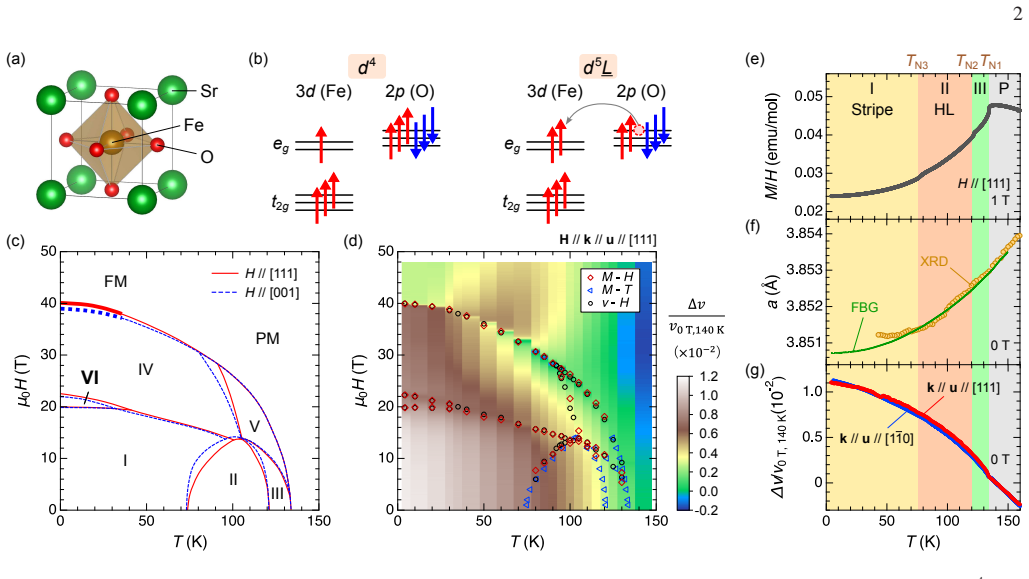
The authors elucidate the field-orientation dependence of the magnetic phase diagram and establish an effective spin Hamiltonian for SrFeO3 that incorporates a cubic single-ion anisotropy together with bilinear and biquadratic interactions in momentum space. In addition, they observe magnetoelastic signatures of a first-order valence transition upon entering the forced FM phase at 40 T, which would be attributed to the suppression of negative charge transfer. These findings emphasize the pivotal importance of electronic itinerancy arising from the formation of a ligand-hole band in stabilizing multiple-Q phases.
What carries the argument
Effective spin Hamiltonian incorporating cubic single-ion anisotropy together with bilinear and biquadratic interactions in momentum space
If this is right
- The magnetic phase diagram changes systematically with field orientation according to the momentum-space terms in the Hamiltonian.
- The quadruple-Q hedgehog-antihedgehog lattice and other multiple-Q states are reproduced by the minimal model without extra microscopic mechanisms.
- Entry into the forced ferromagnetic phase at 40 T coincides with a first-order valence change driven by closing of the negative-charge-transfer channel.
- Ligand-hole formation arising from itinerant electrons is required to stabilize the complex topological spin textures.
Where Pith is reading between the lines
- The same momentum-space interaction framework may describe high-field phases in other cubic helimagnets such as MnSi or Cu2OSeO3.
- Chemical substitution or hydrostatic pressure could shift the 40 T valence transition and thereby modify the extent of the multiple-Q region.
- Pulsed-field neutron or resonant X-ray scattering could directly test the predicted momentum dependence of the biquadratic terms.
Load-bearing premise
The magnetoelastic signatures at 40 T constitute direct evidence of a first-order valence transition caused by suppression of negative charge transfer, and the proposed Hamiltonian supplies the minimal set of terms needed to reproduce the multiple-Q phases.
What would settle it
High-resolution X-ray absorption or photoemission spectra showing no shift in iron valence or ligand-hole character across the 40 T boundary would disprove the valence-transition interpretation.
Figures


read the original abstract
The cubic perovskite SrFeO$_{3}$ is a prototypical centrosymmetric itinerant magnet that hosts a quadruple-${\mathbf Q}$ hedgehog-antihedgehog lattice and exhibits a complex magnetic-field-temperature phase diagram. Yet, the microscopic mechanism underlying the emergence of its versatile multiple-${\mathbf Q}$ phases remains unresolved. Here, we elucidate the field-orientation dependence of the magnetic phase diagram and establish an effective spin Hamiltonian for SrFeO$_{3}$ that incorporates a cubic single-ion anisotropy together with bilinear and biquadratic interactions in momentum space. In addition, we observe magnetoelastic signatures of a first-order valence transition upon entering the forced FM phase at 40 T, which would be attributed to the suppression of negative charge transfer. These findings emphasize the pivotal importance of electronic itinerancy arising from the formation of a ligand-hole band in stabilizing multiple-${\mathbf Q}$ phases.
Editorial analysis
A structured set of objections, weighed in public.
Referee Report
Summary. The manuscript revisits the high-field phase diagram of the centrosymmetric itinerant magnet SrFeO3. It maps the magnetic-field orientation dependence of the phases, constructs an effective spin Hamiltonian that includes cubic single-ion anisotropy together with bilinear and biquadratic interactions in momentum space to account for the quadruple-Q hedgehog lattice and other multiple-Q states, and reports magnetoelastic anomalies at ~40 T that are interpreted as signatures of a first-order valence transition arising from suppression of negative charge transfer. The work concludes that electronic itinerancy associated with a ligand-hole band is essential for stabilizing the observed topological spin textures.
Significance. If the effective Hamiltonian reproduces the orientation-dependent phase boundaries with a minimal set of parameters and the high-field magnetoelastic data are shown to require a valence change rather than conventional spin-lattice coupling, the results would strengthen the case that ligand-hole itinerancy plays a decisive role in the formation of complex multiple-Q states in cubic helimagnets, providing a concrete microscopic link between electronic structure and topological magnetism.
major comments (2)
- [Hamiltonian construction (likely §4)] The effective Hamiltonian is stated to be minimal for reproducing the observed phases, yet the bilinear and biquadratic coupling strengths are free parameters whose values are chosen to match the experimental phase diagram; without an independent microscopic derivation or cross-validation against additional observables (e.g., spin-wave spectra or neutron intensities), the construction risks circularity with the very data used to define the phases.
- [High-field magnetoelastic data (likely §5 and Fig. 7)] The magnetoelastic signatures at 40 T are presented as direct evidence of a first-order valence transition caused by suppression of negative charge transfer. However, the manuscript does not explicitly compare the observed lattice anomalies against the expected magnetostriction of a fully polarized ferromagnetic state without a valence change; a quantitative estimate of the conventional magnetostriction contribution would be required to substantiate the valence-transition interpretation.
minor comments (2)
- [Theory section] Notation for the momentum-space interactions should be defined explicitly (e.g., the precise form of the biquadratic term) to allow direct comparison with related models in the literature.
- [Abstract] The abstract uses the conditional phrasing 'which would be attributed'; a more direct statement of the proposed mechanism would improve readability.
Simulated Author's Rebuttal
We thank the referee for the careful reading of our manuscript and the constructive comments. We address each major point below, indicating where we agree and where revisions or clarifications will be incorporated.
read point-by-point responses
-
Referee: [Hamiltonian construction (likely §4)] The effective Hamiltonian is stated to be minimal for reproducing the observed phases, yet the bilinear and biquadratic coupling strengths are free parameters whose values are chosen to match the experimental phase diagram; without an independent microscopic derivation or cross-validation against additional observables (e.g., spin-wave spectra or neutron intensities), the construction risks circularity with the very data used to define the phases.
Authors: The form of the effective Hamiltonian follows from symmetry considerations for the cubic lattice together with momentum-space interactions expected for an itinerant system with ligand-hole character. While the coupling constants are adjusted to reproduce the measured orientation-dependent phase boundaries, this is the standard procedure for constructing minimal effective models that capture the essential physics of multiple-Q states. The model is not purely circular because it simultaneously accounts for the stability of the quadruple-Q hedgehog lattice and the field-induced transitions without further parameter tuning. A first-principles microscopic derivation lies outside the present scope, but we will expand the manuscript to include a clearer discussion of the physical motivation for each term and note possible consistency checks against existing neutron data. revision: partial
-
Referee: [High-field magnetoelastic data (likely §5 and Fig. 7)] The magnetoelastic signatures at 40 T are presented as direct evidence of a first-order valence transition caused by suppression of negative charge transfer. However, the manuscript does not explicitly compare the observed lattice anomalies against the expected magnetostriction of a fully polarized ferromagnetic state without a valence change; a quantitative estimate of the conventional magnetostriction contribution would be required to substantiate the valence-transition interpretation.
Authors: We agree that an explicit comparison to conventional magnetostriction in the polarized ferromagnetic state would strengthen the valence-transition claim. The observed discontinuity at 40 T is larger than typical spin-lattice effects in related perovskites and occurs precisely at the forced-FM boundary. In the revision we will add a quantitative estimate, obtained by extrapolating the field dependence of the lattice constants from the lower-field phases and by referencing magnetoelastic coefficients reported for SrFeO3 and isostructural compounds, to demonstrate that the anomaly exceeds the expected conventional contribution. revision: yes
Circularity Check
No significant circularity in derivation chain
full rationale
The paper reports experimental mapping of the field-orientation-dependent phase diagram in SrFeO3 together with high-field magnetoelastic data at 40 T. It then constructs an effective spin Hamiltonian containing cubic anisotropy plus bilinear and biquadratic terms chosen to reproduce the observed multiple-Q phases. Because the provided text contains no explicit equations that define the Hamiltonian parameters directly from the same data set in a self-referential loop, nor any load-bearing self-citation that substitutes for an independent uniqueness proof, the modeling step remains a conventional fitting procedure rather than a tautological reduction. The valence-transition interpretation is presented as an inference from the magnetoelastic anomalies and is not required for the Hamiltonian construction itself. The overall chain therefore stays self-contained against external benchmarks.
Axiom & Free-Parameter Ledger
free parameters (1)
- bilinear and biquadratic interaction strengths
axioms (1)
- domain assumption The magnetic phases of SrFeO3 can be captured by a classical or semiclassical spin Hamiltonian containing cubic single-ion anisotropy together with bilinear and biquadratic interactions defined in momentum space.
invented entities (1)
-
ligand-hole band
no independent evidence
Lean theorems connected to this paper
-
IndisputableMonolith/Foundation/AlexanderDuality.leanalexander_duality_circle_linking unclear?
unclearRelation between the paper passage and the cited Recognition theorem.
effective spin Hamiltonian ... cubic single-ion anisotropy together with bilinear and biquadratic interactions in momentum space
-
IndisputableMonolith/Foundation/Cost/FunctionalEquation.leanwashburn_uniqueness_aczel unclear?
unclearRelation between the paper passage and the cited Recognition theorem.
quadruple-Q hedgehog-antihedgehog lattice
What do these tags mean?
- matches
- The paper's claim is directly supported by a theorem in the formal canon.
- supports
- The theorem supports part of the paper's argument, but the paper may add assumptions or extra steps.
- extends
- The paper goes beyond the formal theorem; the theorem is a base layer rather than the whole result.
- uses
- The paper appears to rely on the theorem as machinery.
- contradicts
- The paper's claim conflicts with a theorem or certificate in the canon.
- unclear
- Pith found a possible connection, but the passage is too broad, indirect, or ambiguous to say the theorem truly supports the claim.
Reference graph
Works this paper leans on
-
[1]
[111] [111] [111] [111] [111] [111][111] (e) (f) (g) [111] [111] [111][111] [111] [111] [111][111] [111] [111] [111][111] (0, -1, 1) + Q4 Q4 H Q1 + Q2 Q1 + Q3 Q1 + Q4 [111] [111] sinusoidal sinusoidal FIG. 4. (a) Three types of Q-dependent domains in phase I that can be stabilized by apply ing a magnetic field along (near) the [111] axis. Although the neut...
-
[2]
by means of simulated annealing for a system of N = 83 spins with periodic boundary conditions (see Appendix A for de- tails). Following the experimentally observed magnetic mo d- ulation vector in SrFeO 3, Q = (q, q, q) ( q ≈ 0. 13 r.l.u) 7 [32, 42], the summation in Eq. ( 1) is taken for the set of tetra- hedral wave vectors, Q1 = (Q, Q, Q), Q2 = (Q, −Q...
-
[3]
11, a topologically nontrivial quadruple- Q HL phase (4 Q- HL) emerges as the zero-field state [Fig. 5(f)], hosting eight monopole-anti monopole pairs [ 22], while for even larger K, a topologically trivial quadruple- Q conical state (4 Q-HFC) composed of four helix components appears in the high-field region [Fig. 5(g)]. In light of the neutron scattering ...
-
[4]
The absolute values of magnetization were calibrated using data obtained in MPMS or PPMS
and [001]. The absolute values of magnetization were calibrated using data obtained in MPMS or PPMS. Thermal expansion was measured along the [111] axis at zero field by the fiber-Bragg-grating (FBG) method using an optical sens- ing instrument (Hyperion si155, LUNA) in PPMS. Magne- tostriction measurements were performed by the FBG method up to 49 T in a n...
-
[5]
A. Fert, V . Cros, and J. Sampaio, Skyrmions on the track, N at. Nanotechnol. 8, 152 (2013)
work page 2013
-
[6]
N. Nagaosa and Y . Tokura, Topological properties and dyn am- ics of magnetic skyrmions, Nat. Nanotechnol. 8, 899 (2013)
work page 2013
-
[7]
Y . Tokura and N. Kanazawa, Magnetic Skyrmion Materials, Chem. Rev. 121, 2857 (2021)
work page 2021
-
[8]
A. Neubauer, C. Pfleiderer, B. Binz, A. Rosch, R. Ritz, P . G . Niklowitz, and P . B¨ oni, Topological Hall Effect in the A Phase of MnSi, Phys. Rev. Lett. 102, 186602 (2009)
work page 2009
-
[9]
T. Kurumaji, T. Nakajima, M. Hirschberger, A. Kikkawa, Y. Ya- masaki, H. Sagayama, H. Nakao, Y . Taguchi, T. Arima, and Y . Tokura, Skyrmion lattice with a giant topological Hall e ffect in a frustrated triangular-lattice magnet, Science 365, 914 (2019)
work page 2019
- [10]
-
[11]
S. Seki, M. Garst, J. Waizner, R. Takagi, Y . Otani, and Y . Tokura, Propagation dynamics of spin excitations along skyrmion strings, Nat. Commun. 11, 256 (2020)
work page 2020
-
[12]
F. Jonietz, S. M¨ uhlbauer, C. Pfleiderer, A. Neubauer, W. M¨ unzer, A. Bauer, T. Adams, R. Georgii, P . B¨ oni, R. A. Duine, K. Everschor, M. Garst, and A. Rosch, Spin Transfer Torques in MnSi at Ultralow Current Densities, Science 330, 1648 (2010)
work page 2010
-
[13]
M. T. Birch, I. Belopolski, Y . Fujishiro, M. Kawamura, A. Kikkawa, Y . Taguchi, M. Hirschberger, N. Nagaosa, and Y . Tokura, Dynamic transition and Galilean relativity of curr ent- driven skyrmions, Nature 633, 554 (2024)
work page 2024
-
[14]
N. Kanazawa, J.-H. Kim, D. S. Inosov, J. S. White, N. Eget en- meyer, J. L. Gavilano, S. Ishiwata, Y . Onose, T. Arima, B. Keimer, and Y . Tokura, Possible skyrmion-lattice ground st ate in the B20 chiral-lattice magnet MnGe as seen via small-angle neutron scattering, Phys. Rev. B 86, 134425 (2012)
work page 2012
-
[15]
T. Tanigaki, K. Shibata, N. Kanazawa, X. Y u, Y . Onose, H. S. Park, D. Shindo, and Y . Tokura, Real-space observation of short-period cubic lattice of skyrmions in MnGe, Nano Lett. 15, 5438 (2015)
work page 2015
-
[16]
N. Kanazawa, A. Kitaori, J. S. White, V . Ukleev, H. M. Rønnow, A. Tsukazaki, M. Ichikawa, M. Kawasaki, and Y . Tokura, Direct observation of the statics and dynamics of em er- gent magnetic monopoles in a chiral magnet, Phys. Rev. Lett. 125, 137202 (2020)
work page 2020
-
[17]
Y . Fujishiro, N. Kanazawa, T. Nakajima, X. Z. Y u, K. Ohis hi, T. Arima, H. Mitamura, A. Miyake, K. Akiba, M. Tokunaga, R. Arita, and Y . Tokura, Topological transitions among skyrmion- and hedgehog-lattice states in cubic chiral magnets, Nat. C om- mun. 10, 1059 (2019)
work page 2019
-
[18]
B. Binz, A. Vishwanath, and V . Aji, Theory of the Helical Spin Crystal: A Candidate for the Partially Ordered State of MnSi , Phys. Rev. Lett. 96, 207202 (2006)
work page 2006
-
[19]
B. Binz and A. Vishwanath, Theory of helical spin crysta ls: Phases, textures, and properties, Phys. Rev. B 74, 214408 (2006)
work page 2006
-
[20]
J.-H. Park and J. H. Han, Zero-temperature phases for ch iral magnets in three dimensions, Phys. Rev. B 83, 184406 (2011)
work page 2011
-
[21]
S.-G. Yang, Y .-H. Liu, and J. H. Han, Formation of a topo- logical monopole lattice and its dynamics in three-dimensi onal chiral magnets, Phys. Rev. B 94, 054420 (2016)
work page 2016
-
[22]
S. Grytsiuk, J.-P . Hanke, M. Ho ffmann, J. Bouaziz, O. Gomonay, G. Bihlmayer, S. Lounis, Y . Mokrousov, and S. Bl¨ ugel, Topological-chiral magnetic interactions drive n by emergent orbital magnetism, Nat. Commun. 11, 511 (2020)
work page 2020
-
[23]
S. Okumura, S. Hayami, Y . Kato, and Y . Motome, Magnetic hedgehog lattices in noncentrosymmetric metals, Phys. Rev . B 101, 144416 (2020)
work page 2020
-
[24]
K. Shimizu, S. Okumura, Y . Kato, and Y . Motome, Phase transi- tions between helices, vortices, and hedgehogs driven by spatial anisotropy in chiral magnets, Phys. Rev. B 103, 054427 (2021)
work page 2021
-
[25]
Y . Kato and Y . Motome, Magnetic field–temperature phase dia- grams for multiple-Q magnetic ordering: Exact steepest descent approach to long-range interacting spin systems, Phys. Rev . B 105, 174413 (2022)
work page 2022
-
[26]
S. Okumura, S. Hayami, Y . Kato, and Y . Motome, Magnetic Hedgehog Lattice in a Centrosymmetric Cubic Metal, J. Phys. Soc. Jpn. 91, 093702 (2022)
work page 2022
-
[27]
Y . Kato and Y . Motome, Hidden topological transitions in emer- gent magnetic monopole lattices, Phys. Rev. B 107, 094437 (2023)
work page 2023
-
[28]
R. Yambe and S. Hayami, Anisotropic spin model and multi ple- Q states in cubic systems, Phys. Rev. B 107, 174408 (2023)
work page 2023
-
[29]
R. Mays and P . Nikoli´ c, Hedgehog lattices induced by ch iral spin interactions, Phys. Rev. B 113, 104449 (2026)
work page 2026
-
[30]
K. Aoyama and H. Kawamura, Hedgehog-lattice spin textu re in classical Heisenberg antiferromagnets on the breathing py- rochlore lattice, Phys. Rev. B 103, 014406 (2021)
work page 2021
-
[31]
K. Aoyama and H. Kawamura, Hedgehog lattice and field- induced chirality in breathing-pyrochlore Heisenberg ant iferro- magnets, Phys. Rev. B 106, 064412 (2022)
work page 2022
-
[32]
Y . Kato, S. Hayami, and Y . Motome, Spin excitation spect ra in helimagnetic states: Proper-screw, cycloid, vortex-crys tal, and hedgehog lattices, Phys. Rev. B 104, 224405 (2021)
work page 2021
- [33]
-
[34]
K. Shimizu, S. Okumura, Y . Kato, and Y . Motome, Current- induced motion of nanoscale magnetic torons over the wide range of the Hall angle, Commun. Phys. 8, 69 (2025)
work page 2025
-
[35]
J. B. MacChesney, R. C. Sherwood, J. F. Potter, Electric and Magnetic Properties of the Strontium Ferrates, J. Chem. Phy s. 43, 1907 (1965)
work page 1907
- [36]
-
[37]
A. E. Bocquet, A. Fujimori, T. Mizokawa, T. Saitoh, H. Na - matame, S. Suga, N. Kimizuka, Y . Takeda, and M. Takano, Electronic structure of SrFe 4+O3 and related Fe perovskite ox- ides, Phys. Rev. B 45, 1561 (1992)
work page 1992
-
[38]
N. Hayashi, T. Terashima, and M. Takano, Oxygen-holes c re- ating di fferent electronic phases in Fe 4+ oxides: successful growth of single crystalline films of SrFeO 3 and related per- ovskites at low oxygen pressure, J. Mater. Chem. 11, 2235 10 (2001)
work page 2001
- [39]
-
[40]
S. Nasu, T. Kawakami, S. Kawasaki, and M. Takano, High- Pressure M¨ ossbauer Spectroscopy of Perovskite Iron Oxide s, Hyperfine Interact. 144, 119 (2002)
work page 2002
- [41]
-
[42]
S. Ishiwata, M. Tokunaga, Y . Kaneko, D. Okuyama, Y . Toku - naga, S. Wakimoto, K. Kakurai, T. Arima, Y . Taguchi, and Y . Tokura, V ersatile helimagnetic phases under magnetic field s in cubic perovskite SrFeO 3, Phys. Rev. B 84, 054427 (2011)
work page 2011
-
[43]
Y . W. Long, Y . Kaneko, S. Ishiwata, Y . Tokunaga, T. Matsuda, H. Wadati, Y . Tanaka, S. Shin, Y . Tokura, and Y . Taguchi, Evo- lution of magnetic phases in single crystals of SrFe 1−xCoxO3 solid solution, Phys. Rev. B 86, 064436 (2012)
work page 2012
-
[44]
S. Chakraverty, T. Matsuda, H. Wadati, J. Okamoto, Y . Ya - masaki, H. Nakao, Y . Murakami, S. Ishiwata, M. Kawasaki, Y . Taguchi, Y . Tokura, and H. Y . Hwan, Multiple helimagnetic phases and topological Hall effect in epitaxial thin films of pris- tine and Co-doped SrFeO3, Phys. Rev. B 88, 220405(R) (2013)
work page 2013
-
[45]
P . C. Rogge, R. J. Green, R. Sutarto, and S. J. May, Itiner ancy- dependent noncollinear spin textures in SrFeO 3, CaFeO 3, and CaFeO3/SrFeO3 heterostructures probed via resonant x-ray scattering, Phys. Rev. Mater. 3, 084404 (2019)
work page 2019
-
[46]
S. Ishiwata, T. Nakajima, J.-H. Kim, D. S. Inosov, N. Kanazawa, J. S. White, J. L. Gavilano, R. Georgii, K. M. See- mann, G. Brandl, P . Manuel, D. D. Khalyavin, S. Seki, Y . Tokunaga, M. Kinoshita, Y . W. Long, Y . Kaneko, Y . Taguchi, T. Arima, B. Keimer, and Y . Tokura, Emergent topological spin structures in the centrosymmetric cubic perovskite SrFeO3...
work page 2020
- [47]
-
[48]
D. Takegami, M. Nakamura, A. Melendez-Sans, K. Fujinum a, R. Nakamura, M. Y oshimura, K.-D. Tsuei, A. Tanaka, M. Gen, Y . Tokunaga, S. Ishiwata, and T. Mizokawa, Negative charge- transfer energy SrFeO3 revisited with hard x-ray photoemission spectroscopy, Phys. Rev. B 109, 235138 (2024)
work page 2024
-
[49]
N. D. Andriushin, J. Grumbach, A. A. Kulbakov, Y . V . Ty- moshenko, Y . A. Onykiienko, R. Firouzmandi, E. Cheng, S. Granovsky, Y . Skourski, J. Ollivier, H. C. Walker, V . Kocsis , B. B¨ uchner, B. Keimer, M. Doerr, D. S. Inosov, and D. C. Peets, Anomalous Quasielastic Scattering Contribution in the Centrosymmetric Multi-q Helimagnet SrFeO3, Phys. Rev. X...
work page 2025
-
[50]
Mostovoy, Helicoidal Ordering in Iron Perovskites, Phys
M. Mostovoy, Helicoidal Ordering in Iron Perovskites, Phys. Rev. Lett. 94, 137205 (2005)
work page 2005
-
[51]
M. Azhar and M. Mostovoy, Incommensurate Spiral Order from Double-Exchange Interactions, Phys. Rev. Lett. 118, 027203 (2017)
work page 2017
-
[52]
Z. Li, R. Laskowski, T. Litaka, and T. Tohyama, First-principles calculation of helical spin order in iron perovskite SrFeO 3 and BaFeO3, Phys. Rev. B 85, 134419 (2012)
work page 2012
-
[53]
P . M. Woodward, D. E. Cox, E. Moshopoulou, A. W. Sleight, and S. Morimoto, Structural studies of charge disproportio n- ation and magnetic order in CaFeO 3, Phys. Rev. B 62, 844 (2000)
work page 2000
-
[54]
P . C. Rogge, R. U. Chandrasena, A. Cammarata, R. J. Green , P . Shafer, B. M. Lefler, A. Huon, A. Arab, E. Arenholz, H. N. Lee, T.-L. Lee, S. Nemˇ s´ ak J. M. Rondinelli, A. X. Gray, and S. J. May, Electronic structure of negative charge trans fer CaFeO3 across the metal-insulator transition, Phys. Rev. Mater. 2, 015002 (2018)
work page 2018
-
[55]
J. Q. Li, Y . Matsui, S. K. Park, and Y . Tokura, Charge Orde red States in La 1−xSrxFeO3, Phys. Rev. Lett. 79, 297 (1997)
work page 1997
- [56]
-
[57]
I. Martin and C. D. Batista, Itinerant Electron-Driven Chi- ral Magnetic Ordering and Spontaneous Quantum Hall E ffect in Triangular Lattice Models, Phys. Rev. Lett. 101, 156402 (2008)
work page 2008
-
[58]
Y . Akagi and Y . Motome, Hidden Multiple-Spin Interacti ons as an Origin of Spin Scalar Chiral Order in Frustrated Kondo Lattice Models, Phys. Rev. Lett. 108, 096401 (2012)
work page 2012
- [59]
- [60]
-
[61]
S. Hayami and R. Yambe, Stabilization mechanisms of magnetic skyrmion crystal and multiple- Q states based on momentum-resolved spin interactions, Mater. Today Quantu m 3, 100010 (2024)
work page 2024
-
[62]
S. Zherlitsyn, B. L¨ uthi, B. Wolf, J. L. Sarrao, Z. Fisk, and V . Zlati´ c, Ultrasonic study of the mixed-valence syste m YbIn1−xAgxCu4, Rev. B 60, 3148 (1999)
work page 1999
-
[63]
N. V . Mushnikov and T. Goto, High-field magnetostrictio n of the valence-fluctuating compound YbInCu 4, Phys. Rev. B 70, 054411 (2004)
work page 2004
-
[64]
Y . H. Matsuda, T. Inami, K. Ohwada, Y . Murata, H. Nojiri, Y . Murakami, H. Ohta, W. Zhang, and K. Y oshimura, High Field X-ray Di ffraction Study on a Magnetic-Field-Induced V alence Transition in YbInCu 4, J. Phys. Soc. Jpn. 75, 024710 (2006)
work page 2006
- [65]
-
[66]
R. Kurihara, A. Miyake, M. Tokunaga, A. Ikeda, Y . H. Matsuda, A. Miyata, D. I. Gorbunov, T. Nomura, S. Zherlitsyn, J. Wos- nitza, and F. Iga, Field-induced valence fluctuations in YbB 12, Phys. Rev. B 103, 115103 (2020)
work page 2020
-
[67]
R. Nakamura, A. Ishita, J. Nakamura, H. Ohta, Y . Haraguc hi, H. A. Katori, H. Ishikawa, A. Matsuo, K. Kindo, M. No- hara, and A. Ikeda, Magnetic-field-induced valence change i n Eu(Co1−xNix)2P2 up to 60 T, Phys. Rev. B 107, 235110 (2023)
work page 2023
- [68]
-
[69]
J. N. Reimers, A. J. Berlinsky, and A.-C. Shi, Mean-field ap- proach to magnetic ordering in highly frustrated pyrochlor es, Phys. Rev. B 43, 865 (1991)
work page 1991
- [70]
-
[71]
See Supplemental Material at xxxx for additional exper imental and theoretical data
-
[72]
T. Nakajima, M. Watanabe, Y . Inamura, K. Matsui, T. Kand a, T. Nomoto, K. Ohishi, Y . Kawamura, H. Saito, H. Tamatsukuri, 11 N. Terada, and Y . Kohama, Stroboscopic time-of-flight neutr on diffraction in long pulsed magnetic fields, Phys. Rev. Research 6, 023109 (2024)
work page 2024
- [73]
-
[74]
K. Prokeˇ s, M. Meissner, P . Smeibidl, C. Fritsche, K.-D. Ohloff, and P . Daniels, Neutron scattering in magnetic fields: exten ding the possibilities, Physica B 294-295, 691 (2001)
work page 2001
-
[75]
Revisiting the high-field phase diagram of the topological cubic helimagnet SrFeO 3
K. Momma and F. Izumi, VESTA 3 for three-dimensional vis u- alization of crystal, volumetric and morphology data, J. Ap pl. Crystallogr. 44, 1272 (2011). Supplemental Material for “Revisiting the high-field phase diagram of the topological cubic helimagnet SrFeO 3” Masaki Gen, 1, 2, ∗Shun Okumura, 2, 3, 4, †Shusaku Imajo, 1, 5 Taro Nakajima,1, 2, 6 Karel P...
work page 2011
-
[76]
S. Ishiwata, T. Nakajima, J.-H. Kim, D. S. Inosov, N. Kana zawa, J. S. White, J. L. Gavilano, R. Georgii, K. M. Seemann, G . Brandl, P . Manuel, D. D. Khalyavin, S. Seki, Y . Tokunaga, M. Kinoshita, Y . W. Long, Y . Kaneko, Y . Taguchi, T. Arima, B. Keimer, and Y . Tokura, Emergent topological spin structures in the centrosymmetr ic cubic perovskite SrFeO...
work page 2020
discussion (0)
Sign in with ORCID, Apple, or X to comment. Anyone can read and Pith papers without signing in.