REVIEW 4 major objections 5 minor 108 references
Probing Binary Architectures of Lithium-Rich Giants in GALAH with COSMIC and Stellar Models
T0 review · 4 major / 5 minor · reviewed 2026-08-06 · deepseek-v4-flash
Pith's one-line read The paper argues that the most lithium-rich red giants form via low-efficiency mass transfer from intermediate-mass AGB stars in binaries, with present-day separations near 3.3 AU.
desk verdict A valuable but prior-dominated first map of binary architectures for Li-rich giants; the MS-inheritance argument is solid, but the headline fractions and 'agreement' numbers need reframing. read the letter →
The pith
A machine-rendered reading of the paper's core claim, the machinery that carries it, and where it could break.
The reading
What carries the argument
The carrying mechanism is the abundance-mixing formula $X_{\mathrm{RGB,a.a.}} = (X_{\mathrm{RGB,b.a.}} M_{\mathrm{env}} + X_{\mathrm{AGB}} M_{\mathrm{acc}}) / (M_{\mathrm{env}} + M_{\mathrm{acc}})$, which converts COSMIC-derived accreted masses and red-giant envelope masses into post-transfer surface abundances. That equation lets the paper translate AGB nucleosynthetic yields into $A(\mathrm{Li})$, barium, yttrium, and oxygen predictions that can be compared element-by-element with GALAH's comparisons between lithium-rich stars and matched comparison stars. The underlying physical engine is the Cameron-Fowler beryllium-transport process in hot-bottom burning AGB envelopes, which makes intermediate-mass AGB stars lithium factories whose winds can pollute a companion.
What would settle it
Measure radial velocities of the COSMIC-GALAH candidate systems over a baseline longer than their predicted periods, roughly 0.04 to 14 AU with a peak near 3.3 AU. If none of the giants with $A(\mathrm{Li}) \gtrsim 2.2$ dex shows companion-induced velocity variation or an unseen white dwarf in follow-up spectra, the AGB mass-transfer scenario as the dominant channel for the most enriched giants would be ruled out; detecting the predicted period and mass-ratio distribution would confirm it.
Extended reading notes
Core claim
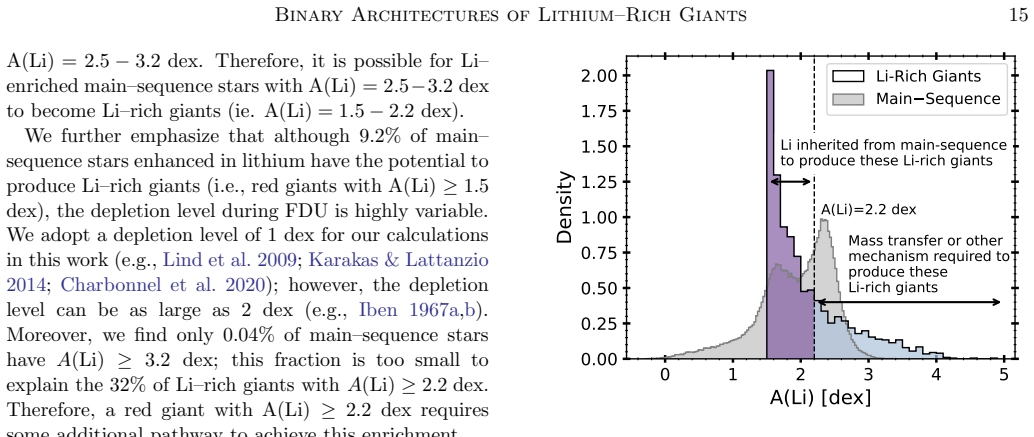
The central discovery is that, under the assumption that lithium-rich red giants form in binaries, the most enriched subset ($A(\mathrm{Li}) \gtrsim 2.2$ dex) requires mass transfer from an intermediate-mass AGB donor, not inheritance from a lithium-rich main-sequence phase. In the COSMIC populations, 29% of matched white-dwarf-red-giant systems contain an AGB star that went through hot-bottom burning (initial mass 4.25 to 8 solar masses), with present-day separations $3.3 \pm 0.5$ AU and initial mass ratios 0.5 to 1.6; mass transfer onto the accretor happens during its main-sequence phase in 98% of Roche-lobe overflow cases. The paper further shows that only 0.04% of GALAH main-sequence stars have $A(\mathrm{Li}) \geq 3.2$ dex, too few to explain the 32% of lithium-rich giants above 2.2 dex by simple post-first-dredge-up depletion, while the 9.2% of main-sequence stars at $A(\mathrm{Li}) = 2.5$ to 3.2 dex can account for the lower-enrichment giants at $A(\mathrm{Li}) = 1.5$ to 2.2 dex. A 1% mass-transfer efficiency reproduces the observed barium and yttrium enhancements to roughly 93 to 95% linear agreement for 6 and 8 solar mass AGB donors, which the paper interprets as evidence for wind Roche-lobe overflow.
Load-bearing premise
The donor star's initial mass is drawn from a uniform distribution between 0.5 and 10 solar masses; that ad hoc prior is what makes intermediate-mass AGB donors common enough to dominate the matched sample, and replacing it with a Gaussian prior centered near 1.5 solar masses drops the intermediate-mass AGB fraction from 35% to 4%.
Editorial extensions
If this is right
- If the claim is correct, the most lithium-rich giants should be found in white-dwarf-red-giant binaries with separations near 3.3 AU and mass ratios 0.5 to 1.6, detectable as radial-velocity variation over a baseline of a few years.
- The observed barium and yttrium enhancements can be explained by about 1% mass-transfer efficiency, implying wind Roche-lobe overflow is the delivery channel; lithium-rich giants with $A(\mathrm{Li}) \gtrsim 2.2$ dex should therefore show correlated s-process enhancement.
- Main-sequence stars with $A(\mathrm{Li}) = 2.5$ to 3.2 dex can become red giants with $A(\mathrm{Li}) = 1.5$ to 2.2 dex without external enrichment, so only the high-lithium tail requires the binary channel.
- Because only 29% of matched systems contain an intermediate-mass AGB donor, the predicted binary detection rate among lithium-rich giants is a testable but prior-dependent number.
Reading between the lines
- An implication left implicit is that the predicted architectures concentrate near the tidal-circularization boundary where wind accretion is efficient; a testable extension would be to check whether the orbits of lithium-rich giants cluster at separations slightly larger than direct Roche-lobe overflow allows.
- The paper's uniform primary-mass prior inflates the intermediate-mass AGB fraction from 4% under a Gaussian prior to 35%; reweighting by a realistic stellar initial mass function would likely lower the predicted companion detection rate and make the barium-yttrium comparison a sharper discriminator between AGB and non-AGB enrichment channels.
- A direct extension of the matching procedure would be to take the 1104 COSMIC-GALAH candidate systems and search for companion motion in upcoming astrometric and radial-velocity releases, converting the predicted architecture into a measured occurrence rate.
- The nucleosynthetic comparison rests on barium and yttrium alone; if a future data release improves uncertainties for other s-process elements such as zirconium, lanthanum, and neodymium, the same 1% efficiency test would either strengthen or break the identification of the AGB donor channel.
Editorial analysis
A structured set of objections, weighed in public.
Referee Report
Summary. The paper combines the COSMIC binary population synthesis code with Monash AGB stellar models and GALAH Li-rich giant samples to ask what binary architectures could produce Li-rich red giants under the assumption of AGB-to-companion mass transfer. Evolving roughly nine million binary systems, the authors select white-dwarf-plus-red-giant systems whose red giants match GALAH Li-rich giants in mass, age, and metallicity. They find that most matched systems undergo mass transfer while the accretor is on the main sequence, that 29% of thermal-pulse AGB systems involve intermediate-mass AGB donors with separations around 3.3 AU and mass ratios 0.5--1.6, and that low mass-transfer efficiency (1%) best reproduces the observed Ba and Y enhancements. The paper concludes that the most enriched Li-rich giants (A(Li) > 2.2 dex) require mass transfer under the binarity assumption, with the preferred donor being an intermediate-mass AGB star. The authors are transparent about many limitations and present the result as a constraint on one hypothesized pathway rather than a definitive formation mechanism.
Significance. If the headline architecture survived the paper's own prior sensitivity tests, it would give a concrete target for Gaia DR4 radial-velocity follow-up and for dedicated binary searches among Li-rich giants. The paper's strengths are its large COSMIC population, its use of detailed nucleosynthesis models with published yields, its explicit discussion of caveats, and its falsifiable predictions (e.g., the expected period/mass-ratio region in Fig. 13 and the APOGEE detectability statement in Section 3.1.1). However, as written, the central quantitative claims are dominated by an ad hoc uniform primary-mass prior and by mass-transfer efficiencies that are calibrated to the very observations later used to claim agreement. The nucleosynthetic comparison also rests on just two reliable elements, so the evidence for an intermediate-mass AGB donor is weaker than the abstract's summary suggests. The paper is a useful scoping study, but the headline conclusions need reframing and quantitative robustness checks before they can be regarded as constraints from the data.
major comments (4)
- [Section 2.2 and Section 4.2] The uniform primary-mass prior between 0.5 and 10 Msun is load-bearing for the abstract's headline quantities. The paper itself reports that the fraction of matched systems with intermediate-mass AGB donors drops from 35% under the uniform prior to 4% under a Gaussian prior centered at 1.5 Msun, while the stellar models in Table 1 and Figure 8 require M_ZAMS > 4.25 Msun for HBB and Li production. Under a more physical, IMF-like prior, essentially none of the matched COSMIC systems would have a donor capable of producing the Li. The statement in Section 4.2 that the main conclusions are consistent between the two priors refers only to the timing of mass transfer (98% versus ~100% on the main sequence), not to the donor mass distribution or to the reported separation s = 3.3 +/- 0.5 AU and mass ratio q = 0.5--1.6. Please report the headline architecture distributions for both priors (or for an IMF-weighted prior), or explicitly reframe the 29% fraction, the separation, and the mass ratio as products of a deliberately flat prior rather than as constraints from GALAH data.
- [Section 3.3, Section 3.4, and Figure 10] The mass-transfer efficiency beta is calibrated to the same observations that are later used to claim agreement. In Section 3.3, beta = 5% is chosen because it yields a final lithium abundance consistent with the average A(Li) of the GALAH sample; in Section 3.4 and Figure 10, beta = 1% is chosen because it best matches the observed Ba, Y, and O enhancements. The '95% agreement in mean enhancements' is therefore an after-fit residual, not an independent prediction. Please provide a formal model comparison that accounts for the number of free parameters, ideally using a held-out subset of elements or an independent calibration sample, or explicitly describe the agreement as a consistency check whose fitted status is stated.
- [Section 3.4 and Figure 11C] The nucleosynthetic support for an intermediate-mass AGB donor rests on only two elements, Ba and Y, while most other s-process elements show no significant difference between Li-rich giants and their doppelgangers, and the models systematically overpredict s-process enhancements relative to the observations. The observed abundances are averages over a population with a range of masses and metallicities, whereas the models are for a single solar-metallicity, 1 Msun accretor, so the reported 95--97% linear-scale agreement conflates genuine model-data mismatch with population averaging. Please quantify the covariance and systematic uncertainties in the abundance comparison, and test at least one model at the mean metallicity of the Li-rich sample ([Fe/H] approximately -0.34 dex), before presenting the 6 and 8 Msun donors as the favored solutions.
- [Section 4.1 and Figure 12] The statement that Li-rich giants with A(Li) >= 2.2 dex could only be produced with mass transfer, under the assumption of binarity, is stronger than the presented evidence. The argument depends on an assumed first dredge-up depletion of about 1 dex (the text itself notes depletions up to 2 dex), on the measured fraction of main-sequence stars in a restricted Teff--log g window, and on excluding the other enrichment channels that the authors list in Section 4.3, such as mergers, the He-flash, and tidal spin-up. Please quantify the fraction of Li-rich giants with A(Li) >= 2.2 under a range of FDU depletion assumptions and state explicitly that 'could only' is conditional on the binary mass-transfer channel being the designated hypothesis.
minor comments (5)
- [Section 2.2] The text says 'We initialize 8,995,738 million binary systems,' which should presumably read '8,995,738 binary systems' (or 'about 9 million'); please correct this numerical typo.
- [Equation (2)] Equation (2) sums over i = 1 to 4, but the text and Figure 3 describe three matched parameters (mass, age, and metallicity); please reconcile the summation index with the list of parameters.
- [Figures 4 and 7] The mass-ratio definition changes between Figure 4 (q = M1/M2 with M1 > M2) and Figure 7 (q = M2/M1 with M2 < M1); please state both definitions explicitly in the respective captions to avoid confusion.
- [Section 2.2] The text says the input eccentricity is 'distributed randomly' without specifying the distribution; please state the eccentricity sampling used by COSMIC, since it affects the initial conditions for RLOF and circularization.
- [Abstract and Section 4.2] The timing fraction is quoted as 98% in several places and as 'almost 100%' in Section 4.2; please use a single consistent value or explain the difference.
Circularity Check
Mass-transfer efficiency is tuned to the GALAH abundance offsets that are then quoted as '95% agreement,' and the 29% intermediate-mass AGB fraction is the direct product of a uniform prior chosen to guarantee that population.
-
fitted input called prediction
[Section 3.3 (Equation 4, Figure 10) and Section 3.4]
"We chose 5% mass transfer efficiency as this resulted in a final lithium abundance consistent with the average A(Li) of the GALAH sample. ... Based on Figure 10, we use 1% mass transfer efficiency in our analysis with stellar models. ... there is a 95 − 97% agreement between the observed Ba value and the values from 6 and 8 M⊙, and a 93 − 95% agreement for Y."
The mass-transfer efficiency beta is a free parameter selected to reproduce the same GALAH abundance offsets (A(Li) average at 5%, then Ba/Y/O at 1%) that are later quoted as '95% agreement.' The agreement is therefore an after-fit comparison, not an independent prediction: the model was tuned to the data and then compared to the same data. The conclusion that low-efficiency wind RLOF 'best reproduces' GALAH observations inherits the same circularity, since the comparison was used to pick beta. No held-out or external constraint fixes beta.
-
self definitional
[Section 2.2 (COSMIC initialization) and Section 4.2 (Assumptions & Simplifications)]
"the primary's mass (ie. AGB companion now a white dwarf) is sampled from a uniform distribution between 0.5 − 10 M⊙. ... We chose to use a uniform distribution to sample from for the primary's mass to ensure a large sample size for systems that undergo RLOF and end up with intermediate–mass AGB companions. ... the number of systems with an intermediate–mass AGB is only 4% if we choose a Gaussian distribution centered on 1.5 M⊙ as compared to 35% if we choose a uniform prior between 0.5−10 M⊙."
The headline result that intermediate-mass AGB stars comprise 29% of matched COSMIC systems is the posterior of a prior explicitly chosen to ensure a large sample of intermediate-mass AGB systems. The paper's own sensitivity test shows the fraction drops to 4% under a Gaussian prior centered at 1.5 Msun. Since the stellar models (Table 1, Figure 8) require M_ZAMS >= 4.25 Msun for HBB and Li production, the 29% fraction and the derived separations (3.3 +- 0.5 AU) and mass ratios (0.5-1.6) are direct products of the input prior rather than constraints from GALAH data; the prior was defined to produce the claimed population.
full rationale
The COSMIC population synthesis is a genuine forward model: nearly 9 million systems are evolved with default COSMIC physics, matched to GALAH red-giant parameters by chi-squared, and the resulting white-dwarf-red-giant architectures (including the APOGEE detectability comparison) are largely independent of the circularity issues. The stellar models of Karakas (2014) and Karakas & Lugaro (2016), although co-authored by a co-author of the present paper, are externally published models with stated assumptions and are not invoked as a uniqueness theorem, so they do not constitute load-bearing self-citation. However, two key quantitative claims are circular or forced. First, the 95% (Ba) and 93-95% (Y) 'agreement' is obtained after choosing the 1% mass-transfer efficiency because it best reproduces the same Ba/Y/O offsets; the 5% efficiency for Li was likewise chosen to match the average A(Li). These agreement statistics are after-fits rather than predictions. Second, the 29% intermediate-mass AGB fraction and associated separations and mass ratios are the posterior of a uniform primary-mass prior that the authors state was chosen to ensure a large sample of exactly those systems; their own Gaussian-prior test drops the fraction to 4%, where the Li-producing channel nearly vanishes. The paper discloses both choices, which is commendable, but disclosure does not remove the circularity. Overall, the central architecture and nucleosynthesis conclusions are partially forced by construction, though the COSMIC framework and matching procedure retain independent predictive content.
Assumptions & free parameters
free parameters (5)
- Mass transfer efficiency beta =
1% (also 5% used for Li mixing)
- Primary mass prior =
uniform 0.5-10 M_sun
- Initial separation upper bound =
14 AU (3000 R_sun)
- First dredge-up Li depletion =
1 dex
- AGB donor Li abundance =
A(Li) = 3.2 dex
assumptions (7)
- domain assumption COSMIC binary interaction prescriptions (Hurley et al. 2002; Vassiliadis & Wood 1993; Vink et al. 2001; Belczynski et al. 2008) are valid for these systems.
- ad hoc to paper The observed Li-rich giant is the secondary (accretor) in a binary whose primary went through AGB and is now a white dwarf.
- domain assumption First dredge-up depletes surface lithium by roughly 1 dex.
- domain assumption Hot bottom burning in AGB stars with M >= 4.25 M_sun produces Li via the pp-2 chain.
- domain assumption Monash AGB model yields from Karakas (2014) and Karakas & Lugaro (2016) correctly represent Li, Ba, Y, and O production.
- domain assumption GALAH DR3 stellar parameters (mass, age, metallicity) are accurate to quoted uncertainties for matching.
- ad hoc to paper Mass transfer efficiency is constant across systems and set to 1% for predictions.
Cite this review
Pith. "Pith review of Probing Binary Architectures of Lithium-Rich Giants in GALAH with COSMIC and Stellar Models." pith.science (2026). https://pith.science/paper/ZZ4PI5GX
@misc{pith2026250705359,
  author       = {Pith},
  title        = {Pith review of: Probing Binary Architectures of Lithium-Rich Giants in GALAH with COSMIC and Stellar Models},
  year         = {2026},
  howpublished = {\url{https://pith.science/paper/ZZ4PI5GX}},
  note         = {Machine review of arXiv:2507.05359}
}
abstract
Surface lithium is depleted when a star goes through the first dredge-up phase, yet $1\%$ of red giants are found to be Li-rich. The formation mechanism for these remains uncertain. We combine observational constraints from GALAH Li-rich giants, with the binary population synthesis code COSMIC to investigate system properties of these objects assuming binary mass transfer. By evolving 9 million binary systems, we find that binary histories most consistent with observational constraints are mass transfer from an intermediate-mass AGB donor to a main-sequence star now observed as a Li-rich red giant. In GALAH, $9\%$ of main-sequence stars have $\rm A(Li)=2.5-3.2$ dex making it plausible to create red giants with $\rm A(Li)=1.5-2.2 \; dex$ via main-sequence mass transfer, but cannot explain the more enriched giants $\rm A(Li) \gtrsim 2.2 \; dex$. Nucleosynthetic yields from stellar models show that AGB stars with initial masses of $4.25-5 \; \rm M_\odot$ and $8 \; \rm M_\odot$ contain the most Li in their ejecta. Intermediate-mass AGB stars comprise $29\%$ of COSMIC results, with present-day separations $s=3.3\pm0.5 \rm \; AU$ and mass ratios $q=0.5-1.6$. We achieve $95\%$ agreement in mean enhancements in $\rm (Ba, Y)$ between GALAH observations and stellar models of 6 and $8 \rm \; M_\odot$ AGB, assuming $1\%$ mass transfer efficiency. We find a low mass transfer efficiency best reproduces GALAH observations suggesting that the preferred mass transfer mechanism for Li-enrichment is via wind Roche Lobe Overflow. While we constrain the most plausible binary parameters assuming AGB mass transfer creates Li-rich giants, discrepancies in nucleosynthesis comparisons, and the small fraction of Li-enhanced main-sequence stars suggests additional enrichment mechanisms are likely.
Figures


Figures from the paper (9 more)



Reference graph
Works this paper leans on
-
[1]
2012, ApJL, 754, L15, doi: 10.1088/2041-8205/754/1/L15
Wolszczan, A. 2012, ApJL, 754, L15, doi: 10.1088/2041-8205/754/1/L15
-
[2]
Alexander, J. B. 1967, The Observatory, 87, 238
1967
-
[3]
2023, The Astronomy and Astrophysics Review, 31, 1
Arcones, A., & Thielemann, F.-K. 2023, The Astronomy and Astrophysics Review, 31, 1
2023
-
[4]
Asplund, M., Grevesse, N., Sauval, A. J., & Scott, P. 2009, ARA&A, 47, 481, doi: 10.1146/annurev.astro.46.060407.145222
arXiv 2009
-
[5]
Belczynski, K., Kalogera, V., Rasio, F. A., et al. 2008, ApJS, 174, 223, doi: 10.1086/521026
doi:10.1086/521026 2008
-
[6]
A., & Critchfield, C
Bethe, H. A., & Critchfield, C. L. 1938, Physical Review, 54, 248
1938
-
[7]
Blanton, M. R., Bershady, M. A., Abolfathi, B., et al. 2017, AJ, 154, 28, doi: 10.3847/1538-3881/aa7567
-
[8]
I., Sackmann, I., Wasserburg, G., et al
Boothroyd, A. I., Sackmann, I., Wasserburg, G., et al. 1995, Astrophysical Journal, Part 2-Letters (ISSN 0004-637X), vol. 442, no. 1, p. L21-L24, 442, L21 Binary Architectures of Lithium–Rich Giants 19
1995
Show all 108 references
-
[9]
Breivik, K., Chatterjee, S., & Larson, S. L. 2017, ApJL, 850, L13, doi: 10.3847/2041-8213/aa97d5
2017 doi
-
[10]
2020, ApJ, 898, 71, doi: 10.3847/1538-4357/ab9d85
Breivik, K., Coughlin, S., Zevin, M., et al. 2020, ApJ, 898, 71, doi: 10.3847/1538-4357/ab9d85
2020 doi
-
[11]
2021, MNRAS, 506, 150, doi: 10.1093/mnras/stab1242
Buder, S., Sharma, S., Kos, J., et al. 2021, MNRAS, 506, 150, doi: 10.1093/mnras/stab1242
2021 doi
- [12]
-
[13]
Cameron, A. G. W., & Fowler, W. A. 1971, ApJ, 164, 111, doi: 10.1086/150821
1971 doi
-
[14]
Cannon, R. C. 1993, MNRAS, 263, 817, doi: 10.1093/mnras/263.4.817
1993 doi
-
[15]
R., Ho, A
Casey, A. R., Ho, A. Y. Q., Ness, M., et al. 2019, ApJ, 880, 125, doi: 10.3847/1538-4357/ab27bf
2019 doi
-
[16]
2023, arXiv e-prints, arXiv:2401.00049, doi: 10.48550/arXiv.2401.00049 Chanam´ e, J., Pinsonneault, M
Castro-Tapia, M., Aguilera-G´ omez, C., & Chanam´ e, J. 2023, arXiv e-prints, arXiv:2401.00049, doi: 10.48550/arXiv.2401.00049 Chanam´ e, J., Pinsonneault, M. H., Aguilera-G´ omez, C., &
-
[17]
Zinn, J. C. 2022, ApJ, 933, 58, doi: 10.3847/1538-4357/ac70c8
2022 doi
-
[18]
2022, arXiv e-prints, arXiv:2206.11275
Chance, Q., Foreman-Mackey, D., Ballard, S., et al. 2022, arXiv e-prints, arXiv:2206.11275. https://arxiv.org/abs/2206.11275
2022 arXiv
-
[19]
2020, A&A, 633, A34, doi: 10.1051/0004-6361/201936360
Charbonnel, C., Lagarde, N., Jasniewicz, G., et al. 2020, A&A, 633, A34, doi: 10.1051/0004-6361/201936360
2020 doi
-
[20]
2022, ApJ, 931, 107, doi: 10.3847/1538-4357/ac60a5
Chawla, C., Chatterjee, S., Breivik, K., et al. 2022, ApJ, 931, 107, doi: 10.3847/1538-4357/ac60a5
2022 doi
-
[21]
2017, MNRAS, 468, 4465, doi: 10.1093/mnras/stx680
Carroll-Nellenback, J. 2017, MNRAS, 468, 4465, doi: 10.1093/mnras/stx680
2017 doi
-
[22]
2020, ApJ, 892, 110, doi: 10.3847/1538-4357/ab7b6e
Chen, Z., Ivanova, N., & Carroll-Nellenback, J. 2020, ApJ, 892, 110, doi: 10.3847/1538-4357/ab7b6e
2020 doi
-
[23]
2018, A&A, 620, A146, doi: 10.1051/0004-6361/201834079
Cseh, B., Lugaro, M., D’Orazi, V., et al. 2018, A&A, 620, A146, doi: 10.1051/0004-6361/201834079
2018 doi
-
[24]
P., et al
Cseh, B., Vil´ agos, B., Roriz, M. P., et al. 2022, A&A, 660, A128, doi: 10.1051/0004-6361/202142468
2022 doi
-
[25]
2012, Research in Astronomy and Astrophysics, 12, 1197, doi: 10.1088/1674-4527/12/9/003 de Mink, S
Cui, X.-Q., Zhao, Y.-H., Chu, Y.-Q., et al. 2012, Research in Astronomy and Astrophysics, 12, 1197, doi: 10.1088/1674-4527/12/9/003 de Mink, S. E., Pols, O. R., & Hilditch, R. W. 2007, A&A, 467, 1181, doi: 10.1051/0004-6361:20067007 De Silva, G. M., Freeman, K. C., Bland-Hawth...
2012 doi
-
[26]
L., & Reddy, B
Deepak, Lambert, D. L., & Reddy, B. E. 2020, MNRAS, 494, 1348, doi: 10.1093/mnras/staa729 Deepak, & Reddy, B. E. 2019, MNRAS, 484, 2000, doi: 10.1093/mnras/stz128 Delgado Mena, E., Israelian, G., Gonz´ alez Hern´ andez, J. I., et al. 2014, A&A, 562, A92, doi: 10.1051/0004-6361...
2020 doi
-
[27]
M., Oudmaijer, R
Dodd, J. M., Oudmaijer, R. D., Radley, I. C., Vioque, M., & Frost, A. J. 2024, MNRAS, 527, 3076, doi: 10.1093/mnras/stad3105
2024 doi
-
[28]
Eggleton, P. P. 1983, ApJ, 268, 368, doi: 10.1086/160960
1983 doi
-
[29]
2023, MNRAS, 518, 1057, doi: 10.1093/mnras/stac3140
El-Badry, K., Rix, H.-W., Quataert, E., et al. 2023, MNRAS, 518, 1057, doi: 10.1093/mnras/stac3140
2023 doi
-
[30]
Escorza, A., & De Rosa, R. J. 2023, A&A, 671, A97, doi: 10.1051/0004-6361/202244782
2023 doi
-
[31]
1996, ApJ, 473, 383 Gaia Collaboration, Prusti, T., de Bruijne, J
Frost, C., & Lattanzio, J. 1996, ApJ, 473, 383 Gaia Collaboration, Prusti, T., de Bruijne, J. H. J., et al. 2016, A&A, 595, A1, doi: 10.1051/0004-6361/201629272 Gaia Collaboration, Brown, A. G. A., Vallenari, A., et al. 2018, A&A, 616, A1, doi: 10.1051/0004-6361/201833051
1996 doi
-
[32]
2019, ApJS, 245, 33, doi: 10.3847/1538-4365/ab505c
Gao, Q., Shi, J.-R., Yan, H.-L., et al. 2019, ApJS, 245, 33, doi: 10.3847/1538-4365/ab505c
2019 doi
-
[33]
M., et al
Gao, X., Lind, K., Amarsi, A. M., et al. 2020, MNRAS, 497, L30, doi: 10.1093/mnrasl/slaa109 Garc ´ ıa-Hern´ andez, D. A., Garc ´ ıa-Lario, P., Plez, B., et al. 2006, Science, 314, 1751, doi: 10.1126/science.1133706 Garc ´ ıa-Hern´ andez, D. A., Zamora, O., Yag¨ ue, A., et al. ...
2020 doi
-
[34]
2004, Astronomy & Astrophysics, 421, L25
Goriely, S., & Siess, L. 2004, Astronomy & Astrophysics, 421, L25
2004
-
[35]
Groenewegen, M. A. T., Wood, P. R., Sloan, G. C., et al. 2007, MNRAS, 376, 313, doi: 10.1111/j.1365-2966.2007.11428.x
2007
-
[36]
E., Siegmund, W
Gunn, J. E., Siegmund, W. A., Mannery, E. J., et al. 2006, AJ, 131, 2332, doi: 10.1086/500975
2006 doi
- [37]
-
[38]
2004, The Astrophysical Journal, 605, 425
Herwig, F. 2004, The Astrophysical Journal, 605, 425
2004
-
[39]
2005, ARA&A, 43, 435, doi: 10.1146/annurev.astro.43.072103.150600
Herwig, F. 2005, ARA&A, 43, 435, doi: 10.1146/annurev.astro.43.072103.150600
2005 arXiv
-
[40]
S., & Webbink, R
Hjellming, M. S., & Webbink, R. F. 1987, ApJ, 318, 794, doi: 10.1086/165412 H¨ ofner, S., & Olofsson, H. 2018, A&A Rv, 26, 1, doi: 10.1007/s00159-017-0106-5
1987 doi
-
[41]
R., Tout, C
Hurley, J. R., Tout, C. A., & Pols, O. R. 2002, MNRAS, 329, 897, doi: 10.1046/j.1365-8711.2002.05038.x
2002
-
[42]
1967a, ApJ, 147, 624, doi: 10.1086/149040 —
Iben, Jr., I. 1967a, ApJ, 147, 624, doi: 10.1086/149040 —. 1967b, ApJ, 147, 650, doi: 10.1086/149041
-
[43]
A., & Rogers, F
Iglesias, C. A., & Rogers, F. J. 1996, ApJ, 464, 943
1996
-
[44]
C., Mayor, M., & Rebolo, R
Israelian, G., Santos, N. C., Mayor, M., & Rebolo, R. 2004, A&A, 414, 601, doi: 10.1051/0004-6361:20034398 20 Sayeed et al
2004 doi
-
[45]
C., et al
Israelian, G., Delgado Mena, E., Santos, N. C., et al. 2009, Nature, 462, 189, doi: 10.1038/nature08483
2009 doi
-
[46]
Karakas, A., & Lattanzio, J. C. 2007, Pub. Astron. Soc. Aus., 24, 103
2007
-
[47]
Karakas, A. I. 2014, Monthly Notices of the Royal Astronomical Society, 445, 347
2014
-
[48]
I., Garc ´ ıa-Hern´ andez, D
Karakas, A. I., Garc ´ ıa-Hern´ andez, D. A., & Lugaro, M. 2012, ApJ, 751, 8, doi: 10.1088/0004-637X/751/1/8
2012 doi
-
[49]
I., & Lattanzio, J
Karakas, A. I., & Lattanzio, J. C. 2014, PASA, 31, e030, doi: 10.1017/pasa.2014.21
2014 doi
-
[50]
I., & Lugaro, M
Karakas, A. I., & Lugaro, M. 2016, The Astrophysical Journal, 825, 26
2016
-
[51]
I., Marino, A
Karakas, A. I., Marino, A. F., & Nataf, D. M. 2014, ApJ, 784, 32, doi: 10.1088/0004-637X/784/1/32
2014 doi
-
[52]
R., Deliyannis, C
King, J. R., Deliyannis, C. P., Hiltgen, D. D., et al. 1997, AJ, 113, 1871, doi: 10.1086/118399
1997 doi
-
[53]
2012, Stellar Structure and Evolution, Springer
Kippenhahn, R., Weigert, A., & Weiss, A. 2012, Stellar Structure and Evolution, Springer
2012
-
[54]
G., & Pols, O
Klencki, J., Nelemans, G., Istrate, A. G., & Pols, O. 2020, A&A, 638, A55, doi: 10.1051/0004-6361/202037694
2020 doi
-
[55]
I., & Lugaro, M
Kobayashi, C., Karakas, A. I., & Lugaro, M. 2020, ApJ, 900, 179, doi: 10.3847/1538-4357/abae65
2020 doi
-
[56]
B., Reddy, B
Kumar, Y. B., Reddy, B. E., Campbell, S. W., et al. 2020, Nature Astronomy, 4, 1059, doi: 10.1038/s41550-020-1139-7
2020 doi
-
[57]
Lattanzio, J., Frost, C., Cannon, R., & Wood, P. R. 1996, Mem. Soc. Astron. Italiana, 67, 729
1996
-
[58]
Lattanzio, J. C. 1984, PhD thesis, Monash University
1984
-
[59]
Lattanzio, J. C. 1986, ApJ, 311, 708, doi: 10.1086/164810
1986 doi
-
[60]
Lattanzio, J. C. 1992, Publications of the Astronomical Society of Australia, 10, 120
1992
-
[61]
C., Siess, L., Church, R
Lattanzio, J. C., Siess, L., Church, R. P., et al. 2015, MNRAS, 446, 2673, doi: 10.1093/mnras/stu2238
2015 doi
-
[62]
M., & Geller, A
Leiner, E. M., & Geller, A. 2021, ApJ, 908, 229, doi: 10.3847/1538-4357/abd7e9
2021 doi
-
[63]
2009, A&A, 503, 545, doi: 10.1051/0004-6361/200912524
Asplund, M. 2009, A&A, 503, 545, doi: 10.1051/0004-6361/200912524
2009 doi
-
[64]
2018, A&A, 616, A2, doi: 10.1051/0004-6361/201832727
Lindegren, L., Hern´ andez, J., Bombrun, A., et al. 2018, A&A, 616, A2, doi: 10.1051/0004-6361/201832727
2018 doi
-
[65]
I., Stancliffe, R
Lugaro, M., Karakas, A. I., Stancliffe, R. J., & Rijs, C. 2012, ApJ, 747, 2, doi: 10.1088/0004-637X/747/1/2
2012 doi
-
[66]
2023, Annual Review of Nuclear and Particle Science, 73, 315
Lugaro, M., Pignatari, M., Reifarth, R., & Wiescher, M. 2023, Annual Review of Nuclear and Particle Science, 73, 315
2023
-
[67]
Mallick, A., Singh, R., & Reddy, B. E. 2023, ApJL, 944, L5, doi: 10.3847/2041-8213/acb5f6
2023 doi
-
[68]
2009, Astronomy & Astrophysics, 508, 1539
Marigo, P., & Aringer, B. 2009, Astronomy & Astrophysics, 508, 1539
2009
-
[69]
L., Simpson, J
Martell, S. L., Simpson, J. D., Balasubramaniam, A. G., et al. 2021, MNRAS, 505, 5340, doi: 10.1093/mnras/stab1356
2021 doi
- [70]
-
[71]
A., Wood, P
McSaveney, J. A., Wood, P. R., Scholz, M., Lattanzio, J. C., & Hinkle, K. H. 2007, Monthly Notices of the Royal Astronomical Society, 378, 1089
2007
-
[72]
2021, ChA&A, 45, 45, doi: 10.1016/j.chinastron.2021.02.003
Ming-hao, D., Shao-lan, B., Jian-rong, S., & Hong-liang, Y. 2021, ChA&A, 45, 45, doi: 10.1016/j.chinastron.2021.02.003
2021 doi
-
[73]
A., & Eggleton, P
Nelson, C. A., & Eggleton, P. P. 2001, ApJ, 552, 664, doi: 10.1086/320560
2001 doi
-
[74]
J., Casey, A
Norfolk, B. J., Casey, A. R., Karakas, A. I., et al. 2019, MNRAS, 490, 2219, doi: 10.1093/mnras/stz2630
2019 doi
-
[75]
Prandtl, L. 1925, Z. Angew. Math. Mech., 136
1925
-
[76]
M., Hogg, D
Price-Whelan, A. M., Hogg, D. W., Rix, H.-W., et al. 2020, ApJ, 895, 2, doi: 10.3847/1538-4357/ab8acc
2020 doi
- [77]
-
[78]
Z., & Fuller, J
Rui, N. Z., & Fuller, J. 2024, The Open Journal of Astrophysics, 7, 81, doi: 10.33232/001c.123878
2024 doi
-
[79]
2017, A&A, 605, A59, doi: 10.1051/0004-6361/201730522
Rybizki, J., Just, A., & Rix, H.-W. 2017, A&A, 605, A59, doi: 10.1051/0004-6361/201730522
2017 doi
-
[80]
J., & Boothroyd, A
Sackmann, I. J., & Boothroyd, A. I. 1992, ApJL, 392, L71, doi: 10.1086/186428
1992 doi
-
[81]
K., Montet, B
Sayeed, M., Ness, M. K., Montet, B. T., et al. 2024, ApJ, 964, 42, doi: 10.3847/1538-4357/ad1936
2024 doi
-
[82]
2022, A&A, 659, A98, doi: 10.1051/0004-6361/202142574
Sen, K., Langer, N., Marchant, P., et al. 2022, A&A, 659, A98, doi: 10.1051/0004-6361/202142574
2022 doi
-
[83]
2015, Journal of Astronomical Telescopes, Instruments, and Systems, 1, 035002, doi: 10.1117/1.JATIS.1.3.035002
Sheinis, A., Anguiano, B., Asplund, M., et al. 2015, Journal of Astronomical Telescopes, Instruments, and Systems, 1, 035002, doi: 10.1117/1.JATIS.1.3.035002
2015 doi
-
[84]
1999a, MNRAS, 304, 925, doi: 10.1046/j.1365-8711.1999.02376.x —
Siess, L., & Livio, M. 1999a, MNRAS, 304, 925, doi: 10.1046/j.1365-8711.1999.02376.x —. 1999b, MNRAS, 308, 1133, doi: 10.1046/j.1365-8711.1999.02784.x
1999
-
[85]
E., Bharat Kumar, Y., & Antia, H
Singh, R., Reddy, B. E., Bharat Kumar, Y., & Antia, H. M. 2019, ApJL, 878, L21, doi: 10.3847/2041-8213/ab2599
2019 doi
-
[86]
V., & Lambert, D
Smith, V. V., & Lambert, D. L. 1989, Astrophysical
1989
-
[87]
345, Oct
Journal, Part 2-Letters (ISSN 0004-637X), vol. 345, Oct. 15, 1989, p. L75-L78. Research supported by the Robert A. Welch Foundation., 345, L75 —. 1990, Astrophysical Journal, Part 2-Letters (ISSN 0004-637X), vol. 361, Oct. 1, 1990, p. L69-L72. Research supported by the Robert ...
1989
-
[88]
Soares-Furtado, M., Cantiello, M., MacLeod, M., & Ness, M. K. 2021, AJ, 162, 273, doi: 10.3847/1538-3881/ac273c Binary Architectures of Lithium–Rich Giants 21
2021 doi
-
[89]
E., & Luger, R
Thiele, S., Breivik, K., Sanderson, R. E., & Luger, R. 2023, ApJ, 945, 162, doi: 10.3847/1538-4357/aca7be
2023 doi
-
[90]
1993, Astrophysical Journal, Part 1 (ISSN 0004-637X), vol
Vassiliadis, E., & Wood, P. 1993, Astrophysical Journal, Part 1 (ISSN 0004-637X), vol. 413, no. 2, p. 641-657., 413, 641
1993
-
[91]
Vassiliadis, E., & Wood, P. R. 1993, ApJ, 413, 641, doi: 10.1086/173033
1993 doi
-
[92]
2009, ApJL, 705, L81, doi: 10.1088/0004-637X/705/1/L81
Villaver, E., & Livio, M. 2009, ApJL, 705, L81, doi: 10.1088/0004-637X/705/1/L81
2009 doi
-
[93]
S., de Koter, A., & Lamers, H
Vink, J. S., de Koter, A., & Lamers, H. J. G. L. M. 2001, A&A, 369, 574, doi: 10.1051/0004-6361:20010127
2001 doi
-
[94]
1953, Zeitschrift fur Astrophysik, 32, 135
Vitense, E. 1953, Zeitschrift fur Astrophysik, 32, 135
1953
-
[95]
2025, MNRAS, 536, 2485, doi: 10.1093/mnras/stae2769
Castro-Ginard, A. 2025, MNRAS, 536, 2485, doi: 10.1093/mnras/stae2769
2025 doi
-
[96]
1982, ApJ, 255, 577, doi: 10.1086/159859
Wallerstein, G., & Sneden, C. 1982, ApJ, 255, 577, doi: 10.1086/159859
1982 doi
-
[97]
J., Hogg, D
Wheeler, A. J., Hogg, D. W., & Ness, M. 2021, ApJ, 908, 247, doi: 10.3847/1538-4357/abd544
2021 doi
-
[98]
Wong, K. W. K., Breivik, K., Farr, W. M., & Luger, R. 2023, ApJ, 950, 181, doi: 10.3847/1538-4357/acc863
2023 doi
-
[99]
Wong, K. W. K., Breivik, K., Kremer, K., & Callister, T. 2021, PhRvD, 103, 083021, doi: 10.1103/PhysRevD.103.083021
2021 doi
-
[100]
R., Bessell, M
Wood, P. R., Bessell, M. S., & Fox, M. W. 1983, ApJ, 272, 99, doi: 10.1086/161265
1983 doi
-
[101]
2021, Nature Astronomy, 5, 86, doi: 10.1038/s41550-020-01217-8
Yan, H.-L., Zhou, Y.-T., Zhang, X., et al. 2021, Nature Astronomy, 5, 86, doi: 10.1038/s41550-020-01217-8
2021 doi
-
[102]
S., Shi, J
Yan, T. S., Shi, J. R., Wang, L., et al. 2022, ApJL, 929, L14, doi: 10.3847/2041-8213/ac63a5
2022 doi
-
[103]
S., Berry, C
Zevin, M., Bavera, S. S., Berry, C. P. L., et al. 2021, ApJ, 910, 152, doi: 10.3847/1538-4357/abe40e
2021 doi
-
[104]
2021, ApJL, 919, L3, doi: 10.3847/2041-8213/ac224c
Zhang, J., Shi, J.-R., Yan, H.-L., et al. 2021, ApJL, 919, L3, doi: 10.3847/2041-8213/ac224c
2021 doi
-
[105]
Zhang, X., & Jeffery, C. S. 2013, MNRAS, 430, 2113, doi: 10.1093/mnras/stt035
2013 doi
-
[106]
S., Li, Y., & Bi, S
Zhang, X., Jeffery, C. S., Li, Y., & Bi, S. 2020, ApJ, 889, 33, doi: 10.3847/1538-4357/ab5e89
2020 doi
-
[107]
2012, Research in Astronomy and Astrophysics, 12, 723, doi: 10.1088/1674-4527/12/7/002
Zhao, G., Zhao, Y.-H., Chu, Y.-Q., Jing, Y.-P., & Deng, L.-C. 2012, Research in Astronomy and Astrophysics, 12, 723, doi: 10.1088/1674-4527/12/7/002
2012 doi
-
[108]
2022, ApJ, 931, 136, doi: 10.3847/1538-4357/ac6b3a 22 Sayeed et al
Zhou, Y., Wang, C., Yan, H., et al. 2022, ApJ, 931, 136, doi: 10.3847/1538-4357/ac6b3a 22 Sayeed et al. APPENDIX A. ABUNDANCE CALCULATION In order to calculate a surface abundance post mass transfer, we first convert number fraction N (i) – which is the output for each species...
2022 doi
Reviewed August 6, 2026 · model on record in the stance chip above.
Discussion (0). Sign in to comment.