Adult sex ratio as an index for male strategy in primates
Pith reviewed 2026-05-25 13:51 UTC · model grok-4.3
The pith
Adult sex ratio indexes whether primate males guard mates or mate multiply.
A machine-rendered reading of the paper's core claim, the machinery that carries it, and where it could break.
Core claim
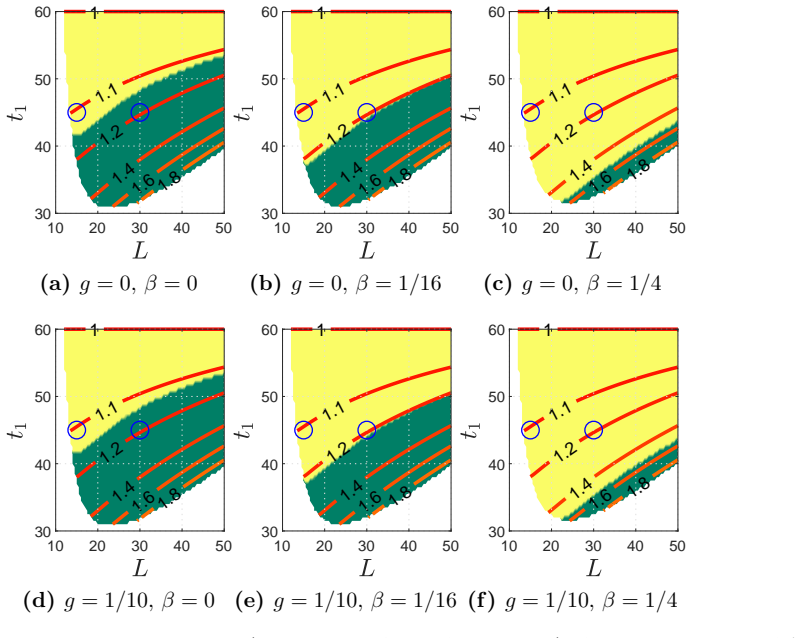
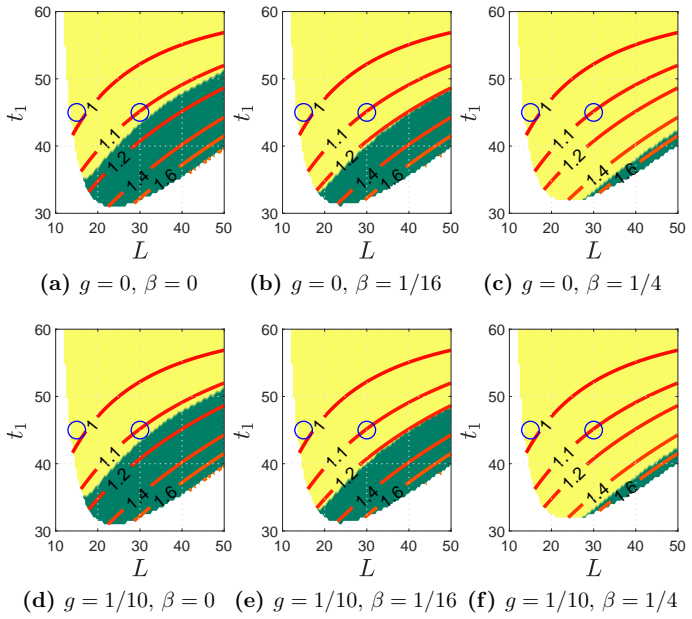
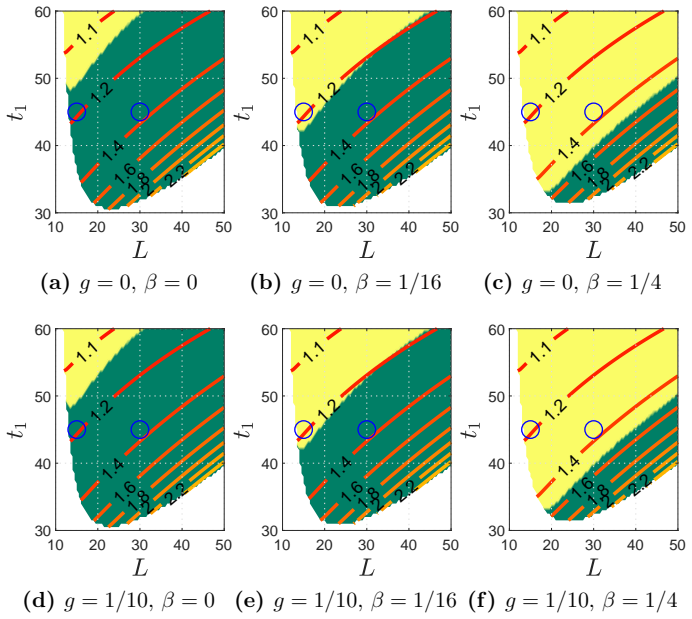
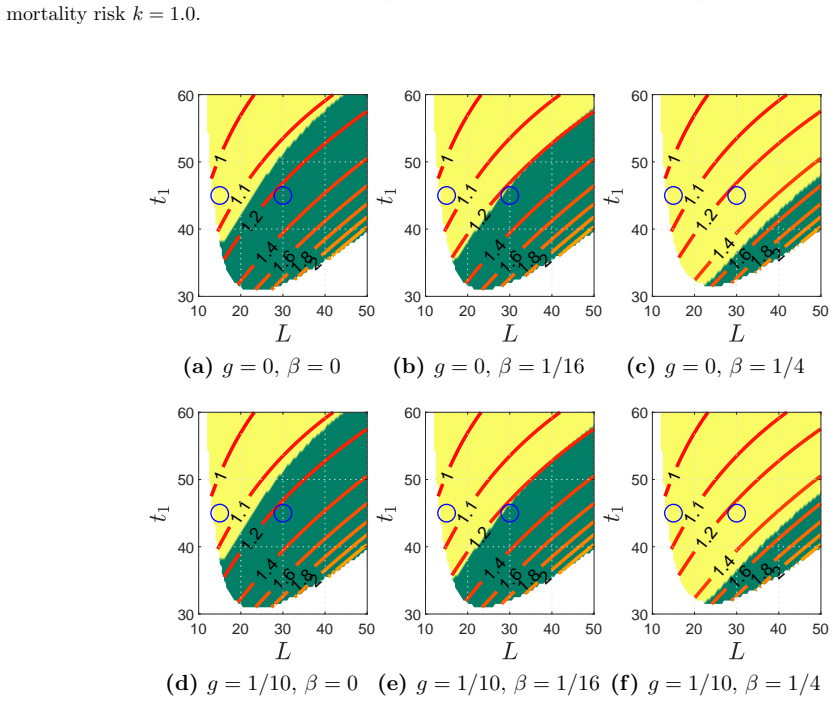
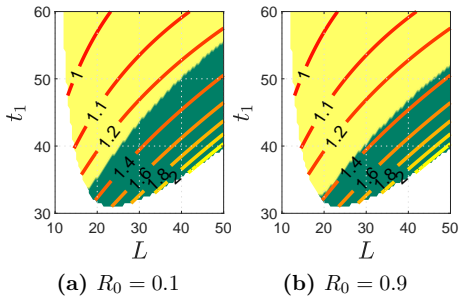
For fixed guarding effectiveness, the dominant strategy changes from multiple mating to guarding along a curve that aligns well with a contour of constant ASR as parameters such as longevity and age of female fertility end are varied. This confirms that ASR may serve as a useful index for predicting optimal male mating strategy given limited ecological and behavioral information.
What carries the argument
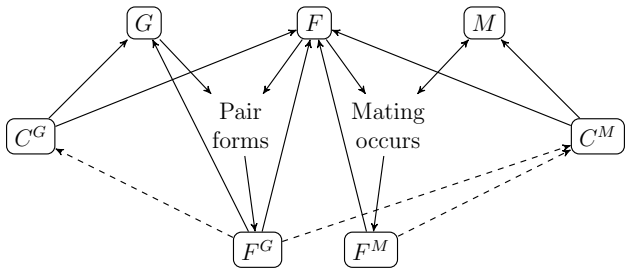
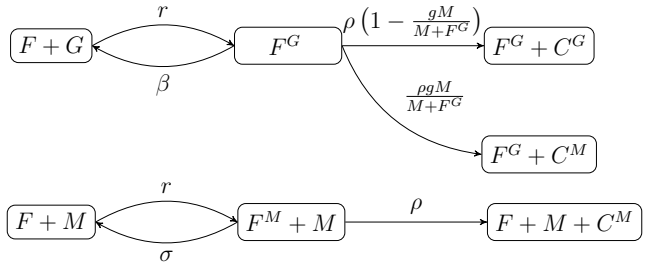
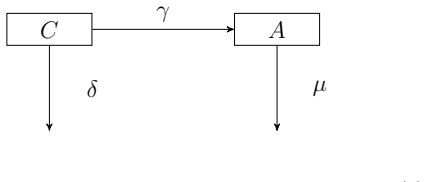
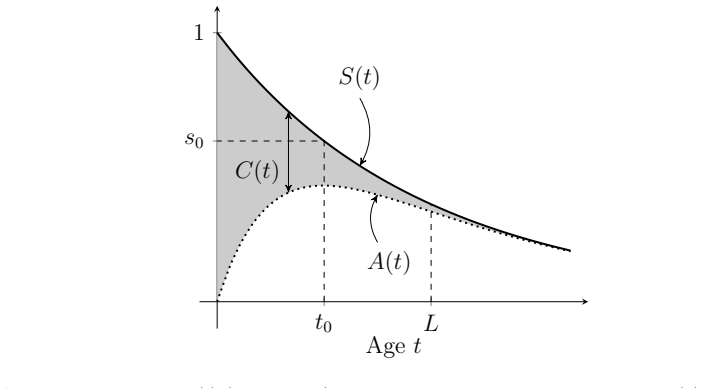
A minimal age-structured system of ordinary differential equations tracking fertile males and females under two competing male strategies: multiple mating versus searching then guarding.
If this is right
- ASR is strongly influenced by life history parameters such as longevity.
- Dominant strategy is affected most strongly by guarding effectiveness and moderately by some life history traits.
- Strategy transition aligns with constant ASR contours under parameter variation.
- ASR can predict male strategy with limited ecology and behavior information.
Where Pith is reading between the lines
- Similar models could test ASR as an index in other species beyond primates.
- Real-world data on ASR and observed strategies could validate the alignment.
- Extensions with more age classes or spatial structure might refine the predictions.
Load-bearing premise
The minimal age structure ODE model with only two strategies captures the essential dynamics determining which mating strategy dominates.
What would settle it
Observations of primate populations with the same ASR but different longevity where the dominant male strategy differs from model predictions.
Figures
read the original abstract
The adult sex ratio (ASR) is defined as the number of fertile males divided by the number of fertile females in a population. We build an ODE model with minimal age structure, in which males compete for paternities using either a multiple-mating or searching-then-guarding strategy, to investigate the value of ASR as an index for predicting which strategy males will adopt, with a focus in our investigation on the differences of strategy choice between chimpanzees Pan troglodytes and human hunter-gatherers Homo sapiens. Parameters in the model characterise aspects of life history and behaviour, and determine both dominant strategy and the ASR when the population is at or near equilibrium. Sensitivity analysis on the model parameters informs us that ASR is strongly influenced by parameters characterising life history, while dominant strategy is affected most strongly by the effectiveness of guarding (average length of time a guarded pair persists, and resistance to paternity theft) and moderately by some life history traits. For fixed effectiveness of guarding and other parameters, dominant strategy tends to change from multiple mating to guarding along a curve that aligns well with a contour of constant ASR, under variation of parameters such as longevity and age female fertility ends. This confirms the hypothesis that ASR may be a useful index for predicting the optimal male mating strategy, provided we have some limited information about ecology and behaviour.
Editorial analysis
A structured set of objections, weighed in public.
Referee Report
Summary. The paper constructs a minimal age-structured ODE model with two male mating strategies (multiple mating vs. searching-then-guarding) whose equilibria determine both the dominant strategy and the adult sex ratio (ASR). Sensitivity analysis on life-history and behavioral parameters shows that ASR is primarily driven by longevity and female fertility schedules while strategy choice is most sensitive to guarding effectiveness. For fixed guarding effectiveness, the boundary between dominant strategies traces a curve that closely follows a level set of constant ASR when longevity and the age at which female fertility ends are varied. This is presented as evidence that ASR can serve as a useful index for predicting male strategy in primates such as chimpanzees and humans, conditional on limited ecological information.
Significance. If the reported alignment is shown to be robust rather than an algebraic consequence of the chosen state space, the result would supply a simple, observable proxy (ASR) for predicting shifts in male mating tactics across primate populations. The minimal ODE formulation is a deliberate strength that keeps the model tractable and falsifiable. No machine-checked proofs or open code are mentioned, but the parameter-sensitivity approach itself is a positive feature that could be extended.
major comments (1)
- [sensitivity analysis / results] Abstract and sensitivity-analysis results: the claim that strategy transition 'aligns well with a contour of constant ASR' under variation of longevity and terminal female fertility age (guarding effectiveness held fixed) is load-bearing for the central hypothesis. Because ASR is an algebraic function of precisely the life-history rates being varied and strategy payoffs depend on the same rates, the alignment could be an artifact of the two-strategy, coarse-age ODE; the manuscript does not report an invasion analysis, a comparison with additional age classes, or a spatial extension that would test whether the contour coincidence survives.
minor comments (2)
- [model description] Notation for the two male strategies and the age-partition variables should be introduced with explicit symbols in the model section rather than only in the text.
- [methods] The manuscript would benefit from a table listing all free parameters, their baseline values, and the ranges used in the sensitivity sweeps.
Simulated Author's Rebuttal
We thank the referee for their constructive review and for highlighting the central claim of our work. We respond to the major comment below, clarifying the intended scope of the minimal model.
read point-by-point responses
-
Referee: [sensitivity analysis / results] Abstract and sensitivity-analysis results: the claim that strategy transition 'aligns well with a contour of constant ASR' under variation of longevity and terminal female fertility age (guarding effectiveness held fixed) is load-bearing for the central hypothesis. Because ASR is an algebraic function of precisely the life-history rates being varied and strategy payoffs depend on the same rates, the alignment could be an artifact of the two-strategy, coarse-age ODE; the manuscript does not report an invasion analysis, a comparison with additional age classes, or a spatial extension that would test whether the contour coincidence survives.
Authors: The alignment is demonstrated within the deliberately minimal two-strategy, coarse-age ODE framework, where life-history parameters are varied while holding guarding effectiveness fixed. Although ASR is algebraically determined by the life-history rates, the strategy equilibrium is determined by the behavioral payoffs (which depend on guarding parameters and the resulting population frequencies). The sensitivity analysis shows that, for fixed guarding effectiveness, the switch in dominant strategy occurs along a curve that closely tracks a level set of constant ASR. This is offered as evidence that ASR can serve as a useful observable proxy under limited ecological information, not as a claim of robustness outside the model class. We did not perform invasion analysis, add age classes, or introduce spatial structure because the model is formulated as a minimal ODE system chosen for tractability and falsifiability; such extensions would require reformulating the model as individual-based or spatially explicit. We therefore view the reported contour coincidence as a feature of the chosen state space rather than an unintended algebraic artifact, but we acknowledge that testing the pattern in richer models would be a natural next step. revision: no
Circularity Check
No circularity: strategy-ASR alignment reported as emergent from independent parameter variation in ODE equilibria
full rationale
The paper constructs a minimal age-structured ODE tracking two male strategies and computes equilibria for ASR and dominant strategy as functions of life-history and behavioral parameters. The reported alignment is obtained by holding guarding effectiveness fixed while varying longevity and terminal female fertility age, then observing that the strategy transition surface intersects constant-ASR contours. This is presented as a numerical/model outcome rather than a definitional identity, fitted input renamed as prediction, or result justified solely by self-citation. No equations or steps are shown that reduce the alignment to an algebraic tautology or to a parameter fit by construction. The derivation therefore remains self-contained against the model's own state variables and rates.
Axiom & Free-Parameter Ledger
free parameters (3)
- effectiveness of guarding
- longevity
- age female fertility ends
axioms (2)
- domain assumption An ODE model with minimal age structure adequately captures the population dynamics determining dominant male mating strategy and equilibrium ASR.
- domain assumption Males adopt exclusively either the multiple-mating or the searching-then-guarding strategy.
Lean theorems connected to this paper
-
IndisputableMonolith/Foundation/RealityFromDistinction.leanreality_from_one_distinction unclear?
unclearRelation between the paper passage and the cited Recognition theorem.
We build an ODE model with minimal age structure, in which males compete for paternities using either a multiple-mating or searching-then-guarding strategy... dominant strategy tends to change from multiple mating to guarding along a curve that aligns well with a contour of constant ASR
-
IndisputableMonolith/Cost/FunctionalEquation.leanwashburn_uniqueness_aczel unclear?
unclearRelation between the paper passage and the cited Recognition theorem.
Sensitivity analysis... ASR is strongly influenced by parameters characterising life history, while dominant strategy is affected most strongly by the effectiveness of guarding
What do these tags mean?
- matches
- The paper's claim is directly supported by a theorem in the formal canon.
- supports
- The theorem supports part of the paper's argument, but the paper may add assumptions or extra steps.
- extends
- The paper goes beyond the formal theorem; the theorem is a base layer rather than the whole result.
- uses
- The paper appears to rely on the theorem as machinery.
- contradicts
- The paper's claim conflicts with a theorem or certificate in the canon.
- unclear
- Pith found a possible connection, but the passage is too broad, indirect, or ambiguous to say the theorem truly supports the claim.
Reference graph
Works this paper leans on
-
[1]
Adam Clark Arcadi and Richard W Wrangham. Infanticide in chimpanzees: review of cases and a new within-group observation from the kanyawara study group in kibale national park. Primates, 40 0 (2): 0 337--351, 1999
work page 1999
-
[2]
N. G. Blurton Jones. Demography and evolutionary ecology of Hadza hunter-gatherers, volume 71. Cambridge University Press, Cambridge, 2016. ISBN 110770703X;9781107707030
work page 2016
-
[3]
Bushman birth spacing: A test for optimal interbirth intervals
Nicholas Blurton Jones. Bushman birth spacing: A test for optimal interbirth intervals. Ethology and Sociobiology, 7 0 (2): 0 91--105, 1986
work page 1986
-
[4]
Sexual coercion in animal societies
Tim H Clutton-Brock and Geoff A Parker. Sexual coercion in animal societies. Animal Behaviour, 49 0 (5): 0 1345--1365, 1995
work page 1995
-
[5]
Mortality of wild and captive chimpanzees
Jackie Courtenay and Gigi Santow. Mortality of wild and captive chimpanzees. Folia Primatologica, 52 0 (3/4): 0 167 -- 177, 1989. ISSN 00155713. URL http://ezproxy.library.usyd.edu.au/login?url=http://search.ebscohost.com/login.aspx?direct=true&db=asn&AN=85043808&site=ehost-live
work page 1989
-
[6]
Grandmothering life histories and human pair bonding
James E Coxworth, Peter S Kim, John S McQueen, and Kristen Hawkes. Grandmothering life histories and human pair bonding. Proceedings of the National Academy of Sciences, 112 0 (38): 0 11806--11811, 2015
work page 2015
-
[7]
Richard Dawkins. The selfish gene. Oxford University Press New York, 1976. ISBN 019857519
work page 1976
-
[8]
Aging and fertility patterns in wild chimpanzees provide insights into the evolution of menopause
Melissa Emery Thompson, James H Jones, Anne E Pusey, Stella Brewer-Marsden, Jane Goodall, David Marsden, Tetsuro Matsuzawa, Toshisada Nishida, Vernon Reynolds, Yukimaru Sugiyama, et al. Aging and fertility patterns in wild chimpanzees provide insights into the evolution of menopause. Current Biology, 17 0 (24): 0 2150--2156, 2007
work page 2007
-
[9]
Michael Gurven and Kim Hill. Why do men hunt? a reevaluation of “man the hunter” and the sexual division of labor. Current Anthropology, 50 0 (1): 0 51--74, 2009
work page 2009
-
[10]
Longevity among hunter-gatherers: a cross-cultural examination
Michael Gurven and Hillard Kaplan. Longevity among hunter-gatherers: a cross-cultural examination. Population and Development review, 33 0 (2): 0 321--365, 2007
work page 2007
-
[11]
Human age structures, paleodemography, and the grandmother hypothesis
Kristen Hawkes and NG Blurton Jones. Human age structures, paleodemography, and the grandmother hypothesis. Grandmotherhood: the evolutionary significance of the second half of female life, 118, 2005
work page 2005
-
[12]
The male's dilemma: increased offspring production is more paternity to steal
Kristen Hawkes, Alan R Rogers, and Eric L Charnov. The male's dilemma: increased offspring production is more paternity to steal. Evolutionary Ecology, 9 0 (6): 0 662--677, 1995
work page 1995
-
[13]
Family provisioning is not the only reason men hunt: a comment on gurven and hill
Kristen Hawkes, James F O’Connell, and James E Coxworth. Family provisioning is not the only reason men hunt: a comment on gurven and hill. Current Anthropology, 51 0 (2): 0 259--264, 2010
work page 2010
-
[14]
Ache life History: the ecology and demography of a foraging people
Kim Hill and Magdalena Hurtado. Ache life History: the ecology and demography of a foraging people. New York. US, 1995
work page 1995
-
[15]
Mortality rates among wild chimpanzees
Kim Hill, Christophe Boesch, Jane Goodall, Anne Pusey, Jennifer Williams, and Richard Wrangham. Mortality rates among wild chimpanzees. Journal of Human Evolution, 40 0 (5): 0 437--450, 2001
work page 2001
-
[16]
Kim Hill, A.M. Hurtado, and R.S. Walker. High adult mortality among hiwi hunter-gatherers: Implications for human evolution. Journal of Human Evolution, 52 0 (4): 0 443 -- 454, 2007. ISSN 0047-2484. doi:https://doi.org/10.1016/j.jhevol.2006.11.003. URL http://www.sciencedirect.com/science/article/pii/S0047248406002193
-
[17]
Nancy Howell. Demography of the Dobe !Kung. Academic Press, New York, 1979. ISBN 0123573505;9780123573506
work page 1979
-
[18]
Sarah Blaffer Hrdy. The optimal number of fathers. In Evolutionary Psychology, pages 111--133. Springer, 2003
work page 2003
-
[19]
Increased longevity evolves from grandmothering
Peter S Kim, James E Coxworth, and Kristen Hawkes. Increased longevity evolves from grandmothering. Proceedings of the Royal Society of London B: Biological Sciences, 279 0 (1749): 0 4880--4884, 2012
work page 2012
-
[20]
Grandmothering drives the evolution of longevity in a probabilistic model
Peter S Kim, John S McQueen, James E Coxworth, and Kristen Hawkes. Grandmothering drives the evolution of longevity in a probabilistic model. Journal of theoretical biology, 353: 0 84--94, 2014
work page 2014
-
[21]
Why does women's fertility end in mid-life? grandmothering and age at last birth
Peter S Kim, John S McQueen, and Kristen Hawkes. Why does women's fertility end in mid-life? grandmothering and age at last birth. Journal of theoretical biology, 461: 0 84--91, 2019
work page 2019
-
[22]
Interaction times change evolutionary outcomes: Two-player matrix games
Vlastimil K r ivan and Ross Cressman. Interaction times change evolutionary outcomes: Two-player matrix games. Journal of theoretical biology, 416: 0 199--207, 2017
work page 2017
-
[23]
Beyond replicator dynamics: From frequency to density dependent models of evolutionary games
Vlastimil K r ivan, Theodore E Galanthay, and Ross Cressman. Beyond replicator dynamics: From frequency to density dependent models of evolutionary games. Journal of theoretical biology, 455: 0 232--248, 2018
work page 2018
-
[24]
Parental investment: the hominid adaptation
Jane B Lancaster and Chet S Lancaster. Parental investment: the hominid adaptation. How humans adapt: A biocultural odyssey, pages 33--56, 1983
work page 1983
-
[25]
Sara L Loo, Matthew H Chan, Kristen Hawkes, and Peter S Kim. Further mathematical modelling of mating sex ratios & male strategies with special relevance to human life history. Bulletin of mathematical biology, 79 0 (8): 0 1907--1922, 2017 a
work page 1907
-
[26]
Sara L Loo, Kristen Hawkes, and Peter S Kim. Evolution of male strategies with sex-ratio--dependent pay-offs: connecting pair bonds with grandmothering. Phil. Trans. R. Soc. B, 372 0 (1729): 0 20170041, 2017 b
work page 2017
-
[27]
The evolution of social monogamy in mammals
Dieter Lukas and Timothy Hugh Clutton-Brock. The evolution of social monogamy in mammals. Science, 341 0 (6145): 0 526--530, 2013
work page 2013
-
[28]
John M McNamara, Lutz Fromhage, Zoltan Barta, and Alasdair I Houston. The optimal coyness game. Proceedings of the Royal Society of London B: Biological Sciences, 276 0 (1658): 0 953--960, 2009
work page 2009
-
[29]
Male coercion and the costs of promiscuous mating for female chimpanzees
Martin N Muller, Sonya M Kahlenberg, Melissa Emery Thompson, and Richard W Wrangham. Male coercion and the costs of promiscuous mating for female chimpanzees. Proceedings of the Royal Society of London B: Biological Sciences, 274 0 (1612): 0 1009--1014, 2007. ISSN 0962-8452. doi:10.1098/rspb.2006.0206. URL http://rspb.royalsocietypublishing.org/content/27...
-
[30]
What pair formation can do to the battle of the sexes: towards more realistic game dynamics
Sido D Mylius. What pair formation can do to the battle of the sexes: towards more realistic game dynamics. Journal of theoretical biology, 197 0 (4): 0 469--485, 1999
work page 1999
-
[31]
Hunt, Noriko Itoh, Kenji Kawanaka, Akiko Matsumoto-Oda, John C
Toshisada Nishida, Nadia Corp, Miya Hamai, Toshikazu Hasegawa, Mariko Hiraiwa-Hasegawa, Kazuhiko Hosaka, Kevin D. Hunt, Noriko Itoh, Kenji Kawanaka, Akiko Matsumoto-Oda, John C. Mitani, Michio Nakamura, Koshi Norikoshi, Tetsuya Sakamaki, Linda Turner, Shigeo Uehara, and Koichiro Zamma. Demography, female life history, and reproductive profiles among the c...
-
[32]
Male infanticide leads to social monogamy in primates
Christopher Opie, Quentin D Atkinson, Robin IM Dunbar, and Susanne Shultz. Male infanticide leads to social monogamy in primates. Proceedings of the National Academy of Sciences, 110 0 (33): 0 13328--13332, 2013
work page 2013
-
[33]
Polyandry: the history of a revolution
Geoff A Parker and Tim R Birkhead. Polyandry: the history of a revolution. Phil. Trans. R. Soc. B, 368 0 (1613): 0 20120335, 2013
work page 2013
-
[34]
The evolution of monogamy in response to partner scarcity
Ryan Schacht and Adrian V Bell. The evolution of monogamy in response to partner scarcity. Scientific reports, 6: 0 32472, 2016
work page 2016
-
[35]
Kramer, Tam \'a s Sz \'e kely, and Peter M
Ryan Schacht, Karen L. Kramer, Tam \'a s Sz \'e kely, and Peter M. Kappeler. Adult sex ratios and reproductive strategies: a critical re-examination of sex differences in human and animal societies. Philosophical Transactions of the Royal Society B: Biological Sciences, 372 0 (1729), 2017. ISSN 0962-8436. doi:10.1098/rstb.2016.0309. URL http://rstb.royals...
-
[36]
Local resource competition and local resource enhancement shape primate birth sex ratios
Joan B Silk and Gillian R Brown. Local resource competition and local resource enhancement shape primate birth sex ratios. Proceedings of the Royal Society B: Biological Sciences, 275 0 (1644): 0 1761--1765, 2008. doi:10.1098/rspb.2008.0340. URL https://royalsocietypublishing.org/doi/abs/10.1098/rspb.2008.0340
-
[37]
Caroline E. G. Tutin. Mating patterns and reproductive strategies in a community of wild chimpanzees (Pan troglodytes schweinfurthii) . Behavioral Ecology and Sociobiology, 6 0 (1): 0 29--38, Nov 1979. ISSN 1432-0762. doi:10.1007/BF00293242. URL https://doi.org/10.1007/BF00293242
-
[38]
Infanticide by males and its implications
Carel P Van Schaik and Charles H Janson. Infanticide by males and its implications. Cambridge University Press, 2000
work page 2000
-
[39]
SL Washburn and GS Lancaster. The evolution of hunting. In Richard B Lee and Irven DeVore, editors, Man the hunter, Chicago, Aldine, chapter 32, pages 293--303. Aldine Publishing Company, Chicago, 1968
work page 1968
discussion (0)
Sign in with ORCID, Apple, or X to comment. Anyone can read and Pith papers without signing in.