The Light Curve of Wind-Reprocessed Tidal Disruption Events
Pith reviewed 2026-06-27 11:52 UTC · model grok-4.3
The pith
The optical peak in tidal disruption events lags the bolometric peak by about three weeks due to reprocessing layer buildup.
A machine-rendered reading of the paper's core claim, the machinery that carries it, and where it could break.
Core claim
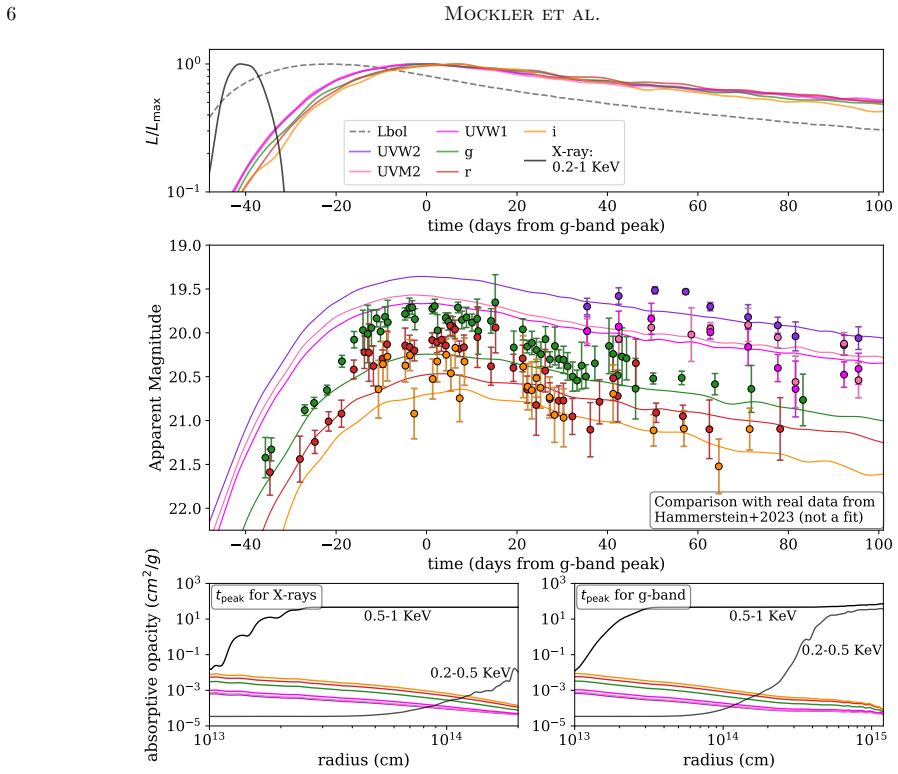
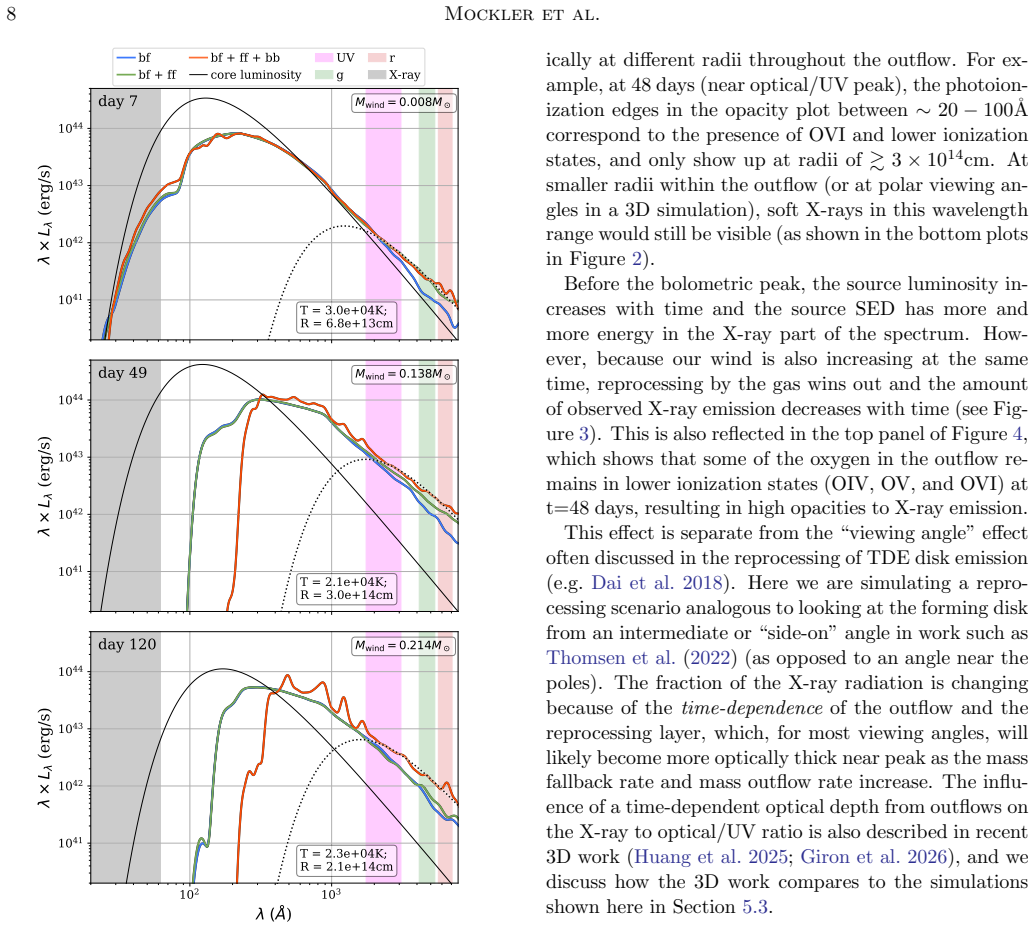
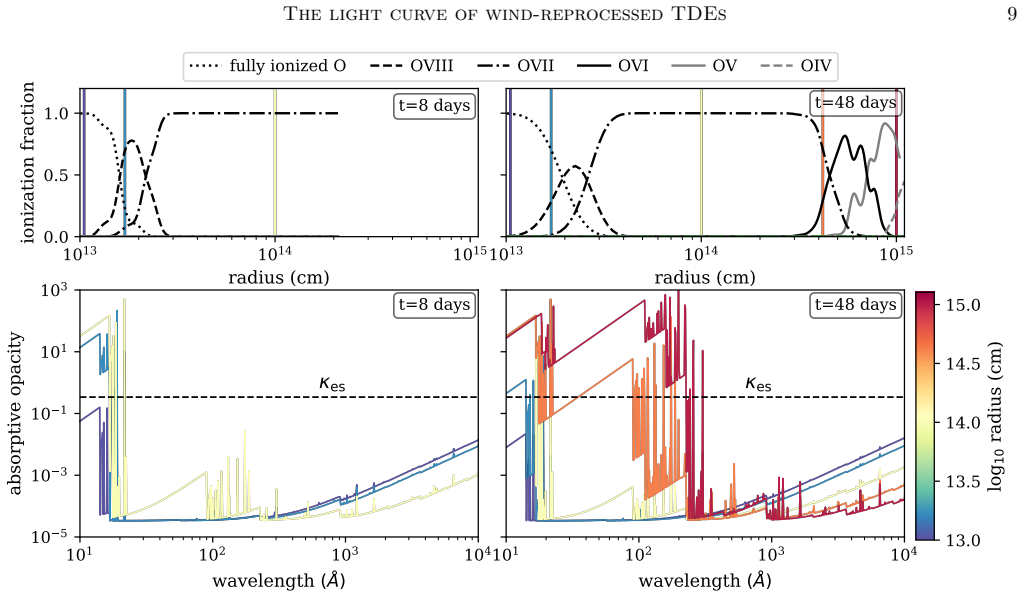
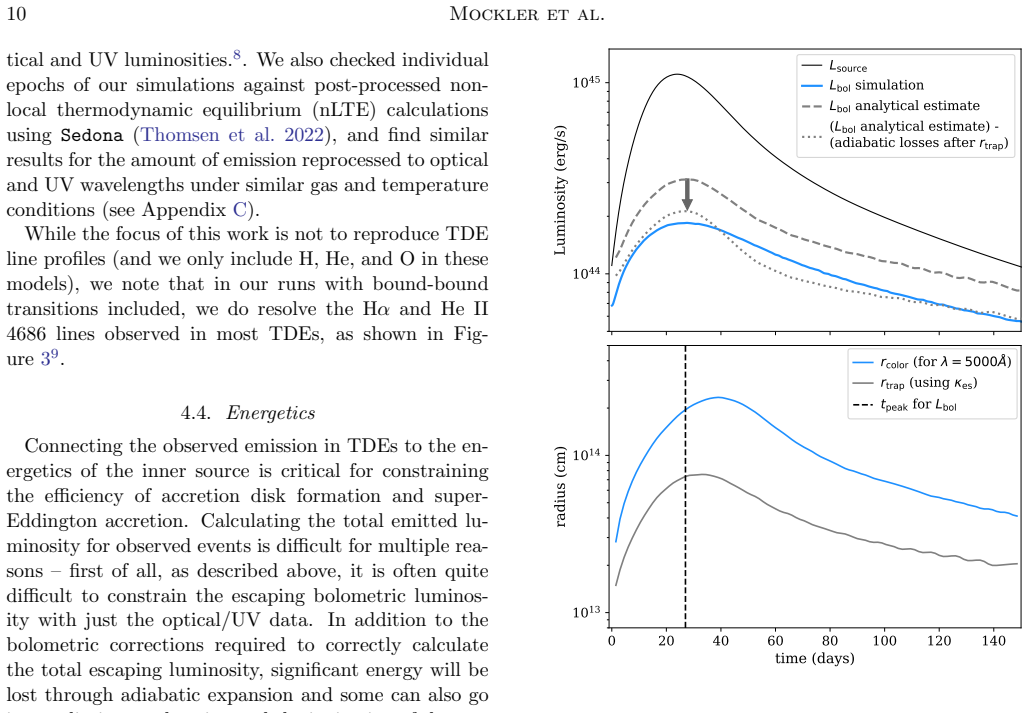
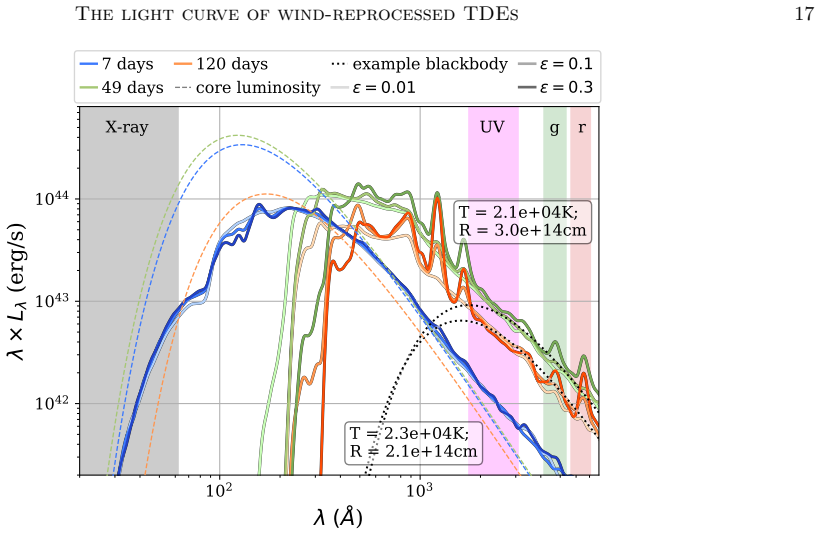
Time-dependent 1D radiation hydrodynamic simulations of a compact evolving X-ray and EUV source with surrounding reprocessing outflow show that an early X-ray flare fades as material builds up and obscures the source, while the optical/UV luminosity rises and peaks about three weeks after the bolometric peak due to the time required to build the reprocessing layer.
What carries the argument
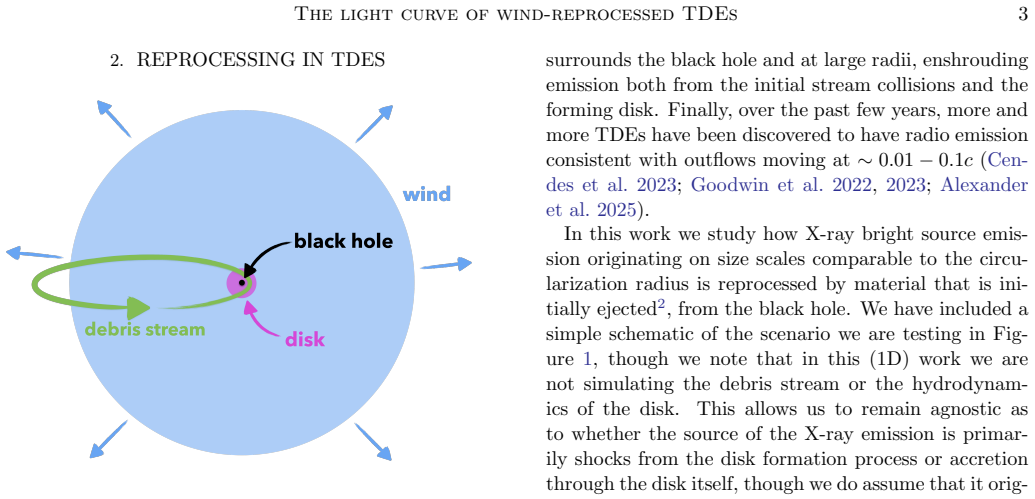
The time-dependent reprocessing outflow that accumulates optical depth around a central high-energy source, converting X-ray and EUV radiation into optical and UV emission on a wavelength-dependent timescale.
If this is right
- Early high-energy emission from TDEs may be missed for events discovered in optical surveys.
- The initial disruption and mass return time to the black hole may occur earlier than optical light curves suggest.
- The efficiency of reprocessing changes with time in the evolving environment.
- Key observables including timescales, luminosities, and color evolution are reproduced by the reprocessing mechanism.
Where Pith is reading between the lines
- The offset implies that mass fallback rate estimates derived from optical data alone may need adjustment for the delayed peak.
- Coordinated X-ray and optical monitoring from the first days after a disruption could directly test the predicted early flare and subsequent fade.
- Similar buildup delays in reprocessing outflows could affect light-curve interpretations in other super-Eddington accretion systems.
Load-bearing premise
The simulations assume that luminosities and mass flow rates taken from prior hydrodynamical simulations of tidal disruptions, together with a compact central source surrounded by outflow, capture the dominant emission mechanism.
What would settle it
A well-observed tidal disruption event in which the optical and bolometric peaks occur simultaneously with no three-week offset, or one that shows no early X-ray flare before the optical rise.
Figures
read the original abstract
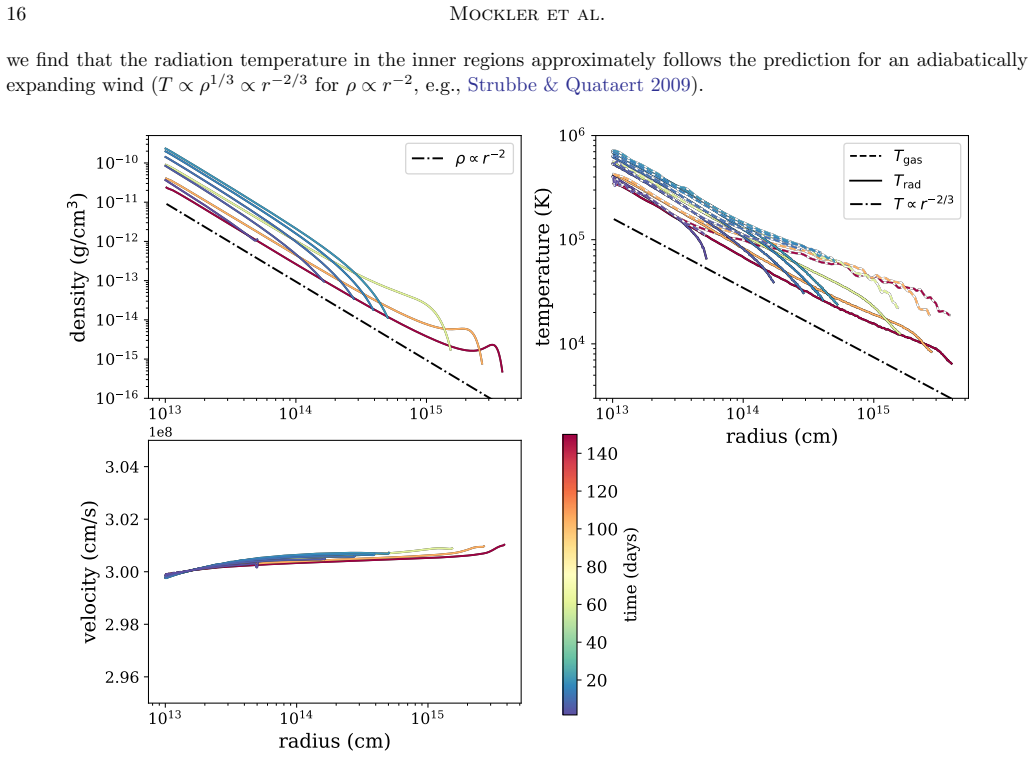
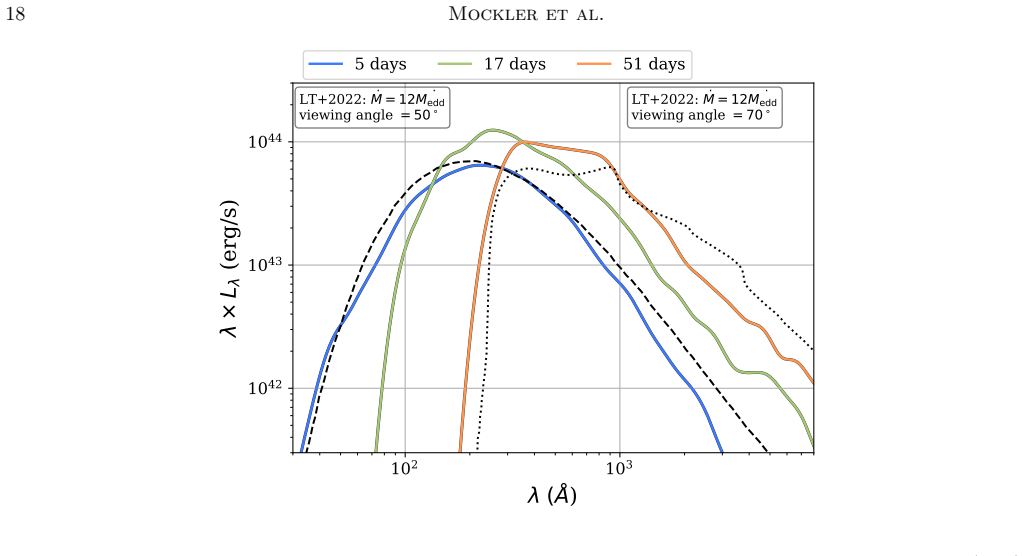
The source of the optical/UV emission in tidal disruption events (TDEs) remains an enduring question in the field. Connecting the observed emission to the source is critical for both our understanding of these transients and for using TDEs to study the efficiency of super-Eddington accretion and black hole growth. To explore this connection, we ran time-dependent 1D radiation hydrodynamic simulations of TDE emission with the Sedona monte carlo radiative transfer code, focusing on the reprocessing paradigm. Our simulations follow a compact, evolving X-ray and EUV bright source and surrounding reprocessing outflow over multiple months, using luminosities and mass flow rates consistent with hydro simulations of tidal disruptions. We determine the efficiency of reprocessing as a function of time in this dramatically changing environment and reproduce key observables including timescales, luminosities, and color evolution. Notably, we see a strong wavelength-dependence in the emission timescale due to reprocessing effects. Early on there is an X-ray flare which quickly fades as material builds up and obscures the hot source. At the same time, the optical/UV luminosity begins to rise. Though the optical/UV light curve has a similar shape to the bolometric light curve, the optical peak is offset by $\sim$3 weeks from the bolometric peak due to the time required to build up the reprocessing layer. This implies that early time, high energy emission may be missed for TDEs discovered in optical surveys, and the initial disruption and mass return time to the black hole may occur earlier than optical light curves suggest.
Editorial analysis
A structured set of objections, weighed in public.
Referee Report
Summary. The manuscript presents time-dependent 1D radiation hydrodynamic simulations of wind-reprocessed tidal disruption events (TDEs) using the Sedona Monte Carlo code. Inputs for central luminosity and mass-flow rate Ṁ(t) are taken directly from prior non-radiative hydrodynamical TDE simulations. The simulations follow the evolution of a compact X-ray/EUV source surrounded by an outflow over months and report reproduction of observed timescales, luminosities, and color evolution. The central result is a wavelength-dependent emission timescale in which an early X-ray flare fades as the reprocessing layer builds up, while the optical/UV light curve peaks ~3 weeks after the bolometric peak due to the time required for sufficient column density to obscure the central source.
Significance. If the reported offset holds under the modeling assumptions, the work supplies a concrete physical mechanism linking the reprocessing outflow to the observed delay between high-energy and optical/UV peaks. This carries implications for the interpretation of optical-survey TDE samples and for the inferred timing of the initial disruption and mass return. The time-dependent treatment and direct comparison to multiple observables constitute a strength of the approach.
major comments (3)
- [Abstract] Abstract and Methods: the ~3-week optical/UV lag is produced by the accumulation of column in the outflow, but both the central luminosity history and Ṁ(t) are prescribed from earlier non-radiative hydrodynamical runs without radiation feedback onto the accretion rate. Because the radiative transfer and outflow dynamics are not coupled back to the central engine, the build-up timescale is not self-consistently determined and could shift if feedback were included.
- [Abstract] Abstract and Simulation Setup: the adopted 1D spherical geometry fixes the covering factor and the radial optical-depth evolution. This choice directly controls the wavelength-dependent obscuration timescale that produces the reported offset; the result may not generalize to bipolar or disk-wind geometries that are more commonly expected in TDEs.
- [Results] Results section: the manuscript states that the simulations reproduce key observables but supplies no error bars, convergence tests with respect to spatial or frequency resolution, or quantitative description of how the input Ṁ(t) and luminosity curves were selected or interpolated from the prior hydro runs. These omissions make it impossible to assess the robustness of the 3-week offset claim.
minor comments (2)
- [Abstract] The abstract introduces the Sedona code but does not state the dimensionality or the Monte Carlo specifics until later; a single sentence clarifying the numerical method at first mention would improve readability.
- Notation for the time-dependent mass-flow rate should be defined explicitly on first use rather than assumed from the cited hydro papers.
Simulated Author's Rebuttal
We thank the referee for their constructive comments on our manuscript. We address each major point below, agreeing where the critique is valid and outlining specific revisions to improve clarity, robustness, and discussion of limitations.
read point-by-point responses
-
Referee: [Abstract] Abstract and Methods: the ~3-week optical/UV lag is produced by the accumulation of column in the outflow, but both the central luminosity history and Ṁ(t) are prescribed from earlier non-radiative hydrodynamical runs without radiation feedback onto the accretion rate. Because the radiative transfer and outflow dynamics are not coupled back to the central engine, the build-up timescale is not self-consistently determined and could shift if feedback were included.
Authors: We agree that prescribing luminosity and Ṁ(t) from non-radiative runs without feedback means the column build-up timescale is not fully self-consistent. This is a deliberate modeling choice to isolate reprocessing effects using existing hydro inputs, but we acknowledge it as a limitation. We will revise the Abstract and Methods to explicitly state the assumption of fixed inputs and add a paragraph discussing how radiation feedback could alter the offset. We will also note this in the context of the reported ~3-week lag. revision: partial
-
Referee: [Abstract] Abstract and Simulation Setup: the adopted 1D spherical geometry fixes the covering factor and the radial optical-depth evolution. This choice directly controls the wavelength-dependent obscuration timescale that produces the reported offset; the result may not generalize to bipolar or disk-wind geometries that are more commonly expected in TDEs.
Authors: The 1D spherical assumption does fix the covering factor and radial optical depth evolution, which directly influences the obscuration timescale. We selected this geometry to enable time-dependent Monte Carlo radiative transfer over months while remaining computationally feasible. We agree the result may differ in bipolar or disk-wind geometries. We will expand the Simulation Setup section to justify the 1D choice, quantify its impact on covering factor, and discuss how the offset might change in more realistic multi-dimensional configurations. revision: yes
-
Referee: [Results] Results section: the manuscript states that the simulations reproduce key observables but supplies no error bars, convergence tests with respect to spatial or frequency resolution, or quantitative description of how the input Ṁ(t) and luminosity curves were selected or interpolated from the prior hydro runs. These omissions make it impossible to assess the robustness of the 3-week offset claim.
Authors: We will add error bars to the reported light curves, provide a quantitative description of the interpolation procedure used for the input Ṁ(t) and luminosity histories from the prior hydrodynamical runs, and include convergence tests (or resolution justification) with respect to spatial and frequency grids. These additions will be placed in the Results and Methods sections to allow assessment of the robustness of the wavelength-dependent timescales. revision: yes
Circularity Check
No significant circularity; offset emerges from independent dynamical simulation.
full rationale
The paper's central result—the ~3-week optical/UV lag relative to the bolometric peak—is produced by the time-dependent build-up of column density in the 1D radiative transfer simulation. Inputs (luminosity history and Ṁ(t)) are taken from external prior hydrodynamical TDE simulations and are not fitted or defined in terms of the target observable. No equations reduce the output to the input by construction, no parameters are renamed as predictions, and no load-bearing self-citations or ansatzes are invoked. The derivation chain is self-contained and independent of the reported lag.
Axiom & Free-Parameter Ledger
axioms (1)
- domain assumption Luminosities and mass flow rates are consistent with hydro simulations of tidal disruptions
Reference graph
Works this paper leans on
-
[1]
arXiv:2202.10478 [astro-ph] , author =
Light. arXiv:2202.10478 [astro-ph] , author =. 2022 , note =
arXiv 2022
-
[2]
Monthly Notices of the Royal Astronomical Society , author =
First light from tidal disruption events , volume =. Monthly Notices of the Royal Astronomical Society , author =. 2021 , note =. doi:10.1093/mnras/stab398 , abstract =
-
[3]
arXiv:2203.01461 [astro-ph] , author =
The. arXiv:2203.01461 [astro-ph] , author =. 2022 , note =
arXiv 2022
-
[4]
The. ApJL , author =. 2022 , pages =. doi:10.3847/2041-8213/ac574b , abstract =
-
[5]
arXiv:2203.06185 [astro-ph] , author =
Across the. arXiv:2203.06185 [astro-ph] , author =. 2022 , note =
arXiv 2022
-
[6]
Trujillo, I and Erwin, Peter and Ramos, A Asensio , year =
-
[7]
Rates of stellar tidal disruption as probes of the supermassive black hole mass function , abstract =
Stone, Nicholas C and Metzger, Brian D , year =. Rates of stellar tidal disruption as probes of the supermassive black hole mass function , abstract =
-
[8]
The. ApJ , author =. 2022 , pages =. doi:10.3847/1538-4357/ac480c , abstract =
-
[9]
2021 , pages =
The Astrophysical Journal , author =. 2021 , pages =
2021
-
[10]
Monthly Notices of the Royal Astronomical Society , author =
Tidal disruption events in post-starburst galaxies: the importance of a complete stellar mass function , volume =. Monthly Notices of the Royal Astronomical Society , author =. 2022 , note =. doi:10.1093/mnras/stac262 , abstract =
-
[11]
arXiv:2203.08162 [astro-ph] , author =
Using the. arXiv:2203.08162 [astro-ph] , author =. 2022 , note =
arXiv 2022
-
[12]
Monthly Notices of the Royal Astronomical Society , author =
The merger rate of galaxies in the. Monthly Notices of the Royal Astronomical Society , author =. 2015 , note =. doi:10.1093/mnras/stv264 , abstract =
-
[13]
Astronomy and Astrophysics , author =
The dominant role of mergers in the size evolution of massive early-type galaxies since z. Astronomy and Astrophysics , author =. 2012 , pages =. doi:10.1051/0004-6361/201219085 , abstract =
-
[14]
The Astrophysical Journal , author =
The. The Astrophysical Journal , author =. 2009 , note =. doi:10.1088/0004-637X/697/2/1369 , abstract =
-
[15]
Man, Allison W. S. and Toft, Sune and Zirm, Andrew W. and Wuyts, Stijn and Wel, Arjen van der , month = dec, year =. ApJ , publisher =. doi:10.1088/0004-637X/744/2/85 , abstract =
-
[16]
Monthly Notices of the Royal Astronomical Society , author =
A surprisingly high pair fraction for extremely massive galaxies at z. Monthly Notices of the Royal Astronomical Society , author =. 2009 , note =. doi:10.1111/j.1745-3933.2008.00608.x , abstract =
-
[17]
The Astrophysical Journal , author =
The. The Astrophysical Journal , author =. 2012 , note =. doi:10.1088/0004-637X/747/1/34 , abstract =
-
[18]
arXiv:2201.02649 [astro-ph] , author =
Systematic light curve modelling of. arXiv:2201.02649 [astro-ph] , author =. 2022 , note =
arXiv 2022
-
[19]
Resonant relaxation in stellar systems , volume =. New Astronomy , author =. 1996 , keywords =. doi:10.1016/S1384-1076(96)00012-7 , abstract =
-
[20]
The Astrophysical Journal , author =
The. The Astrophysical Journal , author =. 1993 , note =. doi:10.1086/173366 , abstract =
doi:10.1086/173366 1993
-
[21]
metallicities of the broad emission line regions in the nitrogen-loudest quasars
-
[22]
Monthly Notices of the Royal Astronomical Society: Letters , author =
White dwarfs stripped by massive black holes: sources of coincident gravitational and electromagnetic radiation , volume =. Monthly Notices of the Royal Astronomical Society: Letters , author =. 2010 , pages =. doi:10.1111/j.1745-3933.2010.00930.x , abstract =
-
[23]
Monthly Notices of the Royal Astronomical Society , author =
Tidal disruption by extreme mass ratio binaries and application to. Monthly Notices of the Royal Astronomical Society , author =. 2018 , note =. doi:10.1093/mnras/stx3039 , abstract =
-
[24]
Monthly Notices of the Royal Astronomical Society , author =
Tidal disruption events from supermassive black hole binaries , volume =. Monthly Notices of the Royal Astronomical Society , author =. 2017 , note =. doi:10.1093/mnras/stw2913 , abstract =
-
[25]
The Astrophysical Journal , author =
Triggering of. The Astrophysical Journal , author =. 1994 , note =. doi:10.1086/187299 , abstract =
doi:10.1086/187299 1994
-
[26]
Astronomy and Astrophysics, v.371, p.806-815 (2001) , author =
On faint companions in the close environment of star-forming dwarf galaxies. Astronomy and Astrophysics, v.371, p.806-815 (2001) , author =. 2001 , pages =. doi:10.1051/0004-6361:20010446 , abstract =
-
[27]
Renaud, F. and Bournaud, F. and Agertz, O. and Kraljic, K. and Schinnerer, E. and Bolatto, A. and Daddi, E. and Hughes, A. , month = may, year =. A diversity of starburst-triggering mechanisms in interacting galaxies and their signatures in. Astronomy & Astrophysics, Volume 625, id.A65,. doi:10.1051/0004-6361/201935222 , abstract =
-
[28]
Monthly Notices of the Royal Astronomical Society , author =
Plunging fireworks: why do infalling galaxies light up on the outskirts of clusters? , volume =. Monthly Notices of the Royal Astronomical Society , author =. 2012 , note =. doi:10.1111/j.1365-2966.2012.22059.x , abstract =
-
[29]
Monthly Notices of the Royal Astronomical Society , author =
Double starbursts triggered by mergers in hierarchical clustering scenarios , volume =. Monthly Notices of the Royal Astronomical Society , author =. 2002 , pages =. doi:10.1046/j.1365-8711.2002.05385.x , abstract =
-
[30]
Madigan, Ann-Marie and Halle, Andrew and Moody, Mackenzie and McCourt, Michael and Nixon, Chris and Wernke, Heather , month = feb, year =. Dynamical. ApJ , publisher =. doi:10.3847/1538-4357/aaa714 , abstract =
-
[31]
The Astrophysical Journal , author =
Kinematic. The Astrophysical Journal , author =. 1989 , note =. doi:10.1086/167332 , abstract =
doi:10.1086/167332 1989
-
[32]
The Astrophysical Journal , author =
Tidal. The Astrophysical Journal , author =. 2019 , note =. doi:10.3847/1538-4357/ab43df , abstract =
-
[33]
Monthly Notices of the Royal Astronomical Society , author =
Tidal disruption discs formed and fed by stream-stream and stream-disc interactions in global. Monthly Notices of the Royal Astronomical Society , author =. 2022 , note =. doi:10.1093/mnras/stab3444 , abstract =
-
[34]
Physical Review D , author =. 2010 , note =. doi:10.1103/PhysRevD.81.104014 , abstract =
-
[35]
The Astrophysical Journal , author =
The. The Astrophysical Journal , author =. 2007 , note =. doi:10.1086/520497 , abstract =
doi:10.1086/520497 2007
-
[36]
Monthly Notices of the Royal Astronomical Society , author =
A numerical study of vector resonant relaxation , volume =. Monthly Notices of the Royal Astronomical Society , author =. 2015 , note =. doi:10.1093/mnras/stv057 , abstract =
-
[37]
Monthly Notices of the Royal Astronomical Society , author =
Resonant relaxation and the warp of the stellar disc in the. Monthly Notices of the Royal Astronomical Society , author =. 2011 , note =. doi:10.1111/j.1365-2966.2010.17897.x , abstract =
-
[38]
Monthly Notices of the Royal Astronomical Society , author =
Gas-driven massive black hole binaries: signatures in the. Monthly Notices of the Royal Astronomical Society , author =. 2011 , note =. doi:10.1111/j.1365-2966.2010.17782.x , abstract =
-
[39]
The Astronomical Journal , author =
Secular perturbations of asteroids with high inclination and eccentricity , volume =. The Astronomical Journal , author =. 1962 , note =. doi:10.1086/108790 , abstract =
doi:10.1086/108790 1962
-
[40]
Planetary and Space Science , author =
The evolution of orbits of artificial satellites of planets under the action of gravitational perturbations of external bodies , volume =. Planetary and Space Science , author =. 1962 , pages =. doi:10.1016/0032-0633(62)90129-0 , language =
-
[41]
Annual Review of Astronomy and Astrophysics , author =
The. Annual Review of Astronomy and Astrophysics , author =. 2016 , pages =. doi:10.1146/annurev-astro-081915-023315 , abstract =
-
[42]
and Dotti, Massimo and Lodato, Giuseppe and Izquierdo-Villalba, David , month = apr, year =
Mazzolari, Giovanni and Bonetti, Matteo and Sesana, Alberto and Colombo, Riccardo M. and Dotti, Massimo and Lodato, Giuseppe and Izquierdo-Villalba, David , month = apr, year =. Extreme
-
[43]
The Astrophysical Journal , author =
The. The Astrophysical Journal , author =. 2002 , note =. doi:10.1086/341002 , abstract =
doi:10.1086/341002 2002
-
[44]
Monthly Notices of the Royal Astronomical Society , author =
Massive black hole binary mergers in dynamical galactic environments , volume =. Monthly Notices of the Royal Astronomical Society , author =. 2017 , note =. doi:10.1093/mnras/stw2452 , abstract =
-
[45]
The Astrophysical Journal , author =
Efficient. The Astrophysical Journal , author =. 2011 , note =. doi:10.1088/0004-637X/732/2/89 , abstract =
-
[46]
The Astrophysical Journal , author =
The. The Astrophysical Journal , author =. 2000 , note =. doi:10.1086/308300 , abstract =
doi:10.1086/308300 2000
-
[47]
The Astrophysical Journal , author =. 2021 , note =. doi:10.3847/1538-4357/abe38d , abstract =
-
[48]
Monthly Notices of the Royal Astronomical Society , author =
The metallicities of the broad emission line regions in the nitrogen-loudest quasars , volume =. Monthly Notices of the Royal Astronomical Society , author =. 2014 , note =. doi:10.1093/mnras/stu007 , abstract =
-
[49]
The Astrophysical Journal , author =
The. The Astrophysical Journal , author =. 2019 , note =. doi:10.3847/1538-4357/ab2711 , abstract =
-
[50]
The Astrophysical Journal , author =
Physics of. The Astrophysical Journal , author =. 2019 , note =. doi:10.3847/1538-4357/ab1f09 , abstract =
-
[51]
The Astrophysical Journal , author =
Wind-reprocessed. The Astrophysical Journal , author =. 2020 , note =. doi:10.3847/1538-4357/ab83f6 , abstract =
-
[52]
Monthly Notices of the Royal Astronomical Society , author =
Gravitational interactions of stars with supermassive black hole binaries -. Monthly Notices of the Royal Astronomical Society , author =. 2018 , note =. doi:10.1093/mnras/sty822 , abstract =
-
[53]
Li, Shuo and Liu, F. K. and Berczik, Peter and Spurzem, Rainer , month = jan, year =. ApJ , publisher =. doi:10.3847/1538-4357/834/2/195 , abstract =
-
[54]
and Kozinsky, Boris and Rasio, Frederic A
Ford, Eric B. and Kozinsky, Boris and Rasio, Frederic A. , month = may, year =. Secular. ApJ , publisher =. doi:10.1086/308815 , language =
-
[55]
Monthly Notices of the Royal Astronomical Society , author =
The tidal disruption rate in dense galactic cusps containing a supermassive binary black hole , volume =. Monthly Notices of the Royal Astronomical Society , author =. 2005 , note =. doi:10.1111/j.1365-2966.2005.08843.x , abstract =
-
[56]
Hot. Nature , author =. 2011 , note =. doi:10.1038/nature10076 , abstract =
-
[57]
The Astrophysical Journal , author =
The. The Astrophysical Journal , author =. 2011 , note =. doi:10.1088/0004-637X/742/2/94 , abstract =
-
[58]
Monthly Notices of the Royal Astronomical Society , author =
Secular dynamics in hierarchical three-body systems , volume =. Monthly Notices of the Royal Astronomical Society , author =. 2013 , note =. doi:10.1093/mnras/stt302 , abstract =
-
[59]
Relativistic three-body effects in hierarchical triples , volume =. Physical Review D , author =. 2020 , note =. doi:10.1103/PhysRevD.102.064033 , abstract =
-
[60]
Monthly Notices of the Royal Astronomical Society , author =
Timescales of. Monthly Notices of the Royal Astronomical Society , author =. 2015 , note =. doi:10.1093/mnras/stv1552 , abstract =
-
[61]
Monthly Notices of the Royal Astronomical Society , author =
The stationary points of the hierarchical three-body problem , volume =. Monthly Notices of the Royal Astronomical Society , author =. 2020 , note =. doi:10.1093/mnras/staa2602 , abstract =
-
[62]
The Astrophysical Journal , author =
Is. The Astrophysical Journal , author =. 2013 , note =. doi:10.1088/0004-637X/762/2/95 , abstract =
-
[63]
Direct. ApJ , author =. 2019 , pages =. doi:10.3847/1538-4357/ab3e4a , abstract =
-
[64]
ApJ , author =. 2016 , pages =. doi:10.3847/0004-637X/828/2/77 , abstract =
-
[65]
Coleman and Hamilton, Douglas P
Miller, M. Coleman and Hamilton, Douglas P. , month = sep, year =. Four-. ApJ , publisher =. doi:10.1086/341788 , language =
-
[66]
Liu, F. K. and Li, Shuo and Komossa, S. , month = apr, year =. A. ApJ , publisher =. doi:10.1088/0004-637X/786/2/103 , abstract =
-
[67]
ApJ , author =. 2013 , pages =. doi:10.1088/2041-8205/771/2/L28 , abstract =
-
[68]
The Astrophysical Journal , author =
The. The Astrophysical Journal , author =. 2018 , note =. doi:10.3847/1538-4357/aada47 , abstract =
-
[69]
Unveiling the hosts of parsec-scale massive black hole binaries: morphology and electromagnetic signatures , shorttitle =
Izquierdo-Villalba, David and Sesana, Alberto and Colpi, Monica , month = jul, year =. Unveiling the hosts of parsec-scale massive black hole binaries: morphology and electromagnetic signatures , shorttitle =
-
[70]
The Astrophysical Journal , author =
A. The Astrophysical Journal , author =. 2022 , note =. doi:10.3847/1538-4357/ac32de , abstract =
-
[71]
A 17-billion-solar-mass black hole in a group galaxy with a diffuse core , volume =. Nature , author =. 2016 , note =. doi:10.1038/nature17197 , abstract =
-
[72]
The Astrophysical Journal , author =
A. The Astrophysical Journal , author =. 2021 , note =. doi:10.3847/1538-4357/ac0896 , abstract =
-
[73]
Monthly Notices of the Royal Astronomical Society , author =
Recoiled star clusters in the. Monthly Notices of the Royal Astronomical Society , author =. 2012 , note =. doi:10.1111/j.1365-2966.2011.20078.x , abstract =
-
[74]
The Astrophysical Journal , author =
Galaxy. The Astrophysical Journal , author =. 2021 , note =. doi:10.3847/1538-4357/abdbb1 , abstract =
-
[75]
Astronomy and Astrophysics , author =
Mergers trigger active galactic nuclei out to z ∼ 0.6 , volume =. Astronomy and Astrophysics , author =. 2020 , pages =. doi:10.1051/0004-6361/201937178 , abstract =
-
[76]
The Astrophysical Journal Supplement Series , author =
A. The Astrophysical Journal Supplement Series , author =. 2008 , note =. doi:10.1086/524363 , abstract =
doi:10.1086/524363 2008
-
[77]
Rapid. Science , author =. 2007 , note =. doi:10.1126/science.1141858 , abstract =
-
[78]
New Astronomy Reviews , author =
The quest for dual and binary supermassive black holes:. New Astronomy Reviews , author =. 2019 , note =. doi:10.1016/j.newar.2020.101525 , abstract =
-
[79]
Monthly Notices of the Royal Astronomical Society , author =
The bulge masses of. Monthly Notices of the Royal Astronomical Society , author =. 2022 , note =. doi:10.1093/mnras/stac1810 , abstract =
-
[80]
Monthly Notices of the Royal Astronomical Society , author =
Rapid eccentricity oscillations and the mergers of compact objects in hierarchical triples , volume =. Monthly Notices of the Royal Astronomical Society , author =. 2014 , note =. doi:10.1093/mnras/stu039 , abstract =
discussion (0)
Sign in with ORCID, Apple, or X to comment. Anyone can read and Pith papers without signing in.