REVIEW 1 major objections
Exothermic reactive bonding for semiconductor die assemblies and associated systems and methods
T0 review · 1 major / 0 minor · reviewed 2026-05-15 · grok-4.3
Pith's one-line read A semiconductor die bonds via exothermic epoxy reaction inside a recessed moat surrounding a conductive pad.
desk verdict Patent filing sketches a moat-and-recessed-pad geometry for exothermic epoxy die bonding but supplies zero materials, thermal data, or validation. read the letter →
The pith
A machine-rendered reading of the paper's core claim, the machinery that carries it, and where it could break.
The reading
What carries the argument
Recessed moat filled with exothermic epoxy surrounding a recessed conductive pad.
What would settle it
A fabricated test die assembled with the moat-and-epoxy structure shows either thermal damage to circuitry or bond failure under standard electrical and mechanical tests.
Extended reading notes
Core claim
The semiconductor die comprises a substrate with integrated circuitry, a dielectric layer whose upper surface includes a recessed moat filled with a first epoxy compound that reacts exothermically with a second epoxy compound, the first epoxy surface remaining coplanar with the dielectric, and a conductive pad laterally surrounded by the moat whose top surface is recessed while its bottom surface couples to the circuitry.
Load-bearing premise
The two epoxy compounds will produce a controlled exothermic reaction that forms a reliable bond without damaging circuitry or shifting alignment.
Editorial extensions
If this is right
- Bonding occurs without external heat sources applied to the die stack.
- The coplanar epoxy surface maintains planarity for subsequent processing steps.
- The recessed pad ensures electrical contact forms only after the epoxy reaction begins.
- The same moat geometry can be repeated across multiple dies in a stack or package.
Reading between the lines
- Assembly lines could eliminate high-temperature ovens currently used for die attach.
- Yield may rise in thin-wafer or high-density packaging where thermal budgets are tight.
- The approach could be combined with existing epoxy dispensing equipment without new capital tools.
Editorial analysis
A structured set of objections, weighed in public.
Referee Report
Summary. The manuscript claims a semiconductor die structure comprising a dielectric layer over integrated circuitry on a substrate, with a recessed moat in the dielectric upper surface filled with a first epoxy compound whose upper surface is coplanar with the dielectric and configured to exothermically react with a second epoxy, plus a conductive pad laterally surrounded by the moat whose top surface is recessed relative to the dielectric and electrically coupled to the circuitry at its bottom surface.
Significance. If the asserted geometry enables a controlled exothermic epoxy reaction that forms reliable bonds without exceeding the thermal budget of underlying circuitry, the approach could simplify die-to-die or die-to-substrate assembly by reducing the need for external heat sources. However, the manuscript supplies only a geometric and material-class description with no candidate compounds, enthalpies, peak-temperature estimates, or heat-flow analysis, so the functional performance remains unverified.
major comments (1)
- Claim 1 (and the corresponding description): the central assertion that the first epoxy will undergo a controlled exothermic reaction sufficient to form a reliable bond without damaging circuitry or causing misalignment is unsupported; no specific epoxy identities, reaction stoichiometry, enthalpy values, or thermal-budget calculations are provided to substantiate that the peak temperature stays within acceptable limits for the semiconductor substrate.
Simulated Author's Rebuttal
We thank the referee for the careful reading and constructive feedback. The manuscript is a patent disclosure centered on a novel die geometry that enables controlled exothermic epoxy bonding. We address the single major comment below.
read point-by-point responses
-
Referee: Claim 1 (and the corresponding description): the central assertion that the first epoxy will undergo a controlled exothermic reaction sufficient to form a reliable bond without damaging circuitry or causing misalignment is unsupported; no specific epoxy identities, reaction stoichiometry, enthalpy values, or thermal-budget calculations are provided to substantiate that the peak temperature stays within acceptable limits for the semiconductor substrate.
Authors: The disclosure is a structural patent application. Enablement is satisfied by describing the recessed moat geometry, coplanar epoxy fill, and recessed conductive pad that together confine the exothermic reaction volume and thermal path. Specific compound identities, stoichiometry, or numerical thermal budgets are not required for this claim scope; the invention resides in the arrangement that permits use of any suitable exothermic epoxy pair already known in the art while respecting semiconductor thermal limits. No experimental data section is expected or needed in a patent specification. revision: no
Circularity Check
No circularity: patent is a pure structural claim with no derivations or self-referential steps
full rationale
The document is a utility patent whose sole load-bearing content is a geometric/material specification (recessed moat, coplanar epoxy surface, recessed conductive pad). No equations, fitted parameters, predictions, ansatzes, or citations appear anywhere in the text. Consequently no step reduces to its own input by construction, and the circularity score is 0.
Assumptions & free parameters
assumptions (1)
- domain assumption Exothermic reaction between the two specified epoxy compounds produces sufficient localized heat and bonding force to form a reliable mechanical and electrical joint.
Cite this review
Pith. "Pith review of Exothermic reactive bonding for semiconductor die assemblies and associated systems and methods." pith.science (2026). https://pith.science/paper/patent/us-12622335
@misc{pith2026patentus-12622335,
  author       = {Pith},
  title        = {Pith review of: Exothermic reactive bonding for semiconductor die assemblies and associated systems and methods},
  year         = {2026},
  howpublished = {\url{https://pith.science/paper/patent/us-12622335}},
  note         = {Machine review of arXiv:patent/us-12622335}
}
read the original abstract
1 . A semiconductor die, comprising: a semiconductor substrate including integrated circuitry; a dielectric layer over the semiconductor substrate, wherein at least a portion of an upper surface of the dielectric layer opposite the semiconductor substrate includes a recessed moat filled with a first epoxy compound configured to exothermically react with a second epoxy compound, the first epoxy compound having an upper surface coplanar with the upper surface of the dielectric layer; and a conductive pad in the dielectric layer laterally surrounded by moat filled with the first epoxy compound, the conductive pad including a top surface recessed with respect to the upper surface of the dielectric layer, wherein the conductive pad is coupled with the integrated circuitry at a bottom surface of the conductive pad opposite the top surface.
Figures
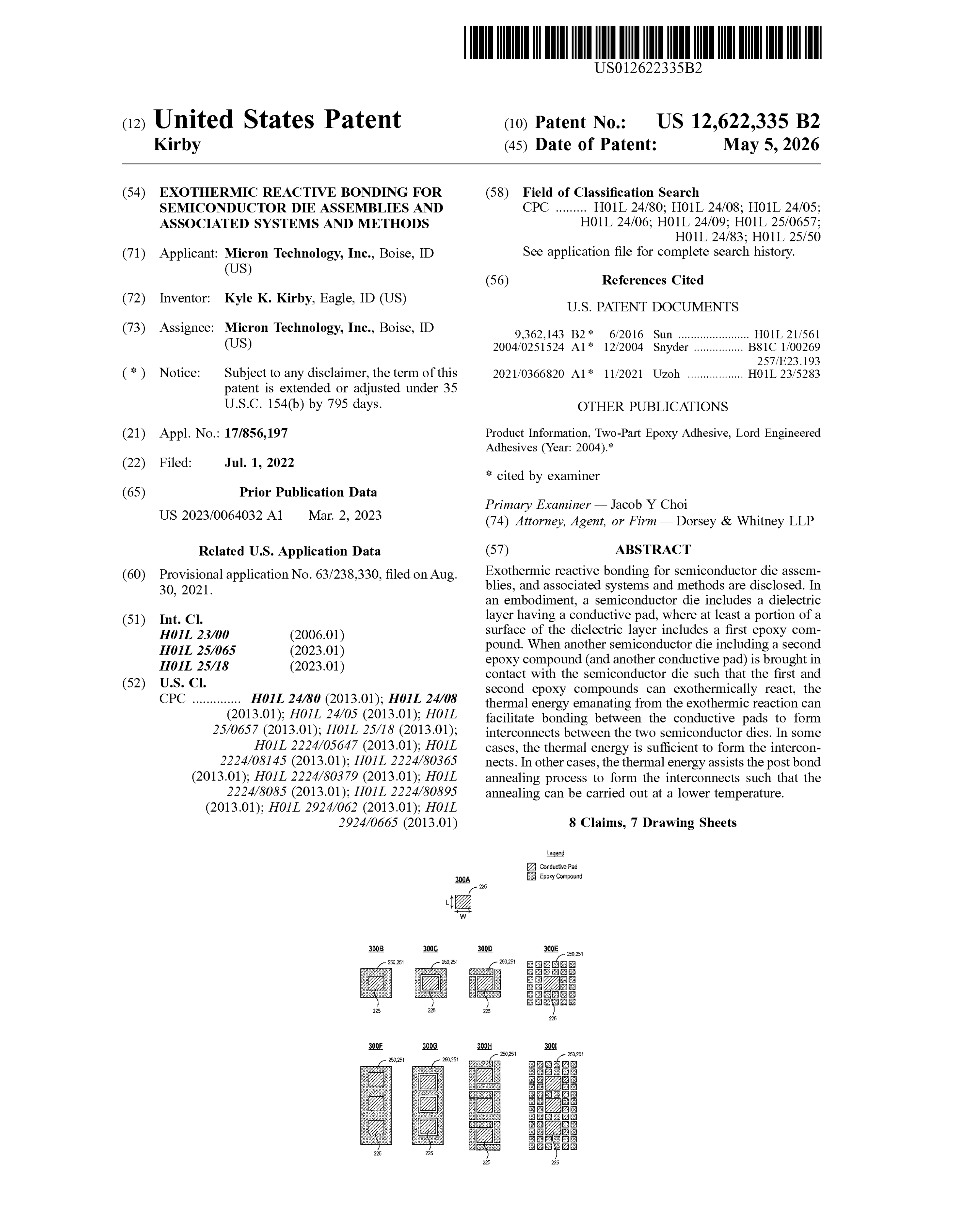


Figures from the paper (1 more)

Lean theorems connected to this paper
-
IndisputableMonolith.Cost.FunctionalEquationwashburn_uniqueness_aczel unclear?
unclearRelation between the paper passage and the cited Recognition theorem.
a recessed moat filled with a first epoxy compound configured to exothermically react with a second epoxy compound, the first epoxy compound having an upper surface coplanar with the upper surface of the dielectric layer; and a conductive pad in the dielectric layer laterally surrounded by moat filled with the first epoxy compound, the conductive pad including a top surface recessed with respect to the upper surface of the dielectric layer
-
IndisputableMonolith.Foundation.LedgerCanonicalityZeroParameterComparisonLedger unclear?
unclearRelation between the paper passage and the cited Recognition theorem.
the conductive pad is coupled with the integrated circuitry at a bottom surface of the conductive pad opposite the top surface
What do these tags mean?
- matches
- The paper's claim is directly supported by a theorem in the formal canon.
- supports
- The theorem supports part of the paper's argument, but the paper may add assumptions or extra steps.
- extends
- The paper goes beyond the formal theorem; the theorem is a base layer rather than the whole result.
- uses
- The paper appears to rely on the theorem as machinery.
- contradicts
- The paper's claim conflicts with a theorem or certificate in the canon.
- unclear
- Pith found a possible connection, but the passage is too broad, indirect, or ambiguous to say the theorem truly supports the claim.
Reviewed May 15, 2026 · model on record in the stance chip above.
Discussion (0). Continue with ORCID to comment.